HEAT
• Heat is produced from molecules of matter that continuously
vibrate.
• Heat is an energy form that transfers from a body of higher
temperature to another body of lower temperature.
• Joule (J)[ jool, joul ] is the SI unit of heat.
• Another common unit of heat is calorie, defined as the
amount of heat needed to change the temperature of one
gram of water by 1ºC at a pressure of 1 atm.
TEMPERATURE
• Temperature is a measure of the hotness or coldness of an
object.
• Kinetic molecular theory tells us that all matter has
molecules or atoms which are constantly moving; thus, they
have kinetic energy.
• The faster these molecules move, the more kinetic energy
they have. The more kinetic energy, the higher is the
temperature of an object.
• Temperature is a measure of the average kinetic energy of
molecules.
INTERNAL
ENERGY
• The sum of kinetic, potential, chemical, electrical, nuclear,
and other energy associated with the atoms and molecules of
a system.
• An increase in internal energy results in a rise in
temperature or a change in phase.
TEMPERATURE SCALES
• Celsius - Anders Celsius introduced the Celsius scale in
1741. On the Celsius scale, the freezing point of water is 0ºC,
while its boiling point is 100ºC under a pressure of 1 atm,
having 100 intervals between two reference points.
• Fahrenheit - Daniel Gabriel Fahrenheit introduced the
Fahrenheit scale in 1724. On the Fahrenheit scale, the
freezing point of water is 32ºF, while its boiling point is
212ºF, having 180 intervals between two reference points.
• Both scales used the freezing and boiling points of water as
reference points. The difference between these two reference
points is divided equally into intervals called degrees (º).
TEMPERATURE SCALES
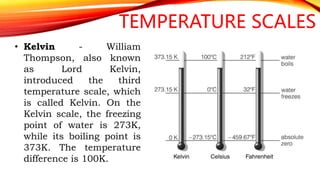
• Kelvin - William
Thompson, also known
as Lord Kelvin,
introduced the third
temperature scale, which
is called Kelvin. On the
Kelvin scale, the freezing
point of water is 273K,
while its boiling point is
373K. The temperature
difference is 100K.
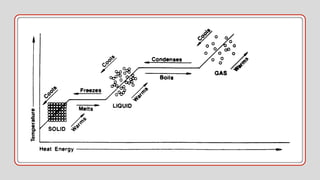
PHASE CHANGE
• When the temperature of substances changes, their
molecular structure and movement also change, this results
in phase change.
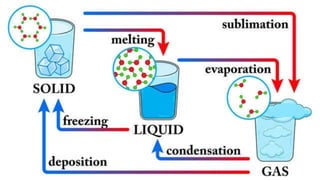
• Fusion or melting is the process that causes a solid to
change to its liquid state.
• The amount of heat required to produce this change is called
the heat of fusion.
PHASE CHANGE
• When liquids release heat, the water molecules begin to move
at a slower pace. The space between the molecules becomes
compact.
• The process of changing liquids to solids is called
solidification or freezing.
• When water boils, evaporation takes place. Heat is
absorbed, and water is converted into steam or water vapor.
PHASE CHANGE
• The amount of heat needed for a liquid to evaporate depends
on the boiling point of the liquid.
• When water vapor releases heat, its gas state changes to the
liquid state through condensation, which accounts for the
formation of clouds in the water cycle.
• Sublimation is the process of transforming a substance from
the solid phase directly to the gas state without passing the
liquid phase and requires additional energy.
PHASE CHANGE
• Deposition is the process of transforming a substance from
gas to solid without passing the liquid phase and requires a
release of energy.
• During any of these phase changes, energy is either given off
or taken in.
• When a substance changes phase, the temperature does not
change, and only the amount of energy changes.
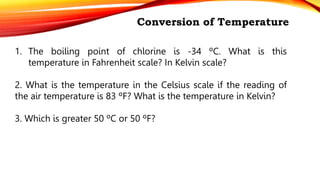
Conversion of Temperature
1. The boiling point of chlorine is -34 ºC. What is this
temperature in Fahrenheit scale? In Kelvin scale?
2. What is the temperature in the Celsius scale if the reading of
the air temperature is 83 ºF? What is the temperature in Kelvin?
3. Which is greater 50 ºC or 50 ºF?
THERMAL EXPANSION
• The tendency of matter to change its shape, area, volume,
and density in response to a change in temperature, usually
not including phase transitions.
• Most matter expands when the temperature is increased, or
contracts when the temperature is reduced.
• This is what happens to the mercury inside the glass tube of
thermometers. The mercury expands at a different rate than
the tube; thus, as the temperature increases, it rises and
drops when the temperature decreases.
THERMAL EXPANSION
• Water does not follow the rule of thermal expansion. Water
expands when it freezes because the crystalline structure of
ice takes up more space than liquid water.
• Heat Capacity of a body is the quantity of heat necessary to
raise its temperature by 1ºC.
• Specific Heat is the amount of heat necessary to raise the
temperature of a mass of a substance by 1 ºC.
Heat and Temperature.pptx

Heat and Temperature.pptx

  • 2.
    HEAT • Heat isproduced from molecules of matter that continuously vibrate. • Heat is an energy form that transfers from a body of higher temperature to another body of lower temperature. • Joule (J)[ jool, joul ] is the SI unit of heat. • Another common unit of heat is calorie, defined as the amount of heat needed to change the temperature of one gram of water by 1ºC at a pressure of 1 atm.
  • 3.
    TEMPERATURE • Temperature isa measure of the hotness or coldness of an object. • Kinetic molecular theory tells us that all matter has molecules or atoms which are constantly moving; thus, they have kinetic energy. • The faster these molecules move, the more kinetic energy they have. The more kinetic energy, the higher is the temperature of an object. • Temperature is a measure of the average kinetic energy of molecules.
  • 4.
    INTERNAL ENERGY • The sumof kinetic, potential, chemical, electrical, nuclear, and other energy associated with the atoms and molecules of a system. • An increase in internal energy results in a rise in temperature or a change in phase.
  • 6.
    TEMPERATURE SCALES • Celsius- Anders Celsius introduced the Celsius scale in 1741. On the Celsius scale, the freezing point of water is 0ºC, while its boiling point is 100ºC under a pressure of 1 atm, having 100 intervals between two reference points. • Fahrenheit - Daniel Gabriel Fahrenheit introduced the Fahrenheit scale in 1724. On the Fahrenheit scale, the freezing point of water is 32ºF, while its boiling point is 212ºF, having 180 intervals between two reference points. • Both scales used the freezing and boiling points of water as reference points. The difference between these two reference points is divided equally into intervals called degrees (º).
  • 7.
    TEMPERATURE SCALES • Kelvin- William Thompson, also known as Lord Kelvin, introduced the third temperature scale, which is called Kelvin. On the Kelvin scale, the freezing point of water is 273K, while its boiling point is 373K. The temperature difference is 100K.
  • 8.
    PHASE CHANGE • Whenthe temperature of substances changes, their molecular structure and movement also change, this results in phase change. • Fusion or melting is the process that causes a solid to change to its liquid state. • The amount of heat required to produce this change is called the heat of fusion.
  • 9.
    PHASE CHANGE • Whenliquids release heat, the water molecules begin to move at a slower pace. The space between the molecules becomes compact. • The process of changing liquids to solids is called solidification or freezing. • When water boils, evaporation takes place. Heat is absorbed, and water is converted into steam or water vapor.
  • 10.
    PHASE CHANGE • Theamount of heat needed for a liquid to evaporate depends on the boiling point of the liquid. • When water vapor releases heat, its gas state changes to the liquid state through condensation, which accounts for the formation of clouds in the water cycle. • Sublimation is the process of transforming a substance from the solid phase directly to the gas state without passing the liquid phase and requires additional energy.
  • 11.
    PHASE CHANGE • Depositionis the process of transforming a substance from gas to solid without passing the liquid phase and requires a release of energy. • During any of these phase changes, energy is either given off or taken in. • When a substance changes phase, the temperature does not change, and only the amount of energy changes.
  • 13.
    Conversion of Temperature 1.The boiling point of chlorine is -34 ºC. What is this temperature in Fahrenheit scale? In Kelvin scale? 2. What is the temperature in the Celsius scale if the reading of the air temperature is 83 ºF? What is the temperature in Kelvin? 3. Which is greater 50 ºC or 50 ºF?
  • 14.
    THERMAL EXPANSION • Thetendency of matter to change its shape, area, volume, and density in response to a change in temperature, usually not including phase transitions. • Most matter expands when the temperature is increased, or contracts when the temperature is reduced. • This is what happens to the mercury inside the glass tube of thermometers. The mercury expands at a different rate than the tube; thus, as the temperature increases, it rises and drops when the temperature decreases.
  • 15.
    THERMAL EXPANSION • Waterdoes not follow the rule of thermal expansion. Water expands when it freezes because the crystalline structure of ice takes up more space than liquid water. • Heat Capacity of a body is the quantity of heat necessary to raise its temperature by 1ºC. • Specific Heat is the amount of heat necessary to raise the temperature of a mass of a substance by 1 ºC.