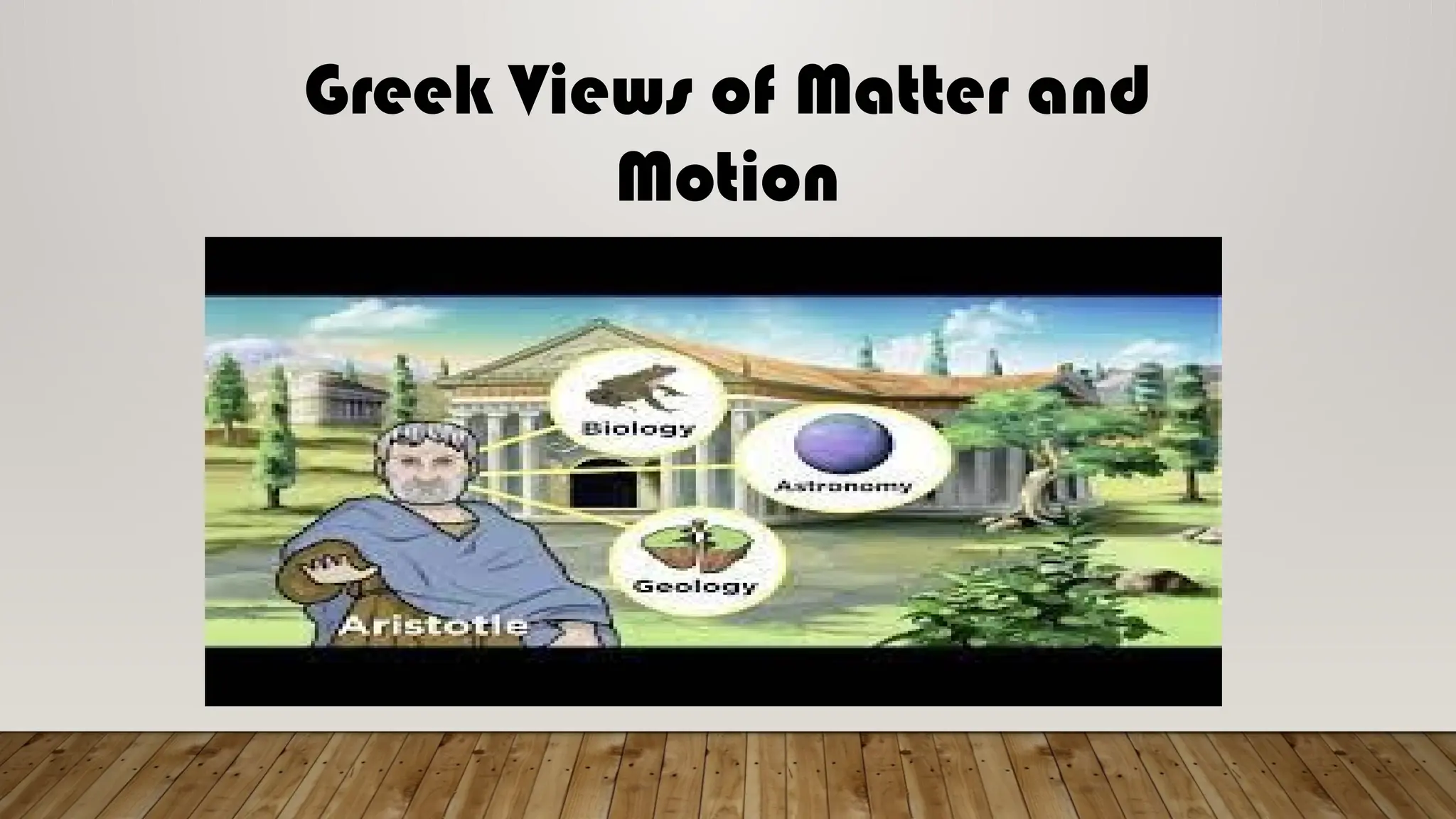
Greek Views of Matter and
Motion
Empedocles
EARLY VIEW ON MATTER
• He argued that all things
are made up of four
elements: fire, air, water,
and earth.
• He stated that the
combination and ratio of
the four elements dictate
the properties of matter.
Empedocles
(490 BC - 430 BC)
Empedocles
EARLY VIEW ON MATTER
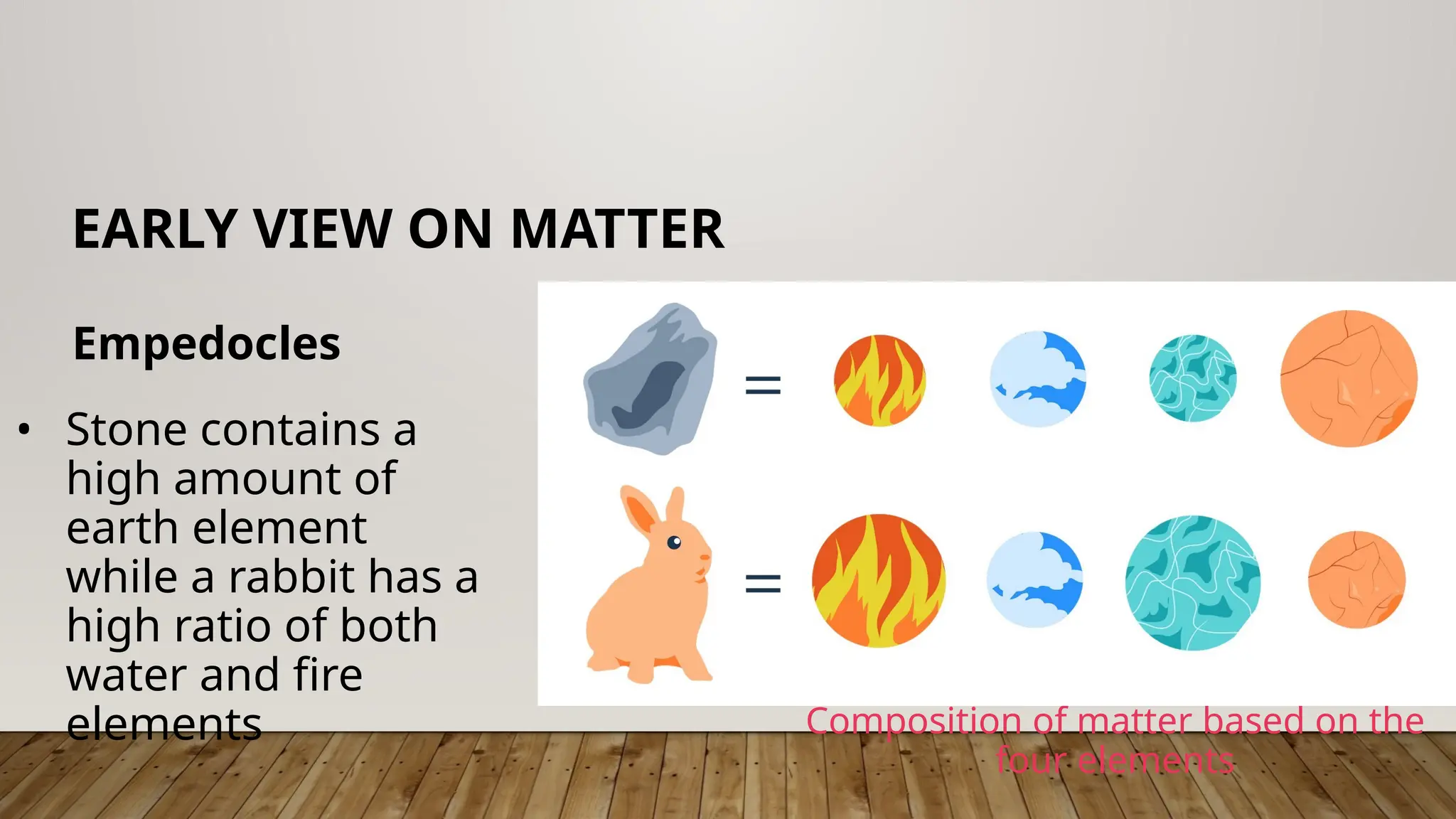
• Stone contains a
high amount of
earth element
while a rabbit has a
high ratio of both
water and fire
elements Composition of matter based on the
four elements
Democritus
THE EXISTENCE OF ATOM
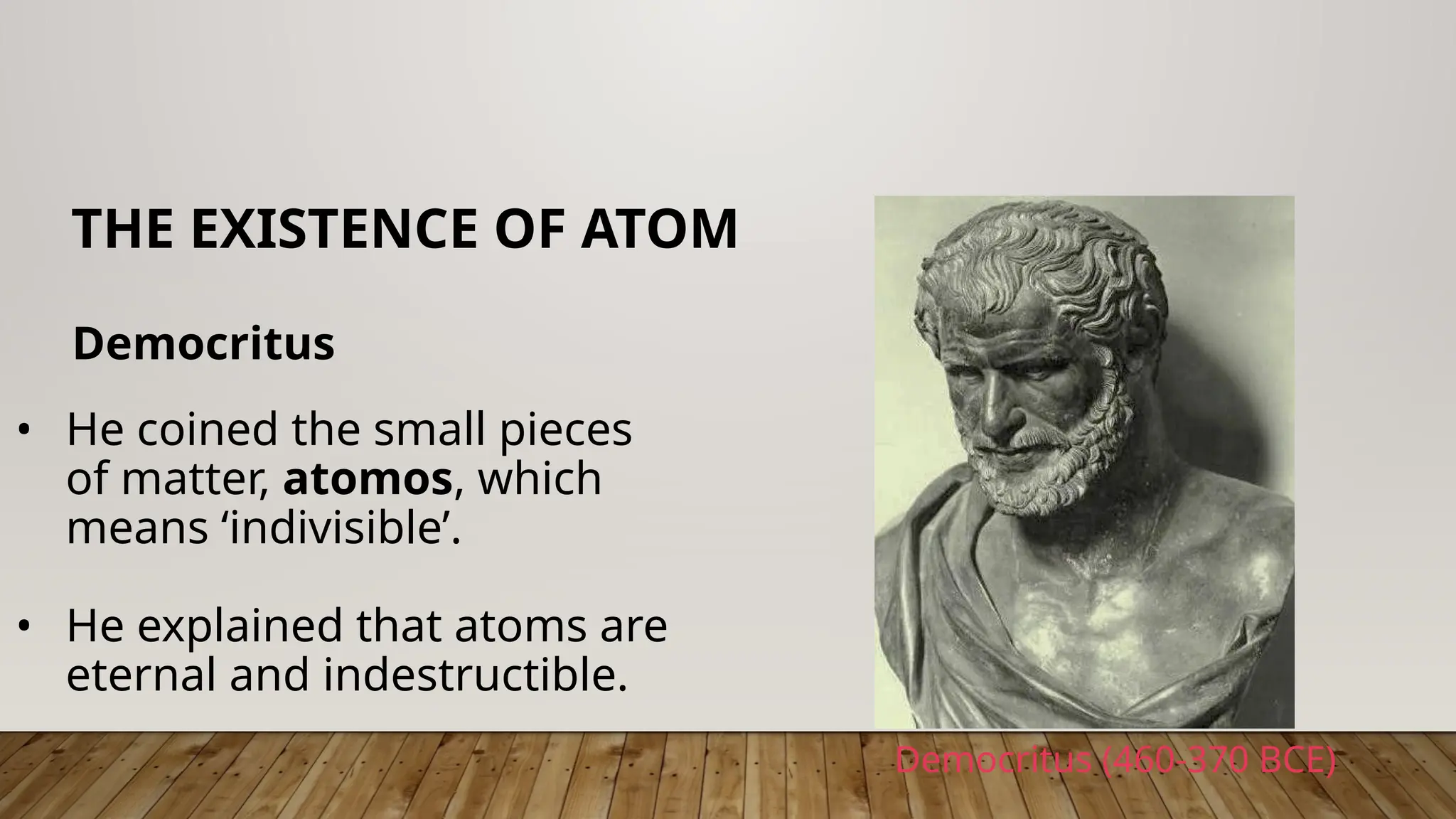
• He coined the small pieces
of matter, atomos, which
means ‘indivisible’.
• He explained that atoms are
eternal and indestructible.
Democritus (460-370 BCE)
Democritus
THE EXISTENCE OF ATOM
• He proposed
that atomos are
specific to the
material that
they constitute. Atomos of stone is different from
atomos of fur.
John Dalton
THE MODERN ATOMIC THEORY
• He constructed and developed
the first version of the Atomic
Theory.
• He explained that matter must
be composed of tiny particles.
John Dalton (1766-1844)
1. All matter is composed
of atoms.
2. All atoms of an element
are entirely identical.
3. Atoms are indestructible
and unchangeable.
4. Elements react to form
compounds in defined
ratios.
THE MODERN ATOMIC THEORY
Dalton’s symbols for some
elements and compounds
• He believed that there
are two forms of
motion: natural and
violent.
ARISTOTLE’S VIEW ON MOTION
Aristotle
(384 - 322 BCE)
• Natural motion is where
an object moves upward
and downward due to
the weight of the
matter.
• Heavier things fall faster
than lighter things.
ARISTOTLE’S VIEW ON MOTION
Heavier object falls faster than the
lighter object.
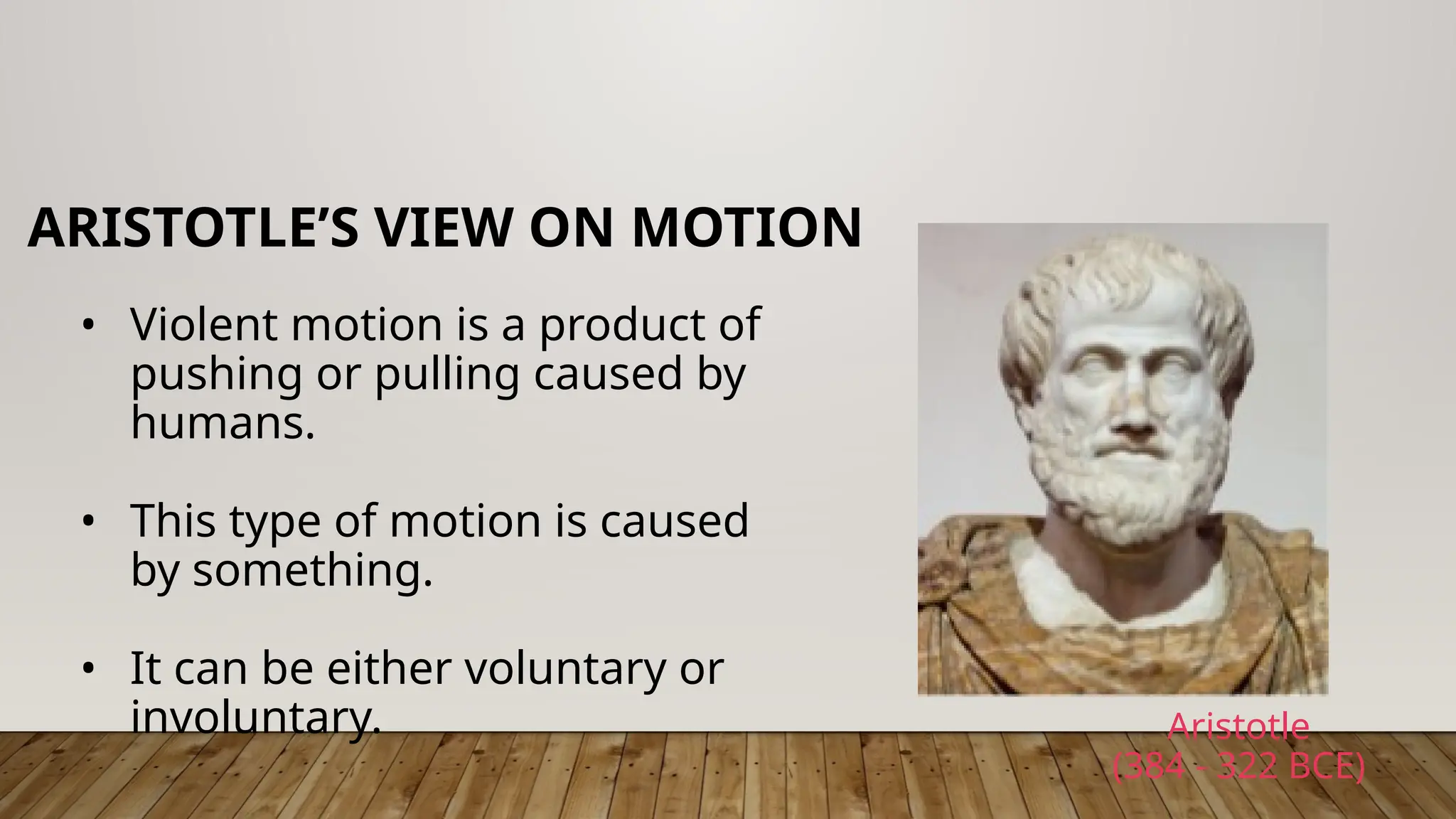
• Violent motion is a product of
pushing or pulling caused by
humans.
• This type of motion is caused
by something.
• It can be either voluntary or
involuntary.
ARISTOTLE’S VIEW ON MOTION
Aristotle
(384 - 322 BCE)
• Example of a violent
motion: throwing a ball
• Violent motion always
require force for it to
occur.
ARISTOTLE’S VIEW ON MOTION
A pitcher throwing the ball.
• All bodies move and
accelerate regardless of
its size and mass.
GALILEO’S LAW OF MOTION
Galileo Galilei
(1564-1642)
Key observations regarding an object’s motion :
(1)development of the concept of velocity using inclined
planes
(2)development of the idea of force that causes the motion of
an object
(3)being at rest is the natural state of an object
(4)inertia is the resistance of an object to changes in its
motion
GALILEO’S LAW OF MOTION
• Newton defined the
relationship between
motion and energy.
NEWTON’S LAWS OF MOTION
Isaac Newton
(1642 - 1727)
Newton developed the following concepts:
(1)the principle of acceleration is the change in velocity that
was induced by force
(2)inertia is the resistance in change of velocity that is
proportional to the object’s mass
(3)momentum is the quantified motion energy that is
equivalent to the mass multiplied by the velocity
NEWTON’S LAWS OF MOTION
(1)All objects remain at rest or in uniform motion along a
straight line unless acted by an external force.
(2)Object’s velocity changes when subjected to an external
force. Force is equal to change in momentum per time
interval.
(3)An action force has always an equal and opposite
reaction force.
NEWTON’S THREE LAWS OF MOTION
• It refers to an apparent movement
of stars and other celestial bodies
around Earth.
• It is caused by Earth’s rotation from
west to east.
• If Earth is not spinning, the stars will
not appear to move westward, and
no diurnal motion will be observed.
EARLY OBSERVABLE NONTERRESTRIAL MOTION
DIURNAL
MOTION
Diurnal motion of the stars
in a night sky.
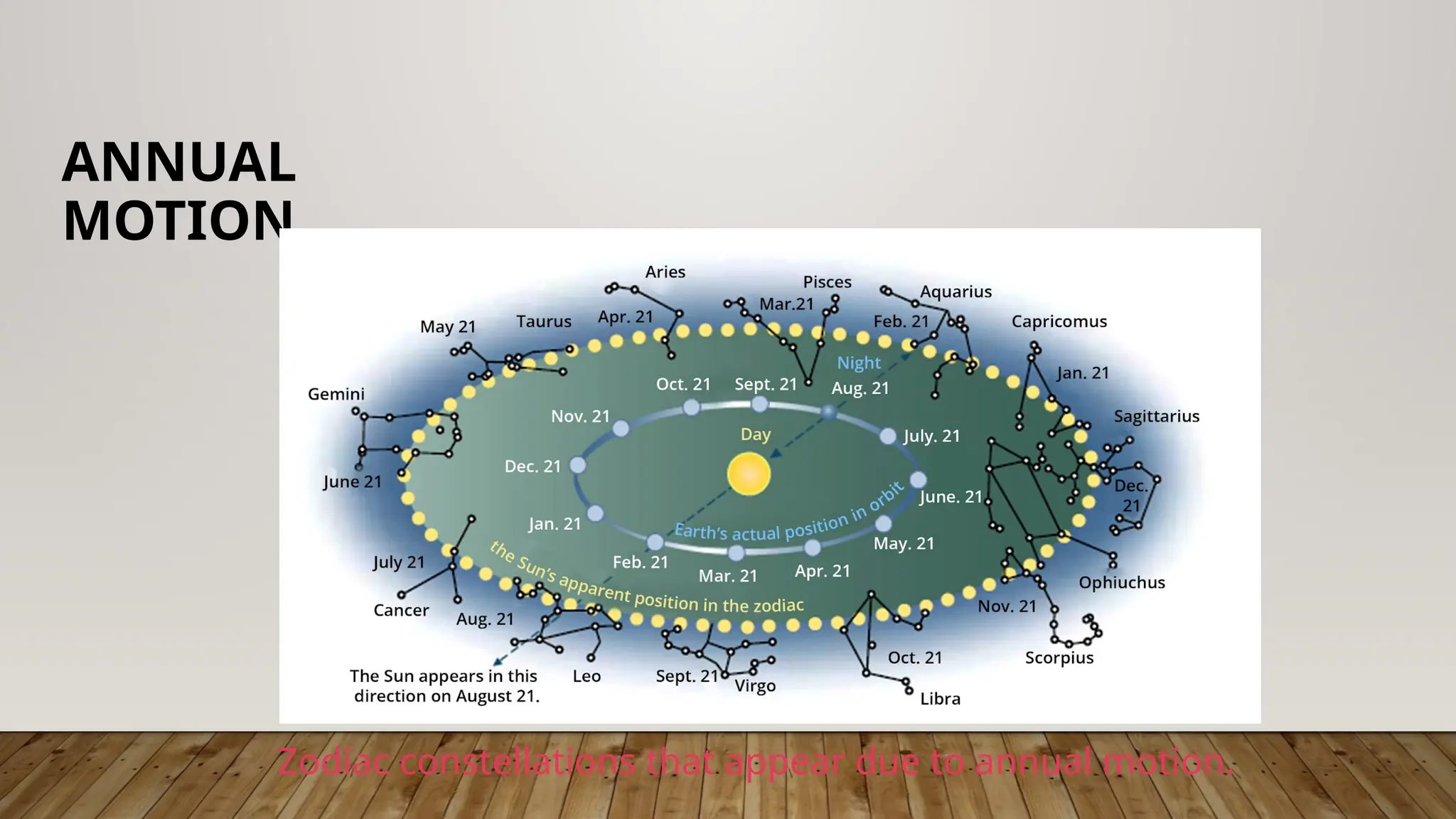
• It refers to the apparent yearly movement of the sun across
a background of stars.
• This movement is caused by Earth’s revolution around Sun.
• The ecliptic is the projected pathway of the sun with
regards to the stars.
• As the sun appears through the ecliptic, the zodiac which
consists of 12 ancient constellations appears.
ANNUAL
MOTION
Zodiac constellations that appear due to annual motion.
ANNUAL
MOTION
• It refers to the conical motion of Earth’s
axis as it spins.
• Because of this, Earth’s axis shifts very
slowly, completing one cycle every 26 000
years.
• This axial precession is caused by the
gravity that continuously changes the
orientation of a planetary object’s
rotational axis
PRECESSION
Earth’s precision
Empedocles​
, a Greek philosopher who used to live in Sicily
from 492 BCE to 432 BCE, introduced the first theory in
describing things that surround us. He argued that all
things are made up of four elements, namely: fire, air,
water, and ​
earth​
.
Democritus (460 BCE - 370 BCE), who is also Greek
philosopher, proposed the presence of small pieces of
matter atomos, which means 'indivisible'​
. He explained
that atomos are ​
eternal ​
and ​
indestructible​
.
1
2
John Dalton​
, a British scientist, is responsible for
constructing the details and developed the first version of
the ​
atomic theory.
Aristotle introduced the concept of motion during the
Greek era. He believed that there are two forms of
motion, namely: ​
natural and violent.
3
4
Galileo was the first person to lay down laws of motion for
objects with masses.
5
7
8
9
6 Isaac Newton was able to develop the ​
three laws of 8
motion​
.
Diurnal motion refers to the apparent movement of stars
and other celestial bodies around the Earth.
Annual motion refers to the apparent yearly movement of
the sun across a background of stars.
Precession ​
refers to the conical motion of Earth’s axis as it
spins.
1. Motion of an object within the earth is called non-terrestrial
motion.
2. The ecliptic is the projected pathway of the sun with
regards to the stars.
3. An object at rest is in its natural form of motion.
4. Newton’s second law of motion says that the action or force
in nature has an equal and opposite reaction.
5. The involuntary motion refers to the ability of humans (as
well as other animals) to move because they have the will
or the capacity to do so.
WRITE TRUE OF THE STATEMENT IS CORRECT,
OTHERWISE, WRITE THE WORD FALSE.

2.greek views of matter and motions in physical science

  • 1.
    Greek Views ofMatter and Motion
  • 2.
    Empedocles EARLY VIEW ONMATTER • He argued that all things are made up of four elements: fire, air, water, and earth. • He stated that the combination and ratio of the four elements dictate the properties of matter. Empedocles (490 BC - 430 BC)
  • 3.
    Empedocles EARLY VIEW ONMATTER • Stone contains a high amount of earth element while a rabbit has a high ratio of both water and fire elements Composition of matter based on the four elements
  • 4.
    Democritus THE EXISTENCE OFATOM • He coined the small pieces of matter, atomos, which means ‘indivisible’. • He explained that atoms are eternal and indestructible. Democritus (460-370 BCE)
  • 5.
    Democritus THE EXISTENCE OFATOM • He proposed that atomos are specific to the material that they constitute. Atomos of stone is different from atomos of fur.
  • 6.
    John Dalton THE MODERNATOMIC THEORY • He constructed and developed the first version of the Atomic Theory. • He explained that matter must be composed of tiny particles. John Dalton (1766-1844)
  • 7.
    1. All matteris composed of atoms. 2. All atoms of an element are entirely identical. 3. Atoms are indestructible and unchangeable. 4. Elements react to form compounds in defined ratios. THE MODERN ATOMIC THEORY Dalton’s symbols for some elements and compounds
  • 8.
    • He believedthat there are two forms of motion: natural and violent. ARISTOTLE’S VIEW ON MOTION Aristotle (384 - 322 BCE)
  • 9.
    • Natural motionis where an object moves upward and downward due to the weight of the matter. • Heavier things fall faster than lighter things. ARISTOTLE’S VIEW ON MOTION Heavier object falls faster than the lighter object.
  • 10.
    • Violent motionis a product of pushing or pulling caused by humans. • This type of motion is caused by something. • It can be either voluntary or involuntary. ARISTOTLE’S VIEW ON MOTION Aristotle (384 - 322 BCE)
  • 11.
    • Example ofa violent motion: throwing a ball • Violent motion always require force for it to occur. ARISTOTLE’S VIEW ON MOTION A pitcher throwing the ball.
  • 12.
    • All bodiesmove and accelerate regardless of its size and mass. GALILEO’S LAW OF MOTION Galileo Galilei (1564-1642)
  • 13.
    Key observations regardingan object’s motion : (1)development of the concept of velocity using inclined planes (2)development of the idea of force that causes the motion of an object (3)being at rest is the natural state of an object (4)inertia is the resistance of an object to changes in its motion GALILEO’S LAW OF MOTION
  • 14.
    • Newton definedthe relationship between motion and energy. NEWTON’S LAWS OF MOTION Isaac Newton (1642 - 1727)
  • 15.
    Newton developed thefollowing concepts: (1)the principle of acceleration is the change in velocity that was induced by force (2)inertia is the resistance in change of velocity that is proportional to the object’s mass (3)momentum is the quantified motion energy that is equivalent to the mass multiplied by the velocity NEWTON’S LAWS OF MOTION
  • 16.
    (1)All objects remainat rest or in uniform motion along a straight line unless acted by an external force. (2)Object’s velocity changes when subjected to an external force. Force is equal to change in momentum per time interval. (3)An action force has always an equal and opposite reaction force. NEWTON’S THREE LAWS OF MOTION
  • 17.
    • It refersto an apparent movement of stars and other celestial bodies around Earth. • It is caused by Earth’s rotation from west to east. • If Earth is not spinning, the stars will not appear to move westward, and no diurnal motion will be observed. EARLY OBSERVABLE NONTERRESTRIAL MOTION DIURNAL MOTION Diurnal motion of the stars in a night sky.
  • 18.
    • It refersto the apparent yearly movement of the sun across a background of stars. • This movement is caused by Earth’s revolution around Sun. • The ecliptic is the projected pathway of the sun with regards to the stars. • As the sun appears through the ecliptic, the zodiac which consists of 12 ancient constellations appears. ANNUAL MOTION
  • 19.
    Zodiac constellations thatappear due to annual motion. ANNUAL MOTION
  • 20.
    • It refersto the conical motion of Earth’s axis as it spins. • Because of this, Earth’s axis shifts very slowly, completing one cycle every 26 000 years. • This axial precession is caused by the gravity that continuously changes the orientation of a planetary object’s rotational axis PRECESSION Earth’s precision
  • 21.
    Empedocles​ , a Greekphilosopher who used to live in Sicily from 492 BCE to 432 BCE, introduced the first theory in describing things that surround us. He argued that all things are made up of four elements, namely: fire, air, water, and ​ earth​ . Democritus (460 BCE - 370 BCE), who is also Greek philosopher, proposed the presence of small pieces of matter atomos, which means 'indivisible'​ . He explained that atomos are ​ eternal ​ and ​ indestructible​ . 1 2
  • 22.
    John Dalton​ , aBritish scientist, is responsible for constructing the details and developed the first version of the ​ atomic theory. Aristotle introduced the concept of motion during the Greek era. He believed that there are two forms of motion, namely: ​ natural and violent. 3 4 Galileo was the first person to lay down laws of motion for objects with masses. 5
  • 23.
    7 8 9 6 Isaac Newtonwas able to develop the ​ three laws of 8 motion​ . Diurnal motion refers to the apparent movement of stars and other celestial bodies around the Earth. Annual motion refers to the apparent yearly movement of the sun across a background of stars. Precession ​ refers to the conical motion of Earth’s axis as it spins.
  • 24.
    1. Motion ofan object within the earth is called non-terrestrial motion. 2. The ecliptic is the projected pathway of the sun with regards to the stars. 3. An object at rest is in its natural form of motion. 4. Newton’s second law of motion says that the action or force in nature has an equal and opposite reaction. 5. The involuntary motion refers to the ability of humans (as well as other animals) to move because they have the will or the capacity to do so. WRITE TRUE OF THE STATEMENT IS CORRECT, OTHERWISE, WRITE THE WORD FALSE.