DISORDERS RELATED TO
ENVIRONMENTAL
FACTORS
EXTREMES OF TEMPERATURES
• THERMOREGULATION
– Heat generation
– Heat loss
– Heat conservation
• Normal core body temp- 37±0.5ᴼC
• Hypothermia
• hyperthermia
HYPOTHERMIA
• Failure of body’s normal thermal regulatory
mechanism to produce sufficient heat in cold
environment. Core temp. falls below 35ᴼC .
Protective mechanisms
• Vasoconstriction
• Shivering
• Increase metabolism
Hypothermia is common in
• Very young children
• Elderly people
• Hypothyroidism
• Addison’s disease
• Myxoedema
• Stroke
• Hepatic failure
• Hypoglycemia
• Exposure to extreme cold climates
EFFECTS OF SYSTEMIC HYPOTHERMIA
• Decreased respiratory drive
• Decreased O2 consumption
• Decreased central and peripheral nerve
conduction
• Decreased GI motility
• Decreased myocardial repolarization
• Decreased coagulation cascade
Clinical features of hypothermia
• Core temp of body 32ᴼ-35ᴼC
• Tachypnea, tachycardia, hypertension and
shivering
• Impaired coordination and apathy
• At temp 32-28ᴼ- shivering stops
• Bradycardia, pupils dilate, reflexes slow,
confusion and lethargy
• Death in hypothermia is due to ventricular
fibrillation
TREATMENT
• ABC
• Initiation of rewarming
• Rectal temp should be measured
• Monitoring of vitals, cardiac rhythm, blood
sugar
• Treat hypoxia
• Treat fluid and electrolyte imbalance
• Control arrhythmias
HYPOTHERMIA OF THE EXTREMITIES
• FROSTNIP
• CHILLBLAINS
• TRENCH FOOT
• FROST BITE
• Cold-induced injuries to the extremities (ie, frostnip,
chilblain, trench foot, and frostbite) range from mild to
severe.
• Cold exposure of the extremities produces immediate
localized vasoconstriction followed by generalized
vasoconstriction.
• When the skin temperature falls to 25°C, tissue
demand for oxygen is greater than what is supplied by
the slowed circulation: the area becomes cyanotic.
• At 15°C, tissue damage occurs due to marked
reduction in tissue metabolism and
oxyhemoglobin dissociation.
• This gives a deceptive pink, well-oxygenated
appearance to the skin.
• Tissue damage may result from ischemia and
intravascular thromboses, endothelial damage, or
by actual freezing.
• Freezing (frostbite) may occur when the skin
temperature drops below −4 to −10°C
• Frostnip is a mild temporary form of cold-induced
injury.
• The involved area has local paresthesias that
completely resolve with passive external
rewarming
• Chilblains or erythema pernio are inflammatory
skin changes caused by exposure to cold without
actual freezing of the tissues.
• These skin lesions may be red or purple papular
lesions, which are painful or ,with burning or
paresthesias.
TRENCH FOOT
• Immersion foot (or hand) TRENCH FOOT is caused by
prolonged immersion in cool or cold water or mud,
usually < 10°C.
• cold and anesthesia of the affected area.
• follows with hot sensation, intense burning, and
shooting pains.
• part becomes pale or cyanotic with diminished
pulsations due to vasospasm
• blistering, swelling, redness, ecchymoses,
hemorrhage,
• necrosis, peripheral nerve injury, or gangrene
FROST BITE
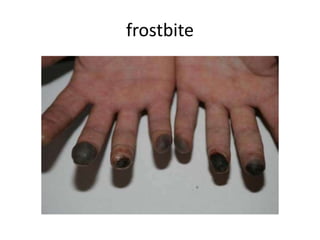
• Frostbite is injury from tissue freezing and formation of ice
crystals in the tissue particularly the extremities.
• The tissues become anesthetised.
• Tissue is initially pale and doughy to touch.
• Later becomes hard and insensitive to pain.
• Gangrene may form.
M/M
• Rewarming in warm water
• Protecting the injured tissue
• Avoid infection
• vasodilators
• Surgical treatment may be reqd. to remove dead tissue
frostbite
HEAT SYNCOPE
• Heat syncope or sudden collapse may result in
unconsciouness
• volume depletion and cutaneous vasodilation
• with consequent systemic and cerebral
hypotension
• history of prolonged vigorous physical activity or
prolonged standing in a hot humid environment.
• Typically, the skin is cool and moist, the pulse is
weak, and the systolic blood pressure is low
• t/t –rest in recumbent position
• Water and electrolyte rehydration
HEAT CRAMPS
• Characterized by painful muscle cramps
(painful skeletal ms contractions)following
vigorous exercise in hot weather.
• No increase in core temperature.
• The patient is alert with normal vitals
• Due to extracellular Na+ depletion following
electrolytes loss due to persistent sweating.
• Responds rapidly to salt replacement.
HEAT EXHAUTION
• Occurs when the core temp. increases between 37ᴼC-40ᴼC
following vigorous physical activity in hot environment and
humidity.
• It is characterized by dehydration, sodium depletion.
• increased pulse, and moist skin. nausea, vomiting,
• malaise, myalgias, hyperventilation, thirst, and weakness.
• CNS symptoms include headache, dizziness, fatigue,
anxiety, paresthesias.
treatment –
• removal of the pt. from hot environment
• Cold sponging
• Fluid replacement saline or isotonic glucose saline
HEAT STROKE
• life-threatening medical emergency
• Characterized by core temp. >40ᴼC and cerebral dysfunction .
• Loss of heat regulatory mechanism.
• Symptoms include all those seen in heat exhaustion with
additional symptoms of dizziness, weakness, confusion, delirium,
blurred vision, convulsions, collapse, and unconsiousness
• Signs
• Skin will be hot
• No sweating
• Dehydration
• hyperventilation
TREATMENT
• Treatment is aimed at rapidly reducing the
core temperature (within 1 hour) while
supporting circulatory and organ system
function to prevent irreversible tissue damage
and death.
• Oral or intravenous fluid administration.
• Cold sponging
• Metabolic abnormalities and cardiac
arrythmias should be treated
DROWNING
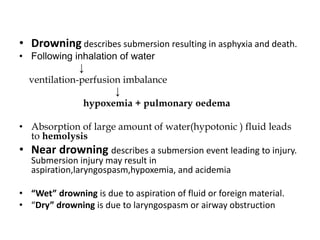
• Drowning describes submersion resulting in asphyxia and death.
• Following inhalation of water
↓
ventilation-perfusion imbalance
↓
hypoxemia + pulmonary oedema
• Absorption of large amount of water(hypotonic ) fluid leads
to hemolysis
• Near drowning describes a submersion event leading to injury.
Submersion injury may result in
aspiration,laryngospasm,hypoxemia, and acidemia
• “Wet” drowning is due to aspiration of fluid or foreign material.
• “Dry” drowning is due to laryngospasm or airway obstruction
NEAR DROWNING
• The first requirement of rescue is immediate
basic life support and CPR.
• Patient must also be assessed for
hypothermia, hypoglycemia, concurrent
injuries, and medical conditions.
• Clinical manifestations are hypoxemia,
pulmonary edema, and hypoventilation
Symptoms and Signs
• anxiety, dyspnea, cough, wheezing,
• cyanosis, chest pain, dysrhythmia,
hypotension,
• vomiting, diarrhea, headache,
• altered level of consciousness, neurologic
deficit,
• apnea
• Hypothermia
Laboratory Findings
• Arterial blood gas - Pao2 is usually decreased;
Paco2 may be increased; pH is decreased.
• blood sugar must be checked rapidly.
• kidney function,
• electrolytes, urinalysis,
• blood count,
• coagulation studies,
Treatment
• A. First Aid
• immediate CPR. - Ventilation, oxygenation, and
circulatory support.
• Hypothermia and associated trauma, especially brain
and cervical spine injury, should always be suspected.
• Patient must be assessed for hypoglycemia, metabolic
acidosis, and concurrent medical conditions.
• Rescuer should not attempt to drain water from the
victim’s lungs. The “Heimlich maneuver”
(subdiaphragmatic pressure) should be used only if
foreign material airway obstruction is suspected.
• Oxygen should be administered immediately at
the highest available concentration.
• Oxygen saturation should be maintained at 90%
or higher.
• Endotracheal intubation and mechanical
ventilation
• Bronchodilators
• Antibiotics
• Hypotension is treated with vasopressors
• Pulmonary oedema- diuretics
• Metabolic acidosis –by proper ventilation and
oxygenation
• Hypothermia should be corrected
COMPLICATIONS
• Dehydration
• Hypotension
• Hemoptysis
• Pulmonary infection
• Arrhythmias
• ARDS
COLD WATER IMMERSION
Death results due to
• Sudden cardiac arrest
• Muscle stiffness due to cold water
• Hypothermia
• Loss of consciousness
• Further water inhalation
DISORDERS
RELATED TO ALTITUDE
HIGH ALTITUDE ILLNESS
• As altitude increases, there is a decrease in both barometric
pressure and oxygen partial pressure leading to hypoxia.
• Acclimatization occurs as a physiologic response to the rise in
altitude and increasing hypoxia.
• Acclimatisation to hypoxaemia at high altitude results in increased
erythropoiesis, haemoconcentration, and hyperventilation
• Physiologic changes include increases in alveolar ventilation and
oxygen extraction by the tissues and increased hemoglobin level
and oxygen binding
• Ascent to altitudes up to 2500 m or travel in a pressurised aircraft
cabin is harmless to healthy people.
• Above 2500 m high-altitude illnesses may occur in previously
healthy people, and above 3500 m these become common.
ACUTE MOUNTAIN SICKNESS
• Characterized by neurologic and pulmonary symptoms.
• Characterized by headache with N,V, dizziness, fatigue
• Facial pallor, dyspnea and cyanosis
• Later - vertigo, tinnitus, visual disturbances
• Occurs in 6-24 hrs. of ascent.
• M/M – Rest, analgesic and Acetazolamide
(acetazolamide acts by inhibiting carbonic anhydrase
enzyme causing metabolic acidosis and thus increasing
ventilation.)
• Prevention – slow ascent and acclimatization
High altitude cerebral edema
• Extension of CNS symptoms of acute mountain
sickness
• Over >3500 m due to loss of acclimatization
• Altered consciousness and ataxic gait
• Confusion, Behavioral changes, Hallucinations
• Seizures, ff by obtundation,and coma
M/M –immediate descent
- O2
- steroids (dexamethasone)
- diuretics( mannitol)
High altitude pulm edema
• High-altitude pulmonary edema is a serious
complication of hypoxia induced pulmonary
hypertension
• The hallmark is markedly elevated pulmonary artery
pressure followed by pulmonary edema. It usually
occurs at levels above 3000 meters
• Early symptoms may appear within 6–36 hours after
arrival at a high-altitude area.
• These include persistent dry cough, shortness of
breath, headache, fatigue, dyspnea at rest, and chest
tightness.
• Later, wheezing, orthopnea ,and hemoptysis may occur
as pulmonary edema worsens
• Physical findings include tachycardia, mild fever,
tachypnea, cyanosis, prolonged respiration, and rales
and rhonchi
• The patient may become confused or comatose
TREATMENT
• The patient must rest in the semi-Fowler position
(head raised), and
• 100% oxygen must be administered.
• Immediate descent is essential.
• Nifedepin to reduce the pulmonary arterial pressure
DYSBARISM & DECOMPRESSION
SICKNESS
• Dysbarism and decompression sickness are
physiologic problems that result from altitude
changes and the environmental pressure effects
on gases in the body during underwater descent
and ascent, particularly when scuba diving is
followed closely by air travel or hiking to high
altitudes
• As a diver descends, the gases in the body
compress; gases dissolve in blood and tissues.
During the ascent, gases in the body expand.
• Dysbarism results from gas compression or
expansion in parts of the body that have limited
compliance
• results in pneumomediastinum, pneumothorax,
and rupture of the pulmonary vein causing
arterial gas embolism
• gastric rupture, bowel obstruction or perforation,
or pneumoperitoneum.
• Less serious conditions can also occur such as ear
squeeze, sinus squeeze, headache, tooth
squeeze.
• Decompression sickness occurs when the
ascent is too rapid and gas bubbles form and
cause damage depending on their location
(eg, coronary, pulmonary, spinal or cerebral
blood vessels, joints, soft tissue).
Clinical Findings
• The range of clinical manifestations varies depending on
the location of the gas bubble formation or the
compressibility of gases in the body.
• Symptom onset may be immediate, within minutes or
hours (in the majority), or present up to 36 hours later.
• Decompression sickness symptoms include pain in the
joints
• skin pruritus or burning , or rashes;
• labyrinthine decompression sickness characterized by
vertigo);
• pulmonary decompression sickness causing inspiratory
pain, cough, and respiratory distress
• arterial gas embolism (cerebral or pulmonary)
Treatment
• Decompression sickness must be considered if
symptoms are temporally related to recent diving
or altitude or pressure changes within the past 48
hours.
• Immediate consultation with a diving medicine or
hyperbaric oxygen specialist is indicated
• Continuous administration of 100% oxygen is
indicated and beneficial for all patients.
• Aspirin may be given for pain. Opioids should be
used very cautiously,
RADIATION HAZARDS
RADIATION EXPOSURE
• Damage from radiation is determined by the
source, type, quantity, duration, bodily location,
and susceptibility and accumulation of exposures
of the person.
• Radiation exposure from medical diagnostic
imaging has dramatically risen over the past few
decades; medical imaging radiation dosing needs
to be standardized and regulated in order to
minimize necessary radiation exposure
• Radiation occurs from both nonionizing and
ionizing radiation sources.
• Nonionizing radiation is low energy, resulting in
injuries related to local thermal damage (ie,
microwave, ultraviolet, visible light and
radiowave).
• Ionizing radiation is high energy, causing bodily
damage in several ways (ie, cellular disruption,
DNA damage, and mutations).
• Ionizing radiation is either electromagnetic (ie, x-
rays and gamma rays) or particulate (ie, alpha or
beta particles, neutrons, and protons
• X rays, CT Scan, MRI and Radiotherapy
• The energy absorbed by a unit mass of a
tissue is the radiation dose.
• This is measured in grays (Gy) and is useful to
assess the high dose exposure.
• Effective dose to cause damage to a particular
tissue is measured in sieverts (Sv). This is
useful to assess chronic low dose exposure.
• Effect depends on the dose and tissue
penetration.
• Radiation exposure results in early and
delayed effects.
• Early effects involve damage of the rapidly
dividing cells (ie, the mucosa, skin, and bone
marrow).
• This may be manifested as nausea, vomiting,
and decreased lymphocyte count over hours
to days after exposure.
• Delayed effects include malignancy,
reproduction abnormalities, liver, kidney, and
central nervous system and immune system
dysfunction
Clinical Findings
A. Injury to Superficial Structures
• Acute radiation exposure to the skin and
mucous membranes may cause erythema,
destruction of fingernails,
• Chronic damage includes skin scarring,
atrophy, and xerostomia. Radiation effects on
the eyes include cataracts, dry eye syndrome,
and retinopathy
B. Injury to Deep Structures
• Hematopoietic system radiation exposure causes
injury to the bone marrow that may vary from
transient decreases to complete destruction of
blood elements.
• Hematopoietic effects consisting of anemia,
thrombocytopenia, and bone marrow
suppression.
• Bone marrow failure is the main cause of death
within the first few months following exposure to
radiation
• Nervous system structures are sensitive to radiation.
• The brain and spinal cord are much more sensitive
than the peripheral nerves.
• cardiovascular system effects of ionizing radiation
result in damage to the heart and coronary arteries.
• Delayed effects from radiation include obliterative
endarteritis; coronary artery disease; pericarditis with
effusion; or constrictive pericarditis,
• Pulmonary system cause pneumonitis or
pulmonaryFibrosis.
• Gastrointestinal system radiation results in mucositis
and mucosal edema within hours or days after
exposure.
• Symptoms include odynophagia, anorexia, nausea,
vomiting, dehydration, and weakness. Delayed effects
include hepatitis, liver dysfunction, and intestinal
stenosis.
• The stomach and colon are the gastrointestinal organs
most at risk for cancer.
• Urogenital system radiation effects are dose-
dependent, infertility
• Endocrine system organs are relatively resistant to low
or moderate doses of radiation. The thyroid gland is
the endocrine gland at highest risk for cancer induction
from internal radiation exposure.
C. Systemic Reaction (Acute Radiation Syndrome)
• Acute radiation syndrome is due to an exposure
to high doses of ionizing radiation over a brief
time course.
• The symptom onset is within hours to days
depending on the dose.
• Symptoms include anorexia, nausea, vomiting,
weakness, exhaustion, and lassitude.
• Dehydration, anemia, and infection may follow
TREATMENT
• Treatment is focused on decontamination,
• Symptomatic relief, supportive care, and
psychosocial support.
• Adequate hydration
• Marrow transplantation for marrow aplasia
• Chelating agents
Environmental diseases

Environmental diseases

  • 1.
  • 2.
    EXTREMES OF TEMPERATURES •THERMOREGULATION – Heat generation – Heat loss – Heat conservation • Normal core body temp- 37±0.5ᴼC • Hypothermia • hyperthermia
  • 3.
    HYPOTHERMIA • Failure ofbody’s normal thermal regulatory mechanism to produce sufficient heat in cold environment. Core temp. falls below 35ᴼC . Protective mechanisms • Vasoconstriction • Shivering • Increase metabolism
  • 4.
    Hypothermia is commonin • Very young children • Elderly people • Hypothyroidism • Addison’s disease • Myxoedema • Stroke • Hepatic failure • Hypoglycemia • Exposure to extreme cold climates
  • 5.
    EFFECTS OF SYSTEMICHYPOTHERMIA • Decreased respiratory drive • Decreased O2 consumption • Decreased central and peripheral nerve conduction • Decreased GI motility • Decreased myocardial repolarization • Decreased coagulation cascade
  • 6.
    Clinical features ofhypothermia • Core temp of body 32ᴼ-35ᴼC • Tachypnea, tachycardia, hypertension and shivering • Impaired coordination and apathy • At temp 32-28ᴼ- shivering stops • Bradycardia, pupils dilate, reflexes slow, confusion and lethargy • Death in hypothermia is due to ventricular fibrillation
  • 7.
    TREATMENT • ABC • Initiationof rewarming • Rectal temp should be measured • Monitoring of vitals, cardiac rhythm, blood sugar • Treat hypoxia • Treat fluid and electrolyte imbalance • Control arrhythmias
  • 8.
    HYPOTHERMIA OF THEEXTREMITIES • FROSTNIP • CHILLBLAINS • TRENCH FOOT • FROST BITE • Cold-induced injuries to the extremities (ie, frostnip, chilblain, trench foot, and frostbite) range from mild to severe. • Cold exposure of the extremities produces immediate localized vasoconstriction followed by generalized vasoconstriction. • When the skin temperature falls to 25°C, tissue demand for oxygen is greater than what is supplied by the slowed circulation: the area becomes cyanotic.
  • 9.
    • At 15°C,tissue damage occurs due to marked reduction in tissue metabolism and oxyhemoglobin dissociation. • This gives a deceptive pink, well-oxygenated appearance to the skin. • Tissue damage may result from ischemia and intravascular thromboses, endothelial damage, or by actual freezing. • Freezing (frostbite) may occur when the skin temperature drops below −4 to −10°C
  • 10.
    • Frostnip isa mild temporary form of cold-induced injury. • The involved area has local paresthesias that completely resolve with passive external rewarming • Chilblains or erythema pernio are inflammatory skin changes caused by exposure to cold without actual freezing of the tissues. • These skin lesions may be red or purple papular lesions, which are painful or ,with burning or paresthesias.
  • 11.
    TRENCH FOOT • Immersionfoot (or hand) TRENCH FOOT is caused by prolonged immersion in cool or cold water or mud, usually < 10°C. • cold and anesthesia of the affected area. • follows with hot sensation, intense burning, and shooting pains. • part becomes pale or cyanotic with diminished pulsations due to vasospasm • blistering, swelling, redness, ecchymoses, hemorrhage, • necrosis, peripheral nerve injury, or gangrene
  • 12.
    FROST BITE • Frostbiteis injury from tissue freezing and formation of ice crystals in the tissue particularly the extremities. • The tissues become anesthetised. • Tissue is initially pale and doughy to touch. • Later becomes hard and insensitive to pain. • Gangrene may form. M/M • Rewarming in warm water • Protecting the injured tissue • Avoid infection • vasodilators • Surgical treatment may be reqd. to remove dead tissue
  • 13.
  • 14.
    HEAT SYNCOPE • Heatsyncope or sudden collapse may result in unconsciouness • volume depletion and cutaneous vasodilation • with consequent systemic and cerebral hypotension • history of prolonged vigorous physical activity or prolonged standing in a hot humid environment. • Typically, the skin is cool and moist, the pulse is weak, and the systolic blood pressure is low • t/t –rest in recumbent position • Water and electrolyte rehydration
  • 15.
    HEAT CRAMPS • Characterizedby painful muscle cramps (painful skeletal ms contractions)following vigorous exercise in hot weather. • No increase in core temperature. • The patient is alert with normal vitals • Due to extracellular Na+ depletion following electrolytes loss due to persistent sweating. • Responds rapidly to salt replacement.
  • 16.
    HEAT EXHAUTION • Occurswhen the core temp. increases between 37ᴼC-40ᴼC following vigorous physical activity in hot environment and humidity. • It is characterized by dehydration, sodium depletion. • increased pulse, and moist skin. nausea, vomiting, • malaise, myalgias, hyperventilation, thirst, and weakness. • CNS symptoms include headache, dizziness, fatigue, anxiety, paresthesias. treatment – • removal of the pt. from hot environment • Cold sponging • Fluid replacement saline or isotonic glucose saline
  • 17.
    HEAT STROKE • life-threateningmedical emergency • Characterized by core temp. >40ᴼC and cerebral dysfunction . • Loss of heat regulatory mechanism. • Symptoms include all those seen in heat exhaustion with additional symptoms of dizziness, weakness, confusion, delirium, blurred vision, convulsions, collapse, and unconsiousness • Signs • Skin will be hot • No sweating • Dehydration • hyperventilation
  • 18.
    TREATMENT • Treatment isaimed at rapidly reducing the core temperature (within 1 hour) while supporting circulatory and organ system function to prevent irreversible tissue damage and death. • Oral or intravenous fluid administration. • Cold sponging • Metabolic abnormalities and cardiac arrythmias should be treated
  • 19.
  • 20.
    • Drowning describessubmersion resulting in asphyxia and death. • Following inhalation of water ↓ ventilation-perfusion imbalance ↓ hypoxemia + pulmonary oedema • Absorption of large amount of water(hypotonic ) fluid leads to hemolysis • Near drowning describes a submersion event leading to injury. Submersion injury may result in aspiration,laryngospasm,hypoxemia, and acidemia • “Wet” drowning is due to aspiration of fluid or foreign material. • “Dry” drowning is due to laryngospasm or airway obstruction
  • 21.
    NEAR DROWNING • Thefirst requirement of rescue is immediate basic life support and CPR. • Patient must also be assessed for hypothermia, hypoglycemia, concurrent injuries, and medical conditions. • Clinical manifestations are hypoxemia, pulmonary edema, and hypoventilation
  • 22.
    Symptoms and Signs •anxiety, dyspnea, cough, wheezing, • cyanosis, chest pain, dysrhythmia, hypotension, • vomiting, diarrhea, headache, • altered level of consciousness, neurologic deficit, • apnea • Hypothermia
  • 23.
    Laboratory Findings • Arterialblood gas - Pao2 is usually decreased; Paco2 may be increased; pH is decreased. • blood sugar must be checked rapidly. • kidney function, • electrolytes, urinalysis, • blood count, • coagulation studies,
  • 24.
    Treatment • A. FirstAid • immediate CPR. - Ventilation, oxygenation, and circulatory support. • Hypothermia and associated trauma, especially brain and cervical spine injury, should always be suspected. • Patient must be assessed for hypoglycemia, metabolic acidosis, and concurrent medical conditions. • Rescuer should not attempt to drain water from the victim’s lungs. The “Heimlich maneuver” (subdiaphragmatic pressure) should be used only if foreign material airway obstruction is suspected.
  • 25.
    • Oxygen shouldbe administered immediately at the highest available concentration. • Oxygen saturation should be maintained at 90% or higher. • Endotracheal intubation and mechanical ventilation • Bronchodilators • Antibiotics • Hypotension is treated with vasopressors • Pulmonary oedema- diuretics • Metabolic acidosis –by proper ventilation and oxygenation • Hypothermia should be corrected
  • 26.
    COMPLICATIONS • Dehydration • Hypotension •Hemoptysis • Pulmonary infection • Arrhythmias • ARDS
  • 27.
    COLD WATER IMMERSION Deathresults due to • Sudden cardiac arrest • Muscle stiffness due to cold water • Hypothermia • Loss of consciousness • Further water inhalation
  • 28.
  • 29.
    HIGH ALTITUDE ILLNESS •As altitude increases, there is a decrease in both barometric pressure and oxygen partial pressure leading to hypoxia. • Acclimatization occurs as a physiologic response to the rise in altitude and increasing hypoxia. • Acclimatisation to hypoxaemia at high altitude results in increased erythropoiesis, haemoconcentration, and hyperventilation • Physiologic changes include increases in alveolar ventilation and oxygen extraction by the tissues and increased hemoglobin level and oxygen binding • Ascent to altitudes up to 2500 m or travel in a pressurised aircraft cabin is harmless to healthy people. • Above 2500 m high-altitude illnesses may occur in previously healthy people, and above 3500 m these become common.
  • 30.
    ACUTE MOUNTAIN SICKNESS •Characterized by neurologic and pulmonary symptoms. • Characterized by headache with N,V, dizziness, fatigue • Facial pallor, dyspnea and cyanosis • Later - vertigo, tinnitus, visual disturbances • Occurs in 6-24 hrs. of ascent. • M/M – Rest, analgesic and Acetazolamide (acetazolamide acts by inhibiting carbonic anhydrase enzyme causing metabolic acidosis and thus increasing ventilation.) • Prevention – slow ascent and acclimatization
  • 31.
    High altitude cerebraledema • Extension of CNS symptoms of acute mountain sickness • Over >3500 m due to loss of acclimatization • Altered consciousness and ataxic gait • Confusion, Behavioral changes, Hallucinations • Seizures, ff by obtundation,and coma M/M –immediate descent - O2 - steroids (dexamethasone) - diuretics( mannitol)
  • 32.
    High altitude pulmedema • High-altitude pulmonary edema is a serious complication of hypoxia induced pulmonary hypertension • The hallmark is markedly elevated pulmonary artery pressure followed by pulmonary edema. It usually occurs at levels above 3000 meters • Early symptoms may appear within 6–36 hours after arrival at a high-altitude area. • These include persistent dry cough, shortness of breath, headache, fatigue, dyspnea at rest, and chest tightness. • Later, wheezing, orthopnea ,and hemoptysis may occur as pulmonary edema worsens
  • 33.
    • Physical findingsinclude tachycardia, mild fever, tachypnea, cyanosis, prolonged respiration, and rales and rhonchi • The patient may become confused or comatose TREATMENT • The patient must rest in the semi-Fowler position (head raised), and • 100% oxygen must be administered. • Immediate descent is essential. • Nifedepin to reduce the pulmonary arterial pressure
  • 34.
    DYSBARISM & DECOMPRESSION SICKNESS •Dysbarism and decompression sickness are physiologic problems that result from altitude changes and the environmental pressure effects on gases in the body during underwater descent and ascent, particularly when scuba diving is followed closely by air travel or hiking to high altitudes • As a diver descends, the gases in the body compress; gases dissolve in blood and tissues. During the ascent, gases in the body expand.
  • 35.
    • Dysbarism resultsfrom gas compression or expansion in parts of the body that have limited compliance • results in pneumomediastinum, pneumothorax, and rupture of the pulmonary vein causing arterial gas embolism • gastric rupture, bowel obstruction or perforation, or pneumoperitoneum. • Less serious conditions can also occur such as ear squeeze, sinus squeeze, headache, tooth squeeze.
  • 36.
    • Decompression sicknessoccurs when the ascent is too rapid and gas bubbles form and cause damage depending on their location (eg, coronary, pulmonary, spinal or cerebral blood vessels, joints, soft tissue).
  • 37.
    Clinical Findings • Therange of clinical manifestations varies depending on the location of the gas bubble formation or the compressibility of gases in the body. • Symptom onset may be immediate, within minutes or hours (in the majority), or present up to 36 hours later. • Decompression sickness symptoms include pain in the joints • skin pruritus or burning , or rashes; • labyrinthine decompression sickness characterized by vertigo); • pulmonary decompression sickness causing inspiratory pain, cough, and respiratory distress • arterial gas embolism (cerebral or pulmonary)
  • 38.
    Treatment • Decompression sicknessmust be considered if symptoms are temporally related to recent diving or altitude or pressure changes within the past 48 hours. • Immediate consultation with a diving medicine or hyperbaric oxygen specialist is indicated • Continuous administration of 100% oxygen is indicated and beneficial for all patients. • Aspirin may be given for pain. Opioids should be used very cautiously,
  • 39.
  • 40.
    RADIATION EXPOSURE • Damagefrom radiation is determined by the source, type, quantity, duration, bodily location, and susceptibility and accumulation of exposures of the person. • Radiation exposure from medical diagnostic imaging has dramatically risen over the past few decades; medical imaging radiation dosing needs to be standardized and regulated in order to minimize necessary radiation exposure
  • 41.
    • Radiation occursfrom both nonionizing and ionizing radiation sources. • Nonionizing radiation is low energy, resulting in injuries related to local thermal damage (ie, microwave, ultraviolet, visible light and radiowave). • Ionizing radiation is high energy, causing bodily damage in several ways (ie, cellular disruption, DNA damage, and mutations). • Ionizing radiation is either electromagnetic (ie, x- rays and gamma rays) or particulate (ie, alpha or beta particles, neutrons, and protons • X rays, CT Scan, MRI and Radiotherapy
  • 42.
    • The energyabsorbed by a unit mass of a tissue is the radiation dose. • This is measured in grays (Gy) and is useful to assess the high dose exposure. • Effective dose to cause damage to a particular tissue is measured in sieverts (Sv). This is useful to assess chronic low dose exposure. • Effect depends on the dose and tissue penetration.
  • 43.
    • Radiation exposureresults in early and delayed effects. • Early effects involve damage of the rapidly dividing cells (ie, the mucosa, skin, and bone marrow). • This may be manifested as nausea, vomiting, and decreased lymphocyte count over hours to days after exposure. • Delayed effects include malignancy, reproduction abnormalities, liver, kidney, and central nervous system and immune system dysfunction
  • 44.
    Clinical Findings A. Injuryto Superficial Structures • Acute radiation exposure to the skin and mucous membranes may cause erythema, destruction of fingernails, • Chronic damage includes skin scarring, atrophy, and xerostomia. Radiation effects on the eyes include cataracts, dry eye syndrome, and retinopathy
  • 45.
    B. Injury toDeep Structures • Hematopoietic system radiation exposure causes injury to the bone marrow that may vary from transient decreases to complete destruction of blood elements. • Hematopoietic effects consisting of anemia, thrombocytopenia, and bone marrow suppression. • Bone marrow failure is the main cause of death within the first few months following exposure to radiation
  • 46.
    • Nervous systemstructures are sensitive to radiation. • The brain and spinal cord are much more sensitive than the peripheral nerves. • cardiovascular system effects of ionizing radiation result in damage to the heart and coronary arteries. • Delayed effects from radiation include obliterative endarteritis; coronary artery disease; pericarditis with effusion; or constrictive pericarditis, • Pulmonary system cause pneumonitis or pulmonaryFibrosis.
  • 47.
    • Gastrointestinal systemradiation results in mucositis and mucosal edema within hours or days after exposure. • Symptoms include odynophagia, anorexia, nausea, vomiting, dehydration, and weakness. Delayed effects include hepatitis, liver dysfunction, and intestinal stenosis. • The stomach and colon are the gastrointestinal organs most at risk for cancer. • Urogenital system radiation effects are dose- dependent, infertility • Endocrine system organs are relatively resistant to low or moderate doses of radiation. The thyroid gland is the endocrine gland at highest risk for cancer induction from internal radiation exposure.
  • 48.
    C. Systemic Reaction(Acute Radiation Syndrome) • Acute radiation syndrome is due to an exposure to high doses of ionizing radiation over a brief time course. • The symptom onset is within hours to days depending on the dose. • Symptoms include anorexia, nausea, vomiting, weakness, exhaustion, and lassitude. • Dehydration, anemia, and infection may follow
  • 49.
    TREATMENT • Treatment isfocused on decontamination, • Symptomatic relief, supportive care, and psychosocial support. • Adequate hydration • Marrow transplantation for marrow aplasia • Chelating agents