Heat 
Photo: Wikimedia.org
Temperature scales 
degree Fahrenheit 
°F 1724 
degree Celcius 
°C 1742 
Kelvin 
K 1848 
212 
100 
37.8 
0 
-17.78 
32 
Heat 2 
-459.67 
-273.15 
0 
100 
373.15 
310.93 
255.37 
0 
273.15 
푁푎퐶푙 ∙ 2퐻2푂 
Absolute zero
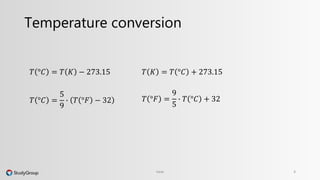
Temperature conversion 
푇 °퐶 = 푇 퐾 − 273.15 푇 퐾 = 푇 °퐶 + 273.15 
Heat 3 
푇 °퐶 = 
5 
9 
∙ 푇 °퐹 − 32 푇 °퐹 = 
9 
5 
∙ 푇 °퐶 + 32
Temperature conversion 
푇 °퐶 = 푇 퐾 − 273.15 푇 퐾 = 푇 °퐶 + 273.15 
Heat 4 
푇 °퐶 = 
5 
9 
∙ 푇 °퐹 − 32 푇 °퐹 = 
9 
5 
∙ 푇 °퐶 + 32
Cold vs. Hot: Random motion 
LOW  Kinetic energy  HIGH 
SOLID 
COLD HOT 
LIQUID 
Heat 5 
GAS
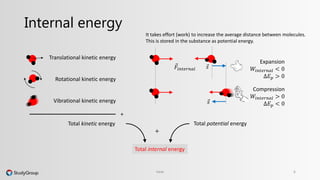
Internal energy 
It takes effort (work) to increase the average distance between molecules. 
This is stored in the substance as potential energy. 
Heat 6 
Translational kinetic energy 
Rotational kinetic energy 
Vibrational kinetic energy 
+ 
Total kinetic energy 
퐹 푖푛푡푒푟푛푎푙 푠 
Expansion 
푊푖푛푡푒푟푛푎푙 < 0 
Δ퐸푝 > 0 
푠 
Compression 
푊푖푛푡푒푟푛푎푙 > 0 
Δ퐸푝 < 0 
Total potential energy 
+ 
Total internal energy
Macroscopic vs. microscopic 
푣 2 푣 7 
푁 molecules 
푣 10 
푣 6 
푣 9 
푣 8 
푣 3 
푣 4 
푣 1 
푣 5 
푣 11 
Heat 7 
푖 
푣 푖 = 0 
푖 
푣 푖 
2 = 푁 ∙ 푣푎푣푔 
2 > 0 
NO macroscopic motion 
푁 ∙ 1 
2 
2 = 퐸푘푖푛 = measure for temperature 
푚푣푎푣푔 
Temperature is a macroscopic quantity 
Temperature is a result of statistical mechanics
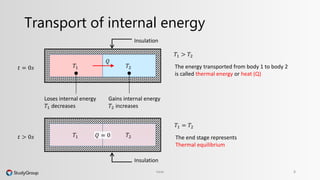
Transport of internal energy 
Insulation 
Heat 8 
푄 
푡 = 0푠 푇1 푇2 
Loses internal energy 
푇1 decreases 
Gains internal energy 
푇2 increases 
푡 > 0푠 푇1 푄 = 0 푇2 
푇1 > 푇2 
The energy transported from body 1 to body 2 
is called thermal energy or heat (Q) 
푇1 = 푇2 
The end stage represents 
Thermal equilibrium 
Insulation
Heat & Work - I 
Explanation: Gravitational potential energy 
is converted into internal energy 
Heat 9 
James Prescott Joule, 1847 
Action: Release the crank 
Reaction: The water temperature increases
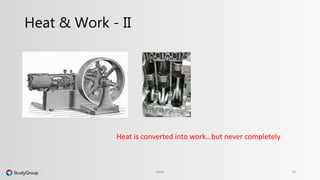
Heat & Work - II 
Heat is converted into work…but never completely 
Heat 10
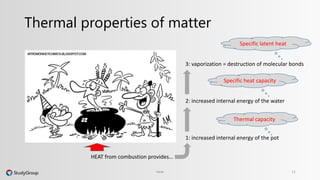
Thermal properties of matter 
HEAT from combustion provides… 
Specific latent heat 
3: vaporization = destruction of molecular bonds 
Specific heat capacity 
2: increased internal energy of the water 
Thermal capacity 
1: increased internal energy of the pot 
Heat 11
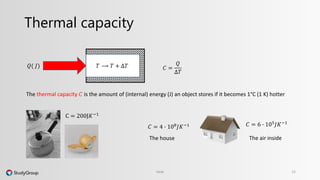
Thermal capacity 
퐶 = 
푄 
Δ푇 
Heat 12 
푄( 퐽) 푇 ⟶푇 + Δ푇 
The thermal capacity 퐶 is the amount of (internal) energy (J) an object stores if it becomes 1°C (1 K) hotter 
C = 200J퐾−1 
퐶 = 4 ∙ 108퐽퐾−1 퐶 = 6 ∙ 105퐽퐾−1 
The house The air inside
Specific heat capacity 
Heat 13 
푄( 퐽) 푇 ⟶푇 + Δ푇 
The specific heat capacity 푐 is the amount of (internal) energy (J) an material per kg stores if it becomes 1°C (1 K) hotter 
퐶 = 푐 ∙ 푚 = 
푄 
Δ푇 
⇒ 푐 = 
푄 
푚 ∙ Δ푇 
If the body consists of one single substance/material: 
퐶 ∝ 푚 or 퐶 = 푐 ∙ 푚 
The constant 푐 is specific for this material and can be 
found in data tables 
푊푎푡푒푟 푐 = 4.18 ∙ 103퐽퐾−1푘푔−1 
푉표푙푢푚푒 푉 = 휋푟2ℎ = 휋 ∙ 1푚 2 ∙ 0,6푚 = 1.9푚3 
푀푎푠푠 푚 = 휌 ∙ 푉 = 998푘푔푚−3 ∙ 1.9푚3 = 1.9 ∙ 103푘푔 
푇ℎ푒푟푚푎푙 푐푎푝푎푐푖푡푦 푝표표푙 퐶 = 푐 ∙ 푚 = 4.18 ∙ 103퐽퐾−1푘푔−1 ∙ 1.9 ∙ 103푘푔 = 8 ∙ 106퐽퐾−1
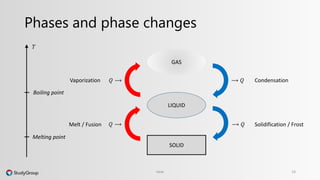
Phases and phase changes 
GAS 
Vaporization Condensation 
LIQUID 
SOLID 
Heat 14 
푄 ⟶ 
푄 ⟶ 
⟶ 푄 
Melt / Fusion ⟶푄 Solidification / Frost 
푇 
Boiling point 
Melting point
Specific latent heat 
Heat required to melt/fuse 1 kg = ‘Latent heat of fusion’ 퐿푓 , 
which is needed to weaken the intermolecular bonds and increase potential energy 
Heat required to vaporize 1 kg = ‘Latent heat of vaporization’ 퐿푣 , 
which is needed to break the already weakend bonds and set the molecules free 
Material 푇푚푒푙푡(퐾) L푓 푘퐽푘푔−1 푇푏표푖푙 (퐾) L푣 푘퐽푘푔−1 
Water 273.15 334 373.15 2260 
Sulphur 386 39 718 1510 
Nitrogen 63 26 77 199 
Heat 15
Example 
33.4 ∙ 106퐽 
Heat 16 
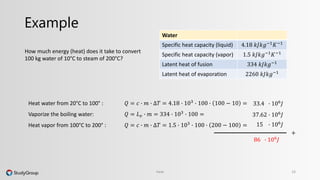
How much energy (heat) does it take to convert 
100 kg water of 10°C to steam of 200°C? 
Water 
Specific heat capacity (liquid) 4.18 푘퐽푘푔−1퐾−1 
Specific heat capacity (vapor) 1.5 푘퐽푘푔−1퐾−1 
Latent heat of fusion 334 푘퐽푘푔−1 
Latent heat of evaporation 2260 푘퐽푘푔−1 
Heat water from 20°C to 100° : 푄 = 푐 ∙ 푚 ∙ Δ푇 = 4.18 ∙ 103 ∙ 100 ∙ 100 − 10 = 
Vaporize the boiling water: 푄 = 퐿푣 ∙ 푚 = 334 ∙ 103 ∙ 100 = 
Heat vapor from 100°C to 200° : 푄 = 푐 ∙ 푚 ∙ Δ푇 = 1.5 ∙ 103 ∙ 100 ∙ 200 − 100 = 
37.62 ∙ 106퐽 
15 ∙ 106퐽 
+ 
86 ∙ 106퐽
Example 
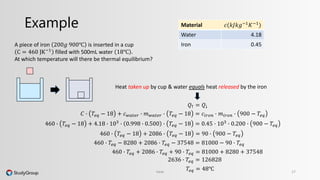
Heat taken up by cup & water equals heat released by the iron 
Heat 17 
A piece of iron 200푔 900℃ is inserted in a cup 
C = 460 JK−1 filled with 500mL water 18℃ . 
At which temperature will there be thermal equilibrium? 
Material 푐(푘퐽푘푔−1퐾−1) 
Water 4.18 
Iron 0.45 
푄↑ = 푄↓ 
퐶 ∙ 푇푒푞 − 18 + 푐푤푎푡푒푟 ∙ 푚푤푎푡푒푟 ∙ 푇푒푞 − 18 = 푐푖푟표푛 ∙ 푚푖푟표푛 ∙ 900 − 푇푒푞 
460 ∙ 푇푒푞 − 18 + 4.18 ∙ 103 ∙ 0.998 ∙ 0.500 ∙ 푇푒푞 − 18 = 0.45 ∙ 103 ∙ 0.200 ∙ 900 − 푇푒푞 
460 ∙ 푇푒푞 − 18 + 2086 ∙ 푇푒푞 − 18 = 90 ∙ 900 − 푇푒푞 
460 ∙ 푇푒푞 − 8280 + 2086 ∙ 푇푒푞 − 37548 = 81000 − 90 ∙ 푇푒푞 
460 ∙ 푇푒푞 + 2086 ∙ 푇푒푞 + 90 ∙ 푇푒푞 = 81000 + 8280 + 37548 
2636 ∙ 푇푒푞 = 126828 
푇푒푞 = 48℃
END 
Disclaimer 
This document is meant to be apprehended through professional teacher mediation (‘live in class’) 
together with a physics text book, preferably on IB level. 
Heat 18

Heat

  • 1.
  • 2.
    Temperature scales degreeFahrenheit °F 1724 degree Celcius °C 1742 Kelvin K 1848 212 100 37.8 0 -17.78 32 Heat 2 -459.67 -273.15 0 100 373.15 310.93 255.37 0 273.15 푁푎퐶푙 ∙ 2퐻2푂 Absolute zero
  • 3.
    Temperature conversion 푇°퐶 = 푇 퐾 − 273.15 푇 퐾 = 푇 °퐶 + 273.15 Heat 3 푇 °퐶 = 5 9 ∙ 푇 °퐹 − 32 푇 °퐹 = 9 5 ∙ 푇 °퐶 + 32
  • 4.
    Temperature conversion 푇°퐶 = 푇 퐾 − 273.15 푇 퐾 = 푇 °퐶 + 273.15 Heat 4 푇 °퐶 = 5 9 ∙ 푇 °퐹 − 32 푇 °퐹 = 9 5 ∙ 푇 °퐶 + 32
  • 5.
    Cold vs. Hot:Random motion LOW  Kinetic energy  HIGH SOLID COLD HOT LIQUID Heat 5 GAS
  • 6.
    Internal energy Ittakes effort (work) to increase the average distance between molecules. This is stored in the substance as potential energy. Heat 6 Translational kinetic energy Rotational kinetic energy Vibrational kinetic energy + Total kinetic energy 퐹 푖푛푡푒푟푛푎푙 푠 Expansion 푊푖푛푡푒푟푛푎푙 < 0 Δ퐸푝 > 0 푠 Compression 푊푖푛푡푒푟푛푎푙 > 0 Δ퐸푝 < 0 Total potential energy + Total internal energy
  • 7.
    Macroscopic vs. microscopic 푣 2 푣 7 푁 molecules 푣 10 푣 6 푣 9 푣 8 푣 3 푣 4 푣 1 푣 5 푣 11 Heat 7 푖 푣 푖 = 0 푖 푣 푖 2 = 푁 ∙ 푣푎푣푔 2 > 0 NO macroscopic motion 푁 ∙ 1 2 2 = 퐸푘푖푛 = measure for temperature 푚푣푎푣푔 Temperature is a macroscopic quantity Temperature is a result of statistical mechanics
  • 8.
    Transport of internalenergy Insulation Heat 8 푄 푡 = 0푠 푇1 푇2 Loses internal energy 푇1 decreases Gains internal energy 푇2 increases 푡 > 0푠 푇1 푄 = 0 푇2 푇1 > 푇2 The energy transported from body 1 to body 2 is called thermal energy or heat (Q) 푇1 = 푇2 The end stage represents Thermal equilibrium Insulation
  • 9.
    Heat & Work- I Explanation: Gravitational potential energy is converted into internal energy Heat 9 James Prescott Joule, 1847 Action: Release the crank Reaction: The water temperature increases
  • 10.
    Heat & Work- II Heat is converted into work…but never completely Heat 10
  • 11.
    Thermal properties ofmatter HEAT from combustion provides… Specific latent heat 3: vaporization = destruction of molecular bonds Specific heat capacity 2: increased internal energy of the water Thermal capacity 1: increased internal energy of the pot Heat 11
  • 12.
    Thermal capacity 퐶= 푄 Δ푇 Heat 12 푄( 퐽) 푇 ⟶푇 + Δ푇 The thermal capacity 퐶 is the amount of (internal) energy (J) an object stores if it becomes 1°C (1 K) hotter C = 200J퐾−1 퐶 = 4 ∙ 108퐽퐾−1 퐶 = 6 ∙ 105퐽퐾−1 The house The air inside
  • 13.
    Specific heat capacity Heat 13 푄( 퐽) 푇 ⟶푇 + Δ푇 The specific heat capacity 푐 is the amount of (internal) energy (J) an material per kg stores if it becomes 1°C (1 K) hotter 퐶 = 푐 ∙ 푚 = 푄 Δ푇 ⇒ 푐 = 푄 푚 ∙ Δ푇 If the body consists of one single substance/material: 퐶 ∝ 푚 or 퐶 = 푐 ∙ 푚 The constant 푐 is specific for this material and can be found in data tables 푊푎푡푒푟 푐 = 4.18 ∙ 103퐽퐾−1푘푔−1 푉표푙푢푚푒 푉 = 휋푟2ℎ = 휋 ∙ 1푚 2 ∙ 0,6푚 = 1.9푚3 푀푎푠푠 푚 = 휌 ∙ 푉 = 998푘푔푚−3 ∙ 1.9푚3 = 1.9 ∙ 103푘푔 푇ℎ푒푟푚푎푙 푐푎푝푎푐푖푡푦 푝표표푙 퐶 = 푐 ∙ 푚 = 4.18 ∙ 103퐽퐾−1푘푔−1 ∙ 1.9 ∙ 103푘푔 = 8 ∙ 106퐽퐾−1
  • 14.
    Phases and phasechanges GAS Vaporization Condensation LIQUID SOLID Heat 14 푄 ⟶ 푄 ⟶ ⟶ 푄 Melt / Fusion ⟶푄 Solidification / Frost 푇 Boiling point Melting point
  • 15.
    Specific latent heat Heat required to melt/fuse 1 kg = ‘Latent heat of fusion’ 퐿푓 , which is needed to weaken the intermolecular bonds and increase potential energy Heat required to vaporize 1 kg = ‘Latent heat of vaporization’ 퐿푣 , which is needed to break the already weakend bonds and set the molecules free Material 푇푚푒푙푡(퐾) L푓 푘퐽푘푔−1 푇푏표푖푙 (퐾) L푣 푘퐽푘푔−1 Water 273.15 334 373.15 2260 Sulphur 386 39 718 1510 Nitrogen 63 26 77 199 Heat 15
  • 16.
    Example 33.4 ∙106퐽 Heat 16 How much energy (heat) does it take to convert 100 kg water of 10°C to steam of 200°C? Water Specific heat capacity (liquid) 4.18 푘퐽푘푔−1퐾−1 Specific heat capacity (vapor) 1.5 푘퐽푘푔−1퐾−1 Latent heat of fusion 334 푘퐽푘푔−1 Latent heat of evaporation 2260 푘퐽푘푔−1 Heat water from 20°C to 100° : 푄 = 푐 ∙ 푚 ∙ Δ푇 = 4.18 ∙ 103 ∙ 100 ∙ 100 − 10 = Vaporize the boiling water: 푄 = 퐿푣 ∙ 푚 = 334 ∙ 103 ∙ 100 = Heat vapor from 100°C to 200° : 푄 = 푐 ∙ 푚 ∙ Δ푇 = 1.5 ∙ 103 ∙ 100 ∙ 200 − 100 = 37.62 ∙ 106퐽 15 ∙ 106퐽 + 86 ∙ 106퐽
  • 17.
    Example Heat takenup by cup & water equals heat released by the iron Heat 17 A piece of iron 200푔 900℃ is inserted in a cup C = 460 JK−1 filled with 500mL water 18℃ . At which temperature will there be thermal equilibrium? Material 푐(푘퐽푘푔−1퐾−1) Water 4.18 Iron 0.45 푄↑ = 푄↓ 퐶 ∙ 푇푒푞 − 18 + 푐푤푎푡푒푟 ∙ 푚푤푎푡푒푟 ∙ 푇푒푞 − 18 = 푐푖푟표푛 ∙ 푚푖푟표푛 ∙ 900 − 푇푒푞 460 ∙ 푇푒푞 − 18 + 4.18 ∙ 103 ∙ 0.998 ∙ 0.500 ∙ 푇푒푞 − 18 = 0.45 ∙ 103 ∙ 0.200 ∙ 900 − 푇푒푞 460 ∙ 푇푒푞 − 18 + 2086 ∙ 푇푒푞 − 18 = 90 ∙ 900 − 푇푒푞 460 ∙ 푇푒푞 − 8280 + 2086 ∙ 푇푒푞 − 37548 = 81000 − 90 ∙ 푇푒푞 460 ∙ 푇푒푞 + 2086 ∙ 푇푒푞 + 90 ∙ 푇푒푞 = 81000 + 8280 + 37548 2636 ∙ 푇푒푞 = 126828 푇푒푞 = 48℃
  • 18.
    END Disclaimer Thisdocument is meant to be apprehended through professional teacher mediation (‘live in class’) together with a physics text book, preferably on IB level. Heat 18