Introduction to 
complex numbers 
wikimedia
Complex numbers 
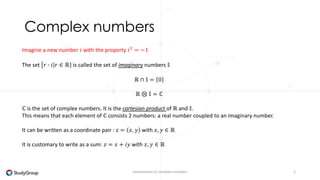
Imagine a new number 푖 with the property 푖2 = −1 
The set 푟 ∙ 푖 푟 ∈ ℝ is called the set of imaginary numbers 핀 
ℝ ∩ 핀 = 0 
ℝ ⊗ 핀 = ℂ 
ℂ is the set of complex numbers. It is the cartesian product of ℝ and 핀. 
This means that each element of ℂ consists 2 numbers: a real number coupled to an imaginary number. 
It can be written as a coordinate pair : z = 푥, 푦 with 푥, 푦 ∈ ℝ 
It is customary to write as a sum: 푧 = 푥 + 푖푦 with 푥, 푦 ∈ ℝ 
Introduction to complex numbers 2
Real & Imaginary part 
Introduction to complex numbers 3 
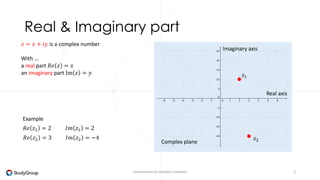
푧 = 푥 + 푖푦 is a complex number 
With … 
a real part 푅푒 푧 = 푥 
an imaginary part Im 푧 = 푦 푧1 
푧2 
Example 
Real axis 
Imaginary axis 
Complex plane 
푅푒 푧1 = 2 퐼푚 푧1 = 2 
푅푒 푧2 = 3 퐼푚 푧2 = −4
Multiplication with a real number 
푧 = 푥 + 푖푦 ∈ ℂ 
푟 ∈ ℝ 
푟 ∙ 푧 = 푟 ∙ 푥 + 푖푦 = 푟푥 + 푖푟푦 3푧 
푧 
Introduction to complex numbers 4
Norm 
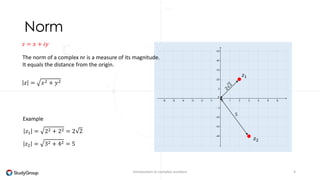
The norm of a complex nr is a measure of its magnitude. 
It equals the distance from the origin. 
Introduction to complex numbers 5 
푧 = 푥 + 푖푦 
푧1 
푧2 
푧 = 푥2 + 푦2 
Example 
푧1 = 22 + 22 = 2 2 
푧2 = 32 + 42 = 5 
5
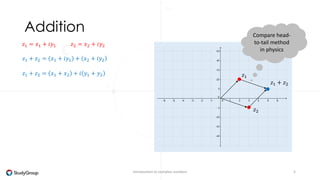
Addition 
Compare head-to- 
tail method 
in physics 
Introduction to complex numbers 6 
푧1 = 푥1 + 푖푦1 푧2 = 푥2 + 푖푦2 
푧1 + 푧2 = 푥1 + 푖푦1 + 푥2 + 푖푦2 
푧1 + 푧2 = 푥1 + 푥2 + 푖 푦1 + 푦2 푧1 
푧2 
푧1 + 푧2
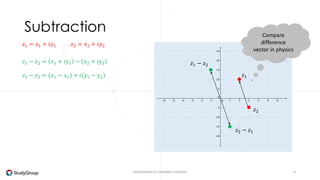
Subtraction 
푧1 − 푧2 = 푥1 + 푖푦1 − 푥2 + 푖푦2 푧1 − 푧2 
Introduction to complex numbers 7 
푧1 = 푥1 + 푖푦1 푧2 = 푥2 + 푖푦2 
푧1 
푧2 
푧1 − 푧2 = 푥1 − 푥2 + 푖 푦1 − 푦2 
푧2 − 푧1 
Compare 
difference 
vector in physics
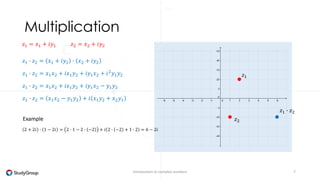
Multiplication 
Introduction to complex numbers 8 
푧1 = 푥1 + 푖푦1 푧2 = 푥2 + 푖푦2 
푧1 ∙ 푧2 = 푥1 + 푖푦1 ∙ 푥2 + 푖푦2 
푧1 ∙ 푧2 = 푥1푥2 + 푖푥1푦2 + 푖푦1푥2 + 푖2푦1푦2 푧1 
푧2 
푧1 ∙ 푧2 
푧1 ∙ 푧2 = 푥1푥2 + 푖푥1푦2 + 푖푦1푥2 − 푦1푦2 
푧1 ∙ 푧2 = 푥1푥2 − 푦1푦2 + 푖 푥1푦2 + 푥2푦1 
Example 
2 + 2푖 ∙ 1 − 2푖 = 2 ∙ 1 − 2 ∙ −2 + 푖 2 ∙ −2 + 1 ∙ 2 = 6 − 2푖
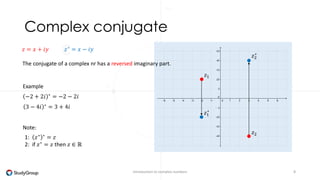
Complex conjugate 
∗ 
The conjugate of a complex nr has a reversed imaginary part. 
∗ 
Introduction to complex numbers 9 
푧 = 푥 + 푖푦 
푧1 
푧2 
Example 
푧∗ = 푥 − 푖푦 
푧1 
푧2 
−2 + 2푖 ∗ = −2 − 2푖 
3 − 4푖 ∗ = 3 + 4푖 
Note: 
1: 푧∗ ∗ = 푧 
2: if 푧∗ = 푧 then 푧 ∈ ℝ
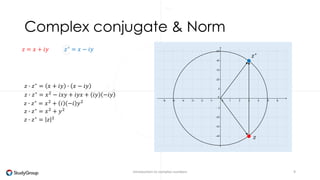
Complex conjugate & Norm 
Introduction to complex numbers 10 
푧 = 푥 + 푖푦 
푧∗ 
푧∗ = 푥 − 푖푦 
푧 
푧 ∙ 푧∗ = 푥 + 푖푦 ∙ 푥 − 푖푦 
푧 ∙ 푧∗ = 푥2 − 푖푥푦 + 푖푦푥 + 푖푦 −푖푦 
푧 ∙ 푧∗ = 푥2 + 푖 −푖 푦2 
푧 ∙ 푧∗ = 푥2 + 푦2 
푧 ∙ 푧∗ = 푧 2
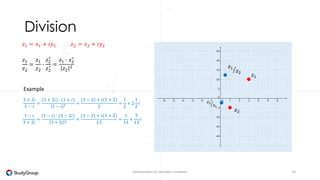
Division 
푧1 푧2 
Introduction to complex numbers 11 
푧1 = 푥1 + 푖푦1 푧2 = 푥2 + 푖푦2 
푧1 
푧2 
푧1 
푧2 
= 
푧1 
푧2 
∙ 
푧∗ 
2 
푧2 
∗ = 
∗ 
푧1 ∙ 푧2 
푧2 
2 
Example 
3 + 2푖 
1 − 푖 
= 
3 + 2푖 ∙ 1 + 푖 
1 − 푖 2 = 
3 − 2 + 푖 3 + 2 
2 
= 
1 
2 
+ 2 
1 
2 
푖 
1 − 푖 
3 + 2푖 
= 
1 − 푖 ∙ 3 − 2푖 
3 + 2푖 2 = 
3 − 2 + 푖 3 + 2 
13 
= 
1 
13 
+ 
5 
13 
푖 
푧2 푧1
END 
Disclaimer 
This document is meant to be apprehended through professional teacher mediation (‘live in class’) 
together with a mathematics text book, preferably on IB level. 
Introduction to complex numbers 12

Complex numbers

  • 1.
    Introduction to complexnumbers wikimedia
  • 2.
    Complex numbers Imaginea new number 푖 with the property 푖2 = −1 The set 푟 ∙ 푖 푟 ∈ ℝ is called the set of imaginary numbers 핀 ℝ ∩ 핀 = 0 ℝ ⊗ 핀 = ℂ ℂ is the set of complex numbers. It is the cartesian product of ℝ and 핀. This means that each element of ℂ consists 2 numbers: a real number coupled to an imaginary number. It can be written as a coordinate pair : z = 푥, 푦 with 푥, 푦 ∈ ℝ It is customary to write as a sum: 푧 = 푥 + 푖푦 with 푥, 푦 ∈ ℝ Introduction to complex numbers 2
  • 3.
    Real & Imaginarypart Introduction to complex numbers 3 푧 = 푥 + 푖푦 is a complex number With … a real part 푅푒 푧 = 푥 an imaginary part Im 푧 = 푦 푧1 푧2 Example Real axis Imaginary axis Complex plane 푅푒 푧1 = 2 퐼푚 푧1 = 2 푅푒 푧2 = 3 퐼푚 푧2 = −4
  • 4.
    Multiplication with areal number 푧 = 푥 + 푖푦 ∈ ℂ 푟 ∈ ℝ 푟 ∙ 푧 = 푟 ∙ 푥 + 푖푦 = 푟푥 + 푖푟푦 3푧 푧 Introduction to complex numbers 4
  • 5.
    Norm The normof a complex nr is a measure of its magnitude. It equals the distance from the origin. Introduction to complex numbers 5 푧 = 푥 + 푖푦 푧1 푧2 푧 = 푥2 + 푦2 Example 푧1 = 22 + 22 = 2 2 푧2 = 32 + 42 = 5 5
  • 6.
    Addition Compare head-to- tail method in physics Introduction to complex numbers 6 푧1 = 푥1 + 푖푦1 푧2 = 푥2 + 푖푦2 푧1 + 푧2 = 푥1 + 푖푦1 + 푥2 + 푖푦2 푧1 + 푧2 = 푥1 + 푥2 + 푖 푦1 + 푦2 푧1 푧2 푧1 + 푧2
  • 7.
    Subtraction 푧1 −푧2 = 푥1 + 푖푦1 − 푥2 + 푖푦2 푧1 − 푧2 Introduction to complex numbers 7 푧1 = 푥1 + 푖푦1 푧2 = 푥2 + 푖푦2 푧1 푧2 푧1 − 푧2 = 푥1 − 푥2 + 푖 푦1 − 푦2 푧2 − 푧1 Compare difference vector in physics
  • 8.
    Multiplication Introduction tocomplex numbers 8 푧1 = 푥1 + 푖푦1 푧2 = 푥2 + 푖푦2 푧1 ∙ 푧2 = 푥1 + 푖푦1 ∙ 푥2 + 푖푦2 푧1 ∙ 푧2 = 푥1푥2 + 푖푥1푦2 + 푖푦1푥2 + 푖2푦1푦2 푧1 푧2 푧1 ∙ 푧2 푧1 ∙ 푧2 = 푥1푥2 + 푖푥1푦2 + 푖푦1푥2 − 푦1푦2 푧1 ∙ 푧2 = 푥1푥2 − 푦1푦2 + 푖 푥1푦2 + 푥2푦1 Example 2 + 2푖 ∙ 1 − 2푖 = 2 ∙ 1 − 2 ∙ −2 + 푖 2 ∙ −2 + 1 ∙ 2 = 6 − 2푖
  • 9.
    Complex conjugate ∗ The conjugate of a complex nr has a reversed imaginary part. ∗ Introduction to complex numbers 9 푧 = 푥 + 푖푦 푧1 푧2 Example 푧∗ = 푥 − 푖푦 푧1 푧2 −2 + 2푖 ∗ = −2 − 2푖 3 − 4푖 ∗ = 3 + 4푖 Note: 1: 푧∗ ∗ = 푧 2: if 푧∗ = 푧 then 푧 ∈ ℝ
  • 10.
    Complex conjugate &Norm Introduction to complex numbers 10 푧 = 푥 + 푖푦 푧∗ 푧∗ = 푥 − 푖푦 푧 푧 ∙ 푧∗ = 푥 + 푖푦 ∙ 푥 − 푖푦 푧 ∙ 푧∗ = 푥2 − 푖푥푦 + 푖푦푥 + 푖푦 −푖푦 푧 ∙ 푧∗ = 푥2 + 푖 −푖 푦2 푧 ∙ 푧∗ = 푥2 + 푦2 푧 ∙ 푧∗ = 푧 2
  • 11.
    Division 푧1 푧2 Introduction to complex numbers 11 푧1 = 푥1 + 푖푦1 푧2 = 푥2 + 푖푦2 푧1 푧2 푧1 푧2 = 푧1 푧2 ∙ 푧∗ 2 푧2 ∗ = ∗ 푧1 ∙ 푧2 푧2 2 Example 3 + 2푖 1 − 푖 = 3 + 2푖 ∙ 1 + 푖 1 − 푖 2 = 3 − 2 + 푖 3 + 2 2 = 1 2 + 2 1 2 푖 1 − 푖 3 + 2푖 = 1 − 푖 ∙ 3 − 2푖 3 + 2푖 2 = 3 − 2 + 푖 3 + 2 13 = 1 13 + 5 13 푖 푧2 푧1
  • 12.
    END Disclaimer Thisdocument is meant to be apprehended through professional teacher mediation (‘live in class’) together with a mathematics text book, preferably on IB level. Introduction to complex numbers 12