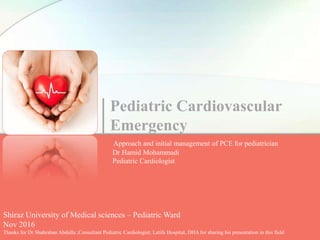
Pediatric Cardiovascular
Emergency
Approach and initial management of PCE for pediatrician
Dr Hamid Mohammadi
Pediatric Cardiologist
Shiraz University of Medical sciences – Pediatric Ward
Nov 2016
Thanks for Dr Shahraban Abdulla ;Consultant Pediatric Cardiologist; Latifa Hospital, DHA for sharing his presentation in this field
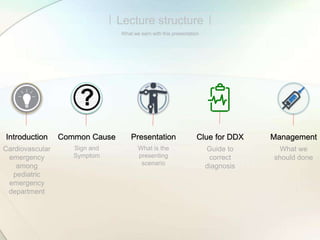
What we earn with this presentation
Lecture structure
Cardiovascular
emergency
among
pediatric
emergency
department
Introduction
What we
should done
Management
Guide to
correct
diagnosis
Clue for DDX
Sign and
Symptom
Common Cause
What is the
presenting
scenario
Presentation
Introduction
• Cardiac emergencies are among the most
stressful ED presentations.
• Cardiac Problem in infancy & childhood are
not rare, often are complex.
• Cardiac disease in infancy & childhood can be
congenital or acquired.
• 2nd or 3rd cause of emergency mortality
department
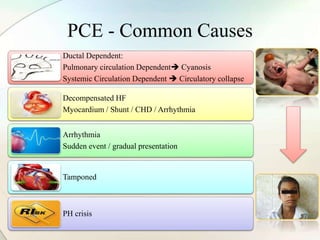
PCE - Common Causes
Ductal Dependent:
Pulmonary circulation Dependent Cyanosis
Systemic Circulation Dependent  Circulatory collapse
Decompensated HF
Myocardium / Shunt / CHD / Arrhythmia
Arrhythmia
Sudden event / gradual presentation
Tamponed
PH crisis
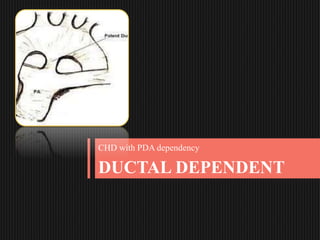
DUCTAL DEPENDENT
CHD with PDA dependency
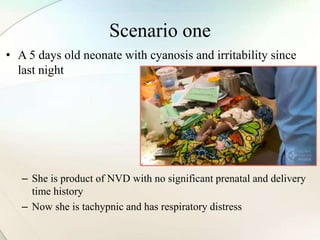
Scenario one
• A 5 days old neonate with cyanosis and irritability since
last night
– She is product of NVD with no significant prenatal and delivery
time history
– Now she is tachypnic and has respiratory distress
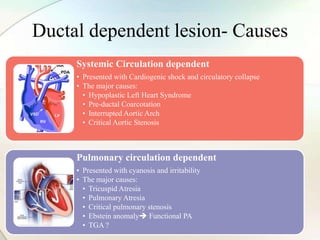
Ductal dependent lesion- Causes
Systemic Circulation dependent
• Presented with Cardiogenic shock and circulatory collapse
• The major causes:
• Hypoplastic Left Heart Syndrome
• Pre-ductal Coarcotation
• Interrupted Aortic Arch
• Critical Aortic Stenosis
Pulmonary circulation dependent
• Presented with cyanosis and irritability
• The major causes:
• Tricuspid Atresia
• Pulmonary Atresia
• Critical pulmonary stenosis
• Ebstein anomaly Functional PA
• TGA ?
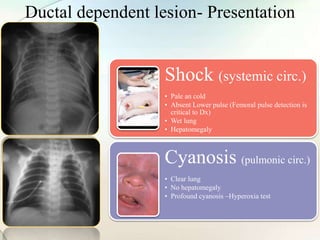
Ductal dependent lesion- Presentation
Shock (systemic circ.)
• Pale an cold
• Absent Lower pulse (Femoral pulse detection is
critical to Dx)
• Wet lung
• Hepatomegaly
Cyanosis (pulmonic circ.)
• Clear lung
• No hepatomegaly
• Profound cyanosis –Hyperoxia test
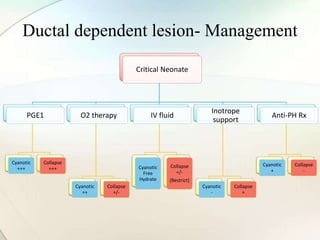
Ductal dependent lesion- Management
Critical Neonate
PGE1
Cyanotic
+++
Collapse
+++
O2 therapy
Cyanotic
++
Collapse
+/-
IV fluid
Cyanotic
Free
Hydrate
Collapse
+/-
(Restrict)
Inotrope
support
Cyanotic
-
Collapse
+
Anti-PH Rx
Cyanotic
+
Collapse
-
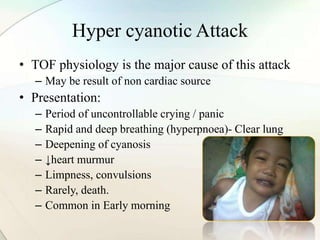
Hyper cyanotic Attack
• TOF physiology is the major cause of this attack
– May be result of non cardiac source
• Presentation:
– Period of uncontrollable crying / panic
– Rapid and deep breathing (hyperpnoea)- Clear lung
– Deepening of cyanosis
– ↓heart murmur
– Limpness, convulsions
– Rarely, death.
– Common in Early morning
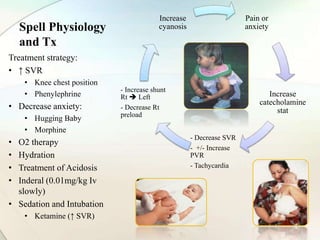
Spell Physiology
and Tx
Pain or
anxiety
Increase
catecholamine
stat
- Decrease SVR
- +/- Increase
PVR
- Tachycardia
- Increase shunt
Rt  Left
- Decrease Rt
preload
Increase
cyanosis
Treatment strategy:
• ↑ SVR
• Knee chest position
• Phenylephrine
• Decrease anxiety:
• Hugging Baby
• Morphine
• O2 therapy
• Hydration
• Treatment of Acidosis
• Inderal (0.01mg/kg Iv
slowly)
• Sedation and Intubation
• Ketamine (↑ SVR)
DECOMPENSATED HEART
The end stage of Cardiac disease
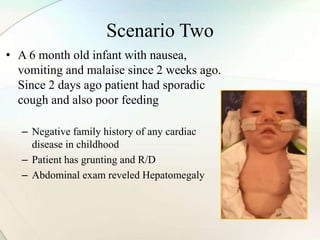
Scenario Two
• A 6 month old infant with nausea,
vomiting and malaise since 2 weeks ago.
Since 2 days ago patient had sporadic
cough and also poor feeding
– Negative family history of any cardiac
disease in childhood
– Patient has grunting and R/D
– Abdominal exam reveled Hepatomegaly
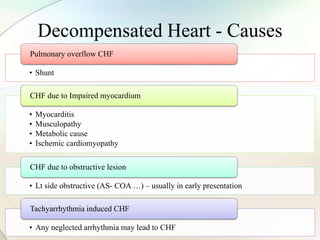
Decompensated Heart - Causes
• Shunt
Pulmonary overflow CHF
• Myocarditis
• Musculopathy
• Metabolic cause
• Ischemic cardiomyopathy
CHF due to Impaired myocardium
• Lt side obstructive (AS- COA …) – usually in early presentation
CHF due to obstructive lesion
• Any neglected arrhythmia may lead to CHF
Tachyarrhythmia induced CHF
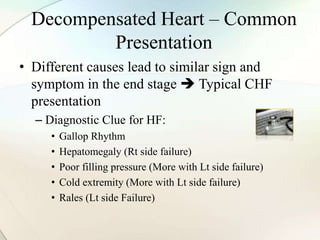
Decompensated Heart – Common
Presentation
• Different causes lead to similar sign and
symptom in the end stage  Typical CHF
presentation
– Diagnostic Clue for HF:
• Gallop Rhythm
• Hepatomegaly (Rt side failure)
• Poor filling pressure (More with Lt side failure)
• Cold extremity (More with Lt side failure)
• Rales (Lt side Failure)
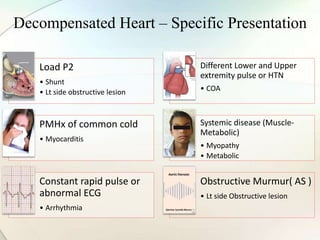
Decompensated Heart – Specific Presentation
Load P2
• Shunt
• Lt side obstructive lesion
Different Lower and Upper
extremity pulse or HTN
• COA
PMHx of common cold
• Myocarditis
Systemic disease (Muscle-
Metabolic)
• Myopathy
• Metabolic
Constant rapid pulse or
abnormal ECG
• Arrhythmia
Obstructive Murmur( AS )
• Lt side Obstructive lesion
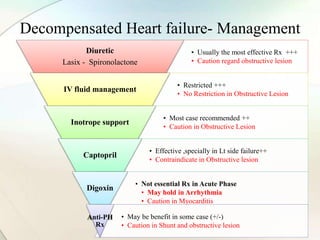
Decompensated Heart failure- Management
• Usually the most effective Rx +++
• Caution regard obstructive lesion
Diuretic
Lasix - Spironolactone
• Restricted +++
• No Restriction in Obstructive Lesion
IV fluid management
• Most case recommended ++
• Caution in Obstructive Lesion
Inotrope support
• Effective ,specially in Lt side failure++
• Contraindicate in Obstructive lesion
Captopril
• Not essential Rx in Acute Phase
• May hold in Arrhythmia
• Caution in Myocarditis
Digoxin
• May be benefit in some case (+/-)
• Caution in Shunt and obstructive lesion
Anti-PH
Rx
ARRYHTMIA
When your art and knowledge are everythings
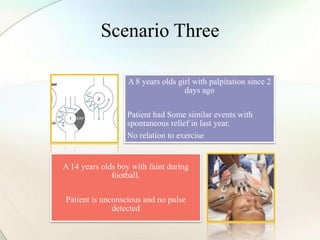
Scenario Three
A 8 years olds girl with palpitation since 2
days ago
Patient had Some similar events with
spontaneous relief in last year.
No relation to exercise
A 14 years olds boy with faint during
football.
Patient is unconscious and no pulse
detected
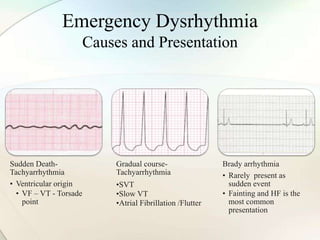
Emergency Dysrhythmia
Causes and Presentation
Sudden Death-
Tachyarrhythmia
• Ventricular origin
• VF – VT - Torsade
point
Gradual course-
Tachyarrhythmia
•SVT
•Slow VT
•Atrial Fibrillation /Flutter
Brady arrhythmia
• Rarely present as
sudden event
• Fainting and HF is the
most common
presentation
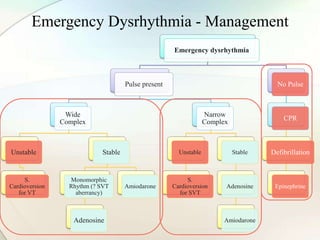
Emergency Dysrhythmia - Management
Emergency dysrhythmia
Pulse present
Wide
Complex
Unstable
S.
Cardioversion
for VT
Stable
Monomorphic
Rhythm (? SVT
aberrancy)
Adenosine
Amiodarone
Narrow
Complex
Unstable
S.
Cardioversion
for SVT
Stable
Adenosine
Amiodarone
No Pulse
CPR
Defibrillation
Epinephrine
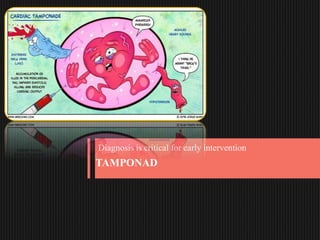
TAMPONAD
Diagnosis is critical for early intervention
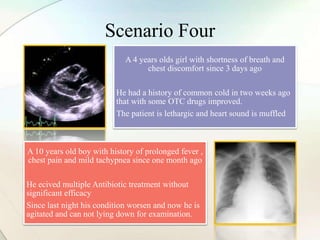
Scenario Four
A 4 years olds girl with shortness of breath and
chest discomfort since 3 days ago
He had a history of common cold in two weeks ago
that with some OTC drugs improved.
The patient is lethargic and heart sound is muffled
A 10 years old boy with history of prolonged fever ,
chest pain and mild tachypnea since one month ago
He ecived multiple Antibiotic treatment without
significant efficacy
Since last night his condition worsen and now he is
agitated and can not lying down for examination.
Tamponade- Causes
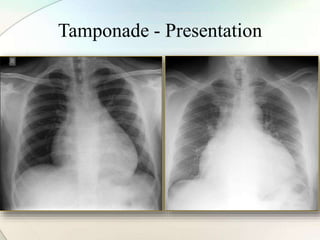
Viral Pericarditis The most common cause of Pericardial effusion
Heart failure
Nephrologic
cause
Renal Failure
Nephrotic Syndrome
Post cardiac
Surgery
Tuberculosis Rarely lead to tamponade
Malignancy
Hypothyroidism
Lupus
Trauma
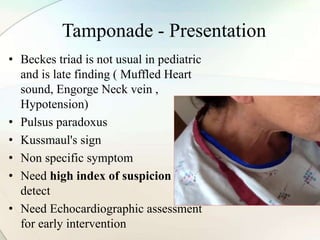
Tamponade - Presentation
• Beckes triad is not usual in pediatric
and is late finding ( Muffled Heart
sound, Engorge Neck vein ,
Hypotension)
• Pulsus paradoxus
• Kussmaul's sign
• Non specific symptom
• Need high index of suspicion to
detect
• Need Echocardiographic assessment
for early intervention
Tamponade - Presentation
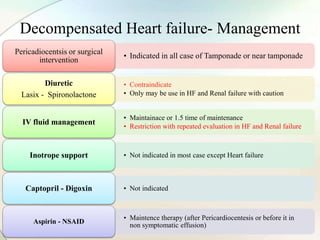
Decompensated Heart failure- Management
• Indicated in all case of Tamponade or near tamponade
Pericadiocentsis or surgical
intervention
• Contraindicate
• Only may be use in HF and Renal failure with caution
Diuretic
Lasix - Spironolactone
• Maintainace or 1.5 time of maintenance
• Restriction with repeated evaluation in HF and Renal failure
IV fluid management
• Not indicated in most case except Heart failureInotrope support
• Not indicatedCaptopril - Digoxin
• Maintence therapy (after Pericardiocentesis or before it in
non symptomatic effusion)
Aspirin - NSAID
Points
• History and Physical exam is the most
informative data to select the best management
in pediatric Cardiovascular emergency (PCE)
• Most of Cardiovascular emergency could be
managed without echocardiography in initial
visit
• Iv fluid handling, Diuretic and inotrope
support are the 3 basis of treatment in the PCE
Research proposal
What is the
position of
cardiovascula
r emergency
in our
Emergency
department
visits,
morbidity and
mortality.
What are the
most common
pitfall &
mismanagem
ent in
approach to
PCE in our
emergency
department
Role of
Simulation
based
education in
preparing
pediatrician
for PCE
Is it possible
to publish a
guideline for
some
common PCE
management
in our center
I’m working
on a PCE
case book and
any
cooperation
in this field is
welcome
Dr Hamid Mohammadi
Thank you

Pediatric Cardiovascular emergency

  • 1.
    Pediatric Cardiovascular Emergency Approach andinitial management of PCE for pediatrician Dr Hamid Mohammadi Pediatric Cardiologist Shiraz University of Medical sciences – Pediatric Ward Nov 2016 Thanks for Dr Shahraban Abdulla ;Consultant Pediatric Cardiologist; Latifa Hospital, DHA for sharing his presentation in this field
  • 2.
    What we earnwith this presentation Lecture structure Cardiovascular emergency among pediatric emergency department Introduction What we should done Management Guide to correct diagnosis Clue for DDX Sign and Symptom Common Cause What is the presenting scenario Presentation
  • 3.
    Introduction • Cardiac emergenciesare among the most stressful ED presentations. • Cardiac Problem in infancy & childhood are not rare, often are complex. • Cardiac disease in infancy & childhood can be congenital or acquired. • 2nd or 3rd cause of emergency mortality department
  • 4.
    PCE - CommonCauses Ductal Dependent: Pulmonary circulation Dependent Cyanosis Systemic Circulation Dependent  Circulatory collapse Decompensated HF Myocardium / Shunt / CHD / Arrhythmia Arrhythmia Sudden event / gradual presentation Tamponed PH crisis
  • 5.
  • 6.
    Scenario one • A5 days old neonate with cyanosis and irritability since last night – She is product of NVD with no significant prenatal and delivery time history – Now she is tachypnic and has respiratory distress
  • 7.
    Ductal dependent lesion-Causes Systemic Circulation dependent • Presented with Cardiogenic shock and circulatory collapse • The major causes: • Hypoplastic Left Heart Syndrome • Pre-ductal Coarcotation • Interrupted Aortic Arch • Critical Aortic Stenosis Pulmonary circulation dependent • Presented with cyanosis and irritability • The major causes: • Tricuspid Atresia • Pulmonary Atresia • Critical pulmonary stenosis • Ebstein anomaly Functional PA • TGA ?
  • 8.
    Ductal dependent lesion-Presentation Shock (systemic circ.) • Pale an cold • Absent Lower pulse (Femoral pulse detection is critical to Dx) • Wet lung • Hepatomegaly Cyanosis (pulmonic circ.) • Clear lung • No hepatomegaly • Profound cyanosis –Hyperoxia test
  • 9.
    Ductal dependent lesion-Management Critical Neonate PGE1 Cyanotic +++ Collapse +++ O2 therapy Cyanotic ++ Collapse +/- IV fluid Cyanotic Free Hydrate Collapse +/- (Restrict) Inotrope support Cyanotic - Collapse + Anti-PH Rx Cyanotic + Collapse -
  • 10.
    Hyper cyanotic Attack •TOF physiology is the major cause of this attack – May be result of non cardiac source • Presentation: – Period of uncontrollable crying / panic – Rapid and deep breathing (hyperpnoea)- Clear lung – Deepening of cyanosis – ↓heart murmur – Limpness, convulsions – Rarely, death. – Common in Early morning
  • 11.
    Spell Physiology and Tx Painor anxiety Increase catecholamine stat - Decrease SVR - +/- Increase PVR - Tachycardia - Increase shunt Rt  Left - Decrease Rt preload Increase cyanosis Treatment strategy: • ↑ SVR • Knee chest position • Phenylephrine • Decrease anxiety: • Hugging Baby • Morphine • O2 therapy • Hydration • Treatment of Acidosis • Inderal (0.01mg/kg Iv slowly) • Sedation and Intubation • Ketamine (↑ SVR)
  • 12.
    DECOMPENSATED HEART The endstage of Cardiac disease
  • 13.
    Scenario Two • A6 month old infant with nausea, vomiting and malaise since 2 weeks ago. Since 2 days ago patient had sporadic cough and also poor feeding – Negative family history of any cardiac disease in childhood – Patient has grunting and R/D – Abdominal exam reveled Hepatomegaly
  • 14.
    Decompensated Heart -Causes • Shunt Pulmonary overflow CHF • Myocarditis • Musculopathy • Metabolic cause • Ischemic cardiomyopathy CHF due to Impaired myocardium • Lt side obstructive (AS- COA …) – usually in early presentation CHF due to obstructive lesion • Any neglected arrhythmia may lead to CHF Tachyarrhythmia induced CHF
  • 15.
    Decompensated Heart –Common Presentation • Different causes lead to similar sign and symptom in the end stage  Typical CHF presentation – Diagnostic Clue for HF: • Gallop Rhythm • Hepatomegaly (Rt side failure) • Poor filling pressure (More with Lt side failure) • Cold extremity (More with Lt side failure) • Rales (Lt side Failure)
  • 16.
    Decompensated Heart –Specific Presentation Load P2 • Shunt • Lt side obstructive lesion Different Lower and Upper extremity pulse or HTN • COA PMHx of common cold • Myocarditis Systemic disease (Muscle- Metabolic) • Myopathy • Metabolic Constant rapid pulse or abnormal ECG • Arrhythmia Obstructive Murmur( AS ) • Lt side Obstructive lesion
  • 17.
    Decompensated Heart failure-Management • Usually the most effective Rx +++ • Caution regard obstructive lesion Diuretic Lasix - Spironolactone • Restricted +++ • No Restriction in Obstructive Lesion IV fluid management • Most case recommended ++ • Caution in Obstructive Lesion Inotrope support • Effective ,specially in Lt side failure++ • Contraindicate in Obstructive lesion Captopril • Not essential Rx in Acute Phase • May hold in Arrhythmia • Caution in Myocarditis Digoxin • May be benefit in some case (+/-) • Caution in Shunt and obstructive lesion Anti-PH Rx
  • 18.
    ARRYHTMIA When your artand knowledge are everythings
  • 19.
    Scenario Three A 8years olds girl with palpitation since 2 days ago Patient had Some similar events with spontaneous relief in last year. No relation to exercise A 14 years olds boy with faint during football. Patient is unconscious and no pulse detected
  • 20.
    Emergency Dysrhythmia Causes andPresentation Sudden Death- Tachyarrhythmia • Ventricular origin • VF – VT - Torsade point Gradual course- Tachyarrhythmia •SVT •Slow VT •Atrial Fibrillation /Flutter Brady arrhythmia • Rarely present as sudden event • Fainting and HF is the most common presentation
  • 21.
    Emergency Dysrhythmia -Management Emergency dysrhythmia Pulse present Wide Complex Unstable S. Cardioversion for VT Stable Monomorphic Rhythm (? SVT aberrancy) Adenosine Amiodarone Narrow Complex Unstable S. Cardioversion for SVT Stable Adenosine Amiodarone No Pulse CPR Defibrillation Epinephrine
  • 22.
    TAMPONAD Diagnosis is criticalfor early intervention
  • 23.
    Scenario Four A 4years olds girl with shortness of breath and chest discomfort since 3 days ago He had a history of common cold in two weeks ago that with some OTC drugs improved. The patient is lethargic and heart sound is muffled A 10 years old boy with history of prolonged fever , chest pain and mild tachypnea since one month ago He ecived multiple Antibiotic treatment without significant efficacy Since last night his condition worsen and now he is agitated and can not lying down for examination.
  • 24.
    Tamponade- Causes Viral PericarditisThe most common cause of Pericardial effusion Heart failure Nephrologic cause Renal Failure Nephrotic Syndrome Post cardiac Surgery Tuberculosis Rarely lead to tamponade Malignancy Hypothyroidism Lupus Trauma
  • 25.
    Tamponade - Presentation •Beckes triad is not usual in pediatric and is late finding ( Muffled Heart sound, Engorge Neck vein , Hypotension) • Pulsus paradoxus • Kussmaul's sign • Non specific symptom • Need high index of suspicion to detect • Need Echocardiographic assessment for early intervention
  • 26.
  • 27.
    Decompensated Heart failure-Management • Indicated in all case of Tamponade or near tamponade Pericadiocentsis or surgical intervention • Contraindicate • Only may be use in HF and Renal failure with caution Diuretic Lasix - Spironolactone • Maintainace or 1.5 time of maintenance • Restriction with repeated evaluation in HF and Renal failure IV fluid management • Not indicated in most case except Heart failureInotrope support • Not indicatedCaptopril - Digoxin • Maintence therapy (after Pericardiocentesis or before it in non symptomatic effusion) Aspirin - NSAID
  • 28.
    Points • History andPhysical exam is the most informative data to select the best management in pediatric Cardiovascular emergency (PCE) • Most of Cardiovascular emergency could be managed without echocardiography in initial visit • Iv fluid handling, Diuretic and inotrope support are the 3 basis of treatment in the PCE
  • 29.
    Research proposal What isthe position of cardiovascula r emergency in our Emergency department visits, morbidity and mortality. What are the most common pitfall & mismanagem ent in approach to PCE in our emergency department Role of Simulation based education in preparing pediatrician for PCE Is it possible to publish a guideline for some common PCE management in our center I’m working on a PCE case book and any cooperation in this field is welcome
  • 30.