Healthy Nutrition:
Study of breakfast and snacking
1st EPAL KALAMARIAS
12-16 February 2018
Health 2020: The European policy
for health and well-being
• Health 2020 is the new European health policy framework.
• According to the Health 2020 programme, the EU aims to
support the countries’ governments to improve the health
and well-being of its people by offering equal and high-
quality public health systems. This can be achieved by
improving the populations’ diet, offering affordable and
attractive healthy foods to all.
• http://www.euro.who.int/en/health-topics/health-policy/health-2020-the-european-
policy-for-health-and-well-being
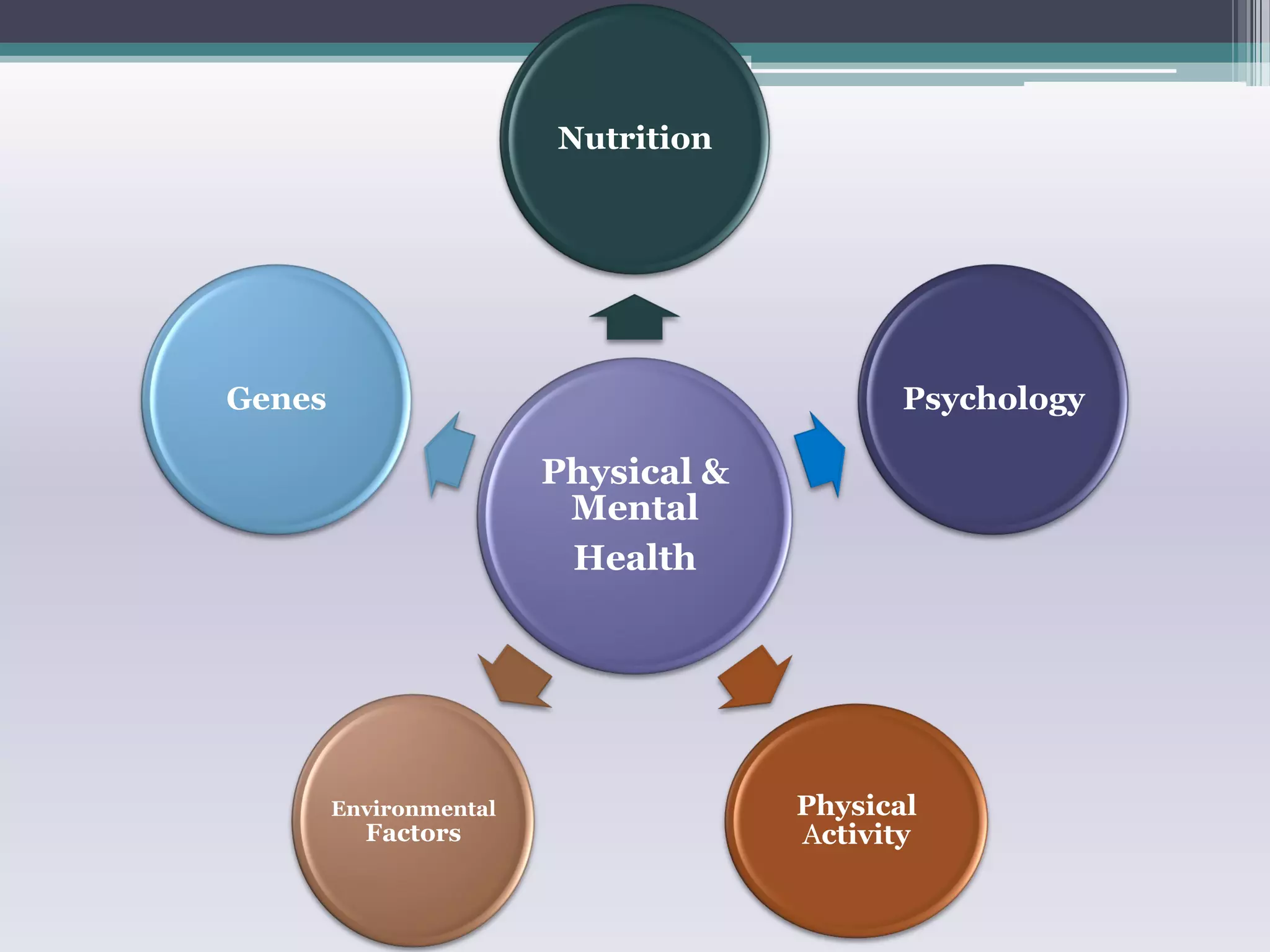
Physical &
Mental
Health
Nutrition
Psychology
Physical
Activity
Environmental
Factors
Genes
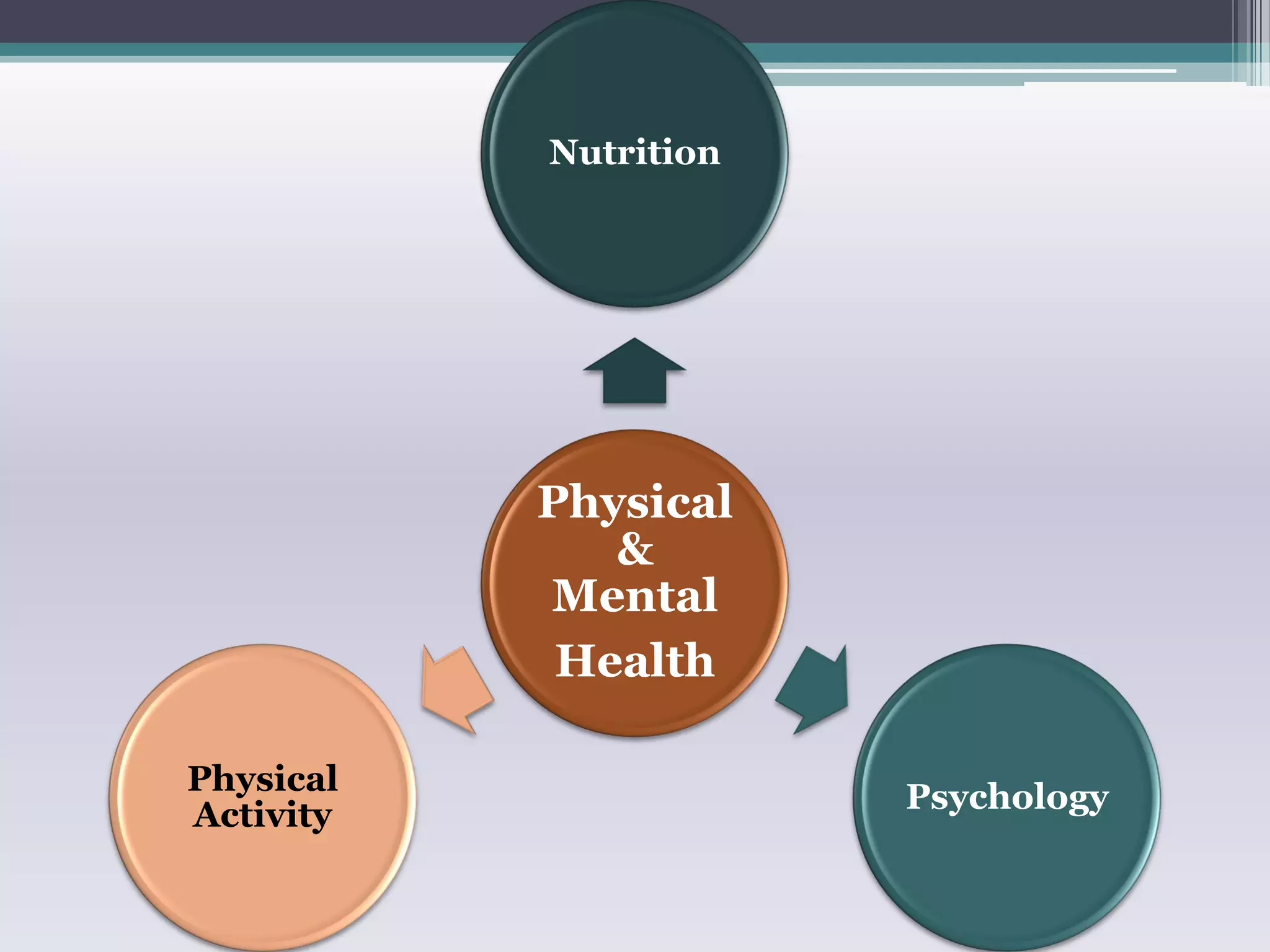
Physical
&
Mental
Health
Nutrition
Psychology
Physical
Activity
• Adolescence is a critical period of each person's life and it is
characterized of quick growth and maturation, as well as,
changes in physical, hormonal and mental condition.
• Adolescents have greater energy and nutrient needs than
adults in order to help their bodies to develop tissues, bones,
muscles, organs, etc.
Adolescence
Energy balance
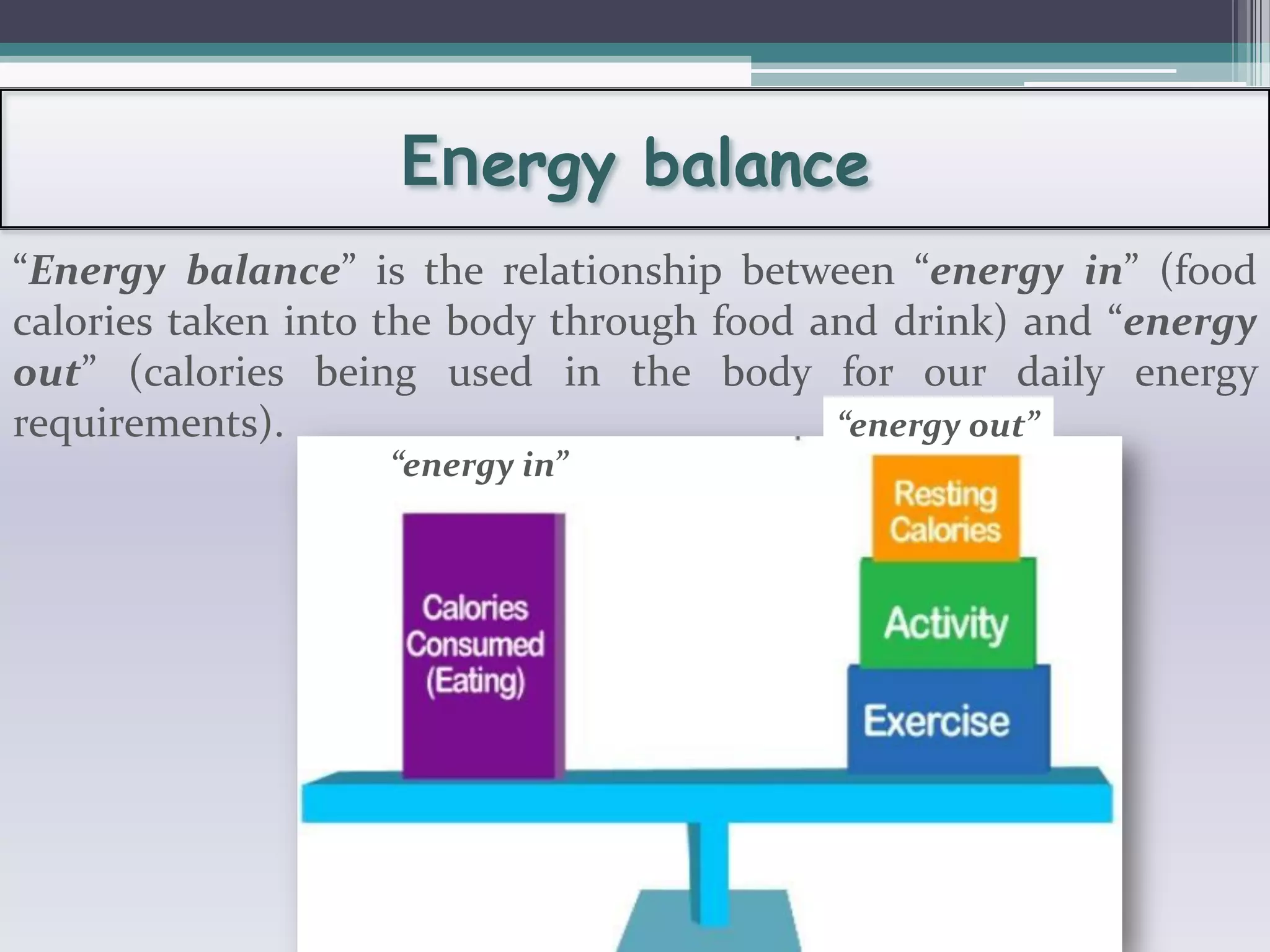
“Energy balance” is the relationship between “energy in” (food
calories taken into the body through food and drink) and “energy
out” (calories being used in the body for our daily energy
requirements).
“energy in”
“energy out”
Energy balance
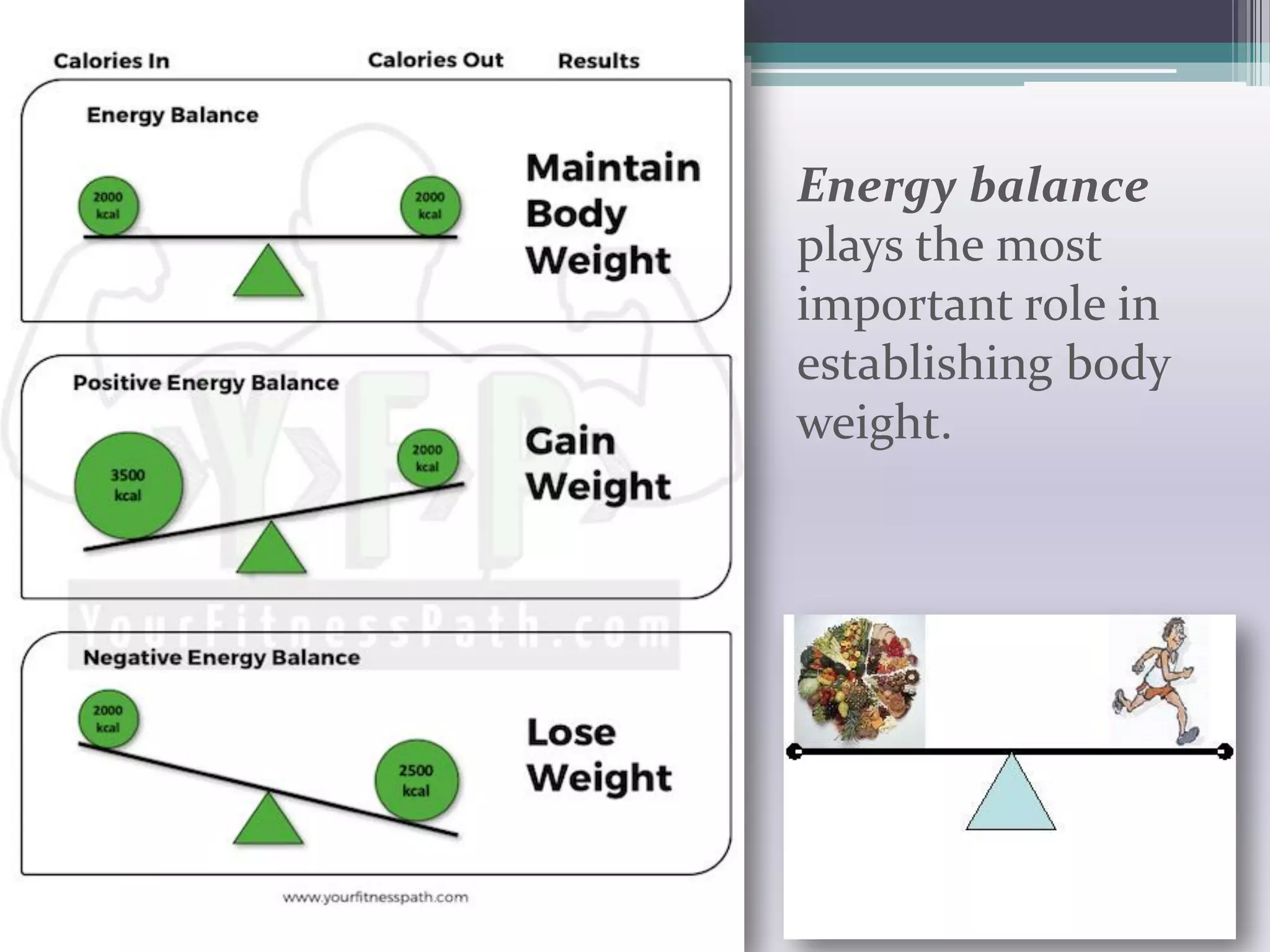
Energy balance
plays the most
important role in
establishing body
weight.
EATING MORE CALORIES =
Consumption of excessive energy
will lead to excessive body weight.
• BMI = weight (kg)/ height(m)2
For example: a 15 years old boy
with weight = 58Kg and height = 1,67m
• His BMI is as follows:
BMI = 58 / (1,67*1,67) = 58 / 2,7889 = 20.8
BMI (Body Mass Index)
The amount and the quality of foods we eat
impair our body composition
How could I calculate my energy needs?
BMR
P.A.
Growth
TEE
Total Energy Needs (TEE) during adolescence include three major components:
1. The energy cost of Basal Metabolic Rate (BMR)
2. The energy cost of Physical Activity (PA), which is variable in intensity and
duration
3. The energy cost of growth
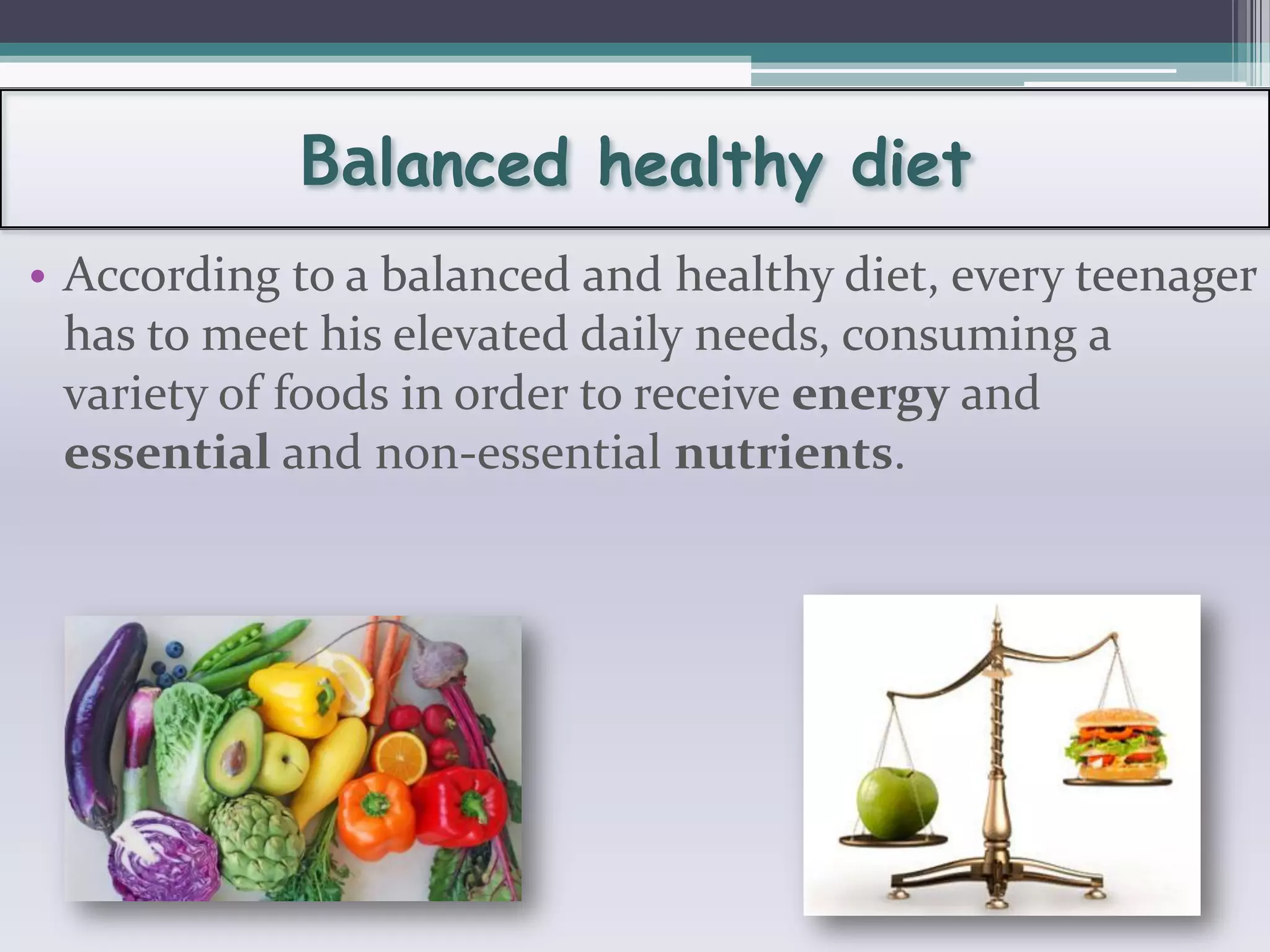
• According to a balanced and healthy diet, every teenager
has to meet his elevated daily needs, consuming a
variety of foods in order to receive energy and
essential and non-essential nutrients.
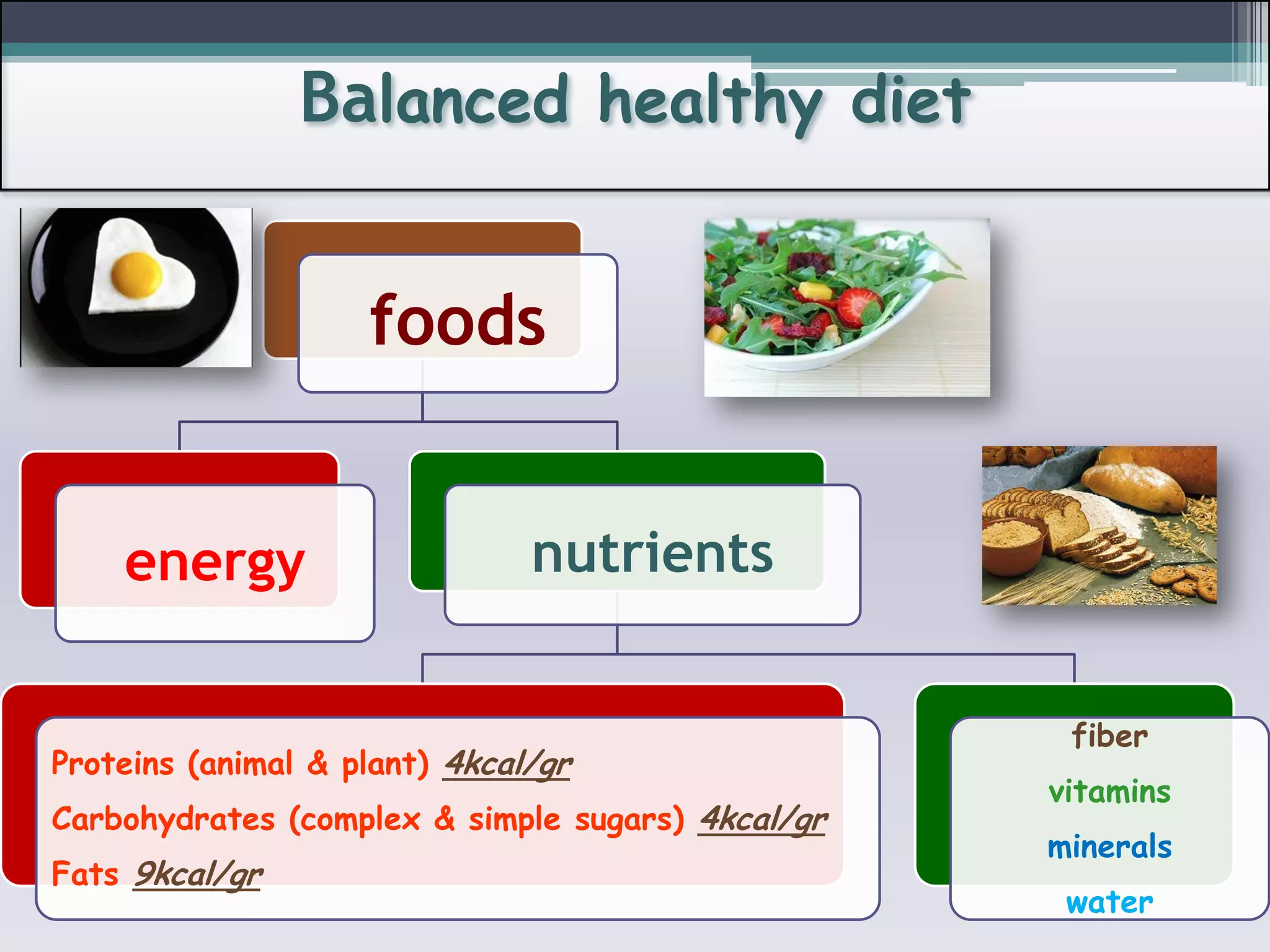
Balanced healthy diet
foods
energy nutrients
Proteins (animal & plant) 4kcal/gr
Carbohydrates (complex & simple sugars) 4kcal/gr
Fats 9kcal/gr
fiber
vitamins
minerals
water
Balanced healthy diet
Food groups
(nutrients with energy)
diary products
• proteins
• carbohydrates
• fats
fats & oils
fats (saturated &
unsaturated
meats & substitutes
• proteins
• fats
fruits & vegetables
• carbohydrates
(simple sugars)
bread & cereal products
• carbohydrates(complex)
• plantproteins
Diary products
carbohydrates
proteins
fats
vitamins Α, D,
Β2, Β12
calcium,
phosphorus
water
Main nutrients
Bread & cereal products
carbohydrates
(mainly complex)
proteins
fiber
vitamins Ε, Β1 Β2, Β6
phosphorous ,
magnesium, zinc,
copper
Main nutrients
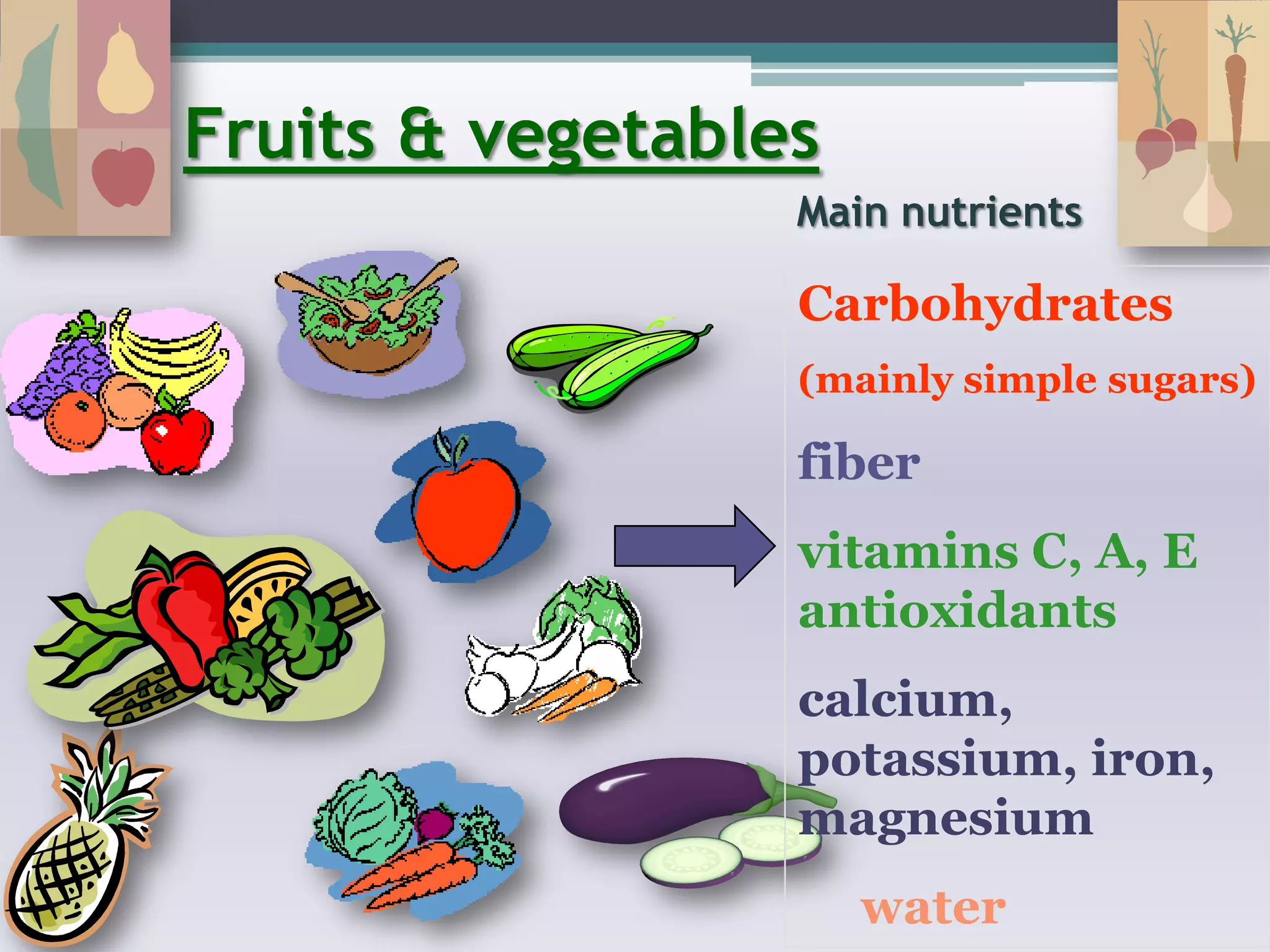
Fruits & vegetables
Carbohydrates
(mainly simple sugars)
fiber
vitamins C, A, E
antioxidants
calcium,
potassium, iron,
magnesium
water
Main nutrients
Meats & beans
Proteins
Fats
Vitamins Α, D, K,
Β1, Β2, Β6, Β12,
folate
Iron, Zinc, Copper,
Phosphorus
Water
Main nutrients
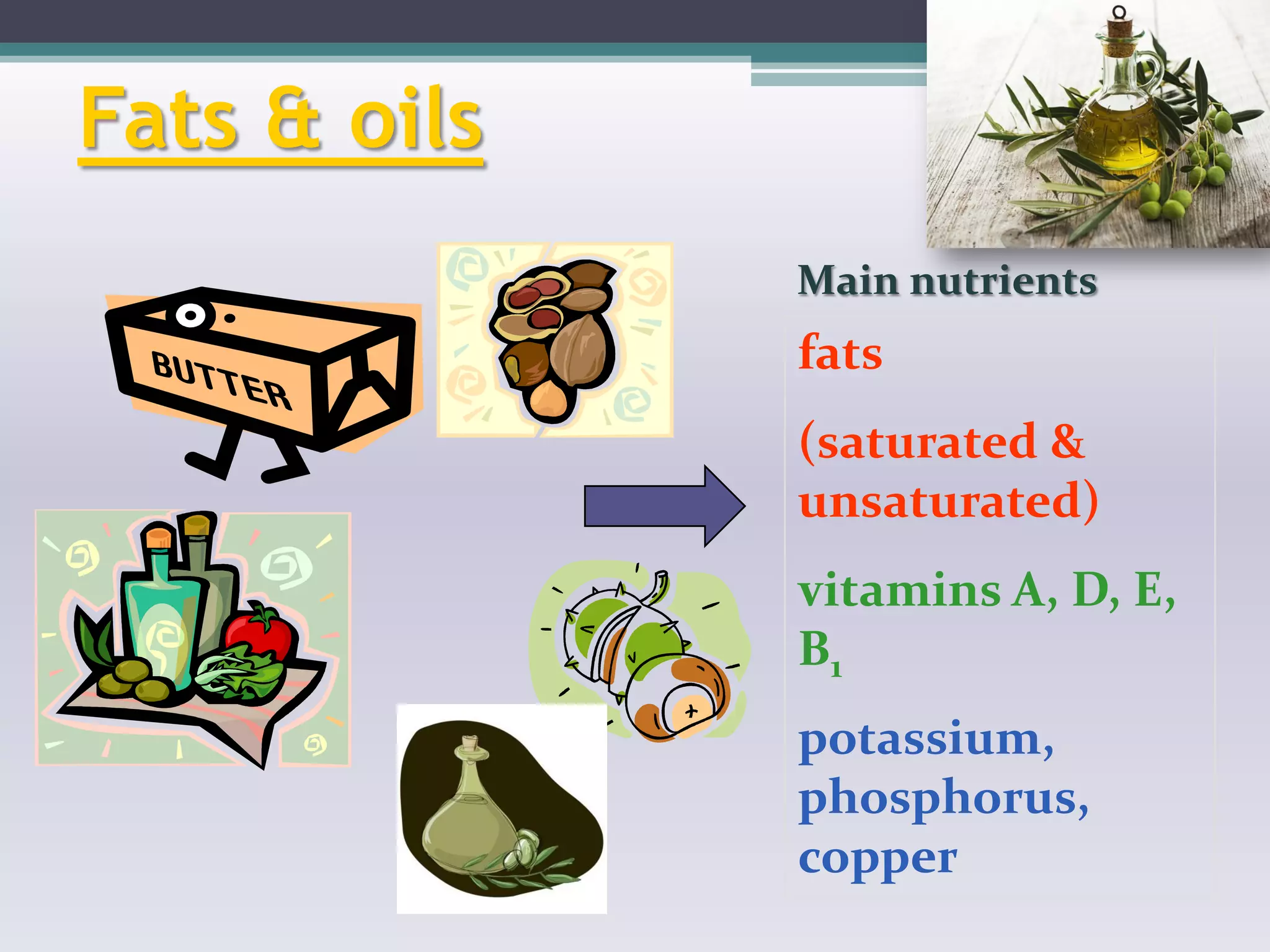
Fats & oils
fats
(saturated &
unsaturated)
vitamins Α, D, Ε,
Β1
potassium,
phosphorus,
copper
Main nutrients
“Sometimes” foods & beverages
Fats (mainly
Saturated)
Sugar (mainly
simple)
Salt
Preservatives &
Other Additives
Main nutrients
What are „Sometimes Foods'?
‘Sometimes foods’ are high in fat, sugar and/or salt.
• They typically have poor nutritional value
• They are often processed and packaged
• There is no need to eat ‘sometimes foods’ on a regular basis.
According to the experts, examples of sometimes foods include:
• chocolate and confectionary
• sweet biscuits, chips and high-fat biscuits
• fried foods
• pastry-based foods such as pies, sausage rolls
• fast food and takeaway foods
• cakes and ice cream
• soft drinks, fruit juice (not fresh), fruit drinks, sports drinks,
energy drinks, flavoured milk and flavoured mineral water.
Food Labels
• “Sometimes foods” are usually packaged and they have a label
on them.
• They are highly processed, with preservatives and other maybe
harmful substances.
• They are high in Sugar, Salt and unhealthy Saturated fats
which can trick our taste buds into wanting more.
• https://fit.webmd.com/teen/food/videos/video-read-the-label
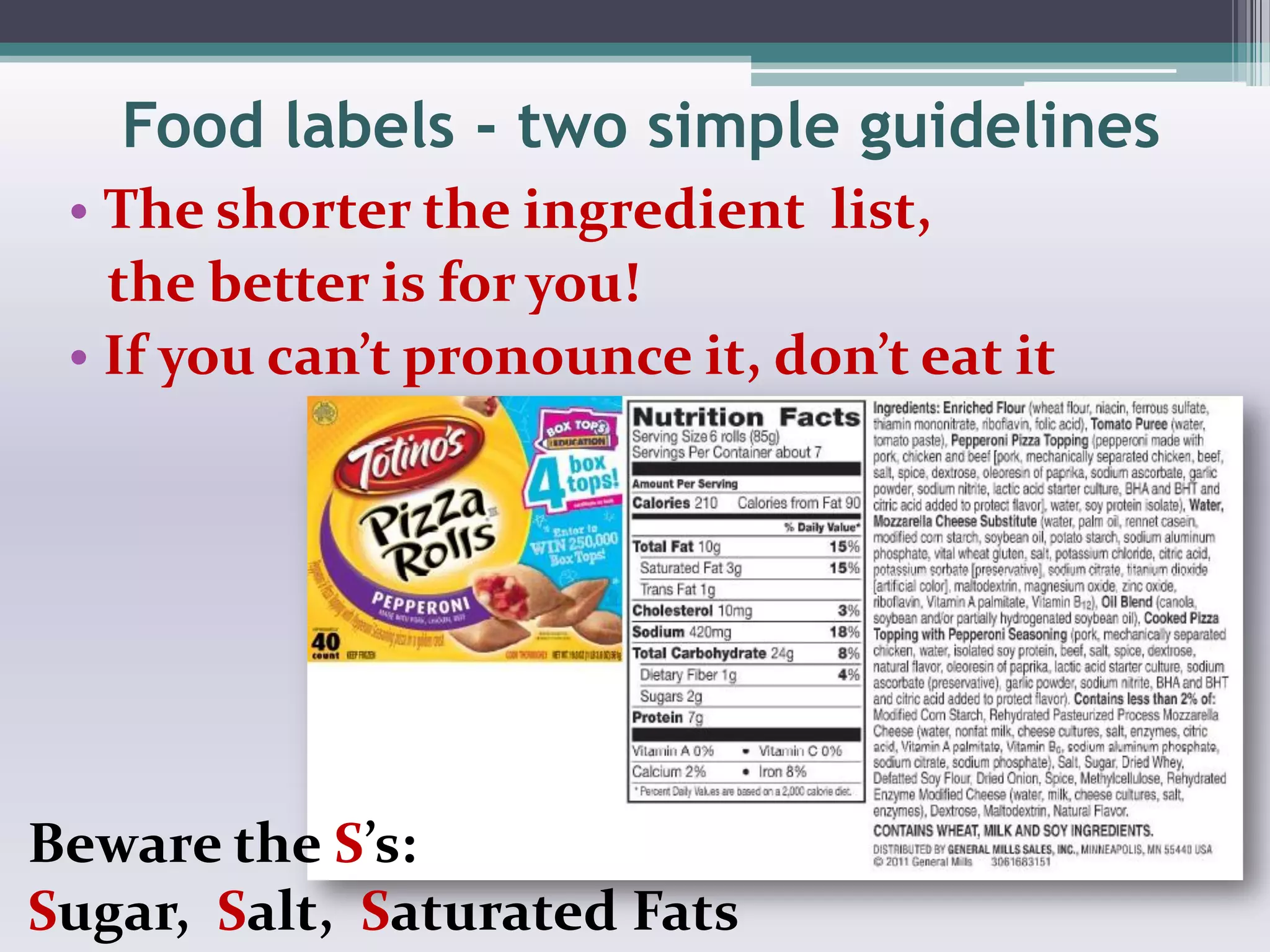
Food labels - two simple guidelines
• The shorter the ingredient list,
the better is for you!
• If you can’t pronounce it, don’t eat it
Beware the S’s:
Sugar, Salt, Saturated Fats
Energy dense foods are not
necessarily nutritious
• 1/3 of the plate• 1/3 of the plate
About breakfast and snacking
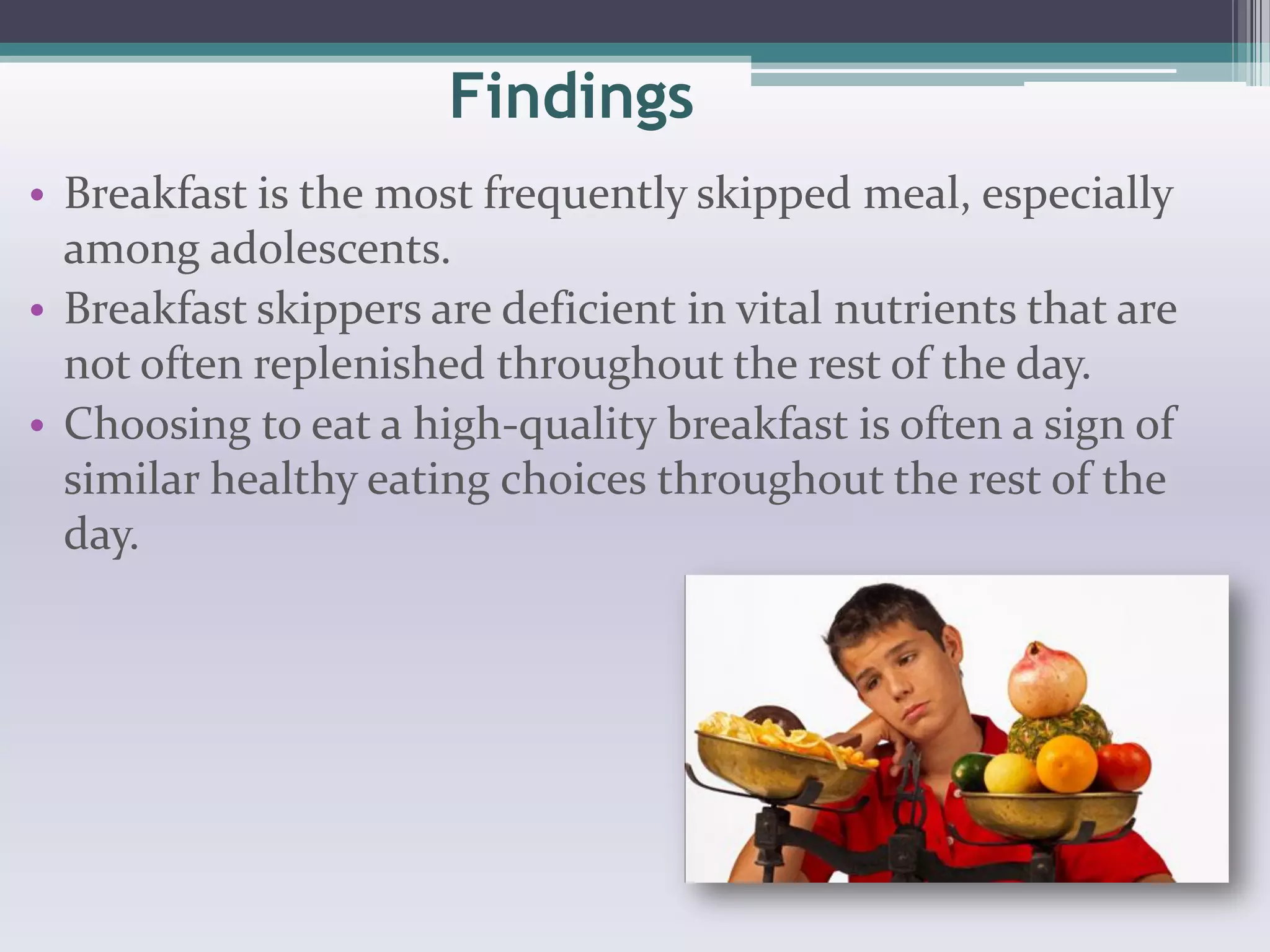
Findings
• Breakfast is the most frequently skipped meal, especially
among adolescents.
• Breakfast skippers are deficient in vital nutrients that are
not often replenished throughout the rest of the day.
• Choosing to eat a high-quality breakfast is often a sign of
similar healthy eating choices throughout the rest of the
day.
Findings
• Breakfast has beneficial effect on cognitive function and
academic performance in school children.
• The quality, the adequacy and variety of the food
consumed does affect academic performance.
• Even a questionably nutritious school breakfast seems to
improve learning in the classroom.
• People who eat breakfast every day are less likely to have
high cholesterol and blood pressure.
Energy from breakfast and snacking:
How many calories are enough?
• 20-25% percent of daily energy it has to be consumed in
breakfast and
• 10-15% percent of daily energy it has to be consumed in
snacking meal
• What does that mean?
• If the daily energy needs are 2000kcals,
400-500kcals are from breakfast and
200-300kcals from a snack
Nutrients from breakfast and snacking:
Which nutrients are needed?
• Complex carbohydrates (Whole-Grain
products)
Give energy for long time and help brain function
• Proteins
Built muscles and support growth
• Vitamins& antioxidants
Help vital functions of the body
• Fiber
Improves digestion and helps support a healthy
digestive tract
• Unsaturated fats (Ω3 fatty acids)
Help brain function
• Calcium
Supports teeth and bones
• Iron
Improves memory, concentration, attention
Nutrients from breakfast and snacking:
Which nutrients are needed?
Researches about breakfast & snacking
• The Effects of Breakfast and Breakfast Composition on Cognition in Children and Adolescents: A
Systematic Review, K Adolphus*, CL Lawton, C L Champ and LDye, Adv Nutr May 2016 Adv Nutrvol. 7: 590S-
612S, 2016
• Breakfast glycaemic index and exercise: Combined effects on adolescents' cognition, S B.Cooper, S
Bandelow, M L.Nute, J G.Morris, ME.Nevill, Physiology & Behavior, Vol. 139, Pages 104-111 Febr. 2015
• Breakfast: The most important meal of the day? Charles Spence, International Journal of Gastronomy and
Food Science, Vol. 8, Pages 1-6, July 2017
• The effect of breakfast composition and energy contribution on cognitive and academic performance: a
systematic review, V Edefonti, V Rosato, M Parpinel, G Nebbia, L Fiorica, E Fossali, M Ferraroni, A Decarli, and C
Agostoni, Am J Clin Nutr vol. 100 no. 2 626-656, August 2014
• Breakfast and Adolescent Academic Performance: An Analytical Review of Recent Research, L.A. Hasz &
M.A. Lamport, European Journal of Business and Social Sciences, Vol. 1, No. 3, pp. 61 - 79, June 2012.
• Impact of breakfast on daily energy intake - an analysis of absolute versus relative breakfast calories,
V Schusdziarra, M Hausmann, C Wittke, J Mittermeier, M Kellner, A Naumann, S Wagenpfeil and J Erdmann,
Nutrition Journal, 10:5, 2011
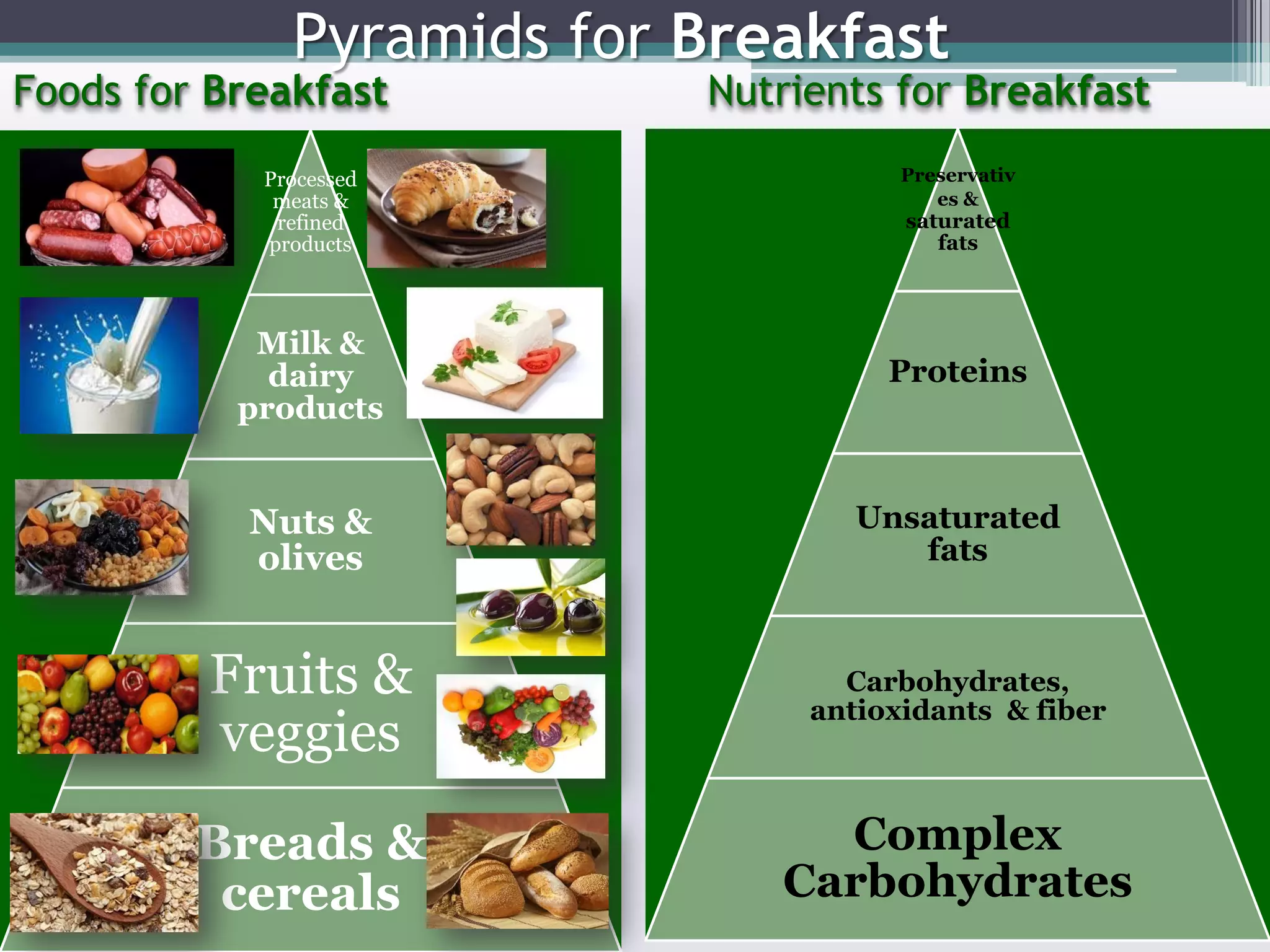
Pyramids for Breakfast
Processed
meats &
refined
products
Milk &
dairy
products
Nuts &
olives
Fruits &
veggies
Breads &
cereals
Preservativ
es &
saturated
fats
Proteins
Unsaturated
fats
Carbohydrates,
antioxidants & fiber
Complex
Carbohydrates
Foods for Breakfast Nutrients for Breakfast
About breakfast and snacking
• Breakfast is the most
important meal of the day, as
well as snacking, because it
helps
 to refuel your body,
gives you energy and
is a great opportunity start
your daily activities with a
boost of nutrients.
About breakfast and snacking
• Eating a healthy breakfast and a snack is especially
important for students, because students who eat
breakfast and snack are more likely to
do better in school,
meet nutrient needs and
concentrate better.
Don‟t skip breakfast!
• Official advice warns that missing out on a morning
meal raises the risk of:
• obesity,
• heart disease and
• diabetes
Choosing healthy options for breakfast and snack is
important for achieving optimal health.
Choices for healthy breakfast
• Oat or other cereals with milk or yogurt and dried
fruits or nuts
• A kind of sandwich with cheese and vegetables
• Boiled eggs and a fresh juice
• Rusks or whole grain bread and honey
• Whole grain bread, olive oil paste and feta cheese with
origan
• Fruit smoothie or milk shake
Choices for healthy snack
• A kind of sandwich with cheese and vegetables
• A kind of sandwich with honey or tahini (sesame paste)
or peanut butter
• Oat or other cereal bars
• A king of homemade pie (spinach, apple or cheese pie)
• Homemade oat biscuits
• Boiled chestnuts
• Homemade banana or carrot cake
• Dried or fresh fruits
• A kind of salad
• Non salty nuts
A Greek advert
• Eat:
In the morning like a King
At noon like a Prince
At evening like a poor
man (beggar)
Thank you very much

Healthy eating behaviors

  • 1.
    Healthy Nutrition: Study ofbreakfast and snacking 1st EPAL KALAMARIAS 12-16 February 2018
  • 2.
    Health 2020: TheEuropean policy for health and well-being • Health 2020 is the new European health policy framework. • According to the Health 2020 programme, the EU aims to support the countries’ governments to improve the health and well-being of its people by offering equal and high- quality public health systems. This can be achieved by improving the populations’ diet, offering affordable and attractive healthy foods to all. • http://www.euro.who.int/en/health-topics/health-policy/health-2020-the-european- policy-for-health-and-well-being
  • 3.
  • 4.
  • 5.
    • Adolescence isa critical period of each person's life and it is characterized of quick growth and maturation, as well as, changes in physical, hormonal and mental condition. • Adolescents have greater energy and nutrient needs than adults in order to help their bodies to develop tissues, bones, muscles, organs, etc. Adolescence
  • 6.
    Energy balance “Energy balance”is the relationship between “energy in” (food calories taken into the body through food and drink) and “energy out” (calories being used in the body for our daily energy requirements). “energy in” “energy out”
  • 7.
  • 8.
    Energy balance plays themost important role in establishing body weight.
  • 9.
    EATING MORE CALORIES= Consumption of excessive energy will lead to excessive body weight.
  • 10.
    • BMI =weight (kg)/ height(m)2 For example: a 15 years old boy with weight = 58Kg and height = 1,67m • His BMI is as follows: BMI = 58 / (1,67*1,67) = 58 / 2,7889 = 20.8 BMI (Body Mass Index)
  • 13.
    The amount andthe quality of foods we eat impair our body composition
  • 14.
    How could Icalculate my energy needs? BMR P.A. Growth TEE Total Energy Needs (TEE) during adolescence include three major components: 1. The energy cost of Basal Metabolic Rate (BMR) 2. The energy cost of Physical Activity (PA), which is variable in intensity and duration 3. The energy cost of growth
  • 15.
    • According toa balanced and healthy diet, every teenager has to meet his elevated daily needs, consuming a variety of foods in order to receive energy and essential and non-essential nutrients. Balanced healthy diet
  • 16.
    foods energy nutrients Proteins (animal& plant) 4kcal/gr Carbohydrates (complex & simple sugars) 4kcal/gr Fats 9kcal/gr fiber vitamins minerals water Balanced healthy diet
  • 17.
    Food groups (nutrients withenergy) diary products • proteins • carbohydrates • fats fats & oils fats (saturated & unsaturated meats & substitutes • proteins • fats fruits & vegetables • carbohydrates (simple sugars) bread & cereal products • carbohydrates(complex) • plantproteins
  • 18.
    Diary products carbohydrates proteins fats vitamins Α,D, Β2, Β12 calcium, phosphorus water Main nutrients
  • 19.
    Bread & cerealproducts carbohydrates (mainly complex) proteins fiber vitamins Ε, Β1 Β2, Β6 phosphorous , magnesium, zinc, copper Main nutrients
  • 20.
    Fruits & vegetables Carbohydrates (mainlysimple sugars) fiber vitamins C, A, E antioxidants calcium, potassium, iron, magnesium water Main nutrients
  • 21.
    Meats & beans Proteins Fats VitaminsΑ, D, K, Β1, Β2, Β6, Β12, folate Iron, Zinc, Copper, Phosphorus Water Main nutrients
  • 22.
    Fats & oils fats (saturated& unsaturated) vitamins Α, D, Ε, Β1 potassium, phosphorus, copper Main nutrients
  • 23.
    “Sometimes” foods &beverages Fats (mainly Saturated) Sugar (mainly simple) Salt Preservatives & Other Additives Main nutrients
  • 24.
    What are „SometimesFoods'? ‘Sometimes foods’ are high in fat, sugar and/or salt. • They typically have poor nutritional value • They are often processed and packaged • There is no need to eat ‘sometimes foods’ on a regular basis. According to the experts, examples of sometimes foods include: • chocolate and confectionary • sweet biscuits, chips and high-fat biscuits • fried foods • pastry-based foods such as pies, sausage rolls • fast food and takeaway foods • cakes and ice cream • soft drinks, fruit juice (not fresh), fruit drinks, sports drinks, energy drinks, flavoured milk and flavoured mineral water.
  • 25.
    Food Labels • “Sometimesfoods” are usually packaged and they have a label on them. • They are highly processed, with preservatives and other maybe harmful substances. • They are high in Sugar, Salt and unhealthy Saturated fats which can trick our taste buds into wanting more. • https://fit.webmd.com/teen/food/videos/video-read-the-label
  • 26.
    Food labels -two simple guidelines • The shorter the ingredient list, the better is for you! • If you can’t pronounce it, don’t eat it Beware the S’s: Sugar, Salt, Saturated Fats
  • 27.
    Energy dense foodsare not necessarily nutritious
  • 28.
    • 1/3 ofthe plate• 1/3 of the plate
  • 29.
  • 30.
    Findings • Breakfast isthe most frequently skipped meal, especially among adolescents. • Breakfast skippers are deficient in vital nutrients that are not often replenished throughout the rest of the day. • Choosing to eat a high-quality breakfast is often a sign of similar healthy eating choices throughout the rest of the day.
  • 31.
    Findings • Breakfast hasbeneficial effect on cognitive function and academic performance in school children. • The quality, the adequacy and variety of the food consumed does affect academic performance. • Even a questionably nutritious school breakfast seems to improve learning in the classroom. • People who eat breakfast every day are less likely to have high cholesterol and blood pressure.
  • 32.
    Energy from breakfastand snacking: How many calories are enough? • 20-25% percent of daily energy it has to be consumed in breakfast and • 10-15% percent of daily energy it has to be consumed in snacking meal • What does that mean? • If the daily energy needs are 2000kcals, 400-500kcals are from breakfast and 200-300kcals from a snack
  • 33.
    Nutrients from breakfastand snacking: Which nutrients are needed? • Complex carbohydrates (Whole-Grain products) Give energy for long time and help brain function • Proteins Built muscles and support growth • Vitamins& antioxidants Help vital functions of the body • Fiber Improves digestion and helps support a healthy digestive tract
  • 34.
    • Unsaturated fats(Ω3 fatty acids) Help brain function • Calcium Supports teeth and bones • Iron Improves memory, concentration, attention Nutrients from breakfast and snacking: Which nutrients are needed?
  • 35.
    Researches about breakfast& snacking • The Effects of Breakfast and Breakfast Composition on Cognition in Children and Adolescents: A Systematic Review, K Adolphus*, CL Lawton, C L Champ and LDye, Adv Nutr May 2016 Adv Nutrvol. 7: 590S- 612S, 2016 • Breakfast glycaemic index and exercise: Combined effects on adolescents' cognition, S B.Cooper, S Bandelow, M L.Nute, J G.Morris, ME.Nevill, Physiology & Behavior, Vol. 139, Pages 104-111 Febr. 2015 • Breakfast: The most important meal of the day? Charles Spence, International Journal of Gastronomy and Food Science, Vol. 8, Pages 1-6, July 2017 • The effect of breakfast composition and energy contribution on cognitive and academic performance: a systematic review, V Edefonti, V Rosato, M Parpinel, G Nebbia, L Fiorica, E Fossali, M Ferraroni, A Decarli, and C Agostoni, Am J Clin Nutr vol. 100 no. 2 626-656, August 2014 • Breakfast and Adolescent Academic Performance: An Analytical Review of Recent Research, L.A. Hasz & M.A. Lamport, European Journal of Business and Social Sciences, Vol. 1, No. 3, pp. 61 - 79, June 2012. • Impact of breakfast on daily energy intake - an analysis of absolute versus relative breakfast calories, V Schusdziarra, M Hausmann, C Wittke, J Mittermeier, M Kellner, A Naumann, S Wagenpfeil and J Erdmann, Nutrition Journal, 10:5, 2011
  • 36.
    Pyramids for Breakfast Processed meats& refined products Milk & dairy products Nuts & olives Fruits & veggies Breads & cereals Preservativ es & saturated fats Proteins Unsaturated fats Carbohydrates, antioxidants & fiber Complex Carbohydrates Foods for Breakfast Nutrients for Breakfast
  • 37.
    About breakfast andsnacking • Breakfast is the most important meal of the day, as well as snacking, because it helps  to refuel your body, gives you energy and is a great opportunity start your daily activities with a boost of nutrients.
  • 38.
    About breakfast andsnacking • Eating a healthy breakfast and a snack is especially important for students, because students who eat breakfast and snack are more likely to do better in school, meet nutrient needs and concentrate better.
  • 39.
    Don‟t skip breakfast! •Official advice warns that missing out on a morning meal raises the risk of: • obesity, • heart disease and • diabetes Choosing healthy options for breakfast and snack is important for achieving optimal health.
  • 40.
    Choices for healthybreakfast • Oat or other cereals with milk or yogurt and dried fruits or nuts • A kind of sandwich with cheese and vegetables • Boiled eggs and a fresh juice • Rusks or whole grain bread and honey • Whole grain bread, olive oil paste and feta cheese with origan • Fruit smoothie or milk shake
  • 41.
    Choices for healthysnack • A kind of sandwich with cheese and vegetables • A kind of sandwich with honey or tahini (sesame paste) or peanut butter • Oat or other cereal bars • A king of homemade pie (spinach, apple or cheese pie) • Homemade oat biscuits • Boiled chestnuts • Homemade banana or carrot cake • Dried or fresh fruits • A kind of salad • Non salty nuts
  • 42.
    A Greek advert •Eat: In the morning like a King At noon like a Prince At evening like a poor man (beggar)
  • 43.