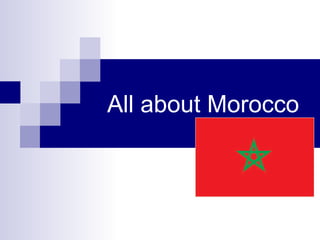
All about Morocco
Geography
Location
 Northern Africa, bordering the North Atlantic
Ocean and the Mediterranean Sea, between
Algeria and Western Sahara
Geographic coordinates
 32 00 N, 5 00 W
Map references
 Africa
Area
 total: 446,550 sq km
 country comparison to the world: 58
 land: 446,300 sq km
 water: 250 sq km
Land boundaries
 total: 2,017.9 km
 border countries: Algeria 1,559 km, Western
Sahara 443 km, Spain (Ceuta) 6.3 km, Spain
(Melilla) 9.6 km
Coastline
 1,835 km
Maritime claims
 territorial sea: 12 nm
 contiguous zone: 24 nm
 exclusive economic zone: 200 nm
 continental shelf: 200 m depth or to the depth
of exploitation
Climate
 Mediterranean, becoming more extreme in the
interior
Terrain
 northern coast and interior are mountainous
with large areas of bordering plateaus,
intermountain valleys, and rich coastal plains
Elevation extremes
 lowest point: Sebkha Tah -55 m
 highest point: Jebel Toubkal 4,165 m
Natural resources:
 phosphates, iron ore, manganese, lead, zinc,
fish, salt
Land use
 arable land: 17.79%
 permanent crops: 2.6%
 other: 79.61% (2011)
Irrigated land:
 14,850 sq km (2004)
Total renewable water resources
 29 cu km (2011)
Freshwater withdrawal
(domestic/industrial/agricultural(
 total: 12.61 cu km/yr (12%/4%/84%)
 per capita: 428.1 cu m/yr (2005)
Natural hazards
 northern mountains geologically unstable and
subject to earthquakes; periodic droughts
Environment - current issues
 land degradation/desertification (soil erosion
resulting from farming of marginal areas,
overgrazing, destruction ofvegetation); water
supplies contaminated by raw sewage;
salutation of reservoirs; oil pollution of coastal
waters
Environment - international
agreements
 party to: Biodiversity, Climate Change,
Climate Change-Kyoto Protocol,
Desertification, Endangered Species,
Hazardous Wastes, Law of the Sea, Marine
Dumping, Ozone Layer Protection, Ship
Pollution, Wetlands, Whaling
 signed, but not ratified: Environmental
Modification
People and Society
Nationality
 noun: Moroccan(s)
 adjective: Moroccan
Ethnic groups
 Arab-Tamazight 99%, other 1%
Languages
 Arabic (official), Berber languages (Tamazight
(official), Tachelhit, Tarifit), French (often the
language of business,government, and
diplomacy)
Religions
 Muslim 99% (official; virtually all Sunni,)
Population
 32,987,206 (July 2014 est.)
 country comparison to the world: 39
Age structure
 0-14 years: 26.7% (male 4,479,676/female 4,342,605)
 15-24 years: 17.7% (male 2,899,041/female 2,931,856)
 25-54 years: 42% (male 6,693,877/female 7,146,696)
 55-64 years: 6.3% (male 1,200,733/female 1,203,447)
 65 years and over: 6.3% (male 940,291/female 1,148,984)
(2014 est)
Dependency ratios
 total dependency ratio: 48.9 %
 youth dependency ratio: 41.5 %
 elderly dependency ratio: 7.4 %
 potential support ratio: 13.5 (2013 est)
Median age
 total: 28.1 years
 male: 27.5 years
 female: 28.7 years (2014 est)
Population growth rate
 1.02% (2014 est)
 country comparison to the world: 117
Birth rate
 18.47 births/1,000 population (2014 est)
 country comparison to the world: 100
Death rate
 4.79 deaths/1,000 population (2014 est)
 country comparison to the world: 196
Net migration rate
 -3.46 migrant(s)/1,000 population (2014 est)
 country comparison to the world: 186
Urbanization
 urban population: 57% of total population
(2011 est)
 rate of urbanization: 1.62% annual rate of
change (2010-15 est)
Major urban areas - population
 Casablanca 3.245 million; RABAT (capital)
1.77 million; Fes 1.044 million; Marrakech
909,000; Tangier 768,000 (2009 est)
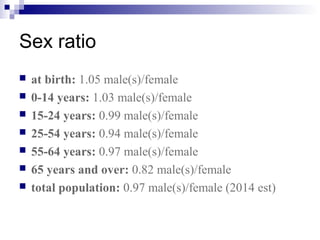
Sex ratio
 at birth: 1.05 male(s)/female
 0-14 years: 1.03 male(s)/female
 15-24 years: 0.99 male(s)/female
 25-54 years: 0.94 male(s)/female
 55-64 years: 0.97 male(s)/female
 65 years and over: 0.82 male(s)/female
 total population: 0.97 male(s)/female (2014 est)
Mother's mean age at first birth
 25.4 (2004 est)
Maternal mortality rate
 100 deaths/100,000 live births (2010 est)
 country comparison to the world: 70
Infant mortality rate
 total: 24.52 deaths/1,000 live births
 country comparison to the world: 74
 male: 28.96 deaths/1,000 live births
 female: 19.87 deaths/1,000 live births (2014 est)
Life expectancy at birth
 total population: 76.51 years
 country comparison to the world: 78
 male: 73.44 years
 female: 79.74 years (2014 est)
Total fertility rate
 2.15 children born/woman (2014 est)
 country comparison to the world: 105
Contraceptive prevalence rate
 67.4% (2011 est)
Health expenditures
 6% of GDP (2011 est)
 country comparison to the world: 109
Physicians density
 0.62 physicians/1,000 population (2009 est)
Hospital bed density
 1.1 beds/1,000 population (2009 est)
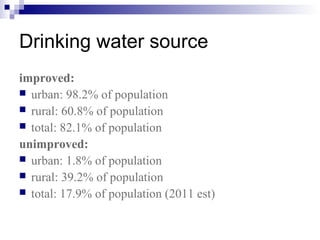
Drinking water source
improved:
 urban: 98.2% of population
 rural: 60.8% of population
 total: 82.1% of population
unimproved:
 urban: 1.8% of population
 rural: 39.2% of population
 total: 17.9% of population (2011 est)
Sanitation facility access
improved:
 urban: 83.1% of population
 rural: 52% of population
 total: 69.8% of population
unimproved:
 urban: 16.9% of population
 rural: 48% of population
 total: 30.2% of population (2011 est)
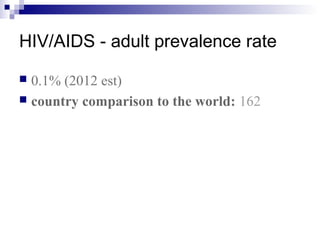
HIV/AIDS - adult prevalence rate
 0.1% (2012 est)
 country comparison to the world: 162
People living with HIV/AIDS
 30,000 (2012 est)
 country comparison to the world: 71
HIV/AIDS - deaths
 1,200 (2012 est)
 country comparison to the world: 70
Obesity - adult prevalence rate
 16.4% (2008 est)
 country comparison to the world: 114
Children under the age of 5 years
underweight
 3.1% (2011est)
 country comparison to the world: 113
Education expenditures
 5.4% of GDP (2009)
 country comparison to the world: 59
Literacy
 definition: age 15 and over can read and write
 total population: 67.1%
 male: 76.1%
 female: 57.6% (2011 est.)
School life expectancy (primary to
tertiary education(
 total: 11 years
 male: 12 years
 female: 11 years (2010)
Child labor - children ages 5-14
 total number: 500,960
 percentage: 8 % (2007 est.)
Unemployment, youth ages 15-24
 total: 18.6%
 country comparison to the world: 65
 male: 18.4%
 female: 19.2% (2012)
Government
Country name
 conventional long form: Kingdom of
Morocco
 conventional short form: Morocco
 local long form: Al Mamlakah al
Maghribiyah
 local short form: Al Maghrib
Government type
 constitutional monarchy
Capital
 name: Rabat
 geographic coordinates: 34 01 N, 6 49 W
 time difference: UTC 0 (5 hours ahead of
Washington, DC during Standard Time)
 daylight saving time: +1 hr, begins last
Sunday in April; ends last Sunday in
September
Administrative divisions
 15 regions; Grand Casablanca, Chaouia-Ouardigha,
Doukkala-Abda, Fes-Boulemane, Gharb-Chrarda-
Beni Hssen,Guelmim-Es Smara, Laayoune-Boujdour-
Sakia El Hamra, Marrakech-Tensift-Al Haouz,
Meknes-Tafilalet, Oriental,Rabat-Sale-Zemmour-
Zaer, Souss-Massa-Draa, Tadla-Azilal, Tanger-
Tetouan, Taza-Al Hoceima-Taounate
note
Independence:
 2 March 1956 (from France)
National holiday
 Throne Day (accession of King MOHAMMED VI to
the throne), 30 July (1999)
Constitution
 several previous; latest drafted 17 June 2011,
approved by referendum 1 July 2011; note - sources
disagree on whether the 2011 referendum was for a
new constitution or for reforms to the previous
constitution (2011)
Legal system
 mixed legal system of civil law based on
French law and Islamic law; judicial review of
legislative acts by Supreme Court
International law organization
participation
 has not submitted an ICJ jurisdiction
declaration; non-party state to the ICCt
Suffrage
 18 years of age; universal
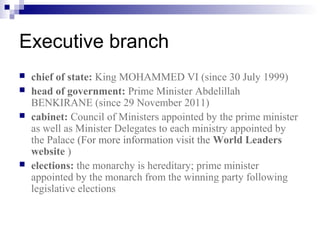
Executive branch
 chief of state: King MOHAMMED VI (since 30 July 1999)
 head of government: Prime Minister Abdelillah
BENKIRANE (since 29 November 2011)
 cabinet: Council of Ministers appointed by the prime minister
as well as Minister Delegates to each ministry appointed by
the Palace (For more information visit the World Leaders
website )
 elections: the monarchy is hereditary; prime minister
appointed by the monarch from the winning party following
legislative elections
Judicial branch
 highest court(s): Supreme Court or Court of Cassation
(consists of 5-judge panels organized into civil, family
matters, commercial, administrative, social, and criminal
sections)
 judge selection and term of office: Supreme Court judges
appointed by the monarch upon the recommendation of the
Supreme Council of the Judiciary
 subordinate courts: courts of appeal; regional and sided
courts (for religious, civil and administrative, and penal
adjudication)
International organization
participation
 ABEDA, AfDB, AFESD, AMF, AMU, CAEU, CD,
EBRD, FAO, G-11, G-77, IAEA, IBRD, ICAO, ICC
(national committees),ICRM, IDA, IDB, IFAD, IFC,
IFRCS, IHO, ILO, IMF, IMO, IMSO, Interpol, IOC,
IOM, IPU, ISO, ITSO, ITU, ITUC (NGOs),
LAS,MIGA, MONUSCO, NAM, OAS (observer),
OIC, OIF, OPCW, OSCE (partner), Paris Club
(associate), PCA, UN, UN Security Council
(temporary), UNCTAD, UNESCO, UNHCR,
UNIDO, UNOCI, UNSC (temporary), UNWTO,
UPU, WCO, WHO, WIPO,WMO, WTO
Diplomatic representation in the US
 chief of mission: Ambassador Mohammed
Rachad BOUHLAL (since 22 December 2011)
 chancery: 1601 21st Street NW, Washington,
DC 20009
 telephone: [1] (202) 462-7979
 FAX: [1] (202) 462-7643
 consulate(s) general: New York
National symbol(s(
 Pentacle symbol; lion
National anthem
 name: "Hymne Cherifien" (Hymn of the Sharif)
 lyrics/music: Ali Squalli HOUSSAINI/Leo
MORGAN
 note: music adopted 1956, lyrics adopted 1970
Economy
GDP (purchasing power parity(
 $180 billion (2013 est.)
 country comparison to the world: 60
 $171.2 billion (2012 est.)
 $166.7 billion (2011 est.)
note
GDP (official exchange rate(
 $104.8 billion (2013 est.)
GDP - real growth rate
 5.1% (2013 est.)
 country comparison to the world: 53
 2.7% (2012 est.)
 5% (2011 est.)
GDP - per capita (PPP(
 $5,500 (2013 est.)
 country comparison to the world: 155
 $5,300 (2012 est.)
 $5,200 (2011 est.)
note
note: data are in
2013 US dollars
Gross national saving
 25.4% of GDP (2013 est.)
 country comparison to the world: 48
 25.1% of GDP (2012 est.)
 27.6% of GDP (2011 est.)
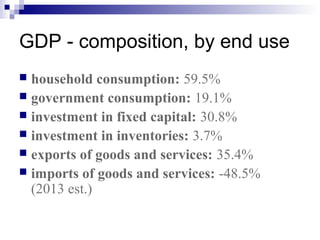
GDP - composition, by end use
 household consumption: 59.5%
 government consumption: 19.1%
 investment in fixed capital: 30.8%
 investment in inventories: 3.7%
 exports of goods and services: 35.4%
 imports of goods and services: -48.5%
(2013 est.)
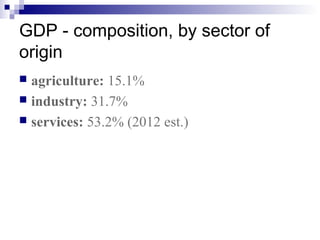
GDP - composition, by sector of
origin
 agriculture: 15.1%
 industry: 31.7%
 services: 53.2% (2012 est.)
products
Agriculture
 barley, wheat, citrus fruits, grapes, vegetables,
olives; livestock; wine
Industries
 phosphate rock mining and processing, food
processing, leather goods, textiles,
construction, energy, tourism
Industrial production growth rate
 1.2% (2013 est.)
 country comparison to the world: 142
Labor force
 11.73 million (2013 est.)
 country comparison to the world: 46
Labor force - by occupation
 agriculture: 44.6%
 industry: 19.8%
 services: 35.5% (2006 est.)
Unemployment rate
 9.5% (2013 est.)
 country comparison to the world: 103
 9% (2012 est.)
Population below poverty line
 15% (2007 est)
Household income or consumption
by percentage share
 lowest 10%: 2.7%
 highest 10%: 33.2% (2007)
Distribution of family income - Gini
index
 40.9 (2007 est.)
 country comparison to the world: 54
 39.5 (1999 est.)
Budget
 revenues: $26.07 billion
 expenditures: $34.51 billion (2013 est)
Taxes and other revenues
 24.9% of GDP (2013 est.)
 country comparison to the world: 131
Budget surplus (+) or deficit(-)
 -8% of GDP (2013 est)
 country comparison to the world: 196
Public debt
 76.9% of GDP (2013 est)
 country comparison to the world: 31
 71.2% of GDP (2012 est)
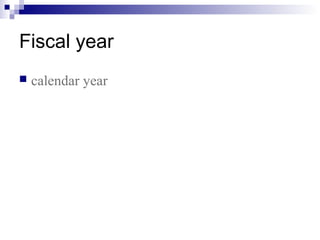
Fiscal year
 calendar year
Inflation rate (consumer prices)
 2.5% (2013 est)
 country comparison to the world: 93
 1.2% (2012 est)
Central bank discount rate
 6.5% (31 December 2010 est.)
 country comparison to the world: 100
 3.31% (31 December 2009 est.)
Commercial bank prime lending
rate
 6.3% (31 December 2013 est.)
 country comparison to the world: 134
 6.3% (31 December 2012 est.)
Stock of narrow money
 $75.71 billion (31 December 2013 est)
 country comparison to the world: 42
 $71.51 billion (31 December 2012 est)
Stock of broad money
 $90.76 billion (31 December 2013 est.)
 country comparison to the world: 57
 $84.52 billion (31 December 2012 est.)
Stock of domestic credit
 $121 billion (31 December 2013 est)
 country comparison to the world: 50
 $111.6 billion (31 December 2012 est)
Market value of publicly traded
shares
 $52.63 billion (31 December 2012 est.)
 country comparison to the world: 48
 $60.09 billion (31 December 2011)
 $69.15 billion (31 December 2010 est.)
Current account balance
 -$9.595 billion (2013 est.)
 country comparison to the world: 176
 -$9.843 billion (2012 est.)
Exports
 $16.78 billion (2013 est)
 country comparison to the world: 76
 $16.99 billion (2012 est)
Exports - commodities
 clothing and textiles, electric components,
inorganic chemicals, transistors, crude
minerals, fertilizers (including phosphates),
petroleum products, citrus fruits, vegetables,
fish
Exports - partners
 France 21%, Spain 17.3%, Brazil 5.4%, India
4.9%, US 4.6% (2012)
Imports
 $38.66 billion (2013 est)
 country comparison to the world: 62
 $38.88 billion (2012 est)
Imports - commodities
 crude petroleum, textile fabric,
telecommunications equipment, wheat, gas
and electricity, transistors, plastics
Imports - partners
 Spain 13.1%, France 12.1%, China 6.9%, US
6.8%, Saudi Arabia 6.2%, Italy 5.1%, Russia
5%, Germany 4.9% (2012)
Reserves of foreign exchange and
gold
 $19.16 billion (31 December 2013 est.)
 country comparison to the world: 61
 $17.54 billion (31 December 2012 est.)
Debt - external
 $36.51 billion (31 December 2013 est)
 country comparison to the world: 68
 $32.15 billion (31 December 2012 est)
Stock of direct foreign investment -
at home
 $51.82 billion (31 December 2013 est)
 country comparison to the world: 54
 $48.18 billion (31 December 2012 est)
Stock of direct foreign investment -
abroad
 $1.972 billion (31 December 2013 est)
 country comparison to the world: 73
 $2.423 billion (31 December 2012 est)
Exchange rates
Moroccan dirhams (MAD) per US dollar -
 8.439 (2013 est)
 8.6026 (2012 est)
 8.4172 (2010 est)
 8.0571 (2009 est)
 7.526 (2008 est)
Energy
Electricity - production
 21.13 billion kWh (2010 est.)
 country comparison to the world: 7 1
Electricity - consumption
 23.61 billion kWh (2010 est.)
 country comparison to the world: 67
Electricity - exports
 0 kWh (2012 est)
 country comparison to the world: 167
Electricity - imports
 3.94 billion kWh (2010 est.)
 country comparison to the world: 41
Electricity - installed generating
capacity
 6.62 million kW (2010 est)
 country comparison to the world: 69
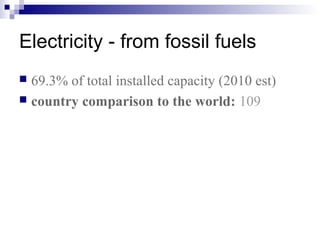
Electricity - from fossil fuels
 69.3% of total installed capacity (2010 est)
 country comparison to the world: 109
Electricity - from nuclear fuels
 0% of total installed capacity (2010 est.)
 country comparison to the world: 139
Electricity - from hydroelectric
plants
 19.4% of total installed capacity (2010 est.)
 country comparison to the world: 93
Electricity - from other renewable
sources
 4.3% of total installed capacity (2010 est.)
 country comparison to the world: 47
Crude oil - production
 5,057 bbl/day (2012 est)
 country comparison to the world: 99
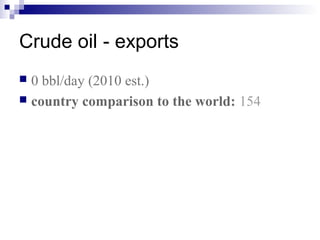
Crude oil - exports
 0 bbl/day (2010 est.)
 country comparison to the world: 154
Crude oil - imports
 122,900 bbl/day (2010 est)
 country comparison to the world: 45
Crude oil - proved reserves
 680,000 bbl (1 January 2013 est)
 country comparison to the world: 98
Refined petroleum products -
production
 131,500 bbl/day (2010 est)
 country comparison to the world: 67
Refined petroleum products -
consumption
 203,600 bbl/day (2011 est)
 country comparison to the world: 58
Refined petroleum products -
exports
 20,830 bbl/day (2010 est)
 country comparison to the world: 72
Refined petroleum products -
import
 143,000 bbl/day (2010 est)
 country comparison to the world: 40
Natural gas - production
 60 million cu m (2011 est.)
 country comparison to the world: 86
Natural gas - consumption
 560 million cu m (2010 est.)
 country comparison to the world: 97
Natural gas - exports
 0 cu m (2011 est)
 country comparison to the world: 148
Natural gas - imports
 150 million cu m (2011 est)
 country comparison to the world: 73
Natural gas - proved reserves
 1.444 billion cu m (1 January 2013 est)
 country comparison to the world: 101
Carbon dioxide emissions from
consumption of energy
 43.71 million Mt (2011 est)
 country comparison to the world: 68
Communications
Telephones - main lines in use
 3.28 million (2012 est)
 country comparison to the world: 4 7
Telephones - mobile cellular:
 39.016 million (2012)
 country comparison to the world: 31
Internet country code
 .ma
Internet hosts
 277,338 (2012 est)
 country comparison to the world: 66
Internet users
 13.213 million (2009 est)
 country comparison to the world: 29
Transportation
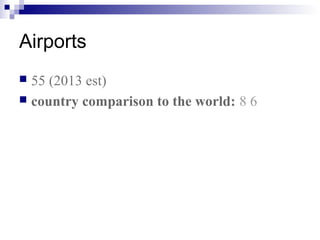
Airports
 55 (2013 est)
 country comparison to the world: 8 6
Airports - with paved runways
 total: 3 1
 over 3,047 m: 11
 2,438 to 3,047 m: 9
 1,524 to 2,437 m: 7
 914 to 1,523 m: 4 (2013 est)
Airports - with unpaved runways
 total: 2 4
 2,438 to 3,047 m: 1
 1,524 to 2,437 m: 7
 914 to 1,523 m: 11
 under 914 m: 5 (2013 est)
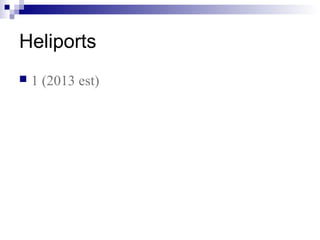
Heliports
 1 (2013 est)
Pipelines
 gas 944 km; oil 270 km; refined products 175
km (2013)
Railways
 total: 2,067 km
 country comparison to the world: 70
 standard gauge: 2,067 km 1.435-m gauge
(1,022 km electrified) (2008 est)
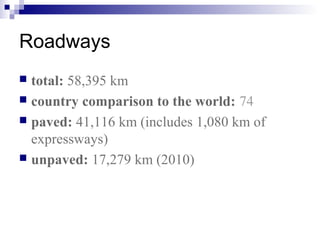
Roadways
 total: 58,395 km
 country comparison to the world: 74
 paved: 41,116 km (includes 1,080 km of
expressways)
 unpaved: 17,279 km (2010)
Merchant marine
 total: 2 6
 country comparison to the world: 88
 by type: cargo 1, chemical tanker 3, container 6,
passenger/cargo 14, roll on/roll off 2
 foreign-owned: 14 (France 3, Germany 1, Italy 1, Spain 9)
 registered in other countries: 4 (Gibraltar 4) (2010)
Ports and terminals
 major seaport(s): Casablanca, Jorf Lasfar,
Mohammedia, Safi, Tangier
 container port(s) (TEUs): Tangier (2,093,408)
Military
Military branches
 Royal Armed Forces (Forces Armees Royales,
FAR): Royal Moroccan Army (includes Air
Defense), Royal Moroccan Navy (includes
Coast Guard, Marines), Royal Moroccan Air
Force (Al Quwwat al Jawyiya al Malakiya
Marakishiya; Force Aerienne Royale
Marocaine) (2010)
Military service age and obligation
 20 years of age for voluntary military service;
no conscription; service obligation - 18 months
(2012 est)
Manpower available for military
service
 males age 16-49: 8,252,682
 females age 16-49: 8,691,419 (2010 est)
Manpower fit for military service
 males age 16-49: 7,026,016
 females age 16-49: 7,377,045 (2010 est)
Manpower reaching militarily
significant age annually
 male: 300,327
 female: 298,366 (2010 est)
Military expenditures
 3.55% of GDP (2012)
 country comparison to the world: 14
 3.37% of GDP (2011)
 3.55% of GDP (2010)
To be continued
All this information are
taken from: The world
factbook

All about Morocco

  • 1.
  • 2.
  • 3.
    Location  Northern Africa,bordering the North Atlantic Ocean and the Mediterranean Sea, between Algeria and Western Sahara
  • 4.
  • 5.
  • 6.
    Area  total: 446,550sq km  country comparison to the world: 58  land: 446,300 sq km  water: 250 sq km
  • 7.
    Land boundaries  total:2,017.9 km  border countries: Algeria 1,559 km, Western Sahara 443 km, Spain (Ceuta) 6.3 km, Spain (Melilla) 9.6 km
  • 8.
  • 9.
    Maritime claims  territorialsea: 12 nm  contiguous zone: 24 nm  exclusive economic zone: 200 nm  continental shelf: 200 m depth or to the depth of exploitation
  • 10.
    Climate  Mediterranean, becomingmore extreme in the interior
  • 11.
    Terrain  northern coastand interior are mountainous with large areas of bordering plateaus, intermountain valleys, and rich coastal plains
  • 12.
    Elevation extremes  lowestpoint: Sebkha Tah -55 m  highest point: Jebel Toubkal 4,165 m
  • 13.
    Natural resources:  phosphates,iron ore, manganese, lead, zinc, fish, salt
  • 14.
    Land use  arableland: 17.79%  permanent crops: 2.6%  other: 79.61% (2011)
  • 15.
  • 16.
    Total renewable waterresources  29 cu km (2011)
  • 17.
    Freshwater withdrawal (domestic/industrial/agricultural(  total:12.61 cu km/yr (12%/4%/84%)  per capita: 428.1 cu m/yr (2005)
  • 18.
    Natural hazards  northernmountains geologically unstable and subject to earthquakes; periodic droughts
  • 19.
    Environment - currentissues  land degradation/desertification (soil erosion resulting from farming of marginal areas, overgrazing, destruction ofvegetation); water supplies contaminated by raw sewage; salutation of reservoirs; oil pollution of coastal waters
  • 20.
    Environment - international agreements party to: Biodiversity, Climate Change, Climate Change-Kyoto Protocol, Desertification, Endangered Species, Hazardous Wastes, Law of the Sea, Marine Dumping, Ozone Layer Protection, Ship Pollution, Wetlands, Whaling  signed, but not ratified: Environmental Modification
  • 21.
  • 22.
  • 23.
  • 24.
    Languages  Arabic (official),Berber languages (Tamazight (official), Tachelhit, Tarifit), French (often the language of business,government, and diplomacy)
  • 25.
    Religions  Muslim 99%(official; virtually all Sunni,)
  • 26.
    Population  32,987,206 (July2014 est.)  country comparison to the world: 39
  • 27.
    Age structure  0-14years: 26.7% (male 4,479,676/female 4,342,605)  15-24 years: 17.7% (male 2,899,041/female 2,931,856)  25-54 years: 42% (male 6,693,877/female 7,146,696)  55-64 years: 6.3% (male 1,200,733/female 1,203,447)  65 years and over: 6.3% (male 940,291/female 1,148,984) (2014 est)
  • 28.
    Dependency ratios  totaldependency ratio: 48.9 %  youth dependency ratio: 41.5 %  elderly dependency ratio: 7.4 %  potential support ratio: 13.5 (2013 est)
  • 29.
    Median age  total:28.1 years  male: 27.5 years  female: 28.7 years (2014 est)
  • 30.
    Population growth rate 1.02% (2014 est)  country comparison to the world: 117
  • 31.
    Birth rate  18.47births/1,000 population (2014 est)  country comparison to the world: 100
  • 32.
    Death rate  4.79deaths/1,000 population (2014 est)  country comparison to the world: 196
  • 33.
    Net migration rate -3.46 migrant(s)/1,000 population (2014 est)  country comparison to the world: 186
  • 34.
    Urbanization  urban population:57% of total population (2011 est)  rate of urbanization: 1.62% annual rate of change (2010-15 est)
  • 35.
    Major urban areas- population  Casablanca 3.245 million; RABAT (capital) 1.77 million; Fes 1.044 million; Marrakech 909,000; Tangier 768,000 (2009 est)
  • 36.
    Sex ratio  atbirth: 1.05 male(s)/female  0-14 years: 1.03 male(s)/female  15-24 years: 0.99 male(s)/female  25-54 years: 0.94 male(s)/female  55-64 years: 0.97 male(s)/female  65 years and over: 0.82 male(s)/female  total population: 0.97 male(s)/female (2014 est)
  • 37.
    Mother's mean ageat first birth  25.4 (2004 est)
  • 38.
    Maternal mortality rate 100 deaths/100,000 live births (2010 est)  country comparison to the world: 70
  • 39.
    Infant mortality rate total: 24.52 deaths/1,000 live births  country comparison to the world: 74  male: 28.96 deaths/1,000 live births  female: 19.87 deaths/1,000 live births (2014 est)
  • 40.
    Life expectancy atbirth  total population: 76.51 years  country comparison to the world: 78  male: 73.44 years  female: 79.74 years (2014 est)
  • 41.
    Total fertility rate 2.15 children born/woman (2014 est)  country comparison to the world: 105
  • 42.
  • 43.
    Health expenditures  6%of GDP (2011 est)  country comparison to the world: 109
  • 44.
    Physicians density  0.62physicians/1,000 population (2009 est)
  • 45.
    Hospital bed density 1.1 beds/1,000 population (2009 est)
  • 46.
    Drinking water source improved: urban: 98.2% of population  rural: 60.8% of population  total: 82.1% of population unimproved:  urban: 1.8% of population  rural: 39.2% of population  total: 17.9% of population (2011 est)
  • 47.
    Sanitation facility access improved: urban: 83.1% of population  rural: 52% of population  total: 69.8% of population unimproved:  urban: 16.9% of population  rural: 48% of population  total: 30.2% of population (2011 est)
  • 48.
    HIV/AIDS - adultprevalence rate  0.1% (2012 est)  country comparison to the world: 162
  • 49.
    People living withHIV/AIDS  30,000 (2012 est)  country comparison to the world: 71
  • 50.
    HIV/AIDS - deaths 1,200 (2012 est)  country comparison to the world: 70
  • 51.
    Obesity - adultprevalence rate  16.4% (2008 est)  country comparison to the world: 114
  • 52.
    Children under theage of 5 years underweight  3.1% (2011est)  country comparison to the world: 113
  • 53.
    Education expenditures  5.4%of GDP (2009)  country comparison to the world: 59
  • 54.
    Literacy  definition: age15 and over can read and write  total population: 67.1%  male: 76.1%  female: 57.6% (2011 est.)
  • 55.
    School life expectancy(primary to tertiary education(  total: 11 years  male: 12 years  female: 11 years (2010)
  • 56.
    Child labor -children ages 5-14  total number: 500,960  percentage: 8 % (2007 est.)
  • 57.
    Unemployment, youth ages15-24  total: 18.6%  country comparison to the world: 65  male: 18.4%  female: 19.2% (2012)
  • 58.
  • 59.
    Country name  conventionallong form: Kingdom of Morocco  conventional short form: Morocco  local long form: Al Mamlakah al Maghribiyah  local short form: Al Maghrib
  • 60.
  • 61.
    Capital  name: Rabat geographic coordinates: 34 01 N, 6 49 W  time difference: UTC 0 (5 hours ahead of Washington, DC during Standard Time)  daylight saving time: +1 hr, begins last Sunday in April; ends last Sunday in September
  • 62.
    Administrative divisions  15regions; Grand Casablanca, Chaouia-Ouardigha, Doukkala-Abda, Fes-Boulemane, Gharb-Chrarda- Beni Hssen,Guelmim-Es Smara, Laayoune-Boujdour- Sakia El Hamra, Marrakech-Tensift-Al Haouz, Meknes-Tafilalet, Oriental,Rabat-Sale-Zemmour- Zaer, Souss-Massa-Draa, Tadla-Azilal, Tanger- Tetouan, Taza-Al Hoceima-Taounate note
  • 63.
    Independence:  2 March1956 (from France)
  • 64.
    National holiday  ThroneDay (accession of King MOHAMMED VI to the throne), 30 July (1999)
  • 65.
    Constitution  several previous;latest drafted 17 June 2011, approved by referendum 1 July 2011; note - sources disagree on whether the 2011 referendum was for a new constitution or for reforms to the previous constitution (2011)
  • 66.
    Legal system  mixedlegal system of civil law based on French law and Islamic law; judicial review of legislative acts by Supreme Court
  • 67.
    International law organization participation has not submitted an ICJ jurisdiction declaration; non-party state to the ICCt
  • 68.
    Suffrage  18 yearsof age; universal
  • 69.
    Executive branch  chiefof state: King MOHAMMED VI (since 30 July 1999)  head of government: Prime Minister Abdelillah BENKIRANE (since 29 November 2011)  cabinet: Council of Ministers appointed by the prime minister as well as Minister Delegates to each ministry appointed by the Palace (For more information visit the World Leaders website )  elections: the monarchy is hereditary; prime minister appointed by the monarch from the winning party following legislative elections
  • 70.
    Judicial branch  highestcourt(s): Supreme Court or Court of Cassation (consists of 5-judge panels organized into civil, family matters, commercial, administrative, social, and criminal sections)  judge selection and term of office: Supreme Court judges appointed by the monarch upon the recommendation of the Supreme Council of the Judiciary  subordinate courts: courts of appeal; regional and sided courts (for religious, civil and administrative, and penal adjudication)
  • 71.
    International organization participation  ABEDA,AfDB, AFESD, AMF, AMU, CAEU, CD, EBRD, FAO, G-11, G-77, IAEA, IBRD, ICAO, ICC (national committees),ICRM, IDA, IDB, IFAD, IFC, IFRCS, IHO, ILO, IMF, IMO, IMSO, Interpol, IOC, IOM, IPU, ISO, ITSO, ITU, ITUC (NGOs), LAS,MIGA, MONUSCO, NAM, OAS (observer), OIC, OIF, OPCW, OSCE (partner), Paris Club (associate), PCA, UN, UN Security Council (temporary), UNCTAD, UNESCO, UNHCR, UNIDO, UNOCI, UNSC (temporary), UNWTO, UPU, WCO, WHO, WIPO,WMO, WTO
  • 72.
    Diplomatic representation inthe US  chief of mission: Ambassador Mohammed Rachad BOUHLAL (since 22 December 2011)  chancery: 1601 21st Street NW, Washington, DC 20009  telephone: [1] (202) 462-7979  FAX: [1] (202) 462-7643  consulate(s) general: New York
  • 73.
  • 74.
    National anthem  name:"Hymne Cherifien" (Hymn of the Sharif)  lyrics/music: Ali Squalli HOUSSAINI/Leo MORGAN  note: music adopted 1956, lyrics adopted 1970
  • 75.
  • 76.
    GDP (purchasing powerparity(  $180 billion (2013 est.)  country comparison to the world: 60  $171.2 billion (2012 est.)  $166.7 billion (2011 est.) note
  • 77.
    GDP (official exchangerate(  $104.8 billion (2013 est.)
  • 78.
    GDP - realgrowth rate  5.1% (2013 est.)  country comparison to the world: 53  2.7% (2012 est.)  5% (2011 est.)
  • 79.
    GDP - percapita (PPP(  $5,500 (2013 est.)  country comparison to the world: 155  $5,300 (2012 est.)  $5,200 (2011 est.) note
  • 80.
    note: data arein 2013 US dollars
  • 81.
    Gross national saving 25.4% of GDP (2013 est.)  country comparison to the world: 48  25.1% of GDP (2012 est.)  27.6% of GDP (2011 est.)
  • 82.
    GDP - composition,by end use  household consumption: 59.5%  government consumption: 19.1%  investment in fixed capital: 30.8%  investment in inventories: 3.7%  exports of goods and services: 35.4%  imports of goods and services: -48.5% (2013 est.)
  • 83.
    GDP - composition,by sector of origin  agriculture: 15.1%  industry: 31.7%  services: 53.2% (2012 est.)
  • 84.
  • 85.
    Agriculture  barley, wheat,citrus fruits, grapes, vegetables, olives; livestock; wine
  • 86.
    Industries  phosphate rockmining and processing, food processing, leather goods, textiles, construction, energy, tourism
  • 87.
    Industrial production growthrate  1.2% (2013 est.)  country comparison to the world: 142
  • 88.
    Labor force  11.73million (2013 est.)  country comparison to the world: 46
  • 89.
    Labor force -by occupation  agriculture: 44.6%  industry: 19.8%  services: 35.5% (2006 est.)
  • 90.
    Unemployment rate  9.5%(2013 est.)  country comparison to the world: 103  9% (2012 est.)
  • 91.
    Population below povertyline  15% (2007 est)
  • 92.
    Household income orconsumption by percentage share  lowest 10%: 2.7%  highest 10%: 33.2% (2007)
  • 93.
    Distribution of familyincome - Gini index  40.9 (2007 est.)  country comparison to the world: 54  39.5 (1999 est.)
  • 94.
    Budget  revenues: $26.07billion  expenditures: $34.51 billion (2013 est)
  • 95.
    Taxes and otherrevenues  24.9% of GDP (2013 est.)  country comparison to the world: 131
  • 96.
    Budget surplus (+)or deficit(-)  -8% of GDP (2013 est)  country comparison to the world: 196
  • 97.
    Public debt  76.9%of GDP (2013 est)  country comparison to the world: 31  71.2% of GDP (2012 est)
  • 98.
  • 99.
    Inflation rate (consumerprices)  2.5% (2013 est)  country comparison to the world: 93  1.2% (2012 est)
  • 100.
    Central bank discountrate  6.5% (31 December 2010 est.)  country comparison to the world: 100  3.31% (31 December 2009 est.)
  • 101.
    Commercial bank primelending rate  6.3% (31 December 2013 est.)  country comparison to the world: 134  6.3% (31 December 2012 est.)
  • 102.
    Stock of narrowmoney  $75.71 billion (31 December 2013 est)  country comparison to the world: 42  $71.51 billion (31 December 2012 est)
  • 103.
    Stock of broadmoney  $90.76 billion (31 December 2013 est.)  country comparison to the world: 57  $84.52 billion (31 December 2012 est.)
  • 104.
    Stock of domesticcredit  $121 billion (31 December 2013 est)  country comparison to the world: 50  $111.6 billion (31 December 2012 est)
  • 105.
    Market value ofpublicly traded shares  $52.63 billion (31 December 2012 est.)  country comparison to the world: 48  $60.09 billion (31 December 2011)  $69.15 billion (31 December 2010 est.)
  • 106.
    Current account balance -$9.595 billion (2013 est.)  country comparison to the world: 176  -$9.843 billion (2012 est.)
  • 107.
    Exports  $16.78 billion(2013 est)  country comparison to the world: 76  $16.99 billion (2012 est)
  • 108.
    Exports - commodities clothing and textiles, electric components, inorganic chemicals, transistors, crude minerals, fertilizers (including phosphates), petroleum products, citrus fruits, vegetables, fish
  • 109.
    Exports - partners France 21%, Spain 17.3%, Brazil 5.4%, India 4.9%, US 4.6% (2012)
  • 110.
    Imports  $38.66 billion(2013 est)  country comparison to the world: 62  $38.88 billion (2012 est)
  • 111.
    Imports - commodities crude petroleum, textile fabric, telecommunications equipment, wheat, gas and electricity, transistors, plastics
  • 112.
    Imports - partners Spain 13.1%, France 12.1%, China 6.9%, US 6.8%, Saudi Arabia 6.2%, Italy 5.1%, Russia 5%, Germany 4.9% (2012)
  • 113.
    Reserves of foreignexchange and gold  $19.16 billion (31 December 2013 est.)  country comparison to the world: 61  $17.54 billion (31 December 2012 est.)
  • 114.
    Debt - external $36.51 billion (31 December 2013 est)  country comparison to the world: 68  $32.15 billion (31 December 2012 est)
  • 115.
    Stock of directforeign investment - at home  $51.82 billion (31 December 2013 est)  country comparison to the world: 54  $48.18 billion (31 December 2012 est)
  • 116.
    Stock of directforeign investment - abroad  $1.972 billion (31 December 2013 est)  country comparison to the world: 73  $2.423 billion (31 December 2012 est)
  • 117.
    Exchange rates Moroccan dirhams(MAD) per US dollar -  8.439 (2013 est)  8.6026 (2012 est)  8.4172 (2010 est)  8.0571 (2009 est)  7.526 (2008 est)
  • 118.
  • 119.
    Electricity - production 21.13 billion kWh (2010 est.)  country comparison to the world: 7 1
  • 120.
    Electricity - consumption 23.61 billion kWh (2010 est.)  country comparison to the world: 67
  • 121.
    Electricity - exports 0 kWh (2012 est)  country comparison to the world: 167
  • 122.
    Electricity - imports 3.94 billion kWh (2010 est.)  country comparison to the world: 41
  • 123.
    Electricity - installedgenerating capacity  6.62 million kW (2010 est)  country comparison to the world: 69
  • 124.
    Electricity - fromfossil fuels  69.3% of total installed capacity (2010 est)  country comparison to the world: 109
  • 125.
    Electricity - fromnuclear fuels  0% of total installed capacity (2010 est.)  country comparison to the world: 139
  • 126.
    Electricity - fromhydroelectric plants  19.4% of total installed capacity (2010 est.)  country comparison to the world: 93
  • 127.
    Electricity - fromother renewable sources  4.3% of total installed capacity (2010 est.)  country comparison to the world: 47
  • 128.
    Crude oil -production  5,057 bbl/day (2012 est)  country comparison to the world: 99
  • 129.
    Crude oil -exports  0 bbl/day (2010 est.)  country comparison to the world: 154
  • 130.
    Crude oil -imports  122,900 bbl/day (2010 est)  country comparison to the world: 45
  • 131.
    Crude oil -proved reserves  680,000 bbl (1 January 2013 est)  country comparison to the world: 98
  • 132.
    Refined petroleum products- production  131,500 bbl/day (2010 est)  country comparison to the world: 67
  • 133.
    Refined petroleum products- consumption  203,600 bbl/day (2011 est)  country comparison to the world: 58
  • 134.
    Refined petroleum products- exports  20,830 bbl/day (2010 est)  country comparison to the world: 72
  • 135.
    Refined petroleum products- import  143,000 bbl/day (2010 est)  country comparison to the world: 40
  • 136.
    Natural gas -production  60 million cu m (2011 est.)  country comparison to the world: 86
  • 137.
    Natural gas -consumption  560 million cu m (2010 est.)  country comparison to the world: 97
  • 138.
    Natural gas -exports  0 cu m (2011 est)  country comparison to the world: 148
  • 139.
    Natural gas -imports  150 million cu m (2011 est)  country comparison to the world: 73
  • 140.
    Natural gas -proved reserves  1.444 billion cu m (1 January 2013 est)  country comparison to the world: 101
  • 141.
    Carbon dioxide emissionsfrom consumption of energy  43.71 million Mt (2011 est)  country comparison to the world: 68
  • 142.
  • 143.
    Telephones - mainlines in use  3.28 million (2012 est)  country comparison to the world: 4 7
  • 144.
    Telephones - mobilecellular:  39.016 million (2012)  country comparison to the world: 31
  • 145.
  • 146.
    Internet hosts  277,338(2012 est)  country comparison to the world: 66
  • 147.
    Internet users  13.213million (2009 est)  country comparison to the world: 29
  • 148.
  • 149.
    Airports  55 (2013est)  country comparison to the world: 8 6
  • 150.
    Airports - withpaved runways  total: 3 1  over 3,047 m: 11  2,438 to 3,047 m: 9  1,524 to 2,437 m: 7  914 to 1,523 m: 4 (2013 est)
  • 151.
    Airports - withunpaved runways  total: 2 4  2,438 to 3,047 m: 1  1,524 to 2,437 m: 7  914 to 1,523 m: 11  under 914 m: 5 (2013 est)
  • 152.
  • 153.
    Pipelines  gas 944km; oil 270 km; refined products 175 km (2013)
  • 154.
    Railways  total: 2,067km  country comparison to the world: 70  standard gauge: 2,067 km 1.435-m gauge (1,022 km electrified) (2008 est)
  • 155.
    Roadways  total: 58,395km  country comparison to the world: 74  paved: 41,116 km (includes 1,080 km of expressways)  unpaved: 17,279 km (2010)
  • 156.
    Merchant marine  total:2 6  country comparison to the world: 88  by type: cargo 1, chemical tanker 3, container 6, passenger/cargo 14, roll on/roll off 2  foreign-owned: 14 (France 3, Germany 1, Italy 1, Spain 9)  registered in other countries: 4 (Gibraltar 4) (2010)
  • 157.
    Ports and terminals major seaport(s): Casablanca, Jorf Lasfar, Mohammedia, Safi, Tangier  container port(s) (TEUs): Tangier (2,093,408)
  • 158.
  • 159.
    Military branches  RoyalArmed Forces (Forces Armees Royales, FAR): Royal Moroccan Army (includes Air Defense), Royal Moroccan Navy (includes Coast Guard, Marines), Royal Moroccan Air Force (Al Quwwat al Jawyiya al Malakiya Marakishiya; Force Aerienne Royale Marocaine) (2010)
  • 160.
    Military service ageand obligation  20 years of age for voluntary military service; no conscription; service obligation - 18 months (2012 est)
  • 161.
    Manpower available formilitary service  males age 16-49: 8,252,682  females age 16-49: 8,691,419 (2010 est)
  • 162.
    Manpower fit formilitary service  males age 16-49: 7,026,016  females age 16-49: 7,377,045 (2010 est)
  • 163.
    Manpower reaching militarily significantage annually  male: 300,327  female: 298,366 (2010 est)
  • 164.
    Military expenditures  3.55%of GDP (2012)  country comparison to the world: 14  3.37% of GDP (2011)  3.55% of GDP (2010)
  • 165.
    To be continued Allthis information are taken from: The world factbook

Editor's Notes

  • #78 note: data are in 2013 US dollars