“H-BRIDGE QUAD MOSFET DRIVER

           FOR DC MOTOR CONTROL”


                   Submitted by

                   Ritesh Kakkar


                     2011-12

DEPARTMENT OF ELECTRICAL & ELECTRONICS ENGINEERING

       SHIVALIK COLLEGE OF ENGINEERING

       DEHRADUN (UTTARAKHAND)-248001


                         1
Acknowledgement


       A special thanks to Mr.Rohan Raj of the Department of
Electrical & Electronics Engineering for his support and guidance
throughout   the   Project   preparation.   Also,   special   thanks   to
Er.A.K.Gupta, Head of Department, Department of Electrical &
Electronics Engineering for supporting our endeavor .


                                   2
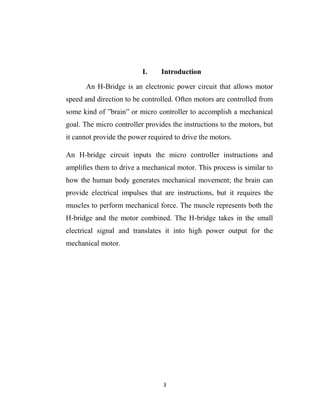
I.    Introduction

      An H-Bridge is an electronic power circuit that allows motor
speed and direction to be controlled. Often motors are controlled from
some kind of ”brain” or micro controller to accomplish a mechanical
goal. The micro controller provides the instructions to the motors, but
it cannot provide the power required to drive the motors.

An H-bridge circuit inputs the micro controller instructions and
amplifies them to drive a mechanical motor. This process is similar to
how the human body generates mechanical movement; the brain can
provide electrical impulses that are instructions, but it requires the
muscles to perform mechanical force. The muscle represents both the
H-bridge and the motor combined. The H-bridge takes in the small
electrical signal and translates it into high power output for the
mechanical motor.


                                 3
II.     Project Requirment


1.    MOSFET IRF 9540/540
2.    MICRO-CONTROLLER (PIC16F67X)
3.    COMPARATOR LM339
4.    PMDC MOTOR
5.    DIODE 1N4007
6.    PCB, WIRES, RESISTANCE, POTTENTIAL METER, REQULATOR
      7805, etc.


                             4
III. Design Schematic


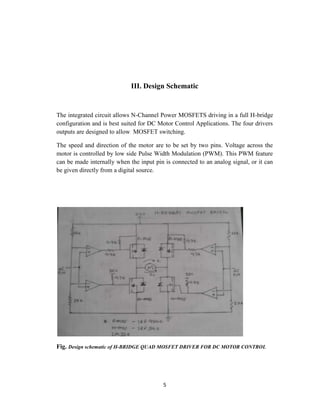
The integrated circuit allows N-Channel Power MOSFETS driving in a full H-bridge
configuration and is best suited for DC Motor Control Applications. The four drivers
outputs are designed to allow MOSFET switching.

The speed and direction of the motor are to be set by two pins. Voltage across the
motor is controlled by low side Pulse Width Modulation (PWM). This PWM feature
can be made internally when the input pin is connected to an analog signal, or it can
be given directly from a digital source.


Fig. Design schematic of H-BRIDGE QUAD MOSFET DRIVER FOR DC MOTOR CONTROL


                                         5
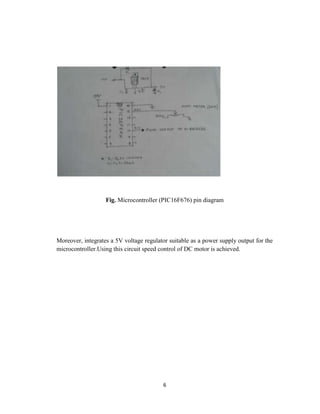
Fig. Microcontroller (PIC16F676) pin diagram


Moreover, integrates a 5V voltage regulator suitable as a power supply output for the
microcontroller.Using this circuit speed control of DC motor is achieved.


                                         6
III.WORKING

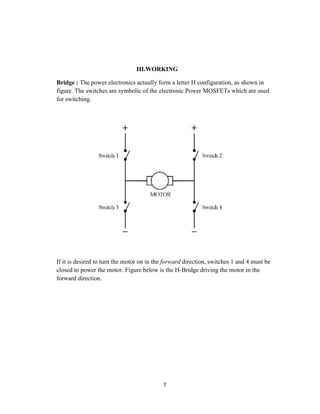
Bridge : The power electronics actually form a letter H configuration, as shown in
figure. The switches are symbolic of the electronic Power MOSFETs which are used
for switching.


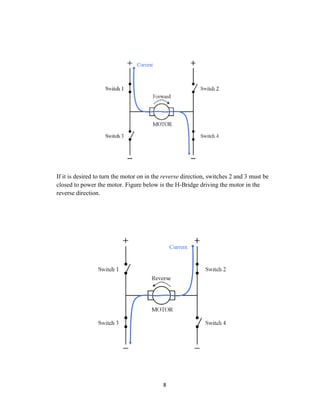
If it is desired to turn the motor on in the forward direction, switches 1 and 4 must be
closed to power the motor. Figure below is the H-Bridge driving the motor in the
forward direction.


                                           7
If it is desired to turn the motor on in the reverse direction, switches 2 and 3 must be
closed to power the motor. Figure below is the H-Bridge driving the motor in the
reverse direction.


                                            8
IV.Test Results


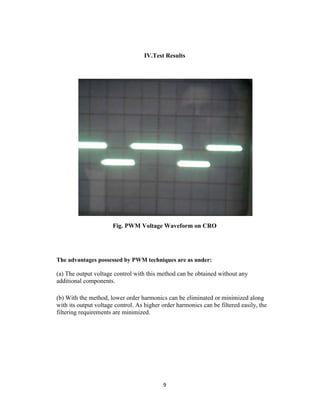
                       Fig. PWM Voltage Waveform on CRO


The advantages possessed by PWM techniques are as under:

(a) The output voltage control with this method can be obtained without any
additional components.

(b) With the method, lower order harmonics can be eliminated or minimized along
with its output voltage control. As higher order harmonics can be filtered easily, the
filtering requirements are minimized.


                                           9
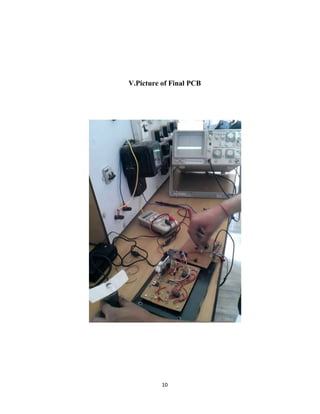
V.Picture of Final PCB


          10
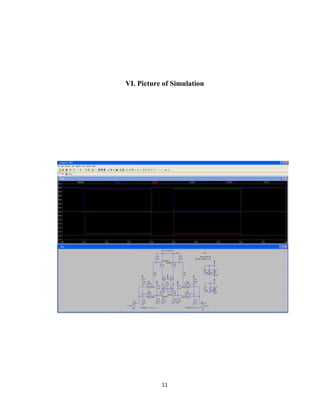
VI. Picture of Simulation


           11
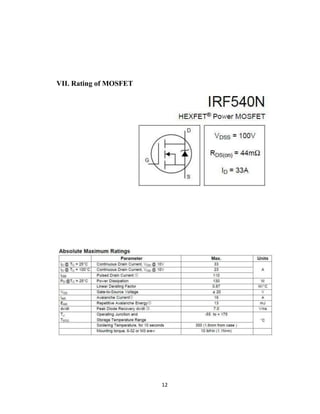
VII. Rating of MOSFET


                        12
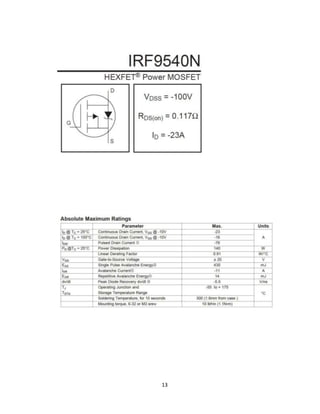
13
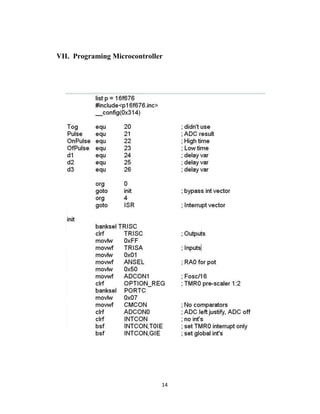
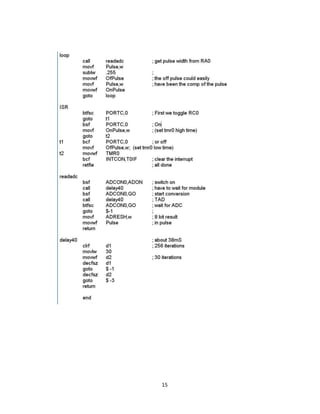
VII. Programing Microcontroller


                              14
15
V. Applications and conclusion


Most often H-bridges are used to control rotational direction of DC motor. And
unless you buy a potentially expensive motor-driver, you need an H-bridge to
control any robot with a motor.


                                     16

Hbridge

  • 1.
    “H-BRIDGE QUAD MOSFETDRIVER FOR DC MOTOR CONTROL” Submitted by Ritesh Kakkar 2011-12 DEPARTMENT OF ELECTRICAL & ELECTRONICS ENGINEERING SHIVALIK COLLEGE OF ENGINEERING DEHRADUN (UTTARAKHAND)-248001 1
  • 2.
    Acknowledgement A special thanks to Mr.Rohan Raj of the Department of Electrical & Electronics Engineering for his support and guidance throughout the Project preparation. Also, special thanks to Er.A.K.Gupta, Head of Department, Department of Electrical & Electronics Engineering for supporting our endeavor . 2
  • 3.
    I. Introduction An H-Bridge is an electronic power circuit that allows motor speed and direction to be controlled. Often motors are controlled from some kind of ”brain” or micro controller to accomplish a mechanical goal. The micro controller provides the instructions to the motors, but it cannot provide the power required to drive the motors. An H-bridge circuit inputs the micro controller instructions and amplifies them to drive a mechanical motor. This process is similar to how the human body generates mechanical movement; the brain can provide electrical impulses that are instructions, but it requires the muscles to perform mechanical force. The muscle represents both the H-bridge and the motor combined. The H-bridge takes in the small electrical signal and translates it into high power output for the mechanical motor. 3
  • 4.
    II. Project Requirment 1. MOSFET IRF 9540/540 2. MICRO-CONTROLLER (PIC16F67X) 3. COMPARATOR LM339 4. PMDC MOTOR 5. DIODE 1N4007 6. PCB, WIRES, RESISTANCE, POTTENTIAL METER, REQULATOR 7805, etc. 4
  • 5.
    III. Design Schematic Theintegrated circuit allows N-Channel Power MOSFETS driving in a full H-bridge configuration and is best suited for DC Motor Control Applications. The four drivers outputs are designed to allow MOSFET switching. The speed and direction of the motor are to be set by two pins. Voltage across the motor is controlled by low side Pulse Width Modulation (PWM). This PWM feature can be made internally when the input pin is connected to an analog signal, or it can be given directly from a digital source. Fig. Design schematic of H-BRIDGE QUAD MOSFET DRIVER FOR DC MOTOR CONTROL 5
  • 6.
    Fig. Microcontroller (PIC16F676)pin diagram Moreover, integrates a 5V voltage regulator suitable as a power supply output for the microcontroller.Using this circuit speed control of DC motor is achieved. 6
  • 7.
    III.WORKING Bridge : Thepower electronics actually form a letter H configuration, as shown in figure. The switches are symbolic of the electronic Power MOSFETs which are used for switching. If it is desired to turn the motor on in the forward direction, switches 1 and 4 must be closed to power the motor. Figure below is the H-Bridge driving the motor in the forward direction. 7
  • 8.
    If it isdesired to turn the motor on in the reverse direction, switches 2 and 3 must be closed to power the motor. Figure below is the H-Bridge driving the motor in the reverse direction. 8
  • 9.
    IV.Test Results Fig. PWM Voltage Waveform on CRO The advantages possessed by PWM techniques are as under: (a) The output voltage control with this method can be obtained without any additional components. (b) With the method, lower order harmonics can be eliminated or minimized along with its output voltage control. As higher order harmonics can be filtered easily, the filtering requirements are minimized. 9
  • 10.
  • 11.
    VI. Picture ofSimulation 11
  • 12.
    VII. Rating ofMOSFET 12
  • 13.
  • 14.
  • 15.
  • 16.
    V. Applications andconclusion Most often H-bridges are used to control rotational direction of DC motor. And unless you buy a potentially expensive motor-driver, you need an H-bridge to control any robot with a motor. 16