Electric Locomotive
Submitted To
Dr. Dwarka Prasad
(Principal)
(LIET polytechnic Alwar)
Submitted By
Subhash Kumar
B.Tech (Final Year)
(Roll. No-14ELDEE052)
INTRODUCTION
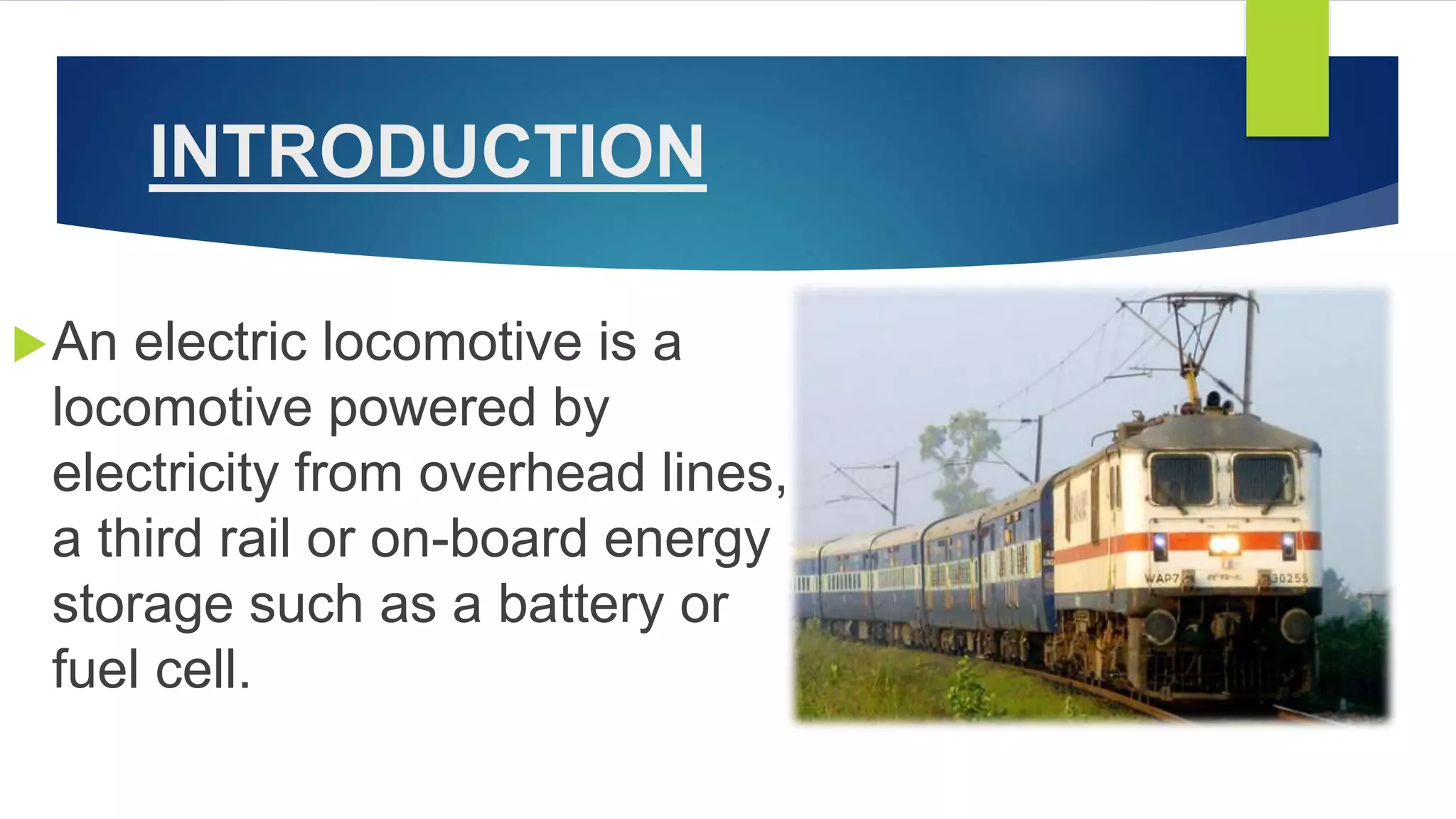
An electric locomotive is a
locomotive powered by
electricity from overhead lines,
a third rail or on-board energy
storage such as a battery or
fuel cell.
History in India
Railway electrification in India began
with the first electric train, between
Bombay Victoria Terminus and Kurla on
the Harbour Line, on 3 February 1925
on the Great Indian Peninsula Railway
(GIPR) at 1500 V DC.
TRACTION SYSTEMS
 A system which causes the propulsion of
vehicle in which tractive or driving force is
obtained from various devices such as diesel
engine drives, steam engine drives, electric
motors, etc. is called as traction system.
Cont.
The traction system can be classified as non-electric
and electric traction systems.
 Non-electric tractionsystem
 Electrictraction system
Non-Electric Traction System
A traction system that doesn’t use
electrical energy for the movement of
vehicle at any stage is referred as
non-electric traction system.
Example NETS
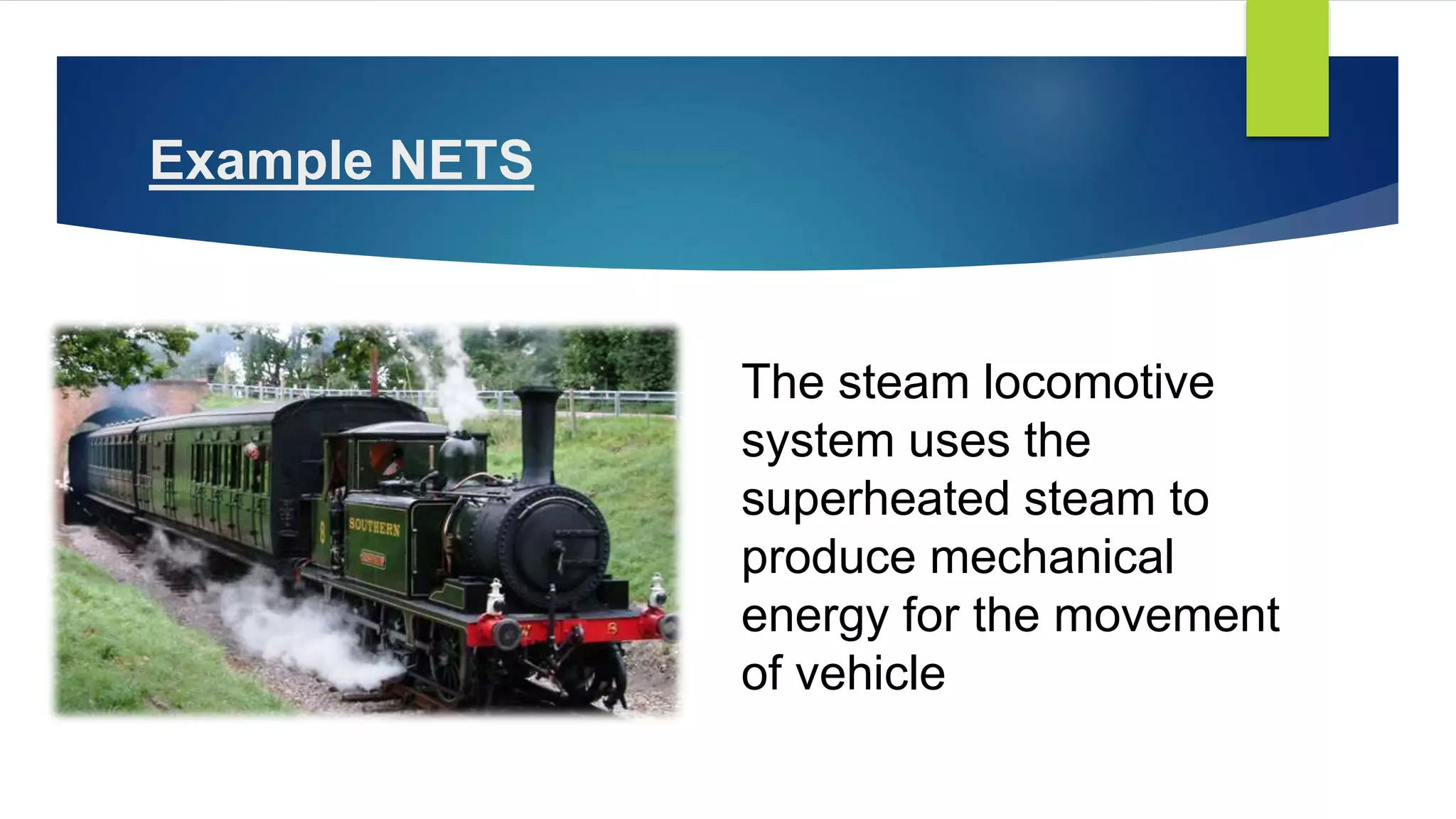
The steam locomotive
system uses the
superheated steam to
produce mechanical
energy for the movement
of vehicle
Electric traction system
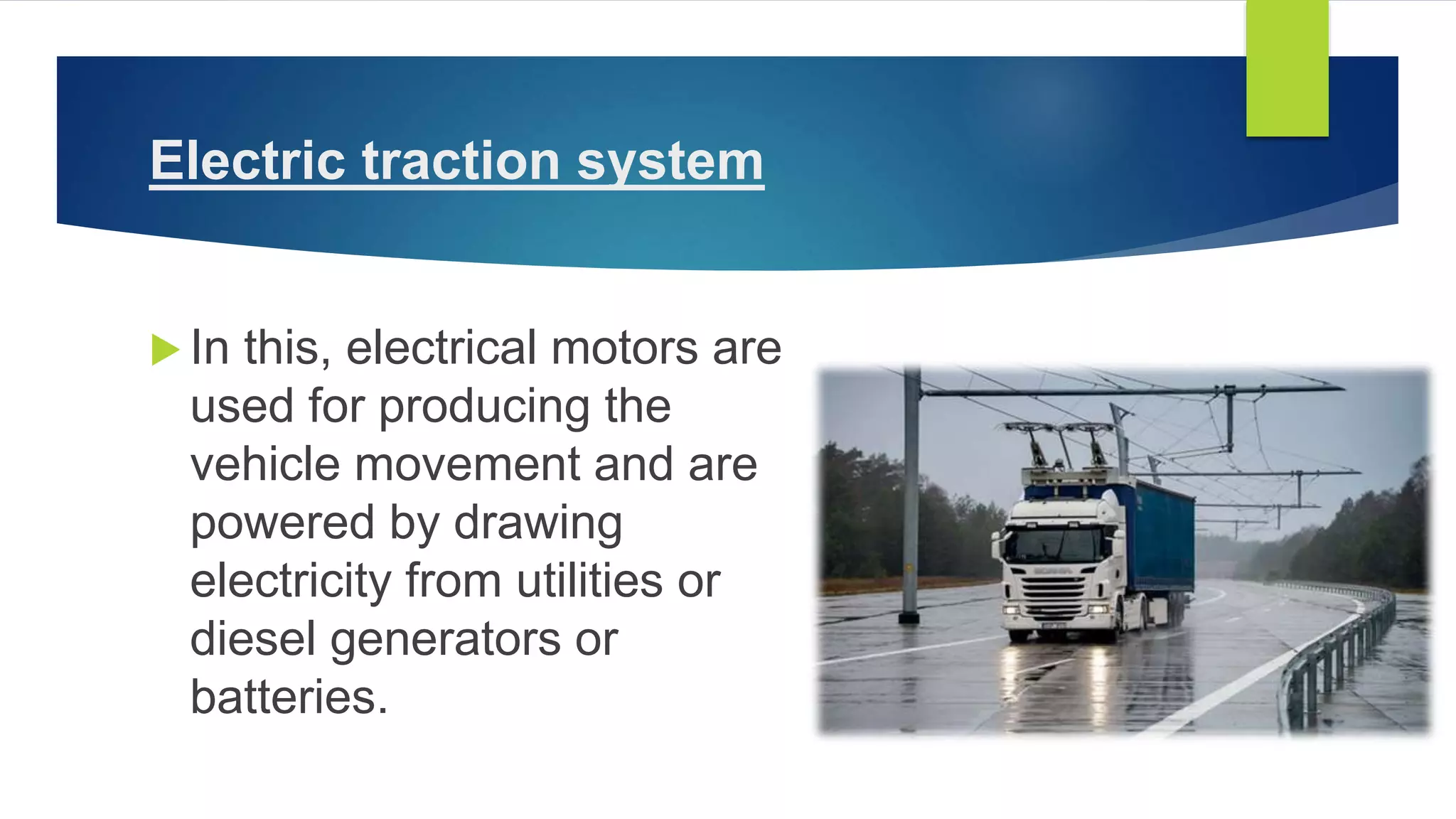
 In this, electrical motors are
used for producing the
vehicle movement and are
powered by drawing
electricity from utilities or
diesel generators or
batteries.
Supply Systems of Electric Traction
DC traction system
Single phase AC traction system
Three phase AC traction system
Composite traction system
1. DC Traction System
 In this traction system, electrical motors are operates on
DC supply to produce necessary movement of the vehicle.
 Mostly DC series motors are used in this system.
 DC compound motors are used where regenerative
braking is required.
 only one conductor or rail is required to supply power to
locomotive while track rails are used as return conductors
in majority of cases.
Cont….
 This single phase low voltage is then
converted into DC voltage using suitable
converters or rectifier such as power
electronic converter, rotary converters,
mercury arc converters, etc. The DC supply is
then applied to the DC motor via suitable
contact system.
2.Single Phase AC Traction System
 In this type of traction system, AC series motors are
used to produce the propulsion of vehicle.
 This single phase supply is fed to the locomotive unit
via a single overhead line while track provides the
return path.
 The secondary tapping of this transformer offer
variable voltage to AC series motor for speed
regulation.
3.Three Phase AC Traction System
 In this, three phase induction motors are used
for the movement of locomotive.
 This system employs two overhead lines for
two phases, whereas the track forms third
phase.
4.Composite Traction System
 So by combining the advantages of AC/DC
and single/three phase systems, the overall
performance of the traction system gives
better result than individual system.
Main Parts of AC Electric Locomotive
 Pantograph
 Circuit Breaker
 Transformer
 Rectifier
 Main Inverter
 Battery
Pantograph
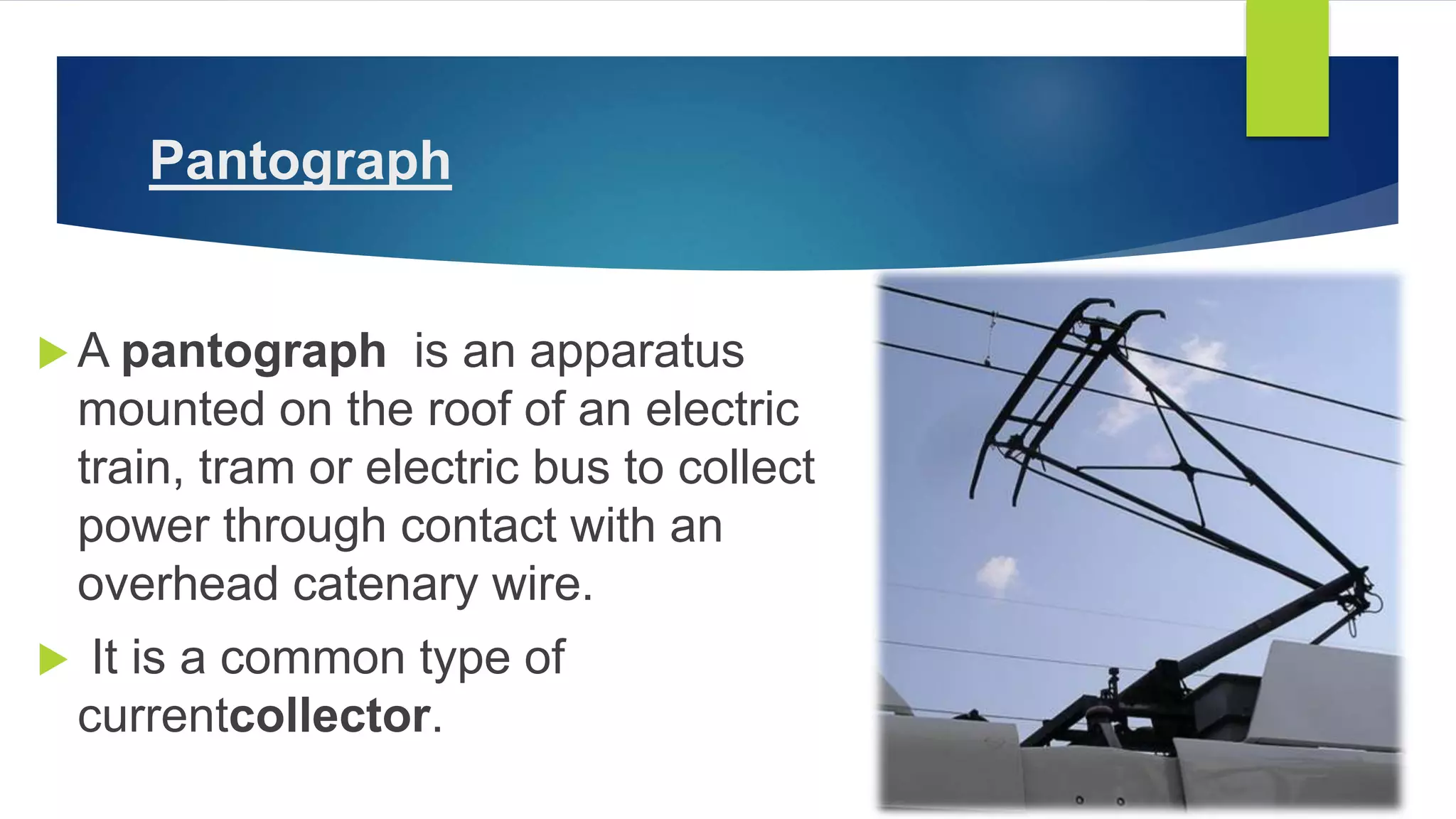
 A pantograph is an apparatus
mounted on the roof of an electric
train, tram or electric bus to collect
power through contact with an
overhead catenary wire.
 It is a common type of
currentcollector.
Circuit Breaker
 A circuit breaker is a switching
device that interrupts the abnormal
or fault current. It is a mechanical
device that disturbs the flow of high
magnitude (fault) current and in
additions performs the function of a
switch.
Circuit Breaker
Transformer
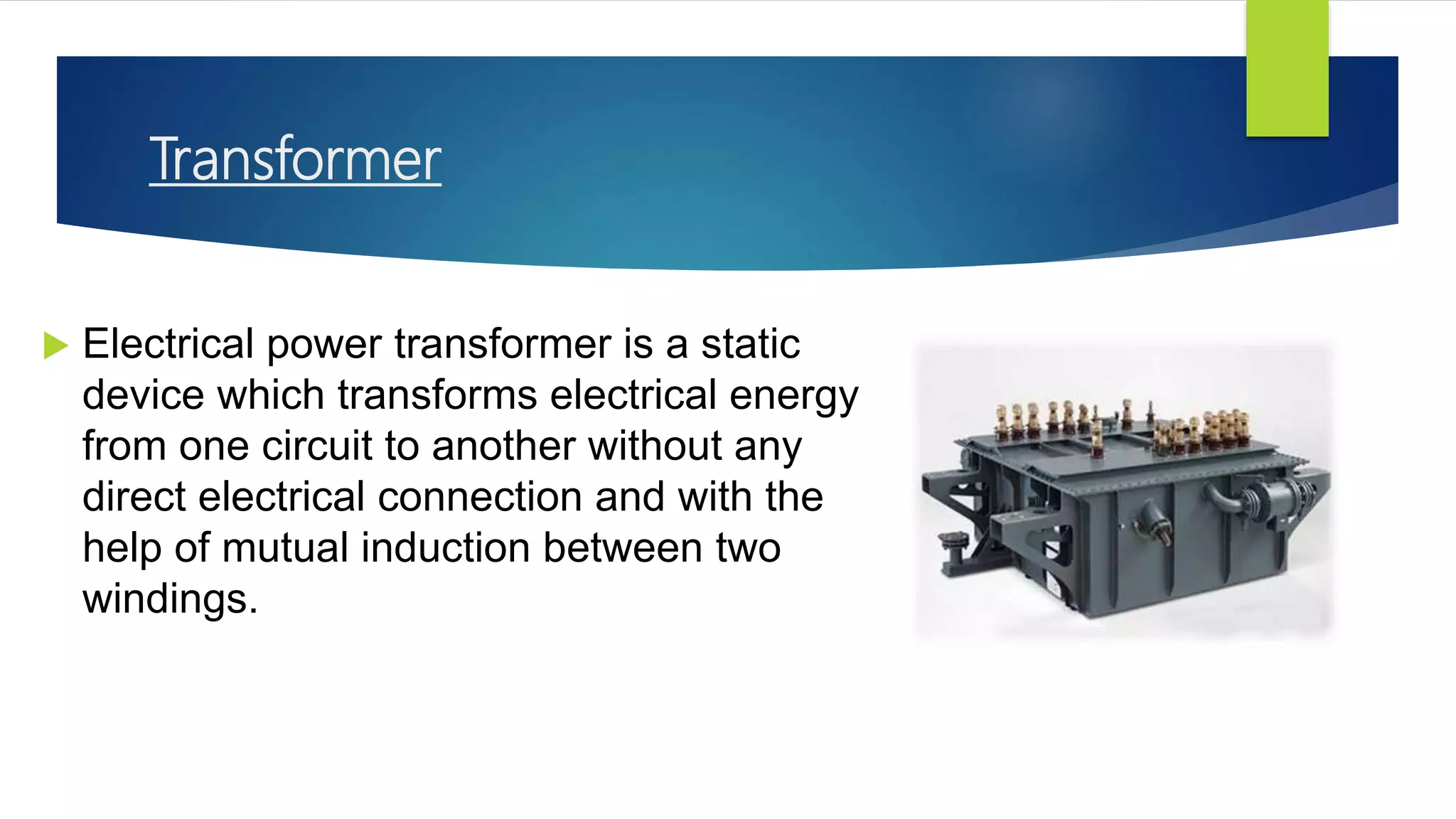
 Electrical power transformer is a static
device which transforms electrical energy
from one circuit to another without any
direct electrical connection and with the
help of mutual induction between two
windings.
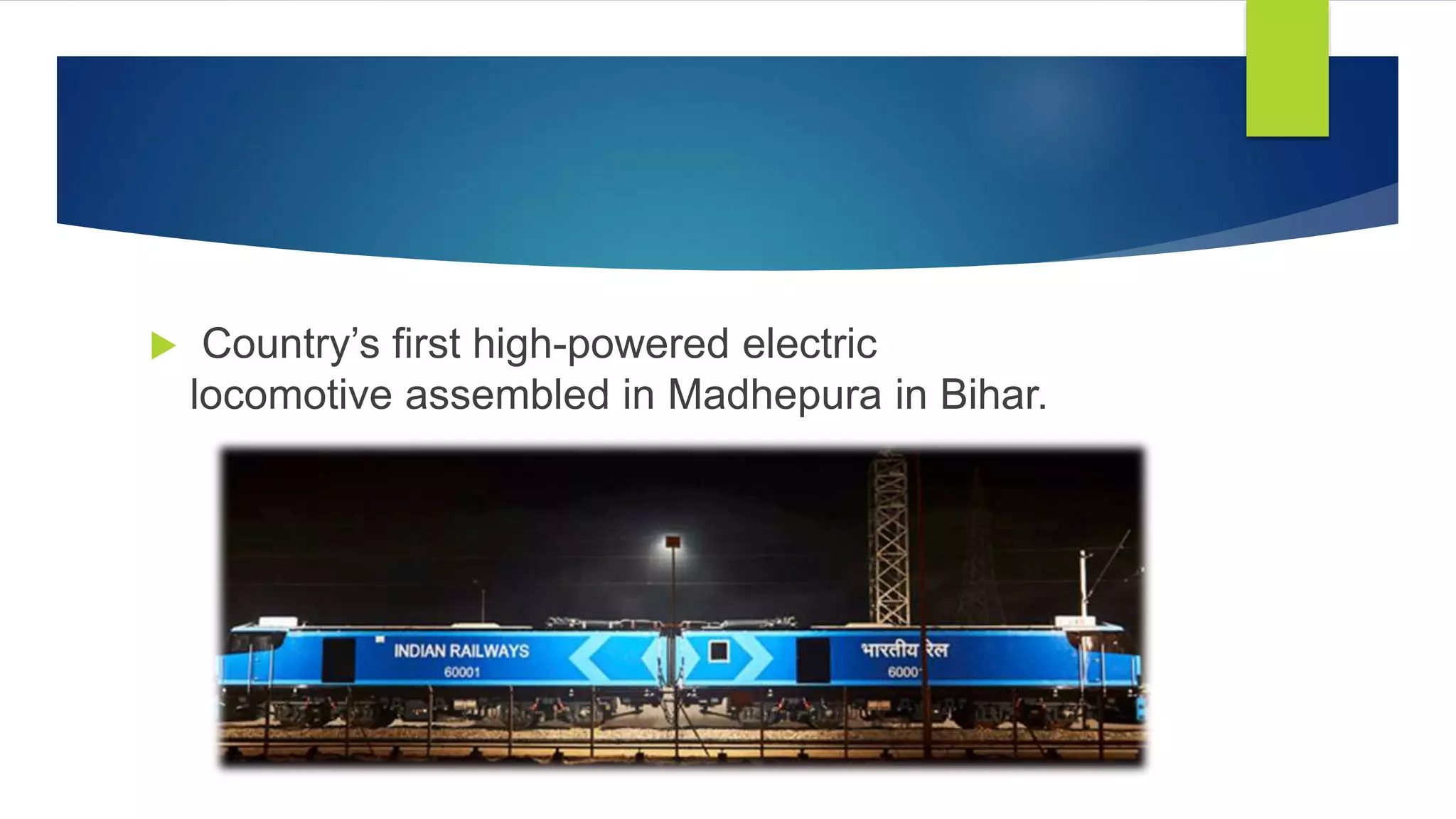
 Country’s first high-powered electric
locomotive assembled in Madhepura in Bihar.
Key Facts
 12000 horsepower (HP) engine .
 maximum speed of 110 km per hour.
 The high horsepower electric locos are equipped
with IGBT (IGBT based propulsion technology)
based propulsion technology.
IGBT based propulsion technology
 It has three-terminal power semiconductor device
primarily used as electronic switch. It gives
combined advantages of high efficiency and fast
switching. It offers greater power gain than standard
bipolar type transistor combined with the higher
voltage operation and lower input losses.
Advantage of electric locomotives
 High starting torque
 Less maintenance required.
 Pollution free.
 Economical operating cost.
 Easy supply of power
 Regenerative braking.
Disadvantage
 High capital cost
 Less flexibility of routes.
 Interference of communication lines.
Future Scope
 In the next five years, Indian railway market will be the 3rd
largest, accounting to 10% of the global market and Metro
rail is going to be 70% of the railway market in India.
 In India, due to increasing population and economic
expansion, the electricity demand and supply balance is
skewed. To tackle the situation we need to develop eco-
friendly cities with more public transports. This need leads to
the expansion of Metro rail network.
REFRENCES
[1].Haut ,F.J.G, “The history of the electric locomotive”, Allen & Unwin,
1969(“https://books.google.co.in/books?id=NyNSAAAAMAAJ&q=electric+lo
comotive&dq=electric+locomotive&hl=en&sa=X&ved=0ahUKEwiwzqre55Pa
AhUHPo8KHWhpD6QQ6AEIKDAA”).
[2] Basil Knowlman Cooper, “Electric Railways”, I. Allan, 1965,url(
https://books.google.co.in/books?id=uxUKAAAAMAAJ&dq=electric+locomot
ive&source=gbs_book_similarbooks).
Electric locomotive ppt

Electric locomotive ppt

  • 1.
    Electric Locomotive Submitted To Dr.Dwarka Prasad (Principal) (LIET polytechnic Alwar) Submitted By Subhash Kumar B.Tech (Final Year) (Roll. No-14ELDEE052)
  • 2.
    INTRODUCTION An electric locomotiveis a locomotive powered by electricity from overhead lines, a third rail or on-board energy storage such as a battery or fuel cell.
  • 3.
    History in India Railwayelectrification in India began with the first electric train, between Bombay Victoria Terminus and Kurla on the Harbour Line, on 3 February 1925 on the Great Indian Peninsula Railway (GIPR) at 1500 V DC.
  • 4.
    TRACTION SYSTEMS  Asystem which causes the propulsion of vehicle in which tractive or driving force is obtained from various devices such as diesel engine drives, steam engine drives, electric motors, etc. is called as traction system.
  • 5.
    Cont. The traction systemcan be classified as non-electric and electric traction systems.  Non-electric tractionsystem  Electrictraction system
  • 6.
    Non-Electric Traction System Atraction system that doesn’t use electrical energy for the movement of vehicle at any stage is referred as non-electric traction system.
  • 7.
    Example NETS The steamlocomotive system uses the superheated steam to produce mechanical energy for the movement of vehicle
  • 8.
    Electric traction system In this, electrical motors are used for producing the vehicle movement and are powered by drawing electricity from utilities or diesel generators or batteries.
  • 9.
    Supply Systems ofElectric Traction DC traction system Single phase AC traction system Three phase AC traction system Composite traction system
  • 10.
    1. DC TractionSystem  In this traction system, electrical motors are operates on DC supply to produce necessary movement of the vehicle.  Mostly DC series motors are used in this system.  DC compound motors are used where regenerative braking is required.  only one conductor or rail is required to supply power to locomotive while track rails are used as return conductors in majority of cases.
  • 11.
    Cont….  This singlephase low voltage is then converted into DC voltage using suitable converters or rectifier such as power electronic converter, rotary converters, mercury arc converters, etc. The DC supply is then applied to the DC motor via suitable contact system.
  • 12.
    2.Single Phase ACTraction System  In this type of traction system, AC series motors are used to produce the propulsion of vehicle.  This single phase supply is fed to the locomotive unit via a single overhead line while track provides the return path.  The secondary tapping of this transformer offer variable voltage to AC series motor for speed regulation.
  • 13.
    3.Three Phase ACTraction System  In this, three phase induction motors are used for the movement of locomotive.  This system employs two overhead lines for two phases, whereas the track forms third phase.
  • 14.
    4.Composite Traction System So by combining the advantages of AC/DC and single/three phase systems, the overall performance of the traction system gives better result than individual system.
  • 15.
    Main Parts ofAC Electric Locomotive  Pantograph  Circuit Breaker  Transformer  Rectifier  Main Inverter  Battery
  • 16.
    Pantograph  A pantographis an apparatus mounted on the roof of an electric train, tram or electric bus to collect power through contact with an overhead catenary wire.  It is a common type of currentcollector.
  • 17.
    Circuit Breaker  Acircuit breaker is a switching device that interrupts the abnormal or fault current. It is a mechanical device that disturbs the flow of high magnitude (fault) current and in additions performs the function of a switch. Circuit Breaker
  • 18.
    Transformer  Electrical powertransformer is a static device which transforms electrical energy from one circuit to another without any direct electrical connection and with the help of mutual induction between two windings.
  • 19.
     Country’s firsthigh-powered electric locomotive assembled in Madhepura in Bihar.
  • 20.
    Key Facts  12000horsepower (HP) engine .  maximum speed of 110 km per hour.  The high horsepower electric locos are equipped with IGBT (IGBT based propulsion technology) based propulsion technology.
  • 21.
    IGBT based propulsiontechnology  It has three-terminal power semiconductor device primarily used as electronic switch. It gives combined advantages of high efficiency and fast switching. It offers greater power gain than standard bipolar type transistor combined with the higher voltage operation and lower input losses.
  • 22.
    Advantage of electriclocomotives  High starting torque  Less maintenance required.  Pollution free.  Economical operating cost.  Easy supply of power  Regenerative braking.
  • 23.
    Disadvantage  High capitalcost  Less flexibility of routes.  Interference of communication lines.
  • 24.
    Future Scope  Inthe next five years, Indian railway market will be the 3rd largest, accounting to 10% of the global market and Metro rail is going to be 70% of the railway market in India.  In India, due to increasing population and economic expansion, the electricity demand and supply balance is skewed. To tackle the situation we need to develop eco- friendly cities with more public transports. This need leads to the expansion of Metro rail network.
  • 25.
    REFRENCES [1].Haut ,F.J.G, “Thehistory of the electric locomotive”, Allen & Unwin, 1969(“https://books.google.co.in/books?id=NyNSAAAAMAAJ&q=electric+lo comotive&dq=electric+locomotive&hl=en&sa=X&ved=0ahUKEwiwzqre55Pa AhUHPo8KHWhpD6QQ6AEIKDAA”). [2] Basil Knowlman Cooper, “Electric Railways”, I. Allan, 1965,url( https://books.google.co.in/books?id=uxUKAAAAMAAJ&dq=electric+locomot ive&source=gbs_book_similarbooks).