Designing School-Wide Systems for Student
                      Success
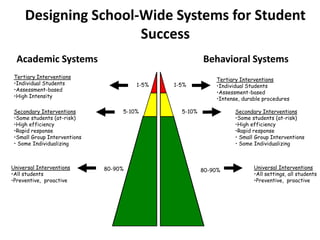
  Academic Systems                                      Behavioral Systems
 Tertiary Interventions                                     Tertiary Interventions
 •Individual Students                  1-5%   1-5%          •Individual Students
 •Assessment-based                                          •Assessment-based
 •High Intensity                                            •Intense, durable procedures

 Secondary Interventions           5-10%        5-10%              Secondary Interventions
 •Some students (at-risk)                                          •Some students (at-risk)
 •High efficiency                                                  •High efficiency
 •Rapid response                                                   •Rapid response
 •Small Group Interventions                                        • Small Group Interventions
 • Some Individualizing                                            • Some Individualizing


Universal Interventions       80-90%                                      Universal Interventions
                                                        80-90%
•All students                                                             •All settings, all students
•Preventive, proactive                                                    •Preventive, proactive
What is PBIS?
• A team-based process including a broad range of
  systemic & individualized strategies for achieving
  important social & learning outcomes.

• PBIS is a proactive approach to teach, monitor, and
  support appropriate school behavior for ALL students

• A focus on preventing problem behavior of all
  students at the school-wide, classroom, non-
  classroom & individual levels.
What is PBIS?
• Relies on research-based behavioral and
  instructional principles.

• Focuses on the critical link between instruction and
  desired student behavioral outcomes.

• Data-driven decision making is key to design and
  sustainability of behavior plan.
What is PBIS?
• Emphasis on positive climate

• Comprehensive - uses a variety of
  supports

• Proactive and preventive

• Ultimate purpose of Positive Behavior
  Support is students achieving
What PBIS is NOT
• A packaged curriculum
• A quick fix
• Newest, flashiest behavior program
• Just about tangible reinforcers
• Just about discipline
• A special education program
• Just for some of the students
How Can PBIS Help?
• Reduction in Office Discipline Referrals
• Improved faculty/staff morale
• Increased instructional time
• Increase in academic achievement
• Creates a positive school culture
The 7 Components of
               PBIS Frameworks:
1. Agreed upon & common       5. Continuum of procedures for
   approach to discipline        encouraging expectations

2. Positive Statement of      6. Continuum of procedures for
   Purpose                       discouraging rule-violating
                                 behavior
3. 3-5 expectations for all
   students & staff           7. Procedures for monitoring and
                                 evaluating effectiveness of the
4. Procedures for teaching       PBIS framework
   expectations
                                                             7
Tier 1: School-Wide Support
Components:
• Develop 3-5 positively stated school-wide
  expectations
• Teach the behaviors necessary to follow the rules.
• School-wide reinforcement plan.
• Core team meets regularly to monitor, plan, make
  recommendations and update staff
• Administrator support and involvement
• Data drives decision-making
Tier 1: School-Wide Support
Components:
• Develop 3-5 positively stated school-wide
  expectations
• Teach the behaviors necessary to follow the rules.
• School-wide reinforcement plan.
• Core team meets regularly to monitor, plan, make
  recommendations and update staff
• Administrator support and involvement
• Data drives decision-making
Tier 1: School-Wide
               Interventions
• Target the whole student body
• Proactive, preventive approach
• Well designed rules, routines, and
  physical arrangements
• Clear expectations in all locations
  including non-instructional
  (playground, bus, halls, cafeteria)

• “Everyone knows the rules.”
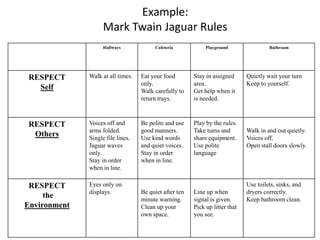
Example:
                    Mark Twain Jaguar Rules
                    Hallways            Cafeteria            Playground                Bathroom


 RESPECT      Walk at all times.   Eat your food        Stay in assigned      Quietly wait your turn
                                   only.                area.                 Keep to yourself.
   Self                            Walk carefully to    Get help when it
                                   return trays.        is needed.


 RESPECT      Voices off and       Be polite and use    Play by the rules.
              arms folded.         good manners.        Take turns and        Walk in and out quietly.
  Others      Single file lines.   Use kind words       share equipment.      Voices off.
              Jaguar waves         and quiet voices.    Use polite            Open stall doors slowly.
              only.                Stay in order        language
              Stay in order        when in line.
              when in line.

 RESPECT      Eyes only on                                                    Use toilets, sinks, and
              displays.            Be quiet after ten   Line up when          dryers correctly.
     the                           minute warning.      signal is given.      Keep bathroom clean.
Environment                        Clean up your        Pick up litter that
                                   own space.           you see.
Classroom Setting
                     Systems
• Classroom-wide positive expectations taught & encouraged

• Teaching classroom routines & cues taught & encouraged

• Ratio of 4:1 (positive to negative adult-student interaction)

• Active supervision

• Redirections for minor, infrequent behavior errors

• Frequent pre-corrections for chronic errors

• Effective academic instruction & curriculum
DATA COLLECTION
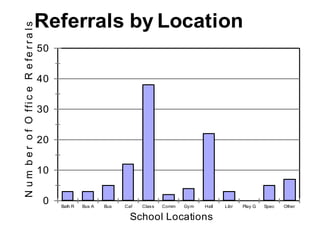
Referrals by Location
N u m b e r o f O ffi c e R e fe r r a l s
                                             50


                                             40


                                             30


                                             20


                                             10


                                              0   Bath R   Bus A   Bus   Caf   Class   Comm   Gym   Hall   Libr   Play G   Spec   Other

                                                                           School Locations
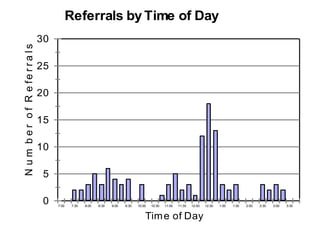
Referrals by Time of Day
                                   30
N u m b e r o f R e fe r r a l s


                                   25

                                   20

                                   15

                                   10

                                    5

                                    0   7:00    7:30   8:00   8:30   9:00   9:30   10:00   10:30   11:00   11:30   12:00   12:30   1:00   1:30   2:00   2:30   3:00   3:30


                                                                                       Tim e of Day
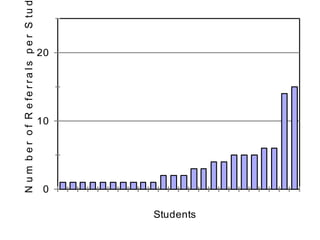
N u m b e r o f R e fe r r a l s p e r S tu d


           0
                          10
                                          20


Students
What does a PBIS School look
               like?
• 80% of students can state the school rules & give
  behavioral example
• Positive adult-to-student interactions exceed
  negative
• Ongoing data collection & team-based planning &
  implementation
• Administrators are active participants.
• Continuum of behavior support is available to all
  students
www.pbisworld.com
For more information on interventions you can use in your classroom
Classroom
Management
&Discipline
Behavior is Learned
Behavior is learned. Somewhere along the line
they have learned that this behavior gets them
what they want.

Functions:
• To get something
• To avoid something
Teacher Caused Problem Behavior
• Inconsistent enforcement of school rules
• Extra assignments for poor behavior (not logical
  consequence)
• Handling personal behavior issues in front of an
  entire class of students
• Group punishments
• Yelling/nagging
• Becoming emotionally involved in student’s
  misbehavior
• Threats/ultimatums
Things We Can Control
• Student learning experience in our classroom
• Academics: Quality and Quantity
• Student Active Engagement
What Students Expect From Us
•   Teachers that care about them
•   Teachers who are understanding
•   Teachers who are patient
•   Teachers who are consistent
•   Teachers who are fair
•   Teachers who believe in them
•   Teachers who hold high expectations for them
•   Teachers who don’t embarrass them
Characteristics of Well-Managed
               Class
• High level of student
  involvement/engagement
• Relatively little amount of wasted
  time, confusion, and disruption
• Work-oriented, but positive climate
• Discipline plan for reinforcement of wanted
  behaviors and hierarchy of consequences for
  problem behaviors
Characteristics of Well-Managed
               Class
• Starts and ends class on-time
• Has agenda, assignments, objectives posted
• Teacher circulates and scans, not sitting at
  desk
• Teacher understands they are the role-model
• Able to set limits and stick to them
  consistently
Characteristics of Well-Managed
               Class
• Teacher invests time in teaching/practicing
  procedures until they are routine.
• Has a signal to bring class to attention
• Know how to praise and encourage
• Meets students at the door every day
• Gives students jobs, everyone has a role
• Teaches school wide rules frequently
  throughout the entire year
Characteristics of Well-Managed
               Class
• Corrects and gives feedback on behavior using
  the school rule language (in order to be
  respectful you need to….)
• Uses consequences that are logical and don’t
  reinforce problem behavior
Students Need to be Taught
             Procedures

•   A signal to get your attention
•   How to enter and leave classroom
•   How to obtain and use materials in your room
•   How to leave class for a personal matter
•   How to respond when intercom
    announcements occur
CHAMPS
Conversation: Can students talk to each other during
  this activity/transition?
Help: How can students ask questions during this
  activity/transition? How do they get your attention?
Activity: What is the task/objective of this
  activity/transition? What is the expected end
  product?
Movement: Can students move about during this
  activity/transition? Can they sharpen their pencil?
Participation: What does appropriate student work
  behavior for this activity/transition look/sound like?
Room Arrangement
• Arrange desks so that all students are easily
  visible….pairs, triads, foursomes promote
  active engagement
• Allow for room to move between aisles
• Plan for student belongings
• Have a consistent place for day/week’s
  assignments/objectives
• Place large sample of heading for student
  work
Giving Students Non-Verbal Cues
•   Stop Speaking…be silent
•   Look at student for a period of time
•   Walk near the student
•   Put your hand on the student’s desk
•   Point to the work that should be done
Giving Students Verbal Reminders
• Say the student’s name
• Don’t yell….state the expectation. “You need
  to………..to be responsible”
• Reinforce those students who are on-task
Universal Behavior Strategies
•   Planned Ignoring
•   Quiet Signal
•   Wait Time
•   Forced Choices
•   Teach Routines Explicitly
•   Proximity
Group Contingencies
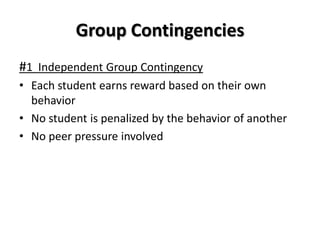
#1 Independent Group Contingency
• Each student earns reward based on their own
  behavior
• No student is penalized by the behavior of another
• No peer pressure involved
Group Contingencies
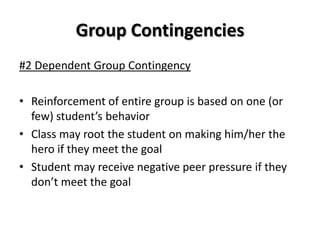
#2 Dependent Group Contingency

• Reinforcement of entire group is based on one (or
  few) student’s behavior
• Class may root the student on making him/her the
  hero if they meet the goal
• Student may receive negative peer pressure if they
  don’t meet the goal
Group Contingencies
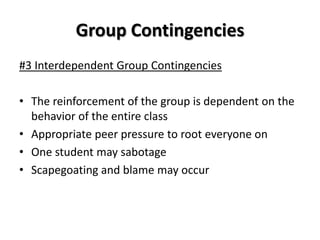
#3 Interdependent Group Contingencies

• The reinforcement of the group is dependent on the
  behavior of the entire class
• Appropriate peer pressure to root everyone on
• One student may sabotage
• Scapegoating and blame may occur
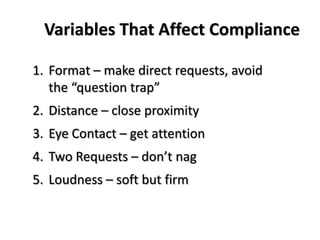
Variables That Affect Compliance

1. Format – make direct requests, avoid
   the “question trap”
2. Distance – close proximity
3. Eye Contact – get attention
4. Two Requests – don’t nag
5. Loudness – soft but firm
Variable that Affect Compliance

6. Time – allow time to comply
7. Start Requests – tell child what to DO
8. Non-emotional requests - no negative
9. Descriptive Requests – clear, observable
10.Reinforce Compliance - consistency
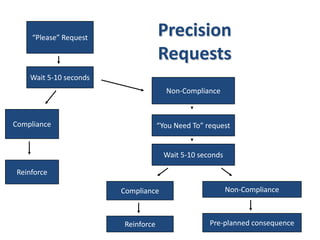
“Please” Request
                                    Precision
                                    Requests
    Wait 5-10 seconds
                                      Non-Compliance


Compliance                          “You Need To” request


                                     Wait 5-10 seconds

Reinforce

                        Compliance                       Non-Compliance


                        Reinforce                  Pre-planned consequence
Teacher Attitudes & Beliefs
• Student behavior is part of the job
• Every discipline issue is a teaching opportunity
• Most student’s don’t get the opportunity to
  practice the wanted behavior, we typically
  exclude them from the activity
• Student behavior can’t be taken personally
• Anyone can become aggressive depending on
  the circumstances
Building and Sustaining
             Relationships
• Sometimes little things matter most
• Greet students personally and say good bye to
  them everyday
• Call students by their name
• Find their strengths and build on them
• Tell personal stories that relate…let them know
  you
• Teach empathy by apologizing
• LISTEN!!!
• Say no and give consequences respectfully
Risk Factors for Aggressive
               Behavior

• A lack of coping skills or ability to handle life
  crises
• Frequent school or discipline problems
• History of drug/alcohol abuse
• Refusal to follow adult direction
• Witness to violent acts in family/community
Risk Factors for Aggressive
              Behavior

• Inability to sympathize or empathize
• No inhibition to show anger
• Feelings of being picked on, bullied, or
  persecuted
• Expressions of violence in drawing or writing
Power Struggles
•   Time constrains
•   Fatigue
•   Innate desire to win
•   Behavioral patterns
•   Insufficient training on student or teachers
    part
Working with Angry Students
• Respond Professionally
• When consequences are necessary, be business-
  like in the delivery
• Make sure consequences are logical
• Remember they will be returning to your
  classroom
• When you aren’t sure what to say, say NOTHING
• Now is not the time to place blame
Dealing with Difficult Behavior


• Ensure safety first…if other students are
  near, clear them to a safe area (do not try to
  move the student)
Calming Techniques
• Do not become angry
• Accept the situation….it is here
• Focus on the goal of calming the person. Resolving the
  problem that caused the situation is now secondary
• Look for any action that will calm the person, do not
  focus on what they are doing wrong right now.
• Acknowledge the anger with statements like
   – I understand that you are angry
   – I see that you need some time to cool off
   – I’m sorry that you feel this way
• Do not take anything said personally
De-Escalation
• Disarm the attitude – quickly agree with the
  person. This technique can take the steam
  out of the anger and calm them quickly.
• Reiteration – simply repeat the person’s own
  words so he/she knows you are not going to
  fight or argue about the situation
• Isolation – say, “we can’t talk publically about
  this, but let’s talk privately. I don’t want other
  people to think you have lost control.
What Works?
•   Gather pertinent information
•   Defer action
•   Refuse to be “baited”
•   Develop a plan to get help
•   Learn to apologize
•   Listen to body language
•   Remain calm and in control
What Works?
• Respond empathetically – don’t interrupt
• Remain non-judgmental
• Use their name
• Give choices that are clear, concise, and
  enforceable
• Listen
• Use credible witnesses
• Move on
“I have come to a frightening conclusion. I am the
    decisive element in the classroom. It is my
 personal approach that creates the climate. It is
   my daily mood that makes the weather. As a
 teacher I possess tremendous power to make a
 child's life miserable or joyous. I can be a tool of
   torture or an instrument of inspiration. I can
       humiliate or humor, hurt or heal. In all
situations, it is my response that decides whether
  a crisis will be escalated or de-escalated, and a
         child humanized or de-humanized.”
                                        - Haim Ginott

Hbg new teacherinduction

  • 1.
    Designing School-Wide Systemsfor Student Success Academic Systems Behavioral Systems Tertiary Interventions Tertiary Interventions •Individual Students 1-5% 1-5% •Individual Students •Assessment-based •Assessment-based •High Intensity •Intense, durable procedures Secondary Interventions 5-10% 5-10% Secondary Interventions •Some students (at-risk) •Some students (at-risk) •High efficiency •High efficiency •Rapid response •Rapid response •Small Group Interventions • Small Group Interventions • Some Individualizing • Some Individualizing Universal Interventions 80-90% Universal Interventions 80-90% •All students •All settings, all students •Preventive, proactive •Preventive, proactive
  • 2.
    What is PBIS? •A team-based process including a broad range of systemic & individualized strategies for achieving important social & learning outcomes. • PBIS is a proactive approach to teach, monitor, and support appropriate school behavior for ALL students • A focus on preventing problem behavior of all students at the school-wide, classroom, non- classroom & individual levels.
  • 3.
    What is PBIS? •Relies on research-based behavioral and instructional principles. • Focuses on the critical link between instruction and desired student behavioral outcomes. • Data-driven decision making is key to design and sustainability of behavior plan.
  • 4.
    What is PBIS? •Emphasis on positive climate • Comprehensive - uses a variety of supports • Proactive and preventive • Ultimate purpose of Positive Behavior Support is students achieving
  • 5.
    What PBIS isNOT • A packaged curriculum • A quick fix • Newest, flashiest behavior program • Just about tangible reinforcers • Just about discipline • A special education program • Just for some of the students
  • 6.
    How Can PBISHelp? • Reduction in Office Discipline Referrals • Improved faculty/staff morale • Increased instructional time • Increase in academic achievement • Creates a positive school culture
  • 7.
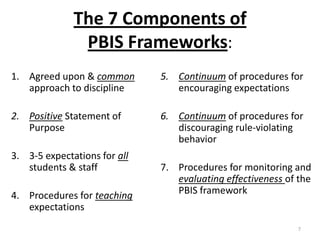
    The 7 Componentsof PBIS Frameworks: 1. Agreed upon & common 5. Continuum of procedures for approach to discipline encouraging expectations 2. Positive Statement of 6. Continuum of procedures for Purpose discouraging rule-violating behavior 3. 3-5 expectations for all students & staff 7. Procedures for monitoring and evaluating effectiveness of the 4. Procedures for teaching PBIS framework expectations 7
  • 8.
    Tier 1: School-WideSupport Components: • Develop 3-5 positively stated school-wide expectations • Teach the behaviors necessary to follow the rules. • School-wide reinforcement plan. • Core team meets regularly to monitor, plan, make recommendations and update staff • Administrator support and involvement • Data drives decision-making
  • 9.
    Tier 1: School-WideSupport Components: • Develop 3-5 positively stated school-wide expectations • Teach the behaviors necessary to follow the rules. • School-wide reinforcement plan. • Core team meets regularly to monitor, plan, make recommendations and update staff • Administrator support and involvement • Data drives decision-making
  • 10.
    Tier 1: School-Wide Interventions • Target the whole student body • Proactive, preventive approach • Well designed rules, routines, and physical arrangements • Clear expectations in all locations including non-instructional (playground, bus, halls, cafeteria) • “Everyone knows the rules.”
  • 11.
    Example: Mark Twain Jaguar Rules Hallways Cafeteria Playground Bathroom RESPECT Walk at all times. Eat your food Stay in assigned Quietly wait your turn only. area. Keep to yourself. Self Walk carefully to Get help when it return trays. is needed. RESPECT Voices off and Be polite and use Play by the rules. arms folded. good manners. Take turns and Walk in and out quietly. Others Single file lines. Use kind words share equipment. Voices off. Jaguar waves and quiet voices. Use polite Open stall doors slowly. only. Stay in order language Stay in order when in line. when in line. RESPECT Eyes only on Use toilets, sinks, and displays. Be quiet after ten Line up when dryers correctly. the minute warning. signal is given. Keep bathroom clean. Environment Clean up your Pick up litter that own space. you see.
  • 12.
    Classroom Setting Systems • Classroom-wide positive expectations taught & encouraged • Teaching classroom routines & cues taught & encouraged • Ratio of 4:1 (positive to negative adult-student interaction) • Active supervision • Redirections for minor, infrequent behavior errors • Frequent pre-corrections for chronic errors • Effective academic instruction & curriculum
  • 13.
  • 14.
    Referrals by Location Nu m b e r o f O ffi c e R e fe r r a l s 50 40 30 20 10 0 Bath R Bus A Bus Caf Class Comm Gym Hall Libr Play G Spec Other School Locations
  • 15.
    Referrals by Timeof Day 30 N u m b e r o f R e fe r r a l s 25 20 15 10 5 0 7:00 7:30 8:00 8:30 9:00 9:30 10:00 10:30 11:00 11:30 12:00 12:30 1:00 1:30 2:00 2:30 3:00 3:30 Tim e of Day
  • 16.
    N u mb e r o f R e fe r r a l s p e r S tu d 0 10 20 Students
  • 17.
    What does aPBIS School look like? • 80% of students can state the school rules & give behavioral example • Positive adult-to-student interactions exceed negative • Ongoing data collection & team-based planning & implementation • Administrators are active participants. • Continuum of behavior support is available to all students
  • 18.
    www.pbisworld.com For more informationon interventions you can use in your classroom
  • 19.
  • 20.
    Behavior is Learned Behavioris learned. Somewhere along the line they have learned that this behavior gets them what they want. Functions: • To get something • To avoid something
  • 21.
    Teacher Caused ProblemBehavior • Inconsistent enforcement of school rules • Extra assignments for poor behavior (not logical consequence) • Handling personal behavior issues in front of an entire class of students • Group punishments • Yelling/nagging • Becoming emotionally involved in student’s misbehavior • Threats/ultimatums
  • 22.
    Things We CanControl • Student learning experience in our classroom • Academics: Quality and Quantity • Student Active Engagement
  • 23.
    What Students ExpectFrom Us • Teachers that care about them • Teachers who are understanding • Teachers who are patient • Teachers who are consistent • Teachers who are fair • Teachers who believe in them • Teachers who hold high expectations for them • Teachers who don’t embarrass them
  • 24.
    Characteristics of Well-Managed Class • High level of student involvement/engagement • Relatively little amount of wasted time, confusion, and disruption • Work-oriented, but positive climate • Discipline plan for reinforcement of wanted behaviors and hierarchy of consequences for problem behaviors
  • 25.
    Characteristics of Well-Managed Class • Starts and ends class on-time • Has agenda, assignments, objectives posted • Teacher circulates and scans, not sitting at desk • Teacher understands they are the role-model • Able to set limits and stick to them consistently
  • 26.
    Characteristics of Well-Managed Class • Teacher invests time in teaching/practicing procedures until they are routine. • Has a signal to bring class to attention • Know how to praise and encourage • Meets students at the door every day • Gives students jobs, everyone has a role • Teaches school wide rules frequently throughout the entire year
  • 27.
    Characteristics of Well-Managed Class • Corrects and gives feedback on behavior using the school rule language (in order to be respectful you need to….) • Uses consequences that are logical and don’t reinforce problem behavior
  • 28.
    Students Need tobe Taught Procedures • A signal to get your attention • How to enter and leave classroom • How to obtain and use materials in your room • How to leave class for a personal matter • How to respond when intercom announcements occur
  • 29.
    CHAMPS Conversation: Can studentstalk to each other during this activity/transition? Help: How can students ask questions during this activity/transition? How do they get your attention? Activity: What is the task/objective of this activity/transition? What is the expected end product? Movement: Can students move about during this activity/transition? Can they sharpen their pencil? Participation: What does appropriate student work behavior for this activity/transition look/sound like?
  • 30.
    Room Arrangement • Arrangedesks so that all students are easily visible….pairs, triads, foursomes promote active engagement • Allow for room to move between aisles • Plan for student belongings • Have a consistent place for day/week’s assignments/objectives • Place large sample of heading for student work
  • 31.
    Giving Students Non-VerbalCues • Stop Speaking…be silent • Look at student for a period of time • Walk near the student • Put your hand on the student’s desk • Point to the work that should be done
  • 32.
    Giving Students VerbalReminders • Say the student’s name • Don’t yell….state the expectation. “You need to………..to be responsible” • Reinforce those students who are on-task
  • 33.
    Universal Behavior Strategies • Planned Ignoring • Quiet Signal • Wait Time • Forced Choices • Teach Routines Explicitly • Proximity
  • 34.
    Group Contingencies #1 IndependentGroup Contingency • Each student earns reward based on their own behavior • No student is penalized by the behavior of another • No peer pressure involved
  • 35.
    Group Contingencies #2 DependentGroup Contingency • Reinforcement of entire group is based on one (or few) student’s behavior • Class may root the student on making him/her the hero if they meet the goal • Student may receive negative peer pressure if they don’t meet the goal
  • 36.
    Group Contingencies #3 InterdependentGroup Contingencies • The reinforcement of the group is dependent on the behavior of the entire class • Appropriate peer pressure to root everyone on • One student may sabotage • Scapegoating and blame may occur
  • 37.
    Variables That AffectCompliance 1. Format – make direct requests, avoid the “question trap” 2. Distance – close proximity 3. Eye Contact – get attention 4. Two Requests – don’t nag 5. Loudness – soft but firm
  • 38.
    Variable that AffectCompliance 6. Time – allow time to comply 7. Start Requests – tell child what to DO 8. Non-emotional requests - no negative 9. Descriptive Requests – clear, observable 10.Reinforce Compliance - consistency
  • 39.
    “Please” Request Precision Requests Wait 5-10 seconds Non-Compliance Compliance “You Need To” request Wait 5-10 seconds Reinforce Compliance Non-Compliance Reinforce Pre-planned consequence
  • 40.
    Teacher Attitudes &Beliefs • Student behavior is part of the job • Every discipline issue is a teaching opportunity • Most student’s don’t get the opportunity to practice the wanted behavior, we typically exclude them from the activity • Student behavior can’t be taken personally • Anyone can become aggressive depending on the circumstances
  • 41.
    Building and Sustaining Relationships • Sometimes little things matter most • Greet students personally and say good bye to them everyday • Call students by their name • Find their strengths and build on them • Tell personal stories that relate…let them know you • Teach empathy by apologizing • LISTEN!!! • Say no and give consequences respectfully
  • 42.
    Risk Factors forAggressive Behavior • A lack of coping skills or ability to handle life crises • Frequent school or discipline problems • History of drug/alcohol abuse • Refusal to follow adult direction • Witness to violent acts in family/community
  • 43.
    Risk Factors forAggressive Behavior • Inability to sympathize or empathize • No inhibition to show anger • Feelings of being picked on, bullied, or persecuted • Expressions of violence in drawing or writing
  • 44.
    Power Struggles • Time constrains • Fatigue • Innate desire to win • Behavioral patterns • Insufficient training on student or teachers part
  • 45.
    Working with AngryStudents • Respond Professionally • When consequences are necessary, be business- like in the delivery • Make sure consequences are logical • Remember they will be returning to your classroom • When you aren’t sure what to say, say NOTHING • Now is not the time to place blame
  • 46.
    Dealing with DifficultBehavior • Ensure safety first…if other students are near, clear them to a safe area (do not try to move the student)
  • 47.
    Calming Techniques • Donot become angry • Accept the situation….it is here • Focus on the goal of calming the person. Resolving the problem that caused the situation is now secondary • Look for any action that will calm the person, do not focus on what they are doing wrong right now. • Acknowledge the anger with statements like – I understand that you are angry – I see that you need some time to cool off – I’m sorry that you feel this way • Do not take anything said personally
  • 48.
    De-Escalation • Disarm theattitude – quickly agree with the person. This technique can take the steam out of the anger and calm them quickly. • Reiteration – simply repeat the person’s own words so he/she knows you are not going to fight or argue about the situation • Isolation – say, “we can’t talk publically about this, but let’s talk privately. I don’t want other people to think you have lost control.
  • 49.
    What Works? • Gather pertinent information • Defer action • Refuse to be “baited” • Develop a plan to get help • Learn to apologize • Listen to body language • Remain calm and in control
  • 50.
    What Works? • Respondempathetically – don’t interrupt • Remain non-judgmental • Use their name • Give choices that are clear, concise, and enforceable • Listen • Use credible witnesses • Move on
  • 51.
    “I have cometo a frightening conclusion. I am the decisive element in the classroom. It is my personal approach that creates the climate. It is my daily mood that makes the weather. As a teacher I possess tremendous power to make a child's life miserable or joyous. I can be a tool of torture or an instrument of inspiration. I can humiliate or humor, hurt or heal. In all situations, it is my response that decides whether a crisis will be escalated or de-escalated, and a child humanized or de-humanized.” - Haim Ginott

Editor's Notes

  • #30 Conversation0=No sound/No talkingExamples: Taking a test, listening to a concert1=Whisper (no vocal cords)Example: Asking another student a question during an independent work time in which conversation is allowed2=Quiet conversational voice (Only people near you can hear.)Examples: Two or three students walking down the hall, four students working in a cooperative group3=Presentational voice (An entire class can hear you.)Examples: A student giving a report, a teacher teaching a class4=Outside voice (You can be heard across a playing field.)Example: Cheering a football gameHELPAsk 3 b4 meRaise handPut green card upACTIVITYLectureActivitiesIndividual tasksMOVEMENTStand, stretch, use the restroomGet coffee, a bite to eatPARTICIPATIONBe on time after breaksShare--we can benefit from others experiences
  • #35 In an independent group-oriented contingency each student is only responsible for his or her own behavior. The only thing that makes this group-oriented is that everyone participating has access to the reinforcers on the same terms. The teacher could choose to have all of the students in the class participate or just the students that need assistance with improving their behavior. Reasons for Effectiveness of Token Economies(Maag, 1999) Tokens or points can be given immediately to be exchanged for reinforcers later.Tokens or points act as visual evidence of the progress they are makingThe value of tokens is unaffected by the mood of the person delivering the tokens.Students are less likely to satiate on any one reinforcer since tokens can be exchanged for a variety of reinforcers.Tokens serve as a reminder to teachers to reinforce students, therefore students are reinforced more often. Steps to Setting Up a Token Economy(Utah Office of Education LRBI, 2005) Pinpoint behaviors to be changed: Define and teach the desired behaviorsSelect tokens: Tokens, marbles in a jar, play money, points, etc.Select reinforcers: Create a bank for students to choose from.Set token values: Set the number of tokens that can be earned for the desired behavior. Some target behaviors may have higher values than others based on preferences of the teacher.Set reinforcer costs: A menu should be posted that is visible to all students.Construct a bank: Set up a record-keeping system where point or token totals can be tracked. Arrange a time for students to cash in tokens or points: Daily or weekly based on teacher preferenceFor a more comprehensive description of setting up a token economy, visit http://www.usu.edu/teachall/text/behavior/LRBIpdfs/Token.pdf
  • #36 In a dependent group-oriented contingency one student or a small group of students may earn the reward for the entire class. In the example provided, one student has difficulty with organization. The teacher could put the one student on a contract to earn a movie party for the entire class. A contingency contract would be made with the student and be posted on his desk or another place visible to the student. Click here to view an example of collaborative contingency contracting.The teacher would need to teach the student what an organized desk would look like. This could easily be done in a visual that would act as a constant prompt to the student for what is required for an organized work area. Click here to view an organized desk visual.The teacher would also train four to five peers to do a mid-day check-in with the target student. One student would be assigned to check in with the student each day. The student would go over the visual with the student and organize supplies before lunch. This would ensure that the desk and supplies does not get too unorganized by the end of the day. The check-in would set up the child for success and assist him or her in practicing the positive behavior of keeping an organized desk. At the end of the day, the teacher would go through the visual and determine if all criteria on the contract were met. The student would receive both verbal praise and a sticker for his chart. If the student meets the contract, he earns a movie for the entire class. After successful completion of this contract, another contract could be arranged for the student that faded out the peer prompts to ensure independent mastery of the task of keeping his desk organized. If he does not, opportunities for practice would be arranged. Another contract with less stringent criteria could then be implemented for success or more prompts throughout the day.
  • #37 Interdependent Group Oriented ContingencyIn an interdependent group oriented contingency, all the students in a defined group must meet the set standard for any of the group members to earn the reinforcement that they will share equally. A simple example of this is to use marbles in a jar to keep track of appropriate behavior during classwide silent reading time. An intermittent beep tape can be used. When the beep sounds, if all group members are exhibiting appropriate behavior, a marble is added to the jar. When the jar is full, the entire group earns the reward. Another way this can be done is to divide the class into teams and have the team with the most marbles at the end of silent reading time earn the reward.