
Positive Behaviour For Learning
(PBL)
A NSW Initiative
What is PBL?
• School – wide behaviour initiative.
• Addresses challenging behaviours and student
wellbeing.
• Aims to improve self-awareness and
motivation to learn.
• Adapted from the U.S.
• Initiated by NSW DET in 2005 (Lindsay
Wasson).
Underlying assumptions
• https://www.youtube.com/watch?v=3dYDdBgevfI
• A positive, structured environment will support student
wellbeing and increase motivation to learn (Mooney et. al
2008).
• Motivation to learn will decrease the prevalence of
challenging behaviours (Mooney et. Al 2008).
Positive environment motivation to learn
reduced problem
behaviour
What is the purpose?
PBL
Increase
Attendance
lower
suspensions
improve
student
motivation
and
engagement
to learn
developing
values for
the
community
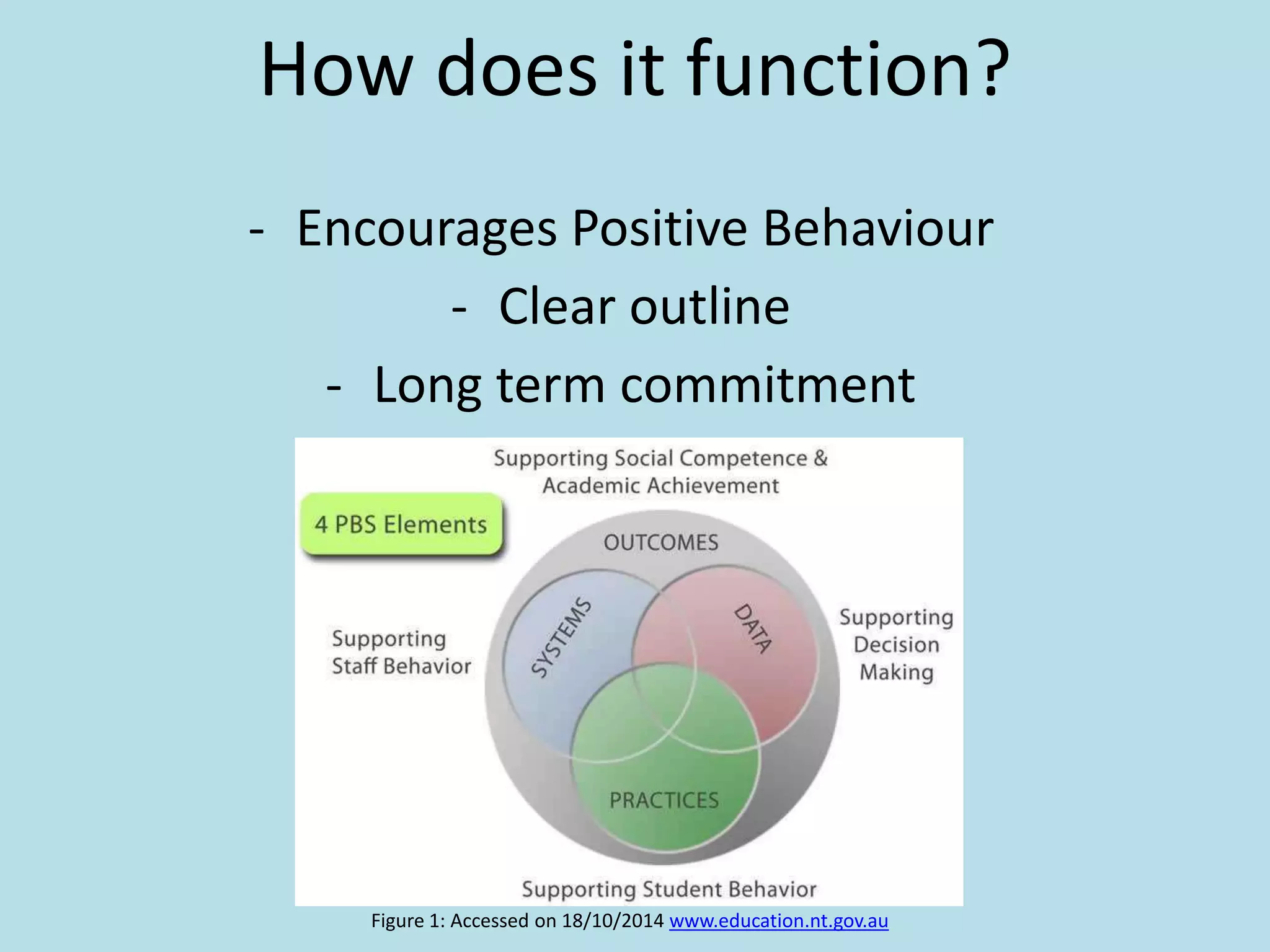
How does it function?
‐ Encourages Positive Behaviour
‐ Clear outline
‐ Long term commitment
Figure 1: Accessed on 18/10/2014 www.education.nt.gov.au
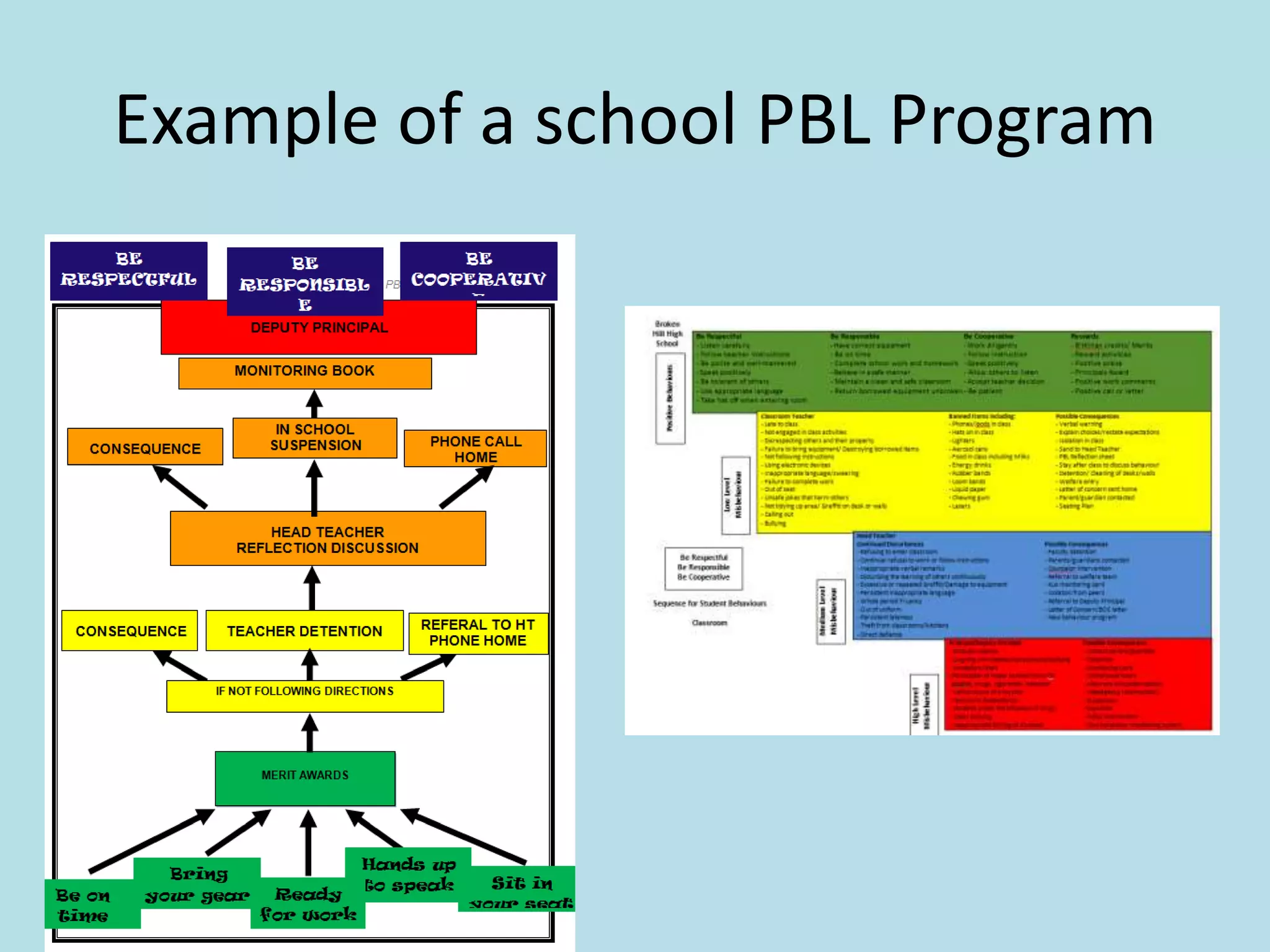
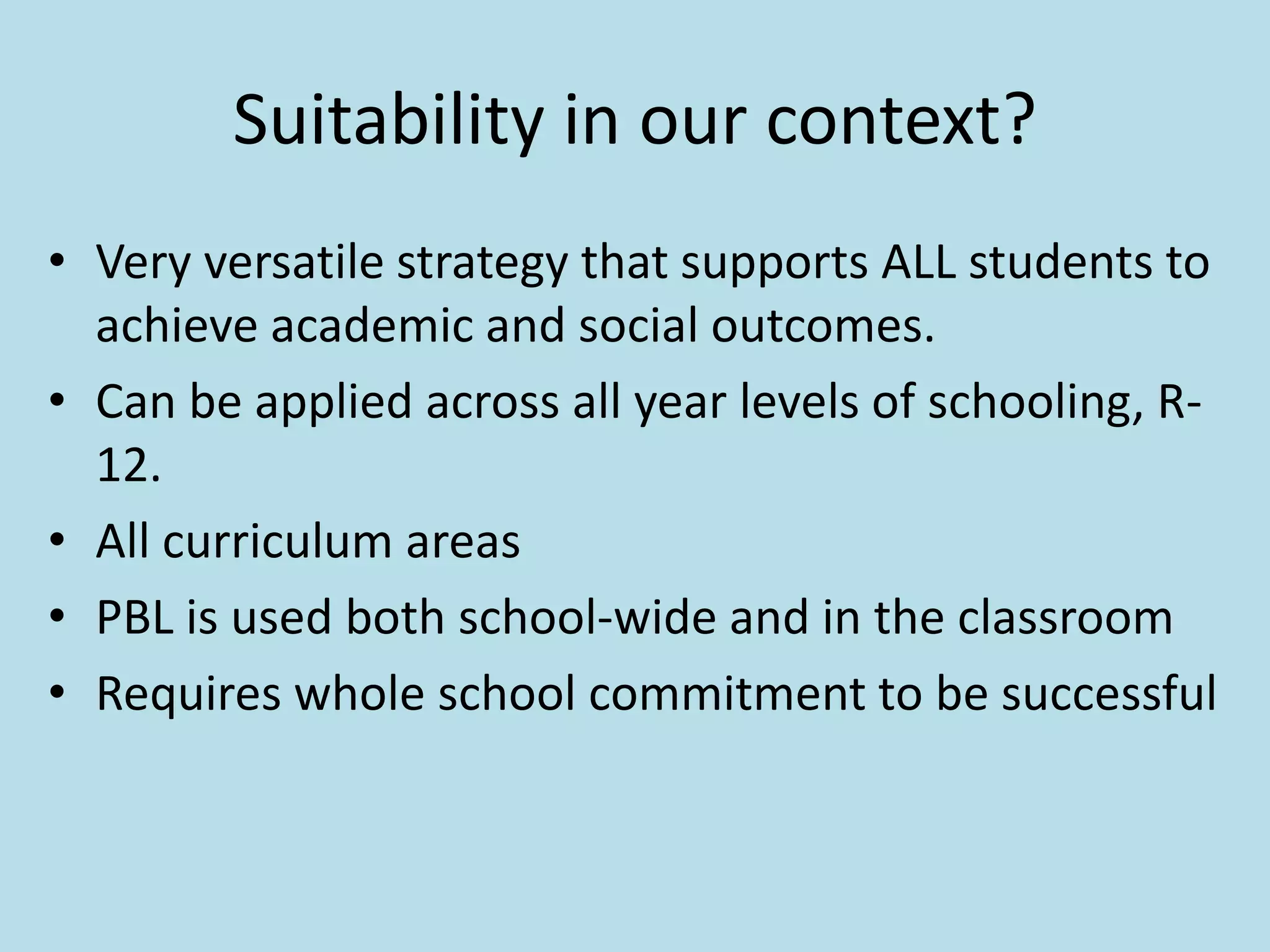
Example of a school PBL Program
Suitability in our context?
• Very versatile strategy that supports ALL students to
achieve academic and social outcomes.
• Can be applied across all year levels of schooling, R-
12.
• All curriculum areas
• PBL is used both school-wide and in the classroom
• Requires whole school commitment to be successful
Implementing PBL
• Professional development sessions every two
weeks
• Visual signs in all classrooms and around the
school
• Verbal reminders – from teachers
• Integration of the 3 key values into teaching
pedagogy and practices
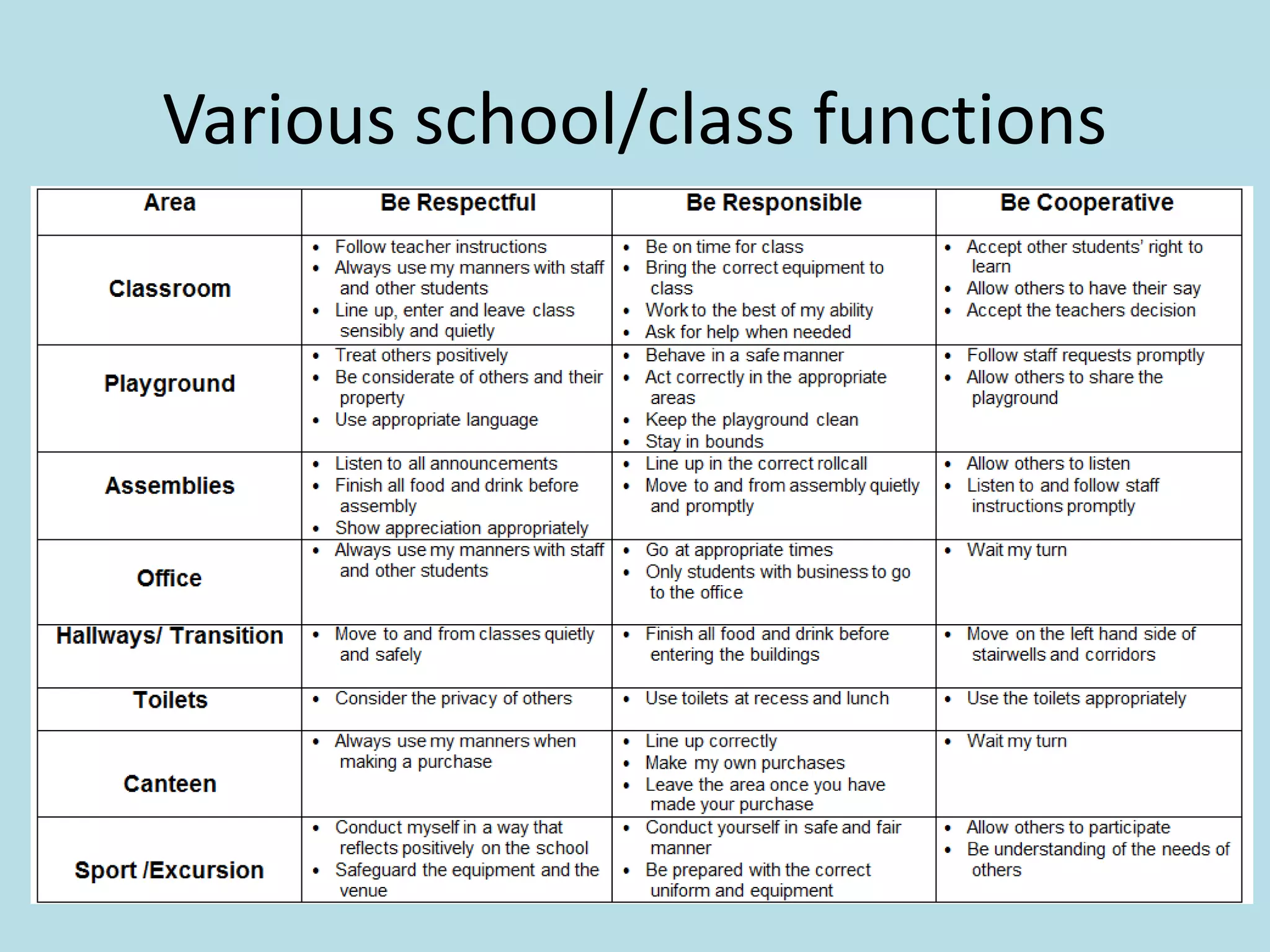
Various school/class functions
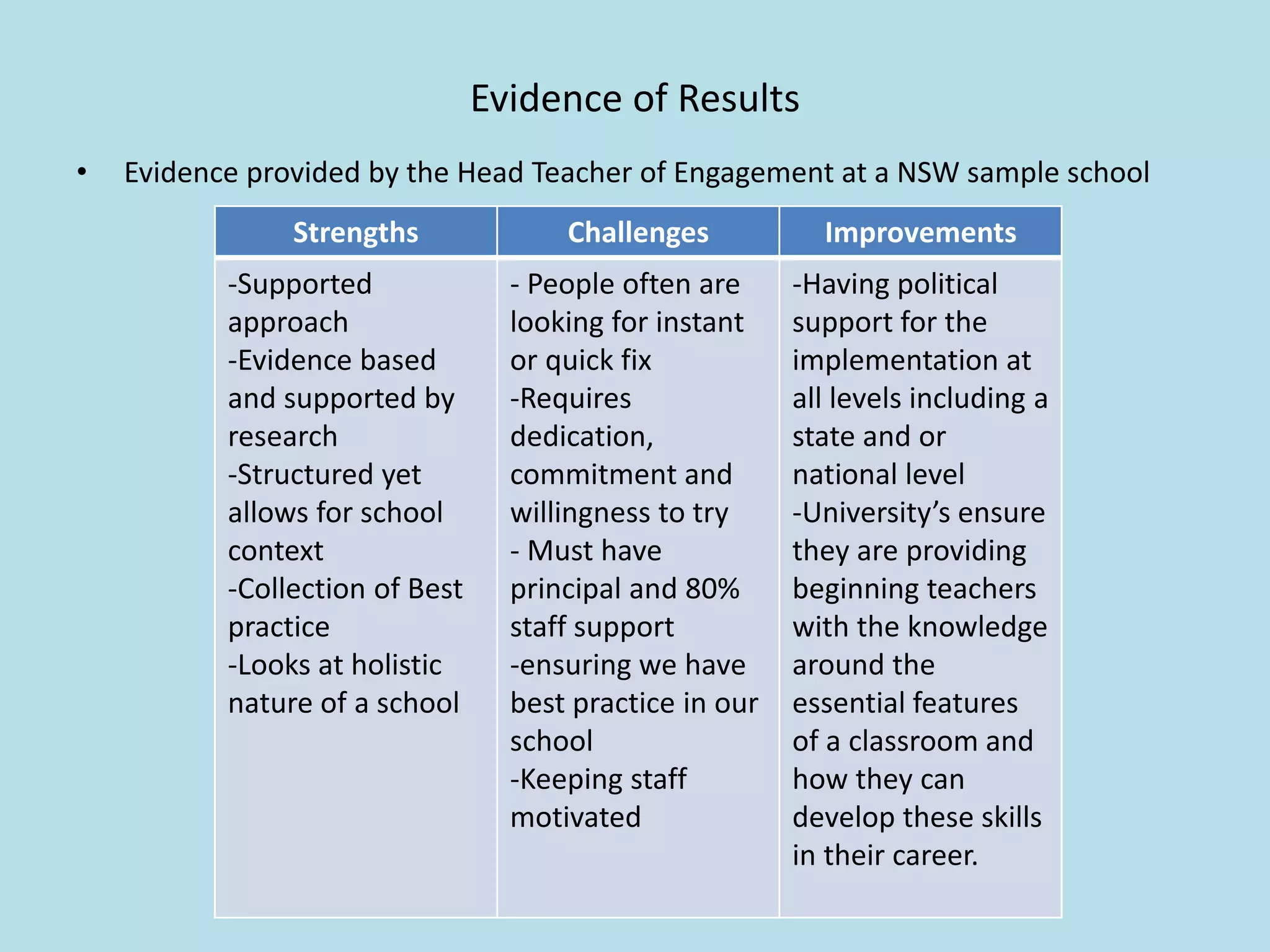
Evidence of Results
• Evidence provided by the Head Teacher of Engagement at a NSW sample school
Strengths Challenges Improvements
-Supported
approach
-Evidence based
and supported by
research
-Structured yet
allows for school
context
-Collection of Best
practice
-Looks at holistic
nature of a school
- People often are
looking for instant
or quick fix
-Requires
dedication,
commitment and
willingness to try
- Must have
principal and 80%
staff support
-ensuring we have
best practice in our
school
-Keeping staff
motivated
-Having political
support for the
implementation at
all levels including a
state and or
national level
-University’s ensure
they are providing
beginning teachers
with the knowledge
around the
essential features
of a classroom and
how they can
develop these skills
in their career.
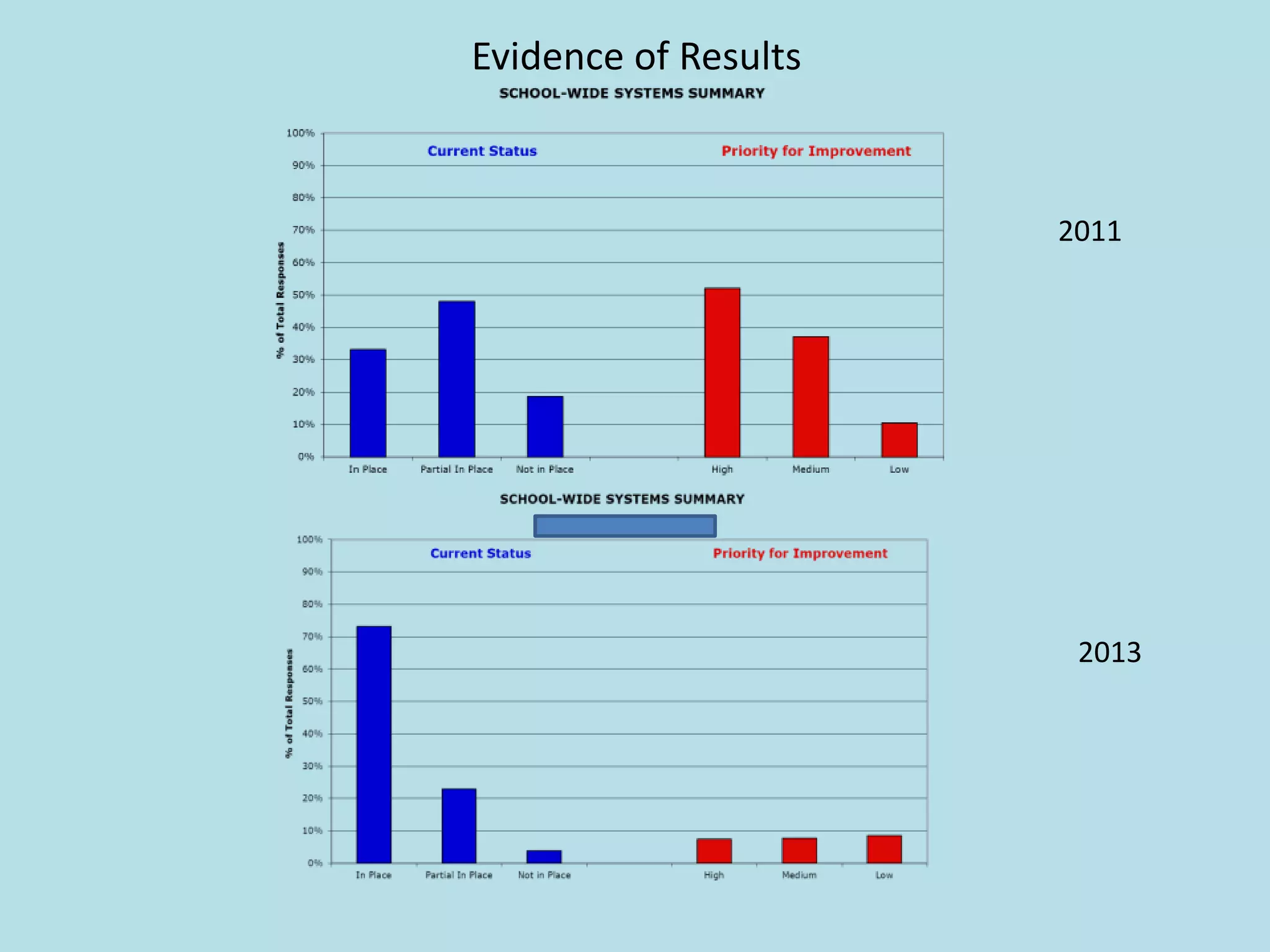
Evidence of Results
2013
2011
Class Activity
• In your teaching areas (primary can group together), come
up with 3 guidelines/rules for your classroom that reflect the
Flinders High School values – 5 mins.
• Be sure to use positive language.
 “Always ask to borrow equipment”
X “Don’t take other people’s things”
Any Questions?
References
• Jill Schofield 2014, ‘Positive Behaviour For Learning Website’, accessed 15th
October 2014, http://pblsupport.pbworks.com/w/page/47299779/frontpage.
• Mooney, M. et. al, 2008, ‘Positive Behaviour for Learning: Investigating the
Transfer of a United States System into the NSW Department of Education and
Training Western Sydney Region Schools’, Curriculum and Leadership Journal, vol.
6, no. 20, viewed 17th October 2014,
http://www.curriculum.edu.au/leader/positive_behaviour_for_learning,24004.ht
ml?issueID=11469.
• Sample School Positive Behaviour for Learning Handbook, 2014.

What is Positive Behaviour for Learning (PBL)? And why is it SO valuable for schools?

  • 1.
    Positive Behaviour ForLearning (PBL) A NSW Initiative
  • 2.
    What is PBL? •School – wide behaviour initiative. • Addresses challenging behaviours and student wellbeing. • Aims to improve self-awareness and motivation to learn. • Adapted from the U.S. • Initiated by NSW DET in 2005 (Lindsay Wasson).
  • 3.
    Underlying assumptions • https://www.youtube.com/watch?v=3dYDdBgevfI •A positive, structured environment will support student wellbeing and increase motivation to learn (Mooney et. al 2008). • Motivation to learn will decrease the prevalence of challenging behaviours (Mooney et. Al 2008). Positive environment motivation to learn reduced problem behaviour
  • 4.
    What is thepurpose? PBL Increase Attendance lower suspensions improve student motivation and engagement to learn developing values for the community
  • 5.
    How does itfunction? ‐ Encourages Positive Behaviour ‐ Clear outline ‐ Long term commitment Figure 1: Accessed on 18/10/2014 www.education.nt.gov.au
  • 6.
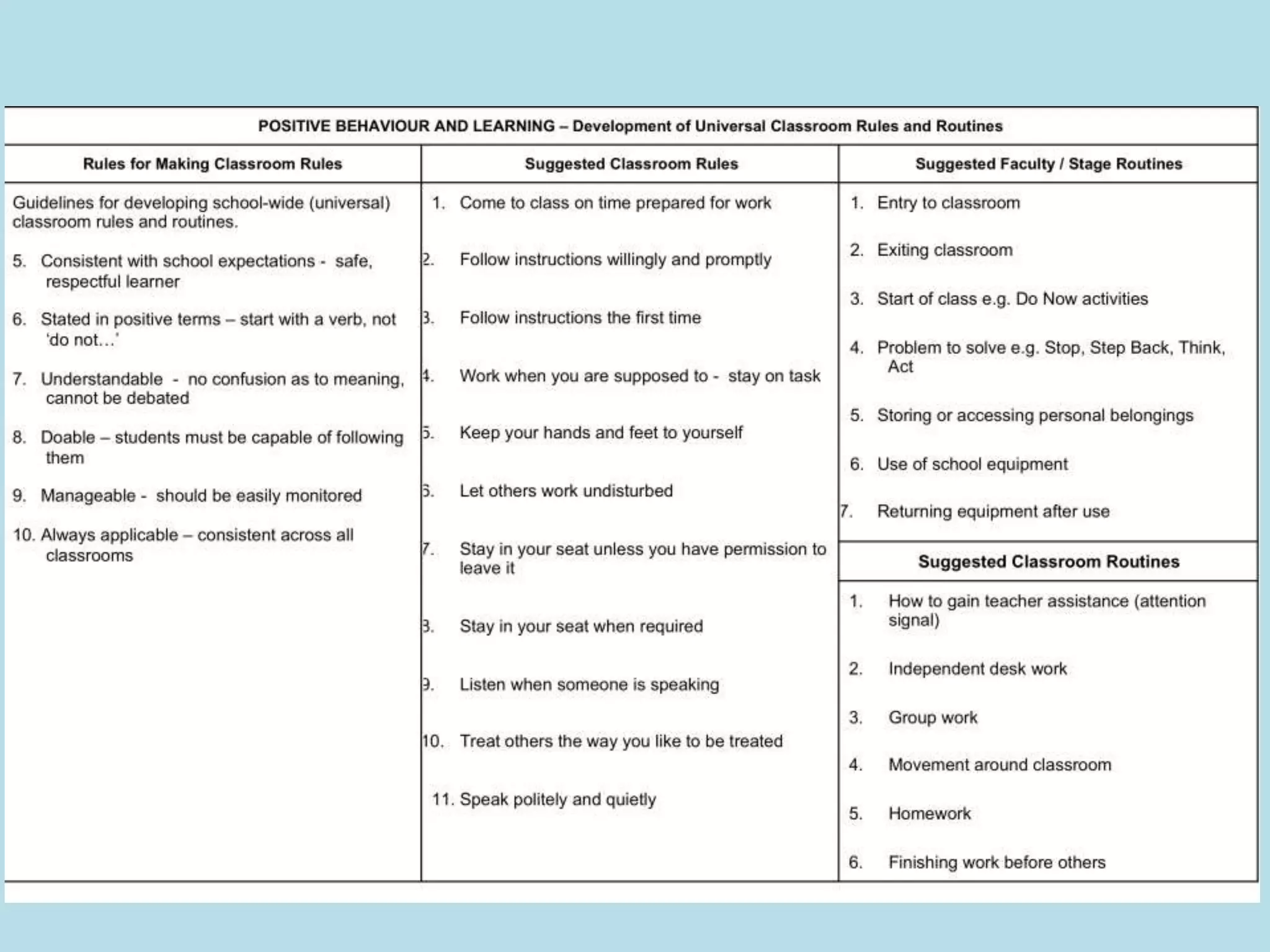
    Example of aschool PBL Program
  • 7.
    Suitability in ourcontext? • Very versatile strategy that supports ALL students to achieve academic and social outcomes. • Can be applied across all year levels of schooling, R- 12. • All curriculum areas • PBL is used both school-wide and in the classroom • Requires whole school commitment to be successful
  • 8.
    Implementing PBL • Professionaldevelopment sessions every two weeks • Visual signs in all classrooms and around the school • Verbal reminders – from teachers • Integration of the 3 key values into teaching pedagogy and practices
  • 9.
  • 10.
    Evidence of Results •Evidence provided by the Head Teacher of Engagement at a NSW sample school Strengths Challenges Improvements -Supported approach -Evidence based and supported by research -Structured yet allows for school context -Collection of Best practice -Looks at holistic nature of a school - People often are looking for instant or quick fix -Requires dedication, commitment and willingness to try - Must have principal and 80% staff support -ensuring we have best practice in our school -Keeping staff motivated -Having political support for the implementation at all levels including a state and or national level -University’s ensure they are providing beginning teachers with the knowledge around the essential features of a classroom and how they can develop these skills in their career.
  • 11.
  • 12.
    Class Activity • Inyour teaching areas (primary can group together), come up with 3 guidelines/rules for your classroom that reflect the Flinders High School values – 5 mins. • Be sure to use positive language.  “Always ask to borrow equipment” X “Don’t take other people’s things”
  • 14.
  • 15.
    References • Jill Schofield2014, ‘Positive Behaviour For Learning Website’, accessed 15th October 2014, http://pblsupport.pbworks.com/w/page/47299779/frontpage. • Mooney, M. et. al, 2008, ‘Positive Behaviour for Learning: Investigating the Transfer of a United States System into the NSW Department of Education and Training Western Sydney Region Schools’, Curriculum and Leadership Journal, vol. 6, no. 20, viewed 17th October 2014, http://www.curriculum.edu.au/leader/positive_behaviour_for_learning,24004.ht ml?issueID=11469. • Sample School Positive Behaviour for Learning Handbook, 2014.

Editor's Notes

  • #6 How does it work?   PBL is a project and program that works on both the teachers behalf and students. It focuses on building students behaviour to a positive structure reducing the problematic behaviours. Defines clear expectations and consequences. This is a whole school/ system driven program as only one classroom wont have the same effect unless the whole school performs with it. This is a long term project for the school and for the students. PBL aims to address and reduce problem behaviours by encouraging positive behaviour from students. Clear expectations = Clear consequences It aims to clearly teach, practice, reward & reteach students what behaviours are expected of them. Systems approach Data-driven decision making PBL is a long term project that will run for 3 to 5 years.
  • #8 broad range of systemic and individualised strategies for achieving important social and learning outcomes while preventing problem behaviour.