PBIS
Positive Behavioral Interventions and
Supports
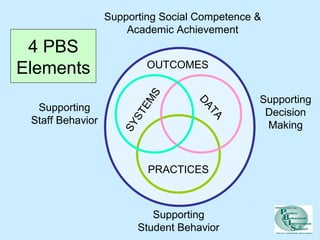
SYSTEMS
PRACTICES
DATA
Supporting
Staff Behavior
Supporting
Student Behavior
OUTCOMES
Supporting Social Competence &
Academic Achievement
Supporting
Decision
Making
4 PBS
Elements
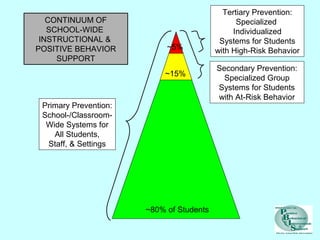
Primary Prevention:
School-/Classroom-
Wide Systems for
All Students,
Staff, & Settings
Secondary Prevention:
Specialized Group
Systems for Students
with At-Risk Behavior
Tertiary Prevention:
Specialized
Individualized
Systems for Students
with High-Risk Behavior
~80% of Students
~15%
~5%
CONTINUUM OF
SCHOOL-WIDE
INSTRUCTIONAL &
POSITIVE BEHAVIOR
SUPPORT
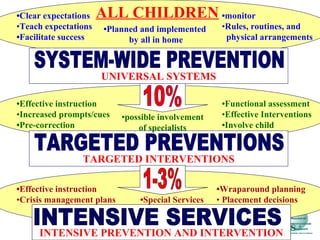
ALL CHILDREN
•Effective instruction
•Increased prompts/cues
•Pre-correction
•Functional assessment
•Effective Interventions
•Involve child
TARGETED INTERVENTIONS
•possible involvement
of specialists
INTENSIVE PREVENTION AND INTERVENTION
•Wraparound planning
• Placement decisions
•Effective instruction
•Crisis management plans •Special Services
UNIVERSAL SYSTEMS
•Clear expectations
•Teach expectations
•Facilitate success
•monitor
•Rules, routines, and
physical arrangements
•Planned and implemented
by all in home
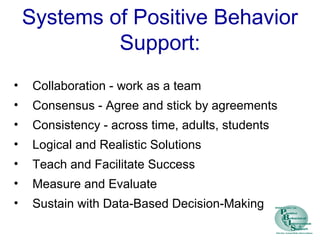
Systems of Positive Behavior
Support:
BIG IDEAS
• Collaboration - work as a team
• Consensus - Agree and stick by agreements
• Consistency - across time, adults, students
• Logical and Realistic Solutions
• Teach and Facilitate Success
• Measure and Evaluate
• Sustain with Data-Based Decision-Making
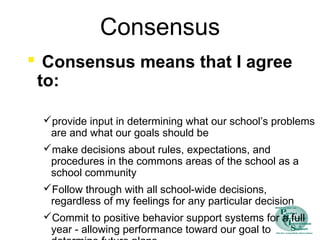
Consensus
 Consensus means that I agree
to:
provide input in determining what our school’s problems
are and what our goals should be
make decisions about rules, expectations, and
procedures in the commons areas of the school as a
school community
Follow through with all school-wide decisions,
regardless of my feelings for any particular decision
Commit to positive behavior support systems for a full
year - allowing performance toward our goal to
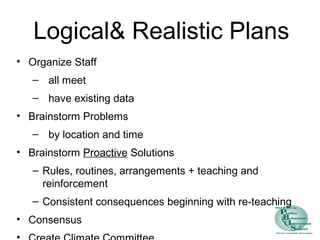
Logical& Realistic Plans
• Organize Staff
– all meet
– have existing data
• Brainstorm Problems
– by location and time
• Brainstorm Proactive Solutions
– Rules, routines, arrangements + teaching and
reinforcement
– Consistent consequences beginning with re-teaching
• Consensus
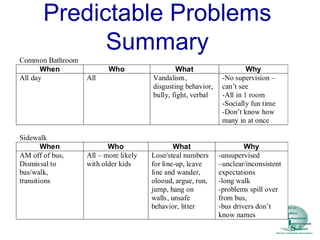
Predictable Problems
Summary
Common Bathroom
When Who What Why
All day All Vandalism,
disgusting behavior,
bully, fight, verbal
-No supervision –
can’t see
-All in 1 room
-Socially fun time
-Don’t know how
many in at once
Sidewalk
When Who What Why
AM off of bus,
Dismissal to
bus/walk,
transitions
All – more likely
with older kids
Lose/steal numbers
for line-up, leave
line and wander,
olooud, argue, run,
jump, hang on
walls, unsafe
behavior, litter
-unsupervised
–unclear/inconsistent
expectations
-long walk
-problems spill over
from bus,
-bus drivers don’t
know names
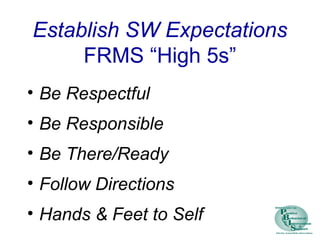
Establish SW Expectations
FRMS “High 5s”
• Be Respectful
• Be Responsible
• Be There/Ready
• Follow Directions
• Hands & Feet to Self
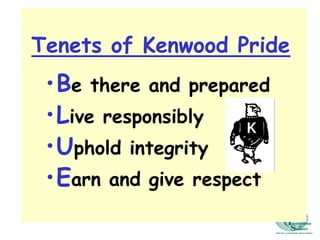
Tenets of Kenwood Pride
•Be there and prepared
•Live responsibly
•Uphold integrity
•Earn and give respect
EXAMPLE
Teachable Expectations
1. Respect Yourself
-in the classroom (do your best)
-on the playground (follow safety rules)
2. Respect Others
-in the classroom (raise your hand to speak)
-in the stairway (single file line)
3. Respect Property
-in the classroom (ask before borrowing)
-in the lunchroom (pick up your mess)
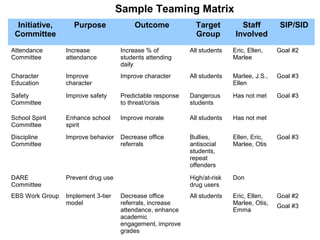
Initiative,
Committee
Purpose Outcome Target
Group
Staff
Involved
SIP/SID
Attendance
Committee
Increase
attendance
Increase % of
students attending
daily
All students Eric, Ellen,
Marlee
Goal #2
Character
Education
Improve
character
Improve character All students Marlee, J.S.,
Ellen
Goal #3
Safety
Committee
Improve safety Predictable response
to threat/crisis
Dangerous
students
Has not met Goal #3
School Spirit
Committee
Enhance school
spirit
Improve morale All students Has not met
Discipline
Committee
Improve behavior Decrease office
referrals
Bullies,
antisocial
students,
repeat
offenders
Ellen, Eric,
Marlee, Otis
Goal #3
DARE
Committee
Prevent drug use High/at-risk
drug users
Don
EBS Work Group Implement 3-tier
model
Decrease office
referrals, increase
attendance, enhance
academic
engagement, improve
grades
All students Eric, Ellen,
Marlee, Otis,
Emma
Goal #2
Goal #3
Sample Teaming Matrix
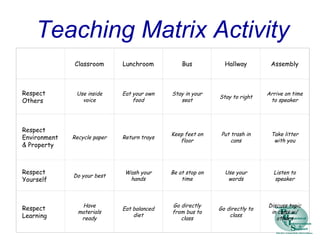
Teaching Matrix Activity
 
Classroom Lunchroom Bus Hallway Assembly
Respect
Others
Use inside
voice
Eat your own
food
Stay in your
seat
Stay to right
Arrive on time
to speaker
Respect
Environment
& Property
Recycle paper Return trays
Keep feet on
floor
Put trash in
cans
Take litter
with you
Respect
Yourself
Do your best
Wash your
hands
Be at stop on
time
Use your
words
Listen to
speaker
Respect
Learning
Have
materials
ready
Eat balanced
diet
Go directly
from bus to
class
Go directly to
class
Discuss topic
in class w/
others
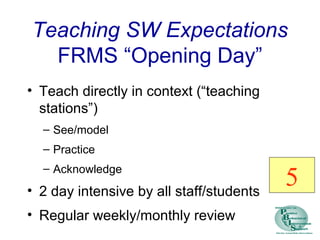
Teaching SW Expectations
FRMS “Opening Day”
• Teach directly in context (“teaching
stations”)
– See/model
– Practice
– Acknowledge
• 2 day intensive by all staff/students
• Regular weekly/monthly review
5
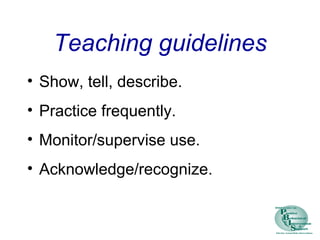
Teaching guidelines
• Show, tell, describe.
• Practice frequently.
• Monitor/supervise use.
• Acknowledge/recognize.
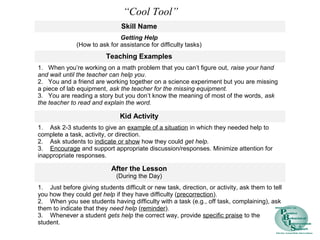
Skill Name
Getting Help
(How to ask for assistance for difficulty tasks)
Teaching Examples
1. When you’re working on a math problem that you can’t figure out, raise your hand
and wait until the teacher can help you.
2. You and a friend are working together on a science experiment but you are missing
a piece of lab equipment, ask the teacher for the missing equipment.
3. You are reading a story but you don’t know the meaning of most of the words, ask
the teacher to read and explain the word.
Kid Activity
1. Ask 2-3 students to give an example of a situation in which they needed help to
complete a task, activity, or direction.
2. Ask students to indicate or show how they could get help.
3. Encourage and support appropriate discussion/responses. Minimize attention for
inappropriate responses.
After the Lesson
(During the Day)
1. Just before giving students difficult or new task, direction, or activity, ask them to tell
you how they could get help if they have difficulty (precorrection).
2. When you see students having difficulty with a task (e.g., off task, complaining), ask
them to indicate that they need help (reminder).
3. Whenever a student gets help the correct way, provide specific praise to the
student.
“Cool Tool”
Establish procedures for
encouraging SW
expectations
• FRMS: “High Fives”
• Guidelines
– Lots to less
– Individual to group
– External- to self-managed
– Frequent to infrequent
– Paired with social recognition
– Label specific expectation & behavior
– Culturally/contextually appropriate & considerate
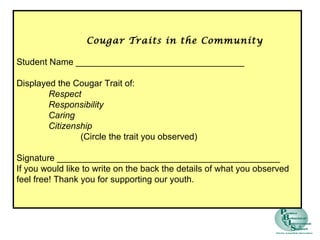
Cougar Traits in the Community
Student Name __________________________________
Displayed the Cougar Trait of:
Respect
Responsibility
Caring
Citizenship
(Circle the trait you observed)
Signature _____________________________________________
If you would like to write on the back the details of what you observed
feel free! Thank you for supporting our youth.
Acknowledging SW
Expectations: Rationale
• Humans require regular & frequent
feedback on their actions
• Humans experience frequent feedback
from others, self, & environment
• W/o formal feedback to encourage
desired behavior, other forms of
feedback shape undesired behaviors
“Super Sub Slips”
• Empowering subs in Cottage
Grove, OR
• Procedures
– Give 5 per sub in subfolder
– Give 2 out immediately
“Bus Bucks”
• Springfield P.S., OR
• Procedures
– Review bus citations
– On-going driver meetings
– Teaching expectations
– Link bus bucks w/ schools
– Acknowledging bus drivers
“Good morning, class!”
Teachers report that when
students are greeted by an
adult in morning, it takes less
time to complete morning
routines & get first lesson
started.
“80% Rule”
• Apply triangle to adult behavior!
• Regularly acknowledge staff
behavior
• Provide Alternative Option for
Students with Chronic Problem
Behavior
– Do not expect school- wide effort to
influence behavior of 1-7% of students.
“Golden Plunger”
• Involve custodian
• Procedure
– Custodian selects one classroom/
hallway each week that is clean &
orderly
– Sticks gold-painted plunger with banner
on wall
“1 Free Period”
• Contributing to a safe, caring,
effective school environment
• Procedures
– Given by Principal
– Principal takes over class for one hour
– Used at any time
“G.O.O.S.E.”
• “Get Out Of School Early”
– Or “arrive late”
• Procedures
– Kids/staff nominate
– Kids/staff reward, then pick
Measure and Evaluate
• Big Ideas:
–School determines what outcomes
are important
–School identifies the simplest way
to get that information
–School uses that information to
evaluate their plans
What systems are problematic?
• Referrals by problem behavior?
– What problem behaviors are most common?
• Referrals by location?
– Are there specific problem locations?
• Referrals by student?
– Are there many students receiving referrals or only a
small number of students with many referrals?
• Referrals by time of day?
– Are there specific times when problems occur?
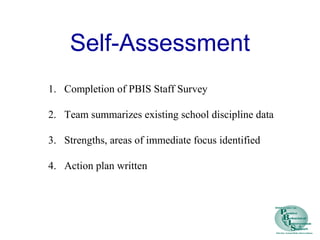
Self-Assessment
1. Completion of PBIS Staff Survey
2. Team summarizes existing school discipline data
3. Strengths, areas of immediate focus identified
4. Action plan written
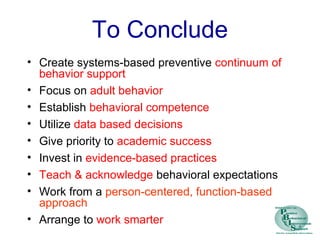
To Conclude
• Create systems-based preventive continuum of
behavior support
• Focus on adult behavior
• Establish behavioral competence
• Utilize data based decisions
• Give priority to academic success
• Invest in evidence-based practices
• Teach & acknowledge behavioral expectations
• Work from a person-centered, function-based
approach
• Arrange to work smarter
Resources
• www.pbis.org
• www.pbismaryland.org
• www.swis.org

School presentation (2)

  • 1.
  • 2.
    SYSTEMS PRACTICES DATA Supporting Staff Behavior Supporting Student Behavior OUTCOMES SupportingSocial Competence & Academic Achievement Supporting Decision Making 4 PBS Elements
  • 3.
    Primary Prevention: School-/Classroom- Wide Systemsfor All Students, Staff, & Settings Secondary Prevention: Specialized Group Systems for Students with At-Risk Behavior Tertiary Prevention: Specialized Individualized Systems for Students with High-Risk Behavior ~80% of Students ~15% ~5% CONTINUUM OF SCHOOL-WIDE INSTRUCTIONAL & POSITIVE BEHAVIOR SUPPORT
  • 4.
    ALL CHILDREN •Effective instruction •Increasedprompts/cues •Pre-correction •Functional assessment •Effective Interventions •Involve child TARGETED INTERVENTIONS •possible involvement of specialists INTENSIVE PREVENTION AND INTERVENTION •Wraparound planning • Placement decisions •Effective instruction •Crisis management plans •Special Services UNIVERSAL SYSTEMS •Clear expectations •Teach expectations •Facilitate success •monitor •Rules, routines, and physical arrangements •Planned and implemented by all in home
  • 5.
    Systems of PositiveBehavior Support: BIG IDEAS • Collaboration - work as a team • Consensus - Agree and stick by agreements • Consistency - across time, adults, students • Logical and Realistic Solutions • Teach and Facilitate Success • Measure and Evaluate • Sustain with Data-Based Decision-Making
  • 6.
    Consensus  Consensus meansthat I agree to: provide input in determining what our school’s problems are and what our goals should be make decisions about rules, expectations, and procedures in the commons areas of the school as a school community Follow through with all school-wide decisions, regardless of my feelings for any particular decision Commit to positive behavior support systems for a full year - allowing performance toward our goal to
  • 7.
    Logical& Realistic Plans •Organize Staff – all meet – have existing data • Brainstorm Problems – by location and time • Brainstorm Proactive Solutions – Rules, routines, arrangements + teaching and reinforcement – Consistent consequences beginning with re-teaching • Consensus
  • 8.
    Predictable Problems Summary Common Bathroom WhenWho What Why All day All Vandalism, disgusting behavior, bully, fight, verbal -No supervision – can’t see -All in 1 room -Socially fun time -Don’t know how many in at once Sidewalk When Who What Why AM off of bus, Dismissal to bus/walk, transitions All – more likely with older kids Lose/steal numbers for line-up, leave line and wander, olooud, argue, run, jump, hang on walls, unsafe behavior, litter -unsupervised –unclear/inconsistent expectations -long walk -problems spill over from bus, -bus drivers don’t know names
  • 9.
    Establish SW Expectations FRMS“High 5s” • Be Respectful • Be Responsible • Be There/Ready • Follow Directions • Hands & Feet to Self
  • 11.
    Tenets of KenwoodPride •Be there and prepared •Live responsibly •Uphold integrity •Earn and give respect
  • 12.
    EXAMPLE Teachable Expectations 1. RespectYourself -in the classroom (do your best) -on the playground (follow safety rules) 2. Respect Others -in the classroom (raise your hand to speak) -in the stairway (single file line) 3. Respect Property -in the classroom (ask before borrowing) -in the lunchroom (pick up your mess)
  • 13.
    Initiative, Committee Purpose Outcome Target Group Staff Involved SIP/SID Attendance Committee Increase attendance Increase% of students attending daily All students Eric, Ellen, Marlee Goal #2 Character Education Improve character Improve character All students Marlee, J.S., Ellen Goal #3 Safety Committee Improve safety Predictable response to threat/crisis Dangerous students Has not met Goal #3 School Spirit Committee Enhance school spirit Improve morale All students Has not met Discipline Committee Improve behavior Decrease office referrals Bullies, antisocial students, repeat offenders Ellen, Eric, Marlee, Otis Goal #3 DARE Committee Prevent drug use High/at-risk drug users Don EBS Work Group Implement 3-tier model Decrease office referrals, increase attendance, enhance academic engagement, improve grades All students Eric, Ellen, Marlee, Otis, Emma Goal #2 Goal #3 Sample Teaming Matrix
  • 14.
    Teaching Matrix Activity   ClassroomLunchroom Bus Hallway Assembly Respect Others Use inside voice Eat your own food Stay in your seat Stay to right Arrive on time to speaker Respect Environment & Property Recycle paper Return trays Keep feet on floor Put trash in cans Take litter with you Respect Yourself Do your best Wash your hands Be at stop on time Use your words Listen to speaker Respect Learning Have materials ready Eat balanced diet Go directly from bus to class Go directly to class Discuss topic in class w/ others
  • 15.
    Teaching SW Expectations FRMS“Opening Day” • Teach directly in context (“teaching stations”) – See/model – Practice – Acknowledge • 2 day intensive by all staff/students • Regular weekly/monthly review 5
  • 16.
    Teaching guidelines • Show,tell, describe. • Practice frequently. • Monitor/supervise use. • Acknowledge/recognize.
  • 17.
    Skill Name Getting Help (Howto ask for assistance for difficulty tasks) Teaching Examples 1. When you’re working on a math problem that you can’t figure out, raise your hand and wait until the teacher can help you. 2. You and a friend are working together on a science experiment but you are missing a piece of lab equipment, ask the teacher for the missing equipment. 3. You are reading a story but you don’t know the meaning of most of the words, ask the teacher to read and explain the word. Kid Activity 1. Ask 2-3 students to give an example of a situation in which they needed help to complete a task, activity, or direction. 2. Ask students to indicate or show how they could get help. 3. Encourage and support appropriate discussion/responses. Minimize attention for inappropriate responses. After the Lesson (During the Day) 1. Just before giving students difficult or new task, direction, or activity, ask them to tell you how they could get help if they have difficulty (precorrection). 2. When you see students having difficulty with a task (e.g., off task, complaining), ask them to indicate that they need help (reminder). 3. Whenever a student gets help the correct way, provide specific praise to the student. “Cool Tool”
  • 18.
    Establish procedures for encouragingSW expectations • FRMS: “High Fives” • Guidelines – Lots to less – Individual to group – External- to self-managed – Frequent to infrequent – Paired with social recognition – Label specific expectation & behavior – Culturally/contextually appropriate & considerate
  • 19.
    Cougar Traits inthe Community Student Name __________________________________ Displayed the Cougar Trait of: Respect Responsibility Caring Citizenship (Circle the trait you observed) Signature _____________________________________________ If you would like to write on the back the details of what you observed feel free! Thank you for supporting our youth.
  • 20.
    Acknowledging SW Expectations: Rationale •Humans require regular & frequent feedback on their actions • Humans experience frequent feedback from others, self, & environment • W/o formal feedback to encourage desired behavior, other forms of feedback shape undesired behaviors
  • 21.
    “Super Sub Slips” •Empowering subs in Cottage Grove, OR • Procedures – Give 5 per sub in subfolder – Give 2 out immediately
  • 22.
    “Bus Bucks” • SpringfieldP.S., OR • Procedures – Review bus citations – On-going driver meetings – Teaching expectations – Link bus bucks w/ schools – Acknowledging bus drivers
  • 23.
    “Good morning, class!” Teachersreport that when students are greeted by an adult in morning, it takes less time to complete morning routines & get first lesson started.
  • 24.
    “80% Rule” • Applytriangle to adult behavior! • Regularly acknowledge staff behavior • Provide Alternative Option for Students with Chronic Problem Behavior – Do not expect school- wide effort to influence behavior of 1-7% of students.
  • 25.
    “Golden Plunger” • Involvecustodian • Procedure – Custodian selects one classroom/ hallway each week that is clean & orderly – Sticks gold-painted plunger with banner on wall
  • 26.
    “1 Free Period” •Contributing to a safe, caring, effective school environment • Procedures – Given by Principal – Principal takes over class for one hour – Used at any time
  • 27.
    “G.O.O.S.E.” • “Get OutOf School Early” – Or “arrive late” • Procedures – Kids/staff nominate – Kids/staff reward, then pick
  • 28.
    Measure and Evaluate •Big Ideas: –School determines what outcomes are important –School identifies the simplest way to get that information –School uses that information to evaluate their plans
  • 29.
    What systems areproblematic? • Referrals by problem behavior? – What problem behaviors are most common? • Referrals by location? – Are there specific problem locations? • Referrals by student? – Are there many students receiving referrals or only a small number of students with many referrals? • Referrals by time of day? – Are there specific times when problems occur?
  • 30.
    Self-Assessment 1. Completion ofPBIS Staff Survey 2. Team summarizes existing school discipline data 3. Strengths, areas of immediate focus identified 4. Action plan written
  • 31.
    To Conclude • Createsystems-based preventive continuum of behavior support • Focus on adult behavior • Establish behavioral competence • Utilize data based decisions • Give priority to academic success • Invest in evidence-based practices • Teach & acknowledge behavioral expectations • Work from a person-centered, function-based approach • Arrange to work smarter
  • 32.

Editor's Notes

  • #4 SAY: One of the most important organizing components of PBS is the establishment of a continuum of behavior support that considers all students and emphasizes prevention. This logic of this 3-tiered approach is derived from the public health approach to disease prevention. All students and staff should be exposed formally and in an on-going manner to primary prevention interventions. Primary prevention is provided to all students and focuses on giving students the necessary pro-social skills that prevents the establishment and occurrence of problem behavior. If done systemically and comprehensively, a majority of students are likely to be affected. Some students will be unresponsive or unsupported by primary prevention, and more specialized interventions will be required. One form of assistance is called secondary prevention, and is characterized by instruction that is more specific and more engaging. These interventions can be standardized to be applied similarly and efficiently across a small number of students. The goal of secondary prevention is to reduce/prevent the likelihood of problem behavior occurrences, and to enable these students to be supported by the school-wide PBS effort. If primary prevention is in place, a small proportion of students will require highly individualized and intensive interventions. The goal or tertiary level interventions is to reduce the intensity, complexity, and impact of the problem behaviors displayed by these students by providing supports that are (a) function-based, (b) contextually appropriate and person-centered, (c) strength-based and instructionally oriented, (d) continuously evaluated and enhanced, and (e) linked to the school-wide PBS approach.