WHAT IS BEHAVIOR?
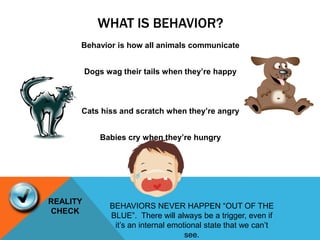
Behavior is how all animals communicate
Dogs wag their tails when they’re happy
Cats hiss and scratch when they’re angry
Babies cry when they’re hungry
REALITY
CHECK
BEHAVIORS NEVER HAPPEN “OUT OF THE
BLUE”. There will always be a trigger, even if
it’s an internal emotional state that we can’t
see.
ALL BEHAVIOR SERVES A PURPOSE
BEHAVIOR is an ACTION
. . . It is measureable
. . . It is how we get our needs met
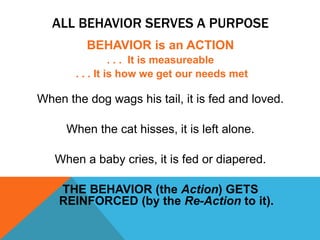
When the dog wags his tail, it is fed and loved.
When the cat hisses, it is left alone.
When a baby cries, it is fed or diapered.
THE BEHAVIOR (the Action) GETS
REINFORCED (by the Re-Action to it).
REINFORCING BEHAVIOR
When we ADD something TO a behavior,
we are
REINFORCING IT (Making it Stronger).
We are increasing the chances that it will occur again.
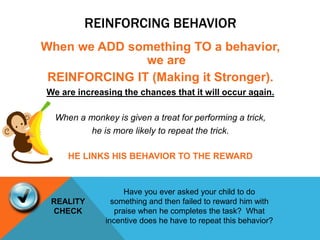
When a monkey is given a treat for performing a trick,
he is more likely to repeat the trick.
HE LINKS HIS BEHAVIOR TO THE REWARD
REALITY
CHECK
Have you ever asked your child to do
something and then failed to reward him with
praise when he completes the task? What
incentive does he have to repeat this behavior?
REINFORCING BEHAVIOR
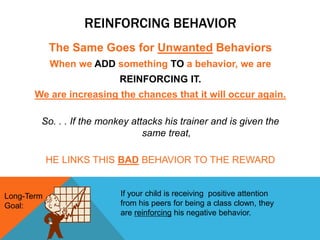
The Same Goes for Unwanted Behaviors
When we ADD something TO a behavior, we are
REINFORCING IT.
We are increasing the chances that it will occur again.
So. . . If the monkey attacks his trainer and is given the
same treat,
HE LINKS THIS BAD BEHAVIOR TO THE REWARD
Long-Term
Goal:
If your child is receiving positive attention
from his peers for being a class clown, they
are reinforcing his negative behavior.
REINFORCING BEHAVIOR
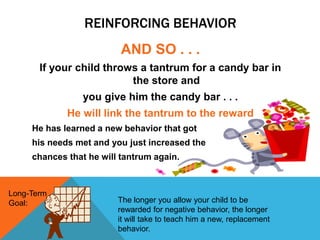
AND SO . . .
If your child throws a tantrum for a candy bar in
the store and
you give him the candy bar . . .
He will link the tantrum to the reward
He has learned a new behavior that got
his needs met and you just increased the
chances that he will tantrum again.
Long-Term
Goal: The longer you allow your child to be
rewarded for negative behavior, the longer
it will take to teach him a new, replacement
behavior.
BEHAVIOR IS LEARNED
THE MOST IMPORTANT THING YOU NEED TO
REMEMBER IS:
“ONLY GIVE ATTENTION TO THOSE
BEHAVIORS YOU WANT
REPEATED.”
Long-Term
Goal:
One of our goals as parents should be to
make sure that our children understand the
importance of using appropriate behaviors
to get their needs met.
BEHAVIOR IS LEARNED
KIDS AREN’T BORN WITH GOOD
BEHAVIORS
Adults need to teach them appropriate behaviors
This is called “socialization” and all cultures socialize children
to:
Respect Adults, Interact with Peers, and Control Impulses
REALITY
CHECK
It’s really important to learn how to separate bad
behavior from the personal identity of the child.
Try to give the message: “I’m upset by your
behavior – not you as a person who is still
learning right from wrong.”
Considering what we’ve learned so far,
it would be logical to assume
that the best way to teach positive behaviors
is to use reinforcement and rewards.
You’re right, but there is a big difference between a Bribe
and a Reward
ARE YOU BRIBING OR REWARDING?
REALITY
CHECK
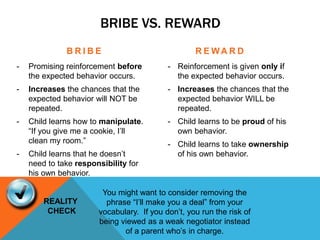
BRIBE VS. REWARD
B R I B E
- Promising reinforcement before
the expected behavior occurs.
- Increases the chances that the
expected behavior will NOT be
repeated.
- Child learns how to manipulate.
“If you give me a cookie, I’ll
clean my room.”
- Child learns that he doesn’t
need to take responsibility for
his own behavior.
R E WA R D
- Reinforcement is given only if
the expected behavior occurs.
- Increases the chances that the
expected behavior WILL be
repeated.
- Child learns to be proud of his
own behavior.
- Child learns to take ownership
of his own behavior.
REALITY
CHECK
You might want to consider removing the
phrase “I’ll make you a deal” from your
vocabulary. If you don’t, you run the risk of
being viewed as a weak negotiator instead
of a parent who’s in charge.
REWARDS = REINFORCEMENT
If we want to increase the chances a positive behavior
becomes LEARNED and is REPEATED . . .
We MUST GIVE IT ATTENTION!
(Attach it to a REWARD)
A REWARD DOESN’T HAVE TO BE MONETARY
But it MUST be:
- Administered quickly
- Linked directly to the desired behavior you want repeated
Long-Term
Goal:
As children mature, EXTERNAL rewards
(candy or praise) will be replaced with
INTERNAL rewards (feeling good about
themselves for behaving well.)
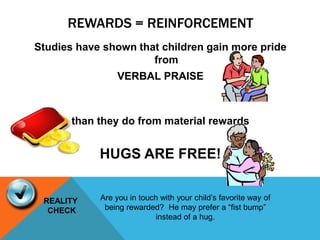
REWARDS = REINFORCEMENT
Studies have shown that children gain more pride
from
VERBAL PRAISE
than they do from material rewards
HUGS ARE FREE!
REALITY
CHECK
Are you in touch with your child’s favorite way of
being rewarded? He may prefer a “fist bump”
instead of a hug.
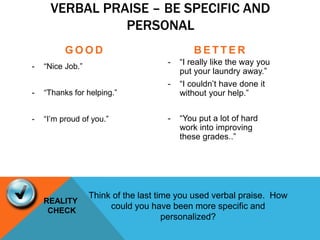
VERBAL PRAISE – BE SPECIFIC AND
PERSONAL
G O O D
- “Nice Job.”
- “Thanks for helping.”
- “I’m proud of you.”
B E T T E R
- “I really like the way you
put your laundry away.”
- “I couldn’t have done it
without your help.”
- “You put a lot of hard
work into improving
these grades..”
Think of the last time you used verbal praise. How
could you have been more specific and
personalized?
REALITY
CHECK
REWARDS = REINFORCEMENT
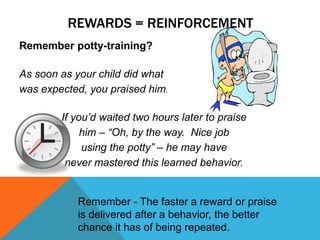
Remember potty-training?
As soon as your child did what
was expected, you praised him.
If you’d waited two hours later to praise
him – “Oh, by the way. Nice job
using the potty” – he may have
never mastered this learned behavior.
Remember - The faster a reward or praise
is delivered after a behavior, the better
chance it has of being repeated.
REWARDS = REINFORCEMENT
Along the same lines,
you probably didn’t praise your child
for wetting his pants.
And yet . . .
Many times, we reinforce and reward unwanted
behaviors we do NOT want repeated.
WE GIVE ATTENTION TO UNWANTED BEHAVIOR
REWARDS = REINFORCEMENT
You may have not given into
a tantrum in the grocery store,
But . . . Did you stop for ice cream on the way
home?
YOU ACCIDENTALLY REWARDED BAD BEHAVIOR
BECAUSE IT WAS GIVEN TOO CLOSE TO THE MISDEED.
Your child says she’s sick and can’t go to
school, but you suspect she’s faking. She has
a fun day running errands with you and baking
cookies.
REALITY
CHECK
CATCH ‘EM BEING GOOD
One of the best ways to increase positive
behaviors (and increase the chances they’ll be
repeated) is to be on the look-out for them.
THEN, GIVE THOSE BEHAVIORS
LOTS OF ATTENTION.
For some reason, parents seem hard-wired to
only see the bad things kids do. Try to turn
things around by seeing the good.
REALITY
CHECK
CATCH ‘EM BEING GOOD
There is ALWAYS something you can find that
kids do right.
It might not be big, but it’s there, if you look hard
enough.
“Thank you for not slamming the door.”
None of us are happy ALL the time or sad all
the time. Same with kids. They’re not bad
ALL the time. Give attention to the times
they’re behaving well.
REALITY
CHECK
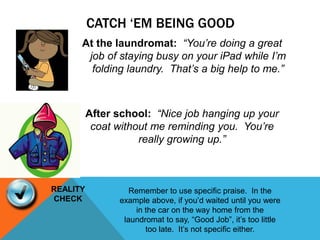
CATCH ‘EM BEING GOOD
At the laundromat: “You’re doing a great
job of staying busy on your iPad while I’m
folding laundry. That’s a big help to me.”
After school: “Nice job hanging up your
coat without me reminding you. You’re
really growing up.”
Remember to use specific praise. In the
example above, if you’d waited until you were
in the car on the way home from the
laundromat to say, “Good Job”, it’s too little
too late. It’s not specific either.
REALITY
CHECK
DON’T GIVE UP
Reversing bad behavior takes time. Your child didn’t
learn unwanted behaviors overnight and they’re not
going to get rid of them overnight.
- Only give attention to those behaviors
you want repeated,
- Catch ‘em being good,
- Use praise and rewards, and
- Be consistent.
No one is a perfect parent. You’re learning new
skills and all new skills take practice.
Be kind to yourself.
I hope this presentation has been helpful.
REALITY
CHECK

Positive Parenting - What is Behavior?

  • 2.
    WHAT IS BEHAVIOR? Behavioris how all animals communicate Dogs wag their tails when they’re happy Cats hiss and scratch when they’re angry Babies cry when they’re hungry REALITY CHECK BEHAVIORS NEVER HAPPEN “OUT OF THE BLUE”. There will always be a trigger, even if it’s an internal emotional state that we can’t see.
  • 3.
    ALL BEHAVIOR SERVESA PURPOSE BEHAVIOR is an ACTION . . . It is measureable . . . It is how we get our needs met When the dog wags his tail, it is fed and loved. When the cat hisses, it is left alone. When a baby cries, it is fed or diapered. THE BEHAVIOR (the Action) GETS REINFORCED (by the Re-Action to it).
  • 4.
    REINFORCING BEHAVIOR When weADD something TO a behavior, we are REINFORCING IT (Making it Stronger). We are increasing the chances that it will occur again. When a monkey is given a treat for performing a trick, he is more likely to repeat the trick. HE LINKS HIS BEHAVIOR TO THE REWARD REALITY CHECK Have you ever asked your child to do something and then failed to reward him with praise when he completes the task? What incentive does he have to repeat this behavior?
  • 5.
    REINFORCING BEHAVIOR The SameGoes for Unwanted Behaviors When we ADD something TO a behavior, we are REINFORCING IT. We are increasing the chances that it will occur again. So. . . If the monkey attacks his trainer and is given the same treat, HE LINKS THIS BAD BEHAVIOR TO THE REWARD Long-Term Goal: If your child is receiving positive attention from his peers for being a class clown, they are reinforcing his negative behavior.
  • 6.
    REINFORCING BEHAVIOR AND SO. . . If your child throws a tantrum for a candy bar in the store and you give him the candy bar . . . He will link the tantrum to the reward He has learned a new behavior that got his needs met and you just increased the chances that he will tantrum again. Long-Term Goal: The longer you allow your child to be rewarded for negative behavior, the longer it will take to teach him a new, replacement behavior.
  • 7.
    BEHAVIOR IS LEARNED THEMOST IMPORTANT THING YOU NEED TO REMEMBER IS: “ONLY GIVE ATTENTION TO THOSE BEHAVIORS YOU WANT REPEATED.” Long-Term Goal: One of our goals as parents should be to make sure that our children understand the importance of using appropriate behaviors to get their needs met.
  • 8.
    BEHAVIOR IS LEARNED KIDSAREN’T BORN WITH GOOD BEHAVIORS Adults need to teach them appropriate behaviors This is called “socialization” and all cultures socialize children to: Respect Adults, Interact with Peers, and Control Impulses REALITY CHECK It’s really important to learn how to separate bad behavior from the personal identity of the child. Try to give the message: “I’m upset by your behavior – not you as a person who is still learning right from wrong.”
  • 9.
    Considering what we’velearned so far, it would be logical to assume that the best way to teach positive behaviors is to use reinforcement and rewards. You’re right, but there is a big difference between a Bribe and a Reward ARE YOU BRIBING OR REWARDING? REALITY CHECK
  • 10.
    BRIBE VS. REWARD BR I B E - Promising reinforcement before the expected behavior occurs. - Increases the chances that the expected behavior will NOT be repeated. - Child learns how to manipulate. “If you give me a cookie, I’ll clean my room.” - Child learns that he doesn’t need to take responsibility for his own behavior. R E WA R D - Reinforcement is given only if the expected behavior occurs. - Increases the chances that the expected behavior WILL be repeated. - Child learns to be proud of his own behavior. - Child learns to take ownership of his own behavior. REALITY CHECK You might want to consider removing the phrase “I’ll make you a deal” from your vocabulary. If you don’t, you run the risk of being viewed as a weak negotiator instead of a parent who’s in charge.
  • 11.
    REWARDS = REINFORCEMENT Ifwe want to increase the chances a positive behavior becomes LEARNED and is REPEATED . . . We MUST GIVE IT ATTENTION! (Attach it to a REWARD) A REWARD DOESN’T HAVE TO BE MONETARY But it MUST be: - Administered quickly - Linked directly to the desired behavior you want repeated Long-Term Goal: As children mature, EXTERNAL rewards (candy or praise) will be replaced with INTERNAL rewards (feeling good about themselves for behaving well.)
  • 12.
    REWARDS = REINFORCEMENT Studieshave shown that children gain more pride from VERBAL PRAISE than they do from material rewards HUGS ARE FREE! REALITY CHECK Are you in touch with your child’s favorite way of being rewarded? He may prefer a “fist bump” instead of a hug.
  • 13.
    VERBAL PRAISE –BE SPECIFIC AND PERSONAL G O O D - “Nice Job.” - “Thanks for helping.” - “I’m proud of you.” B E T T E R - “I really like the way you put your laundry away.” - “I couldn’t have done it without your help.” - “You put a lot of hard work into improving these grades..” Think of the last time you used verbal praise. How could you have been more specific and personalized? REALITY CHECK
  • 14.
    REWARDS = REINFORCEMENT Rememberpotty-training? As soon as your child did what was expected, you praised him. If you’d waited two hours later to praise him – “Oh, by the way. Nice job using the potty” – he may have never mastered this learned behavior. Remember - The faster a reward or praise is delivered after a behavior, the better chance it has of being repeated.
  • 15.
    REWARDS = REINFORCEMENT Alongthe same lines, you probably didn’t praise your child for wetting his pants. And yet . . . Many times, we reinforce and reward unwanted behaviors we do NOT want repeated. WE GIVE ATTENTION TO UNWANTED BEHAVIOR
  • 16.
    REWARDS = REINFORCEMENT Youmay have not given into a tantrum in the grocery store, But . . . Did you stop for ice cream on the way home? YOU ACCIDENTALLY REWARDED BAD BEHAVIOR BECAUSE IT WAS GIVEN TOO CLOSE TO THE MISDEED. Your child says she’s sick and can’t go to school, but you suspect she’s faking. She has a fun day running errands with you and baking cookies. REALITY CHECK
  • 17.
    CATCH ‘EM BEINGGOOD One of the best ways to increase positive behaviors (and increase the chances they’ll be repeated) is to be on the look-out for them. THEN, GIVE THOSE BEHAVIORS LOTS OF ATTENTION. For some reason, parents seem hard-wired to only see the bad things kids do. Try to turn things around by seeing the good. REALITY CHECK
  • 18.
    CATCH ‘EM BEINGGOOD There is ALWAYS something you can find that kids do right. It might not be big, but it’s there, if you look hard enough. “Thank you for not slamming the door.” None of us are happy ALL the time or sad all the time. Same with kids. They’re not bad ALL the time. Give attention to the times they’re behaving well. REALITY CHECK
  • 19.
    CATCH ‘EM BEINGGOOD At the laundromat: “You’re doing a great job of staying busy on your iPad while I’m folding laundry. That’s a big help to me.” After school: “Nice job hanging up your coat without me reminding you. You’re really growing up.” Remember to use specific praise. In the example above, if you’d waited until you were in the car on the way home from the laundromat to say, “Good Job”, it’s too little too late. It’s not specific either. REALITY CHECK
  • 20.
    DON’T GIVE UP Reversingbad behavior takes time. Your child didn’t learn unwanted behaviors overnight and they’re not going to get rid of them overnight. - Only give attention to those behaviors you want repeated, - Catch ‘em being good, - Use praise and rewards, and - Be consistent. No one is a perfect parent. You’re learning new skills and all new skills take practice. Be kind to yourself. I hope this presentation has been helpful. REALITY CHECK