 As you arrive, please brainstorm staff
incentives you would like to see that make
you feel valued as a staff member.
 Then, access Sticky Board link through your
email and post your staff incentive ideas.
 http://linoit.com/users/kathryn_almond-
53/canvases/Staff Acknowledgment
 Lunch 12:30-1:00
Welcome to RRES’S PBIS Training!
May 6, 2014
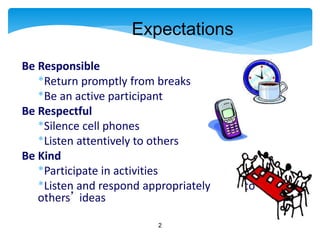
Be Responsible
*Return promptly from breaks
*Be an active participant
Be Respectful
*Silence cell phones
*Listen attentively to others
Be Kind
*Participate in activities
*Listen and respond appropriately to
others’ ideas
Expectations
2
Trainer will raise his/her
hand
Each participant will
raise their hand and
wait quietly
3
Attention Signal
12:30-1:00 Lunch
1:00-1:45 PBIS Overview
1:45-2:00 Break
2:00-2:45 Class
Dojo/Acknowledgement System
2:45-3:00- Questions/Parking
Lot/Exit Slip
Agenda
 In small groups (4-6), discuss what you want Rocky
River to “look” like. What would behavior look like?
What would kids and adults be doing? What would
the environment feel like? What would families and
community partners roles be?
 Write these words/phrases on sticky notes and post
to chart paper entitled “RRES Dream”.
Our Dream for the Rock
The purpose of PBIS is to create a
framework of systems, including
partnerships with families and the
community, to establish a respectful,
responsible and safe learning
environment that supports the needs
of all students.
Purpose
 School personnel must be willing to
examine their own behavior as students
are taught to change theirs.
 Cultural differences exist and need to be
understood.
 Positive relationships between students
and adults are key to student success.
Guiding Principles
All students are valuable and deserve respect.
All students can be taught to demonstrate
appropriate behavior.
Punishment does not work to change behavior.
School climate is a shared responsibility among
administrators, teachers, staff, students and
families.
Guiding Principles
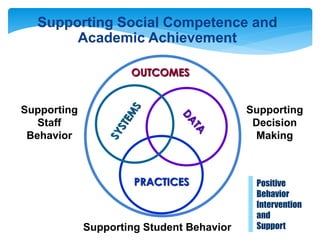
PRACTICES
Supporting
Staff
Behavior
Supporting
Decision
Making
Supporting Student Behavior
OUTCOMES
Positive
Behavior
Intervention
and
Support
Supporting Social Competence and
Academic Achievement
PBIS Training & Implementation
 All PBIS
Modules
organized
around
problem-
solving model
10
Defining & Teaching Expectations
Routines & Procedures
Reinforcement Systems
Effective Consequences
CONTINUUM OF
POSITIVE
BEHAVIOR
INTERVENTION
AND
SUPPORT
Social Skills
Mentoring
Check In
Self Management
Classroom Based Intervention
FBA/BIP
De-escalation
5%
80%
15%
Why Positive Behavior Intervention
and Support?
•Traditional
Discipline:
ΔFocuses on the
student’s
problem
behavior
ΔGoal is to stop
undesirable
behavior through
the use of
punishment
•Positive Behavior
Intervention &
Support:
ΔReplaces
undesired
behavior with a
new behavior or
skill
ΔAlters
environments,
teaches
appropriate skills,
and rewards
appropriate
behavior
Bradshaw, C.P., Koth, C.W., Thornton, L.A., & Leaf, P.J. (2009). Altering school climate through school-wide
Positive Behavioral Interventions and Supports: Findings from a group-randomized effectiveness
trial. Prevention Science, 10(2), 100-115
Bradshaw, C.P., Koth, C.W., Bevans, K.B., Ialongo, N., & Leaf, P.J. (2008). The impact of school-wide Positive
Behavioral Interventions and Supports (PBIS) on the organizational health of elementary schools. School
Psychology Quarterly, 23(4), 462-473.
Bradshaw, C. P., Mitchell, M. M., & Leaf, P. J. (2010). Examining the effects of School-Wide Positive Behavioral
Interventions and Supports on student outcomes: Results from a randomized controlled effectiveness
trial in elementary schools. Journal of Positive Behavior Interventions, 12, 133-148.
Bradshaw, C.P., Reinke, W. M., Brown, L. D., Bevans, K.B., & Leaf, P.J. (2008). Implementation of school-wide
Positive Behavioral Interventions and Supports (PBIS) in elementary schools: Observations from a
randomized trial. Education & Treatment of Children, 31, 1-26.
Horner, R., Sugai, G., Smolkowski, K., Eber, L., Nakasato, J., Todd, A., & Esperanza, J., (2009). A randomized,
wait-list controlled effectiveness trial assessing school-wide positive behavior support in elementary
schools. Journal of Positive Behavior Interventions, 11, 133-145.
Horner, R. H., Sugai, G., & Anderson, C. M. (2010). Examining the evidence base for school-wide positive
behavior support. Focus on Exceptionality, 42(8), 1-14.
Bradshaw, C., Waasdorp, T., Leaf. P., (in press). Effects of School-wide positive behavioral interventions and
supports on child behavior problems and adjustment. Pediatrics.
Waasdorp, T., Bradshaw, C., & Leaf , P., (2012) The Impact of Schoolwide Positive Behavioral Interventions and
Supports on Bullying and Peer Rejection: A Randomized Controlled Effectiveness Trial. Archive of
Pediatric Adolescent Medicine. 2012;166(2):149-156
Rob Horner, University of Oregon, “SW-PBIS: What, Why, and How?”
Experimental Research on PBIS
Effective Process
•3-5 years
•Effective professional development
•Increased efficiency
Expectations
•Defined by building team with staff and community input
•Implemented by all faculty and staff
•Reflect behavior needs /challenges of school
Teaching
•Appropriate behavior is taught
•Positive behavior is publicly acknowledged
•Inappropriate behavior is corrected
PBIS Facts
Help students to take responsibility for their own behavior:
“What are you doing?”
“What should you be doing?”
“Show me.”
“Daily” Corrections
What is a major behavior?
What is a minor behavior?
Major vs. Minor
Defined
 Discipline incidents that can be handled by the
classroom teacher; usually do not warrant a
discipline referral to the office.
 Example: tardiness to class, lack of classroom materials,
incomplete classroom assignments, gum chewing, etc.
Minor Discipline Incidents
Defined
 Discipline incidents that must be handled by the
administration. These may include but are not
limited to: physical fights, property damage, drugs,
weapons, tobacco, etc.
Major Discipline Incidents
1:45-2:00
BREAK!
 Increases the likelihood that desired
behaviors will be repeated
 Focuses staff and student attention on
desired behaviors
 Fosters a positive school climate
 Reduces the need for engaging in time
consuming punitive disciplinary measures
Why Develop a School-wide
Acknowledgement System?
 Create a learning environment where
students are engaged and successful
 Teach, support, and encourage students
to be “self-managers”
 Help students generalize the skills they
learn in school to life experiences
beyond school
Goals of Acknowledgement
(Horner, 2009)
 Acknowledge frequently in the beginning
 Acknowledgement should be contingent on
students engaging in the desired behavior(s)
 Refrain from taking back a reinforcer that
has been earned, or threatening the loss of
reinforcement
 Students should be eligible to earn
acknowledgement throughout the day
Acknowledgement Guidelines
 Keep ratios of reinforcement to correction
high (4:1) (Walker, Ramsey, & Gresham,
2004)
 Involve all staff in implementing your
school’s reinforcement system
 Develop a data based system for
monitoring and documenting appropriate
behaviors
 Involve students to help develop
meaningful reinforcers
Acknowledgement Guidelines
 Reward the “behavior” not the “person”
 Say this: “You were working hard, on-task
and quiet during independent seat
work…that is respectful of others trying to
get their work done… nice job.”
 Rather than: “You are selected as student
of the week. Congratulations!”
Acknowledgement Example
(Horner, 2009)
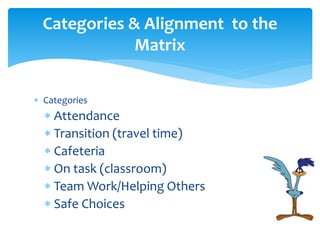
 Categories
 Attendance
 Transition (travel time)
 Cafeteria
 On task (classroom)
 Team Work/Helping Others
 Safe Choices
Categories & Alignment to the
Matrix
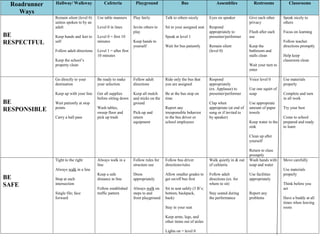
Roadrunner
Ways
Hallway/ Walkway Cafeteria Playground Bus Assemblies Restrooms Classrooms
BE
RESPECTFUL
Remain silent (level 0)
unless spoken to by an
adult
Keep hands and feet to
self
Follow adult directions
Keep the school’s
property clean
Use table manners
Level 0 in lines
Level 0 = first 10
minutes
Level 1 = after first
10 minutes
Play fairly
Invite others to
play
Keep hands to
yourself
Talk to others nicely
Sit in your assigned seat
Speak at level 1
Wait for bus patiently
Eyes on speaker
Respond
appropriately to
presenter/performer
Remain silent
(level 0)
Give each other
privacy
Flush after each
use
Keep the
bathroom and
stalls clean
Wait your turn to
enter
Speak nicely to
others
Focus on learning
Follow teacher
directions promptly
Help keep
classroom clean
BE
RESPONSIBLE
Go directly to your
destination
Keep up with your line
Wait patiently at stop
points
Carry a hall pass
Be ready to make
your selection
Get all supplies
before sitting down
Wash tables,
sweep floor and
pick up trash
Follow adult
directions
Keep all mulch
and sticks on the
ground
Pick-up and
return
equipment
Ride only the bus that
you are assigned
Be at the bus stop on
time
Report any
irresponsible behavior
to the bus driver or
school employees
Respond
appropriately
(ex. Applause) to
presenter/performer
Clap when
appropriate (at end of
song or if invited to
by speaker)
Voice level 0
Use one squirt of
soap
Use appropriate
amount of paper
towels
Keep water in the
sink
Clean up after
yourself
Return to class
promptly
Use materials
properly
Complete and turn
in all work
Try your best
Come to school
prepared and ready
to learn
BE
SAFE
Tight to the right
Always walk in a line
Stop at each
intersection
Single file; face
forward
Always walk in a
line
Keep a safe
distance in line
Follow established
traffic pattern
Follow rules for
structure use
Dress
appropriately
Always walk on
steps to and
from playground
Follow bus driver
directions/rules
Allow smaller grades to
get on/off bus first
Sit in seat safely (3 B’s;
bottom, backpack,
back)
Stay in your seat
Keep arms, legs, and
other items out of aisles
Lights on = level 0
Walk quietly in & out
of cafeteria
Follow adult
directions (ex. for
where to sit)
Stay seated during
the performance
Wash hands with
soap and water
Use facilities
appropriately
Report any
problems
Move carefully
Use materials
properly
Think before you
act
Have a buddy at all
times when leaving
room
 Point System
 10 points (candy, sticker, tattoo)
 20 points (coupons—homework pass,
lunch with a friend)
 30 points Cart (Fridays only)
*Provided by Rocky River Elementary*
Point System, Rewards, & Tiers
This will be tracked within
Class Dojo!
Data Tracking
Exit Ticket- Read the scenarios
around the room. Place your dots
under major or minor incident. You
cannot put a dot on the line.
Major vs Minor
http://linoit.com/users/kathryn_almond-
53/canvases/Parking Lot Questions
Questions Parking Lot

PBIS Presentation to Staff 2014

  • 1.
     As youarrive, please brainstorm staff incentives you would like to see that make you feel valued as a staff member.  Then, access Sticky Board link through your email and post your staff incentive ideas.  http://linoit.com/users/kathryn_almond- 53/canvases/Staff Acknowledgment  Lunch 12:30-1:00 Welcome to RRES’S PBIS Training! May 6, 2014
  • 2.
    Be Responsible *Return promptlyfrom breaks *Be an active participant Be Respectful *Silence cell phones *Listen attentively to others Be Kind *Participate in activities *Listen and respond appropriately to others’ ideas Expectations 2
  • 3.
    Trainer will raisehis/her hand Each participant will raise their hand and wait quietly 3 Attention Signal
  • 4.
    12:30-1:00 Lunch 1:00-1:45 PBISOverview 1:45-2:00 Break 2:00-2:45 Class Dojo/Acknowledgement System 2:45-3:00- Questions/Parking Lot/Exit Slip Agenda
  • 5.
     In smallgroups (4-6), discuss what you want Rocky River to “look” like. What would behavior look like? What would kids and adults be doing? What would the environment feel like? What would families and community partners roles be?  Write these words/phrases on sticky notes and post to chart paper entitled “RRES Dream”. Our Dream for the Rock
  • 6.
    The purpose ofPBIS is to create a framework of systems, including partnerships with families and the community, to establish a respectful, responsible and safe learning environment that supports the needs of all students. Purpose
  • 7.
     School personnelmust be willing to examine their own behavior as students are taught to change theirs.  Cultural differences exist and need to be understood.  Positive relationships between students and adults are key to student success. Guiding Principles
  • 8.
    All students arevaluable and deserve respect. All students can be taught to demonstrate appropriate behavior. Punishment does not work to change behavior. School climate is a shared responsibility among administrators, teachers, staff, students and families. Guiding Principles
  • 9.
  • 10.
    PBIS Training &Implementation  All PBIS Modules organized around problem- solving model 10
  • 11.
    Defining & TeachingExpectations Routines & Procedures Reinforcement Systems Effective Consequences CONTINUUM OF POSITIVE BEHAVIOR INTERVENTION AND SUPPORT Social Skills Mentoring Check In Self Management Classroom Based Intervention FBA/BIP De-escalation 5% 80% 15%
  • 12.
    Why Positive BehaviorIntervention and Support?
  • 13.
    •Traditional Discipline: ΔFocuses on the student’s problem behavior ΔGoalis to stop undesirable behavior through the use of punishment •Positive Behavior Intervention & Support: ΔReplaces undesired behavior with a new behavior or skill ΔAlters environments, teaches appropriate skills, and rewards appropriate behavior
  • 14.
    Bradshaw, C.P., Koth,C.W., Thornton, L.A., & Leaf, P.J. (2009). Altering school climate through school-wide Positive Behavioral Interventions and Supports: Findings from a group-randomized effectiveness trial. Prevention Science, 10(2), 100-115 Bradshaw, C.P., Koth, C.W., Bevans, K.B., Ialongo, N., & Leaf, P.J. (2008). The impact of school-wide Positive Behavioral Interventions and Supports (PBIS) on the organizational health of elementary schools. School Psychology Quarterly, 23(4), 462-473. Bradshaw, C. P., Mitchell, M. M., & Leaf, P. J. (2010). Examining the effects of School-Wide Positive Behavioral Interventions and Supports on student outcomes: Results from a randomized controlled effectiveness trial in elementary schools. Journal of Positive Behavior Interventions, 12, 133-148. Bradshaw, C.P., Reinke, W. M., Brown, L. D., Bevans, K.B., & Leaf, P.J. (2008). Implementation of school-wide Positive Behavioral Interventions and Supports (PBIS) in elementary schools: Observations from a randomized trial. Education & Treatment of Children, 31, 1-26. Horner, R., Sugai, G., Smolkowski, K., Eber, L., Nakasato, J., Todd, A., & Esperanza, J., (2009). A randomized, wait-list controlled effectiveness trial assessing school-wide positive behavior support in elementary schools. Journal of Positive Behavior Interventions, 11, 133-145. Horner, R. H., Sugai, G., & Anderson, C. M. (2010). Examining the evidence base for school-wide positive behavior support. Focus on Exceptionality, 42(8), 1-14. Bradshaw, C., Waasdorp, T., Leaf. P., (in press). Effects of School-wide positive behavioral interventions and supports on child behavior problems and adjustment. Pediatrics. Waasdorp, T., Bradshaw, C., & Leaf , P., (2012) The Impact of Schoolwide Positive Behavioral Interventions and Supports on Bullying and Peer Rejection: A Randomized Controlled Effectiveness Trial. Archive of Pediatric Adolescent Medicine. 2012;166(2):149-156 Rob Horner, University of Oregon, “SW-PBIS: What, Why, and How?” Experimental Research on PBIS
  • 15.
    Effective Process •3-5 years •Effectiveprofessional development •Increased efficiency Expectations •Defined by building team with staff and community input •Implemented by all faculty and staff •Reflect behavior needs /challenges of school Teaching •Appropriate behavior is taught •Positive behavior is publicly acknowledged •Inappropriate behavior is corrected PBIS Facts
  • 16.
    Help students totake responsibility for their own behavior: “What are you doing?” “What should you be doing?” “Show me.” “Daily” Corrections
  • 17.
    What is amajor behavior? What is a minor behavior? Major vs. Minor
  • 18.
    Defined  Discipline incidentsthat can be handled by the classroom teacher; usually do not warrant a discipline referral to the office.  Example: tardiness to class, lack of classroom materials, incomplete classroom assignments, gum chewing, etc. Minor Discipline Incidents
  • 19.
    Defined  Discipline incidentsthat must be handled by the administration. These may include but are not limited to: physical fights, property damage, drugs, weapons, tobacco, etc. Major Discipline Incidents
  • 20.
  • 21.
     Increases thelikelihood that desired behaviors will be repeated  Focuses staff and student attention on desired behaviors  Fosters a positive school climate  Reduces the need for engaging in time consuming punitive disciplinary measures Why Develop a School-wide Acknowledgement System?
  • 22.
     Create alearning environment where students are engaged and successful  Teach, support, and encourage students to be “self-managers”  Help students generalize the skills they learn in school to life experiences beyond school Goals of Acknowledgement (Horner, 2009)
  • 23.
     Acknowledge frequentlyin the beginning  Acknowledgement should be contingent on students engaging in the desired behavior(s)  Refrain from taking back a reinforcer that has been earned, or threatening the loss of reinforcement  Students should be eligible to earn acknowledgement throughout the day Acknowledgement Guidelines
  • 24.
     Keep ratiosof reinforcement to correction high (4:1) (Walker, Ramsey, & Gresham, 2004)  Involve all staff in implementing your school’s reinforcement system  Develop a data based system for monitoring and documenting appropriate behaviors  Involve students to help develop meaningful reinforcers Acknowledgement Guidelines
  • 25.
     Reward the“behavior” not the “person”  Say this: “You were working hard, on-task and quiet during independent seat work…that is respectful of others trying to get their work done… nice job.”  Rather than: “You are selected as student of the week. Congratulations!” Acknowledgement Example (Horner, 2009)
  • 33.
     Categories  Attendance Transition (travel time)  Cafeteria  On task (classroom)  Team Work/Helping Others  Safe Choices Categories & Alignment to the Matrix
  • 34.
    Roadrunner Ways Hallway/ Walkway CafeteriaPlayground Bus Assemblies Restrooms Classrooms BE RESPECTFUL Remain silent (level 0) unless spoken to by an adult Keep hands and feet to self Follow adult directions Keep the school’s property clean Use table manners Level 0 in lines Level 0 = first 10 minutes Level 1 = after first 10 minutes Play fairly Invite others to play Keep hands to yourself Talk to others nicely Sit in your assigned seat Speak at level 1 Wait for bus patiently Eyes on speaker Respond appropriately to presenter/performer Remain silent (level 0) Give each other privacy Flush after each use Keep the bathroom and stalls clean Wait your turn to enter Speak nicely to others Focus on learning Follow teacher directions promptly Help keep classroom clean BE RESPONSIBLE Go directly to your destination Keep up with your line Wait patiently at stop points Carry a hall pass Be ready to make your selection Get all supplies before sitting down Wash tables, sweep floor and pick up trash Follow adult directions Keep all mulch and sticks on the ground Pick-up and return equipment Ride only the bus that you are assigned Be at the bus stop on time Report any irresponsible behavior to the bus driver or school employees Respond appropriately (ex. Applause) to presenter/performer Clap when appropriate (at end of song or if invited to by speaker) Voice level 0 Use one squirt of soap Use appropriate amount of paper towels Keep water in the sink Clean up after yourself Return to class promptly Use materials properly Complete and turn in all work Try your best Come to school prepared and ready to learn BE SAFE Tight to the right Always walk in a line Stop at each intersection Single file; face forward Always walk in a line Keep a safe distance in line Follow established traffic pattern Follow rules for structure use Dress appropriately Always walk on steps to and from playground Follow bus driver directions/rules Allow smaller grades to get on/off bus first Sit in seat safely (3 B’s; bottom, backpack, back) Stay in your seat Keep arms, legs, and other items out of aisles Lights on = level 0 Walk quietly in & out of cafeteria Follow adult directions (ex. for where to sit) Stay seated during the performance Wash hands with soap and water Use facilities appropriately Report any problems Move carefully Use materials properly Think before you act Have a buddy at all times when leaving room
  • 35.
     Point System 10 points (candy, sticker, tattoo)  20 points (coupons—homework pass, lunch with a friend)  30 points Cart (Fridays only) *Provided by Rocky River Elementary* Point System, Rewards, & Tiers
  • 36.
    This will betracked within Class Dojo! Data Tracking
  • 37.
    Exit Ticket- Readthe scenarios around the room. Place your dots under major or minor incident. You cannot put a dot on the line. Major vs Minor
  • 38.