B Y : M E L L I S A G E B R E - M I C H A E L
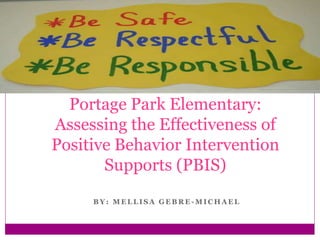
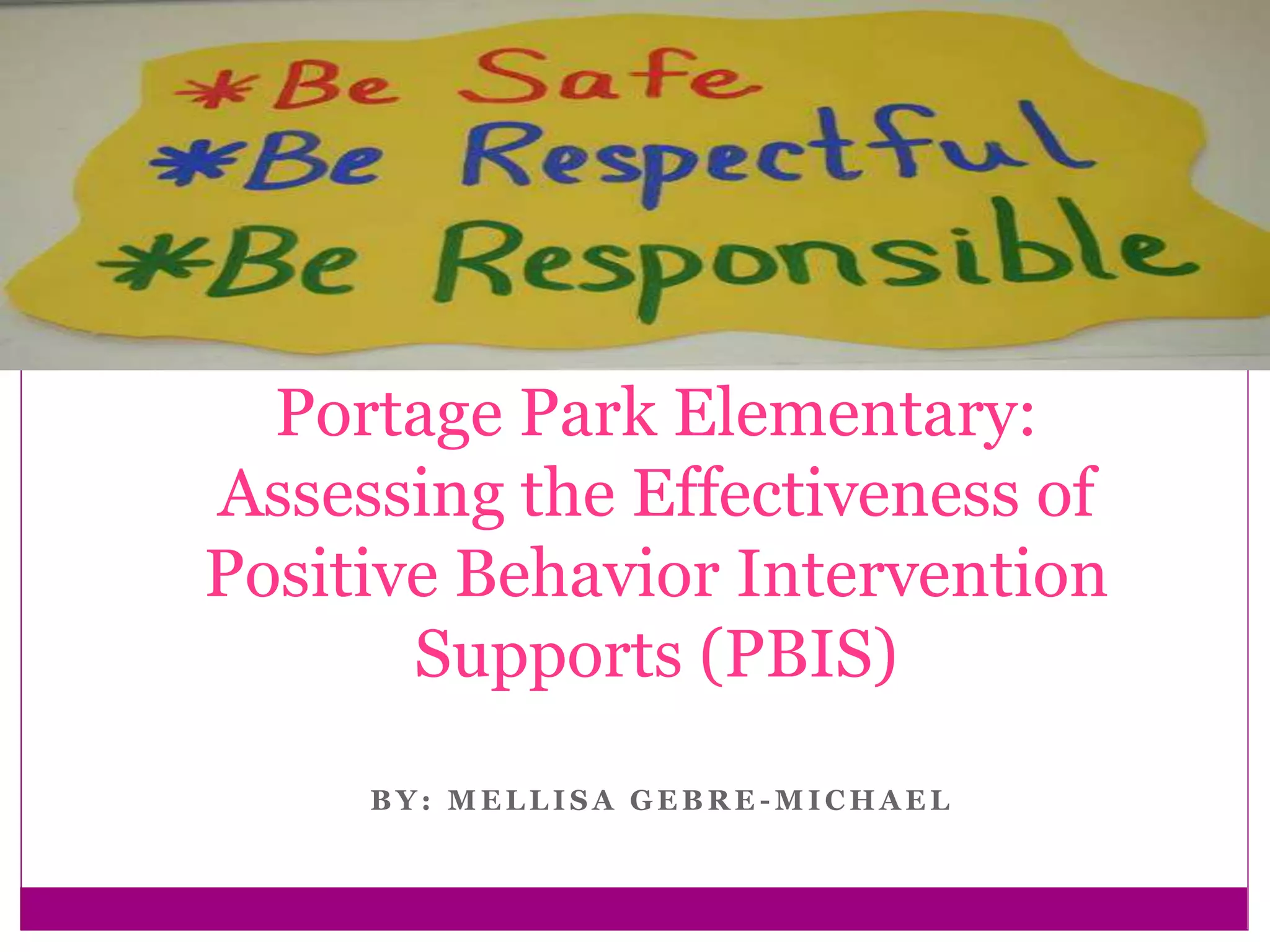
Portage Park Elementary:
Assessing the Effectiveness of
Positive Behavior Intervention
Supports (PBIS)
A little history..
 The first law that was
passed for children with
disabilities was The
Individuals with
Disabilities Education Act
(IDEA) which was signed
into law in 1990
 No Child Left behind Act of
2001 was an effort to
ensure that students in
every public school achieve
important learning goals
while being educated.
Introduction: What is PBIS?
 PBIS is a unique approach that helps to eliminate
challenging behaviors and supplements them with
skills and tools that helps students make better
choices.
 PBIS has changed the dynamics of education and
currently, this intervention is implemented in over
5,000 schools and approximately 80%-90% of
students respond well with the universal concept of
this strategy.
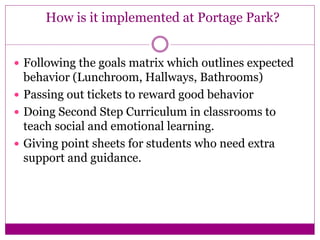
How is it implemented at Portage Park?
 Following the goals matrix which outlines expected
behavior (Lunchroom, Hallways, Bathrooms)
 Passing out tickets to reward good behavior
 Doing Second Step Curriculum in classrooms to
teach social and emotional learning.
 Giving point sheets for students who need extra
support and guidance.
What is the purpose?
 Assess the effectiveness of PBIS in Portage Park
Elementary School.
 Seeing if there has been any positive change within
the student body (behavior, academic success)
 Understanding how the students feel about PBIS and
the school environment.
Research Thoughts..
 Is Positive Behavior Intervention Support (PBIS)
effective within Portage Park Elementary School?
 Has there been a positive correlation since PBIS has
been implemented?
Hypothesis
 PBIS is effective in Portage Park Elementary School
because it promotes positivity and enhances the
school climate.
 Since PBIS promotes positivity there is a positive
correlation since it has been implemented.
Methodology: Design
 Non-Experimental
 Secondary data
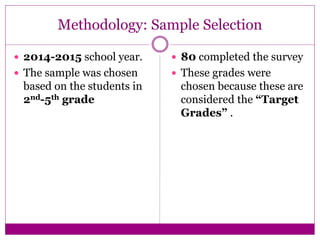
Methodology: Sample Selection
 2014-2015 school year.
 The sample was chosen
based on the students in
2nd-5th grade
 80 completed the survey
 These grades were
chosen because these are
considered the “Target
Grades” .
Methodology: Instrument Selection & Data
Collection
 Used an electronic survey to complete the research.
 Surveying the students was the best way to get
accurate results since they are a part of the student
body.
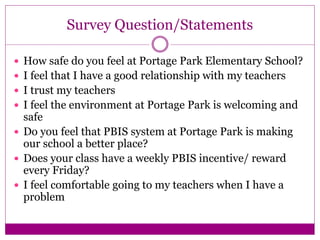
Survey Question/Statements
 How safe do you feel at Portage Park Elementary School?
 I feel that I have a good relationship with my teachers
 I trust my teachers
 I feel the environment at Portage Park is welcoming and
safe
 Do you feel that PBIS system at Portage Park is making
our school a better place?
 Does your class have a weekly PBIS incentive/ reward
every Friday?
 I feel comfortable going to my teachers when I have a
problem
Results
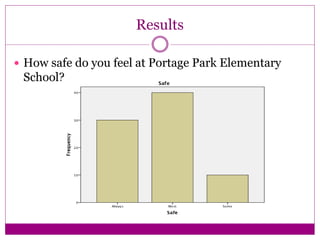
 How safe do you feel at Portage Park Elementary
School?
Continued..
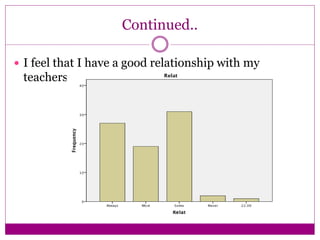
 I feel that I have a good relationship with my
teachers
Continued..
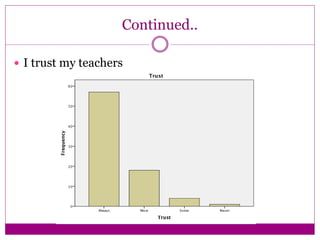
 I trust my teachers
Continued..
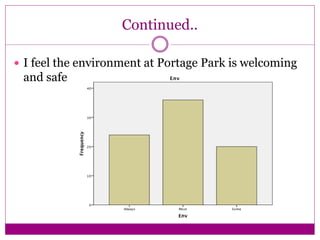
 I feel the environment at Portage Park is welcoming
and safe
Continued..
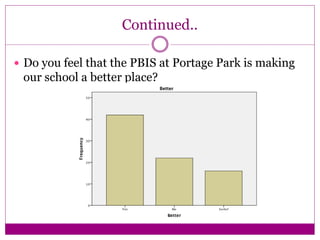
 Do you feel that the PBIS at Portage Park is making
our school a better place?
Continued..
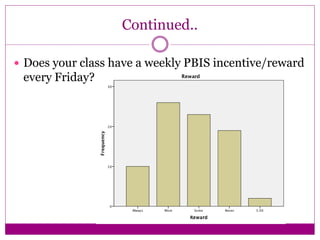
 Does your class have a weekly PBIS incentive/reward
every Friday?
Continued..
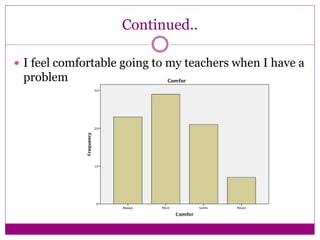
 I feel comfortable going to my teachers when I have a
problem
Conclusions..
 Overall since the implementation of PBIS there has
been a positive change within the school.
 There is room for improvement.
 Surveying the students was great, but next time they
need to ask more specific questions geared towards
PBIS.
 Next time allow the interns to conduct the research.
THANK YOU!!!
References
 Bradshaw, C., Koth, C., Bevans, K., Ialongo, N., & Leaf, P. (n.d.). The Impact Of School-wide
Positive Behavioral Interventions And Supports (PBIS) On The Organizational Health Of
Elementary Schools. School Psychology Quarterly, 462-473.
 Catherine P. Bradshaw, Wendy M. Reinke, Louis D. Brown, Katherine B. Bevans, & Philip J.
Leaf. (n.d.). Implementation Of School-Wide Positive Behavioral Interventions And Supports
(PBIS) In Elementary Schools: Observations From A Randomized Trial. Education and
Treatment of Children, 1-26.
 Cooke, M., Ford, J., Levine, J., Bourke, C., Newell, L., & Lapidus, G. (n.d.). The Effects Of City-
Wide Implementation Of “Second Step” On Elementary School Students’ Prosocial And
Aggressive Behaviors. The Journal of Primary Prevention, 93-115.
 Horner, R. (2009). A Randomized, Wait-List Controlled Effectiveness Trial Assessing School-
Wide Positive Behavior Support in Elementary Schools. Journal of Positive Behavior
Interventions, 11(3), 133-144.
 Muscott, H., Mann, E., & LeBrun, M. (n.d.). Positive Behavioral Interventions And Supports In
New Hampshire: Effects Of Large-Scale Implementation Of Schoolwide Positive Behavior
Support On Student Discipline And Academic Achievement. Journal of Positive Behavior
Interventions, 190-205.
 Swoszowski, N. (n.d.). The Effects of Tier II Check-in/ Check-out Including Adaptation for Non-
Responsers on the Off-Task Behavior of Elementary Students in a Residential Setting.
Education and Treatment of Childrenn, 36(3), 64-78.

PBIS powerpoint

  • 1.
    B Y :M E L L I S A G E B R E - M I C H A E L Portage Park Elementary: Assessing the Effectiveness of Positive Behavior Intervention Supports (PBIS)
  • 2.
    A little history.. The first law that was passed for children with disabilities was The Individuals with Disabilities Education Act (IDEA) which was signed into law in 1990  No Child Left behind Act of 2001 was an effort to ensure that students in every public school achieve important learning goals while being educated.
  • 3.
    Introduction: What isPBIS?  PBIS is a unique approach that helps to eliminate challenging behaviors and supplements them with skills and tools that helps students make better choices.  PBIS has changed the dynamics of education and currently, this intervention is implemented in over 5,000 schools and approximately 80%-90% of students respond well with the universal concept of this strategy.
  • 4.
    How is itimplemented at Portage Park?  Following the goals matrix which outlines expected behavior (Lunchroom, Hallways, Bathrooms)  Passing out tickets to reward good behavior  Doing Second Step Curriculum in classrooms to teach social and emotional learning.  Giving point sheets for students who need extra support and guidance.
  • 5.
    What is thepurpose?  Assess the effectiveness of PBIS in Portage Park Elementary School.  Seeing if there has been any positive change within the student body (behavior, academic success)  Understanding how the students feel about PBIS and the school environment.
  • 6.
    Research Thoughts..  IsPositive Behavior Intervention Support (PBIS) effective within Portage Park Elementary School?  Has there been a positive correlation since PBIS has been implemented?
  • 7.
    Hypothesis  PBIS iseffective in Portage Park Elementary School because it promotes positivity and enhances the school climate.  Since PBIS promotes positivity there is a positive correlation since it has been implemented.
  • 8.
  • 9.
    Methodology: Sample Selection 2014-2015 school year.  The sample was chosen based on the students in 2nd-5th grade  80 completed the survey  These grades were chosen because these are considered the “Target Grades” .
  • 10.
    Methodology: Instrument Selection& Data Collection  Used an electronic survey to complete the research.  Surveying the students was the best way to get accurate results since they are a part of the student body.
  • 11.
    Survey Question/Statements  Howsafe do you feel at Portage Park Elementary School?  I feel that I have a good relationship with my teachers  I trust my teachers  I feel the environment at Portage Park is welcoming and safe  Do you feel that PBIS system at Portage Park is making our school a better place?  Does your class have a weekly PBIS incentive/ reward every Friday?  I feel comfortable going to my teachers when I have a problem
  • 12.
    Results  How safedo you feel at Portage Park Elementary School?
  • 13.
    Continued..  I feelthat I have a good relationship with my teachers
  • 14.
  • 15.
    Continued..  I feelthe environment at Portage Park is welcoming and safe
  • 16.
    Continued..  Do youfeel that the PBIS at Portage Park is making our school a better place?
  • 17.
    Continued..  Does yourclass have a weekly PBIS incentive/reward every Friday?
  • 18.
    Continued..  I feelcomfortable going to my teachers when I have a problem
  • 19.
    Conclusions..  Overall sincethe implementation of PBIS there has been a positive change within the school.  There is room for improvement.  Surveying the students was great, but next time they need to ask more specific questions geared towards PBIS.  Next time allow the interns to conduct the research.
  • 20.
  • 21.
    References  Bradshaw, C.,Koth, C., Bevans, K., Ialongo, N., & Leaf, P. (n.d.). The Impact Of School-wide Positive Behavioral Interventions And Supports (PBIS) On The Organizational Health Of Elementary Schools. School Psychology Quarterly, 462-473.  Catherine P. Bradshaw, Wendy M. Reinke, Louis D. Brown, Katherine B. Bevans, & Philip J. Leaf. (n.d.). Implementation Of School-Wide Positive Behavioral Interventions And Supports (PBIS) In Elementary Schools: Observations From A Randomized Trial. Education and Treatment of Children, 1-26.  Cooke, M., Ford, J., Levine, J., Bourke, C., Newell, L., & Lapidus, G. (n.d.). The Effects Of City- Wide Implementation Of “Second Step” On Elementary School Students’ Prosocial And Aggressive Behaviors. The Journal of Primary Prevention, 93-115.  Horner, R. (2009). A Randomized, Wait-List Controlled Effectiveness Trial Assessing School- Wide Positive Behavior Support in Elementary Schools. Journal of Positive Behavior Interventions, 11(3), 133-144.  Muscott, H., Mann, E., & LeBrun, M. (n.d.). Positive Behavioral Interventions And Supports In New Hampshire: Effects Of Large-Scale Implementation Of Schoolwide Positive Behavior Support On Student Discipline And Academic Achievement. Journal of Positive Behavior Interventions, 190-205.  Swoszowski, N. (n.d.). The Effects of Tier II Check-in/ Check-out Including Adaptation for Non- Responsers on the Off-Task Behavior of Elementary Students in a Residential Setting. Education and Treatment of Childrenn, 36(3), 64-78.