HBase
Леонид Налчаджи
leonid.nalchadzhi@gmail.com
HBase
•
•
•
•
•

Overview
Table layout
Architecture
Client API
Key design

2
Overview

3
Overview
•
•
•

NoSQL
Column oriented
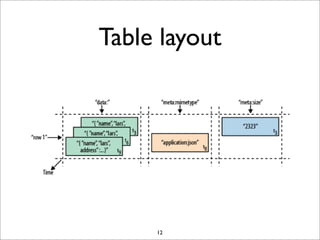
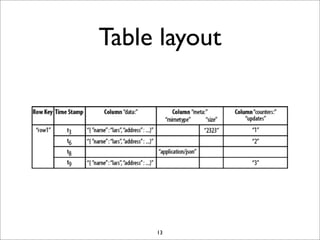
Versioned

4
Overview
•
•
•

All rows ordered by row key
All cells are uninterpreted arrays of bytes
Auto-sharding

5
Overview
•
•
•
•

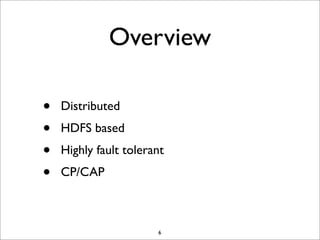
Distributed
HDFS based
Highly fault tolerant
CP/CAP

6
Overview
•
•
•

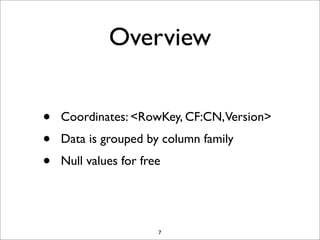
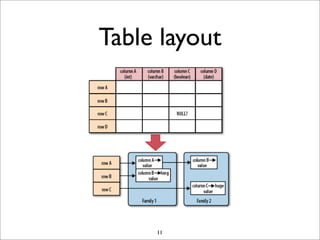
Coordinates: <RowKey, CF:CN,Version>
Data is grouped by column family
Null values for free

7
Overview
•
•

No actual deletes (tombstones)
TTL for cells

8
Disadvantages
•
•
•
•

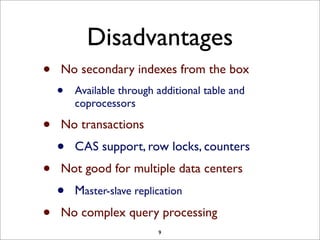
No secondary indexes from the box

•

Available through additional table and
coprocessors

No transactions

•

CAS support, row locks, counters

Not good for multiple data centers

•

Master-slave replication

No complex query processing
9
Table layout

10
Table layout

11
Table layout

12
Table layout

13
Architecture

14
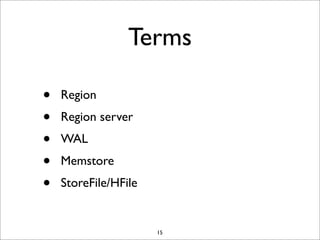
Terms
•
•
•
•
•

Region
Region server
WAL
Memstore
StoreFile/HFile

15
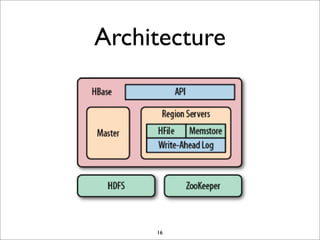
Architecture

16
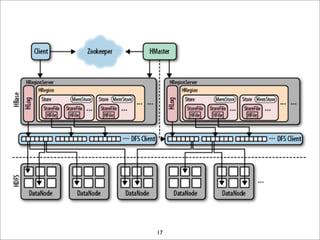
17
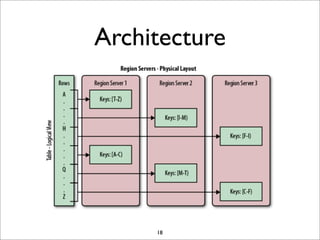
Architecture

18
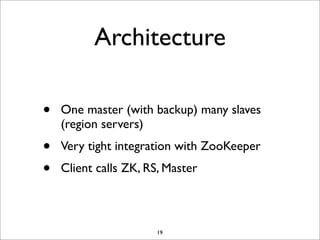
Architecture
•

One master (with backup) many slaves
(region servers)

•
•

Very tight integration with ZooKeeper
Client calls ZK, RS, Master

19
Master
•
•
•
•

Handles schema changes
Cluster housekeeping operations
Not SPOF
Check RS status through ZK

20
Region server
•
•
•
•

Stores data in regions
Region is a container of data
Does actual data manipulation
HDFS DataNode
21
ZooKeeper
•
•
•

Distributed synchronization service
FS-like tree structure contains keys
Provides primitives to achieve a lot of goals

22
Storage
•
•
•

Handled by region server
Memstore: sorted write buffer
2 types of file

•
•

WAL log
Data storage

23
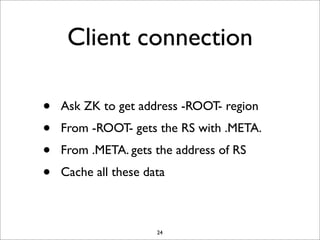
Client connection
•
•
•
•

Ask ZK to get address -ROOT- region
From -ROOT- gets the RS with .META.
From .META. gets the address of RS
Cache all these data

24
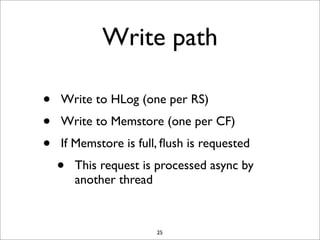
Write path
•
•
•

Write to HLog (one per RS)
Write to Memstore (one per CF)
If Memstore is full, flush is requested

•

This request is processed async by
another thread

25
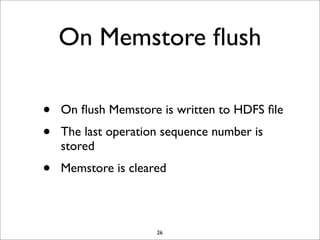
On Memstore flush
•
•

On flush Memstore is written to HDFS file

•

Memstore is cleared

The last operation sequence number is
stored

26
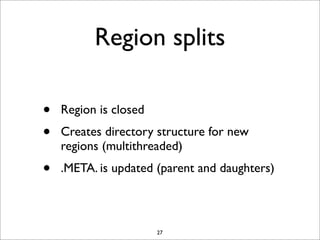
Region splits
•
•

Region is closed

•

.META. is updated (parent and daughters)

Creates directory structure for new
regions (multithreaded)

27
Region splits
•
•
•

Master is notified for load balancing
All steps are tracked in ZK
Parent cleaned up eventually

28
Compaction
•

When Memstore is flushed new store file
is created

•

Compaction is a housekeeping mechanism
which merges store files

•
•

Come in two varieties: minor and major
The type is determined when the
compaction check is executed
29
Minor compaction
•
•
•
•

Fast
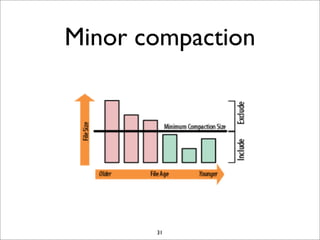
Selects files to include
Params: max size and min number of files
From the oldest to the newest

30
Minor compaction

31
Major compaction
•
•

Compact all files into a single file

•

Starts periodically (each 24 hours by
default)

•

Checks tombstone markers and removes
data

Might be promoted from the minor
compaction

32
HFile format

33
HFile format
•
•
•
•
•

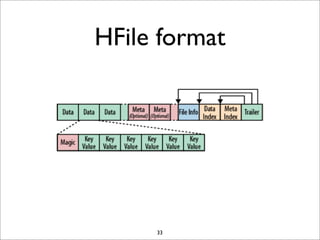
Immutable (trailer is written once)
Trailer has pointers to other blocks
Indexes store offsets to data, metadata
Block size by default 64K
Block contains magic and number of key
values

34
KeyValue format

35
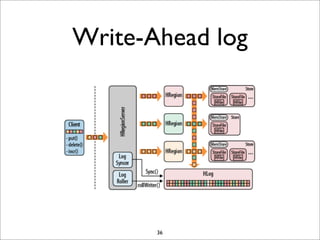
Write-Ahead log

36
Write-Ahead log
•
•
•

One per region server
Contains data from several regions
Stores data sequentially

37
Write-Ahead log
•
•

Rolled periodically (every hour by default)

•

Split is distributed

Applied on cluster restart and on server
failure

38
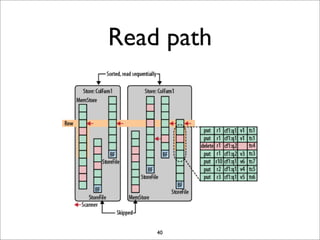
Read path
•
•

There is no single index with logical rows

•

Gets are the same as scans

Data is stored in several files and
Memstore per column family

39
Read path

40
Block cache
•
•

Each region has LRU block cache
Based on priorities
1. Single access
2. Multi access priority
3. Catalog CF: ROOT and META

41
Block cache
•
•
•
•

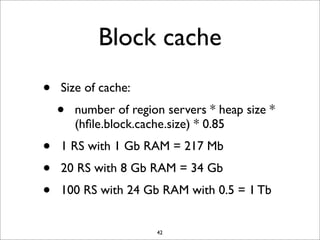
Size of cache:

•

number of region servers * heap size *
(hfile.block.cache.size) * 0.85

1 RS with 1 Gb RAM = 217 Mb
20 RS with 8 Gb RAM = 34 Gb
100 RS with 24 Gb RAM with 0.5 = 1 Tb

42
Block cache
•

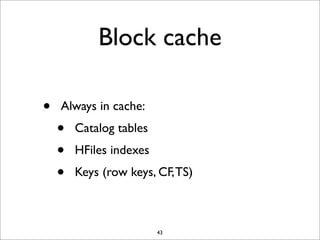
Always in cache:

•
•
•

Catalog tables
HFiles indexes
Keys (row keys, CF, TS)

43
Client API

44
CRUD
•
•
•
•
•

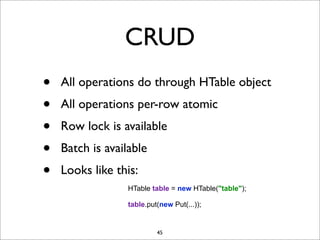
All operations do through HTable object
All operations per-row atomic
Row lock is available
Batch is available
Looks like this:
HTable table = new HTable("table");
table.put(new Put(...));

45
Put
•
•
•
•

Put(byte[] row)
Put(byte[] row, RowLock rowLock)
Put(byte[] row, long ts)
Put(byte[] row, long ts, RowLock rowLock)

46
Put
•

Put add(byte[] family, byte[] qualifier, byte[]
value)

•

Put add(byte[] family, byte[] qualifier, long
ts, byte[] value)

•

Put add(KeyValue kv)

47
Put
•
•

setWriteToWAL()
heapSize()

48
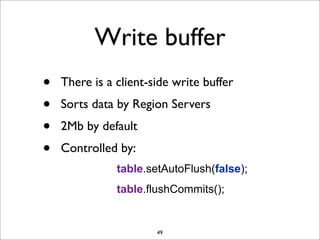
Write buffer
•
•
•
•

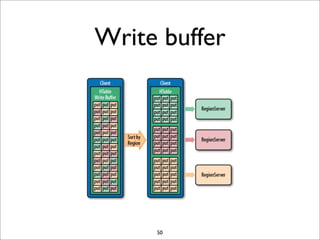
There is a client-side write buffer
Sorts data by Region Servers
2Mb by default
Controlled by:
table.setAutoFlush(false);
table.flushCommits();

49
Write buffer

50
What else
•

CAS:
boolean checkAndPut(byte[] row, byte[] family,

•

byte[] qualifier, byte[] value, Put put) throws IOException

Batch:
void put(List<Put> puts) throws IOException

51
Get
•

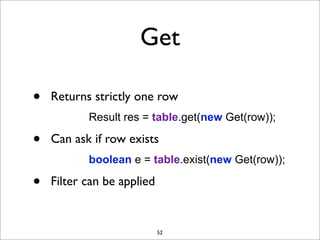
Returns strictly one row
Result res = table.get(new Get(row));

•

Can ask if row exists
boolean e = table.exist(new Get(row));

•

Filter can be applied

52
Row lock
•
•

Region server provide a row lock
Client can ask for explicit lock:
RowLock lockRow(byte[] row) throws IOException;
void unlockRow(RowLock rl) throws IOException;

•

Do not use if you do not have to

53
Scan
•
•
•
•

Iterator over a number of rows
Can be defined start and end rows
Leased for amount of time
Batching and caching is available

54
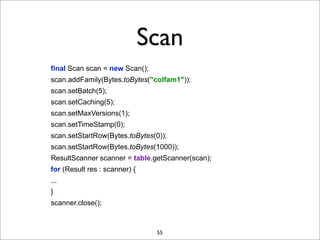
Scan
final Scan scan = new Scan();
scan.addFamily(Bytes.toBytes("colfam1"));
scan.setBatch(5);
scan.setCaching(5);
scan.setMaxVersions(1);
scan.setTimeStamp(0);
scan.setStartRow(Bytes.toBytes(0));
scan.setStartRow(Bytes.toBytes(1000));
ResultScanner scanner = table.getScanner(scan);
for (Result res : scanner) {
...
}
scanner.close();

55
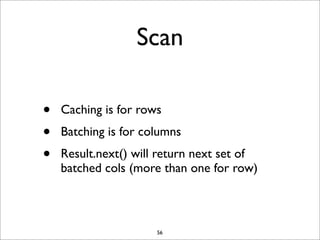
Scan
•
•
•

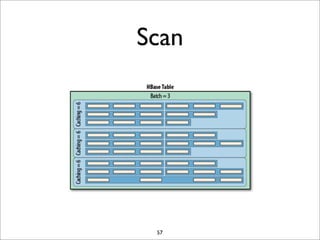
Caching is for rows
Batching is for columns
Result.next() will return next set of
batched cols (more than one for row)

56
Scan

57
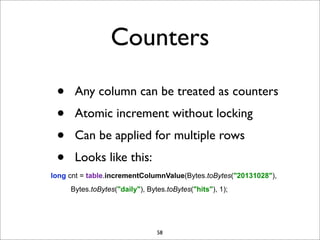
Counters
•
•
•
•

Any column can be treated as counters
Atomic increment without locking
Can be applied for multiple rows
Looks like this:

long cnt = table.incrementColumnValue(Bytes.toBytes("20131028"),
Bytes.toBytes("daily"), Bytes.toBytes("hits"), 1);

58
HTable pooling
•
•
•

Creating an HTable instance is expensive
HTable is not thread safe
Should be created on start up and closed
on application exit

59
HTable pooling
•
•
•

Provided pool: HTablePool
Thread safe
Shares common resources

60
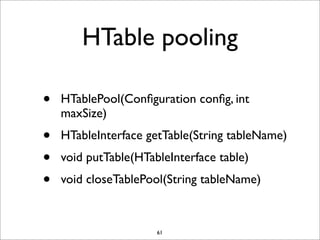
HTable pooling
•

HTablePool(Configuration config, int
maxSize)

•
•
•

HTableInterface getTable(String tableName)
void putTable(HTableInterface table)
void closeTablePool(String tableName)

61
Key design

62
Key design
•
•
•

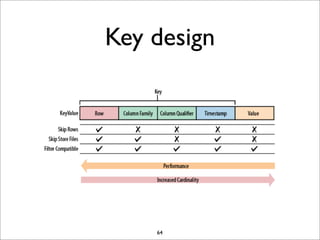
The only index is row key
Row keys are sorted
Key is uninterpreted array of bytes

63
Key design

64
Email example
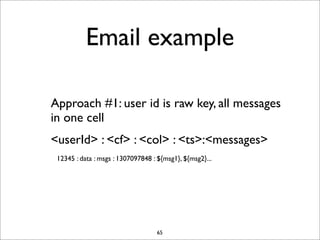
Approach #1: user id is raw key, all messages
in one cell
<userId> : <cf> : <col> : <ts>:<messages>
12345 : data : msgs : 1307097848 : ${msg1}, ${msg2}...

65
Email example
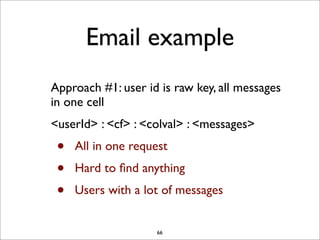
Approach #1: user id is raw key, all messages
in one cell
<userId> : <cf> : <colval> : <messages>

•
•
•

All in one request
Hard to find anything
Users with a lot of messages

66
Email example
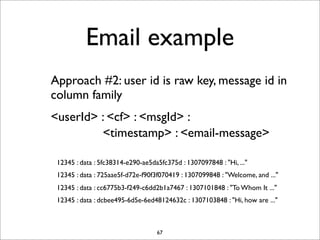
Approach #2: user id is raw key, message id in
column family
<userId> : <cf> : <msgId> :
<timestamp> : <email-message>
12345 : data : 5fc38314-e290-ae5da5fc375d : 1307097848 : "Hi, ..."
12345 : data : 725aae5f-d72e-f90f3f070419 : 1307099848 : "Welcome, and ..."
12345 : data : cc6775b3-f249-c6dd2b1a7467 : 1307101848 : "To Whom It ..."
12345 : data : dcbee495-6d5e-6ed48124632c : 1307103848 : "Hi, how are ..."

67
Email example
Approach #2: user id is raw key, message id in
column family
<userId> : <cf> : <msgId> :
<timestamp> : <email-message>
Can load data on demand

•
•
•

Find anything only with filter
Users with a lot of messages
68
Email example
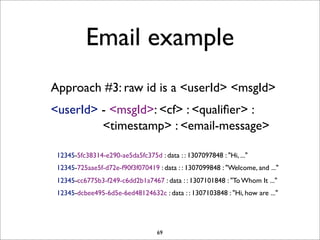
Approach #3: raw id is a <userId> <msgId>
<userId> - <msgId>: <cf> : <qualifier> :
<timestamp> : <email-message>
12345-5fc38314-e290-ae5da5fc375d : data : : 1307097848 : "Hi, ..."
12345-725aae5f-d72e-f90f3f070419 : data : : 1307099848 : "Welcome, and ..."
12345-cc6775b3-f249-c6dd2b1a7467 : data : : 1307101848 : "To Whom It ..."
12345-dcbee495-6d5e-6ed48124632c : data : : 1307103848 : "Hi, how are ..."

69
Email example
Approach #3: raw id is a <userId> <msgId>
<userId> - <msgId>: <cf> : <qualifier> :
<timestamp> : <email-message>
Can load data on demand

•
•
•

Find message with row key
Users with a lot of messages

70
Email example
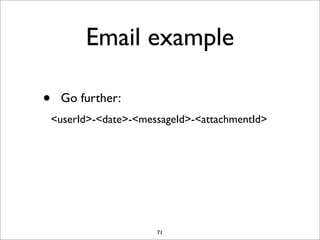
•

Go further:
<userId>-<date>-<messageId>-<attachmentId>

71
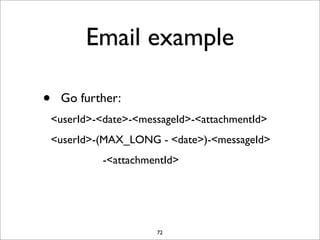
Email example
•

Go further:
<userId>-<date>-<messageId>-<attachmentId>
<userId>-(MAX_LONG - <date>)-<messageId>
-<attachmentId>

72
Performance

73
Performance
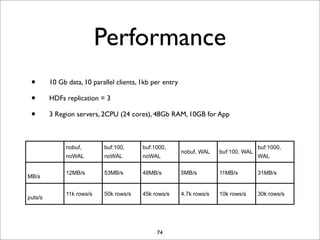
•
•
•

10 Gb data, 10 parallel clients, 1kb per entry
HDFs replication = 3
3 Region servers, 2CPU (24 cores), 48Gb RAM, 10GB for App

nobuf,

puts/s

buf:1000,

noWAL

MB/s

buf:100,
noWAL

noWAL

12MB/s

53MB/s

11k rows/s

50k rows/s

buf:1000,

nobuf, WAL

buf:100, WAL

48MB/s

5MB/s

11MB/s

31MB/s

45k rows/s

4.7k rows/s

10k rows/s

30k rows/s

74

WAL
Sources
•
•
•

HBase. The defenitive guide (O’Reilly)
HBase in action (Manning)
Official documentation
http://hbase.apache.org/0.94/book.html

•

Cloudera articles
http://blog.cloudera.com/blog/category/hbase/

75
HBase
Леонид Налчаджи
leonid.nalchadzhi@gmail.com

Базы данных. HBase