Eng. Ahmed Assad Syria - 2011
3 HAZARD CONTROL
The hazard of sharks … 1/6 Eng. Ahmed Assad Syria - 2011 Sharks are a dormant hazard Figures in the slides 2…6 retrieved from  http://www.safework.sa.gov.au/
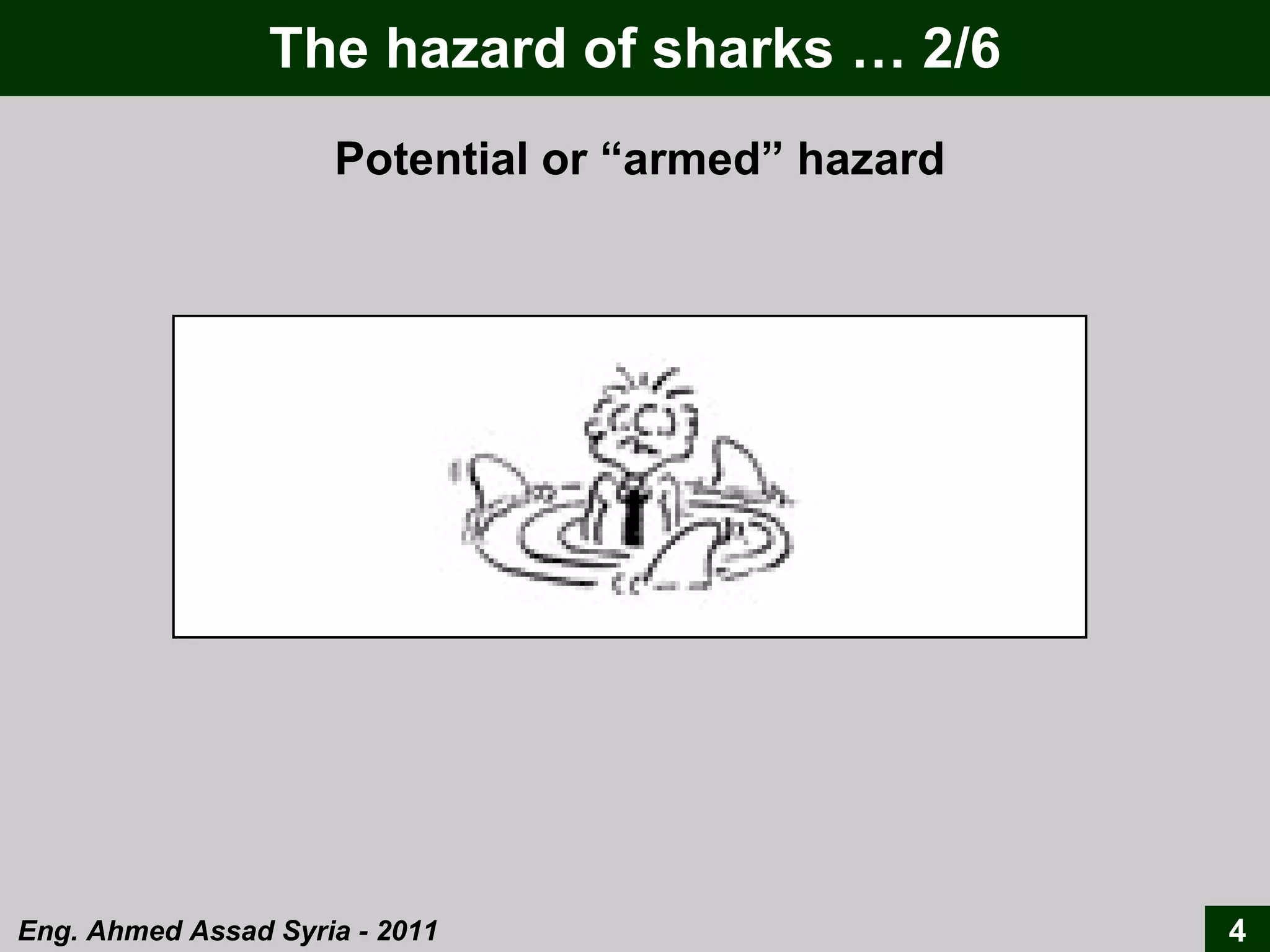
The hazard of sharks … 2/6 Eng. Ahmed Assad Syria - 2011 Potential or “armed” hazard
The hazard of sharks … 3/6 Eng. Ahmed Assad Syria - 2011 Eliminating hazard Replace “sharks” with “toys”
The hazard of sharks … 5/6 Eng. Ahmed Assad Syria - 2011 Introducing administrative tools May be you will have time to escape …
The hazard of sharks … 4/6 Eng. Ahmed Assad Syria - 2011 Engineering out the problem Encage yourself!
The hazard of sharks … 6/6 Eng. Ahmed Assad Syria - 2011 Provision of personal protective equipment An armoured holiday
Hazard control in the risk analysis Eng. Ahmed Assad Syria - 2011 Where we are?
Methods to control hazards Eng. Ahmed Assad Syria - 2011 Two groups of options
Accident prevention 1/2 Eng. Ahmed Assad Syria - 2011 Accident  prevention
Accident prevention 2/2 Accident  prevention Eng. Ahmed Assad Syria - 2011 General The following general features of hazard control should be observed: Designs to eliminate hazards  are most preferred over any other method. Where safeguards by design are not feasible,  protective safety devices   should be employed. Where neither design nor safety devices are practical,  automatic warning devices  should be incorporated. Where none of the above is feasible,  escape procedures  and  personnel training  should be used.
1. Eliminating hazards 1/3 Accident prevention Eng. Ahmed Assad Syria - 2011 Intrinsic safety The most effective method of avoiding accidents is with designs that are  “intrinsically safe” . Intrinsic safety can be achieved by either two methods: Eliminating the hazard entirely. Limiting the hazard to a level below which it can do no harm.
1. Eliminating hazards 2/3 Accident prevention Eng. Ahmed Assad Syria - 2011 Complete elimination: good housekeeping Tripping over misplaced objects, slipping on wet or oily surfaces, and spontaneous ignition of trash or oily rags can be eliminated simply by  keeping facilities clean and orderly .
1. Eliminating hazards 3/3 Accident prevention Eng. Ahmed Assad Syria - 2011 Complete elimination: examples Using  non-combustible  instead of combustible materials. This method has been observed with paints, fabrics, hydraulic fluids, solvents, and electrical insulation. Using  pneumatic or hydraulic , instead of electric, systems where there is a possibility of fire or excessive heating. Fluid control systems are often applied for this reason. Rounding  edges and corners on equipment so personnel will not injure themselves. Eliminating leaks using continuous lines with  as few connections as possible .
2. Limiting hazard level 1/2 Accident prevention Eng. Ahmed Assad Syria - 2011 Hazard level limitation In certain instances the type of hazard can not itself be eliminated. However, the level of the hazard might be limited so no injury or damage will result.   Electricity under some circumstance can be fatal. It may be possible to eliminate any adverse effects by using  low-voltage, low temperature power , such as 12-volt power or battery power.
2. Limiting hazard level 2/2 Accident prevention Eng. Ahmed Assad Syria - 2011 Hazard level limitation: examples Providing  overflow arrangements  that will prevent liquid levels from getting too high. Using  solid state electrical devices  where flammable or explosive gases may be present, so any power requirements will be far less than required for ignition of a flammable mixture. Ensuring that the  concentration  of a flammable or toxic gas is far less than a dangerous limit. If the limit is exceeded, a blower could be started automatically or inert gas introduced. Adding  diluters  to air where flammable dusts are present to minimize the possibility of an explosion. Incorporating  automatic relief provisions  to keep pressure within a safe limit. Using  grounds on capacitor or capacitive circuits  to reduce charge accumulations to acceptable levels after power is shut off. This will lessen the tendency for an electric shock.
3. Isolating hazards 1/4 Accident prevention Eng. Ahmed Assad Syria - 2011 General Isolation here = separation employed as an accident prevention measure.   Fire requires the presence of a  fuel ,  oxidiser , and  ignition source . Isolating any one of these from the other two will eliminate any possibility of fire. Some grades of bituminous coal are often  stored underwater , isolating the coal from the oxygen and ignition source needed for fires to start spontaneously.
3. Isolating hazards 2/4 Accident prevention Eng. Ahmed Assad Syria - 2011 Isolation: examples Isolating workers inside  protective garments or equipment  to prevent environmental injuries. Use of  thermal insulation  to prevent persons from contacting hot surfaces which can burn them. Use of isolators to keep  noise  inside closed spaces. Use of  “explosion-proof” or encapsulated  electrical equipment in flammable atmospheres. Keeping  corrosive gases and liquids  from  incompatible metals or other materials that might be affected adversely.
3. Isolating hazards 3/4 Accident prevention Eng. Ahmed Assad Syria - 2011 Lockins & lockouts Lockout:  prevents an event form occurring or prevents a person, object, force, or other factor from entering an undesired zone. Lockin:   keeps a person, object force, process, or other factor form leaving a restricted zone.  Lockout example:  a switch closing electrical circuit secured with a lock that only specific persons can open. Lockin example:  the same switch with lock preventing opening of the circuit.
3. Isolating hazards 4/4  Eng. Ahmed Assad Syria - 2011 Interlocks Interlocks initiate/prevent action or motion; other send signals to other devices which initiate/prevent the action or motion: Parameter sensing : presence, absence, excess, or inadequacy of pressure, temperature, flow or other parameter permits or stops action. Timers and time delays : operation of the equipment can take place only after a specific length of time has passed. Photoelectric devices : interruption or presence of light on a photoelectrical cell generates a signal which can stop or initiate action. Accident prevention
4. Fail-safe designs Eng. Ahmed Assad Syria - 2011 Equipment failures yield a high percentage of accidents Since failures will occur, fail-safe arrangements are often made to prevent injury to personnel, major catastrophes, damage to equipment, or degraded operations: Fail-passive arrangements:  circuit breakers and fuses  for protection of electrical devices which deenergise system in case of overload. Fail-active arrangements:  a battery operated smoke detector  maintains energised state of the system but activates eliminating the possibility of accident (sprinklers, say). Fail-operational arrangement: allows system functions to continue safely until corrective action is possible. Accident prevention
5. Failure minimization Accident prevention Eng. Ahmed Assad Syria - 2011 Reducing critical failures causing accidents Safety factors and margins: over-design of the system. Failure rate reduction: increase expected lifetimes. Parameter monitoring: keep under surveillance specific parameters, say, temperature, noise, gas concentration.
6. Warning means and devices 1/3 Eng. Ahmed Assad Syria - 2011 Avoiding accidents by attracting attention Visual sense Accident prevention Illumination  A hazardous area brightly illuminated than non-hazardous surrounding areas  Having well-lit highway intersections, obstacles, stairs, and transformer substations  Discrimina-tion  Paint a physical hazard in a bright colour or in alternating light and dark colours A structure, piece of equipment, or fixed object which could be hit by a moving vehicle is painted yellow or orange Notes in instructions  Warning and caution notes inserted in operations and maintenance instructions and manuals to alert personnel to hazards A warning in a car owner’s manual to block the wheels before jacking the car to change a tire
6. Warning means and devices 2/3 Accident prevention Eng. Ahmed Assad Syria - 2011 Avoiding accidents by attracting attention Auditory sense Alarms  A siren, whistle, or similar sound device provides warning of existing or impending danger A siren indicates that there is a fire in a plant; a siren or whistle warns personnel to clear an area where blasting is to take place Buzzer  Alerts person that a specified time has passed or that time has arrived to take the next step in a sequence of actions Some compressed air packs contain buzzers that sound when the pressure in the tank has decreased to a predetermined level, or after a preset time has passed  Shout  Voice action to warn of a danger One person warns another of an obstruction
6. Warning means and devices 3/3 Accident prevention Eng. Ahmed Assad Syria - 2011 Avoiding accidents by attracting attention Smell Odour detection  Presence of an odorous gas can indicate the presence of a hazard An odorant is added to refined natural gas (which has no odour) so that leaks can be readily detected Burning materials give off characteristic odours The presence of an unseen fire can sometimes be detected by characteristic odours of products of combustion Overheating equipment can be recognised by the odour generated Vaporisation of oil can permit detection of a hot bearing; odour of hot, streaming water can warn a car driver of a broken radiator hose
7. Safe procedures Accident prevention Eng. Ahmed Assad Syria - 2011 “ when all else fails, read the instructions” The need to follow prescribed procedures. Safe procedures should include any warnings about hazards established by the analysis of the system. Unfortunately, since many people to not read operating procedures until they have run into difficulty (“when all else fails, read the instructions”), and ignore warnings, this method has low priority in rating means of preventing accidents.
8. Backout & recovery Eng. Ahmed Assad Syria - 2011 “ A near-miss” A failure, error, or other adverse condition may eventually develop into a mishap. At this time, a  contingency  or  emergency  may then exist. By suitable action an accident can be avoided from this  abnormal situation , which may be an extremely dangerous one.  Failure to act correctly or adequately can permit the situation to deteriorate into a mishap.  This  interim period  extends from the time the abnormality appears until normality is recovered or accident develops.  If  recovery  takes place, the incident can be considered a  near-miss . Accident prevention
Minimising and controlling damage Eng. Ahmed Assad Syria - 2011 Damage minimisaiton
1. Isolation and barriers 1/2 Eng. Ahmed Assad Syria - 2011 Damage minimisaiton Distance  by sitting possible points of accidents far from persons, equipment, or vulnerable structures.  Deflectors  can be used to lessen damage by deflecting or absorbing energy. The reminder should then constitute less than the amount that would be damaging (heat reflectors from fires, noise shields, or sloped barricades between explosive storage buildings) Containment  to prevent the spread of fire such as sprinkler systems.   Barriers  of metal, concrete blocks, or other impenetrable or nonconductive material.  Physical insulation
1. Isolation and barriers 2/2 Eng. Ahmed Assad Syria - 2011 Damage minimisaiton The tank’s protective barrier in gas station
2. Personal protective equipment 1/3 Eng. Ahmed Assad Syria - 2011 Damage minimisaiton For scheduled hazardous operation:  spray painting would require protective clothing during scheduled operations. For investigative and corrective purposes:  it may be necessary to determine if the environment is dangerous because of a leak, contamination, or other condition. Against accidents:  this may be constitute the severest requirements because the first few minutes after an accident takes place may be the most critical.* * Reaction time to suppress or control any injury or damage is extremely important. Because of this, protective equipment must be simple and easy to don and operate, especially because it is often required at a time of stress.   Categories
2. Personal protective equipment 2/3 Eng. Ahmed Assad Syria - 2011 Damage minimisaiton The hazard of entering a tank: scheduled/investigative operation
2. Personal protective equipment 3/3 Eng. Ahmed Assad Syria - 2011 Damage minimisaiton Protection in case of accident: accidental release of toxic material
3. Weak links 1/2 Eng. Ahmed Assad Syria - 2011 Damage minimisaiton Boilers with  mechanical fuses  that melt when water levels drop excessively so steam can escape so there is no rupture. Sprinklers  that open to release water for fire extinguishing. Drop-off panels  that will fail along designed fault lines to provide openings to energy of an explosion. “ Weak link” = component designed to fail at low level of stress The most common example is electrical fuse
3. Weak links 2/2 Eng. Ahmed Assad Syria - 2011 Damage minimisaiton Ronan Point Explosion: fatal structural collapse, UK 1968 Floor 18, Apartment 90             Only a few weeks after the occupants had moved in, a gas explosion demolished a load bearing wall, causing the collapse of one entire corner of the building. Four people were killed in the collapse, and seventeen were injured.
4. Escape and survival equipment 1/2 Eng. Ahmed Assad Syria - 2011 Damage minimisaiton Abandoning or scarifying structures, vehicles, or equipment to avoid injury and to personnel
4. Escape and survival equipment 2/2 Eng. Ahmed Assad Syria - 2011 Damage minimisaiton Telescopic Poles in Aluminium/Carbon Fibre
5. Rescue procedures and equipment Eng. Ahmed Assad Syria - 2011 Damage minimisaiton Persons involved in an accident and not able to escape Fellow workers  familiar with the plant, hazards, equipment, and who may have been advised of what to do in any emergency.   Untrained persons  unfamiliar with equipment (passers-by, say).   Persons knowledgeable and capable of handling the need.   A  rescuer  can be everyone:
6. Minor loss acceptance Eng. Ahmed Assad Syria - 2011 Damage minimisaiton The decision to accept losses of potential accidents can be based on the results of a quantitative risk assessment.
To end of part three Eng. Ahmed Assad Syria - 2011

Hazard Control Safety Training

  • 1.
    Eng. Ahmed AssadSyria - 2011
  • 2.
  • 3.
    The hazard ofsharks … 1/6 Eng. Ahmed Assad Syria - 2011 Sharks are a dormant hazard Figures in the slides 2…6 retrieved from http://www.safework.sa.gov.au/
  • 4.
    The hazard ofsharks … 2/6 Eng. Ahmed Assad Syria - 2011 Potential or “armed” hazard
  • 5.
    The hazard ofsharks … 3/6 Eng. Ahmed Assad Syria - 2011 Eliminating hazard Replace “sharks” with “toys”
  • 6.
    The hazard ofsharks … 5/6 Eng. Ahmed Assad Syria - 2011 Introducing administrative tools May be you will have time to escape …
  • 7.
    The hazard ofsharks … 4/6 Eng. Ahmed Assad Syria - 2011 Engineering out the problem Encage yourself!
  • 8.
    The hazard ofsharks … 6/6 Eng. Ahmed Assad Syria - 2011 Provision of personal protective equipment An armoured holiday
  • 9.
    Hazard control inthe risk analysis Eng. Ahmed Assad Syria - 2011 Where we are?
  • 10.
    Methods to controlhazards Eng. Ahmed Assad Syria - 2011 Two groups of options
  • 11.
    Accident prevention 1/2Eng. Ahmed Assad Syria - 2011 Accident prevention
  • 12.
    Accident prevention 2/2Accident prevention Eng. Ahmed Assad Syria - 2011 General The following general features of hazard control should be observed: Designs to eliminate hazards are most preferred over any other method. Where safeguards by design are not feasible, protective safety devices should be employed. Where neither design nor safety devices are practical, automatic warning devices should be incorporated. Where none of the above is feasible, escape procedures and personnel training should be used.
  • 13.
    1. Eliminating hazards1/3 Accident prevention Eng. Ahmed Assad Syria - 2011 Intrinsic safety The most effective method of avoiding accidents is with designs that are “intrinsically safe” . Intrinsic safety can be achieved by either two methods: Eliminating the hazard entirely. Limiting the hazard to a level below which it can do no harm.
  • 14.
    1. Eliminating hazards2/3 Accident prevention Eng. Ahmed Assad Syria - 2011 Complete elimination: good housekeeping Tripping over misplaced objects, slipping on wet or oily surfaces, and spontaneous ignition of trash or oily rags can be eliminated simply by keeping facilities clean and orderly .
  • 15.
    1. Eliminating hazards3/3 Accident prevention Eng. Ahmed Assad Syria - 2011 Complete elimination: examples Using non-combustible instead of combustible materials. This method has been observed with paints, fabrics, hydraulic fluids, solvents, and electrical insulation. Using pneumatic or hydraulic , instead of electric, systems where there is a possibility of fire or excessive heating. Fluid control systems are often applied for this reason. Rounding edges and corners on equipment so personnel will not injure themselves. Eliminating leaks using continuous lines with as few connections as possible .
  • 16.
    2. Limiting hazardlevel 1/2 Accident prevention Eng. Ahmed Assad Syria - 2011 Hazard level limitation In certain instances the type of hazard can not itself be eliminated. However, the level of the hazard might be limited so no injury or damage will result. Electricity under some circumstance can be fatal. It may be possible to eliminate any adverse effects by using low-voltage, low temperature power , such as 12-volt power or battery power.
  • 17.
    2. Limiting hazardlevel 2/2 Accident prevention Eng. Ahmed Assad Syria - 2011 Hazard level limitation: examples Providing overflow arrangements that will prevent liquid levels from getting too high. Using solid state electrical devices where flammable or explosive gases may be present, so any power requirements will be far less than required for ignition of a flammable mixture. Ensuring that the concentration of a flammable or toxic gas is far less than a dangerous limit. If the limit is exceeded, a blower could be started automatically or inert gas introduced. Adding diluters to air where flammable dusts are present to minimize the possibility of an explosion. Incorporating automatic relief provisions to keep pressure within a safe limit. Using grounds on capacitor or capacitive circuits to reduce charge accumulations to acceptable levels after power is shut off. This will lessen the tendency for an electric shock.
  • 18.
    3. Isolating hazards1/4 Accident prevention Eng. Ahmed Assad Syria - 2011 General Isolation here = separation employed as an accident prevention measure. Fire requires the presence of a fuel , oxidiser , and ignition source . Isolating any one of these from the other two will eliminate any possibility of fire. Some grades of bituminous coal are often stored underwater , isolating the coal from the oxygen and ignition source needed for fires to start spontaneously.
  • 19.
    3. Isolating hazards2/4 Accident prevention Eng. Ahmed Assad Syria - 2011 Isolation: examples Isolating workers inside protective garments or equipment to prevent environmental injuries. Use of thermal insulation to prevent persons from contacting hot surfaces which can burn them. Use of isolators to keep noise inside closed spaces. Use of “explosion-proof” or encapsulated electrical equipment in flammable atmospheres. Keeping corrosive gases and liquids from incompatible metals or other materials that might be affected adversely.
  • 20.
    3. Isolating hazards3/4 Accident prevention Eng. Ahmed Assad Syria - 2011 Lockins & lockouts Lockout: prevents an event form occurring or prevents a person, object, force, or other factor from entering an undesired zone. Lockin: keeps a person, object force, process, or other factor form leaving a restricted zone. Lockout example: a switch closing electrical circuit secured with a lock that only specific persons can open. Lockin example: the same switch with lock preventing opening of the circuit.
  • 21.
    3. Isolating hazards4/4 Eng. Ahmed Assad Syria - 2011 Interlocks Interlocks initiate/prevent action or motion; other send signals to other devices which initiate/prevent the action or motion: Parameter sensing : presence, absence, excess, or inadequacy of pressure, temperature, flow or other parameter permits or stops action. Timers and time delays : operation of the equipment can take place only after a specific length of time has passed. Photoelectric devices : interruption or presence of light on a photoelectrical cell generates a signal which can stop or initiate action. Accident prevention
  • 22.
    4. Fail-safe designsEng. Ahmed Assad Syria - 2011 Equipment failures yield a high percentage of accidents Since failures will occur, fail-safe arrangements are often made to prevent injury to personnel, major catastrophes, damage to equipment, or degraded operations: Fail-passive arrangements: circuit breakers and fuses for protection of electrical devices which deenergise system in case of overload. Fail-active arrangements: a battery operated smoke detector maintains energised state of the system but activates eliminating the possibility of accident (sprinklers, say). Fail-operational arrangement: allows system functions to continue safely until corrective action is possible. Accident prevention
  • 23.
    5. Failure minimizationAccident prevention Eng. Ahmed Assad Syria - 2011 Reducing critical failures causing accidents Safety factors and margins: over-design of the system. Failure rate reduction: increase expected lifetimes. Parameter monitoring: keep under surveillance specific parameters, say, temperature, noise, gas concentration.
  • 24.
    6. Warning meansand devices 1/3 Eng. Ahmed Assad Syria - 2011 Avoiding accidents by attracting attention Visual sense Accident prevention Illumination A hazardous area brightly illuminated than non-hazardous surrounding areas Having well-lit highway intersections, obstacles, stairs, and transformer substations Discrimina-tion Paint a physical hazard in a bright colour or in alternating light and dark colours A structure, piece of equipment, or fixed object which could be hit by a moving vehicle is painted yellow or orange Notes in instructions Warning and caution notes inserted in operations and maintenance instructions and manuals to alert personnel to hazards A warning in a car owner’s manual to block the wheels before jacking the car to change a tire
  • 25.
    6. Warning meansand devices 2/3 Accident prevention Eng. Ahmed Assad Syria - 2011 Avoiding accidents by attracting attention Auditory sense Alarms A siren, whistle, or similar sound device provides warning of existing or impending danger A siren indicates that there is a fire in a plant; a siren or whistle warns personnel to clear an area where blasting is to take place Buzzer Alerts person that a specified time has passed or that time has arrived to take the next step in a sequence of actions Some compressed air packs contain buzzers that sound when the pressure in the tank has decreased to a predetermined level, or after a preset time has passed Shout Voice action to warn of a danger One person warns another of an obstruction
  • 26.
    6. Warning meansand devices 3/3 Accident prevention Eng. Ahmed Assad Syria - 2011 Avoiding accidents by attracting attention Smell Odour detection Presence of an odorous gas can indicate the presence of a hazard An odorant is added to refined natural gas (which has no odour) so that leaks can be readily detected Burning materials give off characteristic odours The presence of an unseen fire can sometimes be detected by characteristic odours of products of combustion Overheating equipment can be recognised by the odour generated Vaporisation of oil can permit detection of a hot bearing; odour of hot, streaming water can warn a car driver of a broken radiator hose
  • 27.
    7. Safe proceduresAccident prevention Eng. Ahmed Assad Syria - 2011 “ when all else fails, read the instructions” The need to follow prescribed procedures. Safe procedures should include any warnings about hazards established by the analysis of the system. Unfortunately, since many people to not read operating procedures until they have run into difficulty (“when all else fails, read the instructions”), and ignore warnings, this method has low priority in rating means of preventing accidents.
  • 28.
    8. Backout &recovery Eng. Ahmed Assad Syria - 2011 “ A near-miss” A failure, error, or other adverse condition may eventually develop into a mishap. At this time, a contingency or emergency may then exist. By suitable action an accident can be avoided from this abnormal situation , which may be an extremely dangerous one. Failure to act correctly or adequately can permit the situation to deteriorate into a mishap. This interim period extends from the time the abnormality appears until normality is recovered or accident develops. If recovery takes place, the incident can be considered a near-miss . Accident prevention
  • 29.
    Minimising and controllingdamage Eng. Ahmed Assad Syria - 2011 Damage minimisaiton
  • 30.
    1. Isolation andbarriers 1/2 Eng. Ahmed Assad Syria - 2011 Damage minimisaiton Distance by sitting possible points of accidents far from persons, equipment, or vulnerable structures. Deflectors can be used to lessen damage by deflecting or absorbing energy. The reminder should then constitute less than the amount that would be damaging (heat reflectors from fires, noise shields, or sloped barricades between explosive storage buildings) Containment to prevent the spread of fire such as sprinkler systems. Barriers of metal, concrete blocks, or other impenetrable or nonconductive material. Physical insulation
  • 31.
    1. Isolation andbarriers 2/2 Eng. Ahmed Assad Syria - 2011 Damage minimisaiton The tank’s protective barrier in gas station
  • 32.
    2. Personal protectiveequipment 1/3 Eng. Ahmed Assad Syria - 2011 Damage minimisaiton For scheduled hazardous operation: spray painting would require protective clothing during scheduled operations. For investigative and corrective purposes: it may be necessary to determine if the environment is dangerous because of a leak, contamination, or other condition. Against accidents: this may be constitute the severest requirements because the first few minutes after an accident takes place may be the most critical.* * Reaction time to suppress or control any injury or damage is extremely important. Because of this, protective equipment must be simple and easy to don and operate, especially because it is often required at a time of stress. Categories
  • 33.
    2. Personal protectiveequipment 2/3 Eng. Ahmed Assad Syria - 2011 Damage minimisaiton The hazard of entering a tank: scheduled/investigative operation
  • 34.
    2. Personal protectiveequipment 3/3 Eng. Ahmed Assad Syria - 2011 Damage minimisaiton Protection in case of accident: accidental release of toxic material
  • 35.
    3. Weak links1/2 Eng. Ahmed Assad Syria - 2011 Damage minimisaiton Boilers with mechanical fuses that melt when water levels drop excessively so steam can escape so there is no rupture. Sprinklers that open to release water for fire extinguishing. Drop-off panels that will fail along designed fault lines to provide openings to energy of an explosion. “ Weak link” = component designed to fail at low level of stress The most common example is electrical fuse
  • 36.
    3. Weak links2/2 Eng. Ahmed Assad Syria - 2011 Damage minimisaiton Ronan Point Explosion: fatal structural collapse, UK 1968 Floor 18, Apartment 90             Only a few weeks after the occupants had moved in, a gas explosion demolished a load bearing wall, causing the collapse of one entire corner of the building. Four people were killed in the collapse, and seventeen were injured.
  • 37.
    4. Escape andsurvival equipment 1/2 Eng. Ahmed Assad Syria - 2011 Damage minimisaiton Abandoning or scarifying structures, vehicles, or equipment to avoid injury and to personnel
  • 38.
    4. Escape andsurvival equipment 2/2 Eng. Ahmed Assad Syria - 2011 Damage minimisaiton Telescopic Poles in Aluminium/Carbon Fibre
  • 39.
    5. Rescue proceduresand equipment Eng. Ahmed Assad Syria - 2011 Damage minimisaiton Persons involved in an accident and not able to escape Fellow workers familiar with the plant, hazards, equipment, and who may have been advised of what to do in any emergency. Untrained persons unfamiliar with equipment (passers-by, say). Persons knowledgeable and capable of handling the need. A rescuer can be everyone:
  • 40.
    6. Minor lossacceptance Eng. Ahmed Assad Syria - 2011 Damage minimisaiton The decision to accept losses of potential accidents can be based on the results of a quantitative risk assessment.
  • 41.
    To end ofpart three Eng. Ahmed Assad Syria - 2011