15. EXPLOSION MITIGATIONAND
7. STRUCTURAL FEATURES AND EXITS
4. ACCIDENT
1. INTRODUCTION
CONTENTS
10. MECHANICAL HAZARDS
5. FIRE HAZARDS
2. OBJECTIVES OF INDUSTRIAL SAFETY
16. FILTRATION
11. CHEMICAL HAZARDS
9. BUILT IN GUARDS
14. PREVENTION OF DUST EXPLOSIONS
6. DETECTION OF FIRE HAZARDS
12. DUST EXPLOSION
3. INDUSTRIAL HAZARD V/S RISK
8. FIRE GUARDS
13. FACTORS IMPACTING A DUST
EXPLOSION
Industrial safety refersto reduction from the risk of injury or loss and danger to persons, property from the
industrial hazards.
Industrial Safety
6.
3
1 2
4
Hazard isa term associated with a
substance that is likely to cause
injury to a personnel in a given
environment or situation.
Understanding Hazards
Industrial hazard may be defined as
any condition produced by
industries that may cause injury or
death to personnel or loss of
product or property.
Toxic corrosive chemicals, fire
explosions and personnel falling
into accident are major health and
safety hazards encountered in the
operations of chemical and
pharmaceutical industries.
Identification of hazards and
employing protective measures to
control the hazards are important
to protect the people from their
consequences.
5
4
3
1
2
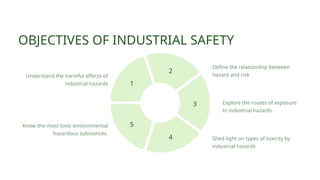
Shed light ontypes of toxicity by
industrial hazards
Know the most toxic environmental
hazardous substances.
Explore the routes of exposure
to industrial hazards
OBJECTIVES OF INDUSTRIAL SAFETY
Define the relationship between
hazard and risk
Understand the harmful effects of
industrial hazards
9.
SSource of hazard— Control procedure — Type of hazard — Contingency plan
Evaluation of Safety Aspects
1
2
3
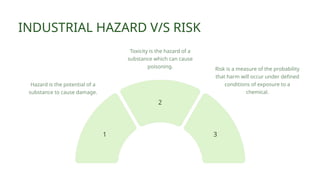
INDUSTRIAL HAZARD V/SRISK
Risk is a measure of the probability
that harm will occur under defined
conditions of exposure to a
chemical.
Hazard is the potential of a
substance to cause damage.
Toxicity is the hazard of a
substance which can cause
poisoning.
Thus, chemicals whichpose
only a small hazard but to
which there is frequent or
excessive exposure may pose
as much risk as chemicals
which have a high degree of
hazard but to which only
limited exposure occurs.
Implication
Reducing risk is based on
reducing exposure.
ACCIDENT
An accident isan unplanned and uncontrolled event which causes
or is likely to cause an injury.
It is something that is unexpected, unpredictable, unintended, or
not desired.
16.
An accident maybe caused from a result of some unsafe activity,
act, working condition etc.
Causes
If any oneof these components is removed, the fire will not
start/extinguish. It is essential to ensure that the third component,
heat, is never sufficient to start a fire.
Elements of Fire
Three elements must be present to start fire:
•Oxygen
•Fuel
•Heat
20.
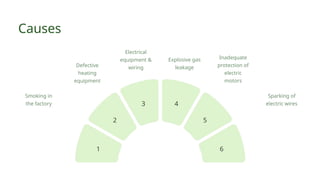
3 4
2
1
5
6
Explosive gas
leakage
Sparkingof
electric wires
Inadequate
protection of
electric
motors
Electrical
equipment &
wiring
Smoking in
the factory
Defective
heating
equipment
Causes
Fires involving ordinarycombustible materials, such as
paper, wood, and textile fibers.
Classification of Fires/CLASS A
A cooling, blanketing, or wetting extinguishing agent
is needed.
23.
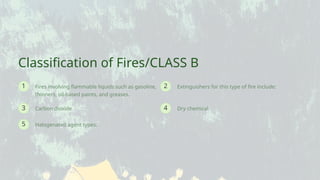
1 2
3 4
5
Drychemical
Halogenated agent types.
Fires involving flammable liquids such as gasoline,
thinners, oil-based paints, and greases.
Extinguishers for this type of fire include:
Carbon dioxide
Classification of Fires/CLASS B
24.
2
1
Classification of Fires/CLASSC
Flammable gases under pressure including
liquefied gases, e.g., propane, butane, ethane.
Dry chemical extinguisher may be used to
extinguish fire.
25.
Special dry powder
extinguishingagents are
required for this class of fire
and must be tailored to the
specific hazardous metal.
Classification of Fires/CLASS
D
Fires involving combustible
metals such as magnesium,
sodium, potassium, titanium,
and aluminum.
26.
Classification of Fires/CLASSE
Fires involving energized electrical equipment. Where a non-conducting gaseous clean agent or
smothering agent is needed. The most common type
of extinguisher for this class is a carbon dioxide
extinguisher.
27.
Fires involving commercialcooking appliances with vegetable oils,
animal oils or fats at high temperatures.
Classification of Fires/CLASS
F
28.
Fire Extinguishers
Fire extinguishersinclude:
•Water and water-based extinguishers
•Foam extinguishers
•Dry chemical extinguishers
•Carbon dioxide extinguishers
•Halon extinguishers.
DETECTION OF FIREHAZARDS
Many automatic fire detection systems are used today
in industry.
Some include:
•Thermal expansion detectors
•Heat sensitive insulation
•Ionization or radiation sensors
•Ultraviolet or I.R detectors
31.
Safety Measures toPrevent
Fire Hazards
Fire generates heat which can cause injury to people. Fire can also
cause explosions and generate smoke and toxic gases. An explosion
may give rise to blast waves which can cause damage to humans
and buildings.
STRUCTURAL FEATURES ANDEXITS
Building of factory should be sufficiently fire resistant or extinguishing water lines are present. Fire resistant
construction will ensure that structural parts do not readily burn. Break glass are provided to start the flow of
water in case of emergency.
34.
No part ofthe
building should
be far from exit.
Each floor should
have 2 exits
sufficiently quite
protective against
flame and smoke
and well
segregated from
each other.
Exits
Wooden or spiral
stairs and ladders
should not be
present at exits.
Exit should be
kept un-
obstructed.
Outside stairways
and fire escapes
should not lead to
interior country
yard or building
corridors.
35.
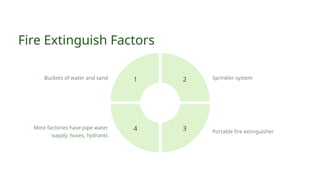
1
3
4
2 Sprinkler system
Portablefire extinguisher
Most factories have pipe water
supply, hoses, hydrants
Fire Extinguish Factors
Buckets of water and sand
FIRE GUARDS
The practiceof fitting guards is
mainly concerned with compliance
with the law. It was considered a
nuisance to labors. Guards were
unsatisfactory for one or more
reasons.
There were unreliable and
hampered the work, thus they
needed much attention.
Guards for power transmission
equipment as motors did not give
problems, but for wood/metal
works, where the faces, eyes are
covered with goggles and masks,
it hampers the work and often
was not used for efficient work.
BUILT IN GUARDS
Themost effective way of protecting machine is to make built-in guards as an integral part of the machine. Built-
in guards are much cheaper and more effective than guards added to machine after it has been delivered.
1 3
2
These areassociated with
power-driven machines,
whether automated or
manually operated by steam,
hydraulic and/or electric power.
Injuries like cutting, tearing,
shearing, puncturing, and
crushing may occur with
moving machinery.
MECHANICAL HAZARDS
Mechanical hazards are
exacerbated by the large
number and different designs
of equipment, crowded
workplace conditions, and
different interaction between
workers and equipment.
42.
Accidents usually takeplace by the combination of
unsafe conditions and carelessness.
Causes of Mechanical Hazards
Most industrial accidents are due to:
•Faulty inspection
•Inability of employee
•Poor discipline
•Lack of concentration
•Unsafe practice
•Mental and physical unfitness for job
•Faulty equipment or improper working condition
•Improper training regarding the safety aspects.
43.
Safety Measures toPrevent Mechanical
Hazards
Risk control must be applied to
hazards for reducing injuries and
harms.
Mechanical hazards can be
reduced by the application of
appropriate safeguards.
Inspection, adjustment, repair,
and calibration of safeguards
should be carried out regularly.
A guard canperform several functions. It can deny bodily access
containing ejected parts.
Risk Control
Options/Guarding
46.
Simultaneous Two-
Handed Operation
OtherMechanical Hazard Risk Control Options
Where a machine has
only one operator, the
use of simultaneous
two-handed operation
buttons can serve as a
risk control.
If physically, guards are
not reasonable,
practicable then a
presence sensing
system can be used
where people enter
areas shared by moving
production equipment.
Presence Sensing
Systems
2
1
3
4
Chemical exposure maycause or
contribute to many serious health
effects such as heart diseases,
central nervous system damage,
kidney and lung damage, cancer,
burns, and rashes.
CHEMICAL HAZARDS
The degree of danger varies
according to the form of the
chemical and the factors like:
•Its physical properties
•Toxicity
Some chemicals have the potential
to cause fires and explosions and
other serious accidents.
Chemicals may be found in solid,
liquid, aerosol or gas and vapor
form.
49.
Routes of entryof chemical hazards are as follows:
•Inhalation
•Skin
•Ingestion
•Absorption
Routes of Entry
50.
Chemical agents canbe classified into:
•Metals: lead, arsenic (As), mercury (Hg), (Cd), nickel (Ni).
•Aromatic hydrocarbons: benzene, toluene, phenol.
•Aliphatic hydrocarbons: methyl alcohol.
•Gases:
•Simple asphyxiants: N2, CO2
•Chemical asphyxiants: CO, H2S, HCN
•Irritant gases: Ammonia, SO2, CL2
•Systemic poison: CS2
•Carcinogens: nickel, chromium, cobalt, coal tar etc.
Classification of Chemical Agents
51.
Resuscitation
Decontamination
Removal from Exposure
Restorationof life of one who is apparently dead
(collapsed or shocked).
Prompt removal of person from exposure site.
Management of over-exposure to chemicals is
performed by:
Management of Over-Exposure to
Chemicals(1)
52.
Acute symptoms ofover exposure
may require general supportive
medical management regardless
of specific agent.
Symptomatic Treatment
Management of Over-Exposure to
Chemicals(2)
A victim whose skin or clothing
has been contaminated requires
immediate removal of garments
and shoes.
53.
Skin should becovered with
protective clothing.
Clothing should be removed
immediately if it gets wet or
contaminated with a chemical.
No eating, drinking, or
smoking where chemicals are
used.
Safety Measures
Before starting work with a
chemical, a "chemical hazard
pocket guide" should be
consulted for necessary
information about the
chemical.
If iron orstone pieces get into the disintegrator or
grinding mill, sparks are emitted, which may bring
about an explosion with some easily combustible
materials.
Dust explosion is a rapid combustion of a dust cloud.
During the process, heat and reaction products are
evolved. The required oxygen for combustion is mostly
supplied by air.
DUST EXPLOSION
56.
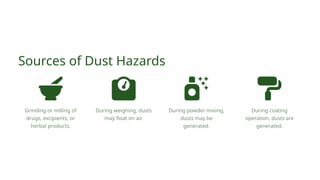
Sources of DustHazards
During coating
operation, dusts are
generated.
Grinding or milling of
drugs, excipients, or
herbal products.
During weighing, dusts
may float on air.
During powder mixing,
dusts may be
generated.
Moisture content ofa dust will
affect ignition and explosion
sustainability.
If the dust is not combustible,
there cannot be an explosion.
Particle Size
Moisture Content
Chemical Properties of the Dust
FACTORS IMPACTING A DUST EXPLOSION(1)
No matter how combustible the
powder, if it is in big lumps, it is
not going to cause a dust
explosion.
59.
FACTORS IMPACTING ADUST EXPLOSION(2)
Combustible Gas Mixed with Dust Cloud Addition of a fuel gas can lower the ignition energy
for a pure dust cloud massively.
1
5 6
3 4
2
ControllingIgnition Sources
Process modification, use of dust-control
equipment, and good housekeeping.
Oxidant Concentration Reduction
Combustible Concentration Reduction
Oxidant reduction can be accomplished by adding
inert gas to enclosed processes.
PREVENTION OF DUST EXPLOSIONS
Separating ignition sources from areas where
explosive atmospheres may form reduces the risk
of explosion considerably.
Air is suckedthrough a suitable filter medium (like paper, wool,
cotton-wool, and nylon). Filter bags can be attached to machines
where dust is produced.
FILTRATION
Toxic (Risk ofpoisoning; e.g.,
Carbon Monoxide, Hydrogen,
Chlorine).
Flammable (Risk of fire or
explosion; e.g., methane,
butane, propane).
Three major types of gas
hazards:
Types of Gas Hazards
Asphyxiant (Risk of suffocation;
e.g., Oxygen deficiency).
70.
Gas Safety atWork
All gas appliances, pipe work, and safety devices must be
maintained in a safe condition and be inspected.
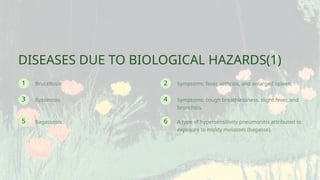
BIOLOGICAL HAZARDS
These includemedical waste or samples of a microorganism, virus
or toxin that can impact human health. It can also include
substances harmful to animals.
6
4
1
3
5
2 Symptoms: fever,arthritis, and enlarged spleen.
A type of hypersensitivity pneumonitis attributed to
exposure to moldy molasses (bagasse).
DISEASES DUE TO BIOLOGICAL HAZARDS(1)
Bagassosis
Symptoms: cough breathlessness, slight fever, and
bronchitis.
Byssinosis
Brucellosis
79.
2
1
DISEASES DUE TOBIOLOGICAL HAZARDS(2)
Symptoms: redness, itchiness, swelling, scaling,
cracking, blistering, and oozing.
Industrial Dermatitis
2
3
1
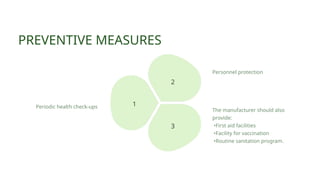
PREVENTIVE MEASURES
Periodic healthcheck-ups
Personnel protection
The manufacturer should also
provide:
•First aid facilities
•Facility for vaccination
•Routine sanitation program.















































![CASE_PRESENTATION_ON_subdural_hematoma(SDH)[1 FINAL PPT]-1.pptx](https://cdn.slidesharecdn.com/ss_thumbnails/casepresentationonsubduralhematomasdh1finalppt-1-260129172522-d405d375-thumbnail.jpg?width=640&height=640&fit=bounds)
