1
CS143: Hash Index
2
What is a Hash Table?
• Hash Table
– Hash function
• h(k): key ‡ integer [0…n]
• e.g., h(‘Susan’) = 7
– Array for keys: T[0…n]
– Given a key k, store it in
T[h(k)]
5
Susan4
James3
2
Neil1
0
h(Susan) = 4
h(James) = 3
h(Neil) = 1
3
Why Hash Table?
• Direct access
• Saved space
– Do not reserve a space for
every possible key
• How can we use this idea for
a record search in a DBMS?
4
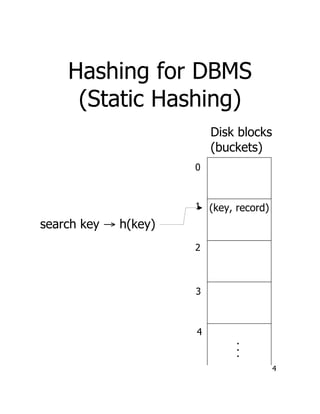
Hashing for DBMS
(Static Hashing)
(key, record)
.
.
.
Disk blocks
(buckets)
search key Æ h(key)
0
1
2
3
4
5
Issues?
• What hash function?
• Overflow?
• How to store records?
6
Record storage
1. Whole record
2. Key and pointer
.
.
.
record
.
.
.
record
key 1
h(key)
h(key)
7
Overflow and Chaining
• Insert
h(a) = 1
h(b) = 2
h(c) = 1
h(d) = 0
h(e) = 1
• Delete
h(b) = 2
h(c) = 1
0
1
2
3
Do we keep keys sorted inside a block?
8
Questions
• Q: Do we keep keys sorted
inside a block?
• Q: How much space should
we use for “good”
performance?
9
What Hash Function?
• Example
– Key = ‘x1 x2 … xn’ n byte
character string
– Have b buckets
– h: (x1 + x2 + ….. xn) mod b
• Desired property
– Uniformity: same # of keys for
every bucket
• Reference
– “The Art of Computer
Programming Vol. 3” by Knuth
10
Major Problem of
Static Hashing
• How to cope with growth?
– Data tends to grow in size
– Overflow blocks unavoidable
10
20
30
40
50
60
70
80
90
39
31
35
36
32
38
34
33
overflow blocks
hash buckets
11
Idea 1
• Periodic reorganization
– New hash function
– Complete reassignment of records
– Very expensive
10
20
30
40
50
…
33
10
20
30
40
50
60
70
80
90
33
40
50
60
12
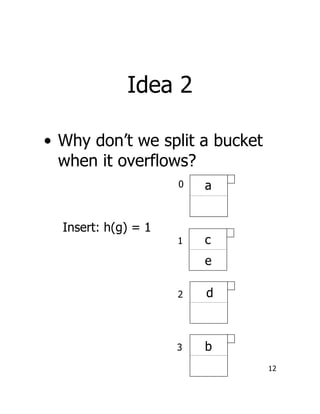
Idea 2
• Why don’t we split a bucket
when it overflows?
0 a
3 b
2 d
1 c
e
Insert: h(g) = 1
13
(a) Use i of b bits output by
hash function
Extendible Hashing
(two ideas)
00110101h(K) Æ
b
use i Æ grows over time
14
(b) Use directory that
maintains pointers to hash
buckets (indirection)
Extendible Hashing
(two ideas)
.
.
.
.
.
.
c
e
hash bucketdirectory
h(c)
15
Example
• h(k) is 4 bits; 2 keys/bucket
Insert 0111, 1010
1
1
1
0001
1001
1100
0
1
i =
16
Example continued
Insert 0000
1
0001
2
1001
1010
2
1100
00
01
10
11
2i =
0111
17
Example continued
Insert 1011
00
01
10
11
2i =
21001
1010
21100
20111
20000
0001
18
Questions on
Extendible Hashing
• Q: What will happen if we
have a lot of duplicate search
keys?
19
Duplicate keys
• Insert 0001
1
1
1
0001
0
1
i =
0001
20
Questions on
Extendible Hashing
• Can we provide minimum
space guarantee?
21
Space Waste
2
1
40001
40000
0000
4i =
3
22
Extendible Hashing:
Deletion
• Two options
a) No merging of buckets
b) Merge buckets and shrink
directory if possible
23
Bucket Merge Example
Can we merge a and b? b and c?
Can we shrink the directory?
1
0001
2
1001
2
1100
00
01
10
11
2i =
a
b
c
24
Bucket Merge
Condition
• Bucket merge condition
– Bucket i’s are the same
– First (i-1) bits of the hash key
are the same
• Directory shrink condition
– All bucket i’s are smaller than
the directory i
25
Summary of
Extendible Hashing
• Can handle growing files
– No periodic reorganizations
• Indirection
– Up to 2 disk accesses to
access a key
• Directory doubles in size
– Not too bad if the data is not
too large
26
Hashing vs. Tree
• Can an extendible-hash index
support?
SELECT
FROM R
WHERE R.A > 5
• Which one is better, B+tree
or Extendible hashing?
SELECT
FROM R
WHERE R.A = 5

Hash