Introduction to Hashing
Supposethat we want to store 10,000 students records (each with a 5-digit ID) in a given
container.
❑A linked list implementation would take O(n) time.
❑A height balanced tree would give O(log n) access time.Using an array of size
100,000 would give O(1) access time but will lead to a lot of
space wastage.
Is there some way that we could get O(1) access without wasting a lot of space?
The answer is hashing.
4.
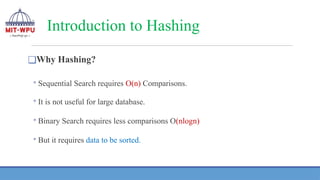
Introduction to Hashing
❑WhyHashing?
◦ Sequential Search requires O(n) Comparisons.
◦ It is not useful for large database.
◦ Binary Search requires less comparisons O(nlogn)
◦ But it requires data to be sorted.
5.
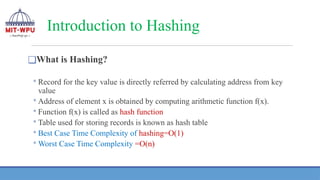
Introduction to Hashing
❑Whatis Hashing?
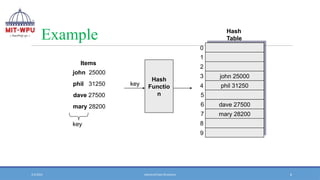
◦ Record for the key value is directly referred by calculating address from key
value
◦ Address of element x is obtained by computing arithmetic function f(x).
◦ Function f(x) is called as hash function
◦ Table used for storing records is known as hash table
◦ Best Case Time Complexity of hashing=O(1)
◦ Worst Case Time Complexity =O(n)
Key terms
❖ HashTable: is an array of size MAX[0 to MAX-1]
❖ Hash Function: that transforms a key into an address.
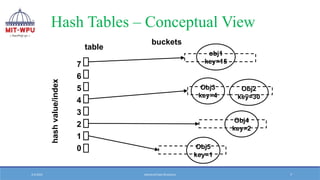
❖ Bucket- Bucket is an index position in hash table that can store more than
one record
❖ When the same index is mapped with two keys, then both the records are
stored in the same bucket
❖ Probe-Each action of address calculation and check for success is called
probe
❖ Collision-The result of two keys hashing into the same address is called
collision
❖ Synonym-Keys those hash to the same address are called synonyms
9.
Key terms
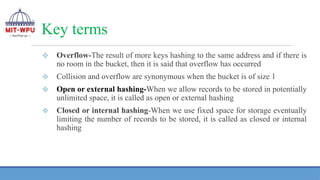
❖ Overflow-Theresult of more keys hashing to the same address and if there is
no room in the bucket, then it is said that overflow has occurred
❖ Collision and overflow are synonymous when the bucket is of size 1
❖ Open or external hashing-When we allow records to be stored in potentially
unlimited space, it is called as open or external hashing
❖ Closed or internal hashing-When we use fixed space for storage eventually
limiting the number of records to be stored, it is called as closed or internal
hashing
10.
Key Terms
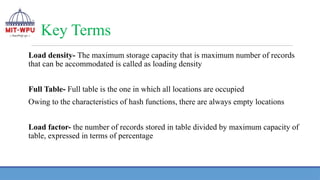
Load density-The maximum storage capacity that is maximum number of records
that can be accommodated is called as loading density
Full Table- Full table is the one in which all locations are occupied
Owing to the characteristics of hash functions, there are always empty locations
Load factor- the number of records stored in table divided by maximum capacity of
table, expressed in terms of percentage
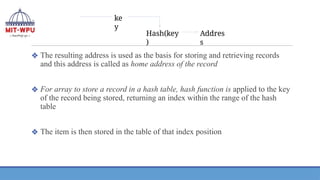
❖ The resultingaddress is used as the basis for storing and retrieving records
and this address is called as home address of the record
❖ For array to store a record in a hash table, hash function is applied to the key
of the record being stored, returning an index within the range of the hash
table
❖ The item is then stored in the table of that index position
ke
y
Hash(key
)
Addres
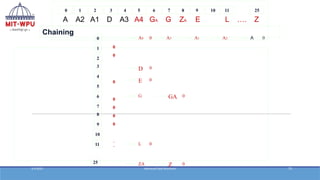
s
13.
Basic Idea
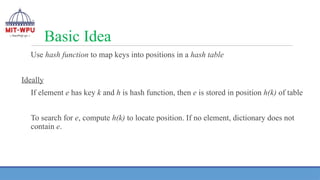
Use hashfunction to map keys into positions in a hash table
Ideally
If element e has key k and h is hash function, then e is stored in position h(k) of table
To search for e, compute h(k) to locate position. If no element, dictionary does not
contain e.
14.
Hash Functions
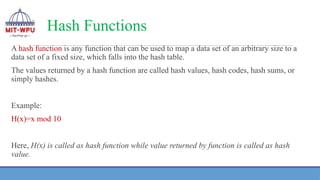
A hashfunction is any function that can be used to map a data set of an arbitrary size to a
data set of a fixed size, which falls into the hash table.
The values returned by a hash function are called hash values, hash codes, hash sums, or
simply hashes.
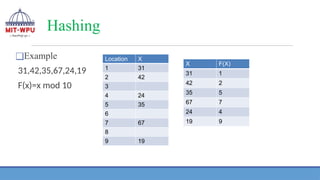
Example:
H(x)=x mod 10
Here, H(x) is called as hash function while value returned by function is called as hash
value.
15.
◦ The averageperformance of hashing depends on how the hash function distributes the
set of keys among the slots
◦ Assumption is that any given record is equally likely to hash into any of the slots,
independently of whether any other record has been already hashed to it or not
◦ This assumption is called as simple uniform hashing
◦ A good hash function is the one which satisfies the assumption of simple uniform
hashing
Characteristics of a good hashing
function
16.
Characteristics of agood hashing
function
❖ Addresses generated from the key are uniformly and randomly distributed
❖ Small variations in the value of key will cause large variations in the record
addresses to distribute records (with similar keys) evenly
❖ The hashing function must minimize the collision
17.
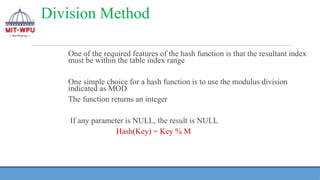
Division Method
One ofthe required features of the hash function is that the resultant index
must be within the table index range
One simple choice for a hash function is to use the modulus division
indicated as MOD
The function returns an integer
If any parameter is NULL, the result is NULL
Hash(Key) = Key % M
18.
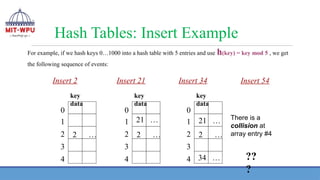
Hash Tables: InsertExample
For example, if we hash keys 0…1000 into a hash table with 5 entries and use h(key) = key mod 5 , we get
the following sequence of events:
0
1
2
3
4
key
data
Insert 2
2 …
0
1
2
3
4
key
data
Insert 21
2 …
21 …
0
1
2
3
4
key
data
Insert 34
2 …
21 …
34 …
Insert 54
There is a
collision at
array entry #4
??
?
19.
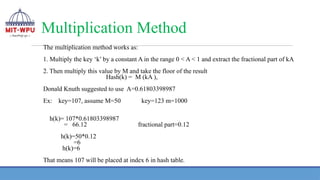
Multiplication Method
The multiplicationmethod works as:
1. Multiply the key ‘k’ by a constant A in the range 0 < A < 1 and extract the fractional part of kA
2. Then multiply this value by M and take the floor of the result
Hash(k) = M (kA ),
Donald Knuth suggested to use A=0.61803398987
Ex: key=107, assume M=50 key=123 m=1000
h(k)= 107*0.61803398987
= 66.12 fractional part=0.12
h(k)=50*0.12
=6
h(k)=6
That means 107 will be placed at index 6 in hash table.
20.
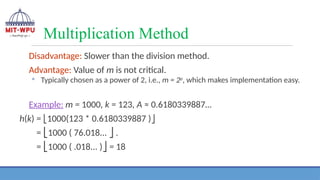
Multiplication Method
Disadvantage: Slowerthan the division method.
Advantage: Value of m is not critical.
◦ Typically chosen as a power of 2, i.e., m = 2p
, which makes implementation easy.
Example: m = 1000, k = 123, A ≈ 0.6180339887…
h(k) = ⎣1000(123 * 0.6180339887 )⎦
= 1000 ( 76.018... .
⎣ ⎦
= 1000 ( .018... )
⎣ ⎦ = 18
21.
Mid-Square Hashing
❖ Themid-square hashing suggests to take square of the key and extract the
middle digits of the squared key as address
❖ The difficulty is when the key is large. As the entire key participates in the
address calculation, if the key is large, then it is very difficult to store the
square of it as the square of key should not exceed the storage limit
❖ So mid-square is used when the key size is less than or equal to 4 digits
22.
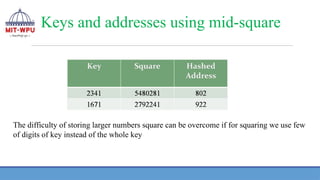
Keys and addressesusing mid-square
The difficulty of storing larger numbers square can be overcome if for squaring we use few
of digits of key instead of the whole key
23.
Keys and addressesusing mid-square
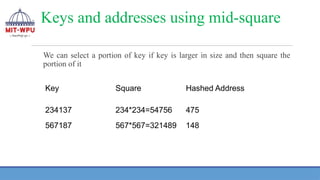
We can select a portion of key if key is larger in size and then square the
portion of it
Key Square Hashed Address
234137 234*234=54756 475
567187 567*567=321489 148
24.
Folding Technique
❖ Infolding technique, the key is subdivided into subparts that are
combined or folded and then combined to form the address
❖ For the key with digits, we can subdivide the digits in three parts, add
them up, and use the result as an address.
❖ Here the size of subparts of key could be as that of the address
25.
Folding Technique (contd…)
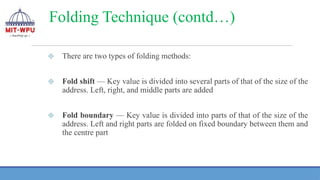
❖There are two types of folding methods:
❖ Fold shift — Key value is divided into several parts of that of the size of the
address. Left, right, and middle parts are added
❖ Fold boundary — Key value is divided into parts of that of the size of the
address. Left and right parts are folded on fixed boundary between them and
the centre part
26.
Folding Technique
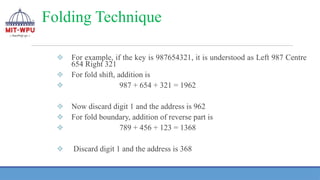
❖ Forexample, if the key is 987654321, it is understood as Left 987 Centre
654 Right 321
❖ For fold shift, addition is
❖ 987 + 654 + 321 = 1962
❖ Now discard digit 1 and the address is 962
❖ For fold boundary, addition of reverse part is
❖ 789 + 456 + 123 = 1368
❖ Discard digit 1 and the address is 368
27.
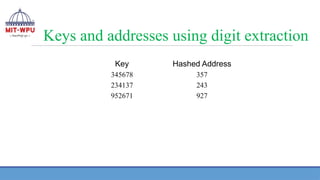
Extraction Method
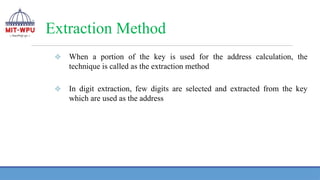
❖ Whena portion of the key is used for the address calculation, the
technique is called as the extraction method
❖ In digit extraction, few digits are selected and extracted from the key
which are used as the address
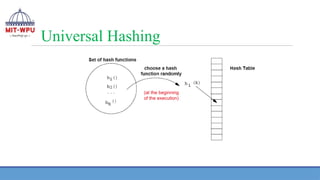
Universal Hashing
❖ Themain idea behind universal hashing is to select the hash function at
random at run time from a carefully designed set of functions
❖ Because of randomization, the algorithm can behave differently on each
execution, even for the same input
❖ This approach guarantees good average case performance, no matter
what keys are provided as input
Issues
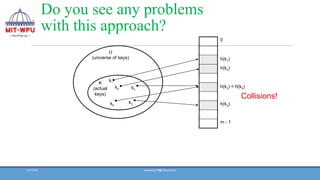
❖ A problemarises, however, when the hash function returns the same value
when applied to two different keys
❖ To handle the situation, where two records need to be hashed to the same
address we can implement a table structure, so as to have a room for two
or more members at the same index positions
32.
32
Do you seeany problems
with this approach?
U
(universe of keys)
K
(actual
keys)
0
m - 1
h(k3)
h(k2) = h(k5)
h(k1)
h(k4)
k1
k4 k2
k5
k3
Collisions!
3/3/2025 Advanced Data Structures
33.
Collision Resolution Strategies
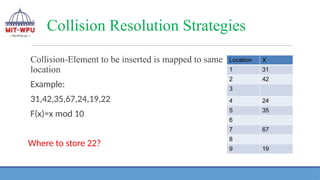
Collision-Elementto be inserted is mapped to same
location
Example:
31,42,35,67,24,19,22
F(x)=x mod 10
Where to store 22?
Location X
1 31
2 42
3
4 24
5 35
6
7 67
8
9 19
34.
Collision Resolution Strategies
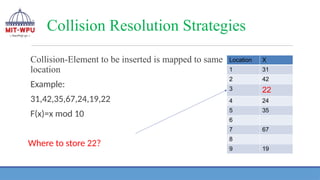
Collision-Elementto be inserted is mapped to same
location
Example:
31,42,35,67,24,19,22
F(x)=x mod 10
Where to store 22?
Location X
1 31
2 42
3 22
4 24
5 35
6
7 67
8
9 19
35.
Collision Resolution Strategies
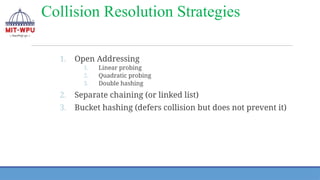
1.Open Addressing
1. Linear probing
2. Quadratic probing
3. Double hashing
2. Separate chaining (or linked list)
3. Bucket hashing (defers collision but does not prevent it)
36.
Open Addressing
When collisionoccurs, it is resolved by finding an available empty location
other than the home address.
If Hash(key) is not empty, the positions are probed in the following sequence
until an empty location is found.
When we reach the end of the table ,the search is wrapped around to start and
search continues till the current collision location.
Closed hash tables use open addressing.
37.
Linear Probing
❖ Ahash table in which a collision is resolved by putting the item in the
next empty place in following the occupied place is called linear probing
❖ This strategy looks for the next free location until it is found
❖ The function that we can use for probing linearly from the next location is
as follows:
❖ (Hash(x) + p(i)) MOD Max
❖ As p(i) = i for linear probing, the function becomes
❖ (Hash(x)+ i)) MOD Max
❖ Initially i = 1, if the location is not empty then it becomes 2, 3, 4, …, and
so on till empty location is found.
38.
Linear Probing
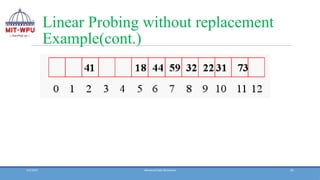
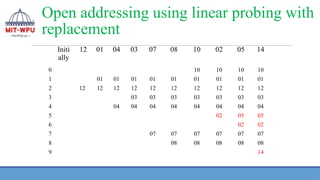
❖ 1.Withreplacement 2.Without replacement
❖ With replacement :
❖ If the slot is already occupied by the key there are two possibilities,
that is, either it is home address (collision) or not key’s home address
❖ If the key’s actual address is different, then the new key having the
address at that slot is placed at that position and the key with other
address is placed in the next empty position
39.
Linear Probing
Example :
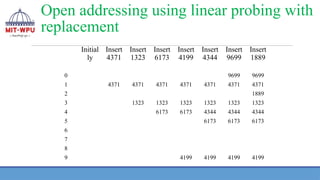
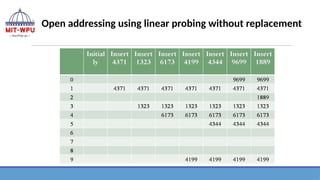
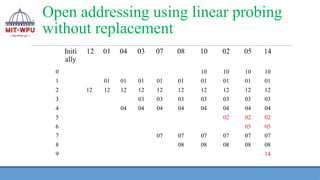
Giventhe input {4371, 1323, 6173, 4199, 4344, 9699, 1889}
and hash function as Key % 10, show the results for the
following:
1. Open addressing using linear probing
2. Open addressing using quadratic probing
3. Open addressing using double hashing h2 (x) = 7 (x
−
MOD 7)
Linear Probing
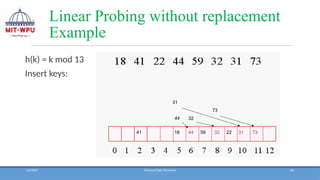
❖ Withoutreplacement :
❖ When some data is to be stored in hash table, and if the slot is already
occupied by the key then another empty location is searched for a new
record
❖ There are two possibilities when location is occupied—it is its home address
or not key’s home address.
❖ In both the cases, the without replacement strategy empty position is
searched for the key that is to be stored
Functions for LinearProbing without
replacement insert function
Algorithm int insert_linear_prob(int hashtable[],int key)
{
loc=key % MAX;
If(hashTable[loc]==-1)
{
hashtable[loc]=key;
return(loc);
}
else{i=(loc+1)%MAX;
while(i!=loc)
{
if(hashTable[i]==-1)
{
hashtable[i]=key;
return(i); }
i=(i+1)%MAX;
}
if(i==loc) print(“Hash is full”)
}
49.
Functions for LinearProbing without
replacement- search function
Search_linear_probe(hashtable,key)
{
int i,j;
loc=key % MAX;
if(hashtable[loc]==key) print “key found”
else{ i=(loc+1)%MAX;
while(i!=loc){
if(hashtable[i]==key) {print “key found” break;}
i=(i+1)%MAX;}
}
if(i==loc) print(“key not found”)
}
50.
Functions for LinearProbing with
replacement insert function
Algorithm int insert_linear_prob(int hashtable[],int key)
{
loc=key % MAX;
If(hashTable[loc]==-1)
{
hashtable[loc]=key;
return(loc);
}
else{
temp=key
if(loc!=(hashtable[loc]%MAX){
temp=hashtable[loc];
Hashtable[loc]=key;}
i=(loc+1)%MAX;
while(i!=loc)
{
if(hashTable[i]==-1)
{
hashtable[i]=temp;
return(i); }
i=(i+1)%MAX;
}
if(i==loc) print(“Hash is full”)
}
51.
Functions for LinearProbing with
replacement- search function
Search_linear_probe(hashtable,key)
{
int i,loc;
loc=key % MAX;
if(hashtable[loc]==key) print “key found”
else{ i=(loc+1)%MAX;
while(i!=loc){
if(hashtable[i]==key) {print “key found” break;}
i=(i+1)%MAX;}
}
if(i==loc) print(“key not found”)
}
52.
Clustering
One problem withthe above technique is the tendency to form “clusters”
A cluster is a group of items not containing any open slots
The bigger a cluster gets, the more likely it is that new values will hash
into the cluster, and make it ever bigger
Clusters cause efficiency to degrade
53.
Quadratic Probing
❖ Inquadratic probing, we add offset by amount square of collision probe number
❖ In quadratic probing, the empty location is searched using the following formula
❖ (Hash(Key) + i2
) MOD Max where i lies between 1 to (Max − 1)/2
❖ Quadratic probing probes the array at location Hash(key)+1,
Hash(key)+4, _____,Hash(key)+9 etc.
❖ Quadratic probing works much better than linear probing, but to make full use of
hash table, there are constraints on the values of i and Max so that the address lies
in table boundaries
54.
Open addressing usingquadratic
probing
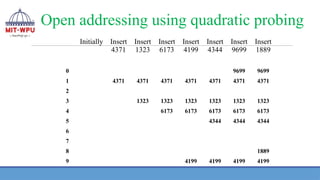
❖ Let us insert these keys using quadratic probing
❖ For 6173, the hashed address 6173 % 10 gives 3 and it is not empty, hence using
quadratic probing we get the address as follows:
Apply probing Hash(6173) = (h(6173 )+ 12
) % 10 = 4 and as it is empty, the key
6173 is stored there
❖ Now while inserting 4344, the location 4 is not empty and hence quadratic
probing generates the address as (4344 + 12
) % 10 = 5 and as is empty 4344 is
stored
❖ For key 9699, the address is (h(9699)+ 12
) % 10 = 0 and is empty so store.
❖ While inserting 1889, the address (1889 + 12
) % 10 = 0 is not empty so probe
again
❖ The address (h(1889) + 22
) % 10 = 3 is not empty so probe again.
❖ The address(h(1889) + 32
) % 10 = 8 is empty so store 1889 at location 8
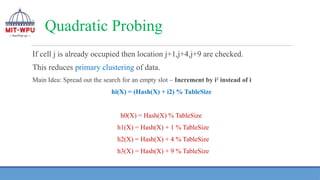
Quadratic Probing
If cellj is already occupied then location j+1,j+4,j+9 are checked.
This reduces primary clustering of data.
Main Idea: Spread out the search for an empty slot – Increment by i2
instead of i
hi(X) = (Hash(X) + i2) % TableSize
h0(X) = Hash(X) % TableSize
h1(X) = Hash(X) + 1 % TableSize
h2(X) = Hash(X) + 4 % TableSize
h3(X) = Hash(X) + 9 % TableSize
57.
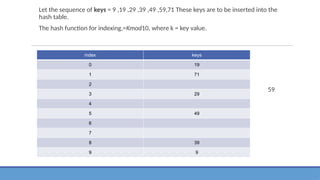
Let the sequenceof keys = 9 ,19 ,29 ,39 ,49 ,59,71 These keys are to be inserted into the
hash table.
The hash function for indexing,=Kmod10, where k = key value.
index keys
0 19
1 71
2
3 29
4
5 49
6
7
8 39
9 9
59
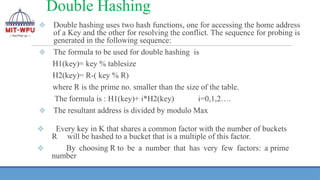
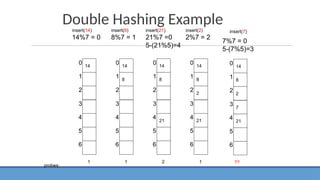
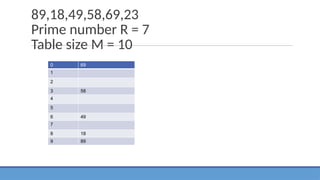
Double Hashing
❖ Doublehashing uses two hash functions, one for accessing the home address
of a Key and the other for resolving the conflict. The sequence for probing is
generated in the following sequence:
❖ The formula to be used for double hashing is
H1(key)= key % tablesize
H2(key)= R-( key % R)
where R is the prime no. smaller than the size of the table.
The formula is : H1(key)+ i*H2(key) i=0,1,2….
❖ The resultant address is divided by modulo Max
❖ Every key in K that shares a common factor with the number of buckets
R will be hashed to a bucket that is a multiple of this factor.
❖ By choosing R to be a number that has very few factors: a prime
number
60.
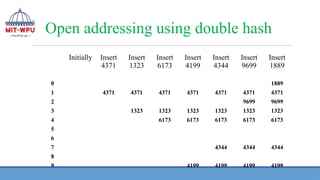
Open addressing usingdouble hash
function
❖ While inserting 6173, the address is Hash1(6173) = 6173 % 10 = 3 and 3 is not
empty
❖ Let us use double hashing. Hence the address is as follows:
❖ Hash(6173) = [Hash1(6173) + Hash2(6173)] % 10= 3 + (R −
6173 % R) ( let R be 7)= 3+ (7 − 6) = 4 Since 4 is empty, we store 6173 at
location 4
❖ Now let us store 4344. The address 4344 % 10 = 4 and as location 4 is not
empty, we use double hashing and we get Hash(4344) = 7
❖ Now for 9699 double hashing generates address 2 and as it is empty, we store it
there.
❖ For key 1889, double hashing generates address 0 and as it is empty, we store
1889 at location 0
Rehashing
❖ If tablegets full, insertion using open addressing with quadratic probing might fail or it might
take too much time.
❖ Rehashing tells us what to do when the hash table gets full.
❖ Instead of waiting for the hash table to get completely full,it is more efficient to rehash when
the table is about 70% or 80 % full.
❖ To find the solution for this is to build another table that is about twice as big and scan down
the entire original hash table, compute the new hash value for each record, and Insert them in a
new table.
❖ In rehashing we can also choose series of hash functions while increasing the size of TABLE.
65.
Rehashing (contd…)
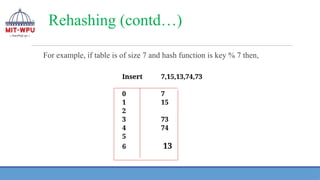
For example,if table is of size 7 and hash function is key % 7 then,
Insert 7,15,13,74,73
0 7
1 15
2
3 73
4 74
5
6 13
66.
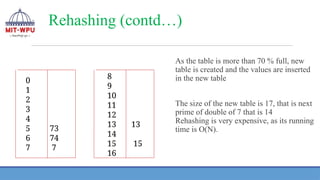
As the tableis more than 70 % full, new
table is created and the values are inserted
in the new table
The size of the new table is 17, that is next
prime of double of 7 that is 14
Rehashing is very expensive, as its running
time is O(N).
0
1
2
3
4
5 73
6 74
7 7
8
9
10
11
12
13 13
14
15 15
16
Rehashing (contd…)
67.
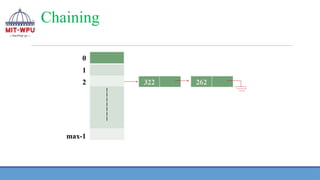
Chaining
❖ This techniqueused to handle synonym is chaining that chains together all
the records that hash to the same address. Instead of relocating synonyms,
a linked list of synonyms is created whose head is home address of
synonyms
❖ However, we need to handle pointers to form a chain of synonyms
❖ The extra memory is needed for storing pointers
Comparison : Rehashingand chaining
Chaining
❖ Unlimited number of synonyms can be handled in chaining
❖ Additional cost to be paid is overhead of multiple linked lists
❖ Sequential search through chain takes more time
Rehashing
❖ Limited but still a good number of synonyms are taken care of
❖ The table size is doubled but no additional field of link is to be
maintained
❖ Searching is faster when compared to chaining
70.
Hash Table Overflow
❖An overflow is said to occur when a new identifier is mapped or hashed into
a full bucket
❖ When the bucket size is one, collision and overflow occur simultaneously
71.
Open Addressing forOverflow Handling
❖ When a new identifier is hashed into a full bucket, we need to find
another bucket for this identifier
❖ The simplest solution is to find the closest unfilled bucket.
❖ This is called as linear probing or linear open addressing
72.
Overflow Handling byChaining
❖ Since the sizes of these lists are not known in advance, the best way to
maintain them is as linked chains
❖ In each slot, additional space is required for a link
❖ Each chain has a head node.
❖ The head node, however, usually is much smaller than the other nodes, since
it has to retain only a link
❖ As the list is accessed at random, the head nodes should be sequential
73.
A A2 A1D A3 A4 GA G ZA E L …. Z
0 1 2 3 4 5 6 7 8 9 10 11 25
Chaining
0
0
0
0
0
0
0
.
.
0
1
2
3
4
5
6
7
8
9
10
11
25
A4 0 A3 A 0
A2
A1
D 0
E 0
G GA 0
L 0
ZA Z 0
3/3/2025 Advanced Data Structures 75
74.
Separate Chaining-Used withOpen Hashing
Data Structure:
#define MAX 1
class node
{
int data;
node * next;
};
node *hashtable[MAX];
Algorithm Initialize(node *hashtable[])
{
for (i=0;i<MAX;i++)
{
allocate memory for head[i];
Hashtable[i]->data=i
Hashtable[i]->next=NULL;
}
}
Separate Chaining-Used withOpen Hashing
Operations on Hash Table:
Algorithm node *find(node *hashtable[],int x)
{
int loc,
node *p;
loc=x % MAX;
p=hashtable[loc];
While(p!=NULL && x!=p->data)
p=p->next;
return (p);
}
77.
FAQ
What is hashing?
Whythere is need of hashing?
What is the time complexity of hashing?
What is collision?
Define hash function, hash key
What are the collision resolution techniques?
78.
MCQs
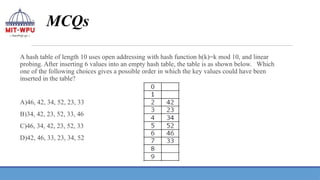
A hash tableof length 10 uses open addressing with hash function h(k)=k mod 10, and linear
probing. After inserting 6 values into an empty hash table, the table is as shown below. Which
one of the following choices gives a possible order in which the key values could have been
inserted in the table?
A)46, 42, 34, 52, 23, 33
B)34, 42, 23, 52, 33, 46
C)46, 34, 42, 23, 52, 33
D)42, 46, 33, 23, 34, 52
79.
MCQs
How many differentinsertion sequences of the key values using the same hash function and linear
probing will result in the hash table shown above?
A.10
B.20
C.30
D.40
80.
MCQs
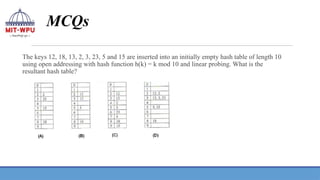
The keys 12,18, 13, 2, 3, 23, 5 and 15 are inserted into an initially empty hash table of length 10
using open addressing with hash function h(k) = k mod 10 and linear probing. What is the
resultant hash table?
81.
MCQs
Consider a hashtable of size seven, with starting index zero, and a hash function (3x + 4)mod7.
Assuming the hash table is initially empty, which of the following is the contents of the table when
the sequence 1, 3, 8, 10 is inserted into the table using closed hashing? Note that ‘_’ denotes an
empty location in the table.
A 8, _, _, _, _, _, 10
B 1, 8, 10, _, _, _, 3
C 1, _, _, _, _, _,3
D 1, 10, 8, _, _, _, 3
82.
MCQs
Given the followinginput (4322, 1334, 1471, 9679, 1989, 6171, 6173, 4199) and the hash
function x mod 10, which of the following statements are true? i. 9679, 1989, 4199 hash to the
same value ii. 1471, 6171 has to the same value iii. All elements hash to the same value iv. Each
element hashes to a different value (GATE CS 2004)
A i only
B ii only
C i and ii only
D iii or iv
83.
Practice Assignments
1. Writea pseudo code to implement quadratic probing
2. Store roll numbers of the students in a database and implement double hashing onto it.
3. Store roll numbers of the students in a database and implement linear probing with and
without replacement onto it.
4. Implement chaining method by identifying one suitable application.
84.
Takeaway
➢Hashing is oneof efficient searching technique.
➢Hashing’s best case time complexity is O(1)
➢Hashing collision is resolved by using different collision resolution techniques.
85.
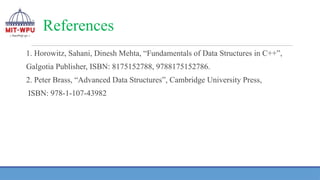
References
1. Horowitz, Sahani,Dinesh Mehta, “Fundamentals of Data Structures in C++”,
Galgotia Publisher, ISBN: 8175152788, 9788175152786.
2. Peter Brass, “Advanced Data Structures”, Cambridge University Press,
ISBN: 978-1-107-43982
Editor's Notes
#64 You can see that this works pretty well for an empty table and gets worse as the table fills up.
There’s another problem here. If a bunch of elements hash to the same spot, they mess each other up.
But, worse, if a bunch of elements hash to the same area of the table, they mess each other up! (Even though the hash function isn’t producing lots of collisions!)
This phenomenon is called primary clustering.



![Key terms
❖ Hash Table: is an array of size MAX[0 to MAX-1]
❖ Hash Function: that transforms a key into an address.
❖ Bucket- Bucket is an index position in hash table that can store more than
one record
❖ When the same index is mapped with two keys, then both the records are
stored in the same bucket
❖ Probe-Each action of address calculation and check for success is called
probe
❖ Collision-The result of two keys hashing into the same address is called
collision
❖ Synonym-Keys those hash to the same address are called synonyms](https://image.slidesharecdn.com/hashing-250818010821-6005dff7/85/Hashing-for-computer-science-studens-at-mit-wpu-pptx-8-320.jpg)


![Functions for Linear Probing without
replacement insert function
Algorithm int insert_linear_prob(int hashtable[],int key)
{
loc=key % MAX;
If(hashTable[loc]==-1)
{
hashtable[loc]=key;
return(loc);
}
else{i=(loc+1)%MAX;
while(i!=loc)
{
if(hashTable[i]==-1)
{
hashtable[i]=key;
return(i); }
i=(i+1)%MAX;
}
if(i==loc) print(“Hash is full”)
}](https://image.slidesharecdn.com/hashing-250818010821-6005dff7/85/Hashing-for-computer-science-studens-at-mit-wpu-pptx-48-320.jpg)
![Functions for Linear Probing without
replacement- search function
Search_linear_probe(hashtable,key)
{
int i,j;
loc=key % MAX;
if(hashtable[loc]==key) print “key found”
else{ i=(loc+1)%MAX;
while(i!=loc){
if(hashtable[i]==key) {print “key found” break;}
i=(i+1)%MAX;}
}
if(i==loc) print(“key not found”)
}](https://image.slidesharecdn.com/hashing-250818010821-6005dff7/85/Hashing-for-computer-science-studens-at-mit-wpu-pptx-49-320.jpg)
![Functions for Linear Probing with
replacement insert function
Algorithm int insert_linear_prob(int hashtable[],int key)
{
loc=key % MAX;
If(hashTable[loc]==-1)
{
hashtable[loc]=key;
return(loc);
}
else{
temp=key
if(loc!=(hashtable[loc]%MAX){
temp=hashtable[loc];
Hashtable[loc]=key;}
i=(loc+1)%MAX;
while(i!=loc)
{
if(hashTable[i]==-1)
{
hashtable[i]=temp;
return(i); }
i=(i+1)%MAX;
}
if(i==loc) print(“Hash is full”)
}](https://image.slidesharecdn.com/hashing-250818010821-6005dff7/85/Hashing-for-computer-science-studens-at-mit-wpu-pptx-50-320.jpg)
![Functions for Linear Probing with
replacement- search function
Search_linear_probe(hashtable,key)
{
int i,loc;
loc=key % MAX;
if(hashtable[loc]==key) print “key found”
else{ i=(loc+1)%MAX;
while(i!=loc){
if(hashtable[i]==key) {print “key found” break;}
i=(i+1)%MAX;}
}
if(i==loc) print(“key not found”)
}](https://image.slidesharecdn.com/hashing-250818010821-6005dff7/85/Hashing-for-computer-science-studens-at-mit-wpu-pptx-51-320.jpg)

![Quadratic Probing Operation
Algorithm Insert(int hashtable[],int key)
{
start=key % MAX;
j=start
for(i=0;i<(MAX-1)/2,i++)
{
If(hashtable[j]==-1)add key
j=(start+i*i)%MAX;
}
}](https://image.slidesharecdn.com/hashing-250818010821-6005dff7/85/Hashing-for-computer-science-studens-at-mit-wpu-pptx-58-320.jpg)
![Open addressing using double hash
function
❖ While inserting 6173, the address is Hash1(6173) = 6173 % 10 = 3 and 3 is not
empty
❖ Let us use double hashing. Hence the address is as follows:
❖ Hash(6173) = [Hash1(6173) + Hash2(6173)] % 10= 3 + (R −
6173 % R) ( let R be 7)= 3+ (7 − 6) = 4 Since 4 is empty, we store 6173 at
location 4
❖ Now let us store 4344. The address 4344 % 10 = 4 and as location 4 is not
empty, we use double hashing and we get Hash(4344) = 7
❖ Now for 9699 double hashing generates address 2 and as it is empty, we store it
there.
❖ For key 1889, double hashing generates address 0 and as it is empty, we store
1889 at location 0](https://image.slidesharecdn.com/hashing-250818010821-6005dff7/85/Hashing-for-computer-science-studens-at-mit-wpu-pptx-60-320.jpg)
![Separate Chaining-Used with Open Hashing
Data Structure:
#define MAX 1
class node
{
int data;
node * next;
};
node *hashtable[MAX];
Algorithm Initialize(node *hashtable[])
{
for (i=0;i<MAX;i++)
{
allocate memory for head[i];
Hashtable[i]->data=i
Hashtable[i]->next=NULL;
}
}](https://image.slidesharecdn.com/hashing-250818010821-6005dff7/85/Hashing-for-computer-science-studens-at-mit-wpu-pptx-74-320.jpg)
![Separate Chaining-Used with Open Hashing
Operations on Hash Table:
Algorithm Insert(node *hashtable[],int x)
{
int loc;
node *p,*q;
loc=x % MAX;
q=new node;
q->data=x;
q->next=NULL;
If(hashtable[loc]->next==NULL)
Hashtable[loc]->next=q;
else
{
for(p=hashtable[loc];p->next!=NULL;p=p->next);
p->next=q;
}
}](https://image.slidesharecdn.com/hashing-250818010821-6005dff7/85/Hashing-for-computer-science-studens-at-mit-wpu-pptx-75-320.jpg)
![Separate Chaining-Used with Open Hashing
Operations on Hash Table:
Algorithm node *find(node *hashtable[],int x)
{
int loc,
node *p;
loc=x % MAX;
p=hashtable[loc];
While(p!=NULL && x!=p->data)
p=p->next;
return (p);
}](https://image.slidesharecdn.com/hashing-250818010821-6005dff7/85/Hashing-for-computer-science-studens-at-mit-wpu-pptx-76-320.jpg)