Introduction
to Haskell
Luca Molteni
Haskell ITA Meeting 17/10/2015
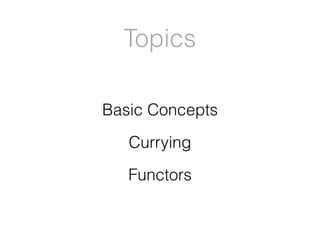
Topics
Basic Concepts
Currying
Functors
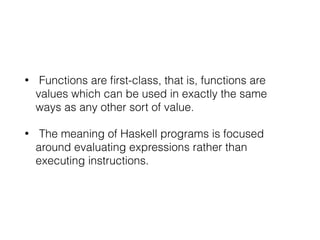
• Functions are first-class, that is, functions are
values which can be used in exactly the same
ways as any other sort of value.
• The meaning of Haskell programs is focused
around evaluating expressions rather than
executing instructions.
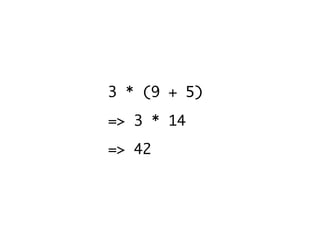
3 * (9 + 5)
=> 3 * 14
=> 42
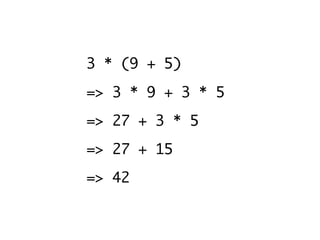
3 * (9 + 5)
=> 3 * 9 + 3 * 5
=> 27 + 3 * 5
=> 27 + 15
=> 42
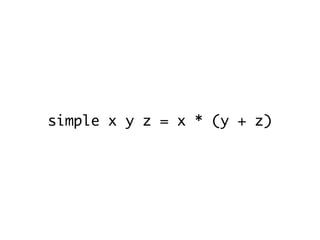
simple x y z = x * (y + z)
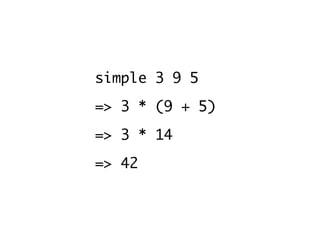
simple 3 9 5
=> 3 * (9 + 5)
=> 3 * 14
=> 42
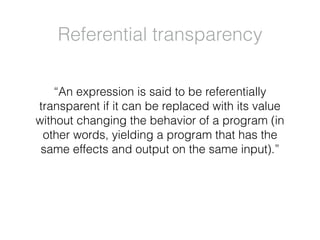
“An expression is said to be referentially
transparent if it can be replaced with its value
without changing the behavior of a program (in
other words, yielding a program that has the
same effects and output on the same input).”
Referential transparency
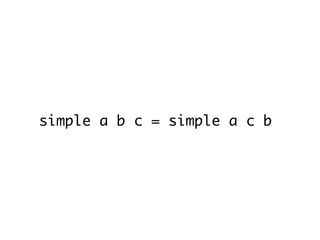
simple a b c = simple a c b
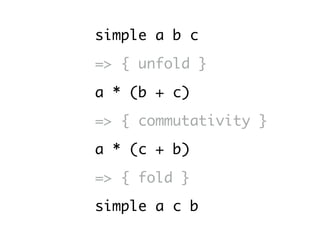
simple a b c
=> { unfold }
a * (b + c)
=> { commutativity }
a * (c + b)
=> { fold }
simple a c b
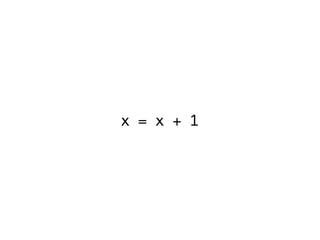
x = x + 1
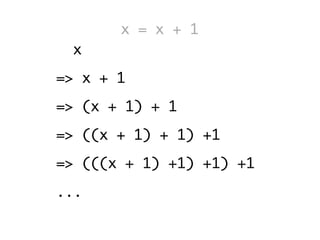
x = x + 1
x
=> x + 1
=> (x + 1) + 1
=> ((x + 1) + 1) +1
=> (((x + 1) +1) +1) +1
...
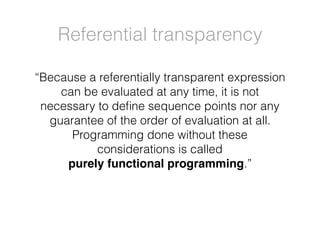
“Because a referentially transparent expression
can be evaluated at any time, it is not
necessary to define sequence points nor any
guarantee of the order of evaluation at all.
Programming done without these
considerations is called
purely functional programming.”
Referential transparency
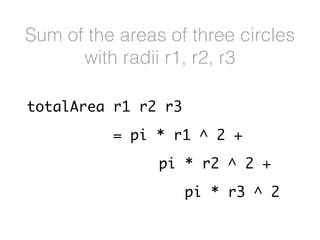
totalArea r1 r2 r3
= pi * r1 ^ 2 +
pi * r2 ^ 2 +
pi * r3 ^ 2
Sum of the areas of three circles
with radii r1, r2, r3
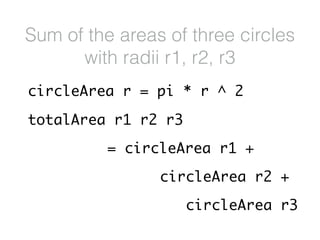
circleArea r = pi * r ^ 2
totalArea r1 r2 r3
= circleArea r1 +
circleArea r2 +
circleArea r3
Sum of the areas of three circles
with radii r1, r2, r3
r1 = 3
r2 = 4
r3 = 5
radii = r1 : r2 : r3 : []
Sum of the areas of n circles?
radii :: [Float]
radii = r1 : r2 : r3 : []
Sum of the areas of n circles?
List
data List a = []
| a : List a
totalArea :: [Float] -> Float
totalArea [] = 0
Sum of the areas of three circles
with radii r1, r2, r3
totalArea :: [Float] -> Float
totalArea [] = 0
totalArea (x : xs) =
circleArea x + totalArea xs
Sum of the areas of three circles
with radii r1, r2, r3
square :: [Int] -> [Int]
square [] = []
square (x : xs) = (x ^ 2) : square xs
Square of list
Map
map :: (a -> b) -> [a] -> [b]
totalArea :: [Float] -> [Float]
totalArea = map circleArea
Sum of the areas of three circles
with radii r1, r2, r3
totalArea :: [Float] -> Float
totalArea = sum . map circleArea
Sum of the areas of three circles
with radii r1, r2, r3
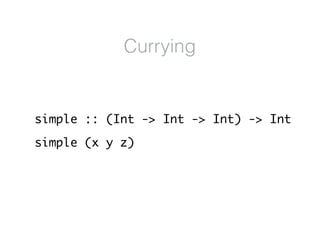
Currying
simple :: (Int -> Int -> Int) -> Int
simple (x y z)
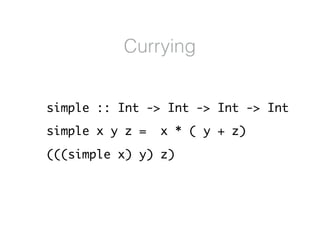
Currying
simple :: Int -> Int -> Int -> Int
simple x y z = x * ( y + z)
(((simple x) y) z)
Currying
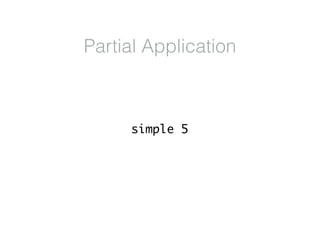
simple 5
Partial Application
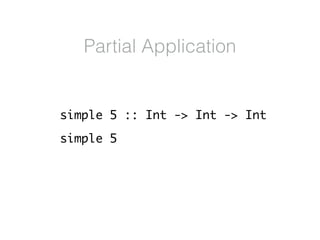
simple 5 :: Int -> Int -> Int
simple 5
Partial Application
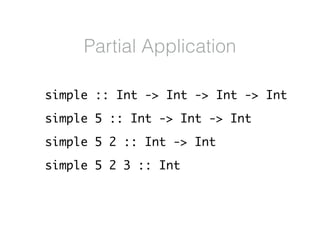
simple :: Int -> Int -> Int -> Int
simple 5 :: Int -> Int -> Int
simple 5 2 :: Int -> Int
simple 5 2 3 :: Int
Partial Application
Point free programming
Tacit programming (point-free programming) is a
programming paradigm in which a function definition
does not include information regarding its arguments,
using combinators and function composition [...]
instead of variables.
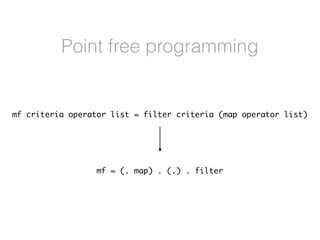
Point free programming
map (x -> increment x) [2,3,4]
[3,4,5]
map increment [2,3,4]
[3,4,5]
map (x -> x + 1) [2,3,4]
[3,4,5]
map (+1) [2,3,4]
[3,4,5]
increment :: Int -> Int
increment x = x + 1
Point free programming
mf criteria operator list = filter criteria (map operator list)
mf = (. map) . (.) . filter
Functors
Functors
map :: (a -> b) -> [a] -> [b]
data List a = []
| a : List a
Functors
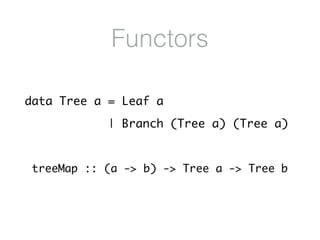
treeMap :: (a -> b) -> Tree a -> Tree b
data Tree a = Leaf a
| Branch (Tree a) (Tree a)
Functors
treeMap :: (a -> b) -> Tree a -> Tree b
map :: (a -> b) -> [a] -> [b]
Functors
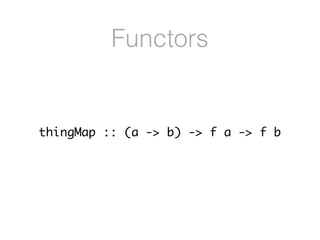
thingMap :: (a -> b) -> f a -> f b
Functors
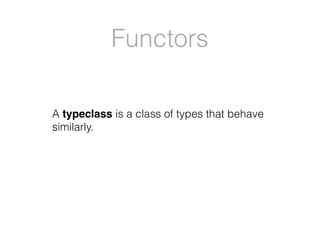
A typeclass is a class of types that behave
similarly.
Functors
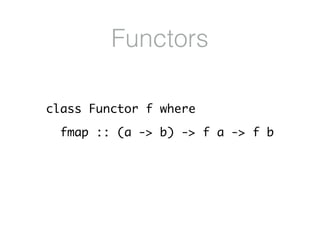
class Functor f where
fmap :: (a -> b) -> f a -> f b
Functors
instance Functor [] where
fmap = map
Functors / Maybe
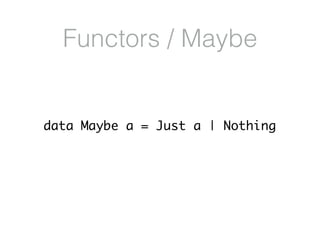
data Maybe a = Just a | Nothing
Functors
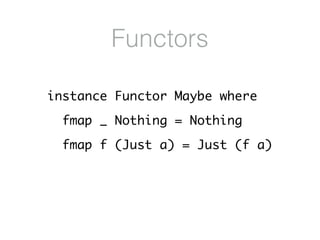
instance Functor Maybe where
fmap _ Nothing = Nothing
fmap f (Just a) = Just (f a)
Functors / Maybe
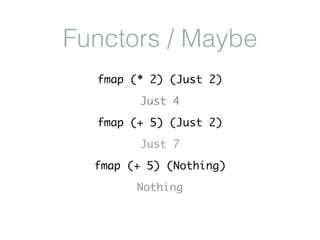
fmap (* 2) (Just 2)
Just 4
fmap (+ 5) (Just 2)
Just 7
fmap (+ 5) (Nothing)
Nothing
The End
@volothamp
It’s not about the destination.
It’s about the journey.

Introduction to haskell

  • 1.
  • 2.
  • 3.
    • Functions arefirst-class, that is, functions are values which can be used in exactly the same ways as any other sort of value. • The meaning of Haskell programs is focused around evaluating expressions rather than executing instructions.
  • 4.
    3 * (9+ 5) => 3 * 14 => 42
  • 5.
    3 * (9+ 5) => 3 * 9 + 3 * 5 => 27 + 3 * 5 => 27 + 15 => 42
  • 6.
    simple x yz = x * (y + z)
  • 7.
    simple 3 95 => 3 * (9 + 5) => 3 * 14 => 42
  • 8.
    “An expression issaid to be referentially transparent if it can be replaced with its value without changing the behavior of a program (in other words, yielding a program that has the same effects and output on the same input).” Referential transparency
  • 9.
    simple a bc = simple a c b
  • 10.
    simple a bc => { unfold } a * (b + c) => { commutativity } a * (c + b) => { fold } simple a c b
  • 11.
    x = x+ 1
  • 12.
    x = x+ 1 x => x + 1 => (x + 1) + 1 => ((x + 1) + 1) +1 => (((x + 1) +1) +1) +1 ...
  • 13.
    “Because a referentiallytransparent expression can be evaluated at any time, it is not necessary to define sequence points nor any guarantee of the order of evaluation at all. Programming done without these considerations is called purely functional programming.” Referential transparency
  • 14.
    totalArea r1 r2r3 = pi * r1 ^ 2 + pi * r2 ^ 2 + pi * r3 ^ 2 Sum of the areas of three circles with radii r1, r2, r3
  • 15.
    circleArea r =pi * r ^ 2 totalArea r1 r2 r3 = circleArea r1 + circleArea r2 + circleArea r3 Sum of the areas of three circles with radii r1, r2, r3
  • 16.
    r1 = 3 r2= 4 r3 = 5 radii = r1 : r2 : r3 : [] Sum of the areas of n circles?
  • 17.
    radii :: [Float] radii= r1 : r2 : r3 : [] Sum of the areas of n circles?
  • 18.
    List data List a= [] | a : List a
  • 19.
    totalArea :: [Float]-> Float totalArea [] = 0 Sum of the areas of three circles with radii r1, r2, r3
  • 20.
    totalArea :: [Float]-> Float totalArea [] = 0 totalArea (x : xs) = circleArea x + totalArea xs Sum of the areas of three circles with radii r1, r2, r3
  • 21.
    square :: [Int]-> [Int] square [] = [] square (x : xs) = (x ^ 2) : square xs Square of list
  • 22.
    Map map :: (a-> b) -> [a] -> [b]
  • 23.
    totalArea :: [Float]-> [Float] totalArea = map circleArea Sum of the areas of three circles with radii r1, r2, r3
  • 24.
    totalArea :: [Float]-> Float totalArea = sum . map circleArea Sum of the areas of three circles with radii r1, r2, r3
  • 25.
  • 26.
    simple :: (Int-> Int -> Int) -> Int simple (x y z) Currying
  • 27.
    simple :: Int-> Int -> Int -> Int simple x y z = x * ( y + z) (((simple x) y) z) Currying
  • 28.
  • 29.
    simple 5 ::Int -> Int -> Int simple 5 Partial Application
  • 30.
    simple :: Int-> Int -> Int -> Int simple 5 :: Int -> Int -> Int simple 5 2 :: Int -> Int simple 5 2 3 :: Int Partial Application
  • 31.
    Point free programming Tacitprogramming (point-free programming) is a programming paradigm in which a function definition does not include information regarding its arguments, using combinators and function composition [...] instead of variables.
  • 32.
    Point free programming map(x -> increment x) [2,3,4] [3,4,5] map increment [2,3,4] [3,4,5] map (x -> x + 1) [2,3,4] [3,4,5] map (+1) [2,3,4] [3,4,5] increment :: Int -> Int increment x = x + 1
  • 33.
    Point free programming mfcriteria operator list = filter criteria (map operator list) mf = (. map) . (.) . filter
  • 34.
  • 35.
    Functors map :: (a-> b) -> [a] -> [b] data List a = [] | a : List a
  • 36.
    Functors treeMap :: (a-> b) -> Tree a -> Tree b data Tree a = Leaf a | Branch (Tree a) (Tree a)
  • 37.
    Functors treeMap :: (a-> b) -> Tree a -> Tree b map :: (a -> b) -> [a] -> [b]
  • 38.
    Functors thingMap :: (a-> b) -> f a -> f b
  • 39.
    Functors A typeclass isa class of types that behave similarly.
  • 40.
    Functors class Functor fwhere fmap :: (a -> b) -> f a -> f b
  • 41.
  • 42.
    Functors / Maybe dataMaybe a = Just a | Nothing
  • 43.
    Functors instance Functor Maybewhere fmap _ Nothing = Nothing fmap f (Just a) = Just (f a)
  • 44.
    Functors / Maybe fmap(* 2) (Just 2) Just 4 fmap (+ 5) (Just 2) Just 7 fmap (+ 5) (Nothing) Nothing
  • 45.
    The End @volothamp It’s notabout the destination. It’s about the journey.