


Virtual Reality
OVERVIEW
 What is Virtual Reality?
 History of Virtual Reality.
 Types of Virtual Reality.
 Devices used in Virtual Reality.
 Applications of Virtual Reality.
 Conclusion.
What is Virtual Reality ?
Virtual reality is, plainly speaking, seeing an imaginary world, rather
than the real one. Seeing, hearing, smelling, testing, feeling. The imaginary
world is a simulation running in a computer. The sense data is fed by some
system to our brain.
HISTORY OF VIRTUAL REALITY
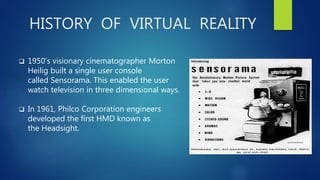
 1950’s visionary cinematographer Morton
Heilig built a single user console
called Sensorama. This enabled the user
watch television in three dimensional ways.
 In 1961, Philco Corporation engineers
developed the first HMD known as
the Headsight.
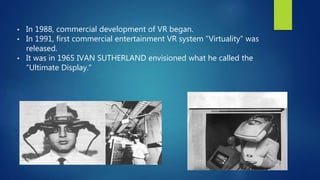
• In 1988, commercial development of VR began.
• In 1991, first commercial entertainment VR system "Virtuality" was
released.
• It was in 1965 IVAN SUTHERLAND envisioned what he called the
“Ultimate Display.”
TYPES OF VIRTUAL REALITY
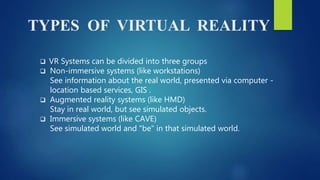
 VR Systems can be divided into three groups
 Non-immersive systems (like workstations)
See information about the real world, presented via computer -
location based services, GIS .
 Augmented reality systems (like HMD)
Stay in real world, but see simulated objects.
 Immersive systems (like CAVE)
See simulated world and "be" in that simulated world.
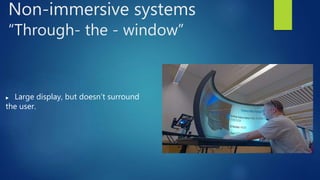
Non-immersive systems
“Through- the - window”
 Large display, but doesn’t surround
the user.
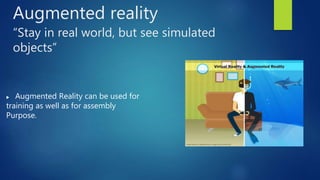
Augmented reality
“Stay in real world, but see simulated
objects”
 Augmented Reality can be used for
training as well as for assembly
Purpose.
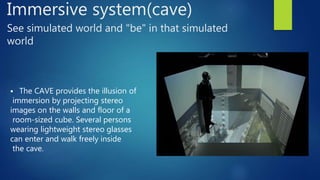
Immersive system(cave)
See simulated world and "be" in that simulated
world
 The CAVE provides the illusion of
immersion by projecting stereo
images on the walls and floor of a
room-sized cube. Several persons
wearing lightweight stereo glasses
can enter and walk freely inside
the cave.
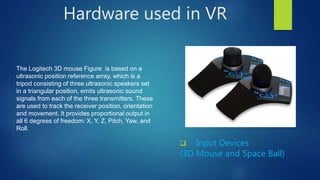
Hardware used in VR
 Input Devices
(3D Mouse and Space Ball)
The Logitech 3D mouse Figure is based on a
ultrasonic position reference array, which is a
tripod consisting of three ultrasonic speakers set
in a triangular position, emits ultrasonic sound
signals from each of the three transmitters. These
are used to track the receiver position, orientation
and movement. It provides proportional output in
all 6 degrees of freedom: X, Y, Z, Pitch, Yaw, and
Roll.
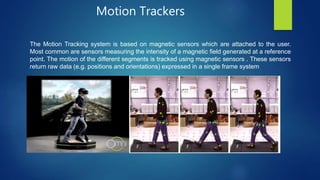
Motion Trackers
The Motion Tracking system is based on magnetic sensors which are attached to the user.
Most common are sensors measuring the intensity of a magnetic field generated at a reference
point. The motion of the different segments is tracked using magnetic sensors . These sensors
return raw data (e.g. positions and orientations) expressed in a single frame system.
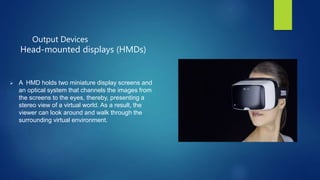
Output Devices
Head-mounted displays (HMDs)
 A HMD holds two miniature display screens and
an optical system that channels the images from
the screens to the eyes, thereby, presenting a
stereo view of a virtual world. As a result, the
viewer can look around and walk through the
surrounding virtual environment.
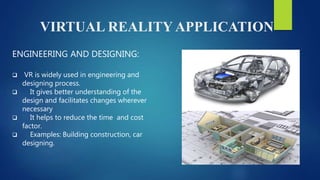
VIRTUAL REALITY APPLICATION
ENGINEERING AND DESIGNING:
 VR is widely used in engineering and
designing process.
 It gives better understanding of the
design and facilitates changes wherever
necessary
 It helps to reduce the time and cost
factor.
 Examples: Building construction, car
designing.
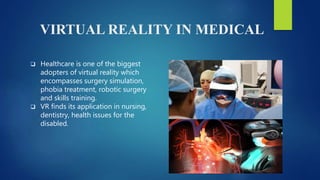
VIRTUAL REALITY IN MEDICAL
 Healthcare is one of the biggest
adopters of virtual reality which
encompasses surgery simulation,
phobia treatment, robotic surgery
and skills training.
 VR finds its application in nursing,
dentistry, health issues for the
disabled.
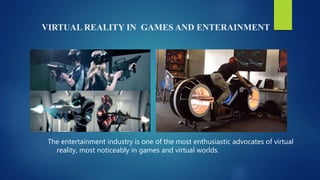
VIRTUAL REALITY IN GAMES AND ENTERAINMENT
The entertainment industry is one of the most enthusiastic advocates of virtual
reality, most noticeably in games and virtual worlds.
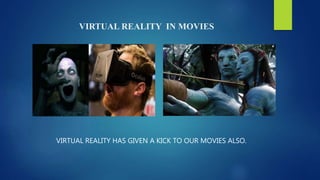
VIRTUAL REALITY IN MOVIES
VIRTUAL REALITY HAS GIVEN A KICK TO OUR MOVIES ALSO.
Positive uses of VR
 Training.
 Risk-free experience.
 Experiencing things you
wouldn’t normally be able to
experience.
 Entertainment; fun, artistic
expression.
 Telepresence applications.
 Disengagement with real world
 VR replacing reality
 People preferring VR to reality
 Addiction
 Psychological damage; identity
problems
 Possible impacts on real body
Dangers of VR
The Future of Virtual Reality
 Virtual Reality is a growing industry
 PC and specialized hardware are getting better, faster
and cheaper because of development in VR.
 Maybe 3D user interfaces will replace the windows
based ones.
 Huge demand for VRML programmers in near future.
 Revolution in gaming industries
Thanks!

Virtual reality

  • 1.
  • 2.
    OVERVIEW  What isVirtual Reality?  History of Virtual Reality.  Types of Virtual Reality.  Devices used in Virtual Reality.  Applications of Virtual Reality.  Conclusion.
  • 3.
    What is VirtualReality ? Virtual reality is, plainly speaking, seeing an imaginary world, rather than the real one. Seeing, hearing, smelling, testing, feeling. The imaginary world is a simulation running in a computer. The sense data is fed by some system to our brain.
  • 4.
    HISTORY OF VIRTUALREALITY  1950’s visionary cinematographer Morton Heilig built a single user console called Sensorama. This enabled the user watch television in three dimensional ways.  In 1961, Philco Corporation engineers developed the first HMD known as the Headsight.
  • 5.
    • In 1988,commercial development of VR began. • In 1991, first commercial entertainment VR system "Virtuality" was released. • It was in 1965 IVAN SUTHERLAND envisioned what he called the “Ultimate Display.”
  • 6.
    TYPES OF VIRTUALREALITY  VR Systems can be divided into three groups  Non-immersive systems (like workstations) See information about the real world, presented via computer - location based services, GIS .  Augmented reality systems (like HMD) Stay in real world, but see simulated objects.  Immersive systems (like CAVE) See simulated world and "be" in that simulated world.
  • 7.
    Non-immersive systems “Through- the- window”  Large display, but doesn’t surround the user.
  • 8.
    Augmented reality “Stay inreal world, but see simulated objects”  Augmented Reality can be used for training as well as for assembly Purpose.
  • 9.
    Immersive system(cave) See simulatedworld and "be" in that simulated world  The CAVE provides the illusion of immersion by projecting stereo images on the walls and floor of a room-sized cube. Several persons wearing lightweight stereo glasses can enter and walk freely inside the cave.
  • 10.
    Hardware used inVR  Input Devices (3D Mouse and Space Ball) The Logitech 3D mouse Figure is based on a ultrasonic position reference array, which is a tripod consisting of three ultrasonic speakers set in a triangular position, emits ultrasonic sound signals from each of the three transmitters. These are used to track the receiver position, orientation and movement. It provides proportional output in all 6 degrees of freedom: X, Y, Z, Pitch, Yaw, and Roll.
  • 11.
    Motion Trackers The MotionTracking system is based on magnetic sensors which are attached to the user. Most common are sensors measuring the intensity of a magnetic field generated at a reference point. The motion of the different segments is tracked using magnetic sensors . These sensors return raw data (e.g. positions and orientations) expressed in a single frame system.
  • 12.
    Output Devices Head-mounted displays(HMDs)  A HMD holds two miniature display screens and an optical system that channels the images from the screens to the eyes, thereby, presenting a stereo view of a virtual world. As a result, the viewer can look around and walk through the surrounding virtual environment.
  • 13.
    VIRTUAL REALITY APPLICATION ENGINEERINGAND DESIGNING:  VR is widely used in engineering and designing process.  It gives better understanding of the design and facilitates changes wherever necessary  It helps to reduce the time and cost factor.  Examples: Building construction, car designing.
  • 14.
    VIRTUAL REALITY INMEDICAL  Healthcare is one of the biggest adopters of virtual reality which encompasses surgery simulation, phobia treatment, robotic surgery and skills training.  VR finds its application in nursing, dentistry, health issues for the disabled.
  • 15.
    VIRTUAL REALITY INGAMES AND ENTERAINMENT The entertainment industry is one of the most enthusiastic advocates of virtual reality, most noticeably in games and virtual worlds.
  • 16.
    VIRTUAL REALITY INMOVIES VIRTUAL REALITY HAS GIVEN A KICK TO OUR MOVIES ALSO.
  • 17.
    Positive uses ofVR  Training.  Risk-free experience.  Experiencing things you wouldn’t normally be able to experience.  Entertainment; fun, artistic expression.  Telepresence applications.  Disengagement with real world  VR replacing reality  People preferring VR to reality  Addiction  Psychological damage; identity problems  Possible impacts on real body Dangers of VR
  • 18.
    The Future ofVirtual Reality  Virtual Reality is a growing industry  PC and specialized hardware are getting better, faster and cheaper because of development in VR.  Maybe 3D user interfaces will replace the windows based ones.  Huge demand for VRML programmers in near future.  Revolution in gaming industries
  • 19.