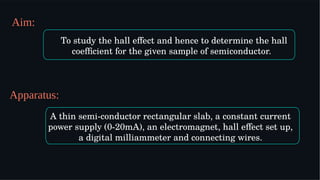
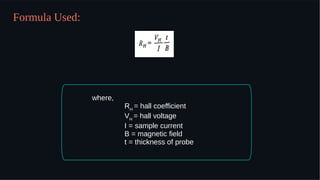
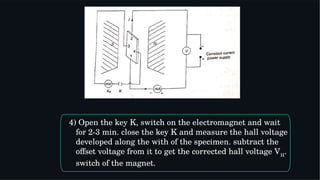
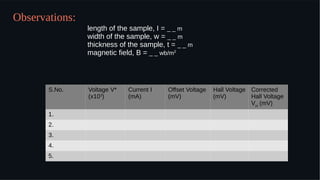
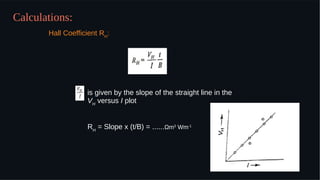
This experiment aims to determine the Hall coefficient of a semiconductor sample using the Hall effect. A rectangular semiconductor sample is placed in a perpendicular magnetic and electric field. Charges in the sample experience a Lorentz force, causing a potential difference called the Hall voltage to develop across the sample. Hall voltage measurements are taken at varying currents through the sample. The Hall coefficient is then calculated from the slope of the Hall voltage-current graph and used to characterize the semiconductor by determining the type and concentration of charge carriers in the sample. Precautions are taken to accurately measure and control the magnetic field and avoid sample heating.