Ashitta Anna Zacharia
M.Sc.Physics,B.Ed.
2
Electricity has an important role in the society. It is a controlled and conventional form
of energy.
The motion of charges creates current. In a conductor, current is formed by the flow of
free electrons in it. While in the gases and electrolytes, current is formed by the flow of
ions. Electricity is the flow of electrons around a circuit. The direction of electron flow is
from negative to positive while the direction of conventional current is from positive to
negative, that is, opposite to the direction of flow of electrons.
Electron flow : positive to negative
Current flow : negative to positive
An electron possess an electric charge of 1.6 ×10⁻¹⁹
coulomb. The unit of electric charge is
coulomb . A coulomb is a charge carried by 6.25×10¹⁸
electrons.
ELECTRIC CURRENT
The flow of electrons in a particular direction constitute electric current. It is expressed
as, rate of flow of electric charge.
Current or intensity of current is a quantity of charge that flows through a conductor in
a circuit in one second.
If a charge of one coulomb flows across any cross section of a conductor in time t, then
the current I through the cross section is :
I = Q/t
The SI unit of electric charge is coulomb (C), unit of time is second (s), then the unit of
current is;
Unit of current (I) = coulomb/secon
i.e;. unit of current = ampere.
3
One ampere is constituted by the flow of one coulomb of charge per second.
1A = 1C/1s
Small quantities of current are expressed in milliampere (1mA=10-3
A) or micro ampere
(1μA=10-6
A).
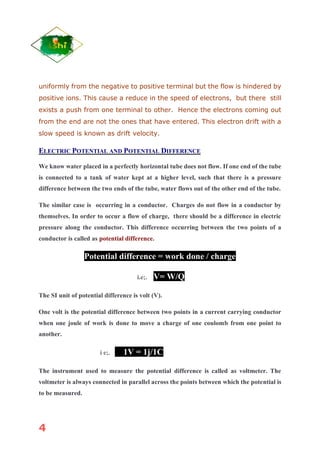
Instrument used to measure the current in the circuit is called as ammeter. It is always
connected in series in a circuit through which the current is to be measured. The circuit
diagram showing how ammeter is connected in a circuit is shown below.
The positive terminal of ammeter must be connected to the positive terminal of the cell
and negative terminal of ammeter should be connected to the negative terminal of the
cell.
Flow of current through the conductor
In any conductor, there are positively charged ions, which is at rest and
free electrons . The free electrons are in random motion. When the
conductor is connected to a battery, the free electrons starts to move
4
uniformly from the negative to positive terminal but the flow is hindered by
positive ions. This cause a reduce in the speed of electrons, but there still
exists a push from one terminal to other. Hence the electrons coming out
from the end are not the ones that have entered. This electron drift with a
slow speed is known as drift velocity.
ELECTRIC POTENTIAL AND POTENTIAL DIFFERENCE
We know water placed in a perfectly horizontal tube does not flow. If one end of the tube
is connected to a tank of water kept at a higher level, such that there is a pressure
difference between the two ends of the tube, water flows out of the other end of the tube.
The similar case is occurring in a conductor. Charges do not flow in a conductor by
themselves. In order to occur a flow of charge, there should be a difference in electric
pressure along the conductor. This difference occurring between the two points of a
conductor is called as potential difference.
Potential difference = work done / charge
i.e;. V= W/Q
The SI unit of potential difference is volt (V).
One volt is the potential difference between two points in a current carrying conductor
when one joule of work is done to move a charge of one coulomb from one point to
another.
i e;. 1V = 1j/1C
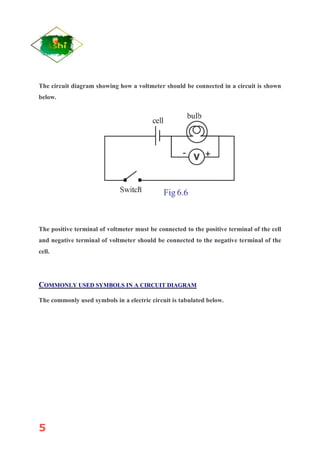
The instrument used to measure the potential difference is called as voltmeter. The
voltmeter is always connected in parallel across the points between which the potential is
to be measured.
5
The circuit diagram showing how a voltmeter should be connected in a circuit is shown
below.
The positive terminal of voltmeter must be connected to the positive terminal of the cell
and negative terminal of voltmeter should be connected to the negative terminal of the
cell.
COMMONLY USED SYMBOLS IN A CIRCUIT DIAGRAM
The commonly used symbols in a electric circuit is tabulated below.
6
ELECTROMOTIVE FORCE
Electromotive force (emf) is the ability to maintain the potential difference between the
ends of a conductor. The emf of a source of current is a potential difference between its
ends when the source is in a open circuit. The emf is equal to the work done on the charge
per unit charge when there is no current flowing. The emf of a cell is measured in unit
volt.
Any device that provides electrical energy can be called as source of emf. Some examples
are :
7
electrochemical cell, battery, fuel cell, solar cell, electrical generator, transformer,
thermoelectric device.
The energy change in some of the above-mentioned examples are :
solar cell : solar energy to electrical energy
generator : mechanical energy to electrical energy
battery : chemical energy to light energy
Fuel cell : chemical energy to mechanical energy.
OHM'S LAW
(Is there a relationship between potential difference across a conductor and the current
through it.)
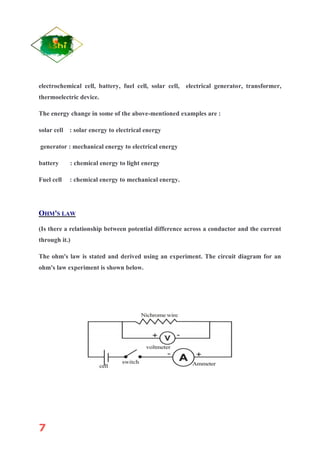
The ohm's law is stated and derived using an experiment. The circuit diagram for an
ohm's law experiment is shown below.
8
Procedure:
The circuit is connected as shown in the diagram the circuit diagram. The reading of
ammeter (I) for the current and voltmeter (V) for the potential difference across a
nichrome wire is noted.
Next two cells are connected in the circuit and the respective reading of ammeter and
voltmeter are tabulated. Repeat the above steps using three and four cells. Calculate the
ratio of V to I for each pair of potential difference V and current I. The tabular column
is for the experiment is shown below.
After calculating the V/I ratio, we can find that, the
values of V/I is approximately same in each case.
Finally a graph is plotted between V and I, where V
is taken along y-axis and I is taken along x-axis. The
V-I diagram is a straight line that passes through
the origin of a graph. The straight line plot shows
that as a current through a wire increases the
voltage across the wire also increases linearly.
9
In 1827, German physicist Georg Simon Ohm founded out the relationship between
current flowing in a metallic wire and potential difference across theterminals. He stated
that, the electric current flowing through a metallic wire is directly proportional to the
voltage across its ends provided, its temperature remains the same. This is called as ohm's
law.
In other words ;
V ~ I
V/I = constant
The constant is taken as R
So; V/I = R
i.e; V = IR
The R is a constant for a given metallic wire at a given temperature and is called as
resistance.
Resistance is a property of a conductor to resist the flow of charges through it to. To
implement resistance in electric circuit resistors are used. The SI unit of resistance is ohm
(Ω).
According to ohm's law,
R = V/I
If the potential difference across the two ends of a conductor is 1 volt and current through
it is 1 ampere, then the resistance of the conductor is one ohm.
10
1ohm = 1Volt / 1 ampere
From ohm's law,
I = V/R
i.e; I ~ 1/R
So, if R is doubled then the current becomes half.
A component used to regulate the current without changing
voltage source is called variable resistance. In a electric circuits
a device rheostat is used to regulate the current in a circuit. The
circuit diagram showing how a rheostat is connected in a circuit is shown in the figure.
FACTORS AFFECTING RESISTANCE
When the electrons flow through a wire, they collide with the atoms of the wire, due to
this collision the speed of electrons flowing gets disturbed and they also lose the energy in
the form of heat energy. This obstruction for the flow of electrons is called resistance.Each
and every wire that may be a very good conductor of electricity will certainly offer some
resistance to the flow of electrons.
The factors that affect resistance are :
(a) length of the conductor (l)
If the wire is long then the collision of electrons flowing through the wire will be
more and hence it will offer more resistance.
R~ l
11
(b) area of cross section ( A)
if the wire is thick the collisions would be less and the resistance offered would be
less.
R ~ 1/A
( c) temperature (T)
When the temperature increases, collisions between the electrons also increases and
this creates more resistance.
R ~ T
(d) nature of the material
High resistance materials are : Nichrome, tungsten, Constantan.
Low resistance materials are : Silver, copper , aluminium.
From this we can write as, resistance of conductor increases with increase in length of the
conductor and decreases with increase in area of cross section.
i.e; R~l
R~1/A
R~l/A
i.e; R =ρ l/A
Where ρ (rho) is a constant of proportionality and is called as the electrical resistivity of
the material of the conductor.
ρ = RA/l
12
The SI unit of resistivity is Ωm . Resistivity is the characteristic property of a material.
The resistivity also varies according to temperature.
The length of a conductor of resistance R Ω is 1 m and its area of cross section is 1 m2
then
ρ = R×1/1
ρ = R
Resistivity of a a substance is the resistance of the conductor of unit length and unit area
of cross section.
The reciprocal of resistance is conductivity . It is denoted by the symbol σ (sigma).
σ =1/ρ
The unit of conductivity is Ω-1
m-1
COMBINATION OF CELLS
The cells can be connected in two ways. They are:
(a) Series connection
This is the method of collecting self one after the other in such a way that positive one
cell is connected to the negative of another cell.
13
The features are :
● The total emf is a sum of the emf all cells. E= E1+E2+E3+....+En
● The current passing through each cell is the same.
● The internal resistance developed in the circuit by the battery increases.
● The current in the external circuit increases under high voltage.
(b) Parallel connection
This is a method of collecting similar poles together.
The features are :
● If all the cells have equal emf than the emf of the circuit is the same as that of a
single cell.
● The total current flowing in the circuit switch up and flows through each cell.
● The internal resistance of the circuit is very low.
● More current can be made available for a longer time under low voltage.
14
Summarization :
Notes prepared by
Ashitta Anna Zacharia
M.Sc. Physics, B.Ed.
mail id : annazacharia95@gmail.com

Current Electricity

  • 1.
  • 2.
    2 Electricity has animportant role in the society. It is a controlled and conventional form of energy. The motion of charges creates current. In a conductor, current is formed by the flow of free electrons in it. While in the gases and electrolytes, current is formed by the flow of ions. Electricity is the flow of electrons around a circuit. The direction of electron flow is from negative to positive while the direction of conventional current is from positive to negative, that is, opposite to the direction of flow of electrons. Electron flow : positive to negative Current flow : negative to positive An electron possess an electric charge of 1.6 ×10⁻¹⁹ coulomb. The unit of electric charge is coulomb . A coulomb is a charge carried by 6.25×10¹⁸ electrons. ELECTRIC CURRENT The flow of electrons in a particular direction constitute electric current. It is expressed as, rate of flow of electric charge. Current or intensity of current is a quantity of charge that flows through a conductor in a circuit in one second. If a charge of one coulomb flows across any cross section of a conductor in time t, then the current I through the cross section is : I = Q/t The SI unit of electric charge is coulomb (C), unit of time is second (s), then the unit of current is; Unit of current (I) = coulomb/secon i.e;. unit of current = ampere.
  • 3.
    3 One ampere isconstituted by the flow of one coulomb of charge per second. 1A = 1C/1s Small quantities of current are expressed in milliampere (1mA=10-3 A) or micro ampere (1μA=10-6 A). Instrument used to measure the current in the circuit is called as ammeter. It is always connected in series in a circuit through which the current is to be measured. The circuit diagram showing how ammeter is connected in a circuit is shown below. The positive terminal of ammeter must be connected to the positive terminal of the cell and negative terminal of ammeter should be connected to the negative terminal of the cell. Flow of current through the conductor In any conductor, there are positively charged ions, which is at rest and free electrons . The free electrons are in random motion. When the conductor is connected to a battery, the free electrons starts to move
  • 4.
    4 uniformly from thenegative to positive terminal but the flow is hindered by positive ions. This cause a reduce in the speed of electrons, but there still exists a push from one terminal to other. Hence the electrons coming out from the end are not the ones that have entered. This electron drift with a slow speed is known as drift velocity. ELECTRIC POTENTIAL AND POTENTIAL DIFFERENCE We know water placed in a perfectly horizontal tube does not flow. If one end of the tube is connected to a tank of water kept at a higher level, such that there is a pressure difference between the two ends of the tube, water flows out of the other end of the tube. The similar case is occurring in a conductor. Charges do not flow in a conductor by themselves. In order to occur a flow of charge, there should be a difference in electric pressure along the conductor. This difference occurring between the two points of a conductor is called as potential difference. Potential difference = work done / charge i.e;. V= W/Q The SI unit of potential difference is volt (V). One volt is the potential difference between two points in a current carrying conductor when one joule of work is done to move a charge of one coulomb from one point to another. i e;. 1V = 1j/1C The instrument used to measure the potential difference is called as voltmeter. The voltmeter is always connected in parallel across the points between which the potential is to be measured.
  • 5.
    5 The circuit diagramshowing how a voltmeter should be connected in a circuit is shown below. The positive terminal of voltmeter must be connected to the positive terminal of the cell and negative terminal of voltmeter should be connected to the negative terminal of the cell. COMMONLY USED SYMBOLS IN A CIRCUIT DIAGRAM The commonly used symbols in a electric circuit is tabulated below.
  • 6.
    6 ELECTROMOTIVE FORCE Electromotive force(emf) is the ability to maintain the potential difference between the ends of a conductor. The emf of a source of current is a potential difference between its ends when the source is in a open circuit. The emf is equal to the work done on the charge per unit charge when there is no current flowing. The emf of a cell is measured in unit volt. Any device that provides electrical energy can be called as source of emf. Some examples are :
  • 7.
    7 electrochemical cell, battery,fuel cell, solar cell, electrical generator, transformer, thermoelectric device. The energy change in some of the above-mentioned examples are : solar cell : solar energy to electrical energy generator : mechanical energy to electrical energy battery : chemical energy to light energy Fuel cell : chemical energy to mechanical energy. OHM'S LAW (Is there a relationship between potential difference across a conductor and the current through it.) The ohm's law is stated and derived using an experiment. The circuit diagram for an ohm's law experiment is shown below.
  • 8.
    8 Procedure: The circuit isconnected as shown in the diagram the circuit diagram. The reading of ammeter (I) for the current and voltmeter (V) for the potential difference across a nichrome wire is noted. Next two cells are connected in the circuit and the respective reading of ammeter and voltmeter are tabulated. Repeat the above steps using three and four cells. Calculate the ratio of V to I for each pair of potential difference V and current I. The tabular column is for the experiment is shown below. After calculating the V/I ratio, we can find that, the values of V/I is approximately same in each case. Finally a graph is plotted between V and I, where V is taken along y-axis and I is taken along x-axis. The V-I diagram is a straight line that passes through the origin of a graph. The straight line plot shows that as a current through a wire increases the voltage across the wire also increases linearly.
  • 9.
    9 In 1827, Germanphysicist Georg Simon Ohm founded out the relationship between current flowing in a metallic wire and potential difference across theterminals. He stated that, the electric current flowing through a metallic wire is directly proportional to the voltage across its ends provided, its temperature remains the same. This is called as ohm's law. In other words ; V ~ I V/I = constant The constant is taken as R So; V/I = R i.e; V = IR The R is a constant for a given metallic wire at a given temperature and is called as resistance. Resistance is a property of a conductor to resist the flow of charges through it to. To implement resistance in electric circuit resistors are used. The SI unit of resistance is ohm (Ω). According to ohm's law, R = V/I If the potential difference across the two ends of a conductor is 1 volt and current through it is 1 ampere, then the resistance of the conductor is one ohm.
  • 10.
    10 1ohm = 1Volt/ 1 ampere From ohm's law, I = V/R i.e; I ~ 1/R So, if R is doubled then the current becomes half. A component used to regulate the current without changing voltage source is called variable resistance. In a electric circuits a device rheostat is used to regulate the current in a circuit. The circuit diagram showing how a rheostat is connected in a circuit is shown in the figure. FACTORS AFFECTING RESISTANCE When the electrons flow through a wire, they collide with the atoms of the wire, due to this collision the speed of electrons flowing gets disturbed and they also lose the energy in the form of heat energy. This obstruction for the flow of electrons is called resistance.Each and every wire that may be a very good conductor of electricity will certainly offer some resistance to the flow of electrons. The factors that affect resistance are : (a) length of the conductor (l) If the wire is long then the collision of electrons flowing through the wire will be more and hence it will offer more resistance. R~ l
  • 11.
    11 (b) area ofcross section ( A) if the wire is thick the collisions would be less and the resistance offered would be less. R ~ 1/A ( c) temperature (T) When the temperature increases, collisions between the electrons also increases and this creates more resistance. R ~ T (d) nature of the material High resistance materials are : Nichrome, tungsten, Constantan. Low resistance materials are : Silver, copper , aluminium. From this we can write as, resistance of conductor increases with increase in length of the conductor and decreases with increase in area of cross section. i.e; R~l R~1/A R~l/A i.e; R =ρ l/A Where ρ (rho) is a constant of proportionality and is called as the electrical resistivity of the material of the conductor. ρ = RA/l
  • 12.
    12 The SI unitof resistivity is Ωm . Resistivity is the characteristic property of a material. The resistivity also varies according to temperature. The length of a conductor of resistance R Ω is 1 m and its area of cross section is 1 m2 then ρ = R×1/1 ρ = R Resistivity of a a substance is the resistance of the conductor of unit length and unit area of cross section. The reciprocal of resistance is conductivity . It is denoted by the symbol σ (sigma). σ =1/ρ The unit of conductivity is Ω-1 m-1 COMBINATION OF CELLS The cells can be connected in two ways. They are: (a) Series connection This is the method of collecting self one after the other in such a way that positive one cell is connected to the negative of another cell.
  • 13.
    13 The features are: ● The total emf is a sum of the emf all cells. E= E1+E2+E3+....+En ● The current passing through each cell is the same. ● The internal resistance developed in the circuit by the battery increases. ● The current in the external circuit increases under high voltage. (b) Parallel connection This is a method of collecting similar poles together. The features are : ● If all the cells have equal emf than the emf of the circuit is the same as that of a single cell. ● The total current flowing in the circuit switch up and flows through each cell. ● The internal resistance of the circuit is very low. ● More current can be made available for a longer time under low voltage.
  • 14.
    14 Summarization : Notes preparedby Ashitta Anna Zacharia M.Sc. Physics, B.Ed. mail id : annazacharia95@gmail.com