Skin
 Largest organ completely covering the body continuous with
membranes lining body orifices.
 Average thickness:1-2mm, 0.5mm on eyelids & 6mm on
palms & soles.
 pH-4 to 5.6
 Renewal of skin takes place in 28-50 days by shedding of

outer layer.
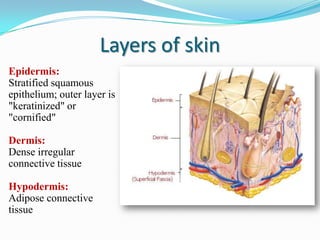
Layers of skin
Epidermis:
Stratified squamous
epithelium; outer layer is
"keratinized" or
"cornified"
Dermis:
Dense irregular
connective tissue

Hypodermis:
Adipose connective
tissue
Epidermis
Epidermis:
Avascular layer that depends on
blood vessels in underlying
dermis for its nutrition.

Cells formed by mitosis in deepest,
or basal, layer, then get pushed
into more superficial layers or
"stata"
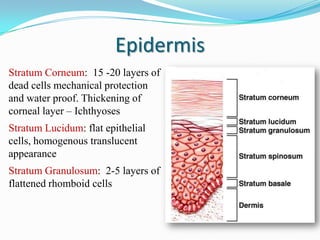
Epidermis
Stratum Corneum: 15 -20 layers of
dead cells mechanical protection
and water proof. Thickening of
corneal layer – Ichthyoses
Stratum Lucidum: flat epithelial
cells, homogenous translucent
appearance
Stratum Granulosum: 2-5 layers of
flattened rhomboid cells
Epidermis
Stratum Spinosum: spinous or
prickle-cell layer
Stratum basale: Usually one cell
thick, 2-3 cell thick in glabrous skin
and hyperproliferative epidermis
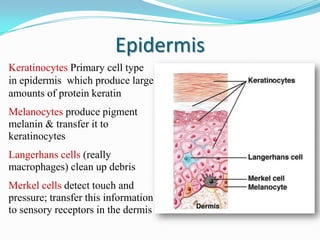
Epidermis
Keratinocytes Primary cell type
in epidermis which produce large
amounts of protein keratin
Melanocytes produce pigment
melanin & transfer it to
keratinocytes
Langerhans cells (really
macrophages) clean up debris

Merkel cells detect touch and
pressure; transfer this information
to sensory receptors in the dermis
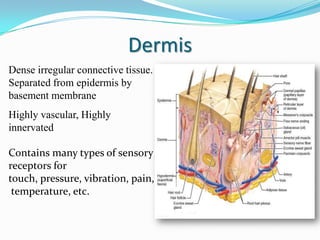
Dermis
Dense irregular connective tissue.
Separated from epidermis by
basement membrane
Highly vascular, Highly
innervated
Contains many types of sensory
receptors for
touch, pressure, vibration, pain,
temperature, etc.
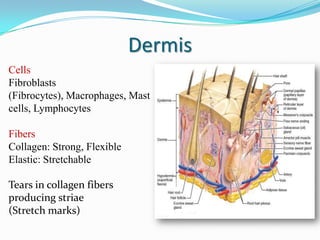
Dermis
Cells
Fibroblasts
(Fibrocytes), Macrophages, Mast
cells, Lymphocytes

Fibers
Collagen: Strong, Flexible
Elastic: Stretchable
Tears in collagen fibers
producing striae
(Stretch marks)
Functions of Skin
● Protection against physical damages and abrasion, infections, UV
and other radiations, oozing body fluid and solutes in.

● Sensory Perception (touch, temperature, pressure, pain, etc.)
● Vitamin D Synthesis
● Temperature regulation
● Excretion (lactic acid, sodium chloride, urea)

● Blood reservoir
Intrinsic Aging
 Chronological aging
 Hormonal aging
Decreased estrogens during menopause
contribute to collagen loss in women
Extrinsic Aging
 Photodamage - 80%
 Smoking
 Stress

 Poor nutrition
 Pollution
 Excess alcohol
Photoaging
● Sun-induced skin aging
● Dermatoheliosis
 ―Photoaging‖ term is described in 1986
by Kligman
Definition of Photoaging
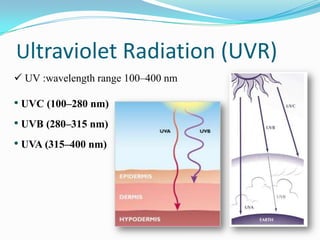
Photoageing is due to (oxidative) damage
caused by short wavelength ultraviolet
radiation (UVB) injury to the outside layers
of the skin (epidermis), longer wavelength
ultraviolet radiation (UVA) to the middle
layers (dermis) and infra-red A radiation to
the deeper dermis and subcutaneous tissue.
Solar Radiation
 Acute exposure
 Immediate





Vitamin D synthesis
Immediate darkening reaction
Antidepressant action
Immunosuppressive action

 Delayed




Sunburn reaction
Delayed pigmentation
Hyperplastic reaction

 Chronic exposure
 Photoaging (dermatoheliosis)
 Photocarcinogenesis
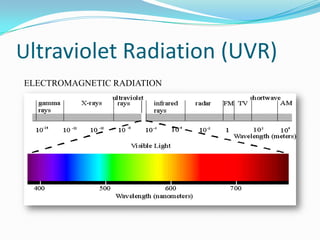
Ultraviolet Radiation (UVR)
ELECTROMAGNETIC RADIATION
Ultraviolet Radiation (UVR)
 UV :wavelength range 100–400 nm

• UVC (100–280 nm)
• UVB (280–315 nm)
• UVA (315–400 nm)
Health Effects of UV Radiation
 SKIN
 SUNBURN, SUNTAN AND SKIN AGEING
 NON-MELANOMA SKIN CANCERS (basal cell carcinoma and
squamous cell carcinoma)
 MALIGNANT MELANOMA

 EYE
 Photokeratitis and Photoconjunctivitis
 Cataracts (UVB)
 IMMUNE SYSTEM
 Immunosuppressive effect
 Higher risk of infection (viral, bacterial, parasitic or fungal)
Ultraviolet Radiation (UVR)
Photobiological effects of UV
UVA: Causes skin aging & wrinkles. Used in tanning beds.

UVB: Causes sunburns, cataracts, immune system
damage, skin cancers.
UVC: These rays are the most dangerous. Fortunately, these
rays are blocked by the ozone layer and don’t reach the
earth.
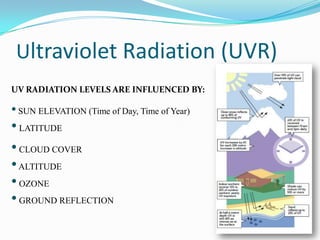
Ultraviolet Radiation (UVR)
UV RADIATION LEVELS ARE INFLUENCED BY:

• SUN ELEVATION (Time of Day, Time of Year)

• LATITUDE
• CLOUD COVER
• ALTITUDE
• OZONE
• GROUND REFLECTION
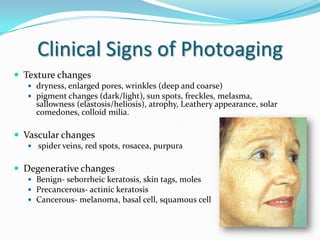
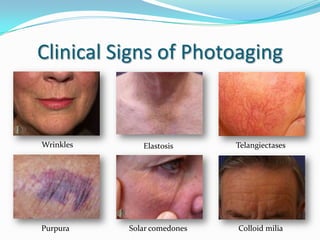
Clinical Signs of Photoaging
 Texture changes
 dryness, enlarged pores, wrinkles (deep and coarse)
 pigment changes (dark/light), sun spots, freckles, melasma,

sallowness (elastosis/heliosis), atrophy, Leathery appearance, solar
comedones, colloid milia.

 Vascular changes
 spider veins, red spots, rosacea, purpura

 Degenerative changes
 Benign- seborrheic keratosis, skin tags, moles
 Precancerous- actinic keratosis
 Cancerous- melanoma, basal cell, squamous cell
Clinical Signs of Photoaging

Wrinkles

Elastosis

Telangiectases

Purpura

Solar comedones

Colloid milia
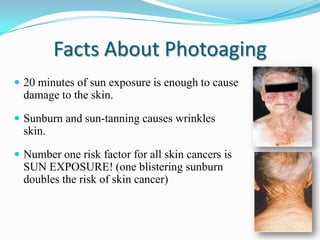
Facts About Photoaging
 20 minutes of sun exposure is enough to cause

damage to the skin.
 Sunburn and sun-tanning causes wrinkles

skin.
 Number one risk factor for all skin cancers is

SUN EXPOSURE! (one blistering sunburn
doubles the risk of skin cancer)
Histologic Changes in Photoaging
● Thickened stratum corneum
● Thin atrophic epidermis with cellular atypia
● Irregular dispersion of melanin
● Loss of dermal glosaminoglycans and collagen
● Loss of normal dermal vasculature
● Elastosis (abnormal elastic fibres in dermis)
Mechanisms Photoaging of Skin
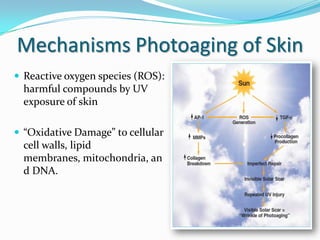
 Collagen
 Main building blocks of human skin (skin’s strength)
 Deraml fibroblasts make procollagen
 Two important regulators of collagen
 Transforming growth factor (TGF)-β
(A cytokine that promotes collagen production)
 Activator protein (AP)-1
(a transcription factor that inhibits collagen production and up-regulates
collagen breakdown)

 TGF-β promotes collagen formation, while AP-1 promotes collagen

breakdown by upregulating enzymes called matrix metalloproteinases
(MMPs).
Mechanisms Photoaging of Skin
 Reactive oxygen species (ROS):

harmful compounds by UV
exposure of skin
 “Oxidative Damage” to cellular

cell walls, lipid
membranes, mitochondria, an
d DNA.
Chronological Aging
 Fine wrinkles
 Laxity

 Benign neoplasms
 Thin skin

 Mild dryness
Prevention
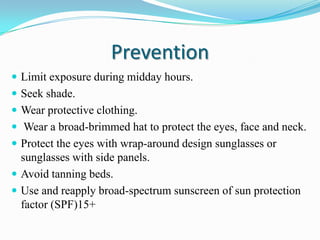
 Limit exposure during midday hours.
 Seek shade.
 Wear protective clothing.
 Wear a broad-brimmed hat to protect the eyes, face and neck.

 Protect the eyes with wrap-around design sunglasses or

sunglasses with side panels.
 Avoid tanning beds.
 Use and reapply broad-spectrum sunscreen of sun protection
factor (SPF)15+
Sunscreens
CLASSIFICATIONS
Physical: Scatters or reflects UV radiation due to large particle size
titanium dioxide
talc, kaolin
zinc oxide
ferric chloride
icthyol, red petrolatum

Chemical: absorbs UV radiation
PABA, PABA esters
benzophenones
cinnamates
salicylates
digalloyl trioleate
anthranilates
Sunscreens


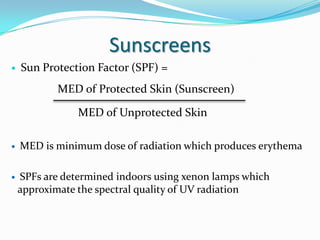
Sun Protection Factor (SPF) =

MED of Protected Skin (Sunscreen)
MED of Unprotected Skin




MED is minimum dose of radiation which produces erythema
SPFs are determined indoors using xenon lamps which
approximate the spectral quality of UV radiation
Sunscreens
 SPF 15 blocks 93%, SPF 30 blocks 97% for 2 hours

 Suggestions to improve sunscreen effectiveness:
 Apply sunscreen 20 minutes before you go outdoors
 Use about 1 ounce (enough to fill a shot glass) to cover the entire body.

Cover all exposed areas liberally. Pay special attention to
face, ears, nose, arms and legs. Remember that lips can burn, too, so
cover lips with a lip balm sunscreen or SPF 30 or higher
 Reapply approximately every 2 hours, or after swimming or heavy
sweating (reapplying does not increase the SPF—it just keeps the SPF at
its maximum level)
Sunscreens
Criteria for Selecting a Sunscreen to Prevent Photoaging
 SPF of 30 or higher
 Broad-spectrum, providing both UVA and UVB protection

 Does not cause skin irritation
 Does not worsen an existing skin condition
Teatment for Photoaging
 Diet high in fruits and vegetables

 Adequate oral hydration ( 64 oz + daily)
 Good daily skin care regimen
 No Smoking

 Rejuvenation procedures
 Protection/Prevention
Teatment for Photoaging
 Alpha Hydroxy Acids (AHA)

 Glycolic Acid
 Retinoids (Stimulates collagen production, Decreases cell damage

from sun exposure, Increases skin cell turnover)
• Tretinoin (Retin-A, Renova)
• Terazatane (Tazorac)
• Differin (Adapalene)
 5-Fluorouracil
 Imiquimod
Teatment for Photoaging
Rejuvenation Procedures
 Botulinum Toxins (Botox, Myobloc, Reloxin)
 Dermal Fillers (Collagen, Hyaluronic

Acid, Radiesse, Sculptra, Hylaform, Captiqu, Cos
moplast, Juvederm)
 Laser & Light treatments
Skin Aging

Skin Aging

  • 5.
    Skin  Largest organcompletely covering the body continuous with membranes lining body orifices.  Average thickness:1-2mm, 0.5mm on eyelids & 6mm on palms & soles.  pH-4 to 5.6  Renewal of skin takes place in 28-50 days by shedding of outer layer.
  • 6.
    Layers of skin Epidermis: Stratifiedsquamous epithelium; outer layer is "keratinized" or "cornified" Dermis: Dense irregular connective tissue Hypodermis: Adipose connective tissue
  • 7.
    Epidermis Epidermis: Avascular layer thatdepends on blood vessels in underlying dermis for its nutrition. Cells formed by mitosis in deepest, or basal, layer, then get pushed into more superficial layers or "stata"
  • 8.
    Epidermis Stratum Corneum: 15-20 layers of dead cells mechanical protection and water proof. Thickening of corneal layer – Ichthyoses Stratum Lucidum: flat epithelial cells, homogenous translucent appearance Stratum Granulosum: 2-5 layers of flattened rhomboid cells
  • 9.
    Epidermis Stratum Spinosum: spinousor prickle-cell layer Stratum basale: Usually one cell thick, 2-3 cell thick in glabrous skin and hyperproliferative epidermis
  • 10.
    Epidermis Keratinocytes Primary celltype in epidermis which produce large amounts of protein keratin Melanocytes produce pigment melanin & transfer it to keratinocytes Langerhans cells (really macrophages) clean up debris Merkel cells detect touch and pressure; transfer this information to sensory receptors in the dermis
  • 11.
    Dermis Dense irregular connectivetissue. Separated from epidermis by basement membrane Highly vascular, Highly innervated Contains many types of sensory receptors for touch, pressure, vibration, pain, temperature, etc.
  • 12.
    Dermis Cells Fibroblasts (Fibrocytes), Macrophages, Mast cells,Lymphocytes Fibers Collagen: Strong, Flexible Elastic: Stretchable Tears in collagen fibers producing striae (Stretch marks)
  • 13.
    Functions of Skin ●Protection against physical damages and abrasion, infections, UV and other radiations, oozing body fluid and solutes in. ● Sensory Perception (touch, temperature, pressure, pain, etc.) ● Vitamin D Synthesis ● Temperature regulation ● Excretion (lactic acid, sodium chloride, urea) ● Blood reservoir
  • 14.
    Intrinsic Aging  Chronologicalaging  Hormonal aging Decreased estrogens during menopause contribute to collagen loss in women
  • 15.
    Extrinsic Aging  Photodamage- 80%  Smoking  Stress  Poor nutrition  Pollution  Excess alcohol
  • 16.
    Photoaging ● Sun-induced skinaging ● Dermatoheliosis  ―Photoaging‖ term is described in 1986 by Kligman
  • 17.
    Definition of Photoaging Photoageingis due to (oxidative) damage caused by short wavelength ultraviolet radiation (UVB) injury to the outside layers of the skin (epidermis), longer wavelength ultraviolet radiation (UVA) to the middle layers (dermis) and infra-red A radiation to the deeper dermis and subcutaneous tissue.
  • 18.
    Solar Radiation  Acuteexposure  Immediate     Vitamin D synthesis Immediate darkening reaction Antidepressant action Immunosuppressive action  Delayed    Sunburn reaction Delayed pigmentation Hyperplastic reaction  Chronic exposure  Photoaging (dermatoheliosis)  Photocarcinogenesis
  • 19.
  • 20.
    Ultraviolet Radiation (UVR) UV :wavelength range 100–400 nm • UVC (100–280 nm) • UVB (280–315 nm) • UVA (315–400 nm)
  • 21.
    Health Effects ofUV Radiation  SKIN  SUNBURN, SUNTAN AND SKIN AGEING  NON-MELANOMA SKIN CANCERS (basal cell carcinoma and squamous cell carcinoma)  MALIGNANT MELANOMA  EYE  Photokeratitis and Photoconjunctivitis  Cataracts (UVB)  IMMUNE SYSTEM  Immunosuppressive effect  Higher risk of infection (viral, bacterial, parasitic or fungal)
  • 22.
    Ultraviolet Radiation (UVR) Photobiologicaleffects of UV UVA: Causes skin aging & wrinkles. Used in tanning beds. UVB: Causes sunburns, cataracts, immune system damage, skin cancers. UVC: These rays are the most dangerous. Fortunately, these rays are blocked by the ozone layer and don’t reach the earth.
  • 23.
    Ultraviolet Radiation (UVR) UVRADIATION LEVELS ARE INFLUENCED BY: • SUN ELEVATION (Time of Day, Time of Year) • LATITUDE • CLOUD COVER • ALTITUDE • OZONE • GROUND REFLECTION
  • 24.
    Clinical Signs ofPhotoaging  Texture changes  dryness, enlarged pores, wrinkles (deep and coarse)  pigment changes (dark/light), sun spots, freckles, melasma, sallowness (elastosis/heliosis), atrophy, Leathery appearance, solar comedones, colloid milia.  Vascular changes  spider veins, red spots, rosacea, purpura  Degenerative changes  Benign- seborrheic keratosis, skin tags, moles  Precancerous- actinic keratosis  Cancerous- melanoma, basal cell, squamous cell
  • 25.
    Clinical Signs ofPhotoaging Wrinkles Elastosis Telangiectases Purpura Solar comedones Colloid milia
  • 26.
    Facts About Photoaging 20 minutes of sun exposure is enough to cause damage to the skin.  Sunburn and sun-tanning causes wrinkles skin.  Number one risk factor for all skin cancers is SUN EXPOSURE! (one blistering sunburn doubles the risk of skin cancer)
  • 27.
    Histologic Changes inPhotoaging ● Thickened stratum corneum ● Thin atrophic epidermis with cellular atypia ● Irregular dispersion of melanin ● Loss of dermal glosaminoglycans and collagen ● Loss of normal dermal vasculature ● Elastosis (abnormal elastic fibres in dermis)
  • 28.
    Mechanisms Photoaging ofSkin  Collagen  Main building blocks of human skin (skin’s strength)  Deraml fibroblasts make procollagen  Two important regulators of collagen  Transforming growth factor (TGF)-β (A cytokine that promotes collagen production)  Activator protein (AP)-1 (a transcription factor that inhibits collagen production and up-regulates collagen breakdown)  TGF-β promotes collagen formation, while AP-1 promotes collagen breakdown by upregulating enzymes called matrix metalloproteinases (MMPs).
  • 29.
    Mechanisms Photoaging ofSkin  Reactive oxygen species (ROS): harmful compounds by UV exposure of skin  “Oxidative Damage” to cellular cell walls, lipid membranes, mitochondria, an d DNA.
  • 30.
    Chronological Aging  Finewrinkles  Laxity  Benign neoplasms  Thin skin  Mild dryness
  • 31.
    Prevention  Limit exposureduring midday hours.  Seek shade.  Wear protective clothing.  Wear a broad-brimmed hat to protect the eyes, face and neck.  Protect the eyes with wrap-around design sunglasses or sunglasses with side panels.  Avoid tanning beds.  Use and reapply broad-spectrum sunscreen of sun protection factor (SPF)15+
  • 32.
    Sunscreens CLASSIFICATIONS Physical: Scatters orreflects UV radiation due to large particle size titanium dioxide talc, kaolin zinc oxide ferric chloride icthyol, red petrolatum Chemical: absorbs UV radiation PABA, PABA esters benzophenones cinnamates salicylates digalloyl trioleate anthranilates
  • 33.
    Sunscreens  Sun Protection Factor(SPF) = MED of Protected Skin (Sunscreen) MED of Unprotected Skin   MED is minimum dose of radiation which produces erythema SPFs are determined indoors using xenon lamps which approximate the spectral quality of UV radiation
  • 34.
    Sunscreens  SPF 15blocks 93%, SPF 30 blocks 97% for 2 hours  Suggestions to improve sunscreen effectiveness:  Apply sunscreen 20 minutes before you go outdoors  Use about 1 ounce (enough to fill a shot glass) to cover the entire body. Cover all exposed areas liberally. Pay special attention to face, ears, nose, arms and legs. Remember that lips can burn, too, so cover lips with a lip balm sunscreen or SPF 30 or higher  Reapply approximately every 2 hours, or after swimming or heavy sweating (reapplying does not increase the SPF—it just keeps the SPF at its maximum level)
  • 35.
    Sunscreens Criteria for Selectinga Sunscreen to Prevent Photoaging  SPF of 30 or higher  Broad-spectrum, providing both UVA and UVB protection  Does not cause skin irritation  Does not worsen an existing skin condition
  • 36.
    Teatment for Photoaging Diet high in fruits and vegetables  Adequate oral hydration ( 64 oz + daily)  Good daily skin care regimen  No Smoking  Rejuvenation procedures  Protection/Prevention
  • 37.
    Teatment for Photoaging Alpha Hydroxy Acids (AHA)  Glycolic Acid  Retinoids (Stimulates collagen production, Decreases cell damage from sun exposure, Increases skin cell turnover) • Tretinoin (Retin-A, Renova) • Terazatane (Tazorac) • Differin (Adapalene)  5-Fluorouracil  Imiquimod
  • 38.
    Teatment for Photoaging RejuvenationProcedures  Botulinum Toxins (Botox, Myobloc, Reloxin)  Dermal Fillers (Collagen, Hyaluronic Acid, Radiesse, Sculptra, Hylaform, Captiqu, Cos moplast, Juvederm)  Laser & Light treatments