How to
Treat Hyper-
pigmentation
What is Hyperpigmentation?
Hyperpigmentation is the change of skin color because
the body produces too much of a pigment called melanin,
which is responsible for the brown color of the skin,
causing it to become darker than usual.
Hyperpigmentation could be diffuse or circumscribed.
Diffuse hyperpigmentation could be secondary to certain
medications, metabolic and nutritional diseases and
autoimmune disorders. Circumscribed hyperpigmentation
may occur in a variety of conditions.
• The most common disorders associated with this type
of skin hyperpigmentation are:
– Postinflammatory hyperpigmentation, secondary to
trauma or inflammatory lesions
– Melasma, a dark mask-like discoloration most often
located on the face
Post-inflammatory Hyperpigmentation
Post inflammatory hyperpigmentation (PIH) is an acquired
increase of pigmentation occurring after cutaneous
inflammation, such as infections, trauma and inflammatory skin
diseases. This is because cells that normally produce melanin
(melanocytes) evenly across your skin go into overdrive and
produce too much melanin. If the excess melanin is produced in
the upper layer of skin (epidermis), the pigmentation color is a
darker shade of brown. If the excess melanin is produced in the
lower layer of skin (the dermis), a gray or blue discoloration
becomes visible. This condition can occur in all skin types, but
most often affects people with darker skin as black, olive skin,
yellow skin, or mixture thereof and is particularly common in
African-American, Latin American indigenous, Asian, native
American, Pacific Islander and Middle Eastern descent.
• Causes: Many types of inflammatory skin conditions or
cutaneous injuries can cause pigmentary changes; however,
there are some diseases that show a proclivity to develop PIH
rather than hypopigmentation.
Signs & Symptoms
• PIH typically manifests as spots or patches in the
same distribution as the initial inflammatory
process. The location of the excess pigment within
the layers of the skin will determine its coloration.
Epidermal, (superficial) increase of melanin will
appear tan, brown, or dark brown and may take
months to years to resolve without treatment.
Hyperpigmentation within the dermis (deep) has a
blue-gray appearance and may either be
permanent or resolve over a prolonged period of
time if left untreated. The intensity of PIH may also
correlate with darker skin types. In addition, PIH
can worsen with ultraviolet (UV) irradiation or with
persistent or recurrent inflammation.
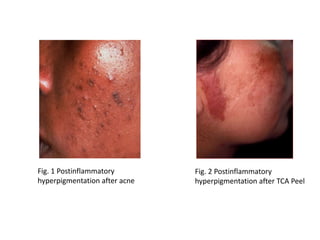
Fig. 1 Postinflammatory
hyperpigmentation after acne
Fig. 2 Postinflammatory
hyperpigmentation after TCA Peel
Treatment
• The treatment of PIH should begin first with
addressing the underlying inflammatory skin
condition. Initiating treatment early for PIH may
help speed its resolution and prevent further
darkening
• Photoprotection: Photoprotection is one of the
most important measures to prevent the worsening
of PIH and to improve it. A daily broad spectrum
sunscreen with a sun protection factor (SPF) of 30
or more should be used, along with other sun-
protective measures, such as sun avoidance and
the use of protective clothing (Wide brimmed hat,
long sleeves and long pants)
Treatment Cont’d
• Topical treatment: Hydroquinone alone or in
combination with other agents, helps in the
reduction of pigmentation and must be prescribed
by a physician. Other topical agents include:
Tretinoin, tazarotene, Kojic acid, azelaic acid,
arbutin, N-acetylglucosamine, among others.
• Cosmetic procedures: Chemical peels with glycolic
acid and salicylic acid may help, but should be
performed by specifically trained professionals.
Special attention should be taken in selecting and
using the specific chemical peel to avoid irritation,
which can worsen PIH and lead to other
complications, such as new areas of discoloration,
keloid formation, and hypertrophic scarring
What is Melasma?
• Melasma is a common acquired, symmetric skin
problem characterized by light to dark brown
macules and patches occurring in the sun-
exposed areas of the face, particularly on
cheeks, bridge of the nose, forehead, chin, and
above the upper lip. It also can appear on other
sun-exposed parts of the body, such as the
forearms and neck.
• One of the most important risk factors is sun
exposure. Excessive solar radiation without
protection triggers melasma.
What is Melasma? Cont’d
• Women are far more likely than men to get
melasma (9:1 ratio). It is seen more often in
women between 20 to 50 years old. It is so
common during pregnancy that some people call it
the “mask of pregnancy”. Hormones seem to
trigger melasma.
• People with darker skin, such as those with black
skin, olive skin, yellow skin, or mixture thereof of
African-American, Latin American indigenous,
Asian, native American, Pacific Islander and Middle
Eastern descent, are more likely to get melasma.
What are the Causes of Melasma?
What causes melasma is not yet clear. It likely occurs when the brown
color-making cells in the skin (melanocytes) produce too much melanin.
People with darker skin are more prone to melasma because they have
more active melanocytes than those with light skin. Factors related with
the presence of melasma include:
• Genetic Influence: As mentioned above, people with darker skin of
African-American, Latin American indigenous, Asian, Native American,
Pacific Islander and Middle Eastern descent, are more likely to get
melasma.
• Sun exposure: Ultraviolet (UV) light from the sun stimulates the
melanocytes. In fact, just a small amount of sun exposure can make
melasma return after fading. Sun exposure is why melasma often is
worse in summer. It also is the main reason why many people with
melasma get it again and again.
• A change in hormones: Pregnant women often get melasma. Birth
control pills and hormone replacement medicine also can trigger
melasma.
• Cosmetics: Skin care products that irritate the skin may worsen
melasma.
Signs & Symptoms
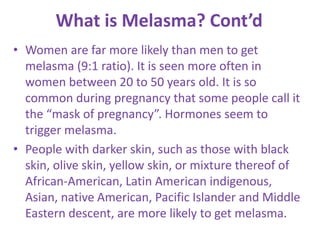
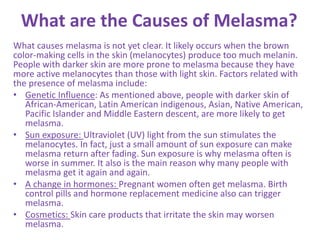
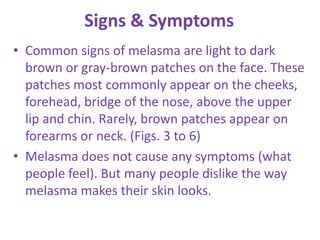
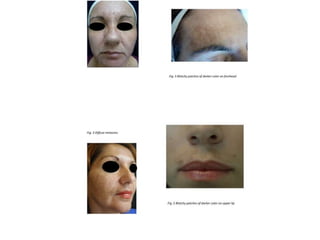
• Common signs of melasma are light to dark
brown or gray-brown patches on the face. These
patches most commonly appear on the cheeks,
forehead, bridge of the nose, above the upper
lip and chin. Rarely, brown patches appear on
forearms or neck. (Figs. 3 to 6)
• Melasma does not cause any symptoms (what
people feel). But many people dislike the way
melasma makes their skin looks.
Treatment
• Melasma can fade on its own. This often
happens when a trigger is causing the melasma,
such as a pregnancy or birth control pills. When
the woman delivers the baby or stops taking the
birth control pills, melsama can fade. Some
people, however, have melasma for years — or
even a lifetime.
• If the melasma continues a variety of
treatments is available, most of them should be
prescribed by a physician.
Treatment Cont’d
Photoprotection: A daily broad spectrum sunscreen with a sun
protection factor (SPF) of 30 or more should be used, along with other
sun-protective measures, such as sun avoidance and the use of protective
clothing (Wide brimmed hat, long sleeves and long pants)
Topical treatment:
• Non-prescription “bleaching” or brightening agents: There are a lot of
products on the market that contain bleaching agents derived from
plants such as arbutin, licorice extract, emblica, etc., claiming to be
depigmenting agents. Before using them a doctor should be
consulted.
• Hydroquinone: This medicine is a common first treatment for
melasma. It is applied to the skin and works by lightening the skin. It
could be used alone or in combination with other agents than
enhance its effect.
• Tretinoin and corticosteroids: To enhance skin lightening, a
dermatologist may prescribe a second medicine. This medicine may be
tretinoin or a corticosteroid. Sometimes a medicine contains 2 or 3
ingredients in 1 cream.
• Other topical (applied to the skin) medicines: Your dermatologist may
prescribe azelaic acid or kojic acid to help lighten melasma.
Treatment Cont’d
• Procedures: If a topical medicine does not get
rid of melasma, a procedure may succeed.
Procedures for melasma include chemical peels
(such as glycolic acid) microdermabrasion, and
certain type of lasers and lights. A dermatologist
should perform these procedures. New skin
problems can occur when the person who gives
the treatment does not tailor it to the patient’s
skin type.
Quality of Life with Melasma
• Melasma have a significant emotional and
psychological distress on affected patients. The
discoloration affects their self-esteem. It is also
considered in some Asian cultures a sign of “bad
luck”.
• Physicians must consider the devastating
psychosocial impact of pigmentary
imperfections in addition to pharmacological
and physical treatment.
Where to Get Help?
• http://www.askderm.com/
• http://www.askderm.com/skin-care
• http://www.askderm.com/skin-
care?skin_concern=273
• http://www.askderm.com/cellex-c-high-
potency-serum
• http://www.askderm.com/gly-derm-gly-mist
• http://www.askderm.com/dcl-profoundly-
effective-quot-a-quot

How to Treat Hyperpigmentation

  • 1.
  • 2.
    What is Hyperpigmentation? Hyperpigmentationis the change of skin color because the body produces too much of a pigment called melanin, which is responsible for the brown color of the skin, causing it to become darker than usual. Hyperpigmentation could be diffuse or circumscribed. Diffuse hyperpigmentation could be secondary to certain medications, metabolic and nutritional diseases and autoimmune disorders. Circumscribed hyperpigmentation may occur in a variety of conditions. • The most common disorders associated with this type of skin hyperpigmentation are: – Postinflammatory hyperpigmentation, secondary to trauma or inflammatory lesions – Melasma, a dark mask-like discoloration most often located on the face
  • 3.
    Post-inflammatory Hyperpigmentation Post inflammatoryhyperpigmentation (PIH) is an acquired increase of pigmentation occurring after cutaneous inflammation, such as infections, trauma and inflammatory skin diseases. This is because cells that normally produce melanin (melanocytes) evenly across your skin go into overdrive and produce too much melanin. If the excess melanin is produced in the upper layer of skin (epidermis), the pigmentation color is a darker shade of brown. If the excess melanin is produced in the lower layer of skin (the dermis), a gray or blue discoloration becomes visible. This condition can occur in all skin types, but most often affects people with darker skin as black, olive skin, yellow skin, or mixture thereof and is particularly common in African-American, Latin American indigenous, Asian, native American, Pacific Islander and Middle Eastern descent. • Causes: Many types of inflammatory skin conditions or cutaneous injuries can cause pigmentary changes; however, there are some diseases that show a proclivity to develop PIH rather than hypopigmentation.
  • 5.
    Signs & Symptoms •PIH typically manifests as spots or patches in the same distribution as the initial inflammatory process. The location of the excess pigment within the layers of the skin will determine its coloration. Epidermal, (superficial) increase of melanin will appear tan, brown, or dark brown and may take months to years to resolve without treatment. Hyperpigmentation within the dermis (deep) has a blue-gray appearance and may either be permanent or resolve over a prolonged period of time if left untreated. The intensity of PIH may also correlate with darker skin types. In addition, PIH can worsen with ultraviolet (UV) irradiation or with persistent or recurrent inflammation.
  • 6.
    Fig. 1 Postinflammatory hyperpigmentationafter acne Fig. 2 Postinflammatory hyperpigmentation after TCA Peel
  • 7.
    Treatment • The treatmentof PIH should begin first with addressing the underlying inflammatory skin condition. Initiating treatment early for PIH may help speed its resolution and prevent further darkening • Photoprotection: Photoprotection is one of the most important measures to prevent the worsening of PIH and to improve it. A daily broad spectrum sunscreen with a sun protection factor (SPF) of 30 or more should be used, along with other sun- protective measures, such as sun avoidance and the use of protective clothing (Wide brimmed hat, long sleeves and long pants)
  • 8.
    Treatment Cont’d • Topicaltreatment: Hydroquinone alone or in combination with other agents, helps in the reduction of pigmentation and must be prescribed by a physician. Other topical agents include: Tretinoin, tazarotene, Kojic acid, azelaic acid, arbutin, N-acetylglucosamine, among others. • Cosmetic procedures: Chemical peels with glycolic acid and salicylic acid may help, but should be performed by specifically trained professionals. Special attention should be taken in selecting and using the specific chemical peel to avoid irritation, which can worsen PIH and lead to other complications, such as new areas of discoloration, keloid formation, and hypertrophic scarring
  • 9.
    What is Melasma? •Melasma is a common acquired, symmetric skin problem characterized by light to dark brown macules and patches occurring in the sun- exposed areas of the face, particularly on cheeks, bridge of the nose, forehead, chin, and above the upper lip. It also can appear on other sun-exposed parts of the body, such as the forearms and neck. • One of the most important risk factors is sun exposure. Excessive solar radiation without protection triggers melasma.
  • 10.
    What is Melasma?Cont’d • Women are far more likely than men to get melasma (9:1 ratio). It is seen more often in women between 20 to 50 years old. It is so common during pregnancy that some people call it the “mask of pregnancy”. Hormones seem to trigger melasma. • People with darker skin, such as those with black skin, olive skin, yellow skin, or mixture thereof of African-American, Latin American indigenous, Asian, native American, Pacific Islander and Middle Eastern descent, are more likely to get melasma.
  • 11.
    What are theCauses of Melasma? What causes melasma is not yet clear. It likely occurs when the brown color-making cells in the skin (melanocytes) produce too much melanin. People with darker skin are more prone to melasma because they have more active melanocytes than those with light skin. Factors related with the presence of melasma include: • Genetic Influence: As mentioned above, people with darker skin of African-American, Latin American indigenous, Asian, Native American, Pacific Islander and Middle Eastern descent, are more likely to get melasma. • Sun exposure: Ultraviolet (UV) light from the sun stimulates the melanocytes. In fact, just a small amount of sun exposure can make melasma return after fading. Sun exposure is why melasma often is worse in summer. It also is the main reason why many people with melasma get it again and again. • A change in hormones: Pregnant women often get melasma. Birth control pills and hormone replacement medicine also can trigger melasma. • Cosmetics: Skin care products that irritate the skin may worsen melasma.
  • 12.
    Signs & Symptoms •Common signs of melasma are light to dark brown or gray-brown patches on the face. These patches most commonly appear on the cheeks, forehead, bridge of the nose, above the upper lip and chin. Rarely, brown patches appear on forearms or neck. (Figs. 3 to 6) • Melasma does not cause any symptoms (what people feel). But many people dislike the way melasma makes their skin looks.
  • 14.
    Treatment • Melasma canfade on its own. This often happens when a trigger is causing the melasma, such as a pregnancy or birth control pills. When the woman delivers the baby or stops taking the birth control pills, melsama can fade. Some people, however, have melasma for years — or even a lifetime. • If the melasma continues a variety of treatments is available, most of them should be prescribed by a physician.
  • 15.
    Treatment Cont’d Photoprotection: Adaily broad spectrum sunscreen with a sun protection factor (SPF) of 30 or more should be used, along with other sun-protective measures, such as sun avoidance and the use of protective clothing (Wide brimmed hat, long sleeves and long pants) Topical treatment: • Non-prescription “bleaching” or brightening agents: There are a lot of products on the market that contain bleaching agents derived from plants such as arbutin, licorice extract, emblica, etc., claiming to be depigmenting agents. Before using them a doctor should be consulted. • Hydroquinone: This medicine is a common first treatment for melasma. It is applied to the skin and works by lightening the skin. It could be used alone or in combination with other agents than enhance its effect. • Tretinoin and corticosteroids: To enhance skin lightening, a dermatologist may prescribe a second medicine. This medicine may be tretinoin or a corticosteroid. Sometimes a medicine contains 2 or 3 ingredients in 1 cream. • Other topical (applied to the skin) medicines: Your dermatologist may prescribe azelaic acid or kojic acid to help lighten melasma.
  • 16.
    Treatment Cont’d • Procedures:If a topical medicine does not get rid of melasma, a procedure may succeed. Procedures for melasma include chemical peels (such as glycolic acid) microdermabrasion, and certain type of lasers and lights. A dermatologist should perform these procedures. New skin problems can occur when the person who gives the treatment does not tailor it to the patient’s skin type.
  • 17.
    Quality of Lifewith Melasma • Melasma have a significant emotional and psychological distress on affected patients. The discoloration affects their self-esteem. It is also considered in some Asian cultures a sign of “bad luck”. • Physicians must consider the devastating psychosocial impact of pigmentary imperfections in addition to pharmacological and physical treatment.
  • 18.
    Where to GetHelp? • http://www.askderm.com/ • http://www.askderm.com/skin-care • http://www.askderm.com/skin- care?skin_concern=273 • http://www.askderm.com/cellex-c-high- potency-serum • http://www.askderm.com/gly-derm-gly-mist • http://www.askderm.com/dcl-profoundly- effective-quot-a-quot