HAIR COMBING PROPERTIES
Praful C. Somewar*, Roshan A. Shid
Subject Name – Cosmetic Science, B.Pharm Final Year
Guide Name – Chandrashekar M. Chakole
Bajiraoji Karanjekar College of Pharmacy, Sakoli, Dist.- Bhandara
M.S. – 441802
Rashtrasant Tukadoji Maharaj Nagpur University
CONTENT
 Introduction
 Factor influencing the friction
 Evaluation of Hair
 Scanning Electron Microscopy
 Atomic Force Microscopy
 Mechanical Methods
 Piezoelectric Sensors
 References
INTRODUCTION
 Combability is a term which describes the easy (or)
difficult methods for combing the hair.
 It is related to the forces which are opposite to the hair
combing action.
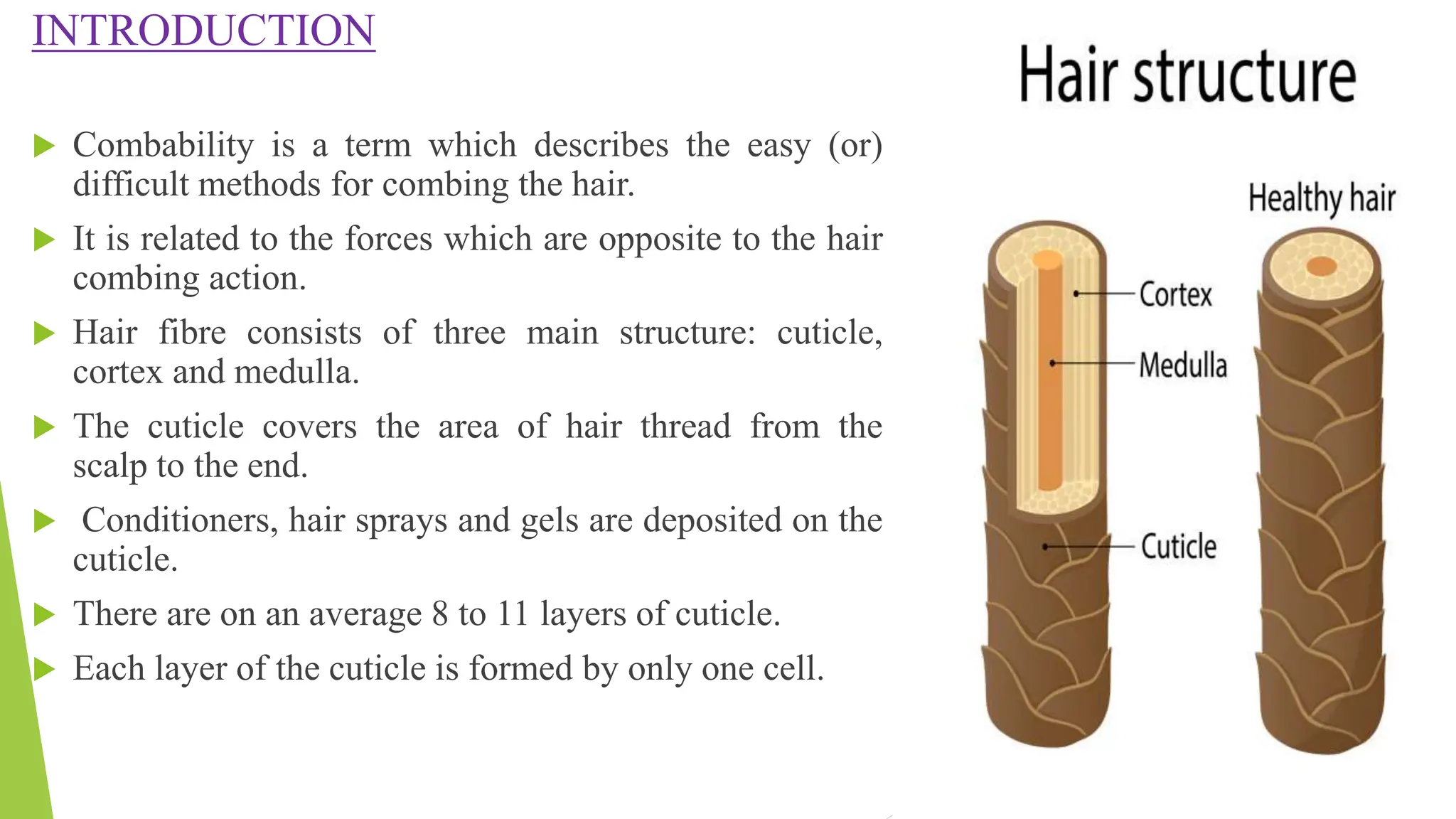
 Hair fibre consists of three main structure: cuticle,
cortex and medulla.
 The cuticle covers the area of hair thread from the
scalp to the end.
 Conditioners, hair sprays and gels are deposited on the
cuticle.
 There are on an average 8 to 11 layers of cuticle.
 Each layer of the cuticle is formed by only one cell.
Benefits of Regular Hair Combing
Promotes Blood
Circulation
• Regular combing
stimulates the scalp,
increasing blood
flow to the hair
follicles.
Enhances Hair
Growth
• It helps in the even
distribution of
natural oils,
contributing to
healthier hair
growth.
Improves Hair
Texture
• By distributing
natural oils,
combing helps to
improve hair texture
and reduce frizz.
Factors influencing the friction :
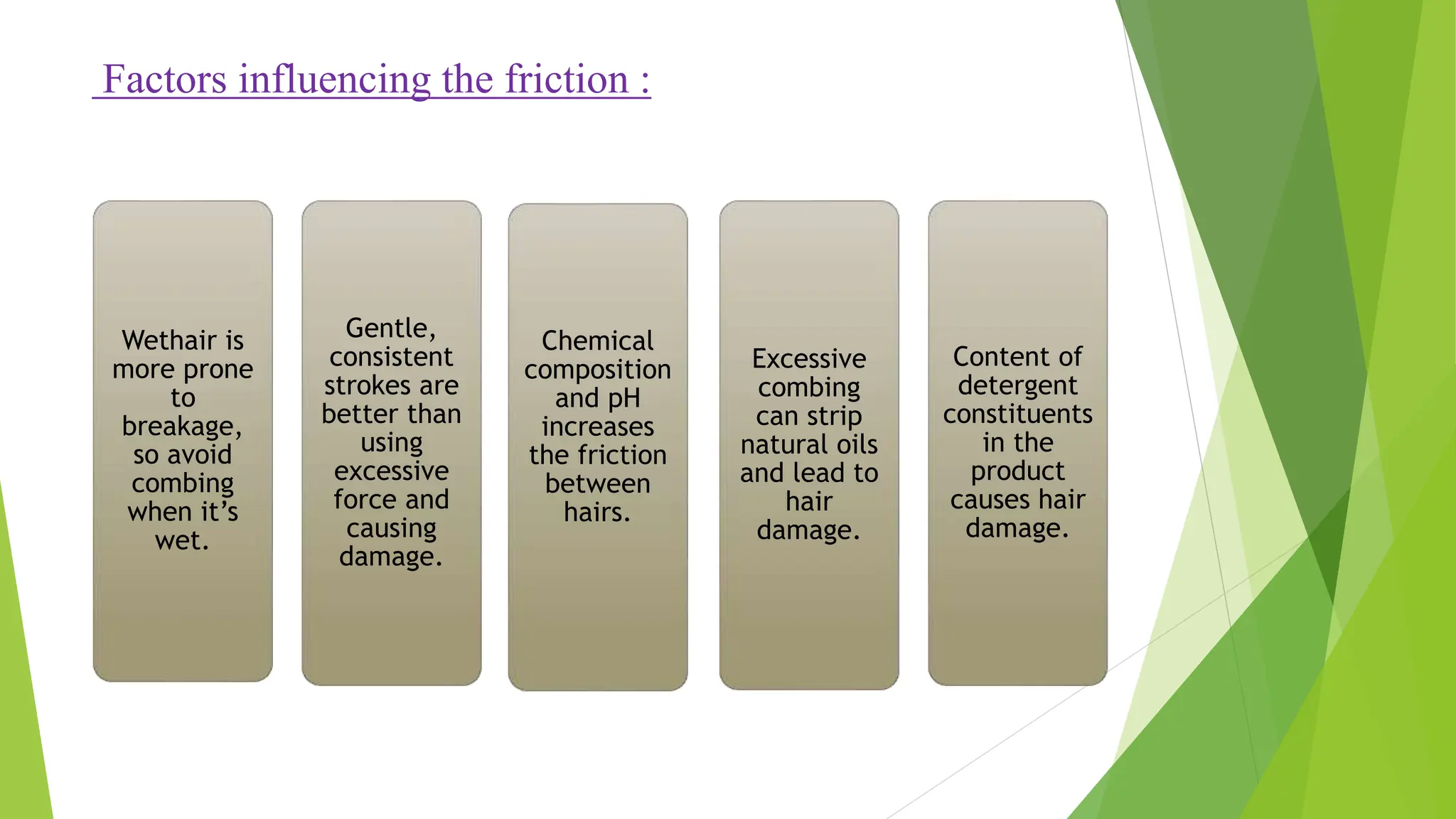
Wethair is
more prone
to
breakage,
so avoid
combing
when it’s
wet.
Gentle,
consistent
strokes are
better than
using
excessive
force and
causing
damage.
Chemical
composition
and pH
increases
the friction
between
hairs.
Excessive
combing
can strip
natural oils
and lead to
hair
damage.
Content of
detergent
constituents
in the
product
causes hair
damage.
Evaluation of Hair
The sensitivity of hair
can be detected by
various devices.
Specific area of hair is
pre-determined for the
analysis to get more
accurate result.
Methods for evaluating
hair products are listed
below:
• Scanning Electron Microscopy
(SEM)
• Atomic Force Microscopy (AFM)
• Mechanical Methods
• Piezoelectric Sensors
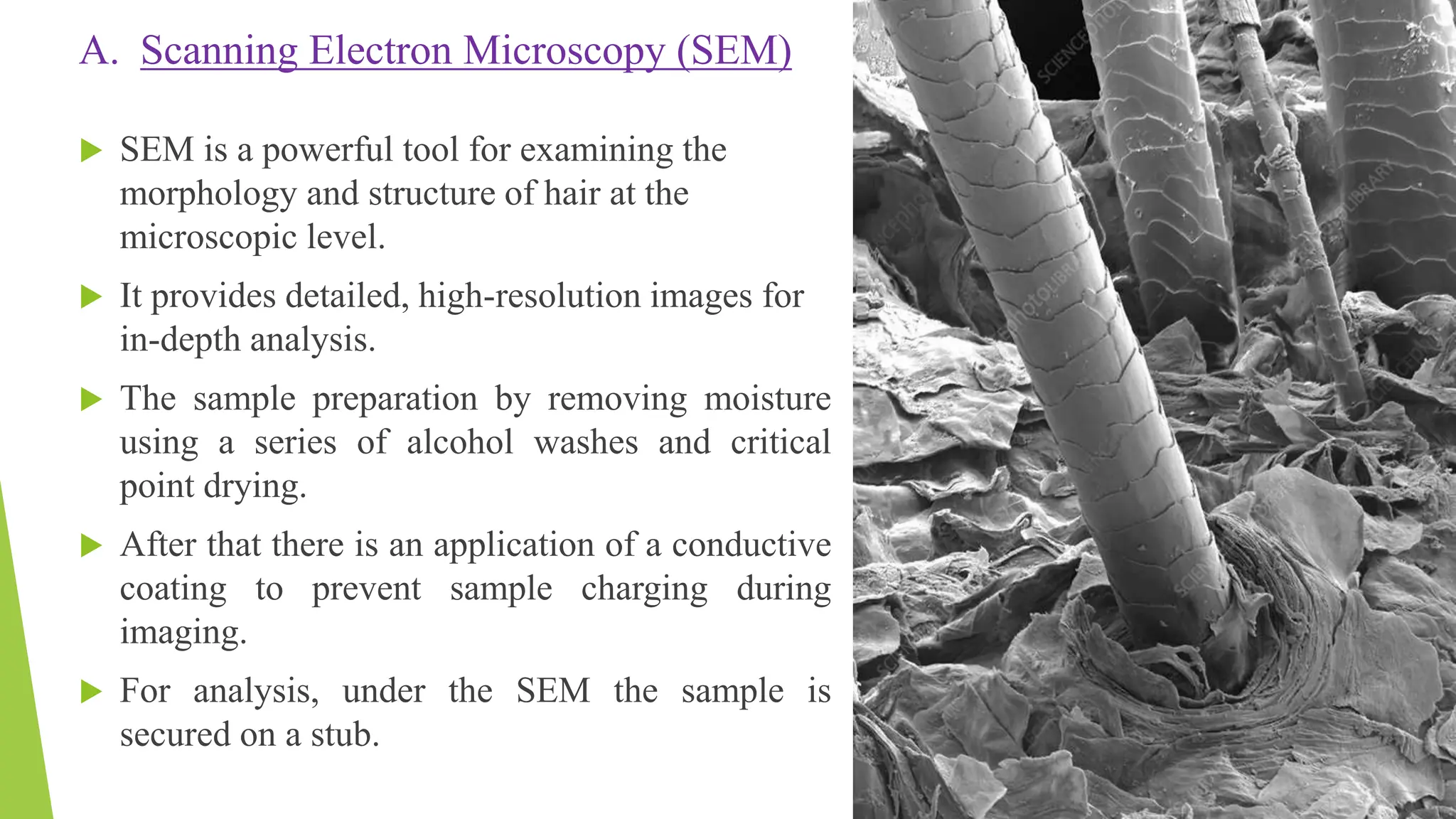
A. Scanning Electron Microscopy (SEM)
 SEM is a powerful tool for examining the
morphology and structure of hair at the
microscopic level.
 It provides detailed, high-resolution images for
in-depth analysis.
 The sample preparation by removing moisture
using a series of alcohol washes and critical
point drying.
 After that there is an application of a conductive
coating to prevent sample charging during
imaging.
 For analysis, under the SEM the sample is
secured on a stub.
B. Atomic Force Microscopy (AFM)
 AFM captures the topography and
morphology of individual hair strands,
revealing details at the nanoscale.
 The hair samples are thoroughly cleaned
and degreased to remove any surface
impurities.
 The prepared hair samples are delicately
mounted on AFM stages for precise
imaging.
 The hair samples must be dried before the
AFM imaging process to get precise
results.
C. Mechanical Assays
 Mechanical assays are essential for understanding the physical
properties of hair strands.
 These tests are used to measure strength, flexibility and other
characteristics along with durability.
 Types of mechanical assays for hairs:
1. Tensile testing
2. Bending testing
3. Compression testing
4. Shear testing
D. Piezoelectric Sensors
 Piezoelectric sensors are cutting edge devices that convert
mechanical energy into electrical signals.
 Piezoelectric sensors are utilized medical devices for real-time
imaging.
 It used to monitor scalp health and detect pressure points for
personalized hair-care solutions.
 It detects hair vibrations to evaluate hair strength, elasticity, and
damage for treatments.
References
 Singh, S.P., Nigam, V., Textbook of Cosmetic Science, 1st edition 2021, Thakur
Publication Pvt. Ltd.
 Pathak, K., Vaidya, A., A Textbook of Cosmetic Science – Concepts &
Principles, 1st edition 2018, Nirali Prakashan.
 Mithal, B.M., Shah, R.N., (2000), A Hand Book of Cosmetics, Dellhi : Delhi
Vallabh Prakashan.
THANK YOU

HAIR COMBING PROPERTIES AND IT'S EVALUATION

  • 1.
    HAIR COMBING PROPERTIES PrafulC. Somewar*, Roshan A. Shid Subject Name – Cosmetic Science, B.Pharm Final Year Guide Name – Chandrashekar M. Chakole Bajiraoji Karanjekar College of Pharmacy, Sakoli, Dist.- Bhandara M.S. – 441802 Rashtrasant Tukadoji Maharaj Nagpur University
  • 2.
    CONTENT  Introduction  Factorinfluencing the friction  Evaluation of Hair  Scanning Electron Microscopy  Atomic Force Microscopy  Mechanical Methods  Piezoelectric Sensors  References
  • 3.
    INTRODUCTION  Combability isa term which describes the easy (or) difficult methods for combing the hair.  It is related to the forces which are opposite to the hair combing action.  Hair fibre consists of three main structure: cuticle, cortex and medulla.  The cuticle covers the area of hair thread from the scalp to the end.  Conditioners, hair sprays and gels are deposited on the cuticle.  There are on an average 8 to 11 layers of cuticle.  Each layer of the cuticle is formed by only one cell.
  • 4.
    Benefits of RegularHair Combing Promotes Blood Circulation • Regular combing stimulates the scalp, increasing blood flow to the hair follicles. Enhances Hair Growth • It helps in the even distribution of natural oils, contributing to healthier hair growth. Improves Hair Texture • By distributing natural oils, combing helps to improve hair texture and reduce frizz.
  • 5.
    Factors influencing thefriction : Wethair is more prone to breakage, so avoid combing when it’s wet. Gentle, consistent strokes are better than using excessive force and causing damage. Chemical composition and pH increases the friction between hairs. Excessive combing can strip natural oils and lead to hair damage. Content of detergent constituents in the product causes hair damage.
  • 6.
    Evaluation of Hair Thesensitivity of hair can be detected by various devices. Specific area of hair is pre-determined for the analysis to get more accurate result. Methods for evaluating hair products are listed below: • Scanning Electron Microscopy (SEM) • Atomic Force Microscopy (AFM) • Mechanical Methods • Piezoelectric Sensors
  • 7.
    A. Scanning ElectronMicroscopy (SEM)  SEM is a powerful tool for examining the morphology and structure of hair at the microscopic level.  It provides detailed, high-resolution images for in-depth analysis.  The sample preparation by removing moisture using a series of alcohol washes and critical point drying.  After that there is an application of a conductive coating to prevent sample charging during imaging.  For analysis, under the SEM the sample is secured on a stub.
  • 8.
    B. Atomic ForceMicroscopy (AFM)  AFM captures the topography and morphology of individual hair strands, revealing details at the nanoscale.  The hair samples are thoroughly cleaned and degreased to remove any surface impurities.  The prepared hair samples are delicately mounted on AFM stages for precise imaging.  The hair samples must be dried before the AFM imaging process to get precise results.
  • 9.
    C. Mechanical Assays Mechanical assays are essential for understanding the physical properties of hair strands.  These tests are used to measure strength, flexibility and other characteristics along with durability.  Types of mechanical assays for hairs: 1. Tensile testing 2. Bending testing 3. Compression testing 4. Shear testing
  • 10.
    D. Piezoelectric Sensors Piezoelectric sensors are cutting edge devices that convert mechanical energy into electrical signals.  Piezoelectric sensors are utilized medical devices for real-time imaging.  It used to monitor scalp health and detect pressure points for personalized hair-care solutions.  It detects hair vibrations to evaluate hair strength, elasticity, and damage for treatments.
  • 11.
    References  Singh, S.P.,Nigam, V., Textbook of Cosmetic Science, 1st edition 2021, Thakur Publication Pvt. Ltd.  Pathak, K., Vaidya, A., A Textbook of Cosmetic Science – Concepts & Principles, 1st edition 2018, Nirali Prakashan.  Mithal, B.M., Shah, R.N., (2000), A Hand Book of Cosmetics, Dellhi : Delhi Vallabh Prakashan.
  • 12.