

ABDALLAH SABRY EL GAMEEL
HOUSE OFFICER
ALEXANDRIA MAIN UNIVERSITY HOSPITAL
Definition
 Shock : it’s a problem that occurs at the cellular level caused by decrease tissue perfusion.
 Hypovolemic shock yradnoces netfo emulov yrotalucric esaerced morf stluser kcohs : to
haemorrhage .
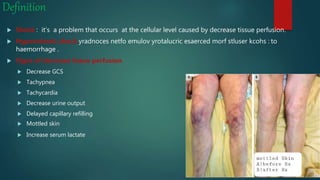
 Signs of decrease tissue perfusion
 Decrease GCS
 Tachypnea
 Tachycardia
 Decrease urine output
 Delayed capillary refilling
 Mottled skin
 Increase serum lactate
Causes
 Haemorrhage
 Trauma ( external/internal ) e.g. Scalp lacerations & pelvic fracture .
 Rupture AAA / ectopic pregnancy
 Git bleeding
 Salt and water loss
 Diarrhoea
 Vomiting
 Polyurea ( DI / DM )
 Burns
 Heat
 3rd space loss
 Ascites
 Acute pancreatitis
 Intestinal obstructions
 Inadequate fluid intake g.e. Starvation
Symptoms
 Symptoms of underlying disease
• Trauma to chest & limb & abdomen
• Pain in chest & abdomen & back
• Melena & haematemesis
• Diarrhoea & Urinary frequency
• Epigastric pain radiating to the back
• Abdominal swelling / bloating
 Dizziness on standing ( +/- lying )
 Shortening of breathing
 Chest pain
Signs
 Vitals
 Blood pressure : < 100 mmHg or a drop of > 40 mmHg from the baseline.
 Heart rate : >100 /min. Weak, thready
 Respiratory rate: increase
 Extrimities
 Cool / pale / mottled periperies
 Delayed capillary refilling > 2 sec.
 Decrease JVP
 CNS
 Decrease GCS / restlessness / confusion.
 Renal function
 Oligourea (< 0.5 ml/kg/hr ) OR acute increase in serum creatinine.
 Global
 Increase lactate ( in absence of hypoxaemia )
Signs
 Sign of underlying disease
 Obivious source of bleeding ( wounds & GIT bleeding)
 Internal source of bleeding ( haemothorax & ascites & tense abdomen & Pelvic instability & Swollen
 Burns
 Palpable AAA
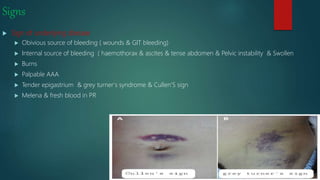
 Tender epigastrium & grey turner’s syndrome & Cullen’S sign
 Melena & fresh blood in PR
Note to Know
 Tachycardia be absent in pt on rate- limiting medications e.g.
( beta blockers & CCB)
 Absolute values of HR and BP are less informative than
monitoring of trends over time. Some patients may maintain
BP within normal limits despite organ dysfunction, but
consider local pathology if there is single organ dysfunction,
e.g. oliguria, without clear evidence of haemodynamic
compromise.
Warning signs
 Blood pressure < 90 mmHg
 Decrease GCS& restlessness
 Oligourea
 Mottled skin not respond to IV fluids
 Ongoing bleeding
Work up
 Full blood count …. (decrease Hb BUT mey be normal in early acute blood loss )
 Urea …… ( increase in GIT bleeding )
 Electrolytes …… ( K decrease in diarrhea &vomiting )
 LFT & Amylase
 Clotting & osmolality & X-match (consider O –ve and types specific blood while awaiting match )
 ABG …….. ( Acidosis in DKA & haemorrhage & pancreatitis )(Alkalosis in vomiting )
 ECG ….. Ischaemia
 X- ray ... ( Haemothorax & pelvic fracture)
 U/S Abdomen ….. ( AAA & free intra-abdominal fluid )
 Urine analysis …. (Na and osmolality in diabetes insipidus )
 Stool analysis …… microscopic / C&S ( Ova & cysts & parasite )
Note to Know
 Treat all hypotensive patients, especially if HR >100 or <50.
 A BP of 100mmHg systolic may be critically low if the patient is normally hypertensive (eg elderly);
use HR and other clinical markers as a guide.
 Always consider giving a fluid challenge early, particularly if you remain unclear on the type of shock
you are faced with.
 In the absence of florid evidence of failure, you are unlikely to push any adult into gross cardiac
failure with e.g. 500mL 0.9% saline IV, which should help with circulatory support while you assess
and plan further.
treatment
 Lay pt flat and elevated legs
 Oxygen 15 L/ min.
 IV access ( 2 large bore cannula and take sample for investigation )
 1 litre saline 0.9 %
 Attempt to stop bleeding by compression if there external bleeding .
 Consider another 1 litre saline 0.9 % If no increase in Bp or decrease in HR
 Consider early blood transfusion as excessive fluid cause haemodilution of the clotting factors
 Treatment of the cause
 Document blood and fluid carefully
Note to Know
 Permissive hypotension Is empolyed in the early phase of haemorrhagic shock so
don’t Push systolic pressure above 100 mmHg.
 Permissive hypotension lamron woleb erusserp doolb fo gniniatniam snaem :
sa dewolla si stneitap citamuart ni noitaticsuser gnirud Aggressive fluid
resuscitation in trauma promotes deleterious effects such as clot disruption,
dilutional coagulopathy and hypothermia.
Hypovolemic Shock

Hypovolemic Shock

  • 1.
    ABDALLAH SABRY ELGAMEEL HOUSE OFFICER ALEXANDRIA MAIN UNIVERSITY HOSPITAL
  • 2.
    Definition  Shock :it’s a problem that occurs at the cellular level caused by decrease tissue perfusion.  Hypovolemic shock yradnoces netfo emulov yrotalucric esaerced morf stluser kcohs : to haemorrhage .  Signs of decrease tissue perfusion  Decrease GCS  Tachypnea  Tachycardia  Decrease urine output  Delayed capillary refilling  Mottled skin  Increase serum lactate
  • 3.
    Causes  Haemorrhage  Trauma( external/internal ) e.g. Scalp lacerations & pelvic fracture .  Rupture AAA / ectopic pregnancy  Git bleeding  Salt and water loss  Diarrhoea  Vomiting  Polyurea ( DI / DM )  Burns  Heat  3rd space loss  Ascites  Acute pancreatitis  Intestinal obstructions  Inadequate fluid intake g.e. Starvation
  • 4.
    Symptoms  Symptoms ofunderlying disease • Trauma to chest & limb & abdomen • Pain in chest & abdomen & back • Melena & haematemesis • Diarrhoea & Urinary frequency • Epigastric pain radiating to the back • Abdominal swelling / bloating  Dizziness on standing ( +/- lying )  Shortening of breathing  Chest pain
  • 5.
    Signs  Vitals  Bloodpressure : < 100 mmHg or a drop of > 40 mmHg from the baseline.  Heart rate : >100 /min. Weak, thready  Respiratory rate: increase  Extrimities  Cool / pale / mottled periperies  Delayed capillary refilling > 2 sec.  Decrease JVP  CNS  Decrease GCS / restlessness / confusion.  Renal function  Oligourea (< 0.5 ml/kg/hr ) OR acute increase in serum creatinine.  Global  Increase lactate ( in absence of hypoxaemia )
  • 6.
    Signs  Sign ofunderlying disease  Obivious source of bleeding ( wounds & GIT bleeding)  Internal source of bleeding ( haemothorax & ascites & tense abdomen & Pelvic instability & Swollen  Burns  Palpable AAA  Tender epigastrium & grey turner’s syndrome & Cullen’S sign  Melena & fresh blood in PR
  • 7.
    Note to Know Tachycardia be absent in pt on rate- limiting medications e.g. ( beta blockers & CCB)  Absolute values of HR and BP are less informative than monitoring of trends over time. Some patients may maintain BP within normal limits despite organ dysfunction, but consider local pathology if there is single organ dysfunction, e.g. oliguria, without clear evidence of haemodynamic compromise.
  • 8.
    Warning signs  Bloodpressure < 90 mmHg  Decrease GCS& restlessness  Oligourea  Mottled skin not respond to IV fluids  Ongoing bleeding
  • 9.
    Work up  Fullblood count …. (decrease Hb BUT mey be normal in early acute blood loss )  Urea …… ( increase in GIT bleeding )  Electrolytes …… ( K decrease in diarrhea &vomiting )  LFT & Amylase  Clotting & osmolality & X-match (consider O –ve and types specific blood while awaiting match )  ABG …….. ( Acidosis in DKA & haemorrhage & pancreatitis )(Alkalosis in vomiting )  ECG ….. Ischaemia  X- ray ... ( Haemothorax & pelvic fracture)  U/S Abdomen ….. ( AAA & free intra-abdominal fluid )  Urine analysis …. (Na and osmolality in diabetes insipidus )  Stool analysis …… microscopic / C&S ( Ova & cysts & parasite )
  • 10.
    Note to Know Treat all hypotensive patients, especially if HR >100 or <50.  A BP of 100mmHg systolic may be critically low if the patient is normally hypertensive (eg elderly); use HR and other clinical markers as a guide.  Always consider giving a fluid challenge early, particularly if you remain unclear on the type of shock you are faced with.  In the absence of florid evidence of failure, you are unlikely to push any adult into gross cardiac failure with e.g. 500mL 0.9% saline IV, which should help with circulatory support while you assess and plan further.
  • 11.
    treatment  Lay ptflat and elevated legs  Oxygen 15 L/ min.  IV access ( 2 large bore cannula and take sample for investigation )  1 litre saline 0.9 %  Attempt to stop bleeding by compression if there external bleeding .  Consider another 1 litre saline 0.9 % If no increase in Bp or decrease in HR  Consider early blood transfusion as excessive fluid cause haemodilution of the clotting factors  Treatment of the cause  Document blood and fluid carefully
  • 12.
    Note to Know Permissive hypotension Is empolyed in the early phase of haemorrhagic shock so don’t Push systolic pressure above 100 mmHg.  Permissive hypotension lamron woleb erusserp doolb fo gniniatniam snaem : sa dewolla si stneitap citamuart ni noitaticsuser gnirud Aggressive fluid resuscitation in trauma promotes deleterious effects such as clot disruption, dilutional coagulopathy and hypothermia.