Parasites
Presented by Zainab Haidar
Under the supervision of Dr.
Habib Wasil Kazim
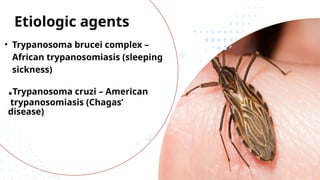
• Trypanosoma brucei complex –
African trypanosomiasis (sleeping
sickness)
.Trypanosoma cruzi – American
trypanosomiasis (Chagas’
disease)
Etiologic agents
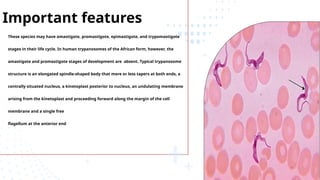
These species may have amastigote, promastigote, epimastigote, and trypomastigote
stages in their life cycle. In human trypanosomes of the African form, however, the
amastigote and promastigote stages of development are absent. Typical trypanosome
structure is an elongated spindle-shaped body that more or less tapers at both ends, a
centrally situated nucleus, a kinetoplast posterior to nucleus, an undulating membrane
arising from the kinetoplast and proceeding forward along the margin of the cell
membrane and a single free
flagellum at the anterior end
Important features
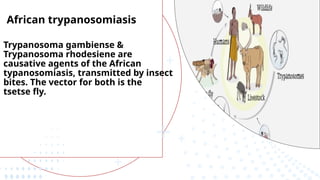
African trypanosomiasis
Trypanosoma gambiense &
Trypanosoma rhodesiene are
causative agents of the African
typanosomiasis, transmitted by insect
bites. The vector for both is the
tsetse fly.
Pathogenesis
The trypomastigotes spread from the skin
through the blood to the lymph node and the
brain. The typical somnolence (sleeping
sickness) usually progresses to coma as a
result of demyelinating encephalitis. In acute
form, cyclical fever spike (approximately every
2 weeks) occurs that is related to antigenic
variation. As antibody mediated agglutination
and lysis of the trypomastigotes occurs, the
fever subsides. With a few remains of
antigenic variants new fever spike occurs and
the cycle repeats itself over a long period.
Epidemiology
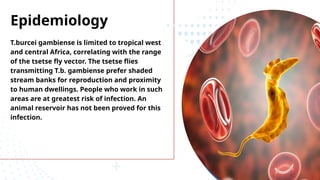
T.burcei gambiense is limited to tropical west
and central Africa, correlating with the range
of the tsetse fly vector. The tsetse flies
transmitting T.b. gambiense prefer shaded
stream banks for reproduction and proximity
to human dwellings. People who work in such
areas are at greatest risk of infection. An
animal reservoir has not been proved for this
infection.
Clinical features
Although both species cause sleeping sickness, the
progress of the disease is different. T.gambiense
induced disease runs a low-grade chronic course over
a few years. One of the earliest signs of disease is an
occasional ulcer at the site of the fly bite. As
reproduction of organisms continues, the lymph
nodes are invaded, and fever, myalgia, arthralgia, and
lymph node enlargement results. Swelling of
the posterior cervical lymph nodes is characteristic of
Gambian sleeping sickness and is called
winterbottom’s sign.
Chronic disease progresses to CNS
involvement with lethargy, tremors,
meningoencephalitis, mental
retardation, and general deterioration.
In the final stages, convulsions,
hemiplegia, and incontinence occur.
The patient becomes difficult to arouse
or obtain a response from, eventually
progressing to a comatose state. Death
is the result of CNS damage and other
infections, such as pneumonia.
In T.rhodesiense, the disease caused is a
more acute, rapidly progressive disease that
is usually fatal. This more virulent organism
also develops in greater numbers in the
blood. Lymphadenopathy is uncommon, and
early in the infection, CNS invasion occurs,
resulting in lethargy, anorexia, and mental
disturbance. The chronic stages described
for T.gambiense are not often seen, because
in addition to rapid CNS disease, the
organism produces kidney damage &
myocarditis, leading to death.
Immunity
Both the humoral and cellular immunity
involve in these infections. The immune
responses of the host to the presence of
these parasites, however, is faced with
antigenic variation, in which organisms
that have changed their antigenic identity
can escape the host immune response and
initiate another disease process with
increased level of parasitemia.
Examination of thin and thick films, in
concentrated anticoagulated blood
preparations, and in aspiration from lymph
nodes and concentrated spinal fluid.
Methods for concentrating parasites in blood
may be helpful approaches including
centrifugation of heparinized samples and an
ion–exchange chromatography.
Levels of parasitosis vary widely, and several
attempts to visualize the organism over a
number of days may be necessary.
Laboratory
Treatment
The same treatment protocol is applied for
these parasites. For the acute stages of
the disease the drug of choice is suramin
with pentamidine as an alternative. In
chronic disease with CNS involvement, the
drug of choice is melarsoprol. Alternatives
include trypars amide combined with
suramin.
•Control of breeding sites of tsetse flies and use
of insecticides.
•Treatment of human cases to reduce
transmission to flies.
•Avoiding insect bite by wearing protective
clothing & use of screen, bed netting and insect
repellants.
Prevention
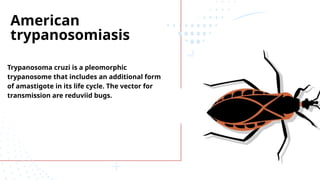
American
trypanosomiasis
Trypanosoma cruzi is a pleomorphic
trypanosome that includes an additional form
of amastigote in its life cycle. The vector for
transmission are reduviid bugs.
During the acute phase, the organism occurs in
blood as a typical trypomastigote and in the
reticuloendothelial cells as a typical amastigote.
The amastigotes can kill cells and cause
inflammation, consisting mainly of
mononuclear cells. Cardiac muscle is the most
frequently and severely affected tissue. In
addition, neuronal damage leads to cardiac
arrhythmias and loss of tone in the colon
(megacolon) and esophagus (megaesophagus).
In the chronic phase, the organism persists in
the amastigote form.
Pathogenesis
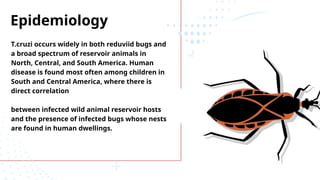
Epidemiology
T.cruzi occurs widely in both reduviid bugs and
a broad spectrum of reservoir animals in
North, Central, and South America. Human
disease is found most often among children in
South and Central America, where there is
direct correlation
between infected wild animal reservoir hosts
and the presence of infected bugs whose nests
are found in human dwellings.
Clinical features
Chagas’ disease may be asymptomatic acute or chronic disease. One of the
earliest signs is development at the site of the bug bite of an erythematous and
indurated area called a chagoma. This is often followed by a rash and edema
around the eyes and face; in young children frequently an acute process with
CNS involvement may occur. Acute infection is also characterized by fever, chills,
malaise, myalgia, and fatigue. The chronic Chagas’ disease is characterized by
hepatosplenomegaly, myocarditis, and enlargement of the esophagus and colon
as a result of the destruction of nerve cells (E.g. Auerbach’s plexus) and other
tissues that control the growth of these organs. Involvement of the CNS may
produce granulomas in the brain with cyst formation and a meningoencephalitis.
Death from chronic Chagas’ disease results from tissue destruction in the many
areas invaded by the organisms, and sudden death results from complete heart
block and brain damage.
Examine thin or thick stained preparations for
trypomastigotes. Wet preparations should also
be examined to look for motile organisms that
leave the blood stream and become difficult to
find. Biopsy of lymph nodes, liver, spleen, or
bone marrow may demonstrate organisms in
amastigote stage. Xenodiagnosis - which
consists of allowing an uninfected, laboratory-
raised reduviid bug to feed on the patient and,
after several weeks, examining the intestinal
contents of the bug for the organism.
Laboratory diagnosis
Immunity
Unlike African trypanosomiasis, the antigenic
variation is less common in T.cruzi
infection. Therefore, the humoral and cellular
immune responses function in the immune
system.
Treatment
The drug of choice is nifurtimox.
Alternative agents include allopurinol &
benzimidazole.
.Bug control, eradication of nests
•Treating infected person & exclusion of
donors by screening blood.
•Development of vaccine.
Prevention
MEDICALLY
IMPORTANT CILIATES
Balantidiasis
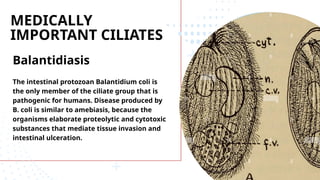
The intestinal protozoan Balantidium coli is
the only member of the ciliate group that is
pathogenic for humans. Disease produced by
B. coli is similar to amebiasis, because the
organisms elaborate proteolytic and cytotoxic
substances that mediate tissue invasion and
intestinal ulceration.
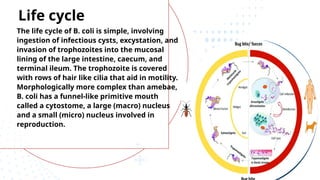
The life cycle of B. coli is simple, involving
ingestion of infectious cysts, excystation, and
invasion of trophozoites into the mucosal
lining of the large intestine, caecum, and
terminal ileum. The trophozoite is covered
with rows of hair like cilia that aid in motility.
Morphologically more complex than amebae,
B. coli has a funnel-like primitive mouth
called a cytostome, a large (macro) nucleus
and a small (micro) nucleus involved in
reproduction.
Life cycle
Epidemiology
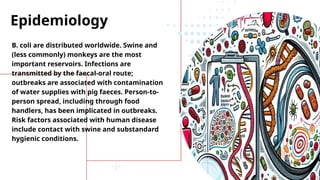
B. coli are distributed worldwide. Swine and
(less commonly) monkeys are the most
important reservoirs. Infections are
transmitted by the faecal-oral route;
outbreaks are associated with contamination
of water supplies with pig faeces. Person-to-
person spread, including through food
handlers, has been implicated in outbreaks.
Risk factors associated with human disease
include contact with swine and substandard
hygienic conditions.
As with other protozoan parasites,
asymptomatic carriage of B. coli can exist.
Symptomatic disease is characterized by
abdominal pain, tenderness, tenesmus,
nausea, anorexia, and watery stools with
blood and pus. Ulceration of the intestinal
mucosa, as with amebiasis, can be seen; a
secondary complication caused by bacterial
invasion into the eroded intestinal mucosa
can occur. Extra intestinal invasion of
organs is extremely rare in balantidiasis.
Clinical features
Laboratory Diagnosis
Microscopic examination of faeces for
trophozoite and cysts is performed. The
trophozoite is very large, varying in length
from 50 to 200μm and in width from 40
to 70μm. The surface is covered with cilia
The drug of choice is tetracycline;
iodoquinol and metronidazole are
alternative agents.
Treatment

Trypanosoma brucei complex – African trypanosomiasis (sleeping sickness

  • 1.
    Parasites Presented by ZainabHaidar Under the supervision of Dr. Habib Wasil Kazim
  • 2.
    • Trypanosoma bruceicomplex – African trypanosomiasis (sleeping sickness) .Trypanosoma cruzi – American trypanosomiasis (Chagas’ disease) Etiologic agents
  • 3.
    These species mayhave amastigote, promastigote, epimastigote, and trypomastigote stages in their life cycle. In human trypanosomes of the African form, however, the amastigote and promastigote stages of development are absent. Typical trypanosome structure is an elongated spindle-shaped body that more or less tapers at both ends, a centrally situated nucleus, a kinetoplast posterior to nucleus, an undulating membrane arising from the kinetoplast and proceeding forward along the margin of the cell membrane and a single free flagellum at the anterior end Important features
  • 4.
    African trypanosomiasis Trypanosoma gambiense& Trypanosoma rhodesiene are causative agents of the African typanosomiasis, transmitted by insect bites. The vector for both is the tsetse fly.
  • 5.
    Pathogenesis The trypomastigotes spreadfrom the skin through the blood to the lymph node and the brain. The typical somnolence (sleeping sickness) usually progresses to coma as a result of demyelinating encephalitis. In acute form, cyclical fever spike (approximately every 2 weeks) occurs that is related to antigenic variation. As antibody mediated agglutination and lysis of the trypomastigotes occurs, the fever subsides. With a few remains of antigenic variants new fever spike occurs and the cycle repeats itself over a long period.
  • 6.
    Epidemiology T.burcei gambiense islimited to tropical west and central Africa, correlating with the range of the tsetse fly vector. The tsetse flies transmitting T.b. gambiense prefer shaded stream banks for reproduction and proximity to human dwellings. People who work in such areas are at greatest risk of infection. An animal reservoir has not been proved for this infection.
  • 7.
    Clinical features Although bothspecies cause sleeping sickness, the progress of the disease is different. T.gambiense induced disease runs a low-grade chronic course over a few years. One of the earliest signs of disease is an occasional ulcer at the site of the fly bite. As reproduction of organisms continues, the lymph nodes are invaded, and fever, myalgia, arthralgia, and lymph node enlargement results. Swelling of the posterior cervical lymph nodes is characteristic of Gambian sleeping sickness and is called winterbottom’s sign.
  • 8.
    Chronic disease progressesto CNS involvement with lethargy, tremors, meningoencephalitis, mental retardation, and general deterioration. In the final stages, convulsions, hemiplegia, and incontinence occur. The patient becomes difficult to arouse or obtain a response from, eventually progressing to a comatose state. Death is the result of CNS damage and other infections, such as pneumonia.
  • 9.
    In T.rhodesiense, thedisease caused is a more acute, rapidly progressive disease that is usually fatal. This more virulent organism also develops in greater numbers in the blood. Lymphadenopathy is uncommon, and early in the infection, CNS invasion occurs, resulting in lethargy, anorexia, and mental disturbance. The chronic stages described for T.gambiense are not often seen, because in addition to rapid CNS disease, the organism produces kidney damage & myocarditis, leading to death.
  • 10.
    Immunity Both the humoraland cellular immunity involve in these infections. The immune responses of the host to the presence of these parasites, however, is faced with antigenic variation, in which organisms that have changed their antigenic identity can escape the host immune response and initiate another disease process with increased level of parasitemia.
  • 11.
    Examination of thinand thick films, in concentrated anticoagulated blood preparations, and in aspiration from lymph nodes and concentrated spinal fluid. Methods for concentrating parasites in blood may be helpful approaches including centrifugation of heparinized samples and an ion–exchange chromatography. Levels of parasitosis vary widely, and several attempts to visualize the organism over a number of days may be necessary. Laboratory
  • 12.
    Treatment The same treatmentprotocol is applied for these parasites. For the acute stages of the disease the drug of choice is suramin with pentamidine as an alternative. In chronic disease with CNS involvement, the drug of choice is melarsoprol. Alternatives include trypars amide combined with suramin.
  • 13.
    •Control of breedingsites of tsetse flies and use of insecticides. •Treatment of human cases to reduce transmission to flies. •Avoiding insect bite by wearing protective clothing & use of screen, bed netting and insect repellants. Prevention
  • 14.
    American trypanosomiasis Trypanosoma cruzi isa pleomorphic trypanosome that includes an additional form of amastigote in its life cycle. The vector for transmission are reduviid bugs.
  • 15.
    During the acutephase, the organism occurs in blood as a typical trypomastigote and in the reticuloendothelial cells as a typical amastigote. The amastigotes can kill cells and cause inflammation, consisting mainly of mononuclear cells. Cardiac muscle is the most frequently and severely affected tissue. In addition, neuronal damage leads to cardiac arrhythmias and loss of tone in the colon (megacolon) and esophagus (megaesophagus). In the chronic phase, the organism persists in the amastigote form. Pathogenesis
  • 16.
    Epidemiology T.cruzi occurs widelyin both reduviid bugs and a broad spectrum of reservoir animals in North, Central, and South America. Human disease is found most often among children in South and Central America, where there is direct correlation between infected wild animal reservoir hosts and the presence of infected bugs whose nests are found in human dwellings.
  • 17.
    Clinical features Chagas’ diseasemay be asymptomatic acute or chronic disease. One of the earliest signs is development at the site of the bug bite of an erythematous and indurated area called a chagoma. This is often followed by a rash and edema around the eyes and face; in young children frequently an acute process with CNS involvement may occur. Acute infection is also characterized by fever, chills, malaise, myalgia, and fatigue. The chronic Chagas’ disease is characterized by hepatosplenomegaly, myocarditis, and enlargement of the esophagus and colon as a result of the destruction of nerve cells (E.g. Auerbach’s plexus) and other tissues that control the growth of these organs. Involvement of the CNS may produce granulomas in the brain with cyst formation and a meningoencephalitis. Death from chronic Chagas’ disease results from tissue destruction in the many areas invaded by the organisms, and sudden death results from complete heart block and brain damage.
  • 18.
    Examine thin orthick stained preparations for trypomastigotes. Wet preparations should also be examined to look for motile organisms that leave the blood stream and become difficult to find. Biopsy of lymph nodes, liver, spleen, or bone marrow may demonstrate organisms in amastigote stage. Xenodiagnosis - which consists of allowing an uninfected, laboratory- raised reduviid bug to feed on the patient and, after several weeks, examining the intestinal contents of the bug for the organism. Laboratory diagnosis
  • 19.
    Immunity Unlike African trypanosomiasis,the antigenic variation is less common in T.cruzi infection. Therefore, the humoral and cellular immune responses function in the immune system.
  • 20.
    Treatment The drug ofchoice is nifurtimox. Alternative agents include allopurinol & benzimidazole.
  • 21.
    .Bug control, eradicationof nests •Treating infected person & exclusion of donors by screening blood. •Development of vaccine. Prevention
  • 22.
    MEDICALLY IMPORTANT CILIATES Balantidiasis The intestinalprotozoan Balantidium coli is the only member of the ciliate group that is pathogenic for humans. Disease produced by B. coli is similar to amebiasis, because the organisms elaborate proteolytic and cytotoxic substances that mediate tissue invasion and intestinal ulceration.
  • 23.
    The life cycleof B. coli is simple, involving ingestion of infectious cysts, excystation, and invasion of trophozoites into the mucosal lining of the large intestine, caecum, and terminal ileum. The trophozoite is covered with rows of hair like cilia that aid in motility. Morphologically more complex than amebae, B. coli has a funnel-like primitive mouth called a cytostome, a large (macro) nucleus and a small (micro) nucleus involved in reproduction. Life cycle
  • 24.
    Epidemiology B. coli aredistributed worldwide. Swine and (less commonly) monkeys are the most important reservoirs. Infections are transmitted by the faecal-oral route; outbreaks are associated with contamination of water supplies with pig faeces. Person-to- person spread, including through food handlers, has been implicated in outbreaks. Risk factors associated with human disease include contact with swine and substandard hygienic conditions.
  • 25.
    As with otherprotozoan parasites, asymptomatic carriage of B. coli can exist. Symptomatic disease is characterized by abdominal pain, tenderness, tenesmus, nausea, anorexia, and watery stools with blood and pus. Ulceration of the intestinal mucosa, as with amebiasis, can be seen; a secondary complication caused by bacterial invasion into the eroded intestinal mucosa can occur. Extra intestinal invasion of organs is extremely rare in balantidiasis. Clinical features
  • 26.
    Laboratory Diagnosis Microscopic examinationof faeces for trophozoite and cysts is performed. The trophozoite is very large, varying in length from 50 to 200μm and in width from 40 to 70μm. The surface is covered with cilia
  • 27.
    The drug ofchoice is tetracycline; iodoquinol and metronidazole are alternative agents. Treatment