Leishmaniasis
Leishmania donovani (complex) (VL)
Leishmania tropica (CL)
Leishmania major (CL)
Leishmania aethiopica (CL)
Leishmania mexicana (Complex) (CL)
Leishmania brazilliensis (complex) (MCL)
Leishmania peruriana
The Parasite
• Phylum

Sarcomastigophora

• Order

Kinetoplastida

• Family

Trypanosomatidae

• Genus

Leishmania
Morphology
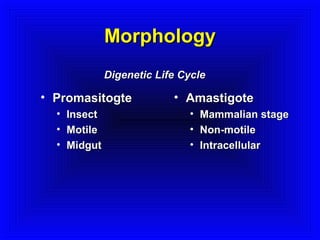
Digenetic Life Cycle

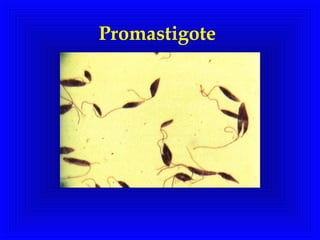
• Promasitogte
• Insect
• Motile
• Midgut

• Amastigote
• Mammalian stage
• Non-motile
• Intracellular
Morphology
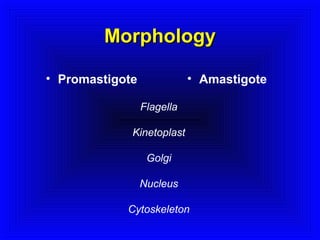
• Promastigote

• Amastigote
Flagella

Kinetoplast
Golgi
Nucleus
Cytoskeleton
Promastigote
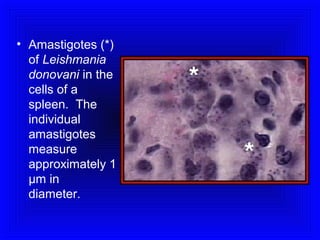
• Amastigotes (*)
of Leishmania
donovani in the
cells of a
spleen. The
individual
amastigotes
measure
approximately 1
µm in
diameter.
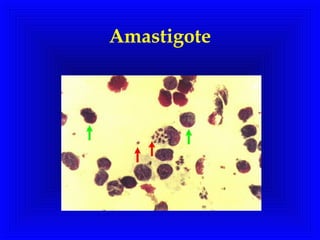
Amastigote
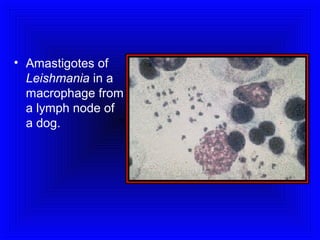
• Amastigotes of
Leishmania in a
macrophage from
a lymph node of
a dog.
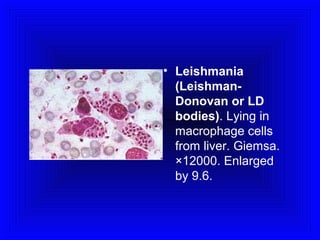
• Leishmania
(LeishmanDonovan or LD
bodies). Lying in
macrophage cells
from liver. Giemsa.
×12000. Enlarged
by 9.6.
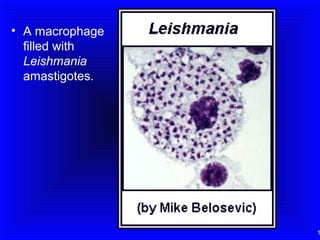
• A macrophage
filled with
Leishmania
amastigotes.

1
Life cycle
•

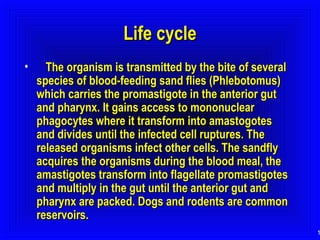
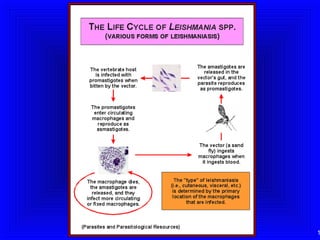
The organism is transmitted by the bite of several
species of blood-feeding sand flies (Phlebotomus)
which carries the promastigote in the anterior gut
and pharynx. It gains access to mononuclear
phagocytes where it transform into amastogotes
and divides until the infected cell ruptures. The
released organisms infect other cells. The sandfly
acquires the organisms during the blood meal, the
amastigotes transform into flagellate promastigotes
and multiply in the gut until the anterior gut and
pharynx are packed. Dogs and rodents are common
reservoirs.

1
1
Mammalian Hosts
•
•
•
•
•
•

Rodents
Gerbils
Hyraxes
Bats
Porcupines
Opossums

•
•
•
•
•
•

Sloths
Primates
Dogs
Foxes
Anteaters
.....

1
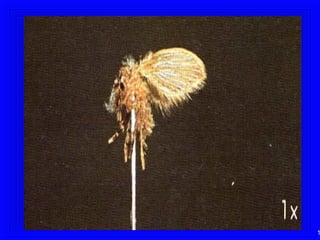
Vectors
Phlebotomine Sandflies
6 genera world wide distribution
Phlebotomus & Lutzomia
500 species
Females Haematophagus
Males sap feeders

1
1
Clinical Disease
• Visceral
• Fatal (90%
untreated)
• Liver
• Spleen
• Bone marrow

• Cutaneous
• Generally Self- healing
• Skin
• Mucous membranes

SPECTRUM OF DISEASE

1
Initial Infection
•
•
•
•

Similar in all species
Inoculation of promastigotes
Inflammation & chemotaxis
Receptor mediated phagocytosis

Promastigote

Amasitgote
Transformation

1
Parasite Spread
Macrophage lysis & parasite release
Lymphatic spread
Blood spread
Target organs
Skin/lymph nodes/spleen/liver/
bone marrow

1
Visceral Leishmaniasis
•
•
•

1903
1920
1931

William Leishman
Pentavalent antimony
Experimental transmission

Leishmania donovani (Complex)
L.d. archibaldi - L.d.chagasi - L.d.donovani - Ld.infantum

1
VL - Clinical Manifestation
Variable - Incubation 3-100+ weeks
Lowgrade fever
Hepato-splenomegaly
Bone marrow hyperplasia
Anemia, Leucopenia & Cachexia
Hypergammaglobulinnemia
Epistaxis , Proteinuria, Hematuria

2
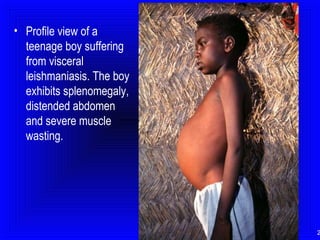
• Profile view of a
teenage boy suffering
from visceral
leishmaniasis. The boy
exhibits splenomegaly,
distended abdomen
and severe muscle
wasting.

2
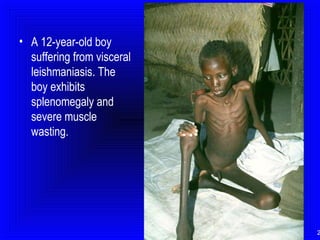
• A 12-year-old boy
suffering from visceral
leishmaniasis. The
boy exhibits
splenomegaly and
severe muscle
wasting.

2
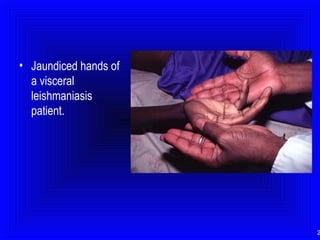
• Jaundiced hands of
a visceral
leishmaniasis
patient.

2
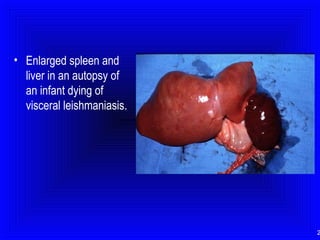
• Enlarged spleen and
liver in an autopsy of
an infant dying of
visceral leishmaniasis.

2
Post Kala Azar Dermal
Leishmanoid
Normally develops <2 years after
recovery
Recrudescence
Restricted to skin
Rare but varies geographically

2
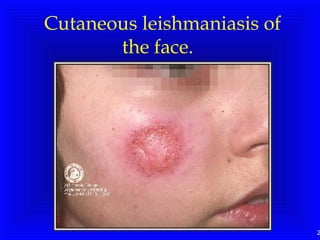
Cutaneous leishmaniasis of
the face. 

2
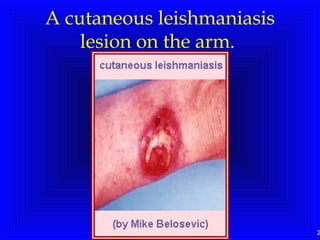
A cutaneous leishmaniasis
lesion on the arm.

2
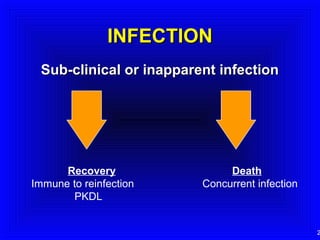
INFECTION
Sub-clinical or inapparent infection

Recovery
Immune to reinfection
PKDL

Death
Concurrent infection

2
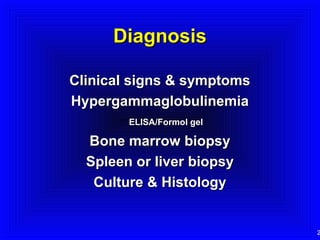
Diagnosis
Clinical signs & symptoms
Hypergammaglobulinemia
ELISA/Formol gel

Bone marrow biopsy
Spleen or liver biopsy
Culture & Histology

2
Speciation
•
•
•
•

Similar morphology
Isoenzyme profiles - Zymodemes
Monoclonal antibodies
DNA hybridisation - PCR

3
Treatment
Good nursing
Diet
Antibiotics
Pentavalent antimony
Pentamidine
New drugs - New delivery

3
Control
•
•
•
•

Vector control
Reservoir control
Treatment of active cases
Vaccination

3

Leishmania