Karthika P
Assistant Professor
Department of Food Science and
Nutrition
Periyar University, Salem
Tamil Nadu
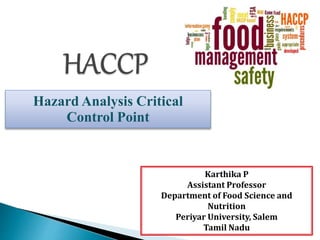
Hazard Analysis Critical
Control Point
HACCP
Principles of HACCP
Pre-requisite programmes/ Good
Manufacturing Practices (GMP’s)
Contents
Hazard Analysis Critical
Control Point
It Identifies, Evaluate and Controls
Hazards which are Significant for
Food Safety
Food Safety Management System
Hazard
Analysis
Identify
critical
control
points
Establish
critical limits
Establish
monitoring
procedures
Establish
corrective
actions
Verifying
Documentati
on
1. Hazards Analysis
Identify the hazards that affects the process
Identify the steps that hazards likely to occur
Decide which hazards are significant
Determine the measures necessary to control the hazards
Physical
Chemical
Biological
2. Critical Control Points (CCP)
A step at which control can be applied and is essential
to prevent or eliminate a food safety hazard.
CCP Eg:
Boiling
Steaming
Cooking
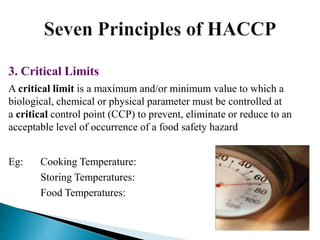
3. Critical Limits
A critical limit is a maximum and/or minimum value to which a
biological, chemical or physical parameter must be controlled at
a critical control point (CCP) to prevent, eliminate or reduce to an
acceptable level of occurrence of a food safety hazard
Eg: Cooking Temperature:
Storing Temperatures:
Food Temperatures:
a
t
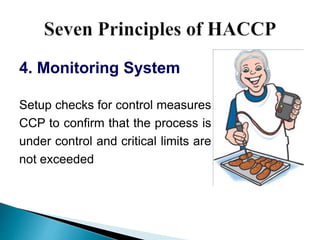
4. Monitoring System
Setup checks for control measures
CCP to confirm that the process is
under control and critical limits are
not exceeded
5. Corrective Action
Immediate adjust the
process and keep the
product in compliance.
6. Verification
Determine the validity of and
compliance rather than monitoring
7. Documentation
Keep records
Temperature Charts
Cleaning Schedules
Pest Control Records
Equipment Maintenance Records
Training Records
Delivery Checks
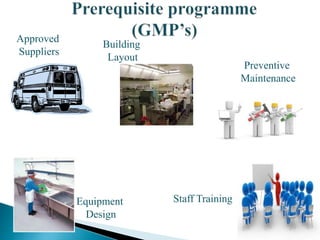
Approved
Suppliers
Building
Layout
Equipment
Design
Preventive
Maintenance
Staff Training
Pest Control
Prerequisite programme
Storage
Personal
Hygiene
Waste
Management
Good
Housekeeping
Cleaning and
Sanitization
HACCP

HACCP