HAZARD & SAFETY MANAGEMENT
(MQA-201T)
TOPIC-HAZARD & RISK MANAGEMENT
Guided by : Presented by:
Dr. Bhavna Patel Henisha Patel
Assistant professor Department of pharmaceutical science,
Roll no : 18 QA 02 (Quality Assurance)
1
 Factory act and rules
 Fundamentals of accident prevention
 Elements of safety programme & safety management
 BOD
 COD
 Determination of some contaminants
 Role of emergency services
CONTENTS
2
 In Great Britain, the second half of the 18th
century, there was a rapid growth of industrial
towns & factories.
 As it was started without planning, they
employed the women as well as their children
in factories who needed to work for more than
12 hours a day.
 Some of the employees took initiative to
implement labour legislations; Factories Act
came into existence in 1819.
 After some modifications, the final amended of
Factories Act took place in 1948.
FACTORY ACT(1948)
3
FACTORIES ACT IN INDIA
 In India, the First factories Act was passed in 1881.
 This Act was basically designed to protect children and to provide few measures for
health and safety of the workers. This law was applicable to only those factories, which
employed 100 or more workers.
 In 1891 another Factories Act was passed which extended to the factories employee 50
or more workers.
FACTORIES ACT INCLUDES
1. Health
2. Safety
3. Welfare
4. Working Hours Of Adults
5. Annual Leave With wages
4
DEFINITIONS
“Factory” It means any premises including the precincts thereof :
a) Where on 10 or more workers are working, or were working on any day of the
preceding 12 months, and in any part of which a manufacturing process is being
carried on with the aid of power, or is ordinarily so carried on; or
b) Whereon 20 or more workers are working, or were working on any day of the
preceding 12 months, and in any part of which a manufacturing process is being carried
on without the aid of power, or is ordinarily so carried on.
But does not include a mine subject to the operation of the Mines Act, 1952 or a mobile
unit belonging to the Armed forces of the Union, a railway running shed or a hotel,
restaurant or eating place.
5
OBJECTIVES
 To ensure adequate safety measures and to promote the health and safety and welfare
of the workers employed in factories.
 The act also makes provisions regarding employment of women and young persons
(including children & adolescents), annual leave with wages etc.
 The Act extended to whole of India including Jammu & Kashmir and covers all
manufacturing processes.
 To regulate the working condition in factories, regulate the working hours , leave,
holidays, overtime, employment of children, women and young person etc.
6
PROVISIONS
REGARDING
HEALTH
Cleanliness
Disposal of
Wastes &
Effluents
Ventilations
&
Temperature
Dust &
Fumes
Drinking
Water
Latrines &
Urinals
PROVISIONS REGARDING SAFETY
1. Fencing of Machinery
2. Work on or near Machinery in
motion
3. Employment of Young Persons on
Dangerous Machines
4. Protection of Eyesprecautions
against Dangerous
5. Fumes, Gases & others
6. Precautions Regarding use of
portable electric light
7. Explosive or Inflammable Dust, Gas
8. Precautions in case of fire
9. Specifications of Defective Parts or
Tests of Stability Safety of Buildings
and machines
10. Safety officers 7
HAZARDOUS PROCESSES
 Provisions regarding Hazardous Process were instructed in the Act under a new chapter
by the Factories (Amendment) Act, 1987. This Act instructed two new schedules:
I. Listing the industries involving hazardous process
II. Relating to permissible levels of certain chemical substances in work environment
PROVISIONS REGARDING HAZARDOUS PROCESSES
1. Constitution of Site Appraisal Committee
2. Compulsory Disclosure of Information
3. Special Responsibility of the occupier in relation to Hazardous processes
4. Maintaining accurate and up-to-date health and medical records of workers exposed
to any chemical, toxic or any other harmful substances manufactured, stored,
handled or transported
5. Appointing qualified, experienced & compete persons in handling such substances to
supervise handling and for protecting the workers from the hazard
8
6. Providing for medical examination of every worker at intervals
 Appointment of Inquiry Committee
 Emergency Standards
 Permissible Limits of Exposure of chemical and toxic
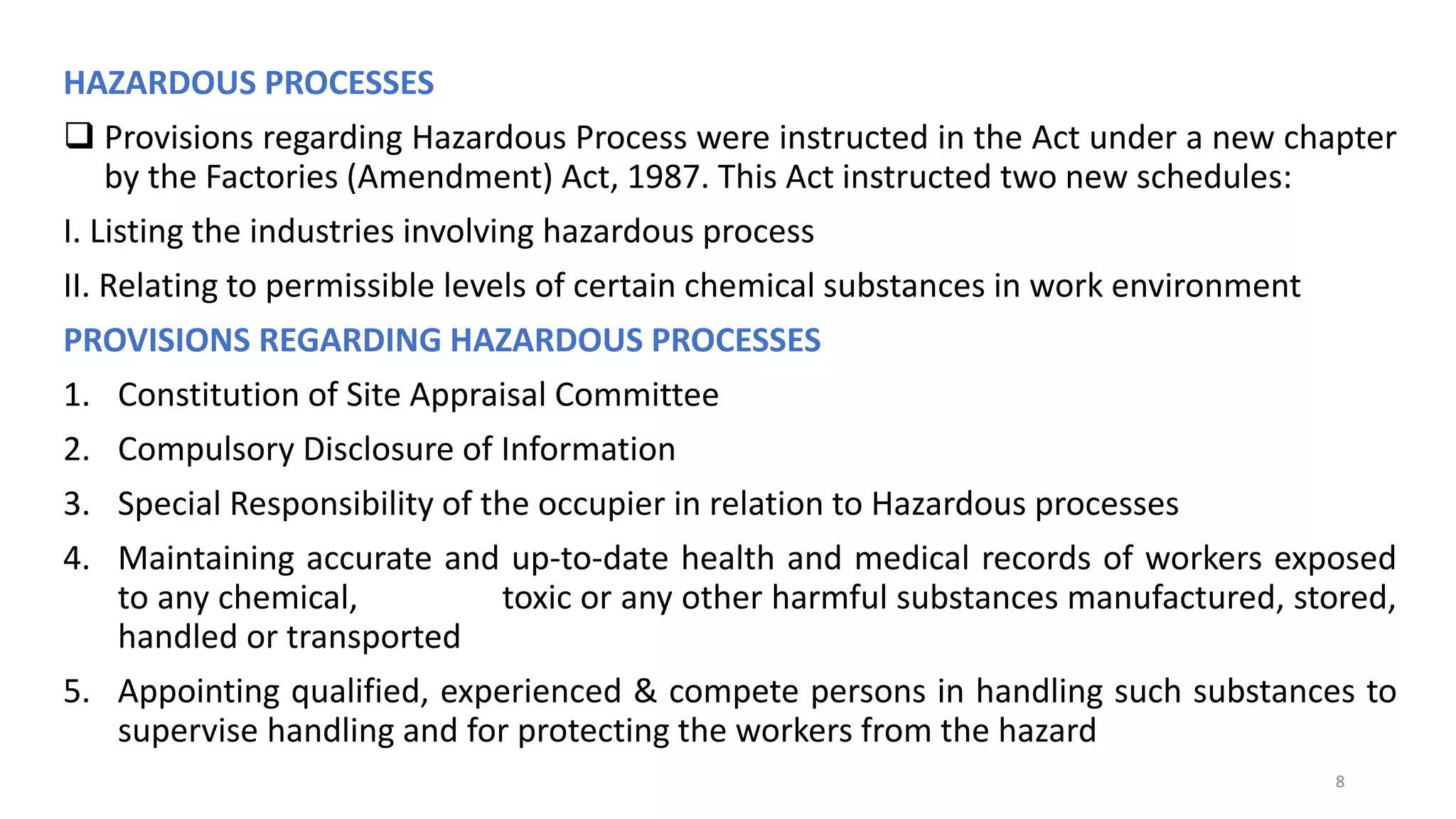
 Substances
 Workers‟ participation in safety management
 Right of workers to warn about imminent danger
9
WORKING HOURS OF ADULTS
• Weekly Hours: < 48 hours
• Weekly Holidays : at least 1 holiday in a week , substitute holidays
• Compensatory Holidays
• Daily Hours : < 9 hours
• Intervals for rest : at least half an hour
• Spread Over
• Night Shifts
• Prohibition of Overlapping Shifts : not more than 2 continuous shift
• Extra wages for overtime : wages at the rate of twice at his ordinary rate of wages for
overtime
• Notice of period of work
10
RESTRICTION ON EMPLOYMENT OF WOMEN & CHILDREN
 Work between 6 a.m. to 7 p.m. only
 Strictly restriction for women for employment between 10 p.m. to 5 a.m.
 Employment of women in night shift is permitted only in the case of fish-curring and
fish-canning
ANNUAL LEAVE WITH WAGES
 Annual leave with wages
 Wages during leave period
 Payment in advance in certain cases
 Mode of Recovery of unpaid wages
 Power to make rules
11
OFFENCES
 A court can take cognizance of the offence only when the complaint is made within 3
months of the date on which the alleged commission of the offence came to the
knowledge of the inspector, but where the offence consist of disobeying a written
order made by an Inspector, complaint may be made within 6 months of the
commission of the offence
PENALTIES
General penalties for offence
• Penalty for the contravention of Provisions Relating to Hazardous process
• Penalty for obstructing Inspector
• Penalty for wrongfully Disclosing Results of Analysis
• Penalty relating to casing of new machinery
• Penalties for Offences by workers & Parents
• Penalty for offence by a medical practitioner
• Penalty for employing child labour
12
Accident Prevention
 Requires the creation and maintenance of a safe working environment, and the
promotion of safe behaviour.
 Originally a reactive process - waiting for accidents or ill health to happen and then
devising and implementing a prevention control.
FUNDAMENTALS OF ACCIDENTAL PREVENTION
13
14
15
Operating Procedures
 Most common form of control measure
 In some cases the only practical way of managing a particular risk.
 Should allow for methodical execution of tasks.
 Should address the hazards that have been identified in the risk assessment.
 Requirement of law - Section 10 of the Quarry Regulations, 1999, it is „the duty of the
quarry operator to ensure that rules and procedures are in place for reasons of health
and safety‟.
A Safe System of Work
 Eliminates identified hazards and controls others.
 Plans to achieve the controlled completion of the work with minimum risk.
 Fundamental to accident prevention.
 Should fully document the hazards, precautions and safe working methods.
16
Framework for Safe System of Work
1. Safe design.
2. Safe installation.
3. Safe premises and plant.
4. Safe tools and equipment.
5. Correct use of plant, tools and equipment.
6. Effective planned maintenance of plant and equipment.
7. Proper working environment ensuring adequate lighting, heating and ventilation.
8. Trained employees.
9. Enforcement of safety policy and rules. Additional protection for vulnerable
employees. proper utilisation of all necessary clothing.
10. Continued emphasis on adherence to the agreed safe method of work.
17
11. Regular annual reviews of all systems of work to ensure:-
 Compliance with current legislation.
 Systems are still workable in practice.
 Plant modifications are accounted for.
 Substituted materials are allowed for.
 New work methods are incorporated into the system.
 Advances in technology are exploited.
 Proper precautions in light of any accidents are taken.
 Continued involvement in and awareness of the importance of written safe systems of
work.
12. Regular feedback to all concerned.
18
Training
 Training helps people acquire the skills, knowledge and attitudes to make them
competent in the health and safety aspects of their work.
 There are generally two types of safety training:-
 Specific safety training (or on the job training) for tasks of a specific nature.
 Planned training, such as general safety training, induction training, management
training, skill training or refresher courses, that are planned by the organisation.
Personnel Protective Equipment
Personnel protective equipment (PPE) may be broadly divided as follows:
– Hearing protection.
– Respiratory protection.
– Eye and face protection.
– Protective clothing.
19
Hierarchy of Control Measures
Eliminate risk by substituting the dangerous for the less dangerous, e.g.
• Use less hazardous substances.
• Substitute a type of machine which is better guarded to make the same product.
• Avoid the use of certain processes.
Minimise risk by:
• Designing suitable systems of working
• Using personal protective clothing and equipment, this should only be used as a last
resort.
The hierarchy reflects an increased reliability in risk elimination and control by the use of
physical engineering controls and safeguards compared to reliance on employees.
20
21
 There are so many aspects to creating and maintaining a safe working environment that
sometimes it’s easy to get lost in it all. To truly succeed in creating a safe place of work,
the key is to develop and implement an effective safety management system.
 A safety management system combines all the different elements in your workplace
that need attention to ensure you provide a safe working environment for everyone
who enters it.
 Safety management systems make health and safety an integral part of your business‟s
core operations. By designing, developing and implementing an effective safety
management system, you will have methods for managing reporting, responsibilities,
planning and resourcing to create a safer workplace.
ELEMENTS OF SAFETY PROGRAMME AND SAFETY MANAGEMENT SYSTEM
22
23
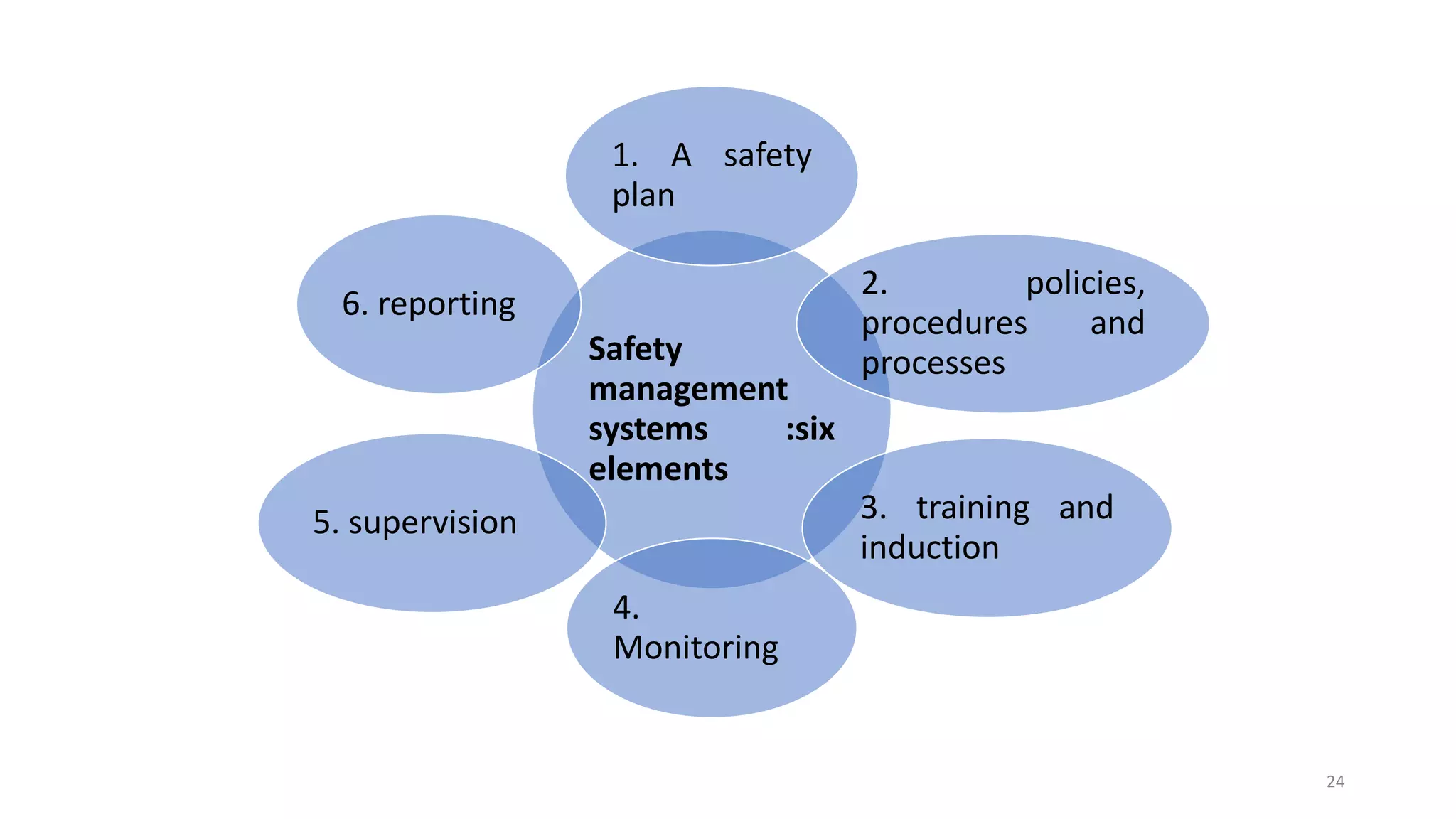
Safety
management
systems :six
elements
1. A safety
plan
2. policies,
procedures and
processes
3. training and
induction
4.
Monitoring
5. supervision
6. reporting
24
1. Safety plan
 A safety plan is a strategic action plan that forms part of the business plan. It analyses
the current and prospective risk for a company and charts how the risks will be
eradicated and controlled over a calendar period (the safety plan must have a budget).
 This plan will ensure that there is a governance structure within your company that
ensures every worker clearly understands their safety obligations (and how to comply)
and is accountable to carry out those obligations.
2. Policies, procedures and processes
 Policies, procedures and processes include all safety paper infrastructures within your
company.
 This paperwork will describe all safety behaviour, expectations, record-keeping,
incident reporting, and incident notification documentation.
25
3. Training and induction
 Depending on the nature of your workplace (whether it is low-risk or high-risk),
everyone who enters your workplace should receive training on:
 the rules of your company;
 the rules of the site; and
 the rules of the location they are visiting.
 The training content will depend on the level of risk the person is exposed to.
4. Monitoring
 Your obligations to monitor your workplace depend on circumstances and need. Always
consider the level of risk. The higher the risk, the more frequent and detailed the
monitoring needs to be.
 Other times when monitoring will be necessary include:
26
 to ensure that all risk has been covered by a new risk assessment that has been carried
out due to a change in process, e.g. the installation of new workstations; and
 when an investigation takes place following an incident.
5. Supervision
 The only way to ensure your workers are carrying out their safety obligations is to have
adequate supervision.
 The level of supervision required in your workplace will increase if the level of safety
control put in place to reduce a risk is low, i.e. the less effective the control measure
used, the higher the level of supervision necessary.
6. Reporting
 The governance structure of your company needs safety reporting at all levels, not just
at board level.
27
• Water is “polluted” by many organic matter in its course of flow
• When organic matter is present in a water supply, the bacteria present in water will
begin the process of breaking down this waste.
• With this much of the available dissolved oxygen is consumed by aerobic bacteria,
robbing other aquatic organisms of the oxygen they need to live.
• Biological Oxygen Demand (BOD) is a measure of the oxygen used by microorganisms
to decompose this waste.
• A large quantity of organic waste in the water supply, guarantees a large number
bacteria present to decompose this waste.
• In this case, the demand for oxygen will be high (due to all the bacteria) so the BOD
level will be high.
BIOLOGICAL OXYGEN DEMAND (BOD)
28
DEFINITION
The amount of oxygen absorbed by a sample of sewage during a specific period, generally
5 days at a specific temperature, generally 20° C for the aerobic destruction of the organic
matter by living organisms.
• Total BOD is of more significance to food webs than to water quality.
• Nitrates and phosphates in a body of water can contribute to high BOD levels.
• Nitrates and phosphates are plant nutrients and can cause plant life and algae to grow
quickly.
• When plants grow quickly, they also die quickly.
• This contributes to the organic waste in the water, which is then decomposed by
bacteria resulting in a high BOD level.
29
Environmental significance
 Principle test for biodegradability of any sample and strength of the waste so measures
the amount of pollution.
 Important parameter to assess the pollution of surface and ground waters where
contamination occurred due to disposal of domestic and industrial effluents.
 Allows calculation of the effect of the discharges on the oxygen resources of the
receiving water.
 Measurement of BOD in raw (influent) and treated (effluent) wastewaters is a standard
practice to evaluate treatment facility performance.
 Data from BOD tests used for the development of engineering criteria for the design of
wastewater treatment plants.
 One of the most important method in sanitary analysis to determine the polluting
power, or strength of sewage, industrial wastes or polluted water.
 It serves as a measure of the amount of clean diluting water required for the successful
disposal of sewage by dilution.
30
 Any effluent to be discharged into natural bodies of water should have BOD less than
30 mg/L.
 Drinking water usually has a BOD of less than 1 mg/L.
 But, when BOD value reaches 5 mg/L, the water is doubtful in purity.
31
32
Factors affecting BOD
1. Temperature
 Elevated temperature decreases the level of DO of water harming aquatic organisms
like fish, amphibians and others
 Increases the metabolic rate of aquatic animals and enzyme activity, resulting in
consumption of more food in a shorter time
 High temperature limits oxygen dispersion into deeper waters, contributing to
anaerobic conditions.
 This can lead to increased bacterial levels when there is ample food supply.
 Higher water temperature increases plant growth rates
 This results in a shorter lifespan and species overpopulation causing an ”algae bloom”
which reduces oxygen levels.
33
2. Eutrophication
 Eutrophication occurs due to oversupply of nutrients, which causes explosive growth
of plants and algae.
 when such organisms die, consume the oxygen in the body of water, thereby creating
the state of hypoxia.
 The primary limiting factor is phosphorus which promotes excessive plant growth and
decay, favouring simple algae and plankton, and causes a severe reduction in water
quality.
 Phosphate adheres tightly to soil, so it is mainly transported by erosion.
 Once into the lakes, phosphate is extracted into water is slow, hence the difficulty of
reversing the effects of eutrophication
 The source of this excess phosphate are detergents, industrial/domestic run-off, and
fertilizers.
34
At higher levels of BOD….
 At high BOD levels, organisms such as macro invertebrates that are more tolerant of
lower dissolved oxygen (i.e. leeches and sludge worms) may appear and become
numerous.
 Organisms needing higher oxygen levels (i.e. caddisfly larvae and mayfly nymphs) will
NOT survive.
The basics of BOD test..
1. The first step is to obtain equal volumes of water from the area to be tested
2. Dilute each specimen with a known volume of distilled water which has been
thoroughly shaken to insure oxygen saturation.
3. Oxygen meter is used to determine the concentration of oxygen within one of the
vials.
4. The remaining vial is than sealed and placed in darkness and tested for oxygen content
five days later.
5. BOD is then determined by subtracting the second meter reading from the first.
35
Possibilities
Water from an exceptionally clear lake might show a BOD of less than 2 ml/L
of water.
36
37
Step 1 : Sample collection
• Samples for BOD test can be either grab or composite.
• Composite sample more preferred as it is more representative of the wastestream over
a period of time.
• Samples should be taken at a point of well-mixed and proportional to the amount of
the flow.
• Preservation of sample is not practical as biological activity will continue after a sample
has been taken
• Testing should be started as quickly as possible, preferrrably <6hrs.
• If not possible samples should be kept ≤ 4°C.
Do not allow samples to freeze. Samples may be kept for no more than 48 hours before
beginning the BOD test.
38
Step 2 Dilution
• The BOD concentration in waste water is more than sample due to biological activity.
• So, it is necessary to dilute the sample before incubation to bring the oxygen demand
and supply into appropriate balance
• If not diluted, microorganisms will use up the DO in the BOD bottle before the five day
incubation time is up.
• There is no way of knowing at what point during the five days the DO reached zero.
Dilution water
• It is high quality organic free water .
• The required volume of water is aerated with a supply of clean compressed air for at
least 12 hours.
• It is stabilized by incubating it at 20ºC for at least 4 hours.
39
Step 3 : Pre-treatment
• Samples with extreme pH values (>8.5 or <6.0) must be neutralized to pH 7.0 prior to
testing.
• This is done by adding either or H2SO4 or NaOH
• Any samples containing residual chlorine must be pre-treated to remove chlorine
before the test is run.
• This is done by adding sodium sulphite to the sample
Step 4 Seeding
• The process of adding live bacteria to a sample.
• Samples form sources like high temperature, extreme pH or having heavy metals could
kill or injure the microorganisms
• The condition must be corrected and healthy active organisms added
40
Laboratory procedure
Completely fill two BOD bottles with dilution water.
Into additional BOD bottles, partially filled with dilution water, carefully mix the proper
volume of sample.
Add dilution water until the bottles are completely filled.
Stopper each bottle taking care to avoid trapping air bubbles inside the bottles as the
bottle stoppers are inserted.
Fill the top of each bottle neck around the stopper with dilution water.
Determine the initial DO content of each set of duplicate bottles, including the dilution
water blank
Place the remaining bottles in the incubator at 20°C and incubate for five days.
At the end of exactly five days (+/-3 hours), test the DO content of the incubated
bottles.
41
Calculate the BOD for each dilution.
The dilution water blanks are used only to check the quality of the dilution water.
If the quality of the water is good and free from impurities, the depletion of DO should
be less than 0.2 mg/L.
In any event, do not use the depletion obtained as a blank correction.
Samples treated for chlorine should always be seeded
CALCULATIONS BOD
Variations in BOD test is subject to a number of factors temperature, weather etc.
results can vary widely from day to day, or even hour to hour.
42
 The COD (Chemical Oxygen Demand) test represents the amount of chemically
digestible organics (food).
 COD measures all organics that were biochemically digestible as well as all the organics
that can be digested by heat and sulfuric acid. It is used in the same applications as
BOD.
 COD has the advantage over BOD in that the analysis can be completed within a few
hours whereas BOD requires 5 days.
 The major drawback of the COD test is the presence of hazardous chemicals and toxic
waste disposal.
 It is expressed in milligrams per litter (mg/L) also referred to as ppm (parts per million),
which indicates the mass of oxygen consumed per litter of solution.
CHEMICAL OXYGEN DEMAND (COD)
43
DIFFERENCE
B.O.D
BOD is only a
measurement of
consumed oxygen by
aquatic microorganism
to decompose or oxidize
organic matter.
C.O.D
COD refers the
requirement of
dissolved oxygen for the
oxidization of organic &
inorganic constituents
both.
 Although, some of the organic compounds, which can be broken down by
microorganisms, are countable for the biological oxygen demand, they may not be
encountered in measuring chemical oxygen demand C.O.D
44
DEFINITION
COD is the total amount of oxygen required to chemically oxidize the bio degradable and
non- biodegradable organic matter.
HISTORY
 Earlier potassium permanganate was used as an oxidizing agent
 COD values were very much lower than that of 5th day BOD
 It indicated that potassium permanganate was not very effective in oxidizing all the
organic matter present After that other oxidizing agents like ceric sulphate, potassium
iodate and potassium di-chromate were also used
 Potassium di chromate was found to be the most effective due to
- Completely oxidize all organic matter
- Relatively cheap
- Easy to purify
45
COD TEST BY DICHROMATE PRINCIPLE
1. Water sample is refluxed in strong acidic solution with a known excess amount of
potassium dichromate.
2. After digestion, the remaining unreduced K2Cr2O7 is titrated with Ferrous Ammonium
Sulphate (FAS)to determine K2Cr2O7 consumed.
3. This gives us the oxidizable organic matter in terms of oxygen equivalent.
TEST PROCEDURE
1. Wash 300 ml round bottom refluxing flask.
2. In refluxing flask put one spatula of HgSO4 + 10 ml sample + 5ml K2Cr2O7 + 15 ml
concentrated H2SO4.
3. Add small amount of silver sulphate
4. Shake well and reflux for 2 hr.
5. Cool and add little amount of distilled water to the flask through the condenser
6. Titrate the solution in the flask against FAS using Ferroin indicator
46
7. End point green colour to reddish brown
NOTE: For blank, add 10 ml distilled water instead of sample. Rest of the procedure is the
same.
CALCULATIONS
The COD in mg/l is determined by the formula,
A = ml of FAS required for blank.
B = ml of FAS requires for sample.
47
ADVANTAGES OF COD TEST
1. COD result are available much sooner
than BOD test results.
2. The COD test requires fewer
manipulations of the sample.
3. The COD test oxidizes a wide range of
chemical compounds.
4. It can be standardize more easily.
DISADVANTAGES OF COD TEST
1. The major disadvantage is that the
results are not directly applicable to
5-day BOD results without
correlation studies over a long period
of time.
2. One more limitation of COD is its
inability to differentiate between
biologically oxidizable and
biologically inert organic matter.
48
 Liquid chromatography
 Mass spectroscopy
 NMR spectra
 UV spectra
 Microscopic technique
 IR spectra
DETERMINATION OF SOME CONTAMINANTS
49
 The Emergency control organization is responsible for:
 Implementing emergency procedures as prescribed in the emergency plan &
procedures
 Ensuring that all personnel within their area of responsibility are trained for their role
in emergency
 Reporting any matters likely to affect the viability of the emergency plan & procedures
 Checking on the effectiveness of emergency systems and equipment.
ROLE OF EMERGENCY SERVICES
50
Roles & responsibilities
 Chief warden ( campus emergency coordinator)
 Deputy chief warden ( emergency response officer)
 Communications officer
 Area wardens
 Wardens
 Insufficient wardens
 Staff in charge of student
 Critical incident management review committee
 ECO identification
 Maintenance of warden coverage
51
1. Journal on industrial waste water treatment by k.l moed.
2. HLTHMAN, volume 20 part 8 CHAPTER 2 WASTE WATER TREATMENT
3. Emergency control organization commercial services & development, November
2013
4. National science foundation. Water quality index,2004.
5. https://www.slideshare.net/koratshruti/hazards-and-risk-management
REFERENCES
52
53

hazard & risk management

  • 1.
    HAZARD & SAFETYMANAGEMENT (MQA-201T) TOPIC-HAZARD & RISK MANAGEMENT Guided by : Presented by: Dr. Bhavna Patel Henisha Patel Assistant professor Department of pharmaceutical science, Roll no : 18 QA 02 (Quality Assurance) 1
  • 2.
     Factory actand rules  Fundamentals of accident prevention  Elements of safety programme & safety management  BOD  COD  Determination of some contaminants  Role of emergency services CONTENTS 2
  • 3.
     In GreatBritain, the second half of the 18th century, there was a rapid growth of industrial towns & factories.  As it was started without planning, they employed the women as well as their children in factories who needed to work for more than 12 hours a day.  Some of the employees took initiative to implement labour legislations; Factories Act came into existence in 1819.  After some modifications, the final amended of Factories Act took place in 1948. FACTORY ACT(1948) 3
  • 4.
    FACTORIES ACT ININDIA  In India, the First factories Act was passed in 1881.  This Act was basically designed to protect children and to provide few measures for health and safety of the workers. This law was applicable to only those factories, which employed 100 or more workers.  In 1891 another Factories Act was passed which extended to the factories employee 50 or more workers. FACTORIES ACT INCLUDES 1. Health 2. Safety 3. Welfare 4. Working Hours Of Adults 5. Annual Leave With wages 4
  • 5.
    DEFINITIONS “Factory” It meansany premises including the precincts thereof : a) Where on 10 or more workers are working, or were working on any day of the preceding 12 months, and in any part of which a manufacturing process is being carried on with the aid of power, or is ordinarily so carried on; or b) Whereon 20 or more workers are working, or were working on any day of the preceding 12 months, and in any part of which a manufacturing process is being carried on without the aid of power, or is ordinarily so carried on. But does not include a mine subject to the operation of the Mines Act, 1952 or a mobile unit belonging to the Armed forces of the Union, a railway running shed or a hotel, restaurant or eating place. 5
  • 6.
    OBJECTIVES  To ensureadequate safety measures and to promote the health and safety and welfare of the workers employed in factories.  The act also makes provisions regarding employment of women and young persons (including children & adolescents), annual leave with wages etc.  The Act extended to whole of India including Jammu & Kashmir and covers all manufacturing processes.  To regulate the working condition in factories, regulate the working hours , leave, holidays, overtime, employment of children, women and young person etc. 6
  • 7.
    PROVISIONS REGARDING HEALTH Cleanliness Disposal of Wastes & Effluents Ventilations & Temperature Dust& Fumes Drinking Water Latrines & Urinals PROVISIONS REGARDING SAFETY 1. Fencing of Machinery 2. Work on or near Machinery in motion 3. Employment of Young Persons on Dangerous Machines 4. Protection of Eyesprecautions against Dangerous 5. Fumes, Gases & others 6. Precautions Regarding use of portable electric light 7. Explosive or Inflammable Dust, Gas 8. Precautions in case of fire 9. Specifications of Defective Parts or Tests of Stability Safety of Buildings and machines 10. Safety officers 7
  • 8.
    HAZARDOUS PROCESSES  Provisionsregarding Hazardous Process were instructed in the Act under a new chapter by the Factories (Amendment) Act, 1987. This Act instructed two new schedules: I. Listing the industries involving hazardous process II. Relating to permissible levels of certain chemical substances in work environment PROVISIONS REGARDING HAZARDOUS PROCESSES 1. Constitution of Site Appraisal Committee 2. Compulsory Disclosure of Information 3. Special Responsibility of the occupier in relation to Hazardous processes 4. Maintaining accurate and up-to-date health and medical records of workers exposed to any chemical, toxic or any other harmful substances manufactured, stored, handled or transported 5. Appointing qualified, experienced & compete persons in handling such substances to supervise handling and for protecting the workers from the hazard 8
  • 9.
    6. Providing formedical examination of every worker at intervals  Appointment of Inquiry Committee  Emergency Standards  Permissible Limits of Exposure of chemical and toxic  Substances  Workers‟ participation in safety management  Right of workers to warn about imminent danger 9
  • 10.
    WORKING HOURS OFADULTS • Weekly Hours: < 48 hours • Weekly Holidays : at least 1 holiday in a week , substitute holidays • Compensatory Holidays • Daily Hours : < 9 hours • Intervals for rest : at least half an hour • Spread Over • Night Shifts • Prohibition of Overlapping Shifts : not more than 2 continuous shift • Extra wages for overtime : wages at the rate of twice at his ordinary rate of wages for overtime • Notice of period of work 10
  • 11.
    RESTRICTION ON EMPLOYMENTOF WOMEN & CHILDREN  Work between 6 a.m. to 7 p.m. only  Strictly restriction for women for employment between 10 p.m. to 5 a.m.  Employment of women in night shift is permitted only in the case of fish-curring and fish-canning ANNUAL LEAVE WITH WAGES  Annual leave with wages  Wages during leave period  Payment in advance in certain cases  Mode of Recovery of unpaid wages  Power to make rules 11
  • 12.
    OFFENCES  A courtcan take cognizance of the offence only when the complaint is made within 3 months of the date on which the alleged commission of the offence came to the knowledge of the inspector, but where the offence consist of disobeying a written order made by an Inspector, complaint may be made within 6 months of the commission of the offence PENALTIES General penalties for offence • Penalty for the contravention of Provisions Relating to Hazardous process • Penalty for obstructing Inspector • Penalty for wrongfully Disclosing Results of Analysis • Penalty relating to casing of new machinery • Penalties for Offences by workers & Parents • Penalty for offence by a medical practitioner • Penalty for employing child labour 12
  • 13.
    Accident Prevention  Requiresthe creation and maintenance of a safe working environment, and the promotion of safe behaviour.  Originally a reactive process - waiting for accidents or ill health to happen and then devising and implementing a prevention control. FUNDAMENTALS OF ACCIDENTAL PREVENTION 13
  • 14.
  • 15.
  • 16.
    Operating Procedures  Mostcommon form of control measure  In some cases the only practical way of managing a particular risk.  Should allow for methodical execution of tasks.  Should address the hazards that have been identified in the risk assessment.  Requirement of law - Section 10 of the Quarry Regulations, 1999, it is „the duty of the quarry operator to ensure that rules and procedures are in place for reasons of health and safety‟. A Safe System of Work  Eliminates identified hazards and controls others.  Plans to achieve the controlled completion of the work with minimum risk.  Fundamental to accident prevention.  Should fully document the hazards, precautions and safe working methods. 16
  • 17.
    Framework for SafeSystem of Work 1. Safe design. 2. Safe installation. 3. Safe premises and plant. 4. Safe tools and equipment. 5. Correct use of plant, tools and equipment. 6. Effective planned maintenance of plant and equipment. 7. Proper working environment ensuring adequate lighting, heating and ventilation. 8. Trained employees. 9. Enforcement of safety policy and rules. Additional protection for vulnerable employees. proper utilisation of all necessary clothing. 10. Continued emphasis on adherence to the agreed safe method of work. 17
  • 18.
    11. Regular annualreviews of all systems of work to ensure:-  Compliance with current legislation.  Systems are still workable in practice.  Plant modifications are accounted for.  Substituted materials are allowed for.  New work methods are incorporated into the system.  Advances in technology are exploited.  Proper precautions in light of any accidents are taken.  Continued involvement in and awareness of the importance of written safe systems of work. 12. Regular feedback to all concerned. 18
  • 19.
    Training  Training helpspeople acquire the skills, knowledge and attitudes to make them competent in the health and safety aspects of their work.  There are generally two types of safety training:-  Specific safety training (or on the job training) for tasks of a specific nature.  Planned training, such as general safety training, induction training, management training, skill training or refresher courses, that are planned by the organisation. Personnel Protective Equipment Personnel protective equipment (PPE) may be broadly divided as follows: – Hearing protection. – Respiratory protection. – Eye and face protection. – Protective clothing. 19
  • 20.
    Hierarchy of ControlMeasures Eliminate risk by substituting the dangerous for the less dangerous, e.g. • Use less hazardous substances. • Substitute a type of machine which is better guarded to make the same product. • Avoid the use of certain processes. Minimise risk by: • Designing suitable systems of working • Using personal protective clothing and equipment, this should only be used as a last resort. The hierarchy reflects an increased reliability in risk elimination and control by the use of physical engineering controls and safeguards compared to reliance on employees. 20
  • 21.
  • 22.
     There areso many aspects to creating and maintaining a safe working environment that sometimes it’s easy to get lost in it all. To truly succeed in creating a safe place of work, the key is to develop and implement an effective safety management system.  A safety management system combines all the different elements in your workplace that need attention to ensure you provide a safe working environment for everyone who enters it.  Safety management systems make health and safety an integral part of your business‟s core operations. By designing, developing and implementing an effective safety management system, you will have methods for managing reporting, responsibilities, planning and resourcing to create a safer workplace. ELEMENTS OF SAFETY PROGRAMME AND SAFETY MANAGEMENT SYSTEM 22
  • 23.
  • 24.
    Safety management systems :six elements 1. Asafety plan 2. policies, procedures and processes 3. training and induction 4. Monitoring 5. supervision 6. reporting 24
  • 25.
    1. Safety plan A safety plan is a strategic action plan that forms part of the business plan. It analyses the current and prospective risk for a company and charts how the risks will be eradicated and controlled over a calendar period (the safety plan must have a budget).  This plan will ensure that there is a governance structure within your company that ensures every worker clearly understands their safety obligations (and how to comply) and is accountable to carry out those obligations. 2. Policies, procedures and processes  Policies, procedures and processes include all safety paper infrastructures within your company.  This paperwork will describe all safety behaviour, expectations, record-keeping, incident reporting, and incident notification documentation. 25
  • 26.
    3. Training andinduction  Depending on the nature of your workplace (whether it is low-risk or high-risk), everyone who enters your workplace should receive training on:  the rules of your company;  the rules of the site; and  the rules of the location they are visiting.  The training content will depend on the level of risk the person is exposed to. 4. Monitoring  Your obligations to monitor your workplace depend on circumstances and need. Always consider the level of risk. The higher the risk, the more frequent and detailed the monitoring needs to be.  Other times when monitoring will be necessary include: 26
  • 27.
     to ensurethat all risk has been covered by a new risk assessment that has been carried out due to a change in process, e.g. the installation of new workstations; and  when an investigation takes place following an incident. 5. Supervision  The only way to ensure your workers are carrying out their safety obligations is to have adequate supervision.  The level of supervision required in your workplace will increase if the level of safety control put in place to reduce a risk is low, i.e. the less effective the control measure used, the higher the level of supervision necessary. 6. Reporting  The governance structure of your company needs safety reporting at all levels, not just at board level. 27
  • 28.
    • Water is“polluted” by many organic matter in its course of flow • When organic matter is present in a water supply, the bacteria present in water will begin the process of breaking down this waste. • With this much of the available dissolved oxygen is consumed by aerobic bacteria, robbing other aquatic organisms of the oxygen they need to live. • Biological Oxygen Demand (BOD) is a measure of the oxygen used by microorganisms to decompose this waste. • A large quantity of organic waste in the water supply, guarantees a large number bacteria present to decompose this waste. • In this case, the demand for oxygen will be high (due to all the bacteria) so the BOD level will be high. BIOLOGICAL OXYGEN DEMAND (BOD) 28
  • 29.
    DEFINITION The amount ofoxygen absorbed by a sample of sewage during a specific period, generally 5 days at a specific temperature, generally 20° C for the aerobic destruction of the organic matter by living organisms. • Total BOD is of more significance to food webs than to water quality. • Nitrates and phosphates in a body of water can contribute to high BOD levels. • Nitrates and phosphates are plant nutrients and can cause plant life and algae to grow quickly. • When plants grow quickly, they also die quickly. • This contributes to the organic waste in the water, which is then decomposed by bacteria resulting in a high BOD level. 29
  • 30.
    Environmental significance  Principletest for biodegradability of any sample and strength of the waste so measures the amount of pollution.  Important parameter to assess the pollution of surface and ground waters where contamination occurred due to disposal of domestic and industrial effluents.  Allows calculation of the effect of the discharges on the oxygen resources of the receiving water.  Measurement of BOD in raw (influent) and treated (effluent) wastewaters is a standard practice to evaluate treatment facility performance.  Data from BOD tests used for the development of engineering criteria for the design of wastewater treatment plants.  One of the most important method in sanitary analysis to determine the polluting power, or strength of sewage, industrial wastes or polluted water.  It serves as a measure of the amount of clean diluting water required for the successful disposal of sewage by dilution. 30
  • 31.
     Any effluentto be discharged into natural bodies of water should have BOD less than 30 mg/L.  Drinking water usually has a BOD of less than 1 mg/L.  But, when BOD value reaches 5 mg/L, the water is doubtful in purity. 31
  • 32.
  • 33.
    Factors affecting BOD 1.Temperature  Elevated temperature decreases the level of DO of water harming aquatic organisms like fish, amphibians and others  Increases the metabolic rate of aquatic animals and enzyme activity, resulting in consumption of more food in a shorter time  High temperature limits oxygen dispersion into deeper waters, contributing to anaerobic conditions.  This can lead to increased bacterial levels when there is ample food supply.  Higher water temperature increases plant growth rates  This results in a shorter lifespan and species overpopulation causing an ”algae bloom” which reduces oxygen levels. 33
  • 34.
    2. Eutrophication  Eutrophicationoccurs due to oversupply of nutrients, which causes explosive growth of plants and algae.  when such organisms die, consume the oxygen in the body of water, thereby creating the state of hypoxia.  The primary limiting factor is phosphorus which promotes excessive plant growth and decay, favouring simple algae and plankton, and causes a severe reduction in water quality.  Phosphate adheres tightly to soil, so it is mainly transported by erosion.  Once into the lakes, phosphate is extracted into water is slow, hence the difficulty of reversing the effects of eutrophication  The source of this excess phosphate are detergents, industrial/domestic run-off, and fertilizers. 34
  • 35.
    At higher levelsof BOD….  At high BOD levels, organisms such as macro invertebrates that are more tolerant of lower dissolved oxygen (i.e. leeches and sludge worms) may appear and become numerous.  Organisms needing higher oxygen levels (i.e. caddisfly larvae and mayfly nymphs) will NOT survive. The basics of BOD test.. 1. The first step is to obtain equal volumes of water from the area to be tested 2. Dilute each specimen with a known volume of distilled water which has been thoroughly shaken to insure oxygen saturation. 3. Oxygen meter is used to determine the concentration of oxygen within one of the vials. 4. The remaining vial is than sealed and placed in darkness and tested for oxygen content five days later. 5. BOD is then determined by subtracting the second meter reading from the first. 35
  • 36.
    Possibilities Water from anexceptionally clear lake might show a BOD of less than 2 ml/L of water. 36
  • 37.
  • 38.
    Step 1 :Sample collection • Samples for BOD test can be either grab or composite. • Composite sample more preferred as it is more representative of the wastestream over a period of time. • Samples should be taken at a point of well-mixed and proportional to the amount of the flow. • Preservation of sample is not practical as biological activity will continue after a sample has been taken • Testing should be started as quickly as possible, preferrrably <6hrs. • If not possible samples should be kept ≤ 4°C. Do not allow samples to freeze. Samples may be kept for no more than 48 hours before beginning the BOD test. 38
  • 39.
    Step 2 Dilution •The BOD concentration in waste water is more than sample due to biological activity. • So, it is necessary to dilute the sample before incubation to bring the oxygen demand and supply into appropriate balance • If not diluted, microorganisms will use up the DO in the BOD bottle before the five day incubation time is up. • There is no way of knowing at what point during the five days the DO reached zero. Dilution water • It is high quality organic free water . • The required volume of water is aerated with a supply of clean compressed air for at least 12 hours. • It is stabilized by incubating it at 20ºC for at least 4 hours. 39
  • 40.
    Step 3 :Pre-treatment • Samples with extreme pH values (>8.5 or <6.0) must be neutralized to pH 7.0 prior to testing. • This is done by adding either or H2SO4 or NaOH • Any samples containing residual chlorine must be pre-treated to remove chlorine before the test is run. • This is done by adding sodium sulphite to the sample Step 4 Seeding • The process of adding live bacteria to a sample. • Samples form sources like high temperature, extreme pH or having heavy metals could kill or injure the microorganisms • The condition must be corrected and healthy active organisms added 40
  • 41.
    Laboratory procedure Completely filltwo BOD bottles with dilution water. Into additional BOD bottles, partially filled with dilution water, carefully mix the proper volume of sample. Add dilution water until the bottles are completely filled. Stopper each bottle taking care to avoid trapping air bubbles inside the bottles as the bottle stoppers are inserted. Fill the top of each bottle neck around the stopper with dilution water. Determine the initial DO content of each set of duplicate bottles, including the dilution water blank Place the remaining bottles in the incubator at 20°C and incubate for five days. At the end of exactly five days (+/-3 hours), test the DO content of the incubated bottles. 41
  • 42.
    Calculate the BODfor each dilution. The dilution water blanks are used only to check the quality of the dilution water. If the quality of the water is good and free from impurities, the depletion of DO should be less than 0.2 mg/L. In any event, do not use the depletion obtained as a blank correction. Samples treated for chlorine should always be seeded CALCULATIONS BOD Variations in BOD test is subject to a number of factors temperature, weather etc. results can vary widely from day to day, or even hour to hour. 42
  • 43.
     The COD(Chemical Oxygen Demand) test represents the amount of chemically digestible organics (food).  COD measures all organics that were biochemically digestible as well as all the organics that can be digested by heat and sulfuric acid. It is used in the same applications as BOD.  COD has the advantage over BOD in that the analysis can be completed within a few hours whereas BOD requires 5 days.  The major drawback of the COD test is the presence of hazardous chemicals and toxic waste disposal.  It is expressed in milligrams per litter (mg/L) also referred to as ppm (parts per million), which indicates the mass of oxygen consumed per litter of solution. CHEMICAL OXYGEN DEMAND (COD) 43
  • 44.
    DIFFERENCE B.O.D BOD is onlya measurement of consumed oxygen by aquatic microorganism to decompose or oxidize organic matter. C.O.D COD refers the requirement of dissolved oxygen for the oxidization of organic & inorganic constituents both.  Although, some of the organic compounds, which can be broken down by microorganisms, are countable for the biological oxygen demand, they may not be encountered in measuring chemical oxygen demand C.O.D 44
  • 45.
    DEFINITION COD is thetotal amount of oxygen required to chemically oxidize the bio degradable and non- biodegradable organic matter. HISTORY  Earlier potassium permanganate was used as an oxidizing agent  COD values were very much lower than that of 5th day BOD  It indicated that potassium permanganate was not very effective in oxidizing all the organic matter present After that other oxidizing agents like ceric sulphate, potassium iodate and potassium di-chromate were also used  Potassium di chromate was found to be the most effective due to - Completely oxidize all organic matter - Relatively cheap - Easy to purify 45
  • 46.
    COD TEST BYDICHROMATE PRINCIPLE 1. Water sample is refluxed in strong acidic solution with a known excess amount of potassium dichromate. 2. After digestion, the remaining unreduced K2Cr2O7 is titrated with Ferrous Ammonium Sulphate (FAS)to determine K2Cr2O7 consumed. 3. This gives us the oxidizable organic matter in terms of oxygen equivalent. TEST PROCEDURE 1. Wash 300 ml round bottom refluxing flask. 2. In refluxing flask put one spatula of HgSO4 + 10 ml sample + 5ml K2Cr2O7 + 15 ml concentrated H2SO4. 3. Add small amount of silver sulphate 4. Shake well and reflux for 2 hr. 5. Cool and add little amount of distilled water to the flask through the condenser 6. Titrate the solution in the flask against FAS using Ferroin indicator 46
  • 47.
    7. End pointgreen colour to reddish brown NOTE: For blank, add 10 ml distilled water instead of sample. Rest of the procedure is the same. CALCULATIONS The COD in mg/l is determined by the formula, A = ml of FAS required for blank. B = ml of FAS requires for sample. 47
  • 48.
    ADVANTAGES OF CODTEST 1. COD result are available much sooner than BOD test results. 2. The COD test requires fewer manipulations of the sample. 3. The COD test oxidizes a wide range of chemical compounds. 4. It can be standardize more easily. DISADVANTAGES OF COD TEST 1. The major disadvantage is that the results are not directly applicable to 5-day BOD results without correlation studies over a long period of time. 2. One more limitation of COD is its inability to differentiate between biologically oxidizable and biologically inert organic matter. 48
  • 49.
     Liquid chromatography Mass spectroscopy  NMR spectra  UV spectra  Microscopic technique  IR spectra DETERMINATION OF SOME CONTAMINANTS 49
  • 50.
     The Emergencycontrol organization is responsible for:  Implementing emergency procedures as prescribed in the emergency plan & procedures  Ensuring that all personnel within their area of responsibility are trained for their role in emergency  Reporting any matters likely to affect the viability of the emergency plan & procedures  Checking on the effectiveness of emergency systems and equipment. ROLE OF EMERGENCY SERVICES 50
  • 51.
    Roles & responsibilities Chief warden ( campus emergency coordinator)  Deputy chief warden ( emergency response officer)  Communications officer  Area wardens  Wardens  Insufficient wardens  Staff in charge of student  Critical incident management review committee  ECO identification  Maintenance of warden coverage 51
  • 52.
    1. Journal onindustrial waste water treatment by k.l moed. 2. HLTHMAN, volume 20 part 8 CHAPTER 2 WASTE WATER TREATMENT 3. Emergency control organization commercial services & development, November 2013 4. National science foundation. Water quality index,2004. 5. https://www.slideshare.net/koratshruti/hazards-and-risk-management REFERENCES 52
  • 53.