Downloaded 13 times
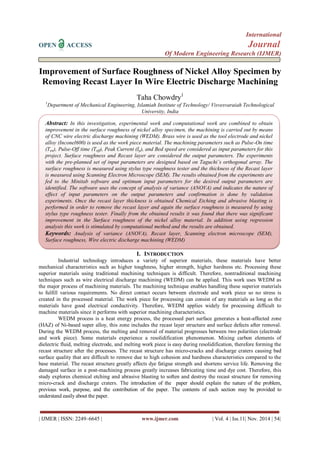
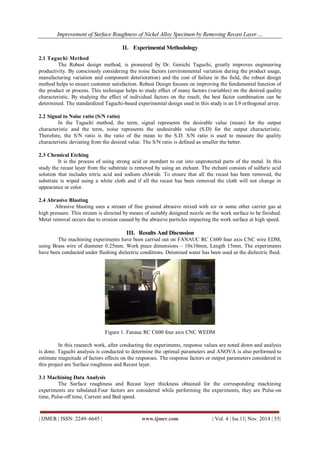
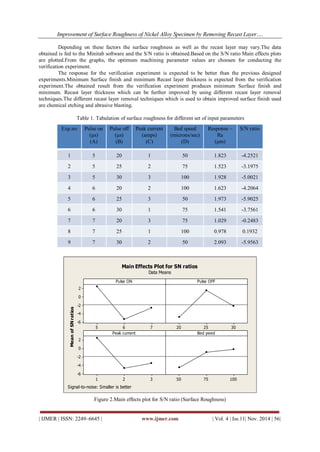
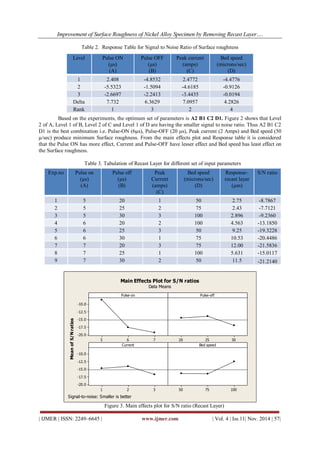
![Improvement of Surface Roughness of Nickel Alloy Specimen by Removing Recast Layer….
| IJMER | ISSN: 2249–6645 | www.ijmer.com | Vol. 4 | Iss.11| Nov. 2014 | 61|
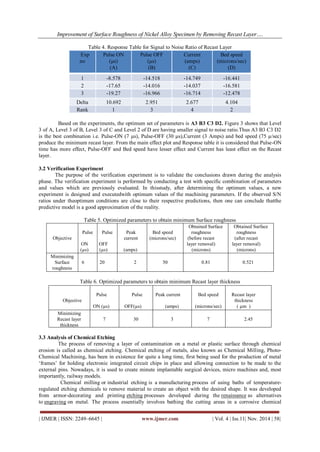
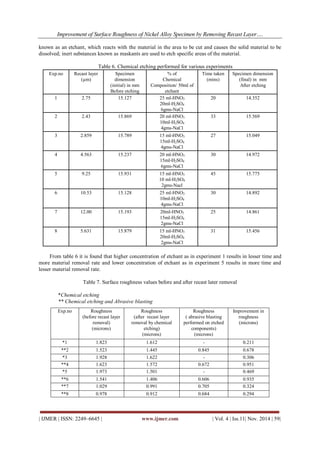
Fig 4.Comparison b/w Experimental and Predicted values of Surface roughness Fig 5.Comparison b/w Experimental and Predicted values of Recast layer
IV. Conclusion
From the results of machining experiments based on L9 orthogonal array and from the results of ANOVA analysis, it can be concluded that while machining the material Inconel-600 with FANUC RB C600 four axis CNC wire cut Electric Discharge Machine, the Pulse ON time has the major effect on Surface roughness and Recast layer thickness. The Pulse OFF time, Peak current and Bed speed have lesser effect on Surface roughness and Recast layer thickness From the regression analysis results, it can be concluded that the prediction of results or responses with minimum errors are possible using regression analysis with MINITAB and MATLAB software. REFRENCES [1] P C Pandey and H S Shan, Modern machining processes, Tata McGraw-Hill Education, 1st edition, New Delhi 1980. [2] P. K. Mishra, Non conventional machining, Hassan El-Hofy, Narosa Publishing House, New Delhi, 1997. [3] Yan-Cherng Lin, Optimization of machining parameters in magnetic force assisted EDM based on Taguchi method, Journal of Materials Processing Techonology 2009, pp 3374-3383.](https://image.slidesharecdn.com/h0401102-5462-141129033625-conversion-gate01/85/Improvement-of-Surface-Roughness-of-Nickel-Alloy-Specimen-by-Removing-Recast-Layer-In-Wire-Electric-Discharge-Machining-8-320.jpg)
![Improvement of Surface Roughness of Nickel Alloy Specimen by Removing Recast Layer….
| IJMER | ISSN: 2249–6645 | www.ijmer.com | Vol. 4 | Iss.11| Nov. 2014 | 62|
[4] Che-Chung Wang ,Recast layer removal after electric discharge machining via Taguchi analysis, Journal of Materials Processing Technology 2009, pp 4134-4140. [5] D.K Aspinwall, Workpiece roughness and integrity after WEDM of Ti-6Al-4V and Inconel-718 using minimum damage generator technology, Journal of Material Processing Technology 2008, pp 187-190. [6] Kung Ling Wu, Study on the characteristics of electric discharge machining using dielectric with surfactant, Journal of Material Processing Technology 2009, pp 3783-3789. [7] R. Ramakrishnana, L. Karunamoorthy, Modeling and multi-response optimization of Inconel 718 on machining of CNC WEDM process, Journal of Materials Processing Technology, 2008, pp 343–349. [8] H. Singh, R. Garg, Effects of process parameters on material removal rate in WEDM, Journal of Achievements in Materials and Manufacturing Engineering, Vol-32, Issue-1, 2009, pp 70-74. [9] Danial Ghodsiyeh, Abolfazl Golshan, Optimizing Finishing process in WED-Machining of Titanium Alloy (Ti6Al4V) by Zinc Coated Brass Wire based on Response Surface Methodology, Indian Journal of Science and Technology, ISSN:0974-6846, Vol.5, Issue.10, 2012, pp 3365-3376. [10] S. Sarkar, S. Mitra, I.K. Gomes and B. Bhattacharyya, Modeling and Optimization of Wire Electrical Discharge Machining In Single Pass Cutting Operation, Proceedings of the International Conference on Mechanical Engineering, Dhaka, Bangladesh,2005. [11] S. S. Mahapatra, Amar patnaik, Optimization of Wire Electric Discharge Machining Process Parameters Using Genetic Algorithm, Indian Journal of Engineering and Material Sciences, Vol. 13, 2006, pp 494-502. [12] A. B. Puri, B. Bhattacharyya, An Analysis and Optimisation of the Geometrical Inaccuracy Due to Wire Lag Phenomenon in WEDM, International Journal of Machine Tools & Manufacture, 2003, Vol. 2, pp 151-159. [13] Nihat Tosun, The Effects of the Cutting Parameters on Performance of WEDM, KSME International Journal, vol.17, No.6, 2003, pp 816-824. [14] M.S. Hewidy, T. A. El-Taweel, M. F. El-Safty, Modelling the machining parameters of wire electrical discharge machining of Inconel 601 using RSM, Journal of Materials Processing Technology, 2005, pp 328–336. [15] S. Sivakiran, C. Bhaskar Reddy, C. Eswara Reddy, Effect Of Process Parameters on MRR in Wire Electrical Discharge Machining of En-31 Steel, International Journal of Engineering Research and Applications, ISSN: 2248- 9622, Vol. 2, Issue. 6, 2012, pp 1221-1226. [16] Atul Kumar, Dr. D. K. Singh, Performance Analysis of Wire Electric Discharge Machining, International Journal of Engineering Research & Technology, Vol. 1, Issue. 4, 2012. [17] B J Ranganath, Thermal metal cutting process, New Delhi, India, I K International Publishing House Pvt. Ltd, 1st edition, 2008. [18] Phadke. M. S. Quality Engineering Using Robust Design, Prentice-Hall, EnglewoodCliffs, NJ, 1989. [19] Taguchi Genichi, Elsayed A Elsayed, Hsiang Thomas Quality Engineering In Production Systems, Mc Graw-Hill Book Company, New York, 1989. [20] Pujari Srinivasa Rao, Dr. Koona Ramji, Prediction of Material removal rate for Aluminum BIS-24345 Alloy in wire-cut EDM, International Journal of Engineering Science and Technology, Vol. 2, 2010, pp 7729- 7739.](https://image.slidesharecdn.com/h0401102-5462-141129033625-conversion-gate01/85/Improvement-of-Surface-Roughness-of-Nickel-Alloy-Specimen-by-Removing-Recast-Layer-In-Wire-Electric-Discharge-Machining-9-320.jpg)

This study investigates the improvement of surface roughness of nickel alloy specimens by removing the recast layer produced in wire electrical discharge machining (WEDM) using chemical etching and abrasive blasting. The effects of machining parameters such as pulse-on time, pulse-off time, peak current, and bed speed on surface quality were analyzed using Taguchi's experimental design and ANOVA. Results indicated that applying optimal parameters significantly enhanced surface roughness and reduced recast layer thickness, validated by verification experiments.


