International 
OPEN ACCESS Journal 
Of Modern Engineering Research (IJMER) 
| IJMER | ISSN: 2249–6645 | www.ijmer.com | Vol. 4 | Iss.10| Oct. 2014 | 75| 
Experimental Approach of CNC Drilling Operation for Mild Steel Using Taguchi Design G. Gangadhar1, Dr. S.Venkateswarlu2, C. Rajesh3 1PG scholar, Department of Mechanical Engineering, SKIT/JNTUA, INDIA) 2Assistant Professor, Department of Mechanical Engineering, SKIT/JNTUA, INDIA) 3Lecturer, Department of Mechanical Engineering, SKIT/JNTUA, INDIA) 
I. Introduction 
Manufacturing processes are technological methods to change raw material from its raw form to the final product. The suitability of materials for a certain process depends usually on a special combination of its properties. There are also special technological tests for certain manufacturing processes to assess the materials suitability of the process. Machining is the most important one among manufacturing process. Machining can be defined as the process of removing metal from the work piece in the form of chips. Machining is necessary where tight tolerances on dimensions and finishes are required. Any machine process requires a cutting tool to remove material. The cutting tool is stronger than the material being machined, and causes fracture of the material. 
Drilling is a process used to produce holes inside solid parts. The tool is rotated and also moved in the axial direction. Drilling is used to create a round hole. It is accomplished by a rotating tool that typically has two or four helical cutting edges. The tool is fed in a direction parallel to its axis of rotation into the work piece to form the round hole. Drilling operations are operations in which holes are produced or refined by bringing a rotating cutter with cutting edges at the lower extremity into contact with the work piece. Drilling operations are done primarily in drill presses but sometimes on lathes or mills. The goal is to improve efficiency, reduce costs, boost productivity, and minimize cycle time, while simultaneously safeguarding the work environment. Dry or near dry processes are the potential candidates to replace wet machining processes. Due to the development of machine design and drive technology, modern CNC machines can be described to an increasingly extent as a characteristic example of complex mechatronic systems. Manually operated type of drilling machine creates problems such as low accuracy, high setup time, low productivity, etc. A CNC machine overcomes all these problems but the main disadvantage of a CNC drilling machine is the high initial cost and requirement of skilled labor for operating the machine. Hence, there arises a need for a low cost CNC machine which can not only drill holes with high accuracy and low machining time but also have low initial cost. [1]. 
Abstract: Drilling is the most common (multi-point) cutting technique targeted for the production of small-diameter holes. Hole making is among the most important operations in manufacturing, and drilling is a major and common hole-making process in components. Productivity can be interpreted in terms of material removal rate in any machining operation. It is, therefore, essential to optimize quality and productivity simultaneously. Mild steel are soft, ductile, easily machined and is extensive used us a main engineering material in various industry such as air craft and aerospace industry. The Taguchi method is applied to formulate the experimental layout to ascertain the Element of impact each optimum process parameters for CNC drilling machining with drilling operation of mild steel. A total of 27 experimental runs were conducted using an orthogonal array, and the ideal combination of controllable factor levels was determined for the material removal rate, time of machining and circularity has been measured. Design optimization for quality was carried out and single to noise ratio and analysis of variance (ANOVA) were employed using experiment result to confirm effectiveness of this approach. 
Keywords: Mild steel, Taguchi, ANOVA, MRR, Circularity.
Experimental Approach of CNC Drilling Operation for Mild Steel Using Taguchi Design 
| IJMER | ISSN: 2249–6645 | www.ijmer.com | Vol. 4 | Iss.10| Oct. 2014 | 76| 
Machining requires attention to many details for a work piece to meet the specifications set out in the engineering drawings or blueprints. Besides the obvious problems related to correct dimensions, there is the problem of achieving the correct finish or surface smoothness on the work piece. The inferior finish found on the machined surface of a work piece may be caused by incorrect clamping, a dull tool, or inappropriate presentation of a tool. Frequently, this poor surface finish, known as chatter, is evident by an undulating or irregular finish, and the appearance of waves on the machined surfaces of the work piece. II. Literature Survey Out of the various machining processes, drilling is used to produce holes in materials etc. So in order to achieve the optimum working conditions various research were conducted by different researchers from across the globe. This report reviews some of the journal published by them regarding optimization processes. Yogendra Tyagi,Vadansh Chaturvedi and Jyoti Vimal [2] have conducted an experiment on drilling of mild steel, and applied the taguchi methods for determining the optimum parameters condition for the machining process using the taguchi methods and analysis of variance. Here too the confirmation experiment was conducted and this confirms the successful implementation of taguchi methods.Timur Canel,A. Ugur Kaya,Bekir Celik [3] studied the laser drilling on PVC material in order to increase the quality of the cavity. Taguchi optimization methods was used to obtain the optimum parameters. Taguchi L9 orthogonal array is used to find the signal to noise ratio is used for circularity. Variance analysis is performed usingthe calculated S/N ratio to conclude optimum stage. The experimental results are compatible with Taguchi method with 93% rate. Thiren G. Pokar,Prof. V. D. Patel[4] used grey based taguchi method to determine the optimum micro drilling process parameters.B.Shivapragash,K.Chandrasekaran,C.Parthasarathy,M.Samuel [5] have tried to optimize the drilling process involving metal matrix composites(MMC) in order to minimize the damage done to it during the process by using taguchi and grey rational analysis. The input parameter are spindle speed, depth of cut and feed rate whereas the output parameter are MRR and surface roughness. Wen Jialing and Wen Pengfei [6] used an orthogonal experimental design in order to find out the optimum process parameters for injection molding of aspheric plastic lens, to reduce volumetric shrinkage and volumetric shrinkage variation. III. Experimental Details 3.1 Work Piece Material Drilling operation will be performed on Mild steel work piece .mild steel are soft, ductile and easily machined The Composition of mild conation carbon (0.05%to0.3%) and small quantities of manganese (Mn), silicon (Si), phosphorus (P), sulphur (S). A rectangular mild steel plate of size (300 mm ×100mm ×5mm) in shaping machine for performing CNC drilling machine. Holy oil was used as the coolant fluid in this experiment .Young’s Modulus (210GPa), Poisson’s Ratio (0.29) Density (7.8g/cm³), Melting Point (140ºC) Modulus of elasticity (200GPa) Bulk Modulus (140GPa). 3.2 High Speed Steel One of our tools for the CNC drilling operation will be the high speed steel. High speed steel (HSS) are used for making drilling tools, we used tool diameter 10mm in the drilling machine and point angle is118º This property allows HSS to drilling faster than high carbon steel, hence the name high speed steel. At room temperature, in their generally recommended heat treatment, HSS grades generally display high hardness composition of high speed steel are carbon (0.6%to0.75%), tungsten (14%to20%),Chromium (3%to5%), Vanadium (1%to1.5%), Cobalt (5%to10%) and remaining is iron. 3.3 Plan of Experimental Design Design of experiment is the design of any information gathering experiment where variation is present, whether under full control of the experimenter or not. Taguchi methods are statistical method applied to problems in engineering, marketing etc. In this particular case we have used L27 orthogonal arrays with 3 input parameters at 3 levels each. Hence the total number of experimental runs is 27. Table 3.1: Input process parameters 
Factors 
Units 
Level 1 
Level 2 
Level 3 
Spindle Speed (S) 
rpm 
1000 
1500 
2000 
Feed (F) 
mm/rev 
0.5 
1.0 
150 
Drill tool point 
mm 
6.4 
8.8 
10
Experimental Approach of CNC Drilling Operation for Mild Steel Using Taguchi Design 
| IJMER | ISSN: 2249–6645 | www.ijmer.com | Vol. 4 | Iss.10| Oct. 2014 | 77| 
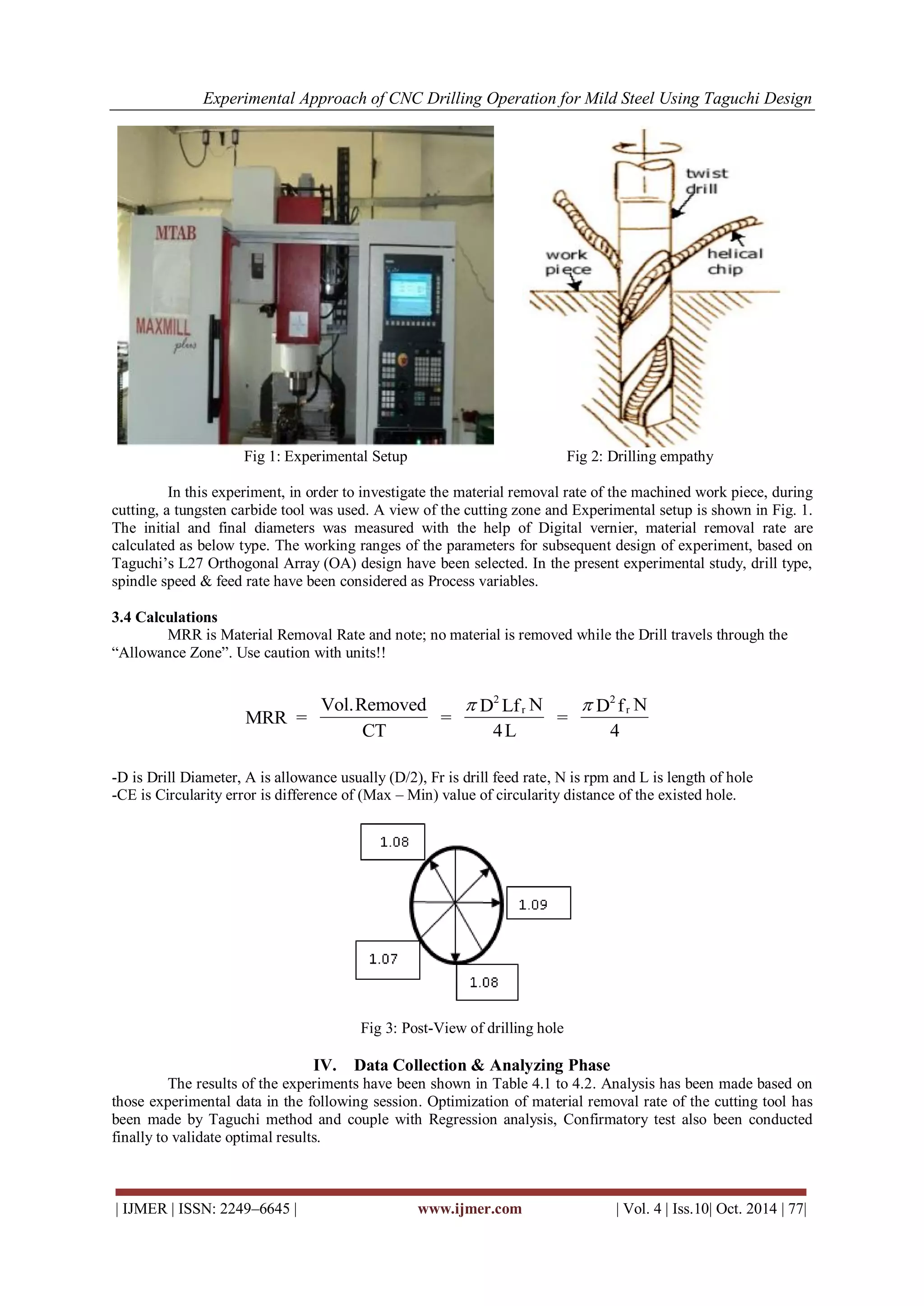
Fig 1: Experimental Setup Fig 2: Drilling empathy 
In this experiment, in order to investigate the material removal rate of the machined work piece, during 
cutting, a tungsten carbide tool was used. A view of the cutting zone and Experimental setup is shown in Fig. 1. 
The initial and final diameters was measured with the help of Digital vernier, material removal rate are 
calculated as below type. The working ranges of the parameters for subsequent design of experiment, based on 
Taguchi’s L27 Orthogonal Array (OA) design have been selected. In the present experimental study, drill type, 
spindle speed & feed rate have been considered as Process variables. 
3.4 Calculations 
MRR is Material Removal Rate and note; no material is removed while the Drill travels through the 
“Allowance Zone”. Use caution with units!! 
-D is Drill Diameter, A is allowance usually (D/2), Fr is drill feed rate, N is rpm and L is length of hole 
-CE is Circularity error is difference of (Max – Min) value of circularity distance of the existed hole. 
Fig 3: Post-View of drilling hole 
IV. Data Collection & Analyzing Phase 
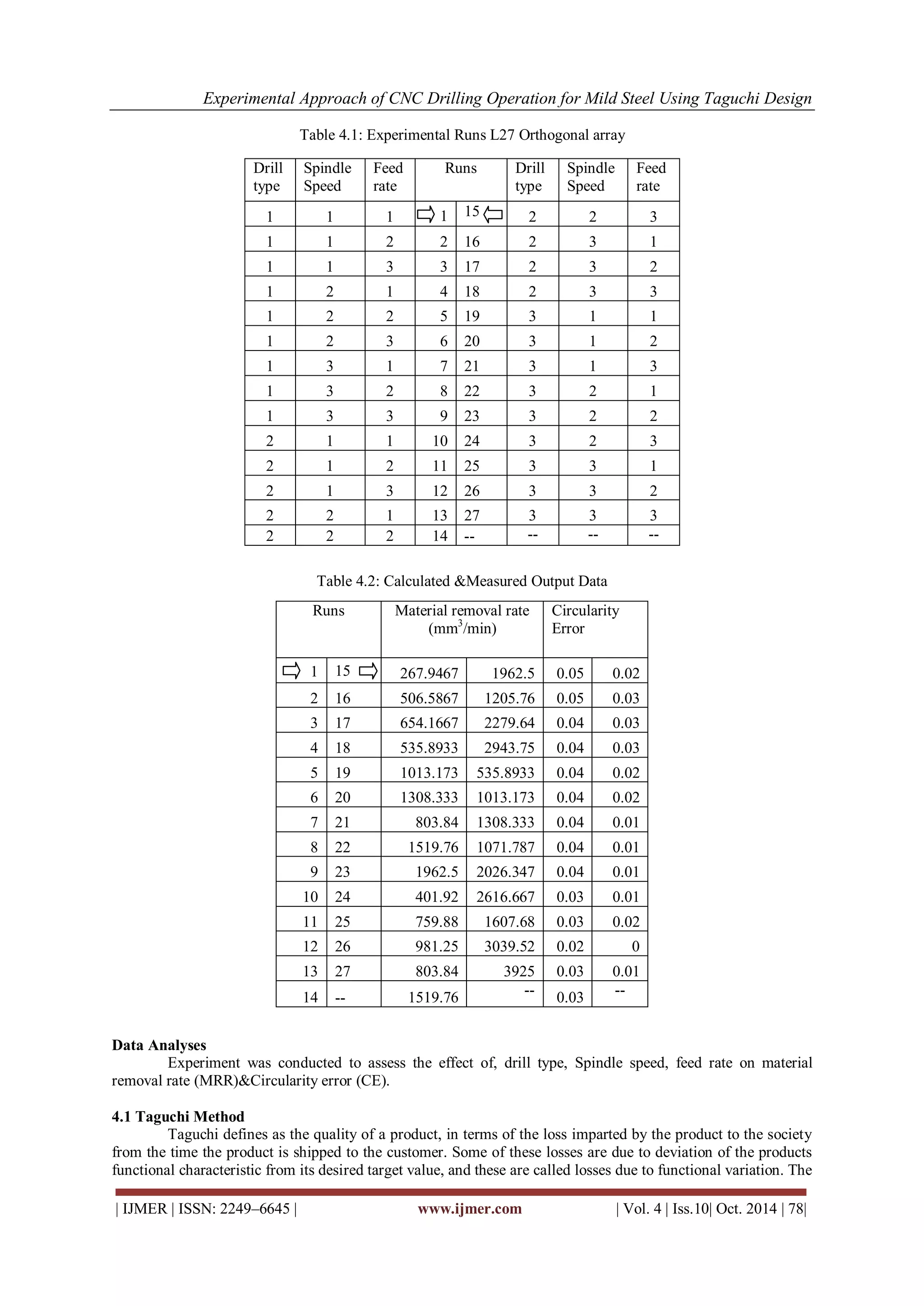
The results of the experiments have been shown in Table 4.1 to 4.2. Analysis has been made based on 
those experimental data in the following session. Optimization of material removal rate of the cutting tool has 
been made by Taguchi method and couple with Regression analysis, Confirmatory test also been conducted 
finally to validate optimal results. 
MRR = 
Vol.Removed 
CT 
= 
D Lf N 
4L 
= 
D f N 
4 
2 
r 
2 
  r
Experimental Approach of CNC Drilling Operation for Mild Steel Using Taguchi Design 
| IJMER | ISSN: 2249–6645 | www.ijmer.com | Vol. 4 | Iss.10| Oct. 2014 | 78| 
Table 4.1: Experimental Runs L27 Orthogonal array 
Table 4.2: Calculated &Measured Output Data 
Data Analyses Experiment was conducted to assess the effect of, drill type, Spindle speed, feed rate on material removal rate (MRR)&Circularity error (CE). 4.1 Taguchi Method 
Taguchi defines as the quality of a product, in terms of the loss imparted by the product to the society from the time the product is shipped to the customer. Some of these losses are due to deviation of the products functional characteristic from its desired target value, and these are called losses due to functional variation. The 
Drill type 
Spindle Speed 
Feed rate 
Runs 
Drill type 
Spindle Speed 
Feed rate 
1 
1 
1 
1 
15 
2 
2 
3 
1 
1 
2 
2 
16 
2 
3 
1 
1 
1 
3 
3 
17 
2 
3 
2 
1 
2 
1 
4 
18 
2 
3 
3 
1 
2 
2 
5 
19 
3 
1 
1 
1 
2 
3 
6 
20 
3 
1 
2 
1 
3 
1 
7 
21 
3 
1 
3 
1 
3 
2 
8 
22 
3 
2 
1 
1 
3 
3 
9 
23 
3 
2 
2 
2 
1 
1 
10 
24 
3 
2 
3 
2 
1 
2 
11 
25 
3 
3 
1 
2 
1 
3 
12 
26 
3 
3 
2 
2 
2 
1 
13 
27 
3 
3 
3 
2 
2 
2 
14 
-- 
-- 
-- 
-- 
Runs 
Material removal rate (mm3/min) 
Circularity Error 
1 
15 
267.9467 
1962.5 
0.05 
0.02 
2 
16 
506.5867 
1205.76 
0.05 
0.03 
3 
17 
654.1667 
2279.64 
0.04 
0.03 
4 
18 
535.8933 
2943.75 
0.04 
0.03 
5 
19 
1013.173 
535.8933 
0.04 
0.02 
6 
20 
1308.333 
1013.173 
0.04 
0.02 
7 
21 
803.84 
1308.333 
0.04 
0.01 
8 
22 
1519.76 
1071.787 
0.04 
0.01 
9 
23 
1962.5 
2026.347 
0.04 
0.01 
10 
24 
401.92 
2616.667 
0.03 
0.01 
11 
25 
759.88 
1607.68 
0.03 
0.02 
12 
26 
981.25 
3039.52 
0.02 
0 
13 
27 
803.84 
3925 
0.03 
0.01 
14 
-- 
1519.76 
-- 
0.03 
--
Experimental Approach of CNC Drilling Operation for Mild Steel Using Taguchi Design 
| IJMER | ISSN: 2249–6645 | www.ijmer.com | Vol. 4 | Iss.10| Oct. 2014 | 79| 
uncontrollable factors, which cause the functional characteristics of a product to deviate from their target values, 
are called noise factors, which can be classified as external factors (e.g. unit to unit variation in product 
parameters) and product deterioration. The overall aim of quality engineering is to make products that are robust 
with respect to all noise factors. 
Taguchi has empirically found that the two stage optimization procedure involving S/N ratios, indeed 
gives the parameter level combination, where the standard deviation is minimum while keeping the mean on 
target. This implies that engineering systems behave in such a way that the manipulated production factors that 
can be divided into three categories: 
1. Control factors, which affect process variability as measured by the S/N ratio. 
2. Signal factors, which do not influence the S/N ratio or process mean. 
3. Factors, which do not affect the S/N ratio or process mean. 
In practice, the target mean value may change during the process development applications in which 
the concept of S/N ratio is useful are the improvement of quality through variability reduction and the 
improvement of measurement. The S/N ratio characteristics can be divided into three categories when the 
characteristic is continuous: nominal is the best, smaller the better and larger is better characteristics. 
The analysis is made with the help of a software package MINITAB 16. The main effect plot and SNR 
plots are shown inFig.1 and 2.These show the variation of individual response with the three parameters i.e. 
Speed, feed, and depth of cut separately. In the plots, the x-axis indicates the value of each process parameter at 
three level and y-axis the response value. Horizontal line indicates the mean value of the response. The signal-to- 
noise ratio plots are used to determine the optimal design conditions to obtain the optimum MRR and 
CE.Fig.3and4shows the main effect plot and SNR plot for Circularity Error. 
1000 1500 2000 
2000 
1500 
1000 
0.5 1.0 1.5 
6.4 8.8 10.0 
2000 
1500 
1000 
speed 
Mean of Means 
feed 
drill dia 
Main Effects Plot for Means 
Data Means 
1000 1500 2000 
65.0 
62.5 
60.0 
57.5 
55.0 
0.5 1.0 1.5 
6.4 8.8 10.0 
65.0 
62.5 
60.0 
57.5 
55.0 
speed 
Mean of SN ratios 
feed 
drill dia 
Main Effects Plot for SN ratios 
Data Means 
Signal-to-noise: Larger is better 
Fig.1 Main effect plot for MRR Fig.2 SNR plot for MRR 
1000 1500 2000 
0.04 
0.03 
0.02 
0.01 
0.5 1.0 1.5 
6.4 8.8 10.0 
0.04 
0.03 
0.02 
0.01 
speed 
Mean of Means 
feed 
drill dia 
Main Effects Plot for Means 
Data Means 
1000 1500 2000 
39 
36 
33 
30 
27 
0.5 1.0 1.5 
6.4 8.8 10.0 
39 
36 
33 
30 
27 
speed 
Mean of SN ratios 
feed 
drill dia 
Main Effects Plot for SN ratios 
Data Means 
Signal-to-noise: Smaller is better 
Fig.3 Main effect plot for CE Fig.4 SNR plot for CE
Experimental Approach of CNC Drilling Operation for Mild Steel Using Taguchi Design 
| IJMER | ISSN: 2249–6645 | www.ijmer.com | Vol. 4 | Iss.10| Oct. 2014 | 80| 
Table 4.3: Optimal turning conditions 
4.2 Analysis Of Variance The non-linear behavior among the process parameters, IF EXISTS, If can only be revealed if more than two levels of the parameter are investigated. Therefore each parameter was analyzed at three levels. The assignment of process parameters along with their values at three levels are given in table 4.4&4.5. In order to remove the biased-ness each experiment was conducted for a fixed duration. It was also decided to investigate the following two factor interaction effects on Material removal rate and Circularity error. 
(i) Interaction between drill type and spindle speed (AxB) 
(ii) Interaction between spindle speed and feed rate (BxC) 
(iii) Interaction between drill type and spindle speed (AXC) 
The total degree of freedom for three parameters each at three levels and three second order interactions is 18. So a three level OA with at least 18 DOF was to be selected. The L27 OA having 26 DOF was selected for the present work. ANOVA Terms & Notations: D.F =Degree of Freedom, S.S = Sum of Squares, M.S = Mean Square, F =Variance Ratio & C = Percentage Contribution. Table 4.4: ANOVA result for Material removal rate (MRR) [95% confidence level] 
SOURCE 
DOF 
S.S 
M.S 
F 
C% 
(S) 
2 
4082367 
2041184 
14.11582 
19.91233 
(F) 
2 
9185327 
4592663 
31.7606 
44.80274 
(D) 
2 
6153159 
3076580 
21.27611 
30.01291 
SXF 
4 
340197.3 
85049.32 
0.588159 
1.659361 
SXD 
4 
227894.8 
56973.7 
0.394002 
1.111589 
FXD 
4 
512763.3 
128190.8 
0.886505 
2.501076 
ERROR 
8 
1156820 
144602.5 
TOTAL 
26 
20501709 
100 
Table 4.5: ANOVA result for Circularity Error (CE) [95% confidence level] 
SOURCE 
DOF 
S.S 
M.S 
F 
C% 
(S) 
2 
0.004052 
0.0020259 
78.1429 
89.8215884 
(F) 
2 
9.63E-05 
0.0000482 
1.85714 
2.13469954 
(D) 
2 
0.000141 
0.0000704 
2.71429 
3.11994548 
SXF 
4 
5.19E-05 
0.000013 
0.5 
1.1494536 
SXD 
4 
5.19E-05 
0.000013 
0.5 
1.1494536 
FXD 
4 
0.000119 
0.0000296 
1.14286 
2.62732251 
ERROR 
8 
0.000207 
0.0000259 
TOTAL 
26 
0.004511 
100 
From ANOVA table for Material removal rate it is clears that feed (44.80%) is the major factor to be selected effectively to get the Maximum Material removal rate. The interaction FXD (2.51%) has more influence than other two interactions. For Circularity Error, speed (89.82%) is the major factor to be selected to get Min- Circularity Error of the drilledholes. The interaction FXD (2.62%) has more influence than other two interactions. 4.3 Calculations Of Optimum MRR&CE. Let T’ = average result for 9 runs of MRR T’ = 1428.7 
MRROPT = T’+ (A3 – T’) + (B3-T’) + (C3-T’) [7] 
Responses 
Best-Levels 
MRR 
3-3-3 
CE 
3-2-3
Experimental Approach of CNC Drilling Operation for Mild Steel Using Taguchi Design 
| IJMER | ISSN: 2249–6645 | www.ijmer.com | Vol. 4 | Iss.10| Oct. 2014 | 81| 
= 1904.933+2143.05+1962.5- 2x1428.7 MRROPT = 3153.083 mm3/min T’ = 0.027407 
CEOPT = T’+ (A3 – T’) + (B2-T’) + (C3-T’) [Ross, 1988] = 0.012222+0.025556+0.024444- 2x0.027407 CEOPT = 0.007407 mm Table 4.6: Optimal Drilling Conditions & Pin Point Optimal Value 
V. Conclusion The machining of mild steels is relatively easy and high if there is no built-up edge or material adhesion problem. However, some problems may arise with the chip form and particle emissions. To develop a rigid and robust drilling machine following are the some concluded points must be taken into considerations: 1) Cutting parameters are to be optimized for producing holes with require quality. 2) Material removal rate (MRR) decreases when spindle speed, feed and tool diameter decrease. 3) CircularityError is mostly affected by spindle speed and feed rates. If the value of spindlespeed and feed rate increase, Error will also increase. 4) Increased Spindle speed, feed rate and tool diameter increases the quality of hole. REFERENCES [1] P.N.RAO., Manufacturing technology Vol: 1 3rd edition, Tata McGraw-hill publishing companies, LTD, (2009). [2] Yogendra Tyagi,Vedansh Chaturvedi,Jyoti Vimal “Parametric optimization of CNC Drilling machine for mild steel using Taguchi design and Signal to Noise ratio Analysis” International Journal of Engineering Science and Technology (IJEST)Volume 4 No-8 August 2012. [3] Timur Canel,A. Ugur Kaya,Bekir Celik “Parameter optimization of nanosecond laser for micro drilling on PVC by Taguchi method” Optics and laser technology 44 (2012) 2347-2353. [4] Thiren G. Pokar,Prof. V. D. Patel “Optimization and modeling of micro drilling process parameters” IJMER Vol. 1, Issue 2, March 2013 [5] B.Shivapragash,K.Chandrasekaram,C.Parthasarathy,M.Samuel “Multiple response optimization in drilling using taguchi and grey relational analysis” (IJMER) Vol. 3, Issue 2, March April 2013,pp-765-768. [6] Wen Jialing and Wen Pengfei “The simulation and optimization of aspheric plastic lens injection molding”. Vol.20 No. 2 Journal of Wuhan University of Technology Jun 2005 Taguchi G. System of experimental design. IEEE J 1987; 33:1106–13 [7] Amit Joshi, Pradeep Kothiyal, Ruby Pant International Journal of Applied Engineering Research, ISSN 0973-4562 Vol.7 No.11 (2012) © Research India Publications. [8] J.Pradeep Kumar, P. Packiaraj International Journal of Advanced Engineering Research and Studies E-ISSN2249– 8974. [9] http://en.wikipedia.org/wiki/Drilling [10]. Metal cutting technical guide (E) Drilling 
Response 
S 
F 
D 
Optimal value 
MRR(mm3/min) 
A3 
B3 
C3 
3153.083 
CE( mm) 
A3 
B2 
C3 
0.007407

Experimental Approach of CNC Drilling Operation for Mild Steel Using Taguchi Design

  • 1.
    International OPEN ACCESSJournal Of Modern Engineering Research (IJMER) | IJMER | ISSN: 2249–6645 | www.ijmer.com | Vol. 4 | Iss.10| Oct. 2014 | 75| Experimental Approach of CNC Drilling Operation for Mild Steel Using Taguchi Design G. Gangadhar1, Dr. S.Venkateswarlu2, C. Rajesh3 1PG scholar, Department of Mechanical Engineering, SKIT/JNTUA, INDIA) 2Assistant Professor, Department of Mechanical Engineering, SKIT/JNTUA, INDIA) 3Lecturer, Department of Mechanical Engineering, SKIT/JNTUA, INDIA) I. Introduction Manufacturing processes are technological methods to change raw material from its raw form to the final product. The suitability of materials for a certain process depends usually on a special combination of its properties. There are also special technological tests for certain manufacturing processes to assess the materials suitability of the process. Machining is the most important one among manufacturing process. Machining can be defined as the process of removing metal from the work piece in the form of chips. Machining is necessary where tight tolerances on dimensions and finishes are required. Any machine process requires a cutting tool to remove material. The cutting tool is stronger than the material being machined, and causes fracture of the material. Drilling is a process used to produce holes inside solid parts. The tool is rotated and also moved in the axial direction. Drilling is used to create a round hole. It is accomplished by a rotating tool that typically has two or four helical cutting edges. The tool is fed in a direction parallel to its axis of rotation into the work piece to form the round hole. Drilling operations are operations in which holes are produced or refined by bringing a rotating cutter with cutting edges at the lower extremity into contact with the work piece. Drilling operations are done primarily in drill presses but sometimes on lathes or mills. The goal is to improve efficiency, reduce costs, boost productivity, and minimize cycle time, while simultaneously safeguarding the work environment. Dry or near dry processes are the potential candidates to replace wet machining processes. Due to the development of machine design and drive technology, modern CNC machines can be described to an increasingly extent as a characteristic example of complex mechatronic systems. Manually operated type of drilling machine creates problems such as low accuracy, high setup time, low productivity, etc. A CNC machine overcomes all these problems but the main disadvantage of a CNC drilling machine is the high initial cost and requirement of skilled labor for operating the machine. Hence, there arises a need for a low cost CNC machine which can not only drill holes with high accuracy and low machining time but also have low initial cost. [1]. Abstract: Drilling is the most common (multi-point) cutting technique targeted for the production of small-diameter holes. Hole making is among the most important operations in manufacturing, and drilling is a major and common hole-making process in components. Productivity can be interpreted in terms of material removal rate in any machining operation. It is, therefore, essential to optimize quality and productivity simultaneously. Mild steel are soft, ductile, easily machined and is extensive used us a main engineering material in various industry such as air craft and aerospace industry. The Taguchi method is applied to formulate the experimental layout to ascertain the Element of impact each optimum process parameters for CNC drilling machining with drilling operation of mild steel. A total of 27 experimental runs were conducted using an orthogonal array, and the ideal combination of controllable factor levels was determined for the material removal rate, time of machining and circularity has been measured. Design optimization for quality was carried out and single to noise ratio and analysis of variance (ANOVA) were employed using experiment result to confirm effectiveness of this approach. Keywords: Mild steel, Taguchi, ANOVA, MRR, Circularity.
  • 2.
    Experimental Approach ofCNC Drilling Operation for Mild Steel Using Taguchi Design | IJMER | ISSN: 2249–6645 | www.ijmer.com | Vol. 4 | Iss.10| Oct. 2014 | 76| Machining requires attention to many details for a work piece to meet the specifications set out in the engineering drawings or blueprints. Besides the obvious problems related to correct dimensions, there is the problem of achieving the correct finish or surface smoothness on the work piece. The inferior finish found on the machined surface of a work piece may be caused by incorrect clamping, a dull tool, or inappropriate presentation of a tool. Frequently, this poor surface finish, known as chatter, is evident by an undulating or irregular finish, and the appearance of waves on the machined surfaces of the work piece. II. Literature Survey Out of the various machining processes, drilling is used to produce holes in materials etc. So in order to achieve the optimum working conditions various research were conducted by different researchers from across the globe. This report reviews some of the journal published by them regarding optimization processes. Yogendra Tyagi,Vadansh Chaturvedi and Jyoti Vimal [2] have conducted an experiment on drilling of mild steel, and applied the taguchi methods for determining the optimum parameters condition for the machining process using the taguchi methods and analysis of variance. Here too the confirmation experiment was conducted and this confirms the successful implementation of taguchi methods.Timur Canel,A. Ugur Kaya,Bekir Celik [3] studied the laser drilling on PVC material in order to increase the quality of the cavity. Taguchi optimization methods was used to obtain the optimum parameters. Taguchi L9 orthogonal array is used to find the signal to noise ratio is used for circularity. Variance analysis is performed usingthe calculated S/N ratio to conclude optimum stage. The experimental results are compatible with Taguchi method with 93% rate. Thiren G. Pokar,Prof. V. D. Patel[4] used grey based taguchi method to determine the optimum micro drilling process parameters.B.Shivapragash,K.Chandrasekaran,C.Parthasarathy,M.Samuel [5] have tried to optimize the drilling process involving metal matrix composites(MMC) in order to minimize the damage done to it during the process by using taguchi and grey rational analysis. The input parameter are spindle speed, depth of cut and feed rate whereas the output parameter are MRR and surface roughness. Wen Jialing and Wen Pengfei [6] used an orthogonal experimental design in order to find out the optimum process parameters for injection molding of aspheric plastic lens, to reduce volumetric shrinkage and volumetric shrinkage variation. III. Experimental Details 3.1 Work Piece Material Drilling operation will be performed on Mild steel work piece .mild steel are soft, ductile and easily machined The Composition of mild conation carbon (0.05%to0.3%) and small quantities of manganese (Mn), silicon (Si), phosphorus (P), sulphur (S). A rectangular mild steel plate of size (300 mm ×100mm ×5mm) in shaping machine for performing CNC drilling machine. Holy oil was used as the coolant fluid in this experiment .Young’s Modulus (210GPa), Poisson’s Ratio (0.29) Density (7.8g/cm³), Melting Point (140ºC) Modulus of elasticity (200GPa) Bulk Modulus (140GPa). 3.2 High Speed Steel One of our tools for the CNC drilling operation will be the high speed steel. High speed steel (HSS) are used for making drilling tools, we used tool diameter 10mm in the drilling machine and point angle is118º This property allows HSS to drilling faster than high carbon steel, hence the name high speed steel. At room temperature, in their generally recommended heat treatment, HSS grades generally display high hardness composition of high speed steel are carbon (0.6%to0.75%), tungsten (14%to20%),Chromium (3%to5%), Vanadium (1%to1.5%), Cobalt (5%to10%) and remaining is iron. 3.3 Plan of Experimental Design Design of experiment is the design of any information gathering experiment where variation is present, whether under full control of the experimenter or not. Taguchi methods are statistical method applied to problems in engineering, marketing etc. In this particular case we have used L27 orthogonal arrays with 3 input parameters at 3 levels each. Hence the total number of experimental runs is 27. Table 3.1: Input process parameters Factors Units Level 1 Level 2 Level 3 Spindle Speed (S) rpm 1000 1500 2000 Feed (F) mm/rev 0.5 1.0 150 Drill tool point mm 6.4 8.8 10
  • 3.
    Experimental Approach ofCNC Drilling Operation for Mild Steel Using Taguchi Design | IJMER | ISSN: 2249–6645 | www.ijmer.com | Vol. 4 | Iss.10| Oct. 2014 | 77| Fig 1: Experimental Setup Fig 2: Drilling empathy In this experiment, in order to investigate the material removal rate of the machined work piece, during cutting, a tungsten carbide tool was used. A view of the cutting zone and Experimental setup is shown in Fig. 1. The initial and final diameters was measured with the help of Digital vernier, material removal rate are calculated as below type. The working ranges of the parameters for subsequent design of experiment, based on Taguchi’s L27 Orthogonal Array (OA) design have been selected. In the present experimental study, drill type, spindle speed & feed rate have been considered as Process variables. 3.4 Calculations MRR is Material Removal Rate and note; no material is removed while the Drill travels through the “Allowance Zone”. Use caution with units!! -D is Drill Diameter, A is allowance usually (D/2), Fr is drill feed rate, N is rpm and L is length of hole -CE is Circularity error is difference of (Max – Min) value of circularity distance of the existed hole. Fig 3: Post-View of drilling hole IV. Data Collection & Analyzing Phase The results of the experiments have been shown in Table 4.1 to 4.2. Analysis has been made based on those experimental data in the following session. Optimization of material removal rate of the cutting tool has been made by Taguchi method and couple with Regression analysis, Confirmatory test also been conducted finally to validate optimal results. MRR = Vol.Removed CT = D Lf N 4L = D f N 4 2 r 2   r
  • 4.
    Experimental Approach ofCNC Drilling Operation for Mild Steel Using Taguchi Design | IJMER | ISSN: 2249–6645 | www.ijmer.com | Vol. 4 | Iss.10| Oct. 2014 | 78| Table 4.1: Experimental Runs L27 Orthogonal array Table 4.2: Calculated &Measured Output Data Data Analyses Experiment was conducted to assess the effect of, drill type, Spindle speed, feed rate on material removal rate (MRR)&Circularity error (CE). 4.1 Taguchi Method Taguchi defines as the quality of a product, in terms of the loss imparted by the product to the society from the time the product is shipped to the customer. Some of these losses are due to deviation of the products functional characteristic from its desired target value, and these are called losses due to functional variation. The Drill type Spindle Speed Feed rate Runs Drill type Spindle Speed Feed rate 1 1 1 1 15 2 2 3 1 1 2 2 16 2 3 1 1 1 3 3 17 2 3 2 1 2 1 4 18 2 3 3 1 2 2 5 19 3 1 1 1 2 3 6 20 3 1 2 1 3 1 7 21 3 1 3 1 3 2 8 22 3 2 1 1 3 3 9 23 3 2 2 2 1 1 10 24 3 2 3 2 1 2 11 25 3 3 1 2 1 3 12 26 3 3 2 2 2 1 13 27 3 3 3 2 2 2 14 -- -- -- -- Runs Material removal rate (mm3/min) Circularity Error 1 15 267.9467 1962.5 0.05 0.02 2 16 506.5867 1205.76 0.05 0.03 3 17 654.1667 2279.64 0.04 0.03 4 18 535.8933 2943.75 0.04 0.03 5 19 1013.173 535.8933 0.04 0.02 6 20 1308.333 1013.173 0.04 0.02 7 21 803.84 1308.333 0.04 0.01 8 22 1519.76 1071.787 0.04 0.01 9 23 1962.5 2026.347 0.04 0.01 10 24 401.92 2616.667 0.03 0.01 11 25 759.88 1607.68 0.03 0.02 12 26 981.25 3039.52 0.02 0 13 27 803.84 3925 0.03 0.01 14 -- 1519.76 -- 0.03 --
  • 5.
    Experimental Approach ofCNC Drilling Operation for Mild Steel Using Taguchi Design | IJMER | ISSN: 2249–6645 | www.ijmer.com | Vol. 4 | Iss.10| Oct. 2014 | 79| uncontrollable factors, which cause the functional characteristics of a product to deviate from their target values, are called noise factors, which can be classified as external factors (e.g. unit to unit variation in product parameters) and product deterioration. The overall aim of quality engineering is to make products that are robust with respect to all noise factors. Taguchi has empirically found that the two stage optimization procedure involving S/N ratios, indeed gives the parameter level combination, where the standard deviation is minimum while keeping the mean on target. This implies that engineering systems behave in such a way that the manipulated production factors that can be divided into three categories: 1. Control factors, which affect process variability as measured by the S/N ratio. 2. Signal factors, which do not influence the S/N ratio or process mean. 3. Factors, which do not affect the S/N ratio or process mean. In practice, the target mean value may change during the process development applications in which the concept of S/N ratio is useful are the improvement of quality through variability reduction and the improvement of measurement. The S/N ratio characteristics can be divided into three categories when the characteristic is continuous: nominal is the best, smaller the better and larger is better characteristics. The analysis is made with the help of a software package MINITAB 16. The main effect plot and SNR plots are shown inFig.1 and 2.These show the variation of individual response with the three parameters i.e. Speed, feed, and depth of cut separately. In the plots, the x-axis indicates the value of each process parameter at three level and y-axis the response value. Horizontal line indicates the mean value of the response. The signal-to- noise ratio plots are used to determine the optimal design conditions to obtain the optimum MRR and CE.Fig.3and4shows the main effect plot and SNR plot for Circularity Error. 1000 1500 2000 2000 1500 1000 0.5 1.0 1.5 6.4 8.8 10.0 2000 1500 1000 speed Mean of Means feed drill dia Main Effects Plot for Means Data Means 1000 1500 2000 65.0 62.5 60.0 57.5 55.0 0.5 1.0 1.5 6.4 8.8 10.0 65.0 62.5 60.0 57.5 55.0 speed Mean of SN ratios feed drill dia Main Effects Plot for SN ratios Data Means Signal-to-noise: Larger is better Fig.1 Main effect plot for MRR Fig.2 SNR plot for MRR 1000 1500 2000 0.04 0.03 0.02 0.01 0.5 1.0 1.5 6.4 8.8 10.0 0.04 0.03 0.02 0.01 speed Mean of Means feed drill dia Main Effects Plot for Means Data Means 1000 1500 2000 39 36 33 30 27 0.5 1.0 1.5 6.4 8.8 10.0 39 36 33 30 27 speed Mean of SN ratios feed drill dia Main Effects Plot for SN ratios Data Means Signal-to-noise: Smaller is better Fig.3 Main effect plot for CE Fig.4 SNR plot for CE
  • 6.
    Experimental Approach ofCNC Drilling Operation for Mild Steel Using Taguchi Design | IJMER | ISSN: 2249–6645 | www.ijmer.com | Vol. 4 | Iss.10| Oct. 2014 | 80| Table 4.3: Optimal turning conditions 4.2 Analysis Of Variance The non-linear behavior among the process parameters, IF EXISTS, If can only be revealed if more than two levels of the parameter are investigated. Therefore each parameter was analyzed at three levels. The assignment of process parameters along with their values at three levels are given in table 4.4&4.5. In order to remove the biased-ness each experiment was conducted for a fixed duration. It was also decided to investigate the following two factor interaction effects on Material removal rate and Circularity error. (i) Interaction between drill type and spindle speed (AxB) (ii) Interaction between spindle speed and feed rate (BxC) (iii) Interaction between drill type and spindle speed (AXC) The total degree of freedom for three parameters each at three levels and three second order interactions is 18. So a three level OA with at least 18 DOF was to be selected. The L27 OA having 26 DOF was selected for the present work. ANOVA Terms & Notations: D.F =Degree of Freedom, S.S = Sum of Squares, M.S = Mean Square, F =Variance Ratio & C = Percentage Contribution. Table 4.4: ANOVA result for Material removal rate (MRR) [95% confidence level] SOURCE DOF S.S M.S F C% (S) 2 4082367 2041184 14.11582 19.91233 (F) 2 9185327 4592663 31.7606 44.80274 (D) 2 6153159 3076580 21.27611 30.01291 SXF 4 340197.3 85049.32 0.588159 1.659361 SXD 4 227894.8 56973.7 0.394002 1.111589 FXD 4 512763.3 128190.8 0.886505 2.501076 ERROR 8 1156820 144602.5 TOTAL 26 20501709 100 Table 4.5: ANOVA result for Circularity Error (CE) [95% confidence level] SOURCE DOF S.S M.S F C% (S) 2 0.004052 0.0020259 78.1429 89.8215884 (F) 2 9.63E-05 0.0000482 1.85714 2.13469954 (D) 2 0.000141 0.0000704 2.71429 3.11994548 SXF 4 5.19E-05 0.000013 0.5 1.1494536 SXD 4 5.19E-05 0.000013 0.5 1.1494536 FXD 4 0.000119 0.0000296 1.14286 2.62732251 ERROR 8 0.000207 0.0000259 TOTAL 26 0.004511 100 From ANOVA table for Material removal rate it is clears that feed (44.80%) is the major factor to be selected effectively to get the Maximum Material removal rate. The interaction FXD (2.51%) has more influence than other two interactions. For Circularity Error, speed (89.82%) is the major factor to be selected to get Min- Circularity Error of the drilledholes. The interaction FXD (2.62%) has more influence than other two interactions. 4.3 Calculations Of Optimum MRR&CE. Let T’ = average result for 9 runs of MRR T’ = 1428.7 MRROPT = T’+ (A3 – T’) + (B3-T’) + (C3-T’) [7] Responses Best-Levels MRR 3-3-3 CE 3-2-3
  • 7.
    Experimental Approach ofCNC Drilling Operation for Mild Steel Using Taguchi Design | IJMER | ISSN: 2249–6645 | www.ijmer.com | Vol. 4 | Iss.10| Oct. 2014 | 81| = 1904.933+2143.05+1962.5- 2x1428.7 MRROPT = 3153.083 mm3/min T’ = 0.027407 CEOPT = T’+ (A3 – T’) + (B2-T’) + (C3-T’) [Ross, 1988] = 0.012222+0.025556+0.024444- 2x0.027407 CEOPT = 0.007407 mm Table 4.6: Optimal Drilling Conditions & Pin Point Optimal Value V. Conclusion The machining of mild steels is relatively easy and high if there is no built-up edge or material adhesion problem. However, some problems may arise with the chip form and particle emissions. To develop a rigid and robust drilling machine following are the some concluded points must be taken into considerations: 1) Cutting parameters are to be optimized for producing holes with require quality. 2) Material removal rate (MRR) decreases when spindle speed, feed and tool diameter decrease. 3) CircularityError is mostly affected by spindle speed and feed rates. If the value of spindlespeed and feed rate increase, Error will also increase. 4) Increased Spindle speed, feed rate and tool diameter increases the quality of hole. REFERENCES [1] P.N.RAO., Manufacturing technology Vol: 1 3rd edition, Tata McGraw-hill publishing companies, LTD, (2009). [2] Yogendra Tyagi,Vedansh Chaturvedi,Jyoti Vimal “Parametric optimization of CNC Drilling machine for mild steel using Taguchi design and Signal to Noise ratio Analysis” International Journal of Engineering Science and Technology (IJEST)Volume 4 No-8 August 2012. [3] Timur Canel,A. Ugur Kaya,Bekir Celik “Parameter optimization of nanosecond laser for micro drilling on PVC by Taguchi method” Optics and laser technology 44 (2012) 2347-2353. [4] Thiren G. Pokar,Prof. V. D. Patel “Optimization and modeling of micro drilling process parameters” IJMER Vol. 1, Issue 2, March 2013 [5] B.Shivapragash,K.Chandrasekaram,C.Parthasarathy,M.Samuel “Multiple response optimization in drilling using taguchi and grey relational analysis” (IJMER) Vol. 3, Issue 2, March April 2013,pp-765-768. [6] Wen Jialing and Wen Pengfei “The simulation and optimization of aspheric plastic lens injection molding”. Vol.20 No. 2 Journal of Wuhan University of Technology Jun 2005 Taguchi G. System of experimental design. IEEE J 1987; 33:1106–13 [7] Amit Joshi, Pradeep Kothiyal, Ruby Pant International Journal of Applied Engineering Research, ISSN 0973-4562 Vol.7 No.11 (2012) © Research India Publications. [8] J.Pradeep Kumar, P. Packiaraj International Journal of Advanced Engineering Research and Studies E-ISSN2249– 8974. [9] http://en.wikipedia.org/wiki/Drilling [10]. Metal cutting technical guide (E) Drilling Response S F D Optimal value MRR(mm3/min) A3 B3 C3 3153.083 CE( mm) A3 B2 C3 0.007407