International Journal of Modern Engineering Research (IJMER)
                www.ijmer.com          Vol.3, Issue.1, Jan-Feb. 2013 pp-580-586      ISSN: 2249-6645


             Investigation on Behaviour of Fly Ash Based Geopolymer
                          Concrete in Acidic Environment
                               Mr. K. Madhan Gopal, 1 Mr. B. Naga Kiran2
                         Assistant Professor, Department of civil Engg. RGMCET, Nandyal, India-518 501.

Abstract: Geopolymer concrete results from the reaction of a source material that is rich in silica and alumina with
alkaline liquid. The term geopolymer was introduced by Davidovits; geopolymers are members of the family of inorganic
polymers. Geopolymer binders have been reported as being acid resistant and thus are promising and alternative binders for
sewer pipe manufacture. This paper presents experimental data on the Behavior of fly ash based geopolymer concrete
exposed to 5% acid solutions for up to 4 weeks. A class F fly ash based geopolymer concrete was initially cured for 24 hours
at 60°C. And also the obtained results were compared with the conventional concrete exposed to 5% acid solutions for up to
4 weeks. The compressive strength of geopolymer concrete and conventional concrete of 150-mm cubes at an age of 28 days
were 32MPa and 48.5MPa, respectively. Initially concrete cubes were cured for a period of 28 days and later cubes were
immersed in acid solutions, After immersion in a 5 % acid solutions, samples were tested at 7, 14 and 28 days. The mass
loss, compressive strength reductions were determined. In this experimental work 3 type of acid solutions are used, i.e., HCl,
H2SO4 and MgSO4.
         The results confirmed that Geopolymer concrete is highly resistant to acid in terms of a very low mass loss and
compressive strength loss when compared to conventional concrete.

Key Words: Geopolymer; Fly ash; Alkaline Liquid; Acid Resistance; Acidic Environment

                                                      I. 1ntroduction
          In spite of a long-term recognition of the problem of sulphuric acid corrosion in concrete sewer pipes, this issue has
not been satisfactorily resolved. A research looked at ways of enhancing the acid resistance of Portland Cement (PC) based
concretes, using the partial replacement of Portland cement by supplementary materials, the use of epoxy modified binders,
and the use of limestone as a sacrificial aggregate [Song et al 2003]. The acid attack in terms of mass loss was reduced;
however, even the improved concretes lost significant mass with immersion time.
          Sulphuric acid resistant binders are still required to enhance the long-term performance of concrete in sulphuric acid
corrosion environments. Geopolymer binders might be a promising alternative in the development of acid resistant concrete.
Since Geopolymers are a novel binder that relies on alumina-silicate rather than calcium silicate hydrate bonds for structural
integrity, they have been reported as being acid resistant.
          This paper reports experimental data on the response of Alkaline Activated Fly ash based Geopolymer (AAFG)
concrete against 5% acid solutions for up to 4 weeks, in terms of visual inspection, mass change, and residual compressive
strength. In this experimental work 3 type of acid solutions are used, i.e., HCl, H2SO4 and MgSO4. And also the obtained
results were compared with the conventional concrete exposed to 5% acid solutions for up to 4 weeks.

                           II. Mix Design Of Geopolymer And Conventional Concrete
 2.1 CONVENTIONAL CONCRETE
       Grade of concrete is M30
                                            Mix proportion (1m3 of concrete):
              Water     : Cement :      FA       : CA        191.6   : 430.00 : 538.70                : 1214.91
                                        0.45    : 1        : 1.25       :     2.82

2.2 GEOPOLYMER CONCRETE
Materials                                                                                     Mass (kg/m3)
                                                20 mm                                         277
Coarse aggregates:                              14 mm                                         370
                                                7 mm                                          647
Fine sand                                                                                     554
Fly ash (low-calcium ASTM Class F)                                                            394
Sodium silicate solution(SiO2/ Na2O =2)                                                       113
Sodium hydroxide solution                                                                     45 (8 Molar)
                                   Table 1: Geopolymer Concrete Mixture Proportions

                                                      III. Materials
Fly ash: Fly ash belonging to class-F obtained from Vijayawada thermal Power Station in Andhra Pradesh was used in the
present investigation. The specific gravity of the fly ash was 1.975.


                                                          www.ijmer.com                                              580 | Page
International Journal of Modern Engineering Research (IJMER)
                    www.ijmer.com          Vol.3, Issue.1, Jan-Feb. 2013 pp-580-586      ISSN: 2249-6645

    Alkaline Liquid: A combination of sodium silicate solution and sodium hydroxide solution was chosen as the alkaline
    liquid.

    Fine aggregate: The fine aggregate used is natural sand obtained from the river Godavari conforming to grading zone-II of
    table 4 of IS: 383-1970. The specific gravity of the fine aggregate was 2.61.

    Cement: The type of cement used all throughout the experiment was Ordinary Portland Cement of grade 53.The specific
    gravity of the fly ash was 3.10.

    Coarse aggregate: The crushed coarse aggregate of maximum size 16 mm, 60% of it passing through 16 mm IS sieve and
    retaining on 12.5mm IS sieve and 40% of this passing through 12.5 mm IS sieve and retaining on 4.75 mm IS sieve size
    obtained from the local crushing plant, Rajahmundry, East Godavari, is used in the present study. The specific gravity of the
    coarse aggregate was 2.77.

    Water: Potable fresh water available from local sources was used for both mixing and curing.

    Acids: The various acids used in the investigation are HCl, H2SO4 and MgSO4 each of 5% concentration.

                                               IV. Experimental Programme
             In this experimental work, properties of materials used in the experimental work were determined. Then Fly ash
    based geopolymer concrete cubes and conventional concrete (M30 Grade) cubes of size 150mm×150mm×150mm were cast.
             Now, geopolymer concrete cubes and conventional concrete cubes were cured for a period of 28 days. Generally,
    heat curing is recommended for geopolymer concrete and heat curing was done at a temperature of 600c for a period of 24
    hours. After completion of curing process, weight of both conventional and geopolymer concrete cubes were taken. Later,
    concrete specimens were immersed in 5% of acidic solutions (HCl, H2SO4, MgSO4) for a period of 7, 14, 28 days.
             After completion of immersion period, concrete specimens were taken out and allowed for drying for a period of 1
    day and weight of concrete cubes were determined. And also, the compressive strength of concrete cubes after acid
    immersion was determined by using U.T.M. and the obtained results are compared. Residual compressive strength and
    percentage weight loss of geopolymer and conventional concrete cubes after acid immersion have been studied and
    compared.

    Compressive strength of reference mixes:
    Compressive strength of geopolymer concrete after 28 days of curing was 32MPa
    Compressive strength of conventional concrete after 28 days of curing was 49.53 MPa.

                                                  V. Results And Discussion
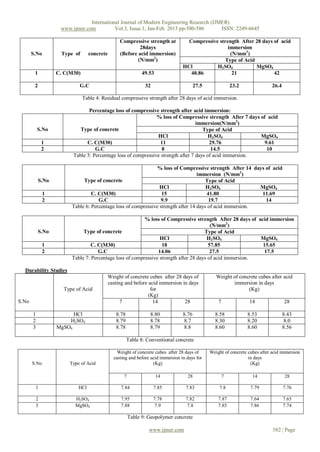
             The compressive strength test on hardened concrete was performed on U.T.M. Three 150x150x150 mm concrete
    cubes were tested for every compressive strength test. The results given in various Figures and Tables are the mean of these
    values. The curing media was replaced with fresh solution at the end of every week to maintain the same concentration (5%)
    throughout the exposure period.

    Residual compressive strength on acid immersion:
                                            Compressive strength at             Compressive strength After 7 days of acid
                                                     28days                                    immersion
      S.No         Type of concrete         (Before acid immersion)                             (N/mm2)
                                                    (N/mm2)                                   Type of Acid
                                                                                 HCl            H2SO4            MgSO4
1                  C. C(M30)                    49.53                       44.34         35                45

2                  G.C                         32                           29.44            27.36               28.8
                               Table 2: Residual compressive strength after 7 days of acid immersion.

                                                Compressive strength at        Compressive strength After14 days of acid
                                                         28days                               immersion
      S.No           Type of     concrete       (Before acid immersion)                        (N/mm2)
                                                        (N/mm2)                              Type of Acid
                                                                              HCl         H2SO4           MgSO4
        1          C. C(M30)                              49.53                 42.35           29               44

        2                    G.C                          32                     28.6            25.69                  27.52
                             Table 3: Residual compressive strength after 14 days of acid immersion.

                                                             www.ijmer.com                                              581 | Page
International Journal of Modern Engineering Research (IJMER)
                    www.ijmer.com          Vol.3, Issue.1, Jan-Feb. 2013 pp-580-586      ISSN: 2249-6645

                                                 Compressive strength at           Compressive strength After 28 days of acid
                                                          28days                                   immersion
       S.No         Type of        concrete      (Before acid immersion)                            (N/mm2)
                                                         (N/mm2)                                 Type of Acid
                                                                                 HCl          H2SO4           MgSO4
        1          C. C(M30)                                 49.53                  40.86            21               42

        2                    G.C                              32                        27.5               23.2               26.4

                               Table 4: Residual compressive strength after 28 days of acid immersion.

                                  Percentage loss of compressive strength after acid immersion:
                                                                 % loss of Compressive strength After 7 days of acid
                                                                                    immersion(N/mm2)
           S.No               Type of concrete                                         Type of Acid
                                                                 HCl                      H2SO4              MgSO4
             1                   C. C(M30)                         11                     29.76                9.61
             2                       G.C                           8                       14.5                 10
                           Table 5: Percentage loss of compressive strength after 7 days of acid immersion.

                                                                % loss of Compressive strength After 14 days of acid
                                                                                   immersion (N/mm2)
            S.No              Type of concrete                                         Type of Acid
                                                                 HCl                   H2SO4               MgSO4
              1                   C. C(M30)                       15                   41.80               11.69
              2                      G.C                          9.9                   19.7                 14
                         Table 6: Percentage loss of compressive strength after 14 days of acid immersion.

                                                          % loss of Compressive strength After 28 days of acid immersion
                                                                                         (N/mm2)
           S.No               Type of concrete                                        Type of Acid
                                                                 HCl                   H2SO4               MgSO4
              1                  C. C(M30)                        18                    57.85               15.65
              2                      G.C                        14.06                    27.5                17.5
                         Table 7: Percentage loss of compressive strength after 28 days of acid immersion.

  Durability Studies
                                          Weight of concrete cubes after 28 days of               Weight of concrete cubes after acid
                                          casting and before acid immersion in days                      immersion in days
                     Type of Acid                             for                                               (Kg)
                                                             (Kg)
S.No                                            7              14            28                    7              14                 28

       1                 HCl                   8.78             8.80             8.76            8.58             8.53               8.43
       2                H2SO4                  8.79             8.78             8.7             8.30             8.20                8.0
       3           MgSO4                       8.78             8.79             8.8             8.60             8.60               8.56

                                                      Table 8: Conventional concrete

                                                Weight of concrete cubes after 28 days of      Weight of concrete cubes after acid immersion
                                              casting and before acid immersion in days for                       in days
       S.No             Type of Acid                              (Kg)                                             (Kg)

                                                   7                 14            28                  7            14                28

        1                    HCl                 7.84              7.85           7.83             7.8             7.79              7.76

        2                  H2SO4                 7.95              7.78           7.82             7.87            7.64              7.65
        3                  MgSO4                 7.88               7.9            7.8             7.85            7.86              7.74

                                                       Table 9: Geopolymer concrete

                                                                www.ijmer.com                                                 582 | Page
International Journal of Modern Engineering Research (IJMER)
               www.ijmer.com          Vol.3, Issue.1, Jan-Feb. 2013 pp-580-586      ISSN: 2249-6645

Percentage weight loss on acid immersion.
                                                   % Weight loss of concrete cubes after acid immersion
                                                             Age of acid immersion in days
   S.No          Type of Acid                    7                            14                           28

     1               HCl                       2.2%                           3.06%                       3.76%

     2              H2SO4                      5.5%                           6.6%                         8%
     3              MgSO4                      2.0%                           2.16%                       2.72%

                                            Table 10: Conventional concrete

                                                       % Weight loss of concrete cubes after acid immersion
                                                                 Age of acid immersion in days
     S.No             Type of Acid                     7                           14                       28

         1                 HCl                        0.4%                         0.7%                    0.9%

         2               H2SO4                        1.0%                         1.7%                    2.2%
         3               MgSO4                        0.3%                         0.5%                    0.7%

                                            Table 11: Geopolymer concrete

GRAPHS


                            Graph 1: % loss of compressive strength in Conventional concrete


                            Graph 2: % loss of compressive strength in Geopolymer concrete


                                                       www.ijmer.com                                        583 | Page
International Journal of Modern Engineering Research (IJMER)
www.ijmer.com          Vol.3, Issue.1, Jan-Feb. 2013 pp-580-586      ISSN: 2249-6645


                 Graph 3: % loss of compressive strength in HCl acid


                   Graph 4: % loss of compressive strength in H2SO4


                  Graph 5: % loss of compressive strength in MgSO4


                   Graph 6: % weight loss in Conventional concrete

                                      www.ijmer.com                                    584 | Page
International Journal of Modern Engineering Research (IJMER)
www.ijmer.com          Vol.3, Issue.1, Jan-Feb. 2013 pp-580-586      ISSN: 2249-6645


                   Graph 7: % weight loss in Geopolymer concrete


                         Graph 8: % weight loss in HCl acid


                        Graph 9: % weight loss in H2SO4 acid


                                     www.ijmer.com                                     585 | Page
International Journal of Modern Engineering Research (IJMER)
                 www.ijmer.com          Vol.3, Issue.1, Jan-Feb. 2013 pp-580-586      ISSN: 2249-6645


                                           Graph 10: % weight loss in MgSO4 acid

                                                     VI. Conclusions
The following conclusions are made based on the laboratory experiments carried out in this investigation.
1. Geopolymer concrete mixes resisted acid attack in a better way as compared to conventional concrete at all ages of
    exposure to HCl, H2SO4.
2. It is observed that the percentage loss of Compressive strength of all Geopolymer Concrete mixes are considerably
    lower than that of Conventional concrete mixes at all ages of acid exposure.
3. It is also observed that the maximum loss of compressive strength and weight occurs in case of H2SO4 acid immersion
    as compared to HCl and MgSO4.
4. The loss of compressive strength of conventional concrete is almost double the loss of compressive strength of
    geopolymer concrete in H2SO4 acid immersion at all ages.
5. The percentage weight loss of Conventional concrete is more when compared to Geopolymer concrete. This is true for
    all the acids tried in this investigation.
6. It is observed that the loss of compressive strength of Geopolymer concrete is more when compared to conventional
    concrete in MgSO4 immersion. So Geopolymer concrete is sensitive to MgSO4.
7. The weight loss of Geopolymer concrete is very low when Geopolymer concrete mixes are exposed to 5% acid attack.

                                                         References
[1]   Bakharev, T. (2005a). Durability of geopolymer materials in sodium and magnesium sulfate solutions. Cement And Concrete
      Research
[2]   Davidovits, J. (1988b). Geopolymer Chemistry and Properties.
[3]   Davidovits, J. (1991). Geopolymers: Inorganic Polymeric New Materials. Journal of Thermal Analysis.
[4]   Davidovits, J. (1994b). Properties of Geopolymer Cements.
[5]   Hardjito, D., Wallah, S. E., & Rangan, B. V. (2002b). Study on Engineering Properties of Fly Ash-Based Geopolymer Concrete.
[6]   Hardjito, D., & Rangan, B. V. (2005). Development and Properties of Low-Calcium Fly Ash-Based Geopolymer Concrete. Research
      Report GC1, Perth, Australia: Faculty of Engineering, Curtin University of Technology.


                                                           www.ijmer.com                                              586 | Page

Du31580586

  • 1.
    International Journal ofModern Engineering Research (IJMER) www.ijmer.com Vol.3, Issue.1, Jan-Feb. 2013 pp-580-586 ISSN: 2249-6645 Investigation on Behaviour of Fly Ash Based Geopolymer Concrete in Acidic Environment Mr. K. Madhan Gopal, 1 Mr. B. Naga Kiran2 Assistant Professor, Department of civil Engg. RGMCET, Nandyal, India-518 501. Abstract: Geopolymer concrete results from the reaction of a source material that is rich in silica and alumina with alkaline liquid. The term geopolymer was introduced by Davidovits; geopolymers are members of the family of inorganic polymers. Geopolymer binders have been reported as being acid resistant and thus are promising and alternative binders for sewer pipe manufacture. This paper presents experimental data on the Behavior of fly ash based geopolymer concrete exposed to 5% acid solutions for up to 4 weeks. A class F fly ash based geopolymer concrete was initially cured for 24 hours at 60°C. And also the obtained results were compared with the conventional concrete exposed to 5% acid solutions for up to 4 weeks. The compressive strength of geopolymer concrete and conventional concrete of 150-mm cubes at an age of 28 days were 32MPa and 48.5MPa, respectively. Initially concrete cubes were cured for a period of 28 days and later cubes were immersed in acid solutions, After immersion in a 5 % acid solutions, samples were tested at 7, 14 and 28 days. The mass loss, compressive strength reductions were determined. In this experimental work 3 type of acid solutions are used, i.e., HCl, H2SO4 and MgSO4. The results confirmed that Geopolymer concrete is highly resistant to acid in terms of a very low mass loss and compressive strength loss when compared to conventional concrete. Key Words: Geopolymer; Fly ash; Alkaline Liquid; Acid Resistance; Acidic Environment I. 1ntroduction In spite of a long-term recognition of the problem of sulphuric acid corrosion in concrete sewer pipes, this issue has not been satisfactorily resolved. A research looked at ways of enhancing the acid resistance of Portland Cement (PC) based concretes, using the partial replacement of Portland cement by supplementary materials, the use of epoxy modified binders, and the use of limestone as a sacrificial aggregate [Song et al 2003]. The acid attack in terms of mass loss was reduced; however, even the improved concretes lost significant mass with immersion time. Sulphuric acid resistant binders are still required to enhance the long-term performance of concrete in sulphuric acid corrosion environments. Geopolymer binders might be a promising alternative in the development of acid resistant concrete. Since Geopolymers are a novel binder that relies on alumina-silicate rather than calcium silicate hydrate bonds for structural integrity, they have been reported as being acid resistant. This paper reports experimental data on the response of Alkaline Activated Fly ash based Geopolymer (AAFG) concrete against 5% acid solutions for up to 4 weeks, in terms of visual inspection, mass change, and residual compressive strength. In this experimental work 3 type of acid solutions are used, i.e., HCl, H2SO4 and MgSO4. And also the obtained results were compared with the conventional concrete exposed to 5% acid solutions for up to 4 weeks. II. Mix Design Of Geopolymer And Conventional Concrete 2.1 CONVENTIONAL CONCRETE Grade of concrete is M30 Mix proportion (1m3 of concrete): Water : Cement : FA : CA 191.6 : 430.00 : 538.70 : 1214.91 0.45 : 1 : 1.25 : 2.82 2.2 GEOPOLYMER CONCRETE Materials Mass (kg/m3) 20 mm 277 Coarse aggregates: 14 mm 370 7 mm 647 Fine sand 554 Fly ash (low-calcium ASTM Class F) 394 Sodium silicate solution(SiO2/ Na2O =2) 113 Sodium hydroxide solution 45 (8 Molar) Table 1: Geopolymer Concrete Mixture Proportions III. Materials Fly ash: Fly ash belonging to class-F obtained from Vijayawada thermal Power Station in Andhra Pradesh was used in the present investigation. The specific gravity of the fly ash was 1.975. www.ijmer.com 580 | Page
  • 2.
    International Journal ofModern Engineering Research (IJMER) www.ijmer.com Vol.3, Issue.1, Jan-Feb. 2013 pp-580-586 ISSN: 2249-6645 Alkaline Liquid: A combination of sodium silicate solution and sodium hydroxide solution was chosen as the alkaline liquid. Fine aggregate: The fine aggregate used is natural sand obtained from the river Godavari conforming to grading zone-II of table 4 of IS: 383-1970. The specific gravity of the fine aggregate was 2.61. Cement: The type of cement used all throughout the experiment was Ordinary Portland Cement of grade 53.The specific gravity of the fly ash was 3.10. Coarse aggregate: The crushed coarse aggregate of maximum size 16 mm, 60% of it passing through 16 mm IS sieve and retaining on 12.5mm IS sieve and 40% of this passing through 12.5 mm IS sieve and retaining on 4.75 mm IS sieve size obtained from the local crushing plant, Rajahmundry, East Godavari, is used in the present study. The specific gravity of the coarse aggregate was 2.77. Water: Potable fresh water available from local sources was used for both mixing and curing. Acids: The various acids used in the investigation are HCl, H2SO4 and MgSO4 each of 5% concentration. IV. Experimental Programme In this experimental work, properties of materials used in the experimental work were determined. Then Fly ash based geopolymer concrete cubes and conventional concrete (M30 Grade) cubes of size 150mm×150mm×150mm were cast. Now, geopolymer concrete cubes and conventional concrete cubes were cured for a period of 28 days. Generally, heat curing is recommended for geopolymer concrete and heat curing was done at a temperature of 600c for a period of 24 hours. After completion of curing process, weight of both conventional and geopolymer concrete cubes were taken. Later, concrete specimens were immersed in 5% of acidic solutions (HCl, H2SO4, MgSO4) for a period of 7, 14, 28 days. After completion of immersion period, concrete specimens were taken out and allowed for drying for a period of 1 day and weight of concrete cubes were determined. And also, the compressive strength of concrete cubes after acid immersion was determined by using U.T.M. and the obtained results are compared. Residual compressive strength and percentage weight loss of geopolymer and conventional concrete cubes after acid immersion have been studied and compared. Compressive strength of reference mixes: Compressive strength of geopolymer concrete after 28 days of curing was 32MPa Compressive strength of conventional concrete after 28 days of curing was 49.53 MPa. V. Results And Discussion The compressive strength test on hardened concrete was performed on U.T.M. Three 150x150x150 mm concrete cubes were tested for every compressive strength test. The results given in various Figures and Tables are the mean of these values. The curing media was replaced with fresh solution at the end of every week to maintain the same concentration (5%) throughout the exposure period. Residual compressive strength on acid immersion: Compressive strength at Compressive strength After 7 days of acid 28days immersion S.No Type of concrete (Before acid immersion) (N/mm2) (N/mm2) Type of Acid HCl H2SO4 MgSO4 1 C. C(M30) 49.53 44.34 35 45 2 G.C 32 29.44 27.36 28.8 Table 2: Residual compressive strength after 7 days of acid immersion. Compressive strength at Compressive strength After14 days of acid 28days immersion S.No Type of concrete (Before acid immersion) (N/mm2) (N/mm2) Type of Acid HCl H2SO4 MgSO4 1 C. C(M30) 49.53 42.35 29 44 2 G.C 32 28.6 25.69 27.52 Table 3: Residual compressive strength after 14 days of acid immersion. www.ijmer.com 581 | Page
  • 3.
    International Journal ofModern Engineering Research (IJMER) www.ijmer.com Vol.3, Issue.1, Jan-Feb. 2013 pp-580-586 ISSN: 2249-6645 Compressive strength at Compressive strength After 28 days of acid 28days immersion S.No Type of concrete (Before acid immersion) (N/mm2) (N/mm2) Type of Acid HCl H2SO4 MgSO4 1 C. C(M30) 49.53 40.86 21 42 2 G.C 32 27.5 23.2 26.4 Table 4: Residual compressive strength after 28 days of acid immersion. Percentage loss of compressive strength after acid immersion: % loss of Compressive strength After 7 days of acid immersion(N/mm2) S.No Type of concrete Type of Acid HCl H2SO4 MgSO4 1 C. C(M30) 11 29.76 9.61 2 G.C 8 14.5 10 Table 5: Percentage loss of compressive strength after 7 days of acid immersion. % loss of Compressive strength After 14 days of acid immersion (N/mm2) S.No Type of concrete Type of Acid HCl H2SO4 MgSO4 1 C. C(M30) 15 41.80 11.69 2 G.C 9.9 19.7 14 Table 6: Percentage loss of compressive strength after 14 days of acid immersion. % loss of Compressive strength After 28 days of acid immersion (N/mm2) S.No Type of concrete Type of Acid HCl H2SO4 MgSO4 1 C. C(M30) 18 57.85 15.65 2 G.C 14.06 27.5 17.5 Table 7: Percentage loss of compressive strength after 28 days of acid immersion. Durability Studies Weight of concrete cubes after 28 days of Weight of concrete cubes after acid casting and before acid immersion in days immersion in days Type of Acid for (Kg) (Kg) S.No 7 14 28 7 14 28 1 HCl 8.78 8.80 8.76 8.58 8.53 8.43 2 H2SO4 8.79 8.78 8.7 8.30 8.20 8.0 3 MgSO4 8.78 8.79 8.8 8.60 8.60 8.56 Table 8: Conventional concrete Weight of concrete cubes after 28 days of Weight of concrete cubes after acid immersion casting and before acid immersion in days for in days S.No Type of Acid (Kg) (Kg) 7 14 28 7 14 28 1 HCl 7.84 7.85 7.83 7.8 7.79 7.76 2 H2SO4 7.95 7.78 7.82 7.87 7.64 7.65 3 MgSO4 7.88 7.9 7.8 7.85 7.86 7.74 Table 9: Geopolymer concrete www.ijmer.com 582 | Page
  • 4.
    International Journal ofModern Engineering Research (IJMER) www.ijmer.com Vol.3, Issue.1, Jan-Feb. 2013 pp-580-586 ISSN: 2249-6645 Percentage weight loss on acid immersion. % Weight loss of concrete cubes after acid immersion Age of acid immersion in days S.No Type of Acid 7 14 28 1 HCl 2.2% 3.06% 3.76% 2 H2SO4 5.5% 6.6% 8% 3 MgSO4 2.0% 2.16% 2.72% Table 10: Conventional concrete % Weight loss of concrete cubes after acid immersion Age of acid immersion in days S.No Type of Acid 7 14 28 1 HCl 0.4% 0.7% 0.9% 2 H2SO4 1.0% 1.7% 2.2% 3 MgSO4 0.3% 0.5% 0.7% Table 11: Geopolymer concrete GRAPHS Graph 1: % loss of compressive strength in Conventional concrete Graph 2: % loss of compressive strength in Geopolymer concrete www.ijmer.com 583 | Page
  • 5.
    International Journal ofModern Engineering Research (IJMER) www.ijmer.com Vol.3, Issue.1, Jan-Feb. 2013 pp-580-586 ISSN: 2249-6645 Graph 3: % loss of compressive strength in HCl acid Graph 4: % loss of compressive strength in H2SO4 Graph 5: % loss of compressive strength in MgSO4 Graph 6: % weight loss in Conventional concrete www.ijmer.com 584 | Page
  • 6.
    International Journal ofModern Engineering Research (IJMER) www.ijmer.com Vol.3, Issue.1, Jan-Feb. 2013 pp-580-586 ISSN: 2249-6645 Graph 7: % weight loss in Geopolymer concrete Graph 8: % weight loss in HCl acid Graph 9: % weight loss in H2SO4 acid www.ijmer.com 585 | Page
  • 7.
    International Journal ofModern Engineering Research (IJMER) www.ijmer.com Vol.3, Issue.1, Jan-Feb. 2013 pp-580-586 ISSN: 2249-6645 Graph 10: % weight loss in MgSO4 acid VI. Conclusions The following conclusions are made based on the laboratory experiments carried out in this investigation. 1. Geopolymer concrete mixes resisted acid attack in a better way as compared to conventional concrete at all ages of exposure to HCl, H2SO4. 2. It is observed that the percentage loss of Compressive strength of all Geopolymer Concrete mixes are considerably lower than that of Conventional concrete mixes at all ages of acid exposure. 3. It is also observed that the maximum loss of compressive strength and weight occurs in case of H2SO4 acid immersion as compared to HCl and MgSO4. 4. The loss of compressive strength of conventional concrete is almost double the loss of compressive strength of geopolymer concrete in H2SO4 acid immersion at all ages. 5. The percentage weight loss of Conventional concrete is more when compared to Geopolymer concrete. This is true for all the acids tried in this investigation. 6. It is observed that the loss of compressive strength of Geopolymer concrete is more when compared to conventional concrete in MgSO4 immersion. So Geopolymer concrete is sensitive to MgSO4. 7. The weight loss of Geopolymer concrete is very low when Geopolymer concrete mixes are exposed to 5% acid attack. References [1] Bakharev, T. (2005a). Durability of geopolymer materials in sodium and magnesium sulfate solutions. Cement And Concrete Research [2] Davidovits, J. (1988b). Geopolymer Chemistry and Properties. [3] Davidovits, J. (1991). Geopolymers: Inorganic Polymeric New Materials. Journal of Thermal Analysis. [4] Davidovits, J. (1994b). Properties of Geopolymer Cements. [5] Hardjito, D., Wallah, S. E., & Rangan, B. V. (2002b). Study on Engineering Properties of Fly Ash-Based Geopolymer Concrete. [6] Hardjito, D., & Rangan, B. V. (2005). Development and Properties of Low-Calcium Fly Ash-Based Geopolymer Concrete. Research Report GC1, Perth, Australia: Faculty of Engineering, Curtin University of Technology. www.ijmer.com 586 | Page