INTERNATIONAL JOURNALEngineering and TechnologyRESEARCH IN
  International Journal of Advanced Research in OF ADVANCED (IJARET), ISSN 0976 –
  6480(Print), ISSN 0976 – 6499(Online) Volume 4, Issue 1, January - February (2013), © IAEME
             ENGINEERING AND TECHNOLOGY (IJARET)
ISSN 0976 - 6480 (Print)
ISSN 0976 - 6499 (Online)
                                                                         IJARET
Volume 4, Issue 1, January- February (2013), pp. 142-150
© IAEME: www.iaeme.com/ijaret.asp                                       ©IAEME
Journal Impact Factor (2012): 2.7078 (Calculated by GISI)
www.jifactor.com


              PARAMETRIC OPTIMIZATION FOR CUTTING SPEED – A
                STATISTICAL REGRESSION MODELING FOR WEDM

                                S V Subrahmanyam1, M. M. M. Sarcar2
      1
          Asst Professor, Dept of Mechanical Engg, GVP College of Engineering, Vizag, A.P. India
      2
          Professor and HOD of Mechanical Engg., A.U. College of Engineering, Vizag, A.P. India


  ABSTRACT

          Better finish, low tolerance, higher production rate, miniaturization, complex shapes
  and profiles of the harder, newer, latest materials like hardened steel, titanium, high strength
  temperature resistant alloy, fiber-reinforced composites and ceramics is the present demand
  of the manufacturing industries such as Aerospace, nuclear, missile, turbine, automobile, tool
  and die making. To satisfy these needs a different class of modern machining techniques,
  unconventional in nature, like Wire Electrical discharge Machining (WEDM) emerged. In
  WEDM the material removal takes place due to thermal erosion. In this process there is no
  contact between the tool and work. In WEDM rough machining produces lesser accuracy and
  surface finish, while finish machining produces less surface roughness with less speed. To get
  optimum process parameters for higher cutting efficiency and accuracy is very difficult.
  Hence, the objective of this paper is, to improve the Cutting Speed and to optimize the effects
  of eight input process parameters on cutting speed during the machining of hot die steel (EN-
  31) using Taguchi L27(38) orthogonal array (OA) as design of experiments (DOE).

  Keywords: EN31, Cutting Speed, Orthogonal array, WEDM

 I.           INTRODUCTION

          In WEDM the process of Metal erosion effect takes place when electric sparks are
  generated between the work piece and a wire electrode flushed or immersed in the dielectric
  fluid. The WEDM machining plays a major role in manufacturing sectors especially
  industries like aerospace, ordinance, automobile and general engineering etc. WEDM
  machining process parameters can be optimized by using taguchi method. Taguch method is
  based on Orthogonal Array, which provides a set of experiments which are well balanced and
  reduces variance for control parameters during the experimentation. Nihat Tosun et al [1] find

                                                  142
International Journal of Advanced Research in Engineering and Technology (IJARET), ISSN 0976 –
  6480(Print), ISSN 0976 – 6499(Online) Volume 4, Issue 1, January - February (2013), © IAEME

  on the effect and optimization of machining parameters on the notch and material removal
  rate (MRR) in wire electrical discharge machining (WEDM) operations. Can Cogun [2] the
  settings of machining parameters were determined by using taguchi experimental design
  method. The level of importance of the machining parameters on the kerf and the MRR is
  determined by using ANOVA. Amar Patnaik et al [3] Introducing zinc coated copper as
  electrode tool with the process parameters of discharge current, pulse duration, pulse
  frequency, wire speed, wire tension, dielectric flow rate. By using factors, maximization of
  MRR and minimization of surface roughness is done in WEDM process using taguchi
  method. H.Singh et al [4] analyze the effects of various input process parameters like pulse
  on time, pulse off time, gap voltage, peak current , wire feed and wire tension have been
  investigated and impact on MRR is obtained. Finally they reported MRR increase with
  increase in pulse on time and peak current. MRR decrease with increase in pulse off time and
  servo voltage. Wire feed and wire tension has no effect on MRR. Sarkar et al. [5] performed
  experiments using +-titanium aluminide alloy as work material and then formulated
  mathematical models to predict the cutting speed, SF and dimensional deviation as the
  function of different control parameters. In WEDM operations, material removal rate (MRR)
  determines the economics of machining and rate of production. In setting the machining
  parameters, the main goal is the maximum MRR. The main purpose of this paper is to
  investigate effects of machining parameters on the material removal rate of wire EDMed
  En31 alloy steel. Hewidy et al [6] developed mathematical models correlating the various
  WEDM machining parameters (peak current, duty factor, wire tension and water pressure)
  with metal removal rate, wear ratio and surface roughness based on the response surface
  methodology. A.K.M. Nurul Amin et al [7] Conducted experiments on cutting of tungsten
  carbide ceramic using electro-discharge machining (EDM) with a graphite electrode by using
  taguchi methodology

II.      EXPERIMENTAL SET UP AND DATA COLLECTION

         The experimental setup, design of experiment based on Taguchi Orthogonal Array
  and the method of conducting experiments are discussed in this section.

  2.1. Work Material and tool/cutting tool material

          The experiments were conducted on EN 31 alloy steel material as a work piece. The
  work piece material chemical composition of the is shown in Table 1. Brass wire of 0.25 mm
  diameter was used as tool electrode in the experimental set up. This is a diffused wire of brass
  of type ELECTRA_Duracut. 0.25 mm diameter stratified wire (Zinc coated copper wire) with
  vertical configuration has been used and discarded once used. High MRR in WEDM without
  wire breakage can be attained by the use of zinc coated copper wire because evaporation of
  zinc causes cooling at the interface of work piece and wire and a coating of zinc oxide on the
  surface of wire helps to prevent short-circuits (Sho et al., 1989).
                     Table 1: the chemical composition of EN31 Alloy steel.

                       Material C     Cr Mn Si           Fe
                        EN31    0.95 1.45 0.60 0.22 Balance %wt


                                                143
International Journal of Advanced Research in Engineering and Technology (IJARET), ISSN 0976 –
6480(Print), ISSN 0976 – 6499(Online) Volume 4, Issue 1, January - February (2013), © IAEME

2.2. Schematic of Machining

        All the experiments were conducted on SPRINTCUT (AU) WITH PULSE
GENERATOR ELPULS 40A DLX CNC Wire-cut EDM machine made by
ELECTRONICA company. All the three axes of the machine are servo controlled and can
be programmed to follow a CNC code which is fed through the control panel. All three axes
have an accuracy of 1µm. Through an NC code, machining can be programmed. During the
experimentation the work piece is considered as positive terminal, where as the tool (wire) is
connected to negative terminal of the source. The size of the work piece considered for
experimentation on the wire-cut EDM is 125 mm x 25 mm x 5 mm. A small gap of 0.025
mm to 0.05 mm is maintained in between the wire and work-piece. The high energy density
erodes material from both the wire and work piece by local melting and vaporizing. The di-
electric fluid (de-ionized water) is continuously flashed through the gap along the wire, to
the sparking area to remove the debris produced during the erosion. A collection tank is
located at the bottom to collect the used wire erosions and then is discarded. The wires once
used cannot be reused again, due to the variation in dimensional accuracy.

2.3. Experimental procedure

        The work piece is a rectangle plate having dimensions of 5mmx25mmx125mm.
Work piece is machined with zinc coated copper wire, used as a cutting tool, having
diameter of 0.20mm and de-ionized water as a dielectric fluid, into 5mmx5mmx25mm
pieces. Each piece is cut with different input process parameter combination considering
each combination as a separate job. The parameters are varied basing on the Taguchi
Orthogonal Array design. During this operation the respective output parameters or
responses, cutting speed, surface roughness, and dimensional deviations, machining time,
gap current and kerf are gathered. Out of these some like cutting speed, Gap current, gap
voltage were gathered from system display screen and others like MRR, Surface Roughness,
dimensional deviations were calculated separately. Surface roughness Ra values were
measured using Mitutoyo Surface Tester. Dimensional Deviations were measured using
Digital Micro Meter.

2.4. Process parameters and design

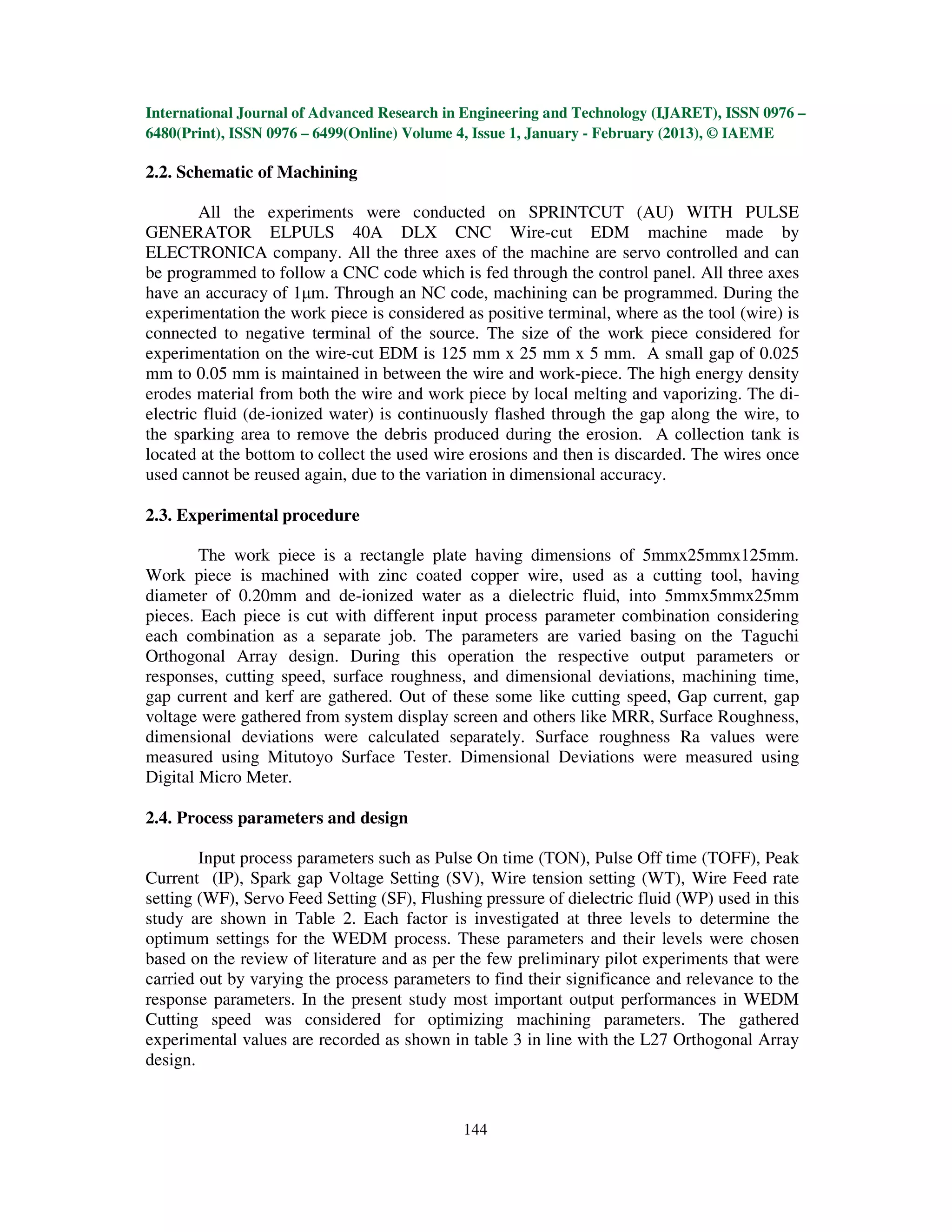
        Input process parameters such as Pulse On time (TON), Pulse Off time (TOFF), Peak
Current (IP), Spark gap Voltage Setting (SV), Wire tension setting (WT), Wire Feed rate
setting (WF), Servo Feed Setting (SF), Flushing pressure of dielectric fluid (WP) used in this
study are shown in Table 2. Each factor is investigated at three levels to determine the
optimum settings for the WEDM process. These parameters and their levels were chosen
based on the review of literature and as per the few preliminary pilot experiments that were
carried out by varying the process parameters to find their significance and relevance to the
response parameters. In the present study most important output performances in WEDM
Cutting speed was considered for optimizing machining parameters. The gathered
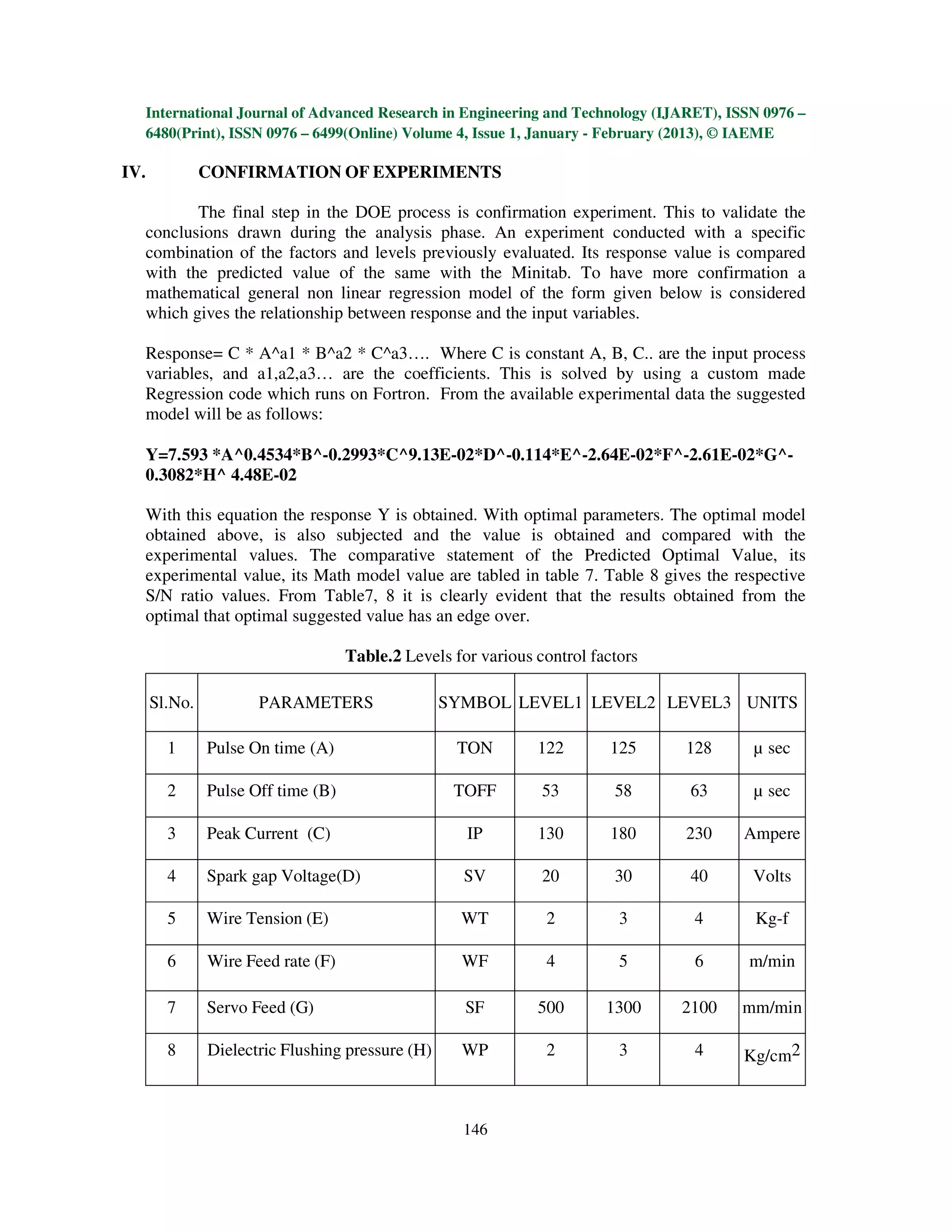
experimental values are recorded as shown in table 3 in line with the L27 Orthogonal Array
design.


                                             144
International Journal of Advanced Research in Engineering and Technology (IJARET), ISSN 0976 –
       6480(Print), ISSN 0976 – 6499(Online) Volume 4, Issue 1, January - February (2013), © IAEME

III.          EXPERIMENTAL DATA ANALYSIS

       3.1 Analysis of Variance (ANOVA)

                In any Experimentation with several variables it is really hard to know which
       variable is exactly influencing and which is not. The reason being in WEDM type of
       experimentation each parameter will have its own control on the other since they are
       acting together as one unit. In spite of that it is necessary to find, if at all, any variation
       exists in the experimentation, then by which variable and to take necessary decisions can
       be made concerning that parameters. For that purpose ANOVA is use. ANOVA is a
       statistical method that can interpret experimental data. It categorizes machining
       parameters into significant and insignificant ones.

       3.2 S/N Ratio

               In any experimentation the expectation will be that the desired values are to
       obtained as outputs, if not at least the mean output values correlate to the desired ones.
       This desired value is termed as signal and the deviation from the desired or signal is
       termed as noise. The signal is the mean for the response and the square deviation for the
       output is noise. So, the ratio of mean to square deviation is S/N ratio. This is calculated
       as a logarithmic transformation of the loss function as equation 1. As per the objective of
       the study, maximization of Cutting Speed, it is clear that ‘the higher value’ of the
       experimental data and its corresponding input parameters are of the optimum machining
       performance characteristics. It is denoted by ‘η’ with a unit of dB.
                                      ଵ       ଵ
                          η = -10 log ∑୬
                                       ୧ୀଵ                                     (1)
                                      ୬       ௬ଶ


       MINITAB 15 software was used to analyze the experimental data. ANOVA, S/N ratio
       calculation are calculated using Minitab 15. Table 3 shows the L27 OA along with the
       experimental Response Cutting Speed value and the S/N ratio for the cutting speed
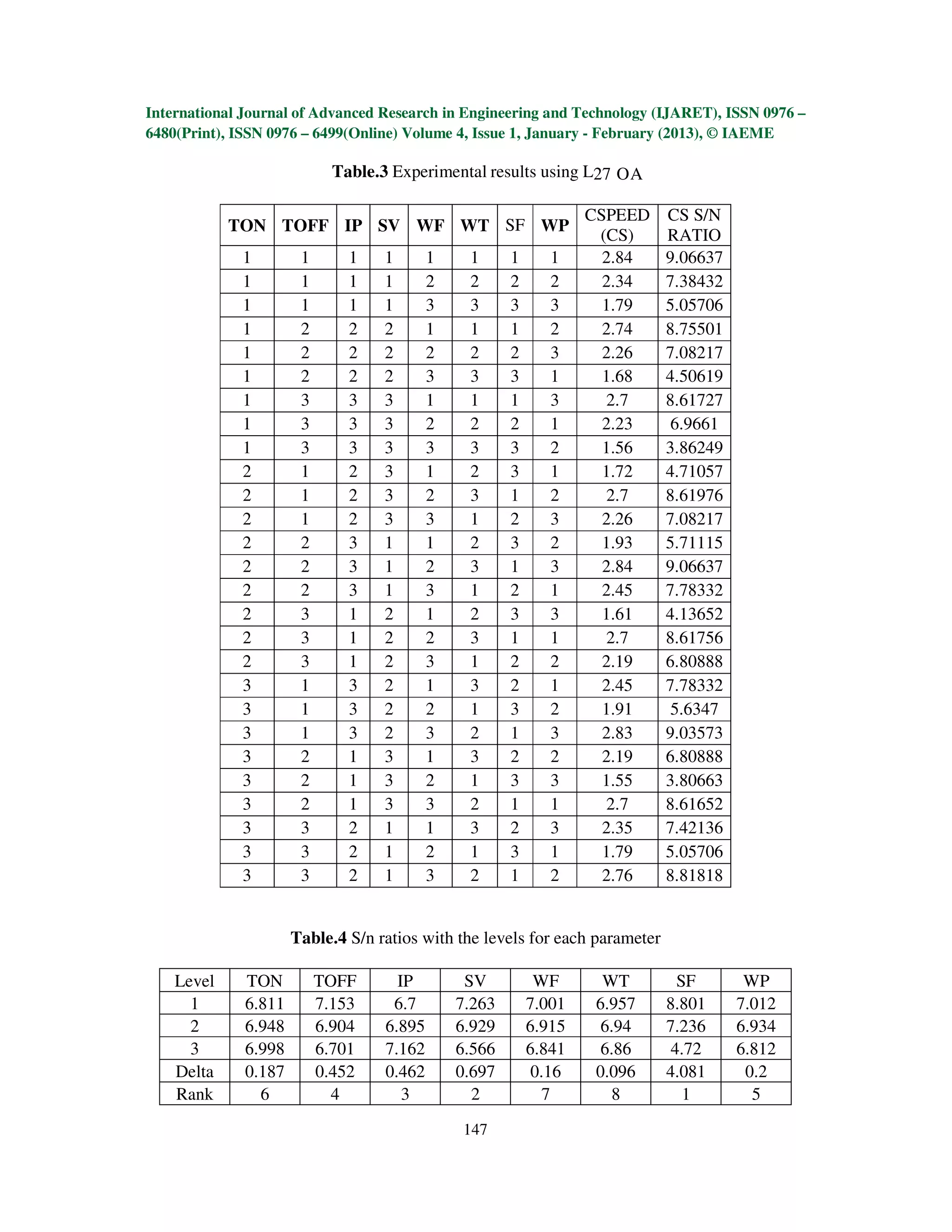
       obtained from Minitab. Table 4, 5 shows the S/N ratio, mean S/N ratio of the
       parameters according to the level of each parameter.

       a. Result Analysis

               As discussed earlier higher η value corresponds to better performance. The level
       with greatest η value is the optimal level of machining parameters. Table 6 is the Anova
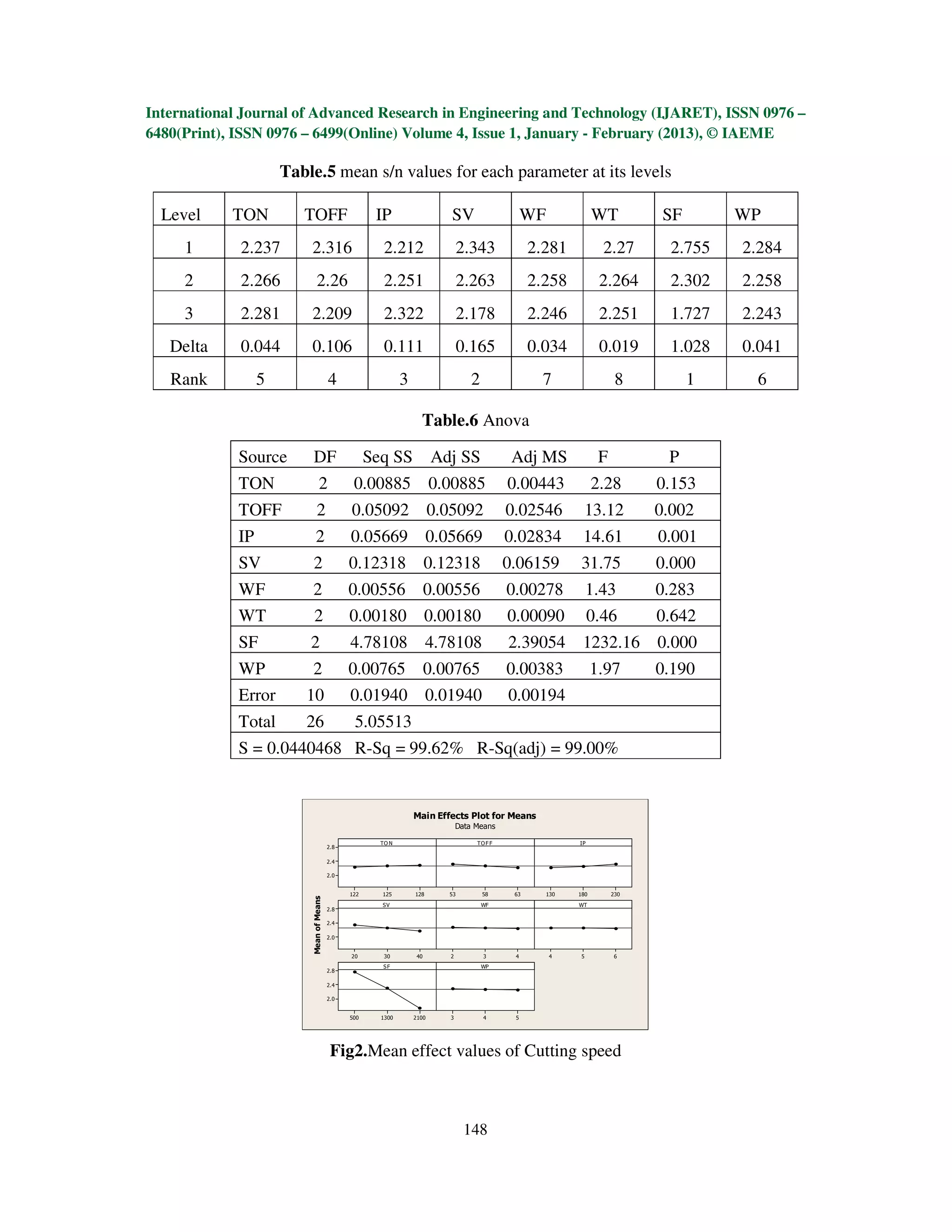
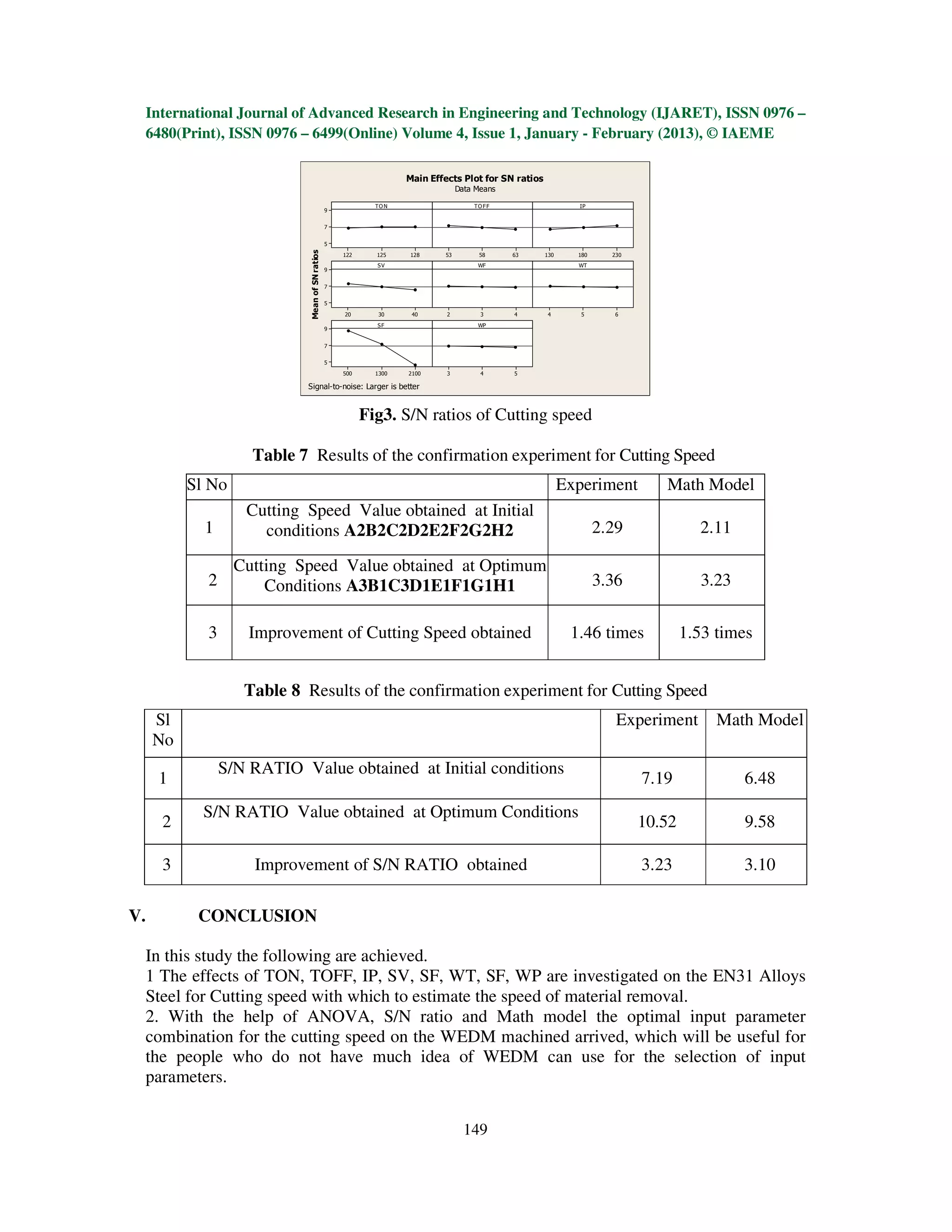
       result. Figures 2, 3 show graphically the effect of the eight control factors on Cutting
       Speed. From the results it is evident that parameters at level A3B1C3D1E1F1G1H1,
       optimal level, gives maximum Cutting Speed. It is also evident from Table 4, 5 that WT
       WF WP are having less significant impact on the Cutting Speed. Here WT is totally
       insignificant, WF, WP show less influence.


                                                    145
International Journal of Advanced Research in Engineering and Technology (IJARET), ISSN 0976 –
  6480(Print), ISSN 0976 – 6499(Online) Volume 4, Issue 1, January - February (2013), © IAEME

IV.            CONFIRMATION OF EXPERIMENTS

         The final step in the DOE process is confirmation experiment. This to validate the
  conclusions drawn during the analysis phase. An experiment conducted with a specific
  combination of the factors and levels previously evaluated. Its response value is compared
  with the predicted value of the same with the Minitab. To have more confirmation a
  mathematical general non linear regression model of the form given below is considered
  which gives the relationship between response and the input variables.

  Response= C * A^a1 * B^a2 * C^a3…. Where C is constant A, B, C.. are the input process
  variables, and a1,a2,a3… are the coefficients. This is solved by using a custom made
  Regression code which runs on Fortron. From the available experimental data the suggested
  model will be as follows:

  Y=7.593 *A^0.4534*B^-0.2993*C^9.13E-02*D^-0.114*E^-2.64E-02*F^-2.61E-02*G^-
  0.3082*H^ 4.48E-02

  With this equation the response Y is obtained. With optimal parameters. The optimal model
  obtained above, is also subjected and the value is obtained and compared with the
  experimental values. The comparative statement of the Predicted Optimal Value, its
  experimental value, its Math model value are tabled in table 7. Table 8 gives the respective
  S/N ratio values. From Table7, 8 it is clearly evident that the results obtained from the
  optimal that optimal suggested value has an edge over.

                                    Table.2 Levels for various control factors

      Sl.No.          PARAMETERS                  SYMBOL LEVEL1 LEVEL2 LEVEL3 UNITS

        1      Pulse On time (A)                    TON        122        125    128     µ sec

        2      Pulse Off time (B)                  TOFF         53        58      63     µ sec

        3      Peak Current (C)                      IP        130        180    230    Ampere

        4      Spark gap Voltage(D)                  SV         20        30      40     Volts

        5      Wire Tension (E)                     WT          2          3      4      Kg-f

        6      Wire Feed rate (F)                   WF          4          5      6     m/min

        7      Servo Feed (G)                        SF        500       1300    2100   mm/min

        8      Dielectric Flushing pressure (H)     WP          2          3      4     Kg/cm2


                                                    146
International Journal of Advanced Research in Engineering and Technology (IJARET), ISSN 0976 –
6480(Print), ISSN 0976 – 6499(Online) Volume 4, Issue 1, January - February (2013), © IAEME

                             Table.3 Experimental results using L27 OA

                                                                    CSPEED    CS S/N
            TON TOFF IP SV WF WT SF WP
                                                                     (CS)     RATIO
             1         1       1   1        1    1      1      1      2.84    9.06637
             1         1       1   1        2    2      2      2      2.34    7.38432
             1         1       1   1        3    3      3      3      1.79    5.05706
             1         2       2   2        1    1      1      2      2.74    8.75501
             1         2       2   2        2    2      2      3      2.26    7.08217
             1         2       2   2        3    3      3      1      1.68    4.50619
             1         3       3   3        1    1      1      3      2.7     8.61727
             1         3       3   3        2    2      2      1      2.23     6.9661
             1         3       3   3        3    3      3      2      1.56    3.86249
             2         1       2   3        1    2      3      1      1.72    4.71057
             2         1       2   3        2    3      1      2      2.7     8.61976
             2         1       2   3        3    1      2      3      2.26    7.08217
             2         2       3   1        1    2      3      2      1.93    5.71115
             2         2       3   1        2    3      1      3      2.84    9.06637
             2         2       3   1        3    1      2      1      2.45    7.78332
             2         3       1   2        1    2      3      3      1.61    4.13652
             2         3       1   2        2    3      1      1      2.7     8.61756
             2         3       1   2        3    1      2      2      2.19    6.80888
             3         1       3   2        1    3      2      1      2.45    7.78332
             3         1       3   2        2    1      3      2      1.91     5.6347
             3         1       3   2        3    2      1      3      2.83    9.03573
             3         2       1   3        1    3      2      2      2.19    6.80888
             3         2       1   3        2    1      3      3      1.55    3.80663
             3         2       1   3        3    2      1      1      2.7     8.61652
             3         3       2   1        1    3      2      3      2.35    7.42136
             3         3       2   1        2    1      3      1      1.79    5.05706
             3         3       2   1        3    2      1      2      2.76    8.81818


                      Table.4 S/n ratios with the levels for each parameter

    Level     TON          TOFF       IP         SV          WF       WT        SF       WP
      1       6.811        7.153     6.7        7.263       7.001    6.957    8.801     7.012
      2       6.948        6.904    6.895       6.929       6.915     6.94    7.236     6.934
      3       6.998        6.701    7.162       6.566       6.841     6.86     4.72     6.812
    Delta     0.187        0.452    0.462       0.697        0.16    0.096    4.081      0.2
    Rank        6            4         3          2           7        8         1        5
                                                147
International Journal of Advanced Research in Engineering and Technology (IJARET), ISSN 0976 –
6480(Print), ISSN 0976 – 6499(Online) Volume 4, Issue 1, January - February (2013), © IAEME

                      Table.5 mean s/n values for each parameter at its levels

  Level     TON          TOFF                          IP                    SV                    WF               WT         SF        WP
     1       2.237        2.316                          2.212                   2.343              2.281            2.27        2.755   2.284
     2       2.266             2.26                      2.251                   2.263              2.258            2.264       2.302   2.258
     3       2.281        2.209                          2.322                   2.178              2.246            2.251       1.727   2.243
   Delta     0.044        0.106                          0.111                   0.165              0.034            0.019       1.028   0.041
   Rank           5                       4                    3                   2                 7                    8         1     6

                                                                     Table.6 Anova

             Source       DF                          Seq SS              Adj SS               Adj MS                F          P
             TON                   2             0.00885                  0.00885             0.00443               2.28       0.153
             TOFF              2                0.05092                   0.05092             0.02546              13.12       0.002
             IP              2                  0.05669                  0.05669              0.02834          14.61           0.001
             SV           2                     0.12318                  0.12318              0.06159          31.75           0.000
             WF           2                     0.00556 0.00556                               0.00278              1.43        0.283
             WT           2                     0.00180 0.00180                               0.00090              0.46        0.642
             SF           2                     4.78108                  4.78108              2.39054          1232.16         0.000
             WP           2                     0.00765 0.00765                               0.00383               1.97       0.190
             Error       10                     0.01940 0.01940                               0.00194
             Total       26                      5.05513
             S = 0.0440468 R-Sq = 99.62% R-Sq(adj) = 99.00%


                                                                   Main Effects Plot for Means
                                                                                Data Means

                                                        TO N                         TO F F                   IP
                                          2.8

                                          2.4

                                          2.0


                                                122     125        128      53         58      63       130   180        230
                          Mean of Means


                                                        SV                             WF                     WT
                                          2.8

                                          2.4

                                          2.0


                                                20       30         40      2          3       4         4     5          6
                                                        SF                             WP
                                          2.8

                                          2.4

                                          2.0


                                                500     1300       2100     3          4       5


                                           Fig2.Mean effect values of Cutting speed


                                                                                  148
International Journal of Advanced Research in Engineering and Technology (IJARET), ISSN 0976 –
 6480(Print), ISSN 0976 – 6499(Online) Volume 4, Issue 1, January - February (2013), © IAEME

                                                                    Main Effects Plot for SN ratios
                                                                                 Data Means

                                                             TO N                    TO F F                   IP
                                                 9


                                                 7


                                                 5


                             Mean of SN ratios
                                                     122     125    128     53        58      63      130     180     230
                                                             SV                       WF                      WT
                                                 9


                                                 7


                                                 5

                                                     20       30     40      2         3      4       4        5       6

                                                             SF                       WP
                                                 9


                                                 7

                                                 5

                                                     500     1300   2100     3         4      5

                            Signal-to-noise: Larger is better


                                                           Fig3. S/N ratios of Cutting speed

                    Table 7 Results of the confirmation experiment for Cutting Speed
          Sl No                                                                                             Experiment         Math Model
                   Cutting Speed Value obtained at Initial
            1        conditions A2B2C2D2E2F2G2H2                                                                    2.29              2.11

                  Cutting Speed Value obtained at Optimum
            2         Conditions A3B1C3D1E1F1G1H1                                                                   3.36              3.23

            3       Improvement of Cutting Speed obtained                                                    1.46 times             1.53 times


                   Table 8 Results of the confirmation experiment for Cutting Speed
     Sl                                                                                                                Experiment        Math Model
     No
                S/N RATIO Value obtained at Initial conditions
     1                                                                                                                      7.19             6.48
            S/N RATIO Value obtained at Optimum Conditions
     2                                                                                                                      10.52            9.58

     3              Improvement of S/N RATIO obtained                                                                       3.23             3.10

V.         CONCLUSION

 In this study the following are achieved.
 1 The effects of TON, TOFF, IP, SV, SF, WT, SF, WP are investigated on the EN31 Alloys
 Steel for Cutting speed with which to estimate the speed of material removal.
 2. With the help of ANOVA, S/N ratio and Math model the optimal input parameter
 combination for the cutting speed on the WEDM machined arrived, which will be useful for
 the people who do not have much idea of WEDM can use for the selection of input
 parameters.

                                                                                   149
International Journal of Advanced Research in Engineering and Technology (IJARET), ISSN 0976 –
6480(Print), ISSN 0976 – 6499(Online) Volume 4, Issue 1, January - February (2013), © IAEME

REFERENCES

[1]     N. Tosun, C. Cogun, G. Tosun, A study on kerf and material removal rate in wire
electrical discharge machining based on Taguchi method, Journal of Materials Processing
Technology 152 (2004) 316-322.
[2]     Can Cogun (2004) a study on kerf and material removal rate in wire electrical
discharge machining based on Taguchi method. Journal of Materials Processing Technology.
[3]     S. S. Mahapatra, Amar Patnaik, (2006) Optimization of wire electrical discharge
machining (WEDM) process parameters using Taguchi method. International Journal of
Advanced Manufacturing Technology.
[4]     H. Singh, R. Garg (2009) Effects of process parameters on material removal rate in
WEDM, Journal of achievements in material and manufacturing engineering, Volume 32,
Issue.
[5]     Sarkar S, Mitra S, Bhattacharyya B (2005) Parametric analysis and optimization of
wire electrical discharge machining of γ-titanium aluminide alloy. Journal of Materials
Processing Technology 159:286–294.
[6]     M.S. Hewidy, T.A. El-Taweel, M.F. El-Safty, Modelling the machining parameters of
wire electrical discharge machining of Inconel 601 using RSM, Journal of Materials Process-
ing Technology 169 (2005) 328-336.
[7]     Mohd Amri Lajis, H.C.D. Mohd Radzi, A.K.M. Nurul Amin (2009) The Implemen-
tation of Taguchi Method on EDM Process of Tungsten Carbide. European Journal of
Scientific Research, ISSN 1450-216X Vol.26 No.4 (2009), pp.609-617.
[8]     U. D. Gulhane, A. B. Dixit, P. V. Bane and G. S. Salvi, “Optimization Of Process
Parameters For 316l Stainless Steel Using Taguchi Method And Anova” International Journal
of Mechanical Engineering & Technology (IJMET), Volume 3, Issue 2, 2012, pp. 67 - 72,
ISSN Print: 0976 – 6340, ISSN Online: 0976 – 6359, Published by IAEME.
[9]     Rodge M.K, Sarpate S.S and Sharma S.B, “Investigation on Process Response and
Parameters in Wire Electrical Discharge Machining of Inconel 625” International Journal of
Mechanical Engineering & Technology (IJMET), Volume 4, Issue 1, 2013, pp. 54 - 65, ISSN
Print: 0976 – 6340, ISSN Online: 0976 – 6359, Published by IAEME.


                                             150

Parametric optimization for cutting speed – a statistical regression modeling for wedm

  • 1.
    INTERNATIONAL JOURNALEngineering andTechnologyRESEARCH IN International Journal of Advanced Research in OF ADVANCED (IJARET), ISSN 0976 – 6480(Print), ISSN 0976 – 6499(Online) Volume 4, Issue 1, January - February (2013), © IAEME ENGINEERING AND TECHNOLOGY (IJARET) ISSN 0976 - 6480 (Print) ISSN 0976 - 6499 (Online) IJARET Volume 4, Issue 1, January- February (2013), pp. 142-150 © IAEME: www.iaeme.com/ijaret.asp ©IAEME Journal Impact Factor (2012): 2.7078 (Calculated by GISI) www.jifactor.com PARAMETRIC OPTIMIZATION FOR CUTTING SPEED – A STATISTICAL REGRESSION MODELING FOR WEDM S V Subrahmanyam1, M. M. M. Sarcar2 1 Asst Professor, Dept of Mechanical Engg, GVP College of Engineering, Vizag, A.P. India 2 Professor and HOD of Mechanical Engg., A.U. College of Engineering, Vizag, A.P. India ABSTRACT Better finish, low tolerance, higher production rate, miniaturization, complex shapes and profiles of the harder, newer, latest materials like hardened steel, titanium, high strength temperature resistant alloy, fiber-reinforced composites and ceramics is the present demand of the manufacturing industries such as Aerospace, nuclear, missile, turbine, automobile, tool and die making. To satisfy these needs a different class of modern machining techniques, unconventional in nature, like Wire Electrical discharge Machining (WEDM) emerged. In WEDM the material removal takes place due to thermal erosion. In this process there is no contact between the tool and work. In WEDM rough machining produces lesser accuracy and surface finish, while finish machining produces less surface roughness with less speed. To get optimum process parameters for higher cutting efficiency and accuracy is very difficult. Hence, the objective of this paper is, to improve the Cutting Speed and to optimize the effects of eight input process parameters on cutting speed during the machining of hot die steel (EN- 31) using Taguchi L27(38) orthogonal array (OA) as design of experiments (DOE). Keywords: EN31, Cutting Speed, Orthogonal array, WEDM I. INTRODUCTION In WEDM the process of Metal erosion effect takes place when electric sparks are generated between the work piece and a wire electrode flushed or immersed in the dielectric fluid. The WEDM machining plays a major role in manufacturing sectors especially industries like aerospace, ordinance, automobile and general engineering etc. WEDM machining process parameters can be optimized by using taguchi method. Taguch method is based on Orthogonal Array, which provides a set of experiments which are well balanced and reduces variance for control parameters during the experimentation. Nihat Tosun et al [1] find 142
  • 2.
    International Journal ofAdvanced Research in Engineering and Technology (IJARET), ISSN 0976 – 6480(Print), ISSN 0976 – 6499(Online) Volume 4, Issue 1, January - February (2013), © IAEME on the effect and optimization of machining parameters on the notch and material removal rate (MRR) in wire electrical discharge machining (WEDM) operations. Can Cogun [2] the settings of machining parameters were determined by using taguchi experimental design method. The level of importance of the machining parameters on the kerf and the MRR is determined by using ANOVA. Amar Patnaik et al [3] Introducing zinc coated copper as electrode tool with the process parameters of discharge current, pulse duration, pulse frequency, wire speed, wire tension, dielectric flow rate. By using factors, maximization of MRR and minimization of surface roughness is done in WEDM process using taguchi method. H.Singh et al [4] analyze the effects of various input process parameters like pulse on time, pulse off time, gap voltage, peak current , wire feed and wire tension have been investigated and impact on MRR is obtained. Finally they reported MRR increase with increase in pulse on time and peak current. MRR decrease with increase in pulse off time and servo voltage. Wire feed and wire tension has no effect on MRR. Sarkar et al. [5] performed experiments using +-titanium aluminide alloy as work material and then formulated mathematical models to predict the cutting speed, SF and dimensional deviation as the function of different control parameters. In WEDM operations, material removal rate (MRR) determines the economics of machining and rate of production. In setting the machining parameters, the main goal is the maximum MRR. The main purpose of this paper is to investigate effects of machining parameters on the material removal rate of wire EDMed En31 alloy steel. Hewidy et al [6] developed mathematical models correlating the various WEDM machining parameters (peak current, duty factor, wire tension and water pressure) with metal removal rate, wear ratio and surface roughness based on the response surface methodology. A.K.M. Nurul Amin et al [7] Conducted experiments on cutting of tungsten carbide ceramic using electro-discharge machining (EDM) with a graphite electrode by using taguchi methodology II. EXPERIMENTAL SET UP AND DATA COLLECTION The experimental setup, design of experiment based on Taguchi Orthogonal Array and the method of conducting experiments are discussed in this section. 2.1. Work Material and tool/cutting tool material The experiments were conducted on EN 31 alloy steel material as a work piece. The work piece material chemical composition of the is shown in Table 1. Brass wire of 0.25 mm diameter was used as tool electrode in the experimental set up. This is a diffused wire of brass of type ELECTRA_Duracut. 0.25 mm diameter stratified wire (Zinc coated copper wire) with vertical configuration has been used and discarded once used. High MRR in WEDM without wire breakage can be attained by the use of zinc coated copper wire because evaporation of zinc causes cooling at the interface of work piece and wire and a coating of zinc oxide on the surface of wire helps to prevent short-circuits (Sho et al., 1989). Table 1: the chemical composition of EN31 Alloy steel. Material C Cr Mn Si Fe EN31 0.95 1.45 0.60 0.22 Balance %wt 143
  • 3.
    International Journal ofAdvanced Research in Engineering and Technology (IJARET), ISSN 0976 – 6480(Print), ISSN 0976 – 6499(Online) Volume 4, Issue 1, January - February (2013), © IAEME 2.2. Schematic of Machining All the experiments were conducted on SPRINTCUT (AU) WITH PULSE GENERATOR ELPULS 40A DLX CNC Wire-cut EDM machine made by ELECTRONICA company. All the three axes of the machine are servo controlled and can be programmed to follow a CNC code which is fed through the control panel. All three axes have an accuracy of 1µm. Through an NC code, machining can be programmed. During the experimentation the work piece is considered as positive terminal, where as the tool (wire) is connected to negative terminal of the source. The size of the work piece considered for experimentation on the wire-cut EDM is 125 mm x 25 mm x 5 mm. A small gap of 0.025 mm to 0.05 mm is maintained in between the wire and work-piece. The high energy density erodes material from both the wire and work piece by local melting and vaporizing. The di- electric fluid (de-ionized water) is continuously flashed through the gap along the wire, to the sparking area to remove the debris produced during the erosion. A collection tank is located at the bottom to collect the used wire erosions and then is discarded. The wires once used cannot be reused again, due to the variation in dimensional accuracy. 2.3. Experimental procedure The work piece is a rectangle plate having dimensions of 5mmx25mmx125mm. Work piece is machined with zinc coated copper wire, used as a cutting tool, having diameter of 0.20mm and de-ionized water as a dielectric fluid, into 5mmx5mmx25mm pieces. Each piece is cut with different input process parameter combination considering each combination as a separate job. The parameters are varied basing on the Taguchi Orthogonal Array design. During this operation the respective output parameters or responses, cutting speed, surface roughness, and dimensional deviations, machining time, gap current and kerf are gathered. Out of these some like cutting speed, Gap current, gap voltage were gathered from system display screen and others like MRR, Surface Roughness, dimensional deviations were calculated separately. Surface roughness Ra values were measured using Mitutoyo Surface Tester. Dimensional Deviations were measured using Digital Micro Meter. 2.4. Process parameters and design Input process parameters such as Pulse On time (TON), Pulse Off time (TOFF), Peak Current (IP), Spark gap Voltage Setting (SV), Wire tension setting (WT), Wire Feed rate setting (WF), Servo Feed Setting (SF), Flushing pressure of dielectric fluid (WP) used in this study are shown in Table 2. Each factor is investigated at three levels to determine the optimum settings for the WEDM process. These parameters and their levels were chosen based on the review of literature and as per the few preliminary pilot experiments that were carried out by varying the process parameters to find their significance and relevance to the response parameters. In the present study most important output performances in WEDM Cutting speed was considered for optimizing machining parameters. The gathered experimental values are recorded as shown in table 3 in line with the L27 Orthogonal Array design. 144
  • 4.
    International Journal ofAdvanced Research in Engineering and Technology (IJARET), ISSN 0976 – 6480(Print), ISSN 0976 – 6499(Online) Volume 4, Issue 1, January - February (2013), © IAEME III. EXPERIMENTAL DATA ANALYSIS 3.1 Analysis of Variance (ANOVA) In any Experimentation with several variables it is really hard to know which variable is exactly influencing and which is not. The reason being in WEDM type of experimentation each parameter will have its own control on the other since they are acting together as one unit. In spite of that it is necessary to find, if at all, any variation exists in the experimentation, then by which variable and to take necessary decisions can be made concerning that parameters. For that purpose ANOVA is use. ANOVA is a statistical method that can interpret experimental data. It categorizes machining parameters into significant and insignificant ones. 3.2 S/N Ratio In any experimentation the expectation will be that the desired values are to obtained as outputs, if not at least the mean output values correlate to the desired ones. This desired value is termed as signal and the deviation from the desired or signal is termed as noise. The signal is the mean for the response and the square deviation for the output is noise. So, the ratio of mean to square deviation is S/N ratio. This is calculated as a logarithmic transformation of the loss function as equation 1. As per the objective of the study, maximization of Cutting Speed, it is clear that ‘the higher value’ of the experimental data and its corresponding input parameters are of the optimum machining performance characteristics. It is denoted by ‘η’ with a unit of dB. ଵ ଵ η = -10 log ∑୬ ୧ୀଵ (1) ୬ ௬ଶ MINITAB 15 software was used to analyze the experimental data. ANOVA, S/N ratio calculation are calculated using Minitab 15. Table 3 shows the L27 OA along with the experimental Response Cutting Speed value and the S/N ratio for the cutting speed obtained from Minitab. Table 4, 5 shows the S/N ratio, mean S/N ratio of the parameters according to the level of each parameter. a. Result Analysis As discussed earlier higher η value corresponds to better performance. The level with greatest η value is the optimal level of machining parameters. Table 6 is the Anova result. Figures 2, 3 show graphically the effect of the eight control factors on Cutting Speed. From the results it is evident that parameters at level A3B1C3D1E1F1G1H1, optimal level, gives maximum Cutting Speed. It is also evident from Table 4, 5 that WT WF WP are having less significant impact on the Cutting Speed. Here WT is totally insignificant, WF, WP show less influence. 145
  • 5.
    International Journal ofAdvanced Research in Engineering and Technology (IJARET), ISSN 0976 – 6480(Print), ISSN 0976 – 6499(Online) Volume 4, Issue 1, January - February (2013), © IAEME IV. CONFIRMATION OF EXPERIMENTS The final step in the DOE process is confirmation experiment. This to validate the conclusions drawn during the analysis phase. An experiment conducted with a specific combination of the factors and levels previously evaluated. Its response value is compared with the predicted value of the same with the Minitab. To have more confirmation a mathematical general non linear regression model of the form given below is considered which gives the relationship between response and the input variables. Response= C * A^a1 * B^a2 * C^a3…. Where C is constant A, B, C.. are the input process variables, and a1,a2,a3… are the coefficients. This is solved by using a custom made Regression code which runs on Fortron. From the available experimental data the suggested model will be as follows: Y=7.593 *A^0.4534*B^-0.2993*C^9.13E-02*D^-0.114*E^-2.64E-02*F^-2.61E-02*G^- 0.3082*H^ 4.48E-02 With this equation the response Y is obtained. With optimal parameters. The optimal model obtained above, is also subjected and the value is obtained and compared with the experimental values. The comparative statement of the Predicted Optimal Value, its experimental value, its Math model value are tabled in table 7. Table 8 gives the respective S/N ratio values. From Table7, 8 it is clearly evident that the results obtained from the optimal that optimal suggested value has an edge over. Table.2 Levels for various control factors Sl.No. PARAMETERS SYMBOL LEVEL1 LEVEL2 LEVEL3 UNITS 1 Pulse On time (A) TON 122 125 128 µ sec 2 Pulse Off time (B) TOFF 53 58 63 µ sec 3 Peak Current (C) IP 130 180 230 Ampere 4 Spark gap Voltage(D) SV 20 30 40 Volts 5 Wire Tension (E) WT 2 3 4 Kg-f 6 Wire Feed rate (F) WF 4 5 6 m/min 7 Servo Feed (G) SF 500 1300 2100 mm/min 8 Dielectric Flushing pressure (H) WP 2 3 4 Kg/cm2 146
  • 6.
    International Journal ofAdvanced Research in Engineering and Technology (IJARET), ISSN 0976 – 6480(Print), ISSN 0976 – 6499(Online) Volume 4, Issue 1, January - February (2013), © IAEME Table.3 Experimental results using L27 OA CSPEED CS S/N TON TOFF IP SV WF WT SF WP (CS) RATIO 1 1 1 1 1 1 1 1 2.84 9.06637 1 1 1 1 2 2 2 2 2.34 7.38432 1 1 1 1 3 3 3 3 1.79 5.05706 1 2 2 2 1 1 1 2 2.74 8.75501 1 2 2 2 2 2 2 3 2.26 7.08217 1 2 2 2 3 3 3 1 1.68 4.50619 1 3 3 3 1 1 1 3 2.7 8.61727 1 3 3 3 2 2 2 1 2.23 6.9661 1 3 3 3 3 3 3 2 1.56 3.86249 2 1 2 3 1 2 3 1 1.72 4.71057 2 1 2 3 2 3 1 2 2.7 8.61976 2 1 2 3 3 1 2 3 2.26 7.08217 2 2 3 1 1 2 3 2 1.93 5.71115 2 2 3 1 2 3 1 3 2.84 9.06637 2 2 3 1 3 1 2 1 2.45 7.78332 2 3 1 2 1 2 3 3 1.61 4.13652 2 3 1 2 2 3 1 1 2.7 8.61756 2 3 1 2 3 1 2 2 2.19 6.80888 3 1 3 2 1 3 2 1 2.45 7.78332 3 1 3 2 2 1 3 2 1.91 5.6347 3 1 3 2 3 2 1 3 2.83 9.03573 3 2 1 3 1 3 2 2 2.19 6.80888 3 2 1 3 2 1 3 3 1.55 3.80663 3 2 1 3 3 2 1 1 2.7 8.61652 3 3 2 1 1 3 2 3 2.35 7.42136 3 3 2 1 2 1 3 1 1.79 5.05706 3 3 2 1 3 2 1 2 2.76 8.81818 Table.4 S/n ratios with the levels for each parameter Level TON TOFF IP SV WF WT SF WP 1 6.811 7.153 6.7 7.263 7.001 6.957 8.801 7.012 2 6.948 6.904 6.895 6.929 6.915 6.94 7.236 6.934 3 6.998 6.701 7.162 6.566 6.841 6.86 4.72 6.812 Delta 0.187 0.452 0.462 0.697 0.16 0.096 4.081 0.2 Rank 6 4 3 2 7 8 1 5 147
  • 7.
    International Journal ofAdvanced Research in Engineering and Technology (IJARET), ISSN 0976 – 6480(Print), ISSN 0976 – 6499(Online) Volume 4, Issue 1, January - February (2013), © IAEME Table.5 mean s/n values for each parameter at its levels Level TON TOFF IP SV WF WT SF WP 1 2.237 2.316 2.212 2.343 2.281 2.27 2.755 2.284 2 2.266 2.26 2.251 2.263 2.258 2.264 2.302 2.258 3 2.281 2.209 2.322 2.178 2.246 2.251 1.727 2.243 Delta 0.044 0.106 0.111 0.165 0.034 0.019 1.028 0.041 Rank 5 4 3 2 7 8 1 6 Table.6 Anova Source DF Seq SS Adj SS Adj MS F P TON 2 0.00885 0.00885 0.00443 2.28 0.153 TOFF 2 0.05092 0.05092 0.02546 13.12 0.002 IP 2 0.05669 0.05669 0.02834 14.61 0.001 SV 2 0.12318 0.12318 0.06159 31.75 0.000 WF 2 0.00556 0.00556 0.00278 1.43 0.283 WT 2 0.00180 0.00180 0.00090 0.46 0.642 SF 2 4.78108 4.78108 2.39054 1232.16 0.000 WP 2 0.00765 0.00765 0.00383 1.97 0.190 Error 10 0.01940 0.01940 0.00194 Total 26 5.05513 S = 0.0440468 R-Sq = 99.62% R-Sq(adj) = 99.00% Main Effects Plot for Means Data Means TO N TO F F IP 2.8 2.4 2.0 122 125 128 53 58 63 130 180 230 Mean of Means SV WF WT 2.8 2.4 2.0 20 30 40 2 3 4 4 5 6 SF WP 2.8 2.4 2.0 500 1300 2100 3 4 5 Fig2.Mean effect values of Cutting speed 148
  • 8.
    International Journal ofAdvanced Research in Engineering and Technology (IJARET), ISSN 0976 – 6480(Print), ISSN 0976 – 6499(Online) Volume 4, Issue 1, January - February (2013), © IAEME Main Effects Plot for SN ratios Data Means TO N TO F F IP 9 7 5 Mean of SN ratios 122 125 128 53 58 63 130 180 230 SV WF WT 9 7 5 20 30 40 2 3 4 4 5 6 SF WP 9 7 5 500 1300 2100 3 4 5 Signal-to-noise: Larger is better Fig3. S/N ratios of Cutting speed Table 7 Results of the confirmation experiment for Cutting Speed Sl No Experiment Math Model Cutting Speed Value obtained at Initial 1 conditions A2B2C2D2E2F2G2H2 2.29 2.11 Cutting Speed Value obtained at Optimum 2 Conditions A3B1C3D1E1F1G1H1 3.36 3.23 3 Improvement of Cutting Speed obtained 1.46 times 1.53 times Table 8 Results of the confirmation experiment for Cutting Speed Sl Experiment Math Model No S/N RATIO Value obtained at Initial conditions 1 7.19 6.48 S/N RATIO Value obtained at Optimum Conditions 2 10.52 9.58 3 Improvement of S/N RATIO obtained 3.23 3.10 V. CONCLUSION In this study the following are achieved. 1 The effects of TON, TOFF, IP, SV, SF, WT, SF, WP are investigated on the EN31 Alloys Steel for Cutting speed with which to estimate the speed of material removal. 2. With the help of ANOVA, S/N ratio and Math model the optimal input parameter combination for the cutting speed on the WEDM machined arrived, which will be useful for the people who do not have much idea of WEDM can use for the selection of input parameters. 149
  • 9.
    International Journal ofAdvanced Research in Engineering and Technology (IJARET), ISSN 0976 – 6480(Print), ISSN 0976 – 6499(Online) Volume 4, Issue 1, January - February (2013), © IAEME REFERENCES [1] N. Tosun, C. Cogun, G. Tosun, A study on kerf and material removal rate in wire electrical discharge machining based on Taguchi method, Journal of Materials Processing Technology 152 (2004) 316-322. [2] Can Cogun (2004) a study on kerf and material removal rate in wire electrical discharge machining based on Taguchi method. Journal of Materials Processing Technology. [3] S. S. Mahapatra, Amar Patnaik, (2006) Optimization of wire electrical discharge machining (WEDM) process parameters using Taguchi method. International Journal of Advanced Manufacturing Technology. [4] H. Singh, R. Garg (2009) Effects of process parameters on material removal rate in WEDM, Journal of achievements in material and manufacturing engineering, Volume 32, Issue. [5] Sarkar S, Mitra S, Bhattacharyya B (2005) Parametric analysis and optimization of wire electrical discharge machining of γ-titanium aluminide alloy. Journal of Materials Processing Technology 159:286–294. [6] M.S. Hewidy, T.A. El-Taweel, M.F. El-Safty, Modelling the machining parameters of wire electrical discharge machining of Inconel 601 using RSM, Journal of Materials Process- ing Technology 169 (2005) 328-336. [7] Mohd Amri Lajis, H.C.D. Mohd Radzi, A.K.M. Nurul Amin (2009) The Implemen- tation of Taguchi Method on EDM Process of Tungsten Carbide. European Journal of Scientific Research, ISSN 1450-216X Vol.26 No.4 (2009), pp.609-617. [8] U. D. Gulhane, A. B. Dixit, P. V. Bane and G. S. Salvi, “Optimization Of Process Parameters For 316l Stainless Steel Using Taguchi Method And Anova” International Journal of Mechanical Engineering & Technology (IJMET), Volume 3, Issue 2, 2012, pp. 67 - 72, ISSN Print: 0976 – 6340, ISSN Online: 0976 – 6359, Published by IAEME. [9] Rodge M.K, Sarpate S.S and Sharma S.B, “Investigation on Process Response and Parameters in Wire Electrical Discharge Machining of Inconel 625” International Journal of Mechanical Engineering & Technology (IJMET), Volume 4, Issue 1, 2013, pp. 54 - 65, ISSN Print: 0976 – 6340, ISSN Online: 0976 – 6359, Published by IAEME. 150