GYROSCOPE
Physics Presentation
Nilay S Patel
PREPARED & PRESENTED BY :
TABLE OFCONTENTS
Sr. No. TITLE
1. Introduction to Gyroscope
2. History of Gyroscope
3. Parts of Gyroscope
4. Properties of Gyroscope
7. Applications for Gyroscope
6. Applications of Gyro sensors
7. Types of Gyroscope
8. Advantages
9. Disadvantages
10. Conclusion
INTRODUCTION TOGYROSCOPE
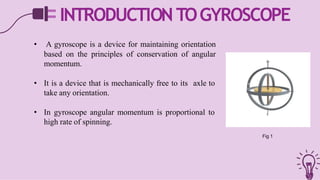
• A gyroscope is a device for maintaining orientation
based on the principles of conservation of angular
momentum.
• It is a device that is mechanically free to its axle to
take any orientation.
• In gyroscope angular momentum is proportional to
high rate of spinning.
Fig 1
HISTORY OFGYROSCOPE
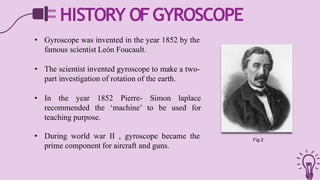
• Gyroscope was invented in the year 1852 by the
famous scientist León Foucault.
• The scientist invented gyroscope to make a two-
part investigation of rotation of the earth.
• In the year 1852 Pierre- Simon laplace
recommended the ‘machine’ to be used for
teaching purpose.
• During world war II , gyroscope became the
prime component for aircraft and guns.
Fig 2
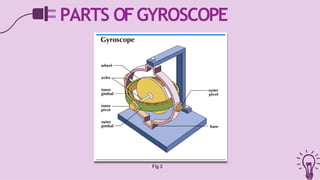
PARTS OFGYROSCOPE
Fig 3
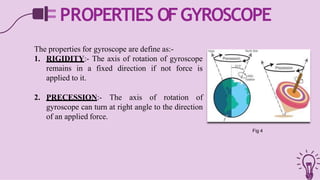
PROPERTIES OFGYROSCOPE
The properties for gyroscope are define as:-
1. RIGIDITY:- The axis of rotation of gyroscope
remains in a fixed direction if not force is
applied to it.
2. PRECESSION:- The axis of rotation of
gyroscope can turn at right angle to the direction
of an applied force.
Fig 4
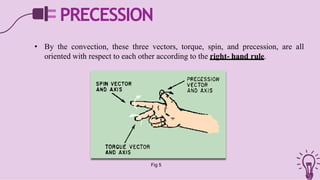
PRECESSION
• By the convection, these three vectors, torque, spin, and precession, are all
oriented with respect to each other according to the right- hand rule.
Fig 5
THECAUSE OFPRECESSION
• The product of angular momentum, which is experienced by the
torque on a disc to produce Gyroscopic precession in a spinning
wheel.
• When the force is applied to the axle, the section at the top of the
gyroscope will try to Move To the left, and the bottom Section
Will move to the right.
APPLICATIONS OFGYROSCOPE
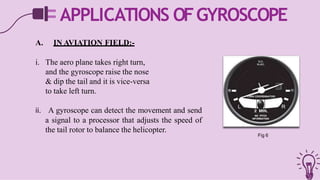
A. IN AVIATION FIELD:-
i. The aero plane takes right turn,
and the gyroscope raise the nose
& dip the tail and it is vice-versa
to take left turn.
ii. A gyroscope can detect the movement and send
a signal to a processor that adjusts the speed of
the tail rotor to balance the helicopter.
Fig 6
APPLICATIONS OFGYROSCOPE
B. IN NAVAL FIELD:-
i. Steering:- To turn the complete ship in a
curve towards left or right.
movement
or down in
of the
vertical
ii. Pitching:- It is a
complete ship up
plane.
iii. Rolling:- In rolling the, axis of precession
is always parallel to axis of spinning of the
ship. Fig 7
APPLICATIONS OFGYROSCOPE
C. IN AUTOMOBILES:-
i. When a car takes a turn, the axis of rotating parts undergoes precession
and the gyroscopic force will be acting on these parts.
ii. The gyroscope increases stability and prevent skidding of the car when
more rate of torque or force is applied.
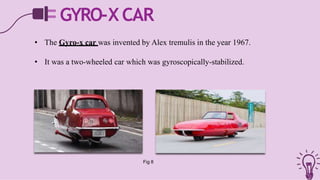
iii. The example for gyroscope in car is:- GYRO-X CAR
GYRO-X CAR
• The Gyro-x car was invented by Alex tremulis in the year 1967.
• It was a two-wheeled car which was gyroscopically-stabilized.
Fig 8
APPLICATIONS OFGYROSCOPE
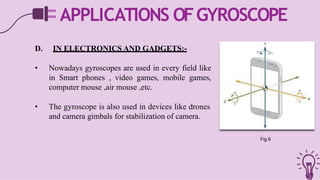
D. IN ELECTRONICS AND GADGETS:-
• Nowadays gyroscopes are used in every field like
in Smart phones , video games, mobile games,
computer mouse ,air mouse ,etc.
• The gyroscope is also used in devices like drones
and camera gimbals for stabilization of camera.
Fig 9
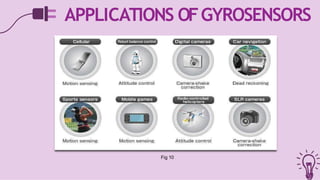
APPLICATIONS OFGYROSENSORS
Fig 10
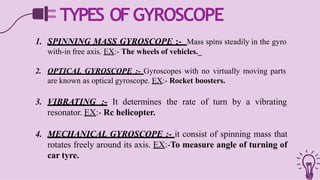
TYPES OFGYROSCOPE
1. SPINNING MASS GYROSCOPE :- Mass spins steadily in the gyro
with-in free axis. EX:- The wheels of vehicles._
2. OPTICAL GYROSCOPE :- Gyroscopes with no virtually moving parts
are known as optical gyroscope. EX:- Rocket boosters.
3. VIBRATING :- It determines the rate of turn by a vibrating
resonator. EX:- Rc helicopter.
4. MECHANICAL GYROSCOPE :- it consist of spinning mass that
rotates freely around its axis. EX:-To measure angle of turning of
car tyre.
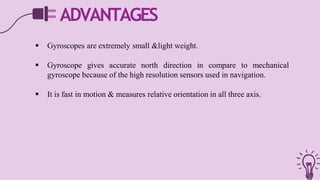
ADVANTAGES
 Gyroscopes are extremely small &light weight.
 Gyroscope gives accurate north direction in compare to mechanical
gyroscope because of the high resolution sensors used in navigation.
 It is fast in motion & measures relative orientation in all three axis.
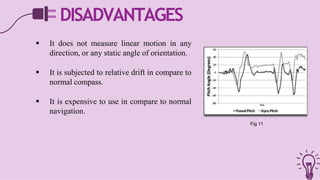
DISADVANTAGES
 It does not measure linear motion in any
direction, or any static angle of orientation.
 It is subjected to relative drift in compare to
normal compass.
 It is expensive to use in compare to normal
navigation.
Fig 11
CONCLUSION
• The gyroscope is important as well as great invention in the world history.
• It is essential to modern day aviation.
• Without gyroscope- flight travel , space travel , navigation , ship sailing,
etc are not possible to work.
• Since the invention of gyroscope it has tilted and turned the landscape of
aviation.
THANK YOU

Gyroscope

  • 1.
    GYROSCOPE Physics Presentation Nilay SPatel PREPARED & PRESENTED BY :
  • 2.
    TABLE OFCONTENTS Sr. No.TITLE 1. Introduction to Gyroscope 2. History of Gyroscope 3. Parts of Gyroscope 4. Properties of Gyroscope 7. Applications for Gyroscope 6. Applications of Gyro sensors 7. Types of Gyroscope 8. Advantages 9. Disadvantages 10. Conclusion
  • 3.
    INTRODUCTION TOGYROSCOPE • Agyroscope is a device for maintaining orientation based on the principles of conservation of angular momentum. • It is a device that is mechanically free to its axle to take any orientation. • In gyroscope angular momentum is proportional to high rate of spinning. Fig 1
  • 4.
    HISTORY OFGYROSCOPE • Gyroscopewas invented in the year 1852 by the famous scientist León Foucault. • The scientist invented gyroscope to make a two- part investigation of rotation of the earth. • In the year 1852 Pierre- Simon laplace recommended the ‘machine’ to be used for teaching purpose. • During world war II , gyroscope became the prime component for aircraft and guns. Fig 2
  • 5.
  • 6.
    PROPERTIES OFGYROSCOPE The propertiesfor gyroscope are define as:- 1. RIGIDITY:- The axis of rotation of gyroscope remains in a fixed direction if not force is applied to it. 2. PRECESSION:- The axis of rotation of gyroscope can turn at right angle to the direction of an applied force. Fig 4
  • 7.
    PRECESSION • By theconvection, these three vectors, torque, spin, and precession, are all oriented with respect to each other according to the right- hand rule. Fig 5
  • 8.
    THECAUSE OFPRECESSION • Theproduct of angular momentum, which is experienced by the torque on a disc to produce Gyroscopic precession in a spinning wheel. • When the force is applied to the axle, the section at the top of the gyroscope will try to Move To the left, and the bottom Section Will move to the right.
  • 9.
    APPLICATIONS OFGYROSCOPE A. INAVIATION FIELD:- i. The aero plane takes right turn, and the gyroscope raise the nose & dip the tail and it is vice-versa to take left turn. ii. A gyroscope can detect the movement and send a signal to a processor that adjusts the speed of the tail rotor to balance the helicopter. Fig 6
  • 10.
    APPLICATIONS OFGYROSCOPE B. INNAVAL FIELD:- i. Steering:- To turn the complete ship in a curve towards left or right. movement or down in of the vertical ii. Pitching:- It is a complete ship up plane. iii. Rolling:- In rolling the, axis of precession is always parallel to axis of spinning of the ship. Fig 7
  • 11.
    APPLICATIONS OFGYROSCOPE C. INAUTOMOBILES:- i. When a car takes a turn, the axis of rotating parts undergoes precession and the gyroscopic force will be acting on these parts. ii. The gyroscope increases stability and prevent skidding of the car when more rate of torque or force is applied. iii. The example for gyroscope in car is:- GYRO-X CAR
  • 12.
    GYRO-X CAR • TheGyro-x car was invented by Alex tremulis in the year 1967. • It was a two-wheeled car which was gyroscopically-stabilized. Fig 8
  • 13.
    APPLICATIONS OFGYROSCOPE D. INELECTRONICS AND GADGETS:- • Nowadays gyroscopes are used in every field like in Smart phones , video games, mobile games, computer mouse ,air mouse ,etc. • The gyroscope is also used in devices like drones and camera gimbals for stabilization of camera. Fig 9
  • 14.
  • 15.
    TYPES OFGYROSCOPE 1. SPINNINGMASS GYROSCOPE :- Mass spins steadily in the gyro with-in free axis. EX:- The wheels of vehicles._ 2. OPTICAL GYROSCOPE :- Gyroscopes with no virtually moving parts are known as optical gyroscope. EX:- Rocket boosters. 3. VIBRATING :- It determines the rate of turn by a vibrating resonator. EX:- Rc helicopter. 4. MECHANICAL GYROSCOPE :- it consist of spinning mass that rotates freely around its axis. EX:-To measure angle of turning of car tyre.
  • 16.
    ADVANTAGES  Gyroscopes areextremely small &light weight.  Gyroscope gives accurate north direction in compare to mechanical gyroscope because of the high resolution sensors used in navigation.  It is fast in motion & measures relative orientation in all three axis.
  • 17.
    DISADVANTAGES  It doesnot measure linear motion in any direction, or any static angle of orientation.  It is subjected to relative drift in compare to normal compass.  It is expensive to use in compare to normal navigation. Fig 11
  • 18.
    CONCLUSION • The gyroscopeis important as well as great invention in the world history. • It is essential to modern day aviation. • Without gyroscope- flight travel , space travel , navigation , ship sailing, etc are not possible to work. • Since the invention of gyroscope it has tilted and turned the landscape of aviation.
  • 19.