Mechanics of Machines A
EMMQ 3142
EMMQ 3142: Mechanics of
Machines A
Course Description / Content
1. Fundamentals of Mechanisms: Terminologies, linkages, kinematic chain, planar
and spatial mechanisms. Degrees of freedom.
2. Kinematic analysis of planar mechanisms: Position, velocity and acceleration
analyses of 4 bar chain and crank slider mechanisms, Instantaneous centres.
Kinematic synthesis: function, path and motion generation; graphical and analytical
methods.
3. Kinetic analysis of simple planar mechanisms: Static and inertia forces on links
4. Balancing of rotating masses: Static and dynamic balancing, balancing of
reciprocating masses: primary and secondary balancing of inline engines.
5. Crank effort diagrams: Fluctuation of speed and energy in engines; coefficient of
energy fluctuation, Fly wheel.
6. Gyroscopes: Gyroscopic couple and effects.
6. Gyroscope
• Vectorial representation of angular motion,
• Gyroscopic couple
• Effect of gyroscopic couple on ship
• Effect of gyroscopic couple on plane disc
• Effect of gyroscopic couple on aero plane
• Stability of two wheelers and four wheelers
Gyroscopes
 A gyroscope is a disc that’s set in motion to spin around an axis. And this disc is made free
to rotate in a constant direction.
 Practically, what that means is that this rotation axis is kept in a steady orientation. Often,
the way that’s done is to enclose this spinning disc along its axis of rotation with a series
of rings, say made of metal or some other solid material. The rings are made free to
rotate at their joints around all three directions of motion. This means that, no matter
where we put our gyroscope or how we move it, the disc that spins in the center will keep
a stable constant orientation.
 It’s axis of rotation always points in the same direction, hence we have a stable
orientation point for figuring out, say, which way is up and which way is down. This
constancy of direction comes in handy when we’re designing, say, a navigation system for
an airborne object.
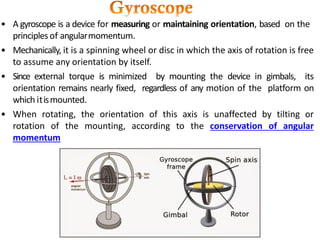
• A gyroscope is a device for measuring or maintaining orientation, based on the
principlesof angularmomentum.
• Mechanically, it is a spinning wheel or disc in which the axis of rotation is free
to assume any orientation by itself.
• Since external torque is minimized by mounting the device in gimbals, its
orientation remains nearly fixed, regardless of any motion of the platform on
which itismounted.
• When rotating, the orientation of this axis is unaffected by tilting or
rotation of the mounting, according to the conservation of angular
momentum
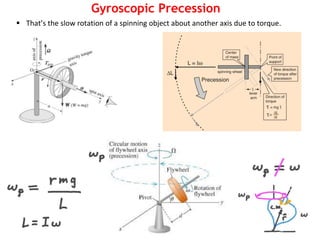
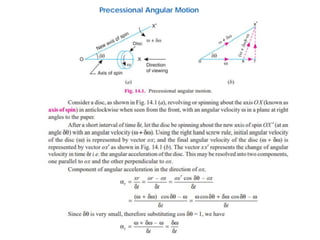
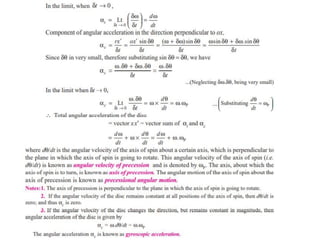
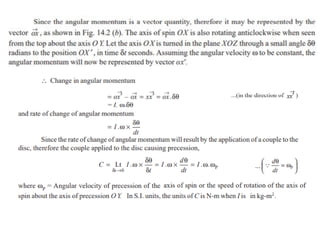
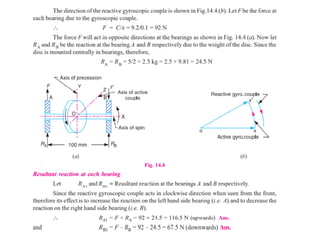
Gyroscopic Precession
 That’s the slow rotation of a spinning object about another axis due to torque.
Example 1
Example 2
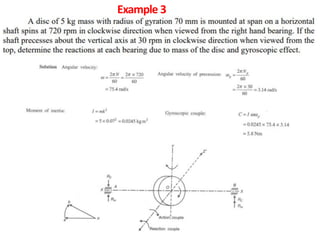
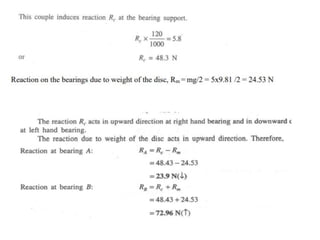
Example 3
Example 4
Chapter 6 - Gyroscope Notes.pdf

Chapter 6 - Gyroscope Notes.pdf

  • 1.
  • 2.
  • 3.
    EMMQ 3142: Mechanicsof Machines A Course Description / Content 1. Fundamentals of Mechanisms: Terminologies, linkages, kinematic chain, planar and spatial mechanisms. Degrees of freedom. 2. Kinematic analysis of planar mechanisms: Position, velocity and acceleration analyses of 4 bar chain and crank slider mechanisms, Instantaneous centres. Kinematic synthesis: function, path and motion generation; graphical and analytical methods. 3. Kinetic analysis of simple planar mechanisms: Static and inertia forces on links 4. Balancing of rotating masses: Static and dynamic balancing, balancing of reciprocating masses: primary and secondary balancing of inline engines. 5. Crank effort diagrams: Fluctuation of speed and energy in engines; coefficient of energy fluctuation, Fly wheel. 6. Gyroscopes: Gyroscopic couple and effects.
  • 4.
    6. Gyroscope • Vectorialrepresentation of angular motion, • Gyroscopic couple • Effect of gyroscopic couple on ship • Effect of gyroscopic couple on plane disc • Effect of gyroscopic couple on aero plane • Stability of two wheelers and four wheelers
  • 5.
    Gyroscopes  A gyroscopeis a disc that’s set in motion to spin around an axis. And this disc is made free to rotate in a constant direction.  Practically, what that means is that this rotation axis is kept in a steady orientation. Often, the way that’s done is to enclose this spinning disc along its axis of rotation with a series of rings, say made of metal or some other solid material. The rings are made free to rotate at their joints around all three directions of motion. This means that, no matter where we put our gyroscope or how we move it, the disc that spins in the center will keep a stable constant orientation.  It’s axis of rotation always points in the same direction, hence we have a stable orientation point for figuring out, say, which way is up and which way is down. This constancy of direction comes in handy when we’re designing, say, a navigation system for an airborne object.
  • 6.
    • A gyroscopeis a device for measuring or maintaining orientation, based on the principlesof angularmomentum. • Mechanically, it is a spinning wheel or disc in which the axis of rotation is free to assume any orientation by itself. • Since external torque is minimized by mounting the device in gimbals, its orientation remains nearly fixed, regardless of any motion of the platform on which itismounted. • When rotating, the orientation of this axis is unaffected by tilting or rotation of the mounting, according to the conservation of angular momentum
  • 7.
    Gyroscopic Precession  That’sthe slow rotation of a spinning object about another axis due to torque.
  • 12.
  • 13.
  • 15.
  • 17.