


Gustav Klimt
Mrs. Hurd’s Artroom
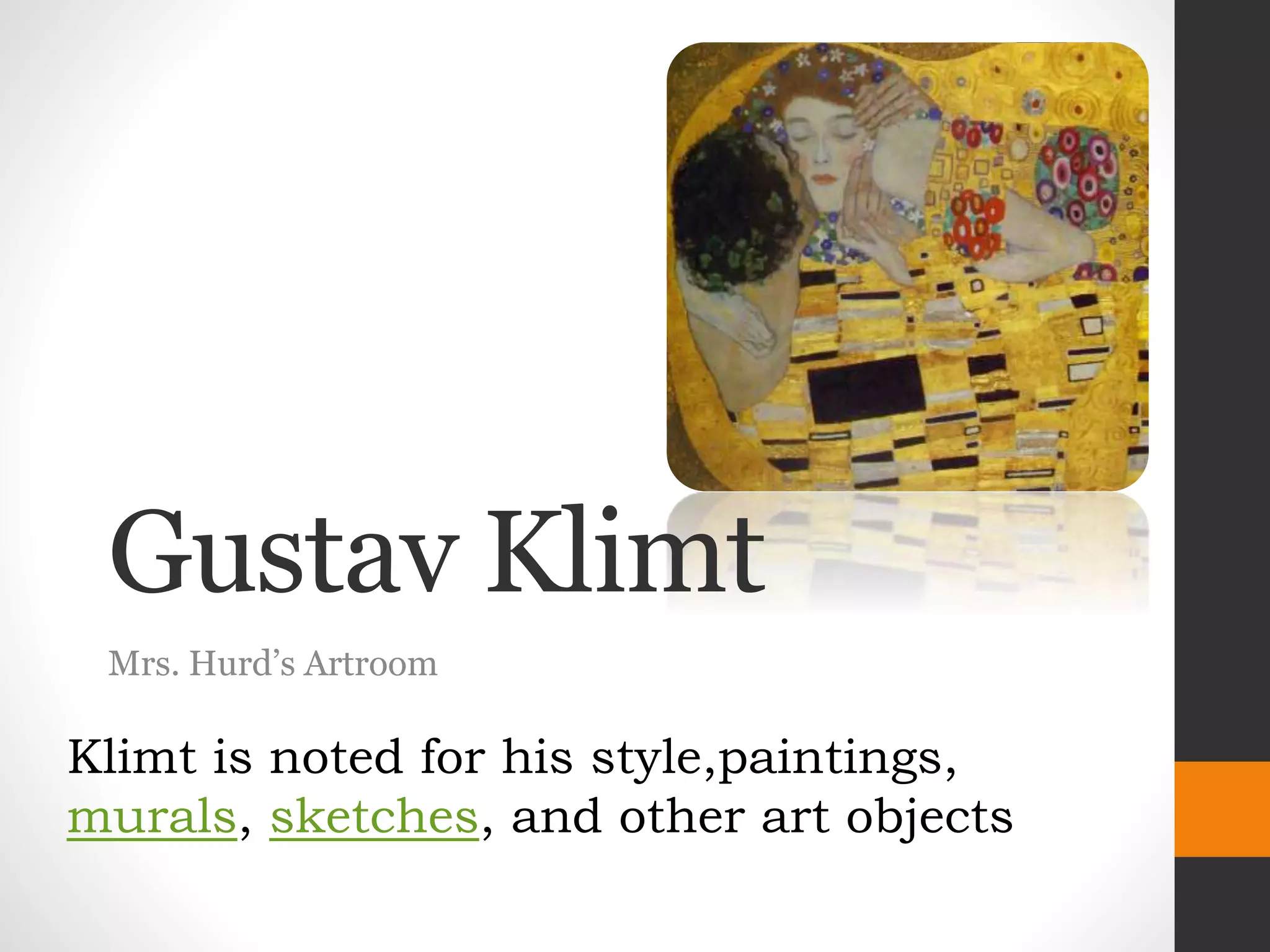
Klimt is noted for his style,paintings,
murals, sketches, and other art objects
WRITE DOWN FACTS, THINGS OF
INTERESTS, PATTERNS, &
INSPIRATION. FOR AGRADE!
YOU SHOULD BE TAKING NOTES DURING PPT!!!
Your sketchbook note page
should look something like
this:
Facts from power point
Fill boxes in with
patterns & designs
Date of Birth/Death
Where did he live?
Why is he famous?
Facts & qualities about
art work.
Who is Gustav Klimt?
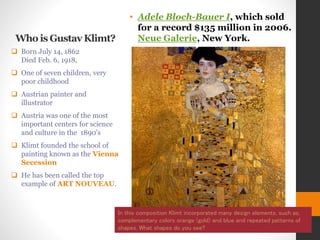
• Adele Bloch-Bauer I, which sold
for a record $135 million in 2006.
Neue Galerie, New York.
 Born July 14, 1862
Died Feb. 6, 1918,
 One of seven children, very
poor childhood
 Austrian painter and
illustrator
 Austria was one of the most
important centers for science
and culture in the 1890’s
 Klimt founded the school of
painting known as the Vienna
Secession
 He has been called the top
example of ART NOUVEAU.
In this composition Klimt incorporated many design elements, such as,
complementary colors orange (gold) and blue and repeated patterns of
shapes. What shapes do you see?
Definitions:
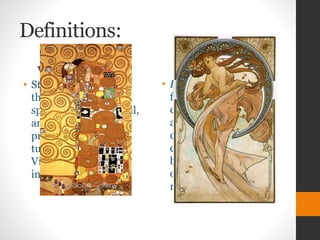
Vienna Succession
• Style that embodies
the high-keyed free
spirited, psychological,
and aesthetic
preoccupations of
turn-of-the-century
Vienna's dazzling
intellectual world
Art Nuevo
• Fine Arts. a style of
fine and applied art
current in the late 19th
and early 20th
centuries,
characterized chiefly
by curvilinear motifs
often derived from
natural forms.
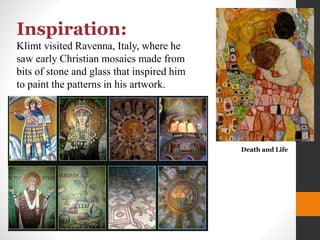
Inspiration:
Klimt visited Ravenna, Italy, where he
saw early Christian mosaics made from
bits of stone and glass that inspired him
to paint the patterns in his artwork.
Death and Life
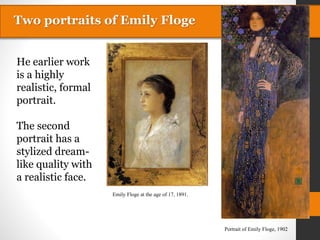
Two portraits of Emily Floge
Emily Floge at the age of 17, 1891.
Portrait of Emily Floge, 1902
He earlier work
is a highly
realistic, formal
portrait.
The second
portrait has a
stylized dream-
like quality with
a realistic face.
Two portraits of Emily Floge
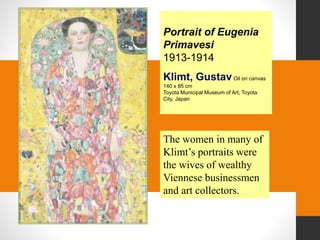
Portrait of Eugenia
Primavesi
1913-1914
Klimt, GustavOil on canvas
140 x 85 cm
Toyota Municipal Museum of Art, Toyota
City, Japan
The women in many of
Klimt’s portraits were
the wives of wealthy
Viennese businessmen
and art collectors.
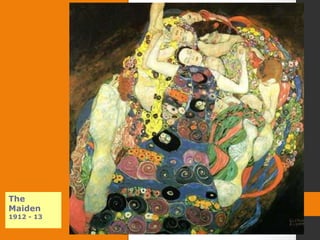
The
Maiden
1912 - 13
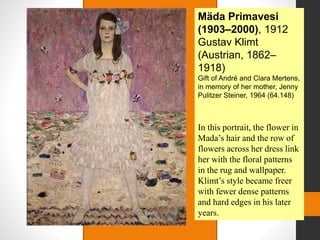
Mäda Primavesi
(1903–2000), 1912
Gustav Klimt
(Austrian, 1862–
1918)
Gift of André and Clara Mertens,
in memory of her mother, Jenny
Pulitzer Steiner, 1964 (64.148)
In this portrait, the flower in
Mada’s hair and the row of
flowers across her dress link
her with the floral patterns
in the rug and wallpaper.
Klimt’s style became freer
with fewer dense patterns
and hard edges in his later
years.
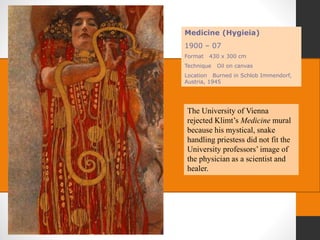
Medicine (Hygieia)
1900 – 07
Format 430 x 300 cm
Technique Oil on canvas
Location Burned in Schlob Immendorf,
Austria, 1945
The University of Vienna
rejected Klimt’s Medicine mural
because his mystical, snake
handling priestess did not fit the
University professors’ image of
the physician as a scientist and
healer.
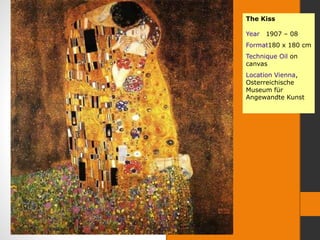
The Kiss
Year 1907 – 08
Format180 x 180 cm
Technique Oil on
canvas
Location Vienna,
Osterreichische
Museum für
Angewandte Kunst
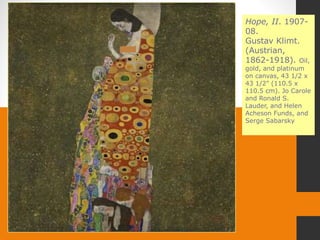
Hope, II. 1907-
08.
Gustav Klimt.
(Austrian,
1862-1918). Oil,
gold, and platinum
on canvas, 43 1/2 x
43 1/2" (110.5 x
110.5 cm). Jo Carole
and Ronald S.
Lauder, and Helen
Acheson Funds, and
Serge Sabarsky
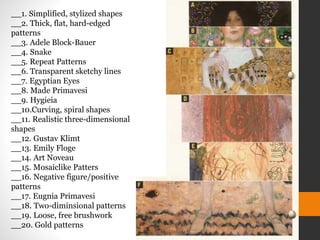
__1. Simplified, stylized shapes
__2. Thick, flat, hard-edged
patterns
__3. Adele Block-Bauer
__4. Snake
__5. Repeat Patterns
__6. Transparent sketchy lines
__7. Egyptian Eyes
__8. Made Primavesi
__9. Hygieia
__10.Curving, spiral shapes
__11. Realistic three-dimensional
shapes
__12. Gustav Klimt
__13. Emily Floge
__14. Art Noveau
__15. Mosaiclike Patters
__16. Negative figure/positive
patterns
__17. Eugnia Primavesi
__18. Two-diminsional patterns
__19. Loose, free brushwork
__20. Gold patterns
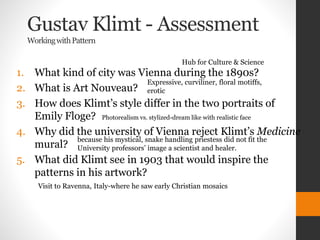
Gustav Klimt - Assessment
WorkingwithPattern
1. What kind of city was Vienna during the 1890s?
2. What is Art Nouveau?
3. How does Klimt’s style differ in the two portraits of
Emily Floge?
4. Why did the university of Vienna reject Klimt’s Medicine
mural?
5. What did Klimt see in 1903 that would inspire the
patterns in his artwork?
Hub for Culture & Science
Expressive, curviliner, floral motiffs,
erotic
Photorealism vs. stylized-dream like with realistic face
because his mystical, snake handling priestess did not fit the
University professors’ image a scientist and healer.
Visit to Ravenna, Italy-where he saw early Christian mosaics
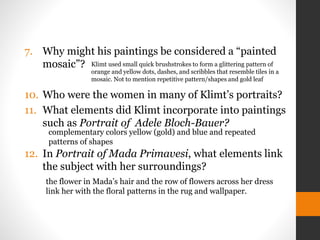
7. Why might his paintings be considered a “painted
mosaic”?
10. Who were the women in many of Klimt’s portraits?
11. What elements did Klimt incorporate into paintings
such as Portrait of Adele Bloch-Bauer?
12. In Portrait of Mada Primavesi, what elements link
the subject with her surroundings?
complementary colors yellow (gold) and blue and repeated
patterns of shapes
the flower in Mada’s hair and the row of flowers across her dress
link her with the floral patterns in the rug and wallpaper.
Klimt used small quick brushstrokes to form a glittering pattern of
orange and yellow dots, dashes, and scribbles that resemble tiles in a
mosaic. Not to mention repetitive pattern/shapes and gold leaf
Your sketchbook practice
page should look something
like this:
Drawing
Notes/Tips &
Tricks
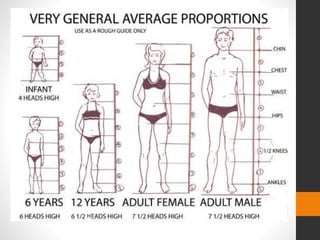
How many heads make up a figue?
Where do the hands go?
Length, shape, of features
Practice
Drawing
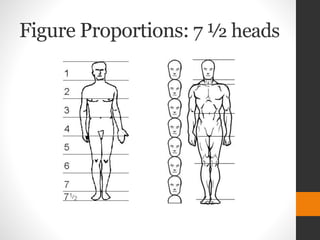
Figure Proportions: 7 ½ heads
Gustav klimt

Gustav klimt

  • 1.
    Gustav Klimt Mrs. Hurd’sArtroom Klimt is noted for his style,paintings, murals, sketches, and other art objects
  • 2.
    WRITE DOWN FACTS,THINGS OF INTERESTS, PATTERNS, & INSPIRATION. FOR AGRADE! YOU SHOULD BE TAKING NOTES DURING PPT!!!
  • 3.
    Your sketchbook notepage should look something like this: Facts from power point Fill boxes in with patterns & designs Date of Birth/Death Where did he live? Why is he famous? Facts & qualities about art work.
  • 4.
    Who is GustavKlimt? • Adele Bloch-Bauer I, which sold for a record $135 million in 2006. Neue Galerie, New York.  Born July 14, 1862 Died Feb. 6, 1918,  One of seven children, very poor childhood  Austrian painter and illustrator  Austria was one of the most important centers for science and culture in the 1890’s  Klimt founded the school of painting known as the Vienna Secession  He has been called the top example of ART NOUVEAU. In this composition Klimt incorporated many design elements, such as, complementary colors orange (gold) and blue and repeated patterns of shapes. What shapes do you see?
  • 5.
    Definitions: Vienna Succession • Stylethat embodies the high-keyed free spirited, psychological, and aesthetic preoccupations of turn-of-the-century Vienna's dazzling intellectual world Art Nuevo • Fine Arts. a style of fine and applied art current in the late 19th and early 20th centuries, characterized chiefly by curvilinear motifs often derived from natural forms.
  • 6.
    Inspiration: Klimt visited Ravenna,Italy, where he saw early Christian mosaics made from bits of stone and glass that inspired him to paint the patterns in his artwork. Death and Life
  • 7.
    Two portraits ofEmily Floge Emily Floge at the age of 17, 1891. Portrait of Emily Floge, 1902 He earlier work is a highly realistic, formal portrait. The second portrait has a stylized dream- like quality with a realistic face. Two portraits of Emily Floge
  • 8.
    Portrait of Eugenia Primavesi 1913-1914 Klimt,GustavOil on canvas 140 x 85 cm Toyota Municipal Museum of Art, Toyota City, Japan The women in many of Klimt’s portraits were the wives of wealthy Viennese businessmen and art collectors.
  • 9.
  • 10.
    Mäda Primavesi (1903–2000), 1912 GustavKlimt (Austrian, 1862– 1918) Gift of André and Clara Mertens, in memory of her mother, Jenny Pulitzer Steiner, 1964 (64.148) In this portrait, the flower in Mada’s hair and the row of flowers across her dress link her with the floral patterns in the rug and wallpaper. Klimt’s style became freer with fewer dense patterns and hard edges in his later years.
  • 11.
    Medicine (Hygieia) 1900 –07 Format 430 x 300 cm Technique Oil on canvas Location Burned in Schlob Immendorf, Austria, 1945 The University of Vienna rejected Klimt’s Medicine mural because his mystical, snake handling priestess did not fit the University professors’ image of the physician as a scientist and healer.
  • 12.
    The Kiss Year 1907– 08 Format180 x 180 cm Technique Oil on canvas Location Vienna, Osterreichische Museum für Angewandte Kunst
  • 13.
    Hope, II. 1907- 08. GustavKlimt. (Austrian, 1862-1918). Oil, gold, and platinum on canvas, 43 1/2 x 43 1/2" (110.5 x 110.5 cm). Jo Carole and Ronald S. Lauder, and Helen Acheson Funds, and Serge Sabarsky
  • 14.
    __1. Simplified, stylizedshapes __2. Thick, flat, hard-edged patterns __3. Adele Block-Bauer __4. Snake __5. Repeat Patterns __6. Transparent sketchy lines __7. Egyptian Eyes __8. Made Primavesi __9. Hygieia __10.Curving, spiral shapes __11. Realistic three-dimensional shapes __12. Gustav Klimt __13. Emily Floge __14. Art Noveau __15. Mosaiclike Patters __16. Negative figure/positive patterns __17. Eugnia Primavesi __18. Two-diminsional patterns __19. Loose, free brushwork __20. Gold patterns
  • 15.
    Gustav Klimt -Assessment WorkingwithPattern 1. What kind of city was Vienna during the 1890s? 2. What is Art Nouveau? 3. How does Klimt’s style differ in the two portraits of Emily Floge? 4. Why did the university of Vienna reject Klimt’s Medicine mural? 5. What did Klimt see in 1903 that would inspire the patterns in his artwork? Hub for Culture & Science Expressive, curviliner, floral motiffs, erotic Photorealism vs. stylized-dream like with realistic face because his mystical, snake handling priestess did not fit the University professors’ image a scientist and healer. Visit to Ravenna, Italy-where he saw early Christian mosaics
  • 16.
    7. Why mighthis paintings be considered a “painted mosaic”? 10. Who were the women in many of Klimt’s portraits? 11. What elements did Klimt incorporate into paintings such as Portrait of Adele Bloch-Bauer? 12. In Portrait of Mada Primavesi, what elements link the subject with her surroundings? complementary colors yellow (gold) and blue and repeated patterns of shapes the flower in Mada’s hair and the row of flowers across her dress link her with the floral patterns in the rug and wallpaper. Klimt used small quick brushstrokes to form a glittering pattern of orange and yellow dots, dashes, and scribbles that resemble tiles in a mosaic. Not to mention repetitive pattern/shapes and gold leaf
  • 17.
    Your sketchbook practice pageshould look something like this: Drawing Notes/Tips & Tricks How many heads make up a figue? Where do the hands go? Length, shape, of features Practice Drawing
  • 18.

Editor's Notes

  • #16 Answers: The Austrian Capital was a vital cultural and scientific center. This was a movement that developed during the 1890s. Some characteristics include handmade materials and flat patterns based on stylized plant forms. The earlier work is a highly realistic, formal portrait. The second portrait has a stylized dream-like quality with a realistic face. Klimt’s mystical, snake handling priestess did not fit the University professors’ image of the physician as scientist and healer. Klimt visited Ravenna, Italy, where he saw early Christian mosaics made from bits of stone and galss. Klimt left out human figures; he preferred to concentrate on the patterns formed by plants and flowers
  • #17 Klimt used small, quick brushstrokes to form a glittering pattern of orange and yellow dots, dashes, and scribbles that resemble tiles in a mosaic. Gold and ceramic tiles, exotic woods, glass, and jewels were among the materials used in “Tree of Life”. Tree symbolizes life cycles. Seedpods and other organic shapes represent creativity and rebirth; the black bird symbolizes death. They were the wives of wealthy Viennese businessmen and art collectors. Klimt used gold paint, repeating patterns and other “mosaic” elements in his portraits. The flower in Mada’s hair and the row of flowers across her dress link her with the floral patterns in the rug and wallpaper. It became freer with fewer dense patterns and hard edges.