Biography of Claude Monet (1840-1926)
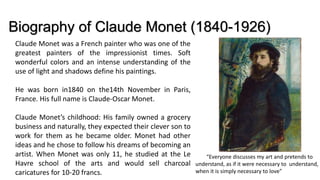
“Everyone discusses my art and pretends to
understand, as if it were necessary to understand,
when it is simply necessary to love”
Claude Monet was a French painter who was one of the
greatest painters of the impressionist times. Soft
wonderful colors and an intense understanding of the
use of light and shadows define his paintings.
He was born in1840 on the14th November in Paris,
France. His full name is Claude-Oscar Monet.
Claude Monet’s childhood: His family owned a grocery
business and naturally, they expected their clever son to
work for them as he became older. Monet had other
ideas and he chose to follow his dreams of becoming an
artist. When Monet was only 11, he studied at the Le
Havre school of the arts and would sell charcoal
caricatures for 10-20 francs.
Life of Claude Monet
When he was 16, he lived with his aunt who had no children of
her own. Monet visited the famous museum, the Louvre, and
took paints and materials with him to practice painting. While
other artists would copy the works of other great painters, Monet
preferred to paint what he viewed from the windows. Even at
this early age, he was beginning to discover the style that would
redefine how painting was performed.
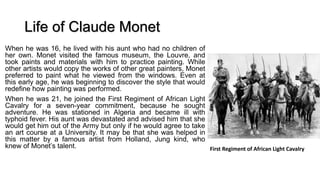
When he was 21, he joined the First Regiment of African Light
Cavalry for a seven-year commitment, because he sought
adventure. He was stationed in Algeria and became ill with
typhoid fever. His aunt was devastated and advised him that she
would get him out of the Army but only if he would agree to take
an art course at a University. It may be that she was helped in
this matter by a famous artist from Holland, Jung kind, who
knew of Monet’s talent. First Regiment of African Light Cavalry
Journey of life as artist begins
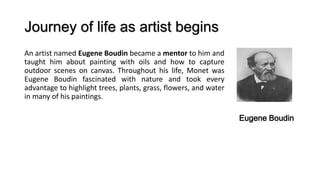
An artist named Eugene Boudin became a mentor to him and
taught him about painting with oils and how to capture
outdoor scenes on canvas. Throughout his life, Monet was
Eugene Boudin fascinated with nature and took every
advantage to highlight trees, plants, grass, flowers, and water
in many of his paintings.
Eugene Boudin
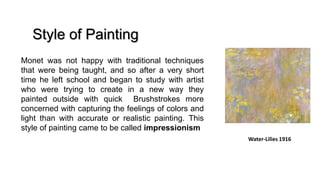
Water-Lilies 1916
Monet was not happy with traditional techniques
that were being taught, and so after a very short
time he left school and began to study with artist
who were trying to create in a new way they
painted outside with quick Brushstrokes more
concerned with capturing the feelings of colors and
light than with accurate or realistic painting. This
style of painting came to be called impressionism
Style of Painting
By 1865, some of Monet was accepted to salon, an annual
art show in Paris, and this work begin to appreciated but
still was poor. He married his first wife in 1870 together
with their young son they moved first to England and then
to Netherlands, but by late 1971, they returned to France.
Monet have very difficult time following his wife’s death,
but within few years his career began to take off as his
dealer had more and more success and selling his painting.
In 1883, Monet settled in a house in Giverny, France, with
Alice hoschede who cared for his children as well as her
own six children. By 1890 Monet was doing well to busy the
house and land around it, and to build a green house, a
studio and a garden full of water lilies.
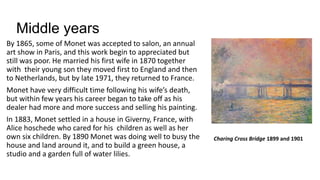
Charing Cross Bridge 1899 and 1901
Middle years
In 1892, following death of her husband Monet married Alice, spend
his remaining life painting in the garden of Giverny. He often painted
the same thing many thing many times in an attempt to capture them
in different seasons, light or colors.
Painters of impressionist movement, and he was one of the most
prolific, and creating more than two thousand five hundred painting,
drawing and pastels in his life time.
He continued his painting up until death on December 5, 1926 at the
age of 86.
Continued…
Artist's worldview influences Claude Monet's work
Several artists influenced Monet's style and the development of his art work including Manet,
Boudin, Hokusai and Jongkind.
Eugène Boudin's Influence on Monet:
By the time he was 22, he was painting full time, spending time in Paris, Normandy, and Flanders.
He spent a while trying to convince Monet to study with him, something Monet finally and
grudgingly agreed to. Monet found that he enjoyed doing the landscapes Boudin showed him.
• By the time Boudin met Monet (1857) he had already met Johan Jongkind who advised him to
paint his seascapes en plein air (means "in the open air“). So, he told Monet the same thing.
Often they would do seascapes and sit outdoors for hours painting the port at Le Havre.
• Perhaps what Monet really took away from Boudin, though, (besides the en plein air painting)
was the method by which Boudin blended the sky and often focused on it, making the sky the
point of interest in many of his paintings. Similar work can be found in Monet’s painting.
Continued…
Manet's Influence on Monet
Manet did not consider himself an Impressionist. His style of art preceded the Impressionist
movement and was more realistic, especially in his early work. Most notably, Manet focused on
figure painting, never becoming a landscape artist. Another large difference between the two artists
is their response to war. Even though Monet had a son as a soldier in World War I, no note of
sorrow even touches his paintings
Looking at his painting, all could have been prosperous and well in France. Manet painted images of
war, including Battle of the Kearsarge and Alabama, 1864.
However, his paintings did have many impressionistic aspects. Many critics who preferred more
realistic styles denounced Manet’s pictures as sketchy. Some even went as far as to say paintings
like Music in the Tuileries were unfinished. This style is seen in the landscaping, which is almost
impressionistic.
Manet also did some work where he did not paint realistically. His Self-portrait with Palette, 1879,
uses a blending of many blocked browns in his jacket. It shows major brush strokes.
Hokusai's Influence on Monet
One of Monet’s interests, in addition to painting and gardening, was
collecting Japanese art. His home had 231 Japanese woodblocks,
Hokusai being prominent among them.
Hokusai’s Japanese flower concentration may have been a factor in
Monet’s realization that his water lilies would be a fantastic subject for
a painting. Hokusai’s flowers did not need landscape as background to
make them beautiful. Monet would blend this with his love of the sea
to eventually create paintings of only his water lilies and the water.
The most obvious and indisputable proof of Monet being influenced by
the art and culture of Japan is his work, Madame Monet en Costume
Japonais (La Japonaise).
Technical elements involved in the
creation of his artistic works.
Brush stroke
Monet's brush stroke is a key feature of his works. The technique, honed
throughout his career relies on fast brush strokes in order to depict light in
never before seen Realism. In Sunrise, Monet's Impressionist brushstroke
can be seen in full effect. The piece itself is a painting of the port at Le Havre
in France and Monet's rapid brush stroke is used to portray the setting suns
reflective power on the gentle darkened sea.
Color palette
Monet's renowned use of color is directly linked to his use of light. The artist
had a love of depicting color in new and experimental ways and this was
heavily influenced by the different ways objects would look depending on
the time of day. Such a pursuit, which included both night and day, meant
that Monet's use of color was widely ranged. His use of dark tones was often
utilized in order to further highlight his use of brighter colors.
Continued…
Perspective
Monet's style notably changed towards his later life as he sought to
pursue even more means of depicting natural lights effect on different
scenes. One example of this was his series of paintings of Haystacks on
his property in Giverny. The artist sought to painstakingly depict the
changing look of something as ordinary as haystacks depending on the
time of day they were seen. What followed was a series of noticeably
different paintings from varied angles but of the same objects.
Monet's personal Impressionist ability is said to have reached its peak with
his Giverny-inspired series of paintings of Water Lilies and these paintings
are what most people think of when considering Monet's illustrious career.
After this high point came Monet's continued pursuit of actualizing the
effects of the changing day on scenes.
• Today Monet is remembered for the changes he helped create in the world
of art. By moving away from realism or realistic paintings, he prepared the
for more modern style of art.
• His painting hand on museum around the world, and his beautiful garden
are open for visitor who want to come and see the place that renowned
artist created to many of his painting.
Later years
References
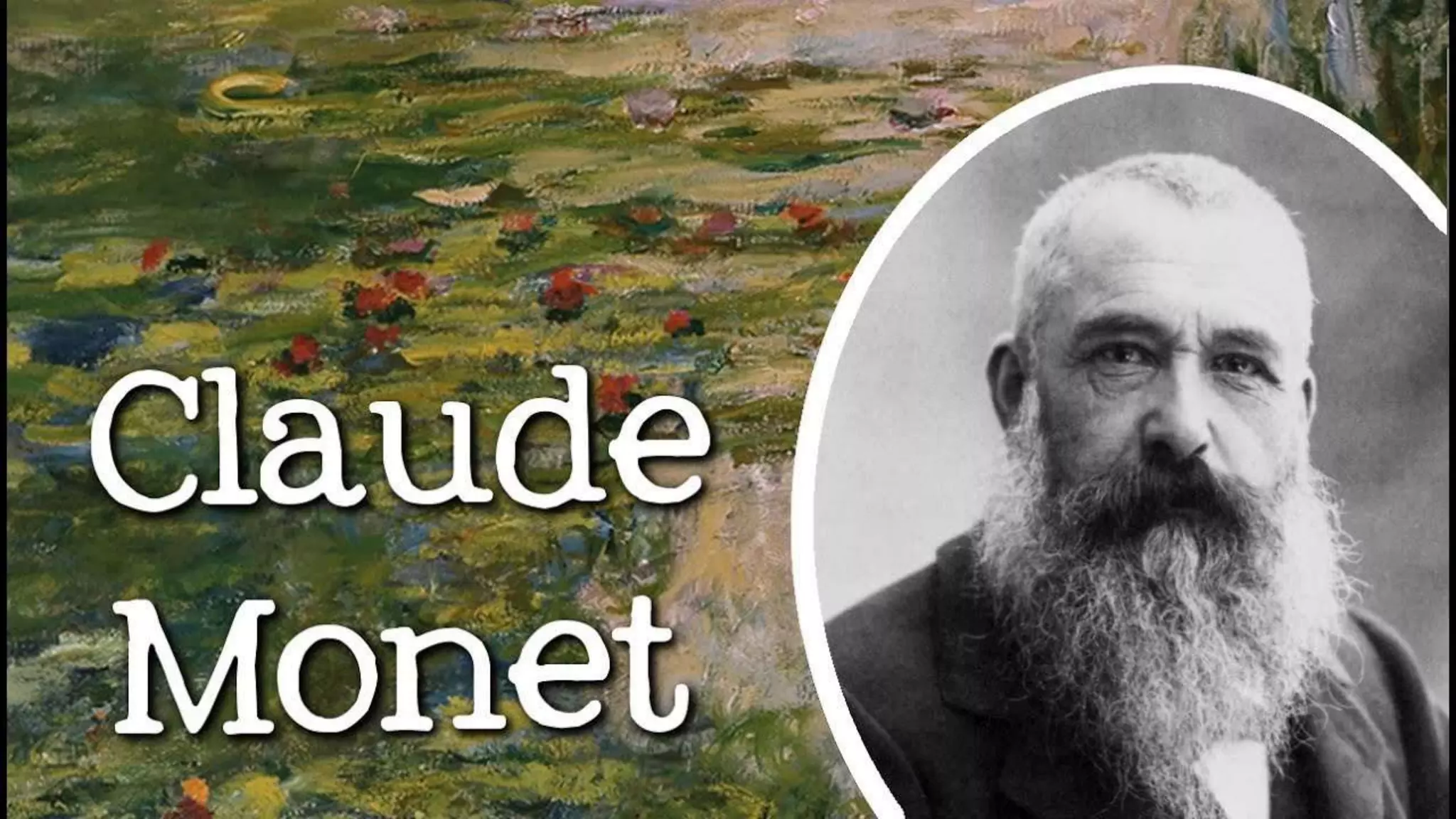
1. Claude Monet 1899 Nadar.jpg
2. Monet, c. (1899-1901). Portrait of the painter Claude Monet[oil on canvas]. Musée d'Orsay,
Paris,retrieved https://en.wikipedia.org/wiki/File:Pierre-
Auguste_Renoir,_1875,_Claude_Monet,_oil_on_canvas,_84_x_60.5_cm,_Mus%C3%A9e_
d%27Orsay,_Paris.jpg
3. Monet, c. (1916). Water-Lilies [image of painting]. National Gallery, London.
retrieved http://www.nationalgallery.org.uk/paintings/claude-monet-water-lilies
4. Monet, c. (1899-1901). Charing Cross Bridge [oil on canvas]. Saint Louis Art Museum,
Saint Louis, retrieved http://en.wikipedia.org/wiki/File:Claude_Monet_-
Charing_Cross_Bridge_(Saint_Louis).jpg
Claude monet ppt (2)

Claude monet ppt (2)

  • 2.
    Biography of ClaudeMonet (1840-1926) “Everyone discusses my art and pretends to understand, as if it were necessary to understand, when it is simply necessary to love” Claude Monet was a French painter who was one of the greatest painters of the impressionist times. Soft wonderful colors and an intense understanding of the use of light and shadows define his paintings. He was born in1840 on the14th November in Paris, France. His full name is Claude-Oscar Monet. Claude Monet’s childhood: His family owned a grocery business and naturally, they expected their clever son to work for them as he became older. Monet had other ideas and he chose to follow his dreams of becoming an artist. When Monet was only 11, he studied at the Le Havre school of the arts and would sell charcoal caricatures for 10-20 francs.
  • 3.
    Life of ClaudeMonet When he was 16, he lived with his aunt who had no children of her own. Monet visited the famous museum, the Louvre, and took paints and materials with him to practice painting. While other artists would copy the works of other great painters, Monet preferred to paint what he viewed from the windows. Even at this early age, he was beginning to discover the style that would redefine how painting was performed. When he was 21, he joined the First Regiment of African Light Cavalry for a seven-year commitment, because he sought adventure. He was stationed in Algeria and became ill with typhoid fever. His aunt was devastated and advised him that she would get him out of the Army but only if he would agree to take an art course at a University. It may be that she was helped in this matter by a famous artist from Holland, Jung kind, who knew of Monet’s talent. First Regiment of African Light Cavalry
  • 4.
    Journey of lifeas artist begins An artist named Eugene Boudin became a mentor to him and taught him about painting with oils and how to capture outdoor scenes on canvas. Throughout his life, Monet was Eugene Boudin fascinated with nature and took every advantage to highlight trees, plants, grass, flowers, and water in many of his paintings. Eugene Boudin
  • 5.
    Water-Lilies 1916 Monet wasnot happy with traditional techniques that were being taught, and so after a very short time he left school and began to study with artist who were trying to create in a new way they painted outside with quick Brushstrokes more concerned with capturing the feelings of colors and light than with accurate or realistic painting. This style of painting came to be called impressionism Style of Painting
  • 6.
    By 1865, someof Monet was accepted to salon, an annual art show in Paris, and this work begin to appreciated but still was poor. He married his first wife in 1870 together with their young son they moved first to England and then to Netherlands, but by late 1971, they returned to France. Monet have very difficult time following his wife’s death, but within few years his career began to take off as his dealer had more and more success and selling his painting. In 1883, Monet settled in a house in Giverny, France, with Alice hoschede who cared for his children as well as her own six children. By 1890 Monet was doing well to busy the house and land around it, and to build a green house, a studio and a garden full of water lilies. Charing Cross Bridge 1899 and 1901 Middle years
  • 7.
    In 1892, followingdeath of her husband Monet married Alice, spend his remaining life painting in the garden of Giverny. He often painted the same thing many thing many times in an attempt to capture them in different seasons, light or colors. Painters of impressionist movement, and he was one of the most prolific, and creating more than two thousand five hundred painting, drawing and pastels in his life time. He continued his painting up until death on December 5, 1926 at the age of 86. Continued…
  • 8.
    Artist's worldview influencesClaude Monet's work Several artists influenced Monet's style and the development of his art work including Manet, Boudin, Hokusai and Jongkind. Eugène Boudin's Influence on Monet: By the time he was 22, he was painting full time, spending time in Paris, Normandy, and Flanders. He spent a while trying to convince Monet to study with him, something Monet finally and grudgingly agreed to. Monet found that he enjoyed doing the landscapes Boudin showed him. • By the time Boudin met Monet (1857) he had already met Johan Jongkind who advised him to paint his seascapes en plein air (means "in the open air“). So, he told Monet the same thing. Often they would do seascapes and sit outdoors for hours painting the port at Le Havre. • Perhaps what Monet really took away from Boudin, though, (besides the en plein air painting) was the method by which Boudin blended the sky and often focused on it, making the sky the point of interest in many of his paintings. Similar work can be found in Monet’s painting.
  • 9.
    Continued… Manet's Influence onMonet Manet did not consider himself an Impressionist. His style of art preceded the Impressionist movement and was more realistic, especially in his early work. Most notably, Manet focused on figure painting, never becoming a landscape artist. Another large difference between the two artists is their response to war. Even though Monet had a son as a soldier in World War I, no note of sorrow even touches his paintings Looking at his painting, all could have been prosperous and well in France. Manet painted images of war, including Battle of the Kearsarge and Alabama, 1864. However, his paintings did have many impressionistic aspects. Many critics who preferred more realistic styles denounced Manet’s pictures as sketchy. Some even went as far as to say paintings like Music in the Tuileries were unfinished. This style is seen in the landscaping, which is almost impressionistic. Manet also did some work where he did not paint realistically. His Self-portrait with Palette, 1879, uses a blending of many blocked browns in his jacket. It shows major brush strokes.
  • 10.
    Hokusai's Influence onMonet One of Monet’s interests, in addition to painting and gardening, was collecting Japanese art. His home had 231 Japanese woodblocks, Hokusai being prominent among them. Hokusai’s Japanese flower concentration may have been a factor in Monet’s realization that his water lilies would be a fantastic subject for a painting. Hokusai’s flowers did not need landscape as background to make them beautiful. Monet would blend this with his love of the sea to eventually create paintings of only his water lilies and the water. The most obvious and indisputable proof of Monet being influenced by the art and culture of Japan is his work, Madame Monet en Costume Japonais (La Japonaise).
  • 11.
    Technical elements involvedin the creation of his artistic works. Brush stroke Monet's brush stroke is a key feature of his works. The technique, honed throughout his career relies on fast brush strokes in order to depict light in never before seen Realism. In Sunrise, Monet's Impressionist brushstroke can be seen in full effect. The piece itself is a painting of the port at Le Havre in France and Monet's rapid brush stroke is used to portray the setting suns reflective power on the gentle darkened sea. Color palette Monet's renowned use of color is directly linked to his use of light. The artist had a love of depicting color in new and experimental ways and this was heavily influenced by the different ways objects would look depending on the time of day. Such a pursuit, which included both night and day, meant that Monet's use of color was widely ranged. His use of dark tones was often utilized in order to further highlight his use of brighter colors.
  • 12.
    Continued… Perspective Monet's style notablychanged towards his later life as he sought to pursue even more means of depicting natural lights effect on different scenes. One example of this was his series of paintings of Haystacks on his property in Giverny. The artist sought to painstakingly depict the changing look of something as ordinary as haystacks depending on the time of day they were seen. What followed was a series of noticeably different paintings from varied angles but of the same objects.
  • 13.
    Monet's personal Impressionistability is said to have reached its peak with his Giverny-inspired series of paintings of Water Lilies and these paintings are what most people think of when considering Monet's illustrious career. After this high point came Monet's continued pursuit of actualizing the effects of the changing day on scenes. • Today Monet is remembered for the changes he helped create in the world of art. By moving away from realism or realistic paintings, he prepared the for more modern style of art. • His painting hand on museum around the world, and his beautiful garden are open for visitor who want to come and see the place that renowned artist created to many of his painting. Later years
  • 14.
    References 1. Claude Monet1899 Nadar.jpg 2. Monet, c. (1899-1901). Portrait of the painter Claude Monet[oil on canvas]. Musée d'Orsay, Paris,retrieved https://en.wikipedia.org/wiki/File:Pierre- Auguste_Renoir,_1875,_Claude_Monet,_oil_on_canvas,_84_x_60.5_cm,_Mus%C3%A9e_ d%27Orsay,_Paris.jpg 3. Monet, c. (1916). Water-Lilies [image of painting]. National Gallery, London. retrieved http://www.nationalgallery.org.uk/paintings/claude-monet-water-lilies 4. Monet, c. (1899-1901). Charing Cross Bridge [oil on canvas]. Saint Louis Art Museum, Saint Louis, retrieved http://en.wikipedia.org/wiki/File:Claude_Monet_- Charing_Cross_Bridge_(Saint_Louis).jpg