GUSTAV KLIMT
With
Mrs. Herron
1st Grade Art
The Study of:
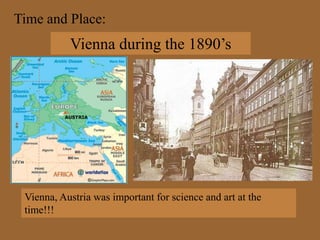
Vienna during the 1890’s
Vienna, Austria was important for science and art at the
time!!!
Time and Place:
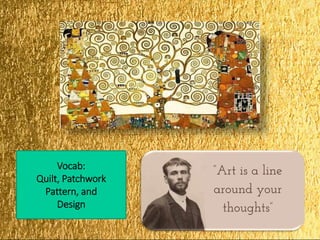
Vocab:
Quilt, Patchwork
Pattern, and
Design
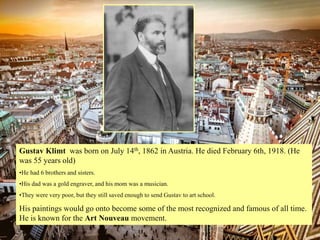
Gustav Klimt was born on July 14th, 1862 in Austria. He died February 6th, 1918. (He
was 55 years old)
•He had 6 brothers and sisters.
•His dad was a gold engraver, and his mom was a musician.
•They were very poor, but they still saved enough to send Gustav to art school.
His paintings would go onto become some of the most recognized and famous of all time.
He is known for the Art Nouveau movement.
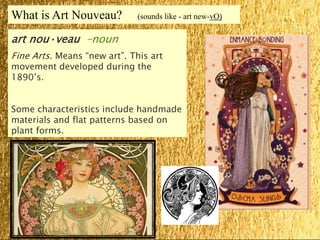
What is Art Nouveau? (sounds like - art new-vO)
art nou·veau –noun
Fine Arts. Means “new art”. This art
movement developed during the
1890’s.
Some characteristics include handmade
materials and flat patterns based on
plant forms.
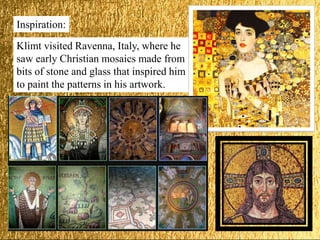
Inspiration:
Klimt visited Ravenna, Italy, where he
saw early Christian mosaics made from
bits of stone and glass that inspired him
to paint the patterns in his artwork.
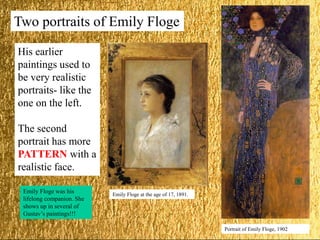
Two portraits of Emily Floge
Emily Floge at the age of 17, 1891.
Portrait of Emily Floge, 1902
His earlier
paintings used to
be very realistic
portraits- like the
one on the left.
The second
portrait has more
PATTERN with a
realistic face.
Emily Floge was his
lifelong companion. She
shows up in several of
Gustav’s paintings!!!
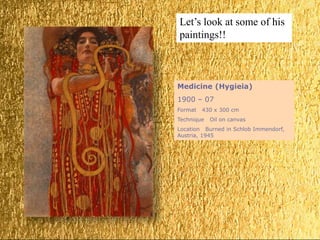
Medicine (Hygieia)
1900 – 07
Format 430 x 300 cm
Technique Oil on canvas
Location Burned in Schlob Immendorf,
Austria, 1945
Let’s look at some of his
paintings!!
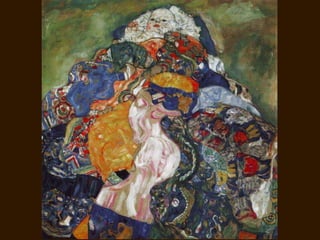
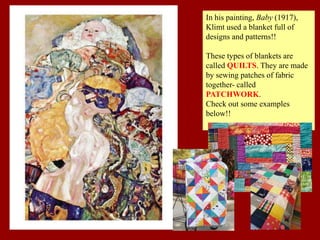
In his painting, Baby (1917),
Klimt used a blanket full of
designs and patterns!!
These types of blankets are
called QUILTS. They are made
by sewing patches of fabric
together- called
PATCHWORK.
Check out some examples
below!!
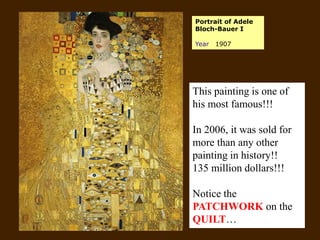
Portrait of Adele
Bloch-Bauer I
Year 1907
This painting is one of
his most famous!!!
In 2006, it was sold for
more than any other
painting in history!!
135 million dollars!!!
Notice the
PATCHWORK on the
QUILT…
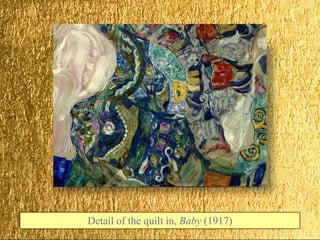
Detail of the quilt in, Baby (1917)
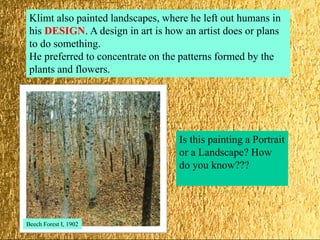
Klimt also painted landscapes, where he left out humans in
his DESIGN. A design in art is how an artist does or plans
to do something.
He preferred to concentrate on the patterns formed by the
plants and flowers.
Is this painting a Portrait
or a Landscape? How
do you know???
Beech Forest I, 1902
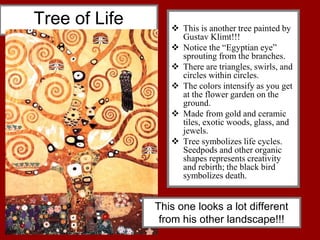
Tree of Life  This is another tree painted by
Gustav Klimt!!!
 Notice the “Egyptian eye”
sprouting from the branches.
 There are triangles, swirls, and
circles within circles.
 The colors intensify as you get
at the flower garden on the
ground.
 Made from gold and ceramic
tiles, exotic woods, glass, and
jewels.
 Tree symbolizes life cycles.
Seedpods and other organic
shapes represents creativity
and rebirth; the black bird
symbolizes death.
This one looks a lot different
from his other landscape!!!
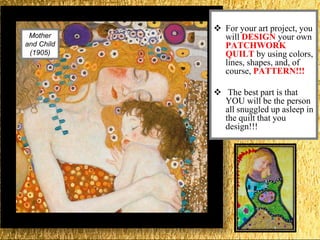
Mother
and Child
(1905)
 For your art project, you
will DESIGN your own
PATCHWORK
QUILT by using colors,
lines, shapes, and, of
course, PATTERN!!!
 The best part is that
YOU will be the person
all snuggled up asleep in
the quilt that you
design!!!

Gustav Klimt- 1st grade

  • 2.
    GUSTAV KLIMT With Mrs. Herron 1stGrade Art The Study of:
  • 3.
    Vienna during the1890’s Vienna, Austria was important for science and art at the time!!! Time and Place:
  • 4.
  • 5.
    Gustav Klimt wasborn on July 14th, 1862 in Austria. He died February 6th, 1918. (He was 55 years old) •He had 6 brothers and sisters. •His dad was a gold engraver, and his mom was a musician. •They were very poor, but they still saved enough to send Gustav to art school. His paintings would go onto become some of the most recognized and famous of all time. He is known for the Art Nouveau movement.
  • 6.
    What is ArtNouveau? (sounds like - art new-vO) art nou·veau –noun Fine Arts. Means “new art”. This art movement developed during the 1890’s. Some characteristics include handmade materials and flat patterns based on plant forms.
  • 7.
    Inspiration: Klimt visited Ravenna,Italy, where he saw early Christian mosaics made from bits of stone and glass that inspired him to paint the patterns in his artwork.
  • 8.
    Two portraits ofEmily Floge Emily Floge at the age of 17, 1891. Portrait of Emily Floge, 1902 His earlier paintings used to be very realistic portraits- like the one on the left. The second portrait has more PATTERN with a realistic face. Emily Floge was his lifelong companion. She shows up in several of Gustav’s paintings!!!
  • 9.
    Medicine (Hygieia) 1900 –07 Format 430 x 300 cm Technique Oil on canvas Location Burned in Schlob Immendorf, Austria, 1945 Let’s look at some of his paintings!!
  • 10.
    In his painting,Baby (1917), Klimt used a blanket full of designs and patterns!! These types of blankets are called QUILTS. They are made by sewing patches of fabric together- called PATCHWORK. Check out some examples below!!
  • 11.
    Portrait of Adele Bloch-BauerI Year 1907 This painting is one of his most famous!!! In 2006, it was sold for more than any other painting in history!! 135 million dollars!!! Notice the PATCHWORK on the QUILT…
  • 12.
    Detail of thequilt in, Baby (1917)
  • 13.
    Klimt also paintedlandscapes, where he left out humans in his DESIGN. A design in art is how an artist does or plans to do something. He preferred to concentrate on the patterns formed by the plants and flowers. Is this painting a Portrait or a Landscape? How do you know??? Beech Forest I, 1902
  • 14.
    Tree of Life This is another tree painted by Gustav Klimt!!!  Notice the “Egyptian eye” sprouting from the branches.  There are triangles, swirls, and circles within circles.  The colors intensify as you get at the flower garden on the ground.  Made from gold and ceramic tiles, exotic woods, glass, and jewels.  Tree symbolizes life cycles. Seedpods and other organic shapes represents creativity and rebirth; the black bird symbolizes death. This one looks a lot different from his other landscape!!!
  • 15.
    Mother and Child (1905)  Foryour art project, you will DESIGN your own PATCHWORK QUILT by using colors, lines, shapes, and, of course, PATTERN!!!  The best part is that YOU will be the person all snuggled up asleep in the quilt that you design!!!

Editor's Notes

  • #6 , founder of the school of painting known as the Vienna Secession, embodies the high-keyed free spirited, psychological, and aesthetic preoccupations of turn-of-the-century Vienna's dazzling intellectual world.
  • #10 The University of Vienna rejected Klimt’s Medicine mural because his mystical, snake handling priestess did not fit the University professors’ image of the physician as a scientist and healer.
  • #14 Klimt used small quick brushstrokes to form a glittering pattern of orange and yellow dots, dashes, and scribbles that resemble tiles in a mosaic.