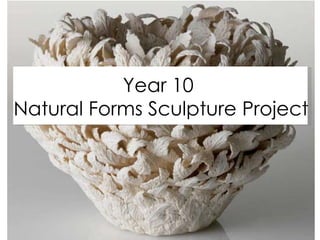
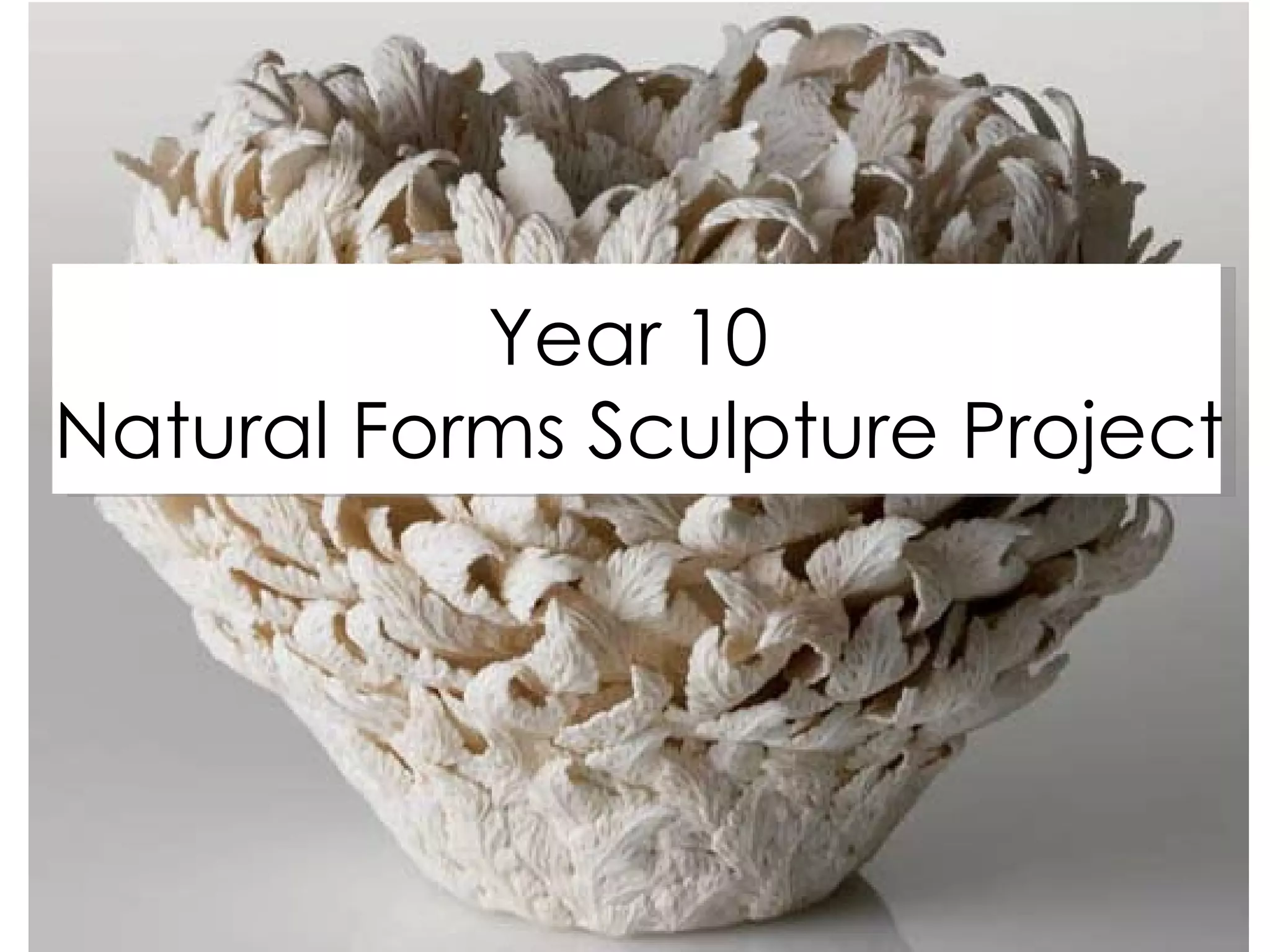
Year 10
Natural Forms Sculpture Project
GCSE: Assessment Objectives
AO1: RESEARCH – IMAGES & ARTISTS

Develop your ideas through investigations informed by contextual and other sources,
demonstrating analytical and cultural understanding.

AO2: EXPERIMENTS WITH MEDIA

Refine your ideas through experimenting and selecting appropriate resources, media,
materials, techniques and processes.
AO3: IDEAS, OBSERVATIONAL DRAWINGS & EXPLANATIONS

Record ideas, observations and insights relevant to your intentions in visual and/or
other forms.
AO4: FINAL IDEA & FINAL PIECE, LINKS WITH ARTISTS

Present a personal, informed and meaningful response demonstrating analytical and
critical understanding, realising intentions and making connections between visual or
other elements.
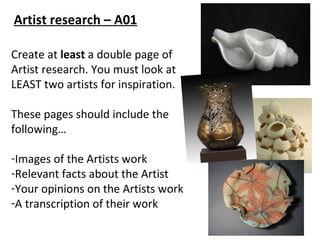
Artist research – A01

Create at least a double page of
Artist research. You must look at
LEAST two artists for inspiration.

These pages should include the
following…

-Images of the Artists work
-Relevant facts about the Artist
-Your opinions on the Artists work
-A transcription of their work
Artists
http://collection.britishcouncil.org
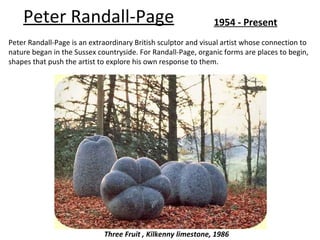
Peter Randall-Page                                         1954 - Present
Peter Randall-Page is an extraordinary British sculptor and visual artist whose connection to
nature began in the Sussex countryside. For Randall-Page, organic forms are places to begin,
shapes that push the artist to explore his own response to them.


                             Three Fruit , Kilkenny limestone, 1986
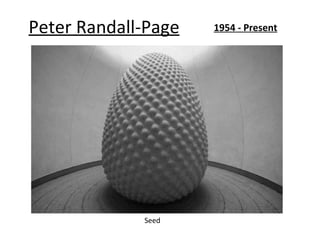
Peter Randall-Page   1954 - Present


             Seed
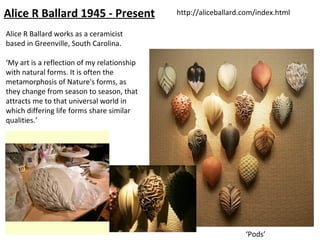
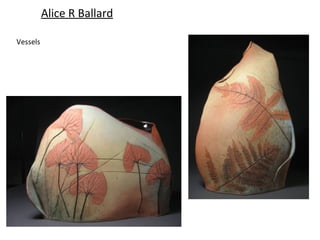
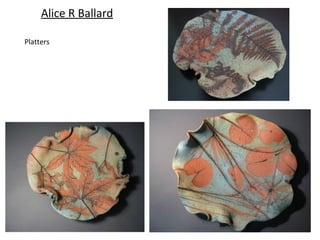
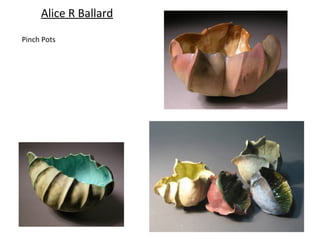
Alice R Ballard 1945 - Present               http://aliceballard.com/index.html

Alice R Ballard works as a ceramicist
based in Greenville, South Carolina.

‘My art is a reflection of my relationship
with natural forms. It is often the
metamorphosis of Nature's forms, as
they change from season to season, that
attracts me to that universal world in
which differing life forms share similar
qualities.’


                                                                 ‘Pods’
Alice R Ballard

Vessels
Alice R Ballard

Platters
Alice R Ballard

Pinch Pots
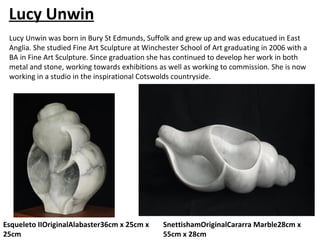
Lucy Unwin
 Lucy Unwin was born in Bury St Edmunds, Suffolk and grew up and was educatued in East
 Anglia. She studied Fine Art Sculpture at Winchester School of Art graduating in 2006 with a
 BA in Fine Art Sculpture. Since graduation she has continued to develop her work in both
 metal and stone, working towards exhibitions as well as working to commission. She is now
 working in a studio in the inspirational Cotswolds countryside.


Esqueleto IIOriginalAlabaster36cm x 25cm x      SnettishamOriginalCararra Marble28cm x
25cm                                            55cm x 28cm
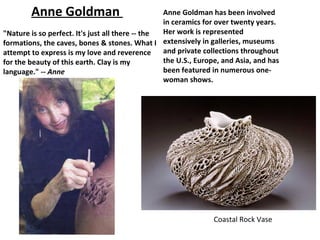
Anne Goldman                              Anne Goldman has been involved
                                                  in ceramics for over twenty years.
"Nature is so perfect. It's just all there -- the Her work is represented
formations, the caves, bones & stones. What I extensively in galleries, museums
attempt to express is my love and reverence       and private collections throughout
for the beauty of this earth. Clay is my          the U.S., Europe, and Asia, and has
language." -- Anne                                been featured in numerous one-
                                                  woman shows.


                                                                Coastal Rock Vase
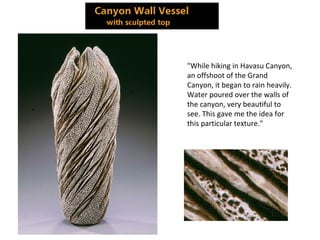
"While hiking in Havasu Canyon,
an offshoot of the Grand
Canyon, it began to rain heavily.
Water poured over the walls of
the canyon, very beautiful to
see. This gave me the idea for
this particular texture."
Carol Alleman

Carol’s artistic inclination
combines her ability to
transform emotion into word
and object through her own
curiosity, love of nature and
life experience. The common
thread, both in the approach
and work itself, directs her
mystical life journey. She
exhibits across North America
while realizing an international
collector base. Her work is
greatly appreciated by a highly
diverse base of collectors:
especially those with a love of
Tiffany, Art Nouveau, Arts and
Crafts, Traditional, Asian and
even Contemporary design.
                                   Carol Alleman, Transitions II, Cast Bronze
                                   Edition of 12, 42" x 25"
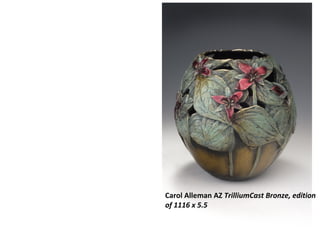
Carol Alleman AZ TrilliumCast Bronze, edition
of 1116 x 5.5
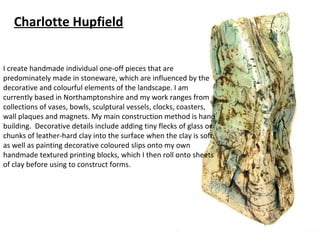
Charlotte Hupfield


I create handmade individual one-off pieces that are
predominately made in stoneware, which are influenced by the
decorative and colourful elements of the landscape. I am
currently based in Northamptonshire and my work ranges from
collections of vases, bowls, sculptural vessels, clocks, coasters,
wall plaques and magnets. My main construction method is hand
building. Decorative details include adding tiny flecks of glass or
chunks of leather-hard clay into the surface when the clay is soft,
as well as painting decorative coloured slips onto my own
handmade textured printing blocks, which I then roll onto sheets
of clay before using to construct forms.
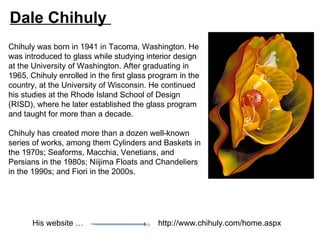
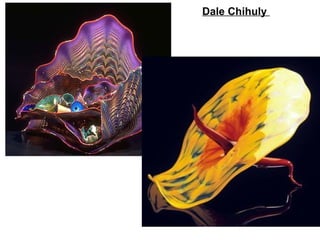
Dale Chihuly
Chihuly was born in 1941 in Tacoma, Washington. He
was introduced to glass while studying interior design
at the University of Washington. After graduating in
1965, Chihuly enrolled in the first glass program in the
country, at the University of Wisconsin. He continued
his studies at the Rhode Island School of Design
(RISD), where he later established the glass program
and taught for more than a decade.

Chihuly has created more than a dozen well-known
series of works, among them Cylinders and Baskets in
the 1970s; Seaforms, Macchia, Venetians, and
Persians in the 1980s; Niijima Floats and Chandeliers
in the 1990s; and Fiori in the 2000s.


       His website …                       http://www.chihuly.com/home.aspx
Dale Chihuly
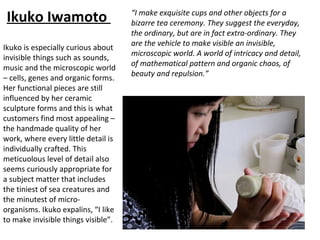
Ikuko Iwamoto                       “I make exquisite cups and other objects for a
                                     bizarre tea ceremony. They suggest the everyday,
                                     the ordinary, but are in fact extra-ordinary. They
                                     are the vehicle to make visible an invisible,
Ikuko is especially curious about
                                     microscopic world. A world of intricacy and detail,
invisible things such as sounds,
                                     of mathematical pattern and organic chaos, of
music and the microscopic world
                                     beauty and repulsion.”
– cells, genes and organic forms.
Her functional pieces are still
influenced by her ceramic
sculpture forms and this is what
customers find most appealing –
the handmade quality of her
work, where every little detail is
individually crafted. This
meticuolous level of detail also
seems curiously appropriate for
a subject matter that includes
the tiniest of sea creatures and
the minutest of micro-
organisms. Ikuko expalins, “I like
to make invisible things visible”.
Ikuko Iwamoto


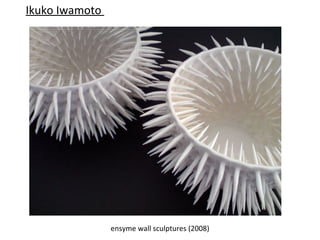
                ensyme wall sculptures (2008)
Ikuko Iwamoto


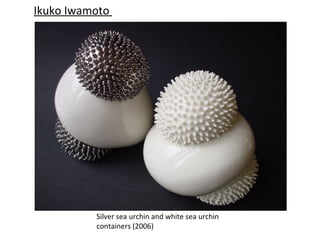
          Silver sea urchin and white sea urchin
          containers (2006)
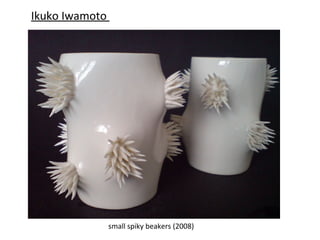
Ikuko Iwamoto


                small spiky beakers (2008)
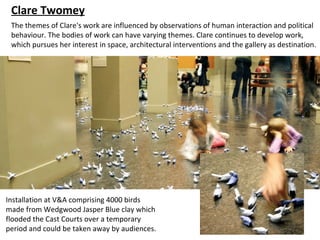
Clare Twomey
 The themes of Clare's work are influenced by observations of human interaction and political
 behaviour. The bodies of work can have varying themes. Clare continues to develop work,
 which pursues her interest in space, architectural interventions and the gallery as destination.


Installation at V&A comprising 4000 birds
made from Wedgwood Jasper Blue clay which
flooded the Cast Courts over a temporary
period and could be taken away by audiences.
Clare Twomey's Specimen, 2009
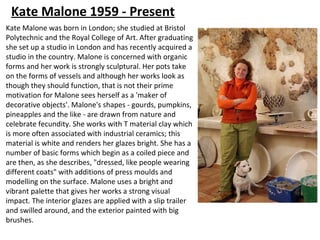
Kate Malone 1959 - Present
Kate Malone was born in London; she studied at Bristol
Polytechnic and the Royal College of Art. After graduating
she set up a studio in London and has recently acquired a
studio in the country. Malone is concerned with organic
forms and her work is strongly sculptural. Her pots take
on the forms of vessels and although her works look as
though they should function, that is not their prime
motivation for Malone sees herself as a 'maker of
decorative objects'. Malone's shapes - gourds, pumpkins,
pineapples and the like - are drawn from nature and
celebrate fecundity. She works with T material clay which
is more often associated with industrial ceramics; this
material is white and renders her glazes bright. She has a
number of basic forms which begin as a coiled piece and
are then, as she describes, "dressed, like people wearing
different coats" with additions of press moulds and
modelling on the surface. Malone uses a bright and
vibrant palette that gives her works a strong visual
impact. The interior glazes are applied with a slip trailer
and swilled around, and the exterior painted with big
brushes.
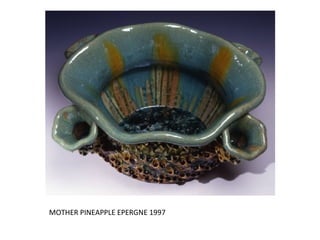
MOTHER PINEAPPLE EPERGNE 1997
Kate MaloneGreen Sprucey Nut Lidded Box,
2006 Crystalline glazed stoneware
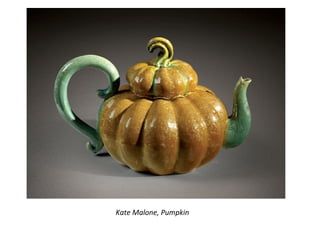
Kate Malone, Pumpkin
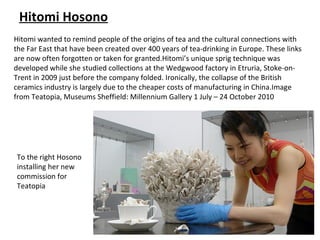
Hitomi Hosono
Hitomi wanted to remind people of the origins of tea and the cultural connections with
the Far East that have been created over 400 years of tea-drinking in Europe. These links
are now often forgotten or taken for granted.Hitomi’s unique sprig technique was
developed while she studied collections at the Wedgwood factory in Etruria, Stoke-on-
Trent in 2009 just before the company folded. Ironically, the collapse of the British
ceramics industry is largely due to the cheaper costs of manufacturing in China.Image
from Teatopia, Museums Sheffield: Millennium Gallery 1 July – 24 October 2010


To the right Hosono
installing her new
commission for
Teatopia
Picture 2
Hitomi Hosono, Leaves Bowl
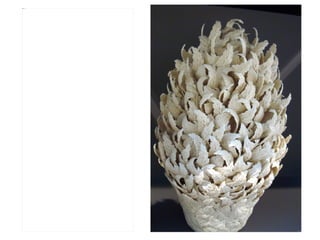
Nuala O'Donovan


Pinecone Series Porcelain, high-
fired and unglazed. Date 2007,
2008, 2009.This work in this series
is based on a pattern found in a
pinecone. It uses the
characteristics of fractal forms in
nature by multiplying the pattern
and form within the overall
finished piece.
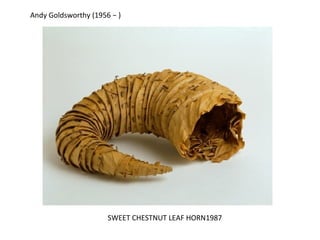
Andy Goldsworthy (1956 − )


                      SWEET CHESTNUT LEAF HORN1987
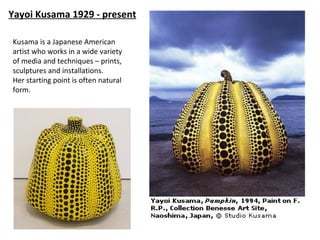
Yayoi Kusama 1929 - present

Kusama is a Japanese American
artist who works in a wide variety
of media and techniques – prints,
sculptures and installations.
Her starting point is often natural
form.
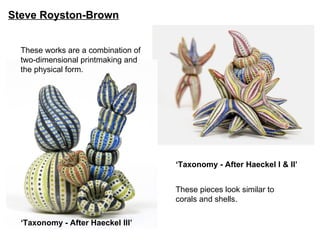
Steve Royston-Brown


  These works are a combination of
  two-dimensional printmaking and
  the physical form.


                                     ‘Taxonomy - After Haeckel I & II’


                                     These pieces look similar to
                                     corals and shells.

  ‘Taxonomy - After Haeckel III’
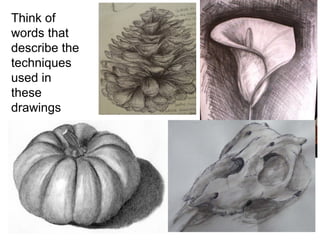
Think of
words that
describe the
techniques
used in
these
drawings
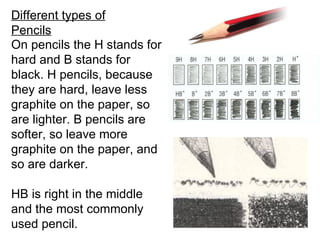
Different types of
Pencils
On pencils the H stands for
hard and B stands for
black. H pencils, because
they are hard, leave less
graphite on the paper, so
are lighter. B pencils are
softer, so leave more
graphite on the paper, and
so are darker.

HB is right in the middle
and the most commonly
used pencil.
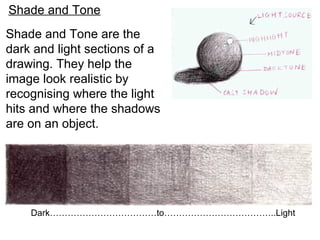
Shade and Tone
Shade and Tone are the
dark and light sections of a
drawing. They help the
image look realistic by
recognising where the light
hits and where the shadows
are on an object.


    Dark………………………………to………………………………..Light
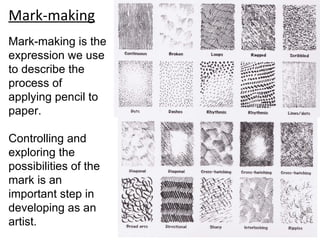
Mark-making
Mark-making is the
expression we use
to describe the
process of
applying pencil to
paper.

Controlling and
exploring the
possibilities of the
mark is an
important step in
developing as an
artist.
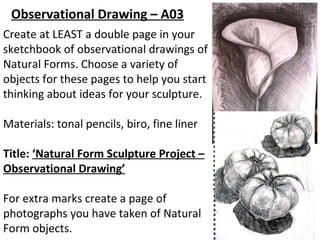
Observational Drawing – A03
Create at LEAST a double page in your
sketchbook of observational drawings of
Natural Forms. Choose a variety of
objects for these pages to help you start
thinking about ideas for your sculpture.

Materials: tonal pencils, biro, fine liner

Title: ‘Natural Form Sculpture Project –
Observational Drawing’

For extra marks create a page of
photographs you have taken of Natural
Form objects.

Natural forms sculpture project

  • 1.
    Year 10 Natural FormsSculpture Project
  • 2.
    GCSE: Assessment Objectives AO1:RESEARCH – IMAGES & ARTISTS Develop your ideas through investigations informed by contextual and other sources, demonstrating analytical and cultural understanding. AO2: EXPERIMENTS WITH MEDIA Refine your ideas through experimenting and selecting appropriate resources, media, materials, techniques and processes. AO3: IDEAS, OBSERVATIONAL DRAWINGS & EXPLANATIONS Record ideas, observations and insights relevant to your intentions in visual and/or other forms. AO4: FINAL IDEA & FINAL PIECE, LINKS WITH ARTISTS Present a personal, informed and meaningful response demonstrating analytical and critical understanding, realising intentions and making connections between visual or other elements.
  • 3.
    Artist research –A01 Create at least a double page of Artist research. You must look at LEAST two artists for inspiration. These pages should include the following… -Images of the Artists work -Relevant facts about the Artist -Your opinions on the Artists work -A transcription of their work
  • 4.
  • 5.
    Peter Randall-Page 1954 - Present Peter Randall-Page is an extraordinary British sculptor and visual artist whose connection to nature began in the Sussex countryside. For Randall-Page, organic forms are places to begin, shapes that push the artist to explore his own response to them. Three Fruit , Kilkenny limestone, 1986
  • 6.
    Peter Randall-Page 1954 - Present Seed
  • 7.
    Alice R Ballard1945 - Present http://aliceballard.com/index.html Alice R Ballard works as a ceramicist based in Greenville, South Carolina. ‘My art is a reflection of my relationship with natural forms. It is often the metamorphosis of Nature's forms, as they change from season to season, that attracts me to that universal world in which differing life forms share similar qualities.’ ‘Pods’
  • 8.
  • 9.
  • 10.
  • 11.
    Lucy Unwin LucyUnwin was born in Bury St Edmunds, Suffolk and grew up and was educatued in East Anglia. She studied Fine Art Sculpture at Winchester School of Art graduating in 2006 with a BA in Fine Art Sculpture. Since graduation she has continued to develop her work in both metal and stone, working towards exhibitions as well as working to commission. She is now working in a studio in the inspirational Cotswolds countryside. Esqueleto IIOriginalAlabaster36cm x 25cm x SnettishamOriginalCararra Marble28cm x 25cm 55cm x 28cm
  • 12.
    Anne Goldman Anne Goldman has been involved in ceramics for over twenty years. "Nature is so perfect. It's just all there -- the Her work is represented formations, the caves, bones & stones. What I extensively in galleries, museums attempt to express is my love and reverence and private collections throughout for the beauty of this earth. Clay is my the U.S., Europe, and Asia, and has language." -- Anne been featured in numerous one- woman shows. Coastal Rock Vase
  • 13.
    "While hiking inHavasu Canyon, an offshoot of the Grand Canyon, it began to rain heavily. Water poured over the walls of the canyon, very beautiful to see. This gave me the idea for this particular texture."
  • 14.
    Carol Alleman Carol’s artisticinclination combines her ability to transform emotion into word and object through her own curiosity, love of nature and life experience. The common thread, both in the approach and work itself, directs her mystical life journey. She exhibits across North America while realizing an international collector base. Her work is greatly appreciated by a highly diverse base of collectors: especially those with a love of Tiffany, Art Nouveau, Arts and Crafts, Traditional, Asian and even Contemporary design. Carol Alleman, Transitions II, Cast Bronze Edition of 12, 42" x 25"
  • 15.
    Carol Alleman AZTrilliumCast Bronze, edition of 1116 x 5.5
  • 16.
    Charlotte Hupfield I createhandmade individual one-off pieces that are predominately made in stoneware, which are influenced by the decorative and colourful elements of the landscape. I am currently based in Northamptonshire and my work ranges from collections of vases, bowls, sculptural vessels, clocks, coasters, wall plaques and magnets. My main construction method is hand building. Decorative details include adding tiny flecks of glass or chunks of leather-hard clay into the surface when the clay is soft, as well as painting decorative coloured slips onto my own handmade textured printing blocks, which I then roll onto sheets of clay before using to construct forms.
  • 18.
    Dale Chihuly Chihuly wasborn in 1941 in Tacoma, Washington. He was introduced to glass while studying interior design at the University of Washington. After graduating in 1965, Chihuly enrolled in the first glass program in the country, at the University of Wisconsin. He continued his studies at the Rhode Island School of Design (RISD), where he later established the glass program and taught for more than a decade. Chihuly has created more than a dozen well-known series of works, among them Cylinders and Baskets in the 1970s; Seaforms, Macchia, Venetians, and Persians in the 1980s; Niijima Floats and Chandeliers in the 1990s; and Fiori in the 2000s. His website … http://www.chihuly.com/home.aspx
  • 19.
  • 20.
    Ikuko Iwamoto “I make exquisite cups and other objects for a bizarre tea ceremony. They suggest the everyday, the ordinary, but are in fact extra-ordinary. They are the vehicle to make visible an invisible, Ikuko is especially curious about microscopic world. A world of intricacy and detail, invisible things such as sounds, of mathematical pattern and organic chaos, of music and the microscopic world beauty and repulsion.” – cells, genes and organic forms. Her functional pieces are still influenced by her ceramic sculpture forms and this is what customers find most appealing – the handmade quality of her work, where every little detail is individually crafted. This meticuolous level of detail also seems curiously appropriate for a subject matter that includes the tiniest of sea creatures and the minutest of micro- organisms. Ikuko expalins, “I like to make invisible things visible”.
  • 21.
    Ikuko Iwamoto ensyme wall sculptures (2008)
  • 22.
    Ikuko Iwamoto Silver sea urchin and white sea urchin containers (2006)
  • 23.
    Ikuko Iwamoto small spiky beakers (2008)
  • 24.
    Clare Twomey Thethemes of Clare's work are influenced by observations of human interaction and political behaviour. The bodies of work can have varying themes. Clare continues to develop work, which pursues her interest in space, architectural interventions and the gallery as destination. Installation at V&A comprising 4000 birds made from Wedgwood Jasper Blue clay which flooded the Cast Courts over a temporary period and could be taken away by audiences.
  • 25.
  • 26.
    Kate Malone 1959- Present Kate Malone was born in London; she studied at Bristol Polytechnic and the Royal College of Art. After graduating she set up a studio in London and has recently acquired a studio in the country. Malone is concerned with organic forms and her work is strongly sculptural. Her pots take on the forms of vessels and although her works look as though they should function, that is not their prime motivation for Malone sees herself as a 'maker of decorative objects'. Malone's shapes - gourds, pumpkins, pineapples and the like - are drawn from nature and celebrate fecundity. She works with T material clay which is more often associated with industrial ceramics; this material is white and renders her glazes bright. She has a number of basic forms which begin as a coiled piece and are then, as she describes, "dressed, like people wearing different coats" with additions of press moulds and modelling on the surface. Malone uses a bright and vibrant palette that gives her works a strong visual impact. The interior glazes are applied with a slip trailer and swilled around, and the exterior painted with big brushes.
  • 27.
  • 28.
    Kate MaloneGreen SpruceyNut Lidded Box, 2006 Crystalline glazed stoneware
  • 29.
  • 30.
    Hitomi Hosono Hitomi wantedto remind people of the origins of tea and the cultural connections with the Far East that have been created over 400 years of tea-drinking in Europe. These links are now often forgotten or taken for granted.Hitomi’s unique sprig technique was developed while she studied collections at the Wedgwood factory in Etruria, Stoke-on- Trent in 2009 just before the company folded. Ironically, the collapse of the British ceramics industry is largely due to the cheaper costs of manufacturing in China.Image from Teatopia, Museums Sheffield: Millennium Gallery 1 July – 24 October 2010 To the right Hosono installing her new commission for Teatopia
  • 31.
  • 32.
  • 34.
    Nuala O'Donovan Pinecone SeriesPorcelain, high- fired and unglazed. Date 2007, 2008, 2009.This work in this series is based on a pattern found in a pinecone. It uses the characteristics of fractal forms in nature by multiplying the pattern and form within the overall finished piece.
  • 35.
    Andy Goldsworthy (1956− ) SWEET CHESTNUT LEAF HORN1987
  • 36.
    Yayoi Kusama 1929- present Kusama is a Japanese American artist who works in a wide variety of media and techniques – prints, sculptures and installations. Her starting point is often natural form.
  • 37.
    Steve Royston-Brown These works are a combination of two-dimensional printmaking and the physical form. ‘Taxonomy - After Haeckel I & II’ These pieces look similar to corals and shells. ‘Taxonomy - After Haeckel III’
  • 38.
    Think of words that describethe techniques used in these drawings
  • 39.
    Different types of Pencils Onpencils the H stands for hard and B stands for black. H pencils, because they are hard, leave less graphite on the paper, so are lighter. B pencils are softer, so leave more graphite on the paper, and so are darker. HB is right in the middle and the most commonly used pencil.
  • 40.
    Shade and Tone Shadeand Tone are the dark and light sections of a drawing. They help the image look realistic by recognising where the light hits and where the shadows are on an object. Dark………………………………to………………………………..Light
  • 41.
    Mark-making Mark-making is the expressionwe use to describe the process of applying pencil to paper. Controlling and exploring the possibilities of the mark is an important step in developing as an artist.
  • 42.
    Observational Drawing –A03 Create at LEAST a double page in your sketchbook of observational drawings of Natural Forms. Choose a variety of objects for these pages to help you start thinking about ideas for your sculpture. Materials: tonal pencils, biro, fine liner Title: ‘Natural Form Sculpture Project – Observational Drawing’ For extra marks create a page of photographs you have taken of Natural Form objects.