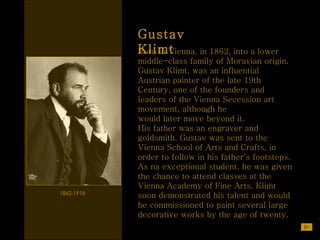
Gustav Klimt 1862-1918  Born in Vienna, in 1862, into a lower  middle-class family of Moravian origin.  Gustav Klimt, was an influential Austrian painter of the late 19th Century, one of the founders and leaders of the Vienna Secession art movement, although he  would later move beyond it.  His father was an engraver and goldsmith. Gustav was sent to the Vienna School of Arts and Crafts, in order to follow in his father's footsteps. As na exceptional student, he was given the chance to attend classes at the Vienna Academy of Fine Arts.   Klimt soon demonstrated his talent and would be commissioned to paint several large decorative works by the age of twenty.
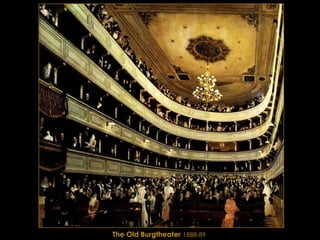
After finishing his studies, Klimt opened a studio together with his two brothers, specialized in interior decoration, particularly theaters. Already by the 1880s, they were renowned for their skill and decorated theaters throughout the Austro-Hungarian Empire, and much of their work can still be seen there. In 1880, Klimt was commissioned to paint the Auditorium of the “ Old Burgtheater” . This painting, with its almost photographic accuracy is considered one of the greatest achievements in Naturalist painting, and was awarded the Emperor's Prize. Paradoxically, it was at this point, that Klimt began turning towards the radical new styles of the Art Noveau. Focusing on experimentation and the study of contemporary styles of art, as well as historical styles that were overlooked within the establishment, such as Japanese, Chinese, Ancient Egyptian and Mycenaean art.  Although educated as classicist, his use of bright, vivid colors and the widespread use of symbolic objects in his paintings would set the trends for the entire period, and would have a profound influence on Viennese Art Noveau and the Secession movement ( founded in 1897), that was against the classicist establishment, which it found to be oppressive.   In 1903, he visited Italy twice and was profoundly influenced by the golden mosaics of Ravenna. This marked the beginning of his "golden style." By 1910, Klimt had moved past his Golden Style, and in 1912,  he changed the background from gold to blue.
The Old Burgtheater   1888-89
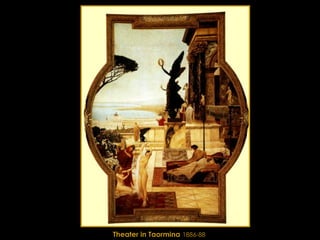
Theater in Taormina   1886-88
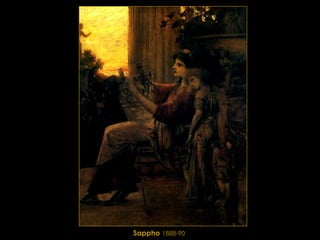
Sappho   1888-90
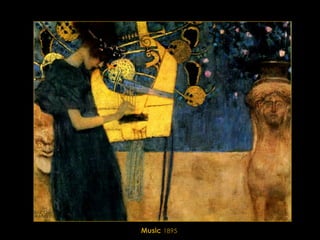
Music   1895
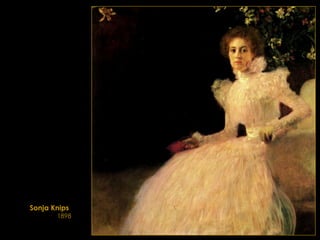
Sonja Knips   1898
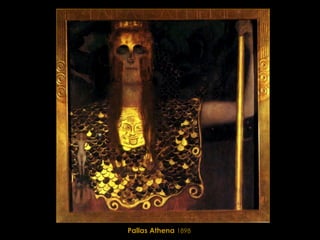
Pallas Athena   1898
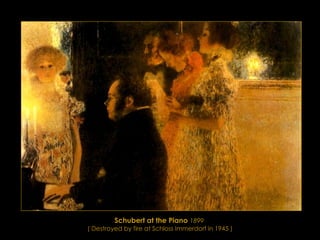
Schubert at the Piano   1899   ( Destroyed by fire at Schloss Immerdorf in 1945 )
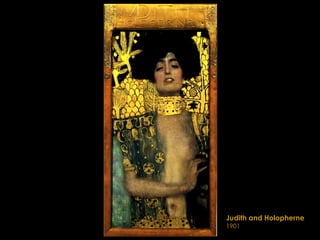
Judith and Holopherne   1901
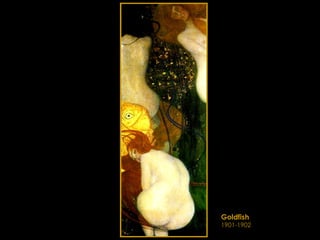
Goldfish 1901-1902
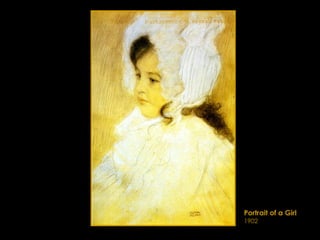
Portrait of a Girl   1902
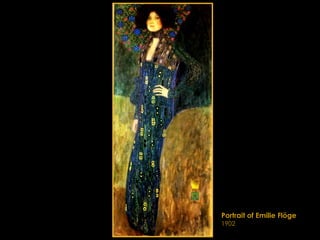
Portrait of Emilie Flöge   1902
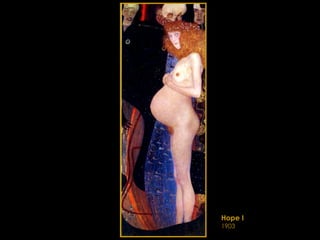
Hope I   1903
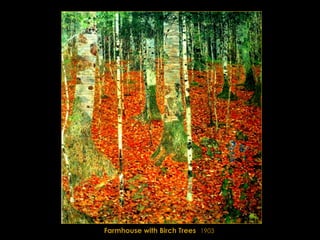
Farmhouse with Birch Trees   1903
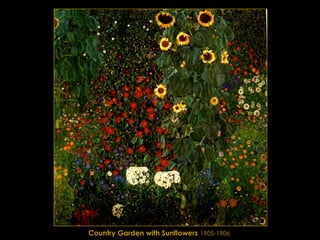
Country Garden with Sunflowers   1905-1906
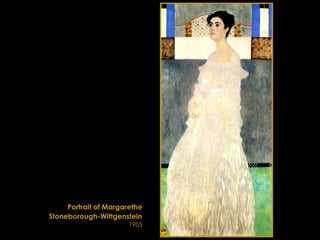
Portrait of Margarethe  Stoneborough-Wittgenstein   1905
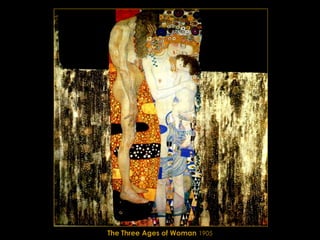
The Three Ages of Woman   1905
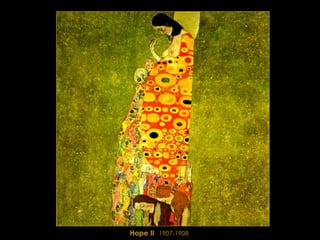
Hope II   1907-1908
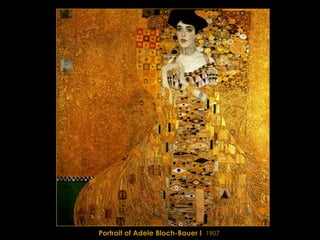
Portrait of Adele Bloch-Bauer I  1907
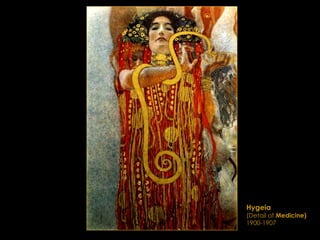
Hygeia   (Detail of  Medicine)   1900-1907
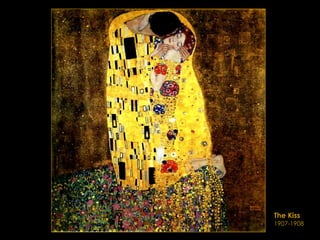
The Kiss   1907-1908
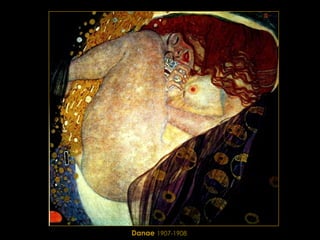
Danae   1907-1908
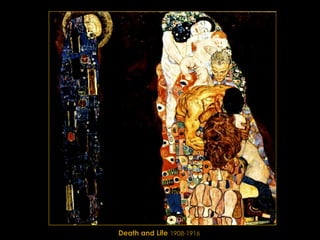
Death and Life   1908-1916
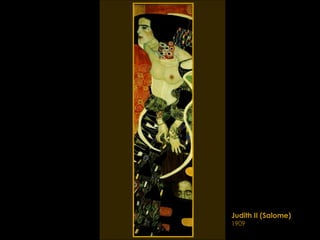
Judith II (Salome)   1909
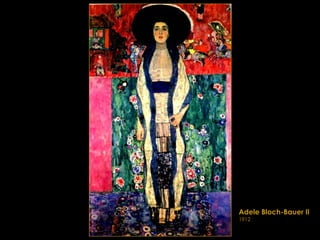
Adele Bloch-Bauer II   1912
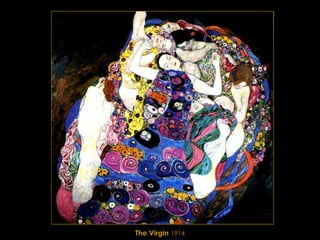
The Virgin   1914
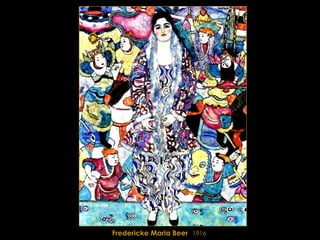
Fredericke Maria Beer   1916
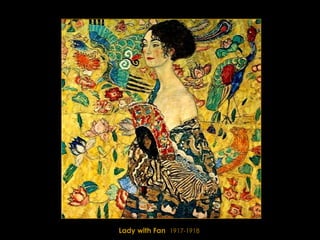
Lady with Fan  1917-1918
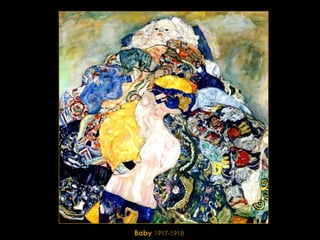
Baby 1917 Baby   1917-1918
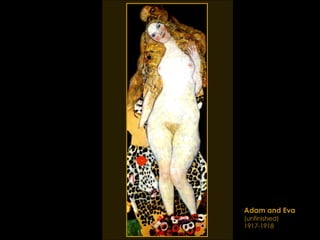
Adam and Eva   (unfinished)   1917-1918
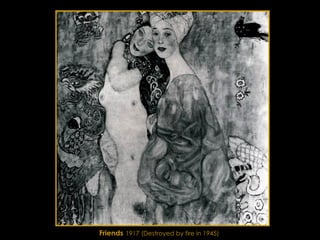
Friends   1917 (Destroyed by fire in 1945)
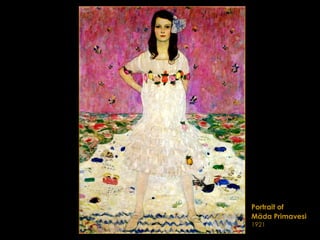
Portrait of  Mäda Primavesi   1921
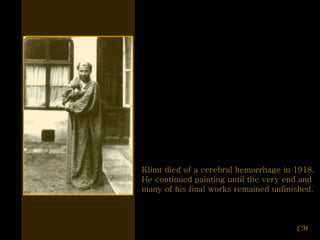
Klimt died of a cerebral hemorrhage in 1918.  He continued painting until the very end and many of his final works remained unfinished. CM

Gustav Klimt 1862 1918

  • 1.
    Gustav Klimt 1862-1918 Born in Vienna, in 1862, into a lower middle-class family of Moravian origin. Gustav Klimt, was an influential Austrian painter of the late 19th Century, one of the founders and leaders of the Vienna Secession art movement, although he would later move beyond it. His father was an engraver and goldsmith. Gustav was sent to the Vienna School of Arts and Crafts, in order to follow in his father's footsteps. As na exceptional student, he was given the chance to attend classes at the Vienna Academy of Fine Arts. Klimt soon demonstrated his talent and would be commissioned to paint several large decorative works by the age of twenty.
  • 2.
    After finishing hisstudies, Klimt opened a studio together with his two brothers, specialized in interior decoration, particularly theaters. Already by the 1880s, they were renowned for their skill and decorated theaters throughout the Austro-Hungarian Empire, and much of their work can still be seen there. In 1880, Klimt was commissioned to paint the Auditorium of the “ Old Burgtheater” . This painting, with its almost photographic accuracy is considered one of the greatest achievements in Naturalist painting, and was awarded the Emperor's Prize. Paradoxically, it was at this point, that Klimt began turning towards the radical new styles of the Art Noveau. Focusing on experimentation and the study of contemporary styles of art, as well as historical styles that were overlooked within the establishment, such as Japanese, Chinese, Ancient Egyptian and Mycenaean art. Although educated as classicist, his use of bright, vivid colors and the widespread use of symbolic objects in his paintings would set the trends for the entire period, and would have a profound influence on Viennese Art Noveau and the Secession movement ( founded in 1897), that was against the classicist establishment, which it found to be oppressive. In 1903, he visited Italy twice and was profoundly influenced by the golden mosaics of Ravenna. This marked the beginning of his "golden style." By 1910, Klimt had moved past his Golden Style, and in 1912, he changed the background from gold to blue.
  • 3.
  • 4.
  • 5.
    Sappho 1888-90
  • 6.
    Music 1895
  • 7.
  • 8.
  • 9.
    Schubert at thePiano 1899 ( Destroyed by fire at Schloss Immerdorf in 1945 )
  • 10.
  • 11.
  • 12.
    Portrait of aGirl 1902
  • 13.
    Portrait of EmilieFlöge 1902
  • 14.
    Hope I 1903
  • 15.
  • 16.
    Country Garden withSunflowers 1905-1906
  • 17.
    Portrait of Margarethe Stoneborough-Wittgenstein 1905
  • 18.
    The Three Agesof Woman 1905
  • 19.
    Hope II 1907-1908
  • 20.
    Portrait of AdeleBloch-Bauer I 1907
  • 21.
    Hygeia (Detail of Medicine) 1900-1907
  • 22.
    The Kiss 1907-1908
  • 23.
    Danae 1907-1908
  • 24.
    Death and Life 1908-1916
  • 25.
  • 26.
  • 27.
  • 28.
  • 29.
    Lady with Fan 1917-1918
  • 30.
    Baby 1917 Baby 1917-1918
  • 31.
    Adam and Eva (unfinished) 1917-1918
  • 32.
    Friends 1917 (Destroyed by fire in 1945)
  • 33.
    Portrait of Mäda Primavesi 1921
  • 34.
    Klimt died ofa cerebral hemorrhage in 1918. He continued painting until the very end and many of his final works remained unfinished. CM