Microcontrollers
                   
 Embedded Systems
     Operations managed behind the scenes by a microcontroller
 Microcontroller (MCU)
     An integrated electronic computing device that includes
      three major components on a single chip
         Microprocessor (MPU)
         Memory
         I/O (Input/Output) ports
Microcontrollers
                 
 Support Devices
     Timers
     A/D converter
     Serial I/O
 Common communication lines
     System Bus
Block Diagram
      
Microprocessor (MPU)
        
           MPU (CPU)
               Read instructions
               Process binary data
Memory
  
   Storage Device
        Addresses
        Registers
   Major Categories
        Read/Write Memory (R/W)
        Read-only-Memory (ROM
Input/Output (I/O)
                
 Input Devices
     Switches and Keypads
     Provide binary information to the MPU
 Output devices
     LEDs and LCDs
     Receive binary information from the MPU
Microprocessor-Based
    Systems
       
Microprocessor
                  Architecture
                      
 The MPU communicates with Memory and I/O using the
  System Bus
     Address bus
         Unidirectional
         Memory and I/O Addresses
     Data bus
         Bidirectional
         Transfers Binary Data and Instructions
     Control lines
         Read and Write timing signals
Microprocessor-Based
    System
       
Example Microprocessor
     System
       
Software
                              
 Machine Language
     Binary Instructions
     Difficult to decipher and write
         Error-prone
     All programs converted into machine language for
      execution
Software
                            
 Assembly Language
     Machine instructions represented in mnemonics
     One-to-one correspondence
     Efficient execution and use of memory
     Machine-specific
Software
                             
 High-Level Languages
     BASIC, C, and C++
     Written in statements of spoken languages
     Machine independent
     Easy to write and troubleshoot
     Larger memory and less efficient execution
Data Format (8-bit)
                   
 Unsigned Integers
      All eight bits represent the magnitude of a number
          Bit7 to Bit0
      Range 00H to FFH (010 to 25510)
Data Format (8-bit)
                   
 Signed Integers
      2's Complement
          Bit 7 is sign bit
      Positive numbers: 00H to 7FH (010 to 12710)
      Negative numbers: 80H to FFH (-110 to -12810)
Data Format (8-bit)
                  
 Binary Coded Decimal Numbers (BCD)
     8 bits of a number divided into groups of four
         Each group represents a decimal digit from 0 to 9
     AH through FH are invalid
     Example: 0010 0101BCD = 2510
Data Format (8-bit)
                 
 American Standard Code for Information Interchange
  (ASCII)
      Seven-bit alphanumeric code with 128 combinations (00H to
       7FH)
      Represents English alphabet, decimal digits from 0 to 9,
       symbols, and commands
MPU-Based Systems
                
 System hardware
     Discrete components
         Microprocessor, Memory, and I/O
     Components connected by buses
         Address, Data, and Control
 System software
     A group of programs that monitors the functions of the
      entire system
MPU-Based Time
and Temperature System
         
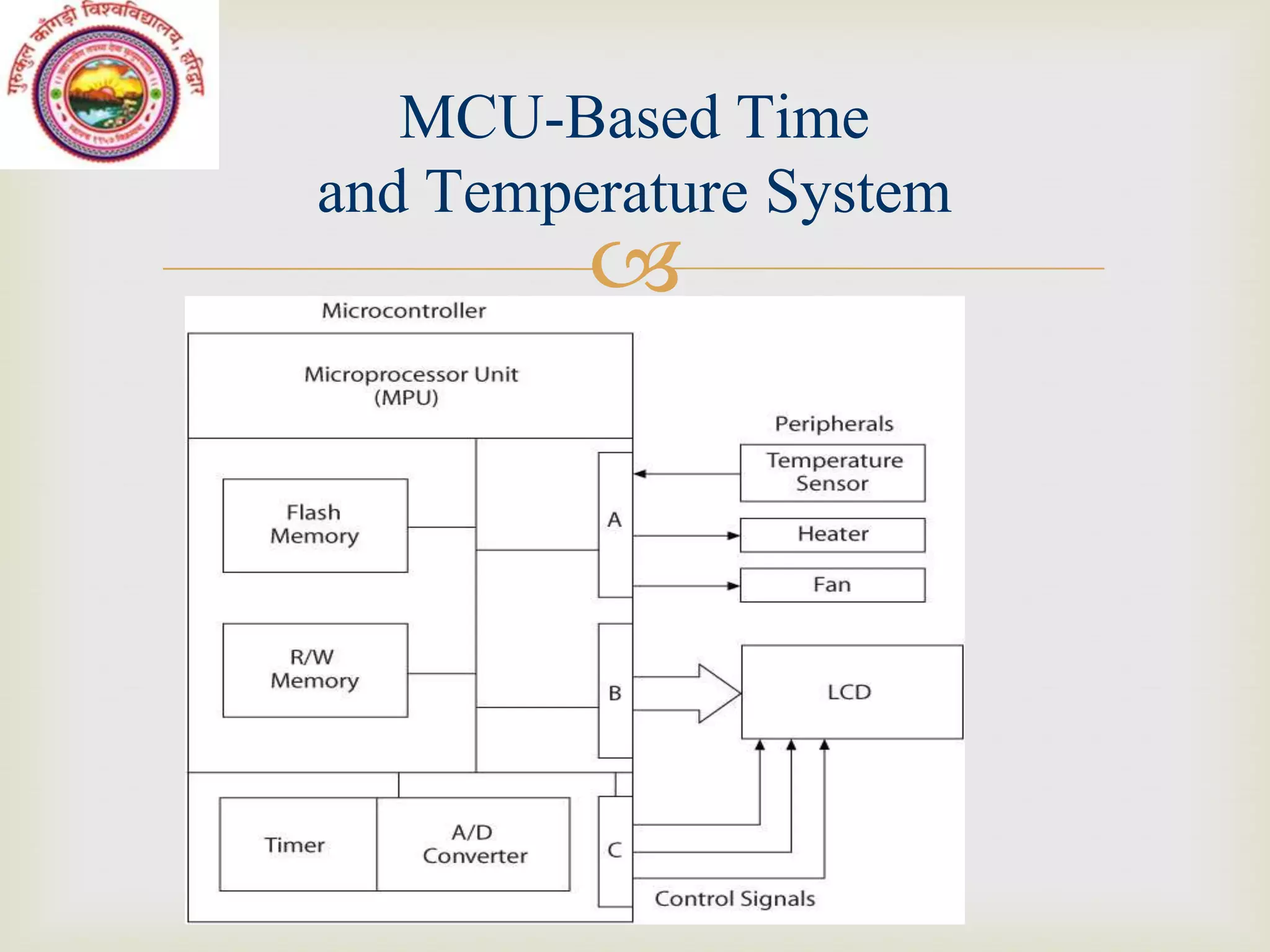
MCU-Based Systems
            
 Includes microprocessor, memory, I/O ports, and support
  devices (such as timers) on a single semiconductor chip
 Buses are generally not available to a system designer
 I/O ports are generally multiplexed and can be
  programmed to perform different functions
MCU-Based Time
and Temperature System
         
Computer Architectures
             
 Princeton versus Harvard Architecture
 CISC versus RISC processors
 Microprocessors and Microcontrollers
Thank you
    
   Sales

[ PPT ] NS _ppt 4..ppt microprocesser and microcontroller fundamentals

  • 3.
    Microcontrollers   Embedded Systems  Operations managed behind the scenes by a microcontroller  Microcontroller (MCU)  An integrated electronic computing device that includes three major components on a single chip  Microprocessor (MPU)  Memory  I/O (Input/Output) ports
  • 4.
    Microcontrollers   Support Devices  Timers  A/D converter  Serial I/O  Common communication lines  System Bus
  • 5.
  • 6.
    Microprocessor (MPU)   MPU (CPU)  Read instructions  Process binary data
  • 7.
    Memory   Storage Device  Addresses  Registers  Major Categories  Read/Write Memory (R/W)  Read-only-Memory (ROM
  • 8.
    Input/Output (I/O)   Input Devices  Switches and Keypads  Provide binary information to the MPU  Output devices  LEDs and LCDs  Receive binary information from the MPU
  • 9.
  • 10.
    Microprocessor Architecture   The MPU communicates with Memory and I/O using the System Bus  Address bus  Unidirectional  Memory and I/O Addresses  Data bus  Bidirectional  Transfers Binary Data and Instructions  Control lines  Read and Write timing signals
  • 11.
  • 12.
  • 13.
    Software   Machine Language  Binary Instructions  Difficult to decipher and write  Error-prone  All programs converted into machine language for execution
  • 14.
    Software   Assembly Language  Machine instructions represented in mnemonics  One-to-one correspondence  Efficient execution and use of memory  Machine-specific
  • 15.
    Software   High-Level Languages  BASIC, C, and C++  Written in statements of spoken languages  Machine independent  Easy to write and troubleshoot  Larger memory and less efficient execution
  • 16.
    Data Format (8-bit)   Unsigned Integers  All eight bits represent the magnitude of a number  Bit7 to Bit0  Range 00H to FFH (010 to 25510)
  • 17.
    Data Format (8-bit)   Signed Integers  2's Complement  Bit 7 is sign bit  Positive numbers: 00H to 7FH (010 to 12710)  Negative numbers: 80H to FFH (-110 to -12810)
  • 18.
    Data Format (8-bit)   Binary Coded Decimal Numbers (BCD)  8 bits of a number divided into groups of four  Each group represents a decimal digit from 0 to 9  AH through FH are invalid  Example: 0010 0101BCD = 2510
  • 19.
    Data Format (8-bit)   American Standard Code for Information Interchange (ASCII)  Seven-bit alphanumeric code with 128 combinations (00H to 7FH)  Represents English alphabet, decimal digits from 0 to 9, symbols, and commands
  • 20.
    MPU-Based Systems   System hardware  Discrete components  Microprocessor, Memory, and I/O  Components connected by buses  Address, Data, and Control  System software  A group of programs that monitors the functions of the entire system
  • 21.
  • 22.
    MCU-Based Systems   Includes microprocessor, memory, I/O ports, and support devices (such as timers) on a single semiconductor chip  Buses are generally not available to a system designer  I/O ports are generally multiplexed and can be programmed to perform different functions
  • 23.
  • 24.
    Computer Architectures   Princeton versus Harvard Architecture  CISC versus RISC processors  Microprocessors and Microcontrollers
  • 25.
    Thank you  Sales