2
Embedded system
Acombination of hardware and software which together
form a component or a part of a larger machine. Ex:
ATM , Cruise missile ..
For example, a fire alarm is an embedded system; it
will sense only smoke.
An example of an embedded system is a microprocessor
that controls an automobile engine.
An embedded system is designed to run on its own
without human intervention, and may be required to
execute a desired work.
3.
3
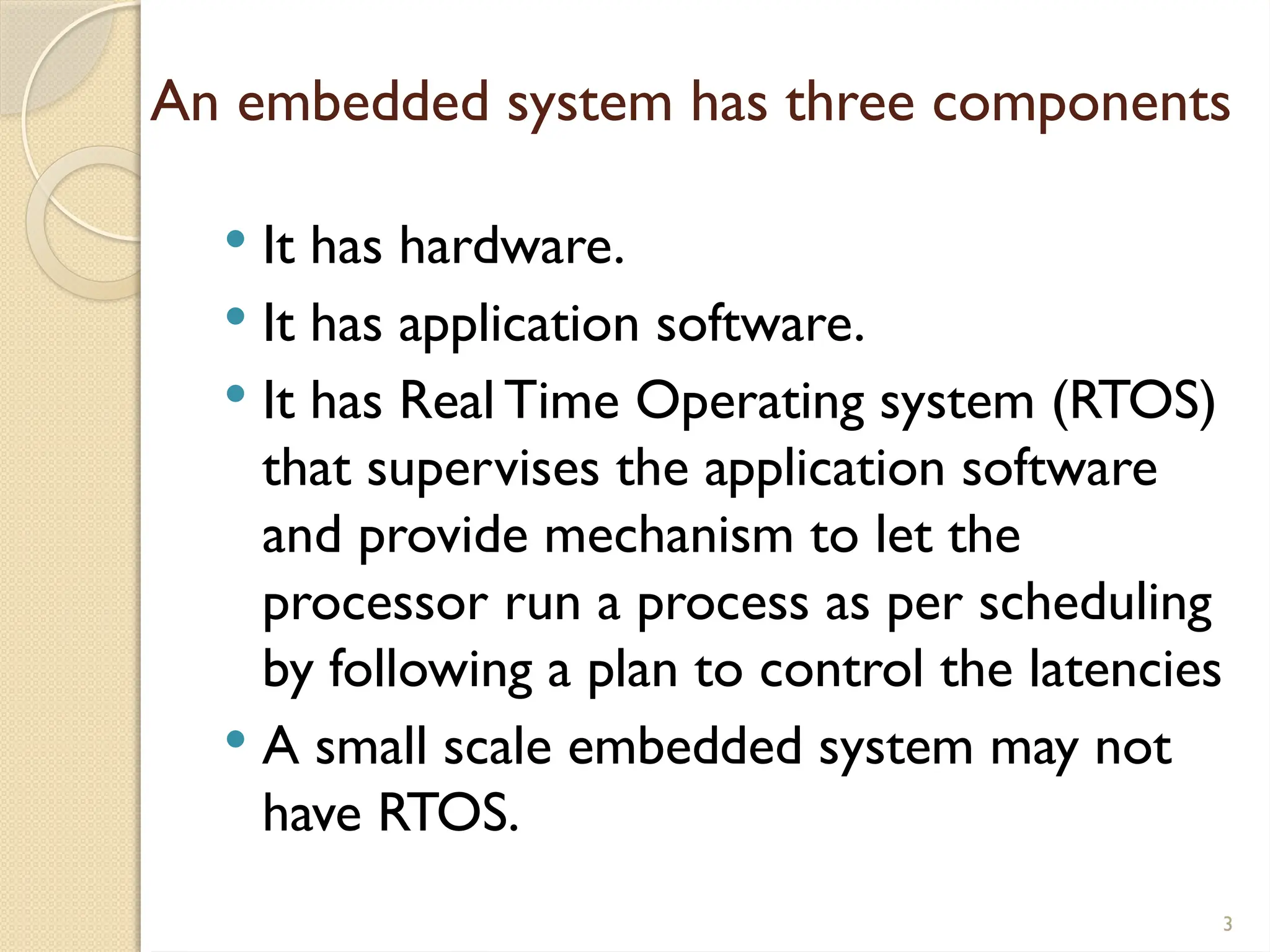
An embedded systemhas three components
It has hardware.
It has application software.
It has Real Time Operating system (RTOS)
that supervises the application software
and provide mechanism to let the
processor run a process as per scheduling
by following a plan to control the latencies
A small scale embedded system may not
have RTOS.
5
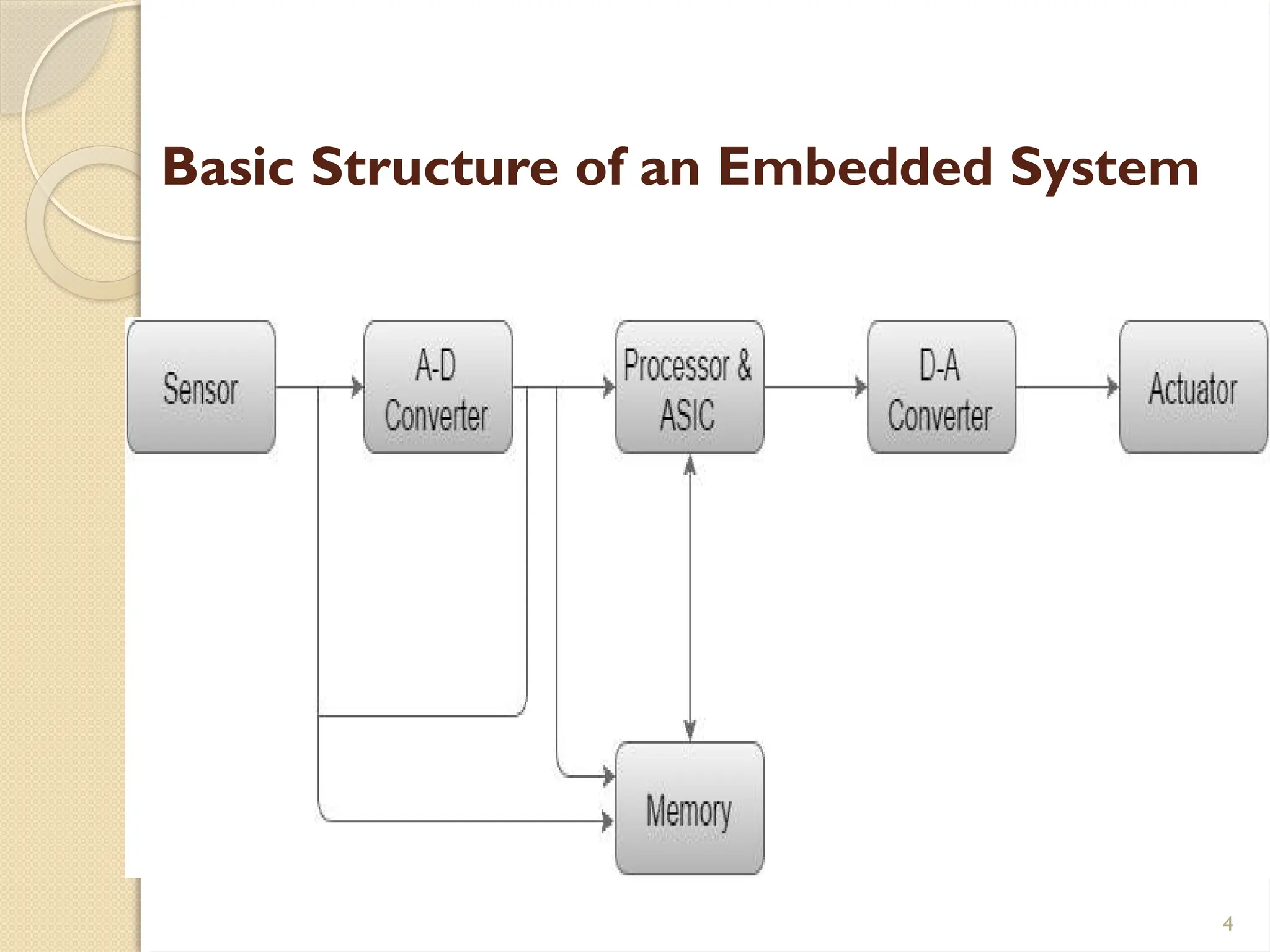
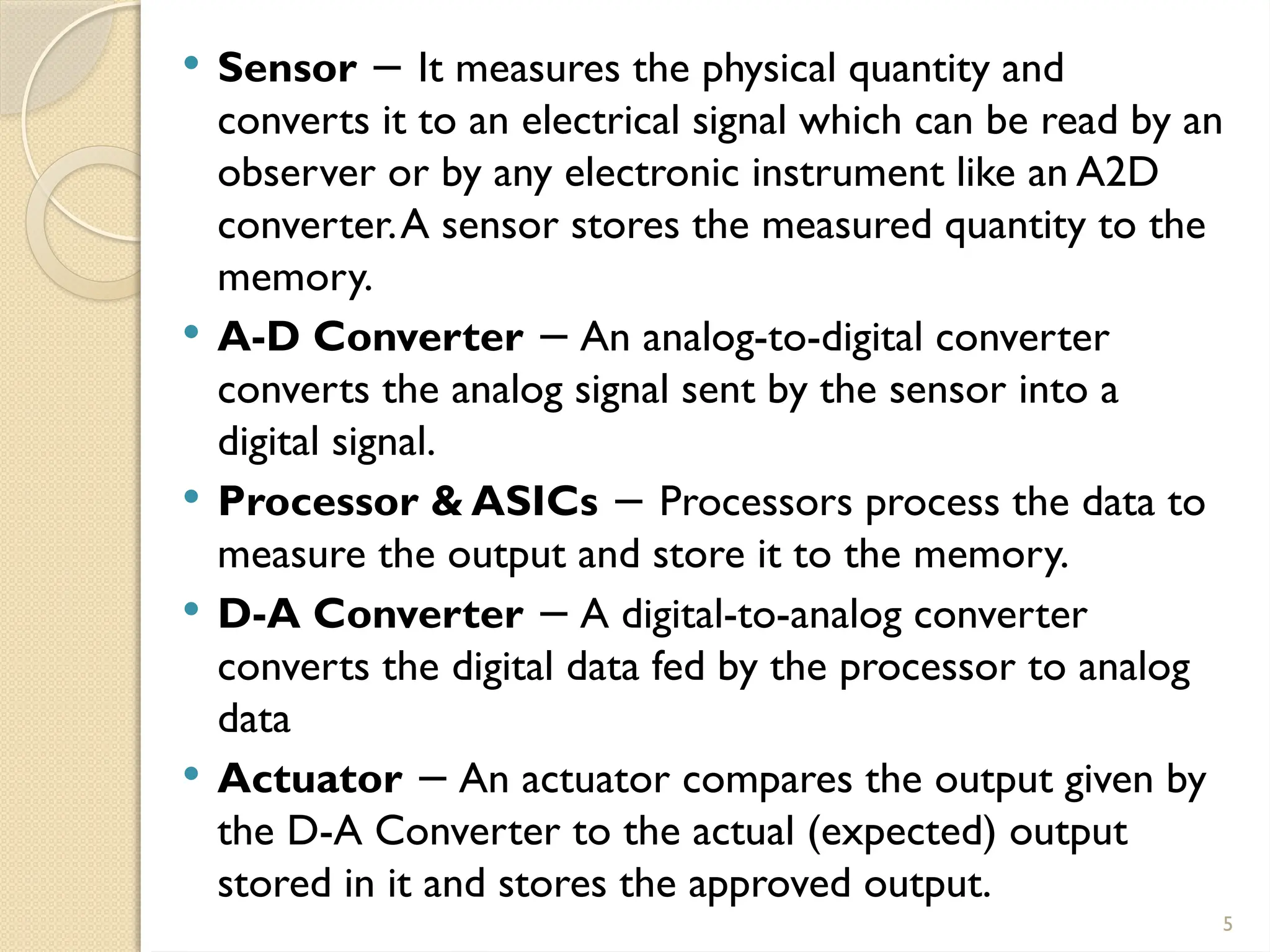
Sensor Itmeasures the physical quantity and
−
converts it to an electrical signal which can be read by an
observer or by any electronic instrument like an A2D
converter.A sensor stores the measured quantity to the
memory.
A-D Converter An analog-to-digital converter
−
converts the analog signal sent by the sensor into a
digital signal.
Processor & ASICs Processors process the data to
−
measure the output and store it to the memory.
D-A Converter A digital-to-analog converter
−
converts the digital data fed by the processor to analog
data
Actuator An actuator compares the output given by
−
the D-A Converter to the actual (expected) output
stored in it and stores the approved output.
6.
6
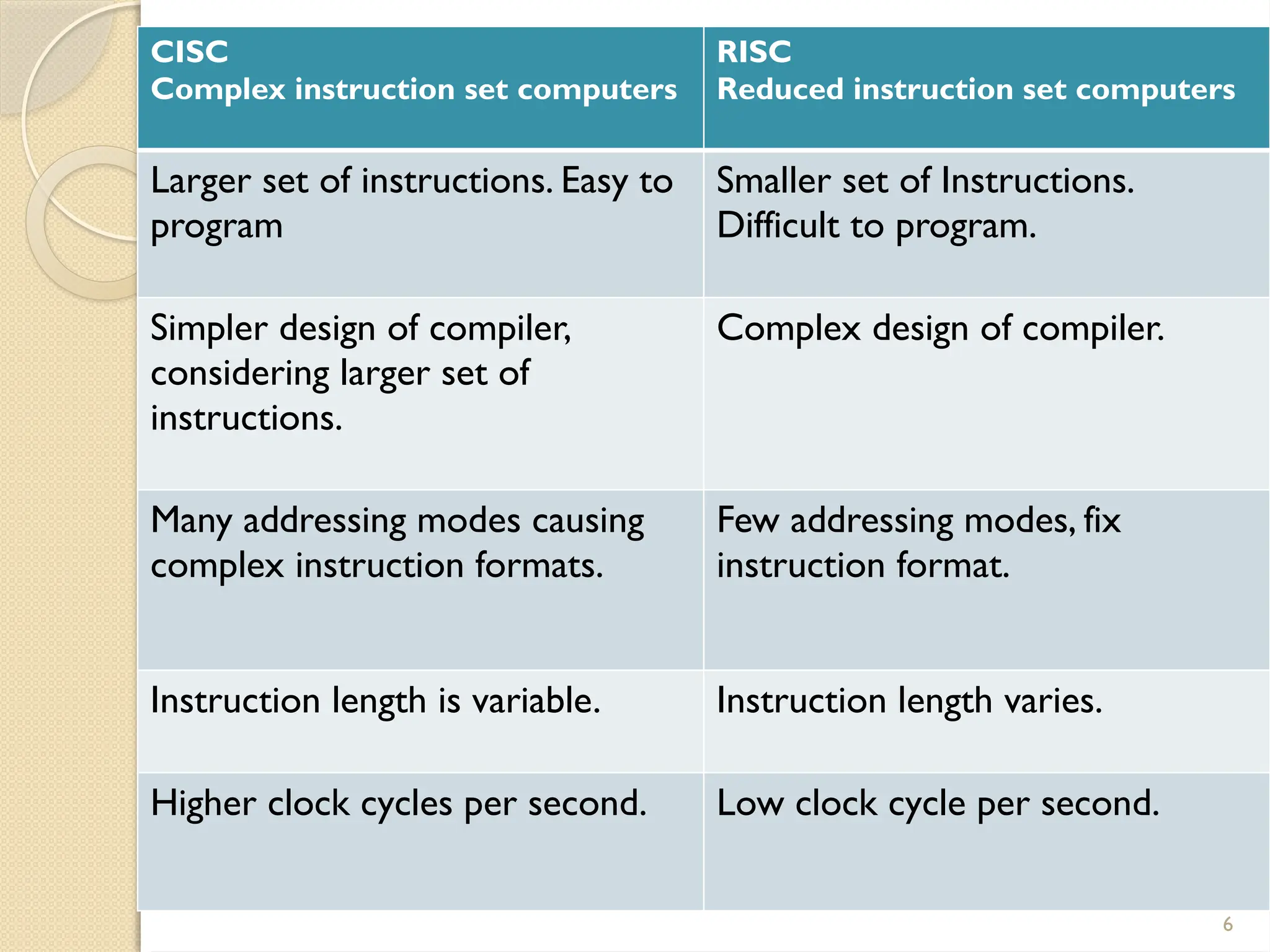
CISC
Complex instruction setcomputers
RISC
Reduced instruction set computers
Larger set of instructions. Easy to
program
Smaller set of Instructions.
Difficult to program.
Simpler design of compiler,
considering larger set of
instructions.
Complex design of compiler.
Many addressing modes causing
complex instruction formats.
Few addressing modes, fix
instruction format.
Instruction length is variable. Instruction length varies.
Higher clock cycles per second. Low clock cycle per second.
7.
7
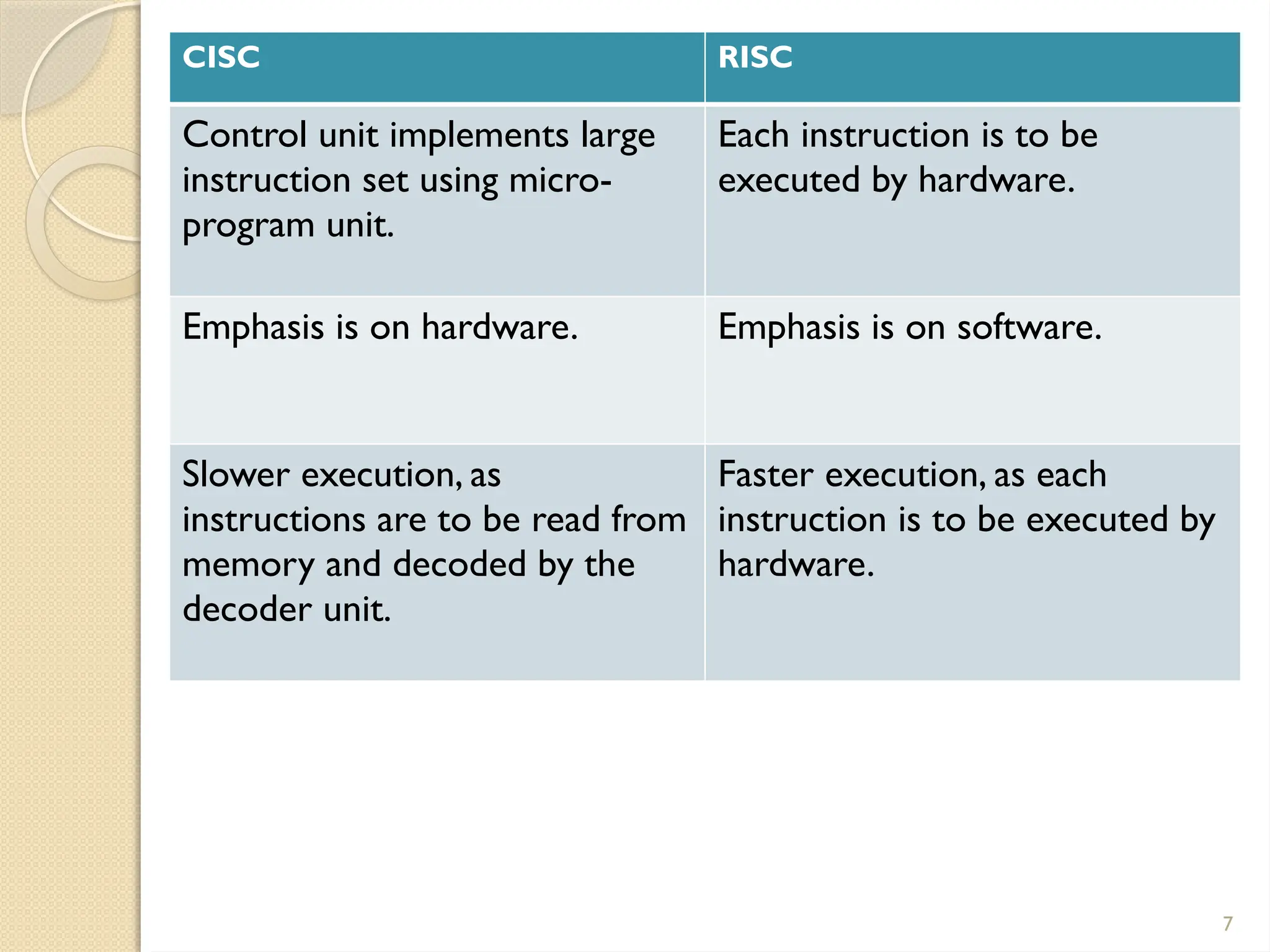
CISC RISC
Control unitimplements large
instruction set using micro-
program unit.
Each instruction is to be
executed by hardware.
Emphasis is on hardware. Emphasis is on software.
Slower execution, as
instructions are to be read from
memory and decoded by the
decoder unit.
Faster execution, as each
instruction is to be executed by
hardware.
13
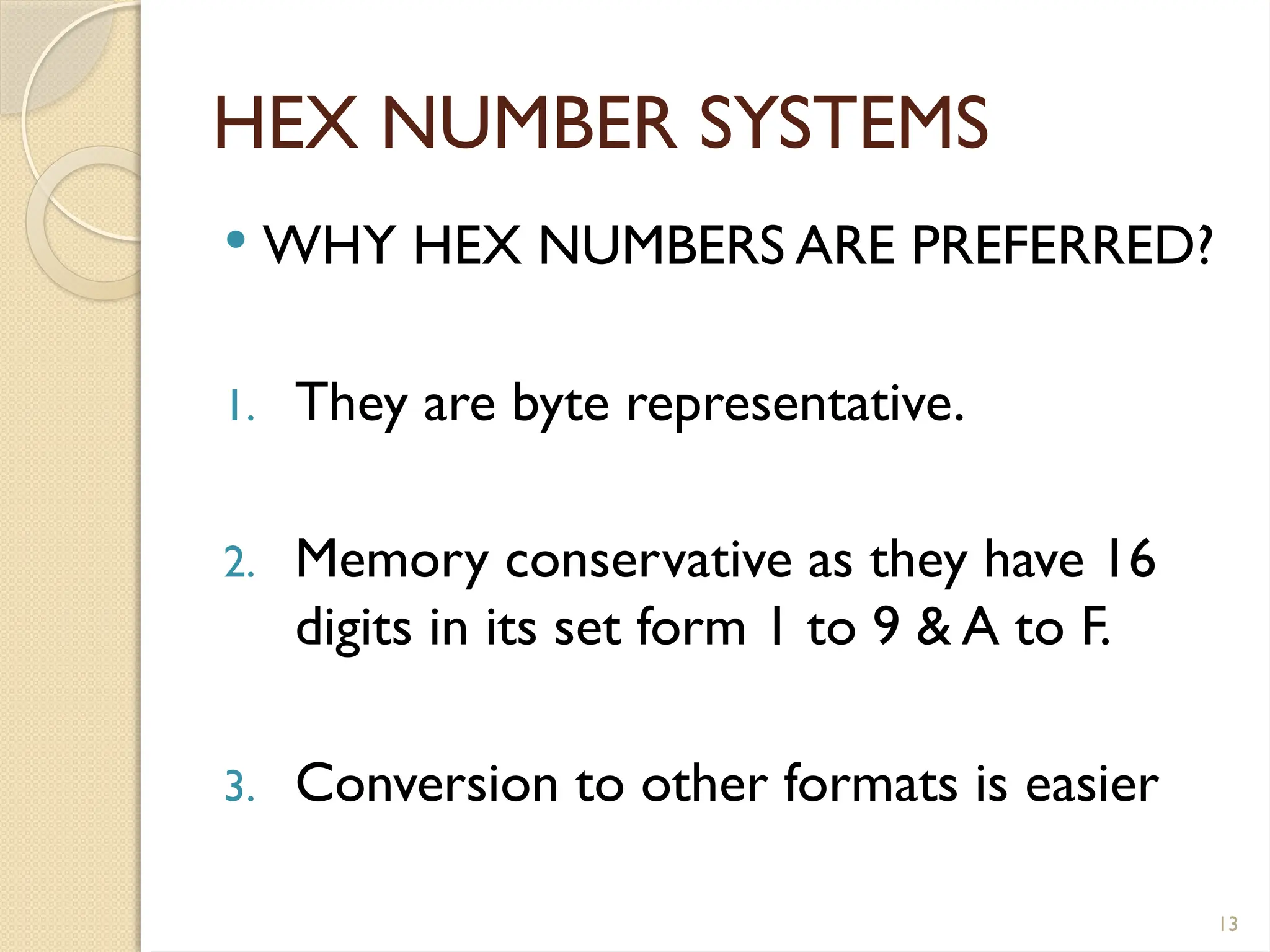
HEX NUMBER SYSTEMS
WHY HEX NUMBERS ARE PREFERRED?
1. They are byte representative.
2. Memory conservative as they have 16
digits in its set form 1 to 9 & A to F.
3. Conversion to other formats is easier
14.
14
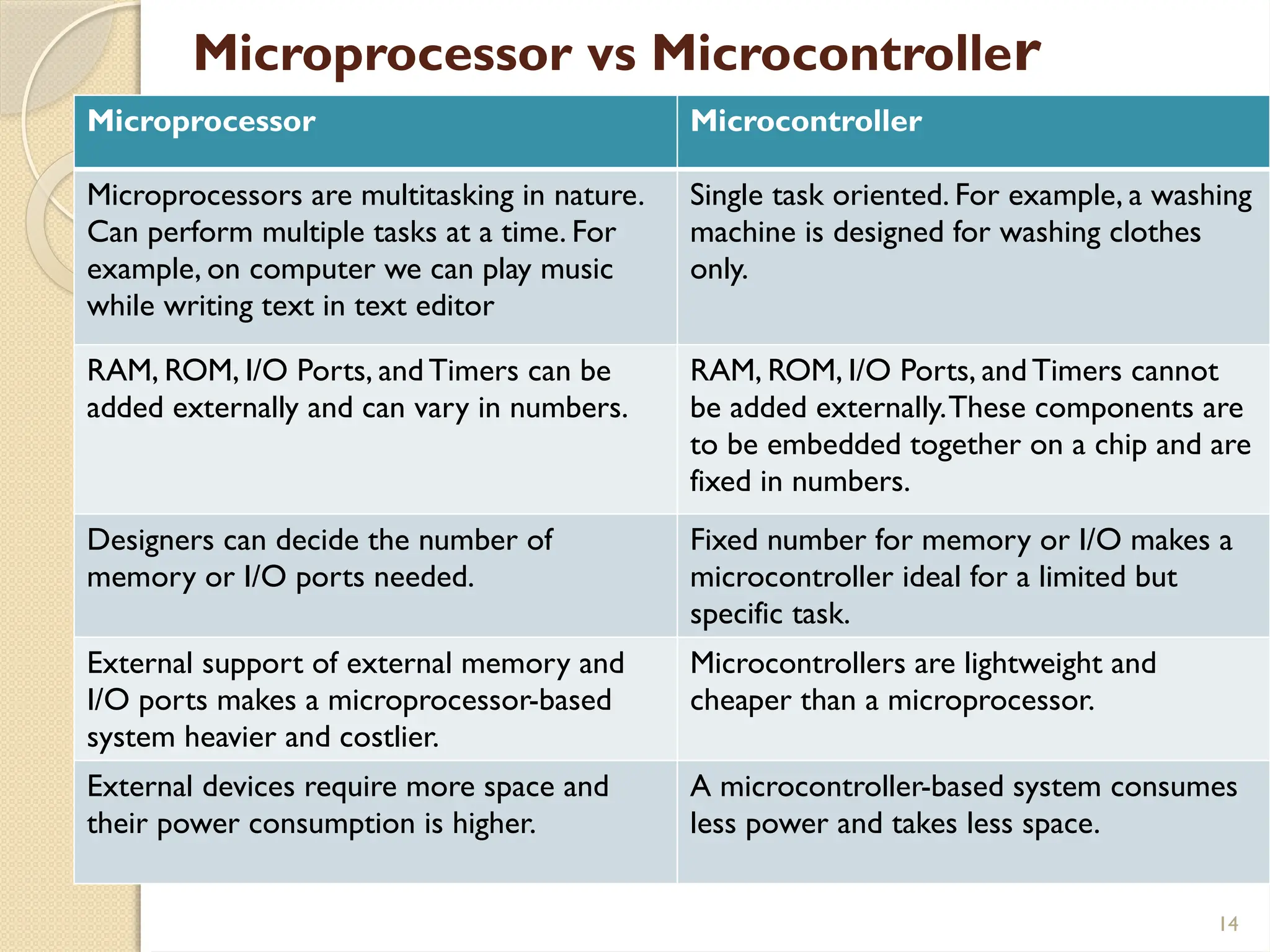
Microprocessor vs Microcontroller
MicroprocessorMicrocontroller
Microprocessors are multitasking in nature.
Can perform multiple tasks at a time. For
example, on computer we can play music
while writing text in text editor
Single task oriented. For example, a washing
machine is designed for washing clothes
only.
RAM, ROM, I/O Ports, and Timers can be
added externally and can vary in numbers.
RAM, ROM, I/O Ports, and Timers cannot
be added externally.These components are
to be embedded together on a chip and are
fixed in numbers.
Designers can decide the number of
memory or I/O ports needed.
Fixed number for memory or I/O makes a
microcontroller ideal for a limited but
specific task.
External support of external memory and
I/O ports makes a microprocessor-based
system heavier and costlier.
Microcontrollers are lightweight and
cheaper than a microprocessor.
External devices require more space and
their power consumption is higher.
A microcontroller-based system consumes
less power and takes less space.
15.
15
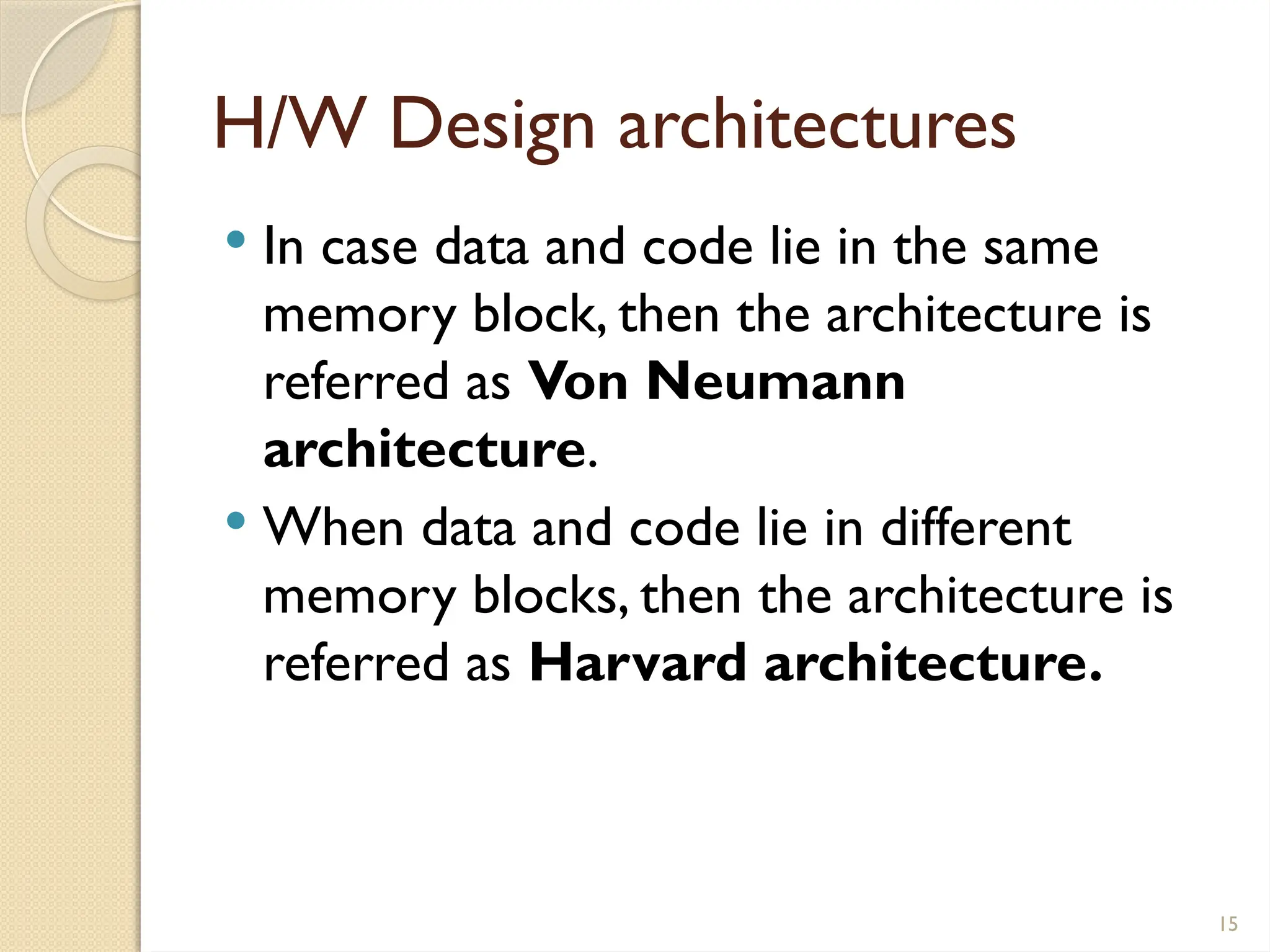
H/W Design architectures
In case data and code lie in the same
memory block, then the architecture is
referred as Von Neumann
architecture.
When data and code lie in different
memory blocks, then the architecture is
referred as Harvard architecture.
16.
16
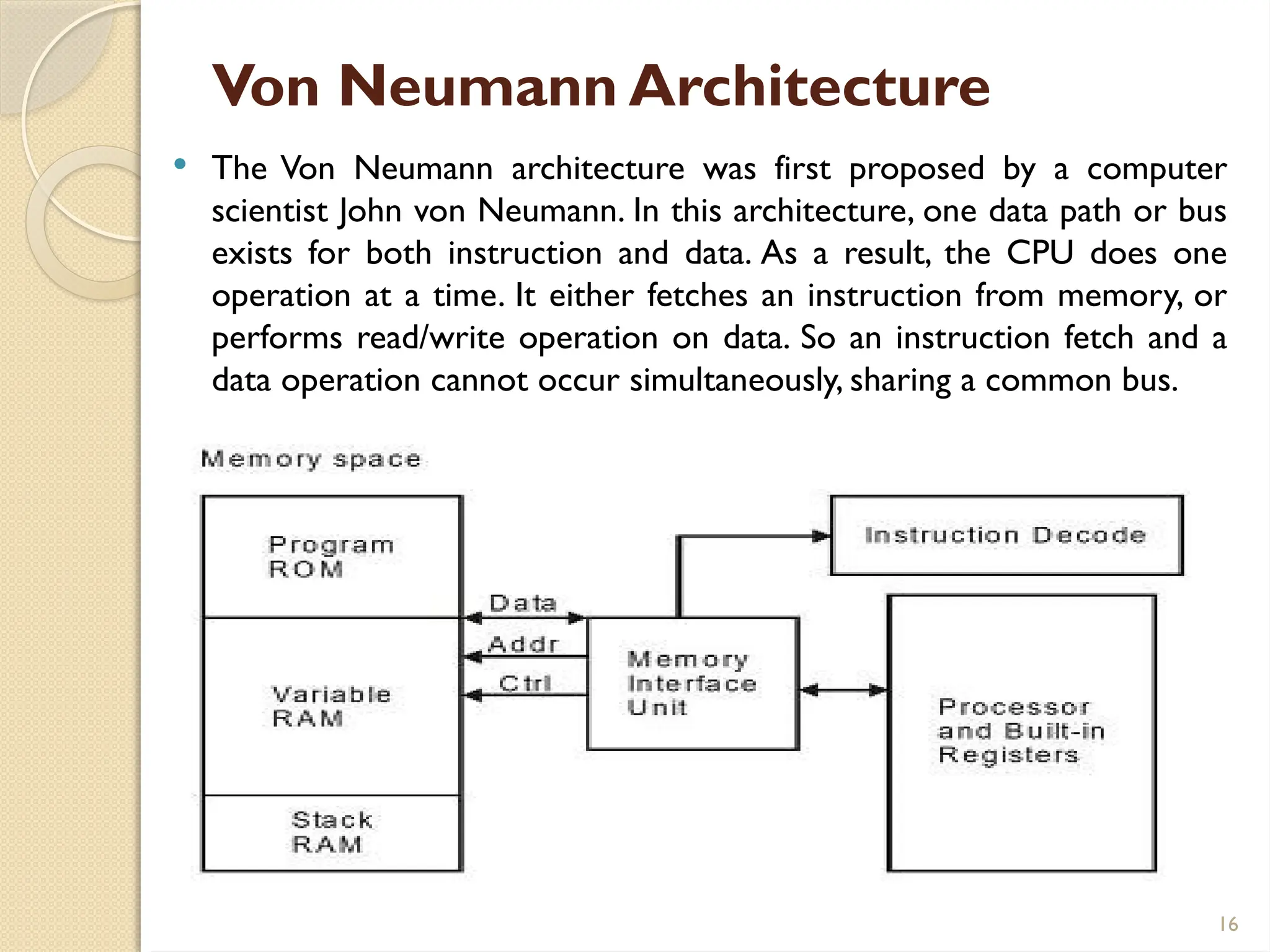
Von Neumann Architecture
The Von Neumann architecture was first proposed by a computer
scientist John von Neumann. In this architecture, one data path or bus
exists for both instruction and data. As a result, the CPU does one
operation at a time. It either fetches an instruction from memory, or
performs read/write operation on data. So an instruction fetch and a
data operation cannot occur simultaneously, sharing a common bus.
17.
17
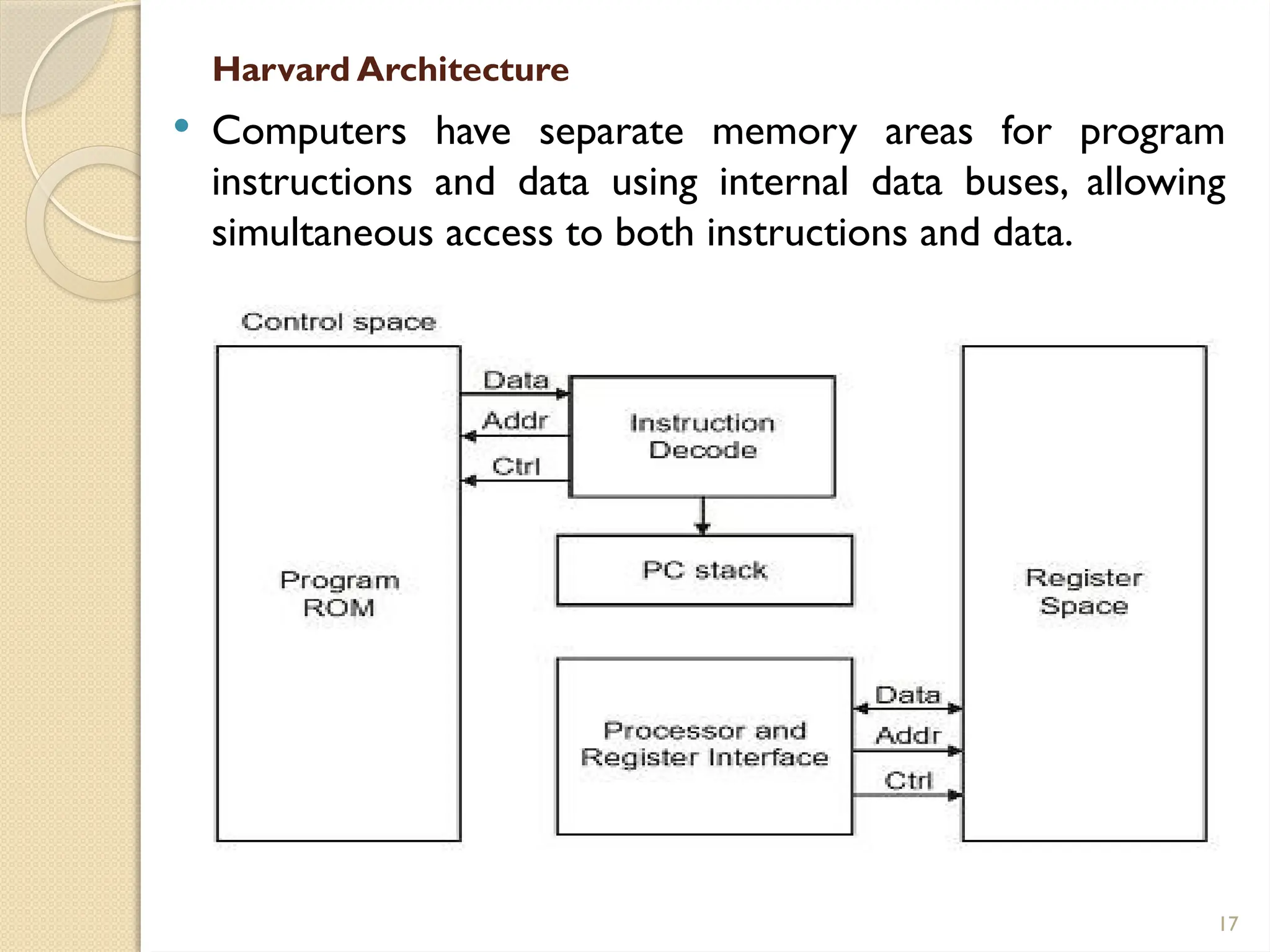
Harvard Architecture
Computershave separate memory areas for program
instructions and data using internal data buses, allowing
simultaneous access to both instructions and data.
18.
18
DebuggingTools in anEmbedded System
Debugging is a methodical process to find and reduce the number of
bugs in a computer program or a piece of electronic hardware, so that it
works as expected.
DEBUGGINGTOOLS
Simulators: Code is tested for the MCU / system by simulating it on
the host computer used for code development. Simulators try to
model the behavior of the complete microcontroller in software.
Microcontroller starter kits(In system programmers): A big
advantage of these kits over simulators is that they work in real-
time and thus allow for easy input/output functionality verification.
Starter kits, however, are completely sufficient and the cheapest
option to develop simple microcontroller projects.
Emulator:An emulator is a hardware kit or a software program or
can be both which emulates the functions of one computer system
(the guest) in another computer system (the host).
19.
19
Criteria for ChoosingMicrocontroller
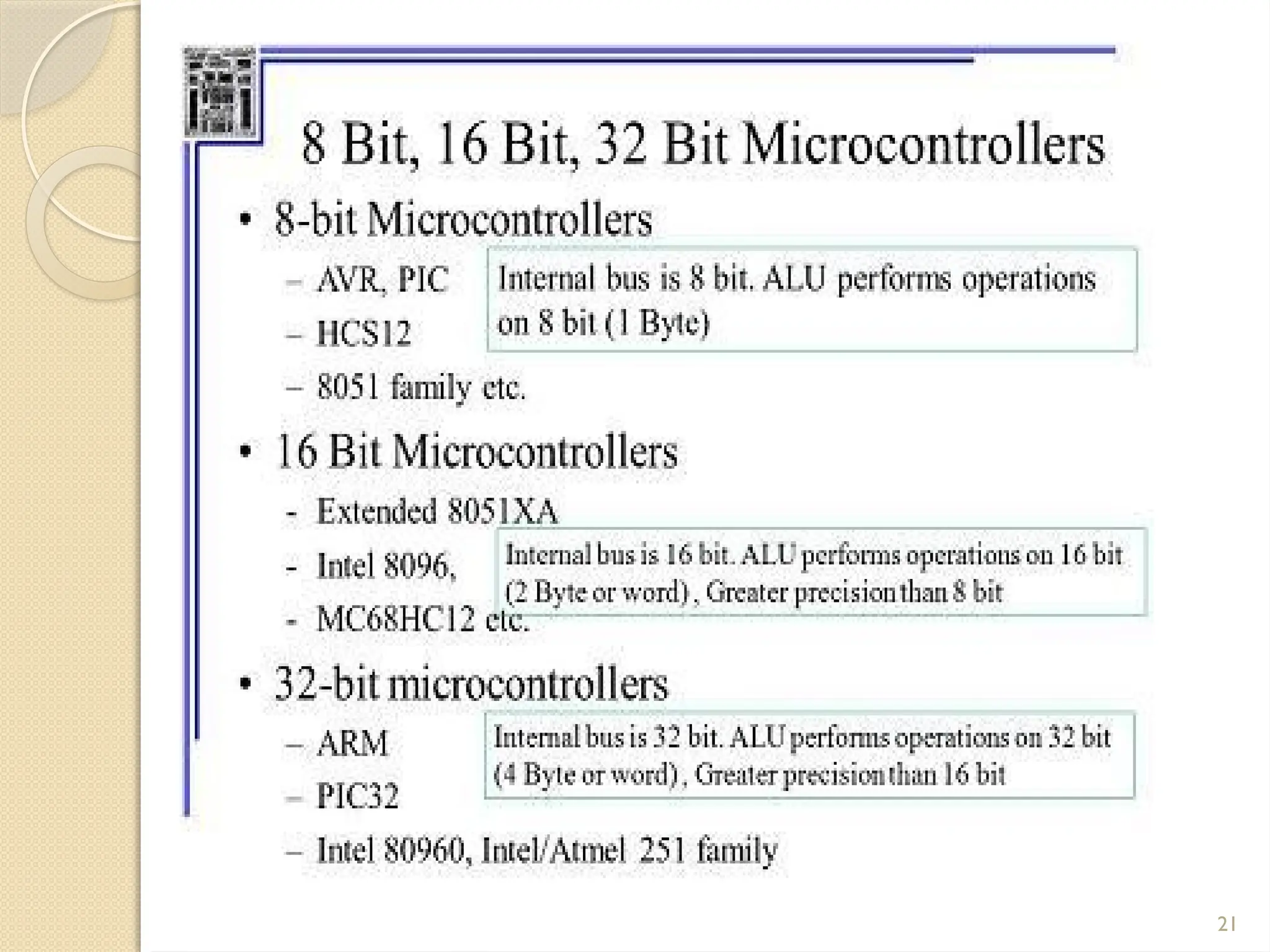
8 bit , 16 bit or 32 bit??? How???
Speed What is the highest speed the microcontroller
−
can support?
Packaging Is it 40-pin DIP (Dual-inline-package) or
−
QFP (Quad flat package)?This is important in terms of
space, assembling, and prototyping the end-product.
Power Consumption This is an important criteria
−
for battery-powered products.
Amount of RAM and ROM on the chip.
Count of I/O pins andTimers on the chip.
Cost per Unit This is important in terms of final
−
cost of the product in which the microcontroller is to
be used.