AIDP Update
Dr. Nishtha Jain
Senior Resident
Department of Neurology
GMC, Kota.
AIDP
• Acute Onset
• Usually Monophasic
• Immune mediated disorder
• Peripheral Nervous System
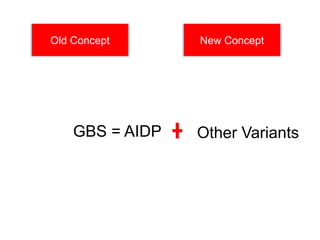
Old Concept
GBS = AIDP
New Concept
Other Variants
• First described by Landry in 1859.
• Recognized as GBS since 1916, when Guillain, Barre´,
and Strohl described two French soldiers who contracted
the illness during World War I.
• Incidence Rate : 1–2 / 100,000 population.
• The lifetime likelihood of any individual acquiring GBS is
1:1000.
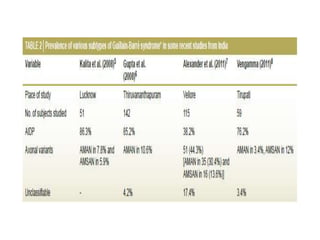
• In Europe and North America : AIDP(90% of the cases).
• In China and Japan : AMAN(most common).
• A peak incidence between June–July and Sept–October.
• Western countries - GBS is common in 5th decade.
• India - more common at a younger age.
• Equally common in men and women.
• Often follows an upper or lower respiratory illness or
gastroenteritis by 10 to 14 days.
• Approximately 70% of patients can identify a preceding
illness.
• Infections associated with GBS - CMV, M. pneumoniae,
EBV, Influenza A, H. influenzae, Enterovirus,
Campylobacter jejuni and Zika virus.
• Cytomegalovirus : most common associated virus.
• Campylobacter jejuni : most frequently associated
bacterial infection.(overall 40%)
• Other less common precipitants are surgery, pregnancy,
cancer, and vaccinations.
• Evolves over days, often beginning with numbness in the
lower limbs and weakness in the same distribution.
• Approximately 50% of patients achieve maximum
weakness by 2 weeks, 80% by 3 weeks, and 90% by 4
weeks.
• Progression beyond 4 weeks is unusual.
• Neuropathic pain - 66% patients(localized to the lower
back and thighs).
• The weakness begins distally and spreads proximally.
• In rare cases, the weakness may be localized to the legs
only (giving the appearance of paraplegia).
• Sensory examination : normal or show minor
deficiencies in vibration and proprioception.
• All patients have areflexia or at least hyporeflexia at
some time in the illness.
• 50% of patients - some degree of facial weakness.
• Weakness attributed to cranial nerves includes ocular
dysmotility, pupillary changes, and ptosis.
• Ophthalmoparesis : approximately 20% of patients with
GBS.
• 30% of patients develop respiratory failure from phrenic
nerve disease, requiring intubation and ventilation.
• Autonomic involvement : tachycardia, bradycardia,
hypertension and hypotension, gastric hypomotility, and
urinary retention.
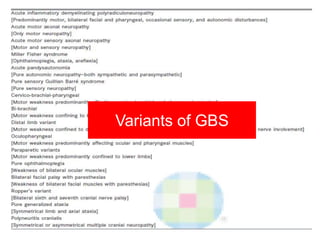
Variants of GBS
AMAN
• An axonal motor variant of GBS
• Reported in 1993 from Northern China
• So K/As Chinese paralytic illness.
• Can present with transient conduction block without
axonal loss and this led to the term acute motor
conduction block neuropathy.
• More common in children during the summer.
• Pure motor without sensory symptoms and signs.
• NCS – decreased CMAP amplitudes, normal latencies
and conduction velocities, and normal sensory studies.
AMSAN
• Sensory involvement also occurs
• Later age of onset
• Broader geographic distribution
• A more protracted course
• Slower and incomplete improvement
Miller Fisher syndrome
• Acute or subacute demyelinating
polyradiculoneuropathy.
• Clinical presentation differs markedly from typical AIDP.
• Triad of ophthalmoplegia, areflexia, and ataxia.
• Often grouped with Bickerstaff brainstem encephalitis -
similar presentation plus encephalopathy and
corticospinal tract dysfunction.
• The prognosis in both Miller Fisher syndrome and
Bickerstaff brainstem encephalitis is favorable.
• Most patients improve within 1 to 2 months and make a
complete recovery in 6 months even without specific
treatment.
Acute Pandysautonomic Neuropathy
• Rare
• Sympathetic and parasympathetic nervous systems
involved.
• CVS involvement, Blurry vision, anhydrosis.
• Recovery is often gradual and incomplete.
• Often combined with sensory features.
Pathogenesis
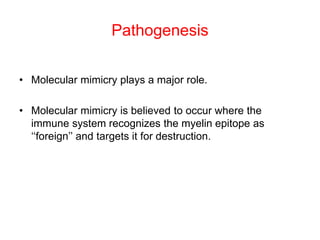
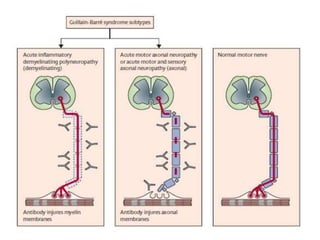
• Molecular mimicry plays a major role.
• Molecular mimicry is believed to occur where the
immune system recognizes the myelin epitope as
‘‘foreign’’ and targets it for destruction.
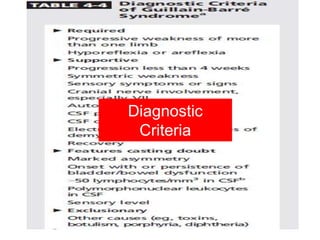
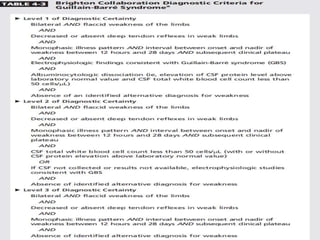
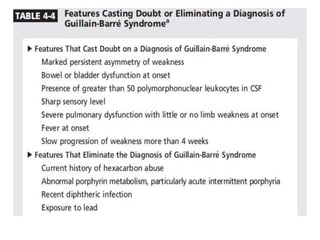
Diagnostic
Criteria
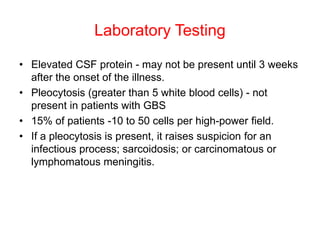
Laboratory Testing
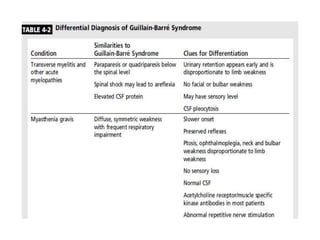
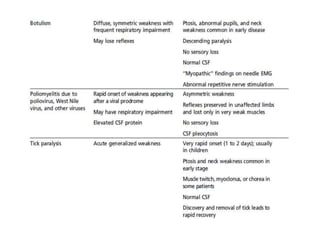
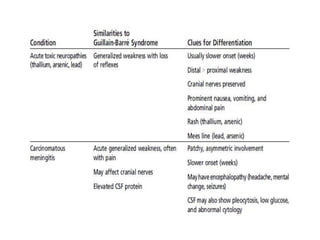
• Elevated CSF protein - may not be present until 3 weeks
after the onset of the illness.
• Pleocytosis (greater than 5 white blood cells) - not
present in patients with GBS
• 15% of patients -10 to 50 cells per high-power field.
• If a pleocytosis is present, it raises suspicion for an
infectious process; sarcoidosis; or carcinomatous or
lymphomatous meningitis.
Electrodiagnosis
• In first few days – NCS may be normal or only show
subtle changes of demyelination, such as prolonged or
absent F waves and H reflexes, and patchy changes in
distal latencies in patients with AIDP.
• As the disease evolves - conduction block, temporal
dispersion, and prolonged distal and F-wave latencies.
• Sensory NCS - A characteristic sural nerve sparing.
• Sensitivity of NCS - As low as 22% in early AIDP and
rise to 87% at 5 weeks.
• A conduction velocity of <70% of the lower limit of
normal and a distal latency of >150% of the upper limit of
normal was highly sensitive and had a specificity of
nearly 100% for AIDP.
• Needle EMG - Decreased recruitment initially, followed
by fibrillation potentials over weeks 2 to 5 in proximal
and distal muscles simultaneously.
• The best electrodiagnostic indicator for a rapid or good
recovery is maintained motor amplitude.
• Patients with an average amplitude >10% of the lower
limit of normal likely have a major component of
conduction block which has the potential to reverse.
• Amplitudes <10% during illness are seen in patients with
a greater degree of axonal injury and a more prolonged
recovery.
Imaging Studies
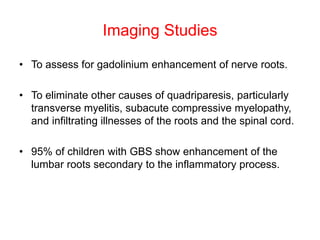
• To assess for gadolinium enhancement of nerve roots.
• To eliminate other causes of quadriparesis, particularly
transverse myelitis, subacute compressive myelopathy,
and infiltrating illnesses of the roots and the spinal cord.
• 95% of children with GBS show enhancement of the
lumbar roots secondary to the inflammatory process.
Management
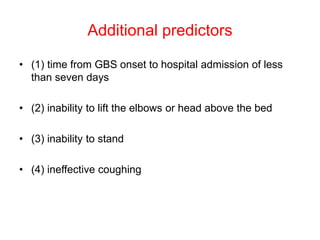
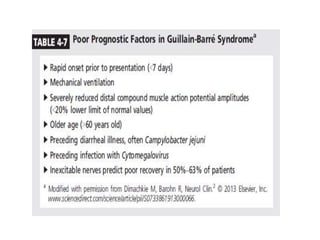
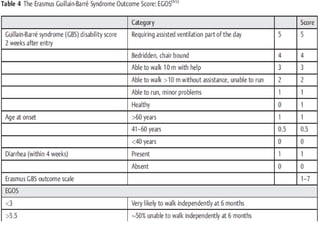
Additional predictors
• (1) time from GBS onset to hospital admission of less
than seven days
• (2) inability to lift the elbows or head above the bed
• (3) inability to stand
• (4) ineffective coughing
Specific treatment
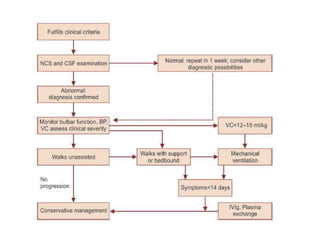
• Plasma exchange
• IVIg
• Corticosteroids(not approved)
Plasma exchange
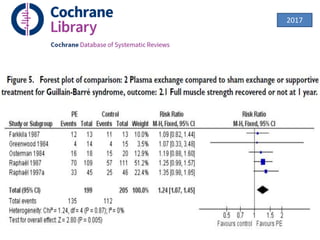
• First treatment shown to be effective.
• Removes autoantibodies, immune complexes,
complement, and cytokines.
• Boosts T-cell suppressor function.
• Dose - 250 mL/kg divided over 5 alternating days.
• Risks - central venous catheter placement, hypotension,
cardiac arrhythmia, vasovagal spell, allergic reaction to
albumin replacement, hypocalcemia, anemia, and
thrombocytopenia.
2017
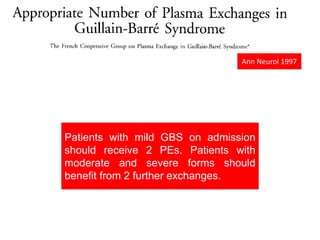
Patients with mild GBS on admission
should receive 2 PEs. Patients with
moderate and severe forms should
benefit from 2 further exchanges.
Ann Neurol 1997
IV immunoglobulin (IVIg)
• Pooled IgG from thousands of blood donors, which
results in a fivefold increase in serum IgG.
• Adverse events - mild infusion-related symptoms
(nausea and headache), aseptic meningitis, rash, severe
rare anaphylaxis, and, in fewer than 2% of cases, renal
failure.
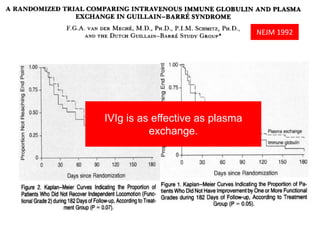
• IVIg may be preferred since it is easier to administer.
IVIg is as effective as plasma
exchange.
NEJM 1992
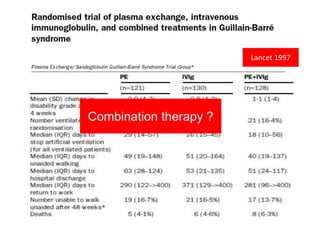
Lancet 1997
Combination therapy ?
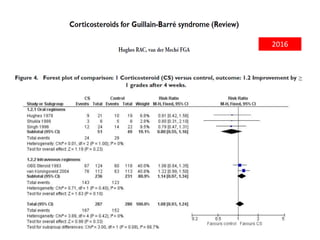
2016
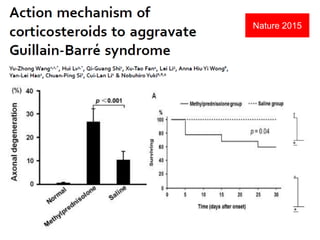
Nature 2015
AAN Recommendations
• PE is recommended for nonambulant patients within 4
weeks of onset (level A, class II evidence) and for
ambulant patients within 2 weeks of onset (level B,
limited class II evidence).
• The effects of PE and IV immunoglobulin (IVIg) are
equivalent.
• There is insufficient evidence to recommend the use of
CSF filtration (level U, limited class II evidence).
• The evidence is insufficient to recommend the use of
immunoabsorption (level U recommendation, class IV
evidence).
• IVIg is recommended for patients with GBS who require
aid to walk within 2 (level A recommendation) or 4 weeks
from the onset of neuropathic symptoms (level B
recommendation derived from class II evidence
concerning PE started within the first 4 weeks and class I
evidence concerning the comparisons between PE and
IVIg started within the first 2 weeks).
• The effects of IVIg and PE are equivalent.
• Corticosteroids are not recommended for the treatment
of patients with GBS (level A, class I evidence).
• PE and IVIg are treatment options for children with
severe GBS (level B recommendation derived from class
II evidence in adults).
Novel Immunomodulatory Approaches
• Inhibition of complement using eculizumab prevents
neuropathy in an animal model of Miller Fisher
syndrome.
• Limitations - significant cost and potential complications,
including a high risk of meningococcal infections.
• Other complement inhibitors - APT070, rEV576,
nafamostat mesylate, and soluble complement receptor
1 have been evaluated in animal models.
• One possible strategy for axon protection is sodium
channel blockade.
• Supporting this approach are data indicating flecainide
protects axons in an animal model (experimental
autoimmune neuritis [EAN]).
• Another general approach to axon protection, or
enhanced regeneration, is growth factor therapy.
• The voltage gated potassium antagonist, 4
aminopyridine represents a potential approach for GBS
patients with residual gait dysfunction.
Treatment-related Fluctuations
• Treatment-related fluctuations are defined as worsening
of weakness after an initial improvement or after
stabilization following treatment with IVIg or plasma
exchange.
• Occur in approximately 10% of patients with GBS.
• Usually take place within the first 2 months after
treatment.
• Treated with another course of IVIg or plasma exchange,
and the treatment is often beneficial.
• If the patient experiences more than one treatment-
related fluctuation, and particularly if it occurs 2 months
or more after the onset of the illness, then the diagnosis
of CIDP becomes a strong consideration.
PROGNOSIS
• The prognosis for most patients with GBS is for good to
excellent recovery.
• Approximately 87% experience full recovery or minor
deficits.
• Most of the improvement in GBS occurs within the first
year, but patients may continue to improve for up to 3
years or longer.
• Mortality in GBS is 3% to 7%
• Most often attributable to respiratory failure, infection, or
uncontrollable autonomic dysfunction.
Conclusion
• New variants
• Diagnostic and prognostic criteria have come
• Newer treatment modalities under trials
Thank You
Referrences
• Guillain-Barre´ Syndrome. P D Donofrio. Continuum
2017;23(5):1295–1309.
• Acquired Immune Demyelinating Neuropathies. M M
Dimachkie. Continuum 2014;20(5):1241–1260.
• Immune-Mediated Neuropathies. Y T So. Continuum
Lifelong Learning Neurol 2012;18(1):85–105.
• Guillain-Barré Syndrome. X A Londono et al. Semin
Neurol 2012;32:179–186.
• Inflammatory Neuropathies. J Whitesell. Semin Neurol
2010;30(4):356-364.

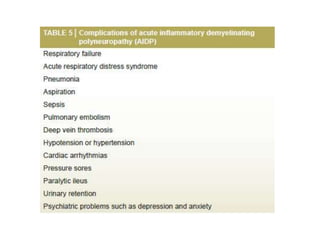
acute inflammatory demyelinating polyneuropathy

  • 1.
    AIDP Update Dr. NishthaJain Senior Resident Department of Neurology GMC, Kota.
  • 2.
    AIDP • Acute Onset •Usually Monophasic • Immune mediated disorder • Peripheral Nervous System
  • 3.
    Old Concept GBS =AIDP New Concept Other Variants
  • 4.
    • First describedby Landry in 1859. • Recognized as GBS since 1916, when Guillain, Barre´, and Strohl described two French soldiers who contracted the illness during World War I.
  • 5.
    • Incidence Rate: 1–2 / 100,000 population. • The lifetime likelihood of any individual acquiring GBS is 1:1000. • In Europe and North America : AIDP(90% of the cases). • In China and Japan : AMAN(most common).
  • 7.
    • A peakincidence between June–July and Sept–October. • Western countries - GBS is common in 5th decade. • India - more common at a younger age. • Equally common in men and women.
  • 8.
    • Often followsan upper or lower respiratory illness or gastroenteritis by 10 to 14 days. • Approximately 70% of patients can identify a preceding illness. • Infections associated with GBS - CMV, M. pneumoniae, EBV, Influenza A, H. influenzae, Enterovirus, Campylobacter jejuni and Zika virus.
  • 9.
    • Cytomegalovirus :most common associated virus. • Campylobacter jejuni : most frequently associated bacterial infection.(overall 40%) • Other less common precipitants are surgery, pregnancy, cancer, and vaccinations.
  • 10.
    • Evolves overdays, often beginning with numbness in the lower limbs and weakness in the same distribution. • Approximately 50% of patients achieve maximum weakness by 2 weeks, 80% by 3 weeks, and 90% by 4 weeks. • Progression beyond 4 weeks is unusual. • Neuropathic pain - 66% patients(localized to the lower back and thighs).
  • 11.
    • The weaknessbegins distally and spreads proximally. • In rare cases, the weakness may be localized to the legs only (giving the appearance of paraplegia). • Sensory examination : normal or show minor deficiencies in vibration and proprioception. • All patients have areflexia or at least hyporeflexia at some time in the illness.
  • 12.
    • 50% ofpatients - some degree of facial weakness. • Weakness attributed to cranial nerves includes ocular dysmotility, pupillary changes, and ptosis. • Ophthalmoparesis : approximately 20% of patients with GBS.
  • 13.
    • 30% ofpatients develop respiratory failure from phrenic nerve disease, requiring intubation and ventilation. • Autonomic involvement : tachycardia, bradycardia, hypertension and hypotension, gastric hypomotility, and urinary retention.
  • 14.
  • 15.
    AMAN • An axonalmotor variant of GBS • Reported in 1993 from Northern China • So K/As Chinese paralytic illness. • Can present with transient conduction block without axonal loss and this led to the term acute motor conduction block neuropathy.
  • 16.
    • More commonin children during the summer. • Pure motor without sensory symptoms and signs. • NCS – decreased CMAP amplitudes, normal latencies and conduction velocities, and normal sensory studies.
  • 17.
    AMSAN • Sensory involvementalso occurs • Later age of onset • Broader geographic distribution • A more protracted course • Slower and incomplete improvement
  • 18.
    Miller Fisher syndrome •Acute or subacute demyelinating polyradiculoneuropathy. • Clinical presentation differs markedly from typical AIDP. • Triad of ophthalmoplegia, areflexia, and ataxia. • Often grouped with Bickerstaff brainstem encephalitis - similar presentation plus encephalopathy and corticospinal tract dysfunction.
  • 19.
    • The prognosisin both Miller Fisher syndrome and Bickerstaff brainstem encephalitis is favorable. • Most patients improve within 1 to 2 months and make a complete recovery in 6 months even without specific treatment.
  • 20.
    Acute Pandysautonomic Neuropathy •Rare • Sympathetic and parasympathetic nervous systems involved. • CVS involvement, Blurry vision, anhydrosis. • Recovery is often gradual and incomplete. • Often combined with sensory features.
  • 21.
    Pathogenesis • Molecular mimicryplays a major role. • Molecular mimicry is believed to occur where the immune system recognizes the myelin epitope as ‘‘foreign’’ and targets it for destruction.
  • 23.
  • 26.
    Laboratory Testing • ElevatedCSF protein - may not be present until 3 weeks after the onset of the illness. • Pleocytosis (greater than 5 white blood cells) - not present in patients with GBS • 15% of patients -10 to 50 cells per high-power field. • If a pleocytosis is present, it raises suspicion for an infectious process; sarcoidosis; or carcinomatous or lymphomatous meningitis.
  • 28.
    Electrodiagnosis • In firstfew days – NCS may be normal or only show subtle changes of demyelination, such as prolonged or absent F waves and H reflexes, and patchy changes in distal latencies in patients with AIDP. • As the disease evolves - conduction block, temporal dispersion, and prolonged distal and F-wave latencies.
  • 29.
    • Sensory NCS- A characteristic sural nerve sparing. • Sensitivity of NCS - As low as 22% in early AIDP and rise to 87% at 5 weeks. • A conduction velocity of <70% of the lower limit of normal and a distal latency of >150% of the upper limit of normal was highly sensitive and had a specificity of nearly 100% for AIDP.
  • 30.
    • Needle EMG- Decreased recruitment initially, followed by fibrillation potentials over weeks 2 to 5 in proximal and distal muscles simultaneously.
  • 31.
    • The bestelectrodiagnostic indicator for a rapid or good recovery is maintained motor amplitude. • Patients with an average amplitude >10% of the lower limit of normal likely have a major component of conduction block which has the potential to reverse. • Amplitudes <10% during illness are seen in patients with a greater degree of axonal injury and a more prolonged recovery.
  • 32.
    Imaging Studies • Toassess for gadolinium enhancement of nerve roots. • To eliminate other causes of quadriparesis, particularly transverse myelitis, subacute compressive myelopathy, and infiltrating illnesses of the roots and the spinal cord. • 95% of children with GBS show enhancement of the lumbar roots secondary to the inflammatory process.
  • 36.
  • 40.
    Additional predictors • (1)time from GBS onset to hospital admission of less than seven days • (2) inability to lift the elbows or head above the bed • (3) inability to stand • (4) ineffective coughing
  • 42.
    Specific treatment • Plasmaexchange • IVIg • Corticosteroids(not approved)
  • 43.
    Plasma exchange • Firsttreatment shown to be effective. • Removes autoantibodies, immune complexes, complement, and cytokines. • Boosts T-cell suppressor function. • Dose - 250 mL/kg divided over 5 alternating days. • Risks - central venous catheter placement, hypotension, cardiac arrhythmia, vasovagal spell, allergic reaction to albumin replacement, hypocalcemia, anemia, and thrombocytopenia.
  • 44.
  • 45.
    Patients with mildGBS on admission should receive 2 PEs. Patients with moderate and severe forms should benefit from 2 further exchanges. Ann Neurol 1997
  • 46.
    IV immunoglobulin (IVIg) •Pooled IgG from thousands of blood donors, which results in a fivefold increase in serum IgG. • Adverse events - mild infusion-related symptoms (nausea and headache), aseptic meningitis, rash, severe rare anaphylaxis, and, in fewer than 2% of cases, renal failure. • IVIg may be preferred since it is easier to administer.
  • 47.
    IVIg is aseffective as plasma exchange. NEJM 1992
  • 48.
  • 49.
  • 50.
  • 51.
    AAN Recommendations • PEis recommended for nonambulant patients within 4 weeks of onset (level A, class II evidence) and for ambulant patients within 2 weeks of onset (level B, limited class II evidence). • The effects of PE and IV immunoglobulin (IVIg) are equivalent. • There is insufficient evidence to recommend the use of CSF filtration (level U, limited class II evidence).
  • 52.
    • The evidenceis insufficient to recommend the use of immunoabsorption (level U recommendation, class IV evidence). • IVIg is recommended for patients with GBS who require aid to walk within 2 (level A recommendation) or 4 weeks from the onset of neuropathic symptoms (level B recommendation derived from class II evidence concerning PE started within the first 4 weeks and class I evidence concerning the comparisons between PE and IVIg started within the first 2 weeks).
  • 53.
    • The effectsof IVIg and PE are equivalent. • Corticosteroids are not recommended for the treatment of patients with GBS (level A, class I evidence). • PE and IVIg are treatment options for children with severe GBS (level B recommendation derived from class II evidence in adults).
  • 55.
    Novel Immunomodulatory Approaches •Inhibition of complement using eculizumab prevents neuropathy in an animal model of Miller Fisher syndrome. • Limitations - significant cost and potential complications, including a high risk of meningococcal infections. • Other complement inhibitors - APT070, rEV576, nafamostat mesylate, and soluble complement receptor 1 have been evaluated in animal models.
  • 56.
    • One possiblestrategy for axon protection is sodium channel blockade. • Supporting this approach are data indicating flecainide protects axons in an animal model (experimental autoimmune neuritis [EAN]). • Another general approach to axon protection, or enhanced regeneration, is growth factor therapy.
  • 57.
    • The voltagegated potassium antagonist, 4 aminopyridine represents a potential approach for GBS patients with residual gait dysfunction.
  • 58.
    Treatment-related Fluctuations • Treatment-relatedfluctuations are defined as worsening of weakness after an initial improvement or after stabilization following treatment with IVIg or plasma exchange. • Occur in approximately 10% of patients with GBS. • Usually take place within the first 2 months after treatment. • Treated with another course of IVIg or plasma exchange, and the treatment is often beneficial.
  • 59.
    • If thepatient experiences more than one treatment- related fluctuation, and particularly if it occurs 2 months or more after the onset of the illness, then the diagnosis of CIDP becomes a strong consideration.
  • 60.
    PROGNOSIS • The prognosisfor most patients with GBS is for good to excellent recovery. • Approximately 87% experience full recovery or minor deficits. • Most of the improvement in GBS occurs within the first year, but patients may continue to improve for up to 3 years or longer.
  • 61.
    • Mortality inGBS is 3% to 7% • Most often attributable to respiratory failure, infection, or uncontrollable autonomic dysfunction.
  • 64.
    Conclusion • New variants •Diagnostic and prognostic criteria have come • Newer treatment modalities under trials
  • 65.
  • 66.
    Referrences • Guillain-Barre´ Syndrome.P D Donofrio. Continuum 2017;23(5):1295–1309. • Acquired Immune Demyelinating Neuropathies. M M Dimachkie. Continuum 2014;20(5):1241–1260. • Immune-Mediated Neuropathies. Y T So. Continuum Lifelong Learning Neurol 2012;18(1):85–105. • Guillain-Barré Syndrome. X A Londono et al. Semin Neurol 2012;32:179–186. • Inflammatory Neuropathies. J Whitesell. Semin Neurol 2010;30(4):356-364.