‫بو وبركاته‬‫ل‬‫بو ا‬‫ة‬‫بو ورحم‬‫م‬‫بو عليك‬‫ م‬‫السل‬
By: Dr. Mohamed Abunada
Head Pediatric Neurology Department
El Rantisi specialized Pediatric
Hospital - Gaza
CONVULSIONS
INTRODUCTION
• The word convulsion (or seizure) describes
an involuntary violent spasm, or a series of
jerking of the face, trunk, or extremities with or
without loss of consciousness, sensory,
autonomic or behavioral disturbances.
• The word epilepsy describes a syndrome of
recurrent unprovoked, seizure unrelated to
fever or to acute cerebral insult.
INTRODUCTION
• Epilepsy is a symptom complex arising
from disordered brain function that it self
may be secondary to a variety of
pathologic processes.
• Status epilepticus (SE) is a severe form
of seizure activity lasting more than 30
minutes or recurrent seizures with failure
to recover consciousness between
repeated attacks.
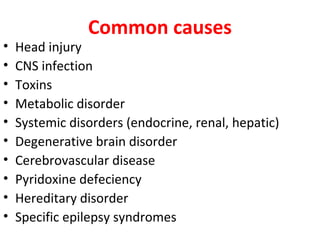
Common causes
• Head injury
• CNS infection
• Toxins
• Metabolic disorder
• Systemic disorders (endocrine, renal, hepatic)
• Degenerative brain disorder
• Cerebrovascular disease
• Pyridoxine defeciency
• Hereditary disorder
• Specific epilepsy syndromes
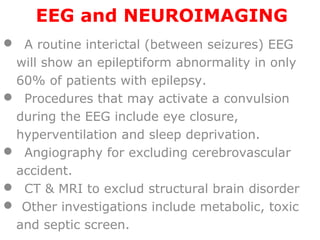
EEG and NEUROIMAGING
 A routine interictal (between seizures) EEG
will show an epileptiform abnormality in only
60% of patients with epilepsy.
 Procedures that may activate a convulsion
during the EEG include eye closure,
hyperventilation and sleep deprivation.
 Angiography for excluding cerebrovascular
accident.
 CT & MRI to exclud structural brain disorder
 Other investigations include metabolic, toxic
and septic screen.
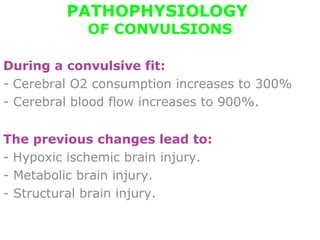
PATHOPHYSIOLOGY
OF CONVULSIONS
During a convulsive fit:
- Cerebral O2 consumption increases to 300%
- Cerebral blood flow increases to 900%.
The previous changes lead to:
- Hypoxic ischemic brain injury.
- Metabolic brain injury.
- Structural brain injury.
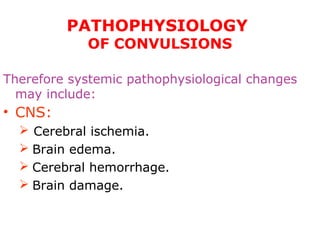
PATHOPHYSIOLOGY
OF CONVULSIONS
Therefore systemic pathophysiological changes
may include:
• CNS:
 Cerebral ischemia.
 Brain edema.
 Cerebral hemorrhage.
 Brain damage.
PATHOPHYSIOLOGY
OF CONVULSIONS
 Respiratory:
 Airway obstruction.
 Apnea.
 Pulmonary edema.
 Aspiration pneumonia.
 CVS:
 Shock.
 Heart failure.
 Hypertension.
 Cardiac arrest.
PATHOPHYSIOLOGY
OF CONVULSIONS
• Metabolic:
 Metabolic acidosis.
 Hyperpyrexia.
 Hypoglycemia, hyponatremia.
• Short repetitive fits are more serious than
prolonged fits as long fits induce cerebral
vascular compensatory changes better than
short repetitive fits.
Classification of convulsions
• Partial seizures:
 Simple partial seizures.
 Complex partial seizures.
 Partial seizures with secondary generalization.
• Generalized seizures:
 Generalized typical absence seizure (petit mal).
 Generalized atypical absence seizure (atypical petit mal).
 Generalized myoclonic seizure.
 Generalized tonic, clonic,or tonic-clonic seizure (grand mal)
 Infantile spasms (with hypsarrhythmic EEG)
Simple partial seizures
 Consciousness retained
 Asynchronous.
 Clonic or tonic motor movement (such as
eye twitches).
 Rarely persisting longer than 10-20 seconds.
 The EEG characteristically shows unilateral
spikes or sharp waves in the anterior
temporal region.
Complex partial seizures
 consciousness impaired
 The average duration is 1-2 minutes.
 The aura signals the onset of convulsion in 30%
of children.
 In the aura, the child complains of epigastric
discomfort, fear, or unpleasant feeling.
Complex partial seizures
 Automatisms are repetitive stereotyped
behaviors that occur in 50-70% of children with
complex partial seizures.
 Automatism follows loss of consciousness and
may include lip smacking, chewing, repetitive
swallowing, excessive salivation, picking and
pulling at clothing.
 The EEG is characterized by sharp waves or
spike discharges in the anterior temporal or
frontal lobe, or by multifocal spikes.
Partial seizures with secondary
generalization
During the partial Seizure the
epileptiform discharge may spread from
the temporal lobe throughout the cortex
causing a generalized tonic-clonic
convulsion.
Generalized typical absence seizure
(Petit mal)
 Onset at age more than 3 years.
  Brief (5-20 sec.) lapses in consciousness,
speech or motor activity.
  Not accompanied by an aura.
  Hyperventilation for 3-4 minutes frequently
induces a seizure.
  The EEG is characterized by 3/sec spike and
generalized wave discharges.
Generalized myoclonic seizures
Brief repetitive symmetric muscle
contractions with loss of body tone.
Cause the child to fall because of a sudden
loss of postural tone.
Generalized tonic, clonic,
or tonic-clonic seizures (grand mal(
 Sudden loss of consciousness.
   Loss of bladder control.
   Perioral cyanosis.
   Followed by 30-60 minute peroid of deep
sleep and postalictal headache.
 
Infantile spasms
(with hypsarrhythmic EEG(
 Begins in the first year of life.
 Characterized by large myoclonic
(salaam) spasms.
  There are at least 3 types of spasms:
flexor, extensor and mixed.
 High incidence of subsequent retardation.
FEBRILE CONVULSION
Definition: convulsion associated with fever
between 6 months and 5 years of age without
evidence of intracranial infection or other CNS
pathology..
  The most common convulsive disorder of
childhood.
 The most common age of onset is 14-18
months.
  The convulsion is usually generalized tonic-
clonic of few seconds duration.
 The problem always resolves without
sequelae.
FEBRILE CONVULSION
 Exceedingly long febrile convulsions may carry
some risk of brain damage.
 A history of febrile convulsion in a close relative
is a risk factor for the development of febrile
convulsion.
 Recurrence of convulsion after the first febrile
convulsion is common (>33%).
 Recurrence is more common in young infants.
 Fewer than 5% of children who have febrile
convulsion develop epilepsy.
Risk factors for developing epilepsy
 Family history of afebrile convulsion.
 Complex first febrile convulsion.
 Initial febrile seizure at age < 9 months.
 Prior neurologic or developmental abnormalities
existed.
Types of febrile
convulsion
     Simple febrile convulsions
 Complex febrile convulsions
Simple febrile convulsions
Brief (< 15 minutes).
Occurs as a solitary event (one attack/24
hours).
Typically generalized tonic-clonic convulsions.
Followed by a brief period of postictal
drowsiness.
Complex febrile convulsions
 Long (> 15 minutes).
 Repeated convulsions for several hours or days.
 May be focal, or generalized tonic-clonic
convulsions.
 Followed by a long period of postictal
drowsiness.
EEG is indicated for
   
    
 The patient with atypical seizure.
 The child at risk for developing epilepsy.
 
Lumbar Puncture
 LP is indicated for all infants aged < one year
with febrile convulsions.
 LP should be considered for any patient aged
12-18 months if a primary focus is not found.
 For age > 18 months meningeal signs are
typically present. LP is deferred if such signs
are not present.
Prophylactic
anti-epileptic treatment
 
    
Following a febrile seizure, treatment with
prophylactic anti-epileptics may be considered in:
 The very young child if febrile seizures recur.
 Children with pre existing neurologic
abnormalities.
 Children with complex febrile seizures.
Treatment of febrile convulsion
 Active measures to control fever.
   Treatment of the cause.
   Reassurance of the parents.
   Oral diazepam 0.3 mg/kg/every 8 hours
(1 mg/kg/day) reduces the risk of febrile
seizures by nearly %50. It is administered at
the onset of each febrile illness for 2-3 days.
NON FEBRILE CONVULSIONS:
Indications for anticonvulsant therapy
 Petit mal, Myoclonic seizures, and Infantile
spasms.
 Two or more unprovoked seizures occur within
6-12 months.
 A single afebrile tonic-clonic seizure has a high
probability of not recurring, therefore
anticonvulsant is not advised following the
initial tonic-clonic seizure.
 Prolonged convulsions may require large and
repeated doses of anticonvulsant, and
consequently mechanical ventilation.
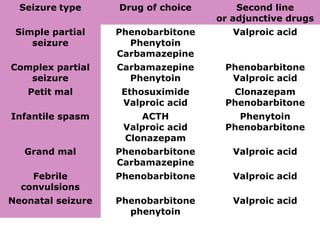
ANTICONVULSANT CHOICE BY SEIZURE TYPE:Seizure type Drug of choice Second line
or adjunctive drugs
Simple partial
seizure
Phenobarbitone
Phenytoin
Carbamazepine
Valproic acid
Complex partial
seizure
Carbamazepine
Phenytoin
Phenobarbitone
Valproic acid
Petit mal Ethosuximide
Valproic acid
Clonazepam
Phenobarbitone
Infantile spasm ACTH
Valproic acid
Clonazepam
Phenytoin
Phenobarbitone
Grand mal Phenobarbitone
Carbamazepine
Valproic acid
Febrile
convulsions
Phenobarbitone Valproic acid
Neonatal seizure Phenobarbitone
phenytoin
Valproic acid
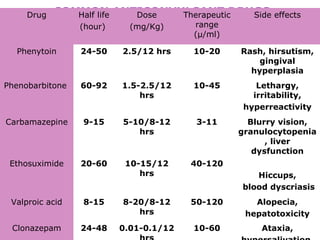
COMMON ANTICONVULSANT DRUGS:Drug Half life
(hour)
Dose
(mg/Kg)
Therapeutic
range
(μ/ml)
Side effects
Phenytoin 24-50 2.5/12 hrs 10-20 Rash, hirsutism,
gingival
hyperplasia
Phenobarbitone 60-92 1.5-2.5/12
hrs
10-45 Lethargy,
irritability,
hyperreactivity
Carbamazepine 9-15 5-10/8-12
hrs
3-11 Blurry vision,
granulocytopenia
, liver
dysfunction
Ethosuximide 20-60 10-15/12
hrs
40-120
Hiccups,
blood dyscriasis
Valproic acid 8-15 8-20/8-12
hrs
50-120 Alopecia,
hepatotoxicity
Clonazepam 24-48 0.01-0.1/12 10-60 Ataxia,
THERAPEUTIC DRUG LEVEL
MONITORING
 At the initiation of therapy to ensure
achievement of therapeutic range.
 During times of accelerated growth.
 If the seizures are out of control.
STATUS EPILEPTICUS:
 SE is defined as continuous seizure activity
for at least 30 minutes, or recurrent seizures
without a return to base line level of
consciousness between seizures.
 Generalized convulsive SE is the most
common type in pediatric population.
· 
The etiologies of SE
The etiologies of SE can be organized into 4
broad categories:
 Atypical febrile seizures.
 Acute CNS disorders (trauma, infection,
metabolic)
 Idiopathic symptomatic epilepsy.
 Chronic, or progressive neurological disorders.
STATUS EPILEPTICUS
 Morbidity is more likely in individuals with
severe CNS pathology.
 Seizures of prolonged duration may be
associated with increased morbidity.
 Mortality is often related to the underlying
etiology, and, therefore highest mortality is
associated with tumors.
Goals of treatment
Goals of treatment can be organized into 4 broad
categories:
 Initial stabilization.
   Terminate seizure activity.
   Prevent seizure recurrence.
   Establish a diagnosis and initiate therapy for
treatable causes.
TREATMENT STRATEGY
 Initial stabilization.
 First line ( benzodiazepines).
 Second line (phenytoin & barbiturates).
 Third line (Refractory status epilepticus).
 Unique therapeutic modalities
Initial stabilization
• Establish airway,
• apply oxygen and ventilation,
• establish IV access
• take samples for initial studies.   
First line ( benzodiazepines(
 Diazepam: 0.5 mg/Kg (maximum 10 mg) slow
IV (not > 1mg/min) or per rectum (undiluted).
 Lorazepam: 0.05-0.1 mg/Kg intravenous, per
rectum or sublingual.
 Midazolam: 0.1-0.2 mg/Kg IV or IM
 Benzodiazepines dose may be repeated every 5
minutes up to 3 doses. Monitor respiration.
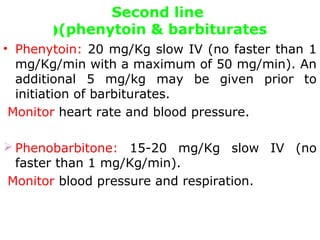
Second line
(phenytoin & barbiturates(
• Phenytoin: 20 mg/Kg slow IV (no faster than 1
mg/Kg/min with a maximum of 50 mg/min). An
additional 5 mg/kg may be given prior to
initiation of barbiturates.
Monitor heart rate and blood pressure.
 Phenobarbitone: 15-20 mg/Kg slow IV (no
faster than 1 mg/Kg/min).
Monitor blood pressure and respiration.
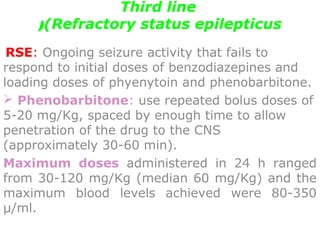
Third line
(Refractory status epilepticus(
 RSE: Ongoing seizure activity that fails to
respond to initial doses of benzodiazepines and
loading doses of phyenytoin and phenobarbitone.
 Phenobarbitone: use repeated bolus doses of
5-20 mg/Kg, spaced by enough time to allow
penetration of the drug to the CNS
(approximately 30-60 min).
Maximum doses administered in 24 h ranged
from 30-120 mg/Kg (median 60 mg/Kg) and the
maximum blood levels achieved were 80-350
μ/ml.
 
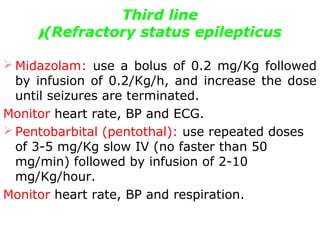
Third line
(Refractory status epilepticus(
 Midazolam: use a bolus of 0.2 mg/Kg followed
by infusion of 0.2/Kg/h, and increase the dose
until seizures are terminated.
Monitor heart rate, BP and ECG.
 Pentobarbital (pentothal): use repeated doses
of 3-5 mg/Kg slow IV (no faster than 50
mg/min) followed by infusion of 2-10
mg/Kg/hour.
Monitor heart rate, BP and respiration.
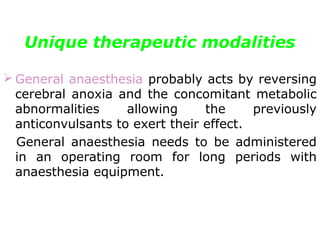
Unique therapeutic modalities
 General anaesthesia probably acts by reversing
cerebral anoxia and the concomitant metabolic
abnormalities allowing the previously
anticonvulsants to exert their effect.
General anaesthesia needs to be administered
in an operating room for long periods with
anaesthesia equipment.
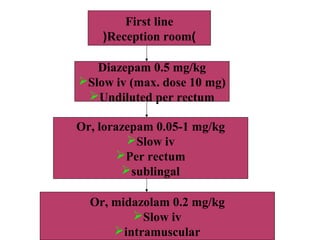
First line
)Reception room(
Diazepam 0.5 mg/kg
Slow iv (max. dose 10 mg)
Undiluted per rectum
Or, lorazepam 0.05-1 mg/kg
Slow iv
Per rectum
sublingal
Or, midazolam 0.2 mg/kg
Slow iv
intramuscular
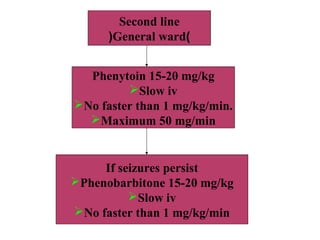
Second line
)General ward(
Phenytoin 15-20 mg/kg
Slow iv
No faster than 1 mg/kg/min.
Maximum 50 mg/min
If seizures persist
Phenobarbitone 15-20 mg/kg
Slow iv
No faster than 1 mg/kg/min
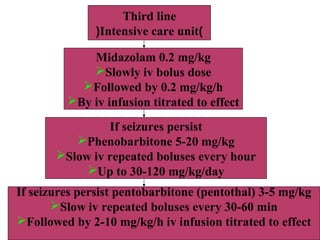
Third line
)Intensive care unit(
Midazolam 0.2 mg/kg
Slowly iv bolus dose
Followed by 0.2 mg/kg/h
By iv infusion titrated to effect
If seizures persist
Phenobarbitone 5-20 mg/kg
Slow iv repeated boluses every hour
Up to 30-120 mg/kg/day
If seizures persist pentobarbitone (pentothal) 3-5 mg/kg
Slow iv repeated boluses every 30-60 min
Followed by 2-10 mg/kg/h iv infusion titrated to effect
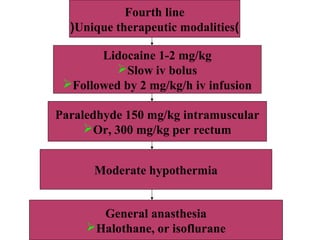
Fourth line
)Unique therapeutic modalities(
Paraledhyde 150 mg/kg intramuscular
Or, 300 mg/kg per rectum
Moderate hypothermia
General anasthesia
Halothane, or isoflurane
Lidocaine 1-2 mg/kg
Slow iv bolus
Followed by 2 mg/kg/h iv infusion
Thank You

Convulsion disorders dr Mohamed abunada

  • 1.
    ‫بو وبركاته‬‫ل‬‫بو ا‬‫ة‬‫بوورحم‬‫م‬‫بو عليك‬‫ م‬‫السل‬ By: Dr. Mohamed Abunada Head Pediatric Neurology Department El Rantisi specialized Pediatric Hospital - Gaza CONVULSIONS
  • 2.
    INTRODUCTION • The wordconvulsion (or seizure) describes an involuntary violent spasm, or a series of jerking of the face, trunk, or extremities with or without loss of consciousness, sensory, autonomic or behavioral disturbances. • The word epilepsy describes a syndrome of recurrent unprovoked, seizure unrelated to fever or to acute cerebral insult.
  • 3.
    INTRODUCTION • Epilepsy isa symptom complex arising from disordered brain function that it self may be secondary to a variety of pathologic processes. • Status epilepticus (SE) is a severe form of seizure activity lasting more than 30 minutes or recurrent seizures with failure to recover consciousness between repeated attacks.
  • 4.
    Common causes • Headinjury • CNS infection • Toxins • Metabolic disorder • Systemic disorders (endocrine, renal, hepatic) • Degenerative brain disorder • Cerebrovascular disease • Pyridoxine defeciency • Hereditary disorder • Specific epilepsy syndromes
  • 5.
    EEG and NEUROIMAGING A routine interictal (between seizures) EEG will show an epileptiform abnormality in only 60% of patients with epilepsy.  Procedures that may activate a convulsion during the EEG include eye closure, hyperventilation and sleep deprivation.  Angiography for excluding cerebrovascular accident.  CT & MRI to exclud structural brain disorder  Other investigations include metabolic, toxic and septic screen.
  • 6.
    PATHOPHYSIOLOGY OF CONVULSIONS During aconvulsive fit: - Cerebral O2 consumption increases to 300% - Cerebral blood flow increases to 900%. The previous changes lead to: - Hypoxic ischemic brain injury. - Metabolic brain injury. - Structural brain injury.
  • 7.
    PATHOPHYSIOLOGY OF CONVULSIONS Therefore systemicpathophysiological changes may include: • CNS:  Cerebral ischemia.  Brain edema.  Cerebral hemorrhage.  Brain damage.
  • 8.
    PATHOPHYSIOLOGY OF CONVULSIONS  Respiratory: Airway obstruction.  Apnea.  Pulmonary edema.  Aspiration pneumonia.  CVS:  Shock.  Heart failure.  Hypertension.  Cardiac arrest.
  • 9.
    PATHOPHYSIOLOGY OF CONVULSIONS • Metabolic: Metabolic acidosis.  Hyperpyrexia.  Hypoglycemia, hyponatremia. • Short repetitive fits are more serious than prolonged fits as long fits induce cerebral vascular compensatory changes better than short repetitive fits.
  • 10.
    Classification of convulsions •Partial seizures:  Simple partial seizures.  Complex partial seizures.  Partial seizures with secondary generalization. • Generalized seizures:  Generalized typical absence seizure (petit mal).  Generalized atypical absence seizure (atypical petit mal).  Generalized myoclonic seizure.  Generalized tonic, clonic,or tonic-clonic seizure (grand mal)  Infantile spasms (with hypsarrhythmic EEG)
  • 11.
    Simple partial seizures Consciousness retained  Asynchronous.  Clonic or tonic motor movement (such as eye twitches).  Rarely persisting longer than 10-20 seconds.  The EEG characteristically shows unilateral spikes or sharp waves in the anterior temporal region.
  • 12.
    Complex partial seizures consciousness impaired  The average duration is 1-2 minutes.  The aura signals the onset of convulsion in 30% of children.  In the aura, the child complains of epigastric discomfort, fear, or unpleasant feeling.
  • 13.
    Complex partial seizures Automatisms are repetitive stereotyped behaviors that occur in 50-70% of children with complex partial seizures.  Automatism follows loss of consciousness and may include lip smacking, chewing, repetitive swallowing, excessive salivation, picking and pulling at clothing.  The EEG is characterized by sharp waves or spike discharges in the anterior temporal or frontal lobe, or by multifocal spikes.
  • 14.
    Partial seizures withsecondary generalization During the partial Seizure the epileptiform discharge may spread from the temporal lobe throughout the cortex causing a generalized tonic-clonic convulsion.
  • 15.
    Generalized typical absenceseizure (Petit mal)  Onset at age more than 3 years.   Brief (5-20 sec.) lapses in consciousness, speech or motor activity.   Not accompanied by an aura.   Hyperventilation for 3-4 minutes frequently induces a seizure.   The EEG is characterized by 3/sec spike and generalized wave discharges.
  • 16.
    Generalized myoclonic seizures Briefrepetitive symmetric muscle contractions with loss of body tone. Cause the child to fall because of a sudden loss of postural tone.
  • 17.
    Generalized tonic, clonic, ortonic-clonic seizures (grand mal(  Sudden loss of consciousness.    Loss of bladder control.    Perioral cyanosis.    Followed by 30-60 minute peroid of deep sleep and postalictal headache.  
  • 18.
    Infantile spasms (with hypsarrhythmicEEG(  Begins in the first year of life.  Characterized by large myoclonic (salaam) spasms.   There are at least 3 types of spasms: flexor, extensor and mixed.  High incidence of subsequent retardation.
  • 19.
    FEBRILE CONVULSION Definition: convulsionassociated with fever between 6 months and 5 years of age without evidence of intracranial infection or other CNS pathology..   The most common convulsive disorder of childhood.  The most common age of onset is 14-18 months.   The convulsion is usually generalized tonic- clonic of few seconds duration.  The problem always resolves without sequelae.
  • 20.
    FEBRILE CONVULSION  Exceedinglylong febrile convulsions may carry some risk of brain damage.  A history of febrile convulsion in a close relative is a risk factor for the development of febrile convulsion.  Recurrence of convulsion after the first febrile convulsion is common (>33%).  Recurrence is more common in young infants.  Fewer than 5% of children who have febrile convulsion develop epilepsy.
  • 21.
    Risk factors fordeveloping epilepsy  Family history of afebrile convulsion.  Complex first febrile convulsion.  Initial febrile seizure at age < 9 months.  Prior neurologic or developmental abnormalities existed.
  • 22.
    Types of febrile convulsion     Simple febrile convulsions  Complex febrile convulsions
  • 23.
    Simple febrile convulsions Brief(< 15 minutes). Occurs as a solitary event (one attack/24 hours). Typically generalized tonic-clonic convulsions. Followed by a brief period of postictal drowsiness.
  • 24.
    Complex febrile convulsions Long (> 15 minutes).  Repeated convulsions for several hours or days.  May be focal, or generalized tonic-clonic convulsions.  Followed by a long period of postictal drowsiness.
  • 25.
    EEG is indicatedfor           The patient with atypical seizure.  The child at risk for developing epilepsy.  
  • 26.
    Lumbar Puncture  LPis indicated for all infants aged < one year with febrile convulsions.  LP should be considered for any patient aged 12-18 months if a primary focus is not found.  For age > 18 months meningeal signs are typically present. LP is deferred if such signs are not present.
  • 27.
    Prophylactic anti-epileptic treatment        Following afebrile seizure, treatment with prophylactic anti-epileptics may be considered in:  The very young child if febrile seizures recur.  Children with pre existing neurologic abnormalities.  Children with complex febrile seizures.
  • 28.
    Treatment of febrileconvulsion  Active measures to control fever.    Treatment of the cause.    Reassurance of the parents.    Oral diazepam 0.3 mg/kg/every 8 hours (1 mg/kg/day) reduces the risk of febrile seizures by nearly %50. It is administered at the onset of each febrile illness for 2-3 days.
  • 29.
    NON FEBRILE CONVULSIONS: Indicationsfor anticonvulsant therapy  Petit mal, Myoclonic seizures, and Infantile spasms.  Two or more unprovoked seizures occur within 6-12 months.  A single afebrile tonic-clonic seizure has a high probability of not recurring, therefore anticonvulsant is not advised following the initial tonic-clonic seizure.  Prolonged convulsions may require large and repeated doses of anticonvulsant, and consequently mechanical ventilation.
  • 30.
    ANTICONVULSANT CHOICE BYSEIZURE TYPE:Seizure type Drug of choice Second line or adjunctive drugs Simple partial seizure Phenobarbitone Phenytoin Carbamazepine Valproic acid Complex partial seizure Carbamazepine Phenytoin Phenobarbitone Valproic acid Petit mal Ethosuximide Valproic acid Clonazepam Phenobarbitone Infantile spasm ACTH Valproic acid Clonazepam Phenytoin Phenobarbitone Grand mal Phenobarbitone Carbamazepine Valproic acid Febrile convulsions Phenobarbitone Valproic acid Neonatal seizure Phenobarbitone phenytoin Valproic acid
  • 31.
    COMMON ANTICONVULSANT DRUGS:DrugHalf life (hour) Dose (mg/Kg) Therapeutic range (μ/ml) Side effects Phenytoin 24-50 2.5/12 hrs 10-20 Rash, hirsutism, gingival hyperplasia Phenobarbitone 60-92 1.5-2.5/12 hrs 10-45 Lethargy, irritability, hyperreactivity Carbamazepine 9-15 5-10/8-12 hrs 3-11 Blurry vision, granulocytopenia , liver dysfunction Ethosuximide 20-60 10-15/12 hrs 40-120 Hiccups, blood dyscriasis Valproic acid 8-15 8-20/8-12 hrs 50-120 Alopecia, hepatotoxicity Clonazepam 24-48 0.01-0.1/12 10-60 Ataxia,
  • 32.
    THERAPEUTIC DRUG LEVEL MONITORING At the initiation of therapy to ensure achievement of therapeutic range.  During times of accelerated growth.  If the seizures are out of control.
  • 33.
    STATUS EPILEPTICUS:  SEis defined as continuous seizure activity for at least 30 minutes, or recurrent seizures without a return to base line level of consciousness between seizures.  Generalized convulsive SE is the most common type in pediatric population. · 
  • 34.
    The etiologies ofSE The etiologies of SE can be organized into 4 broad categories:  Atypical febrile seizures.  Acute CNS disorders (trauma, infection, metabolic)  Idiopathic symptomatic epilepsy.  Chronic, or progressive neurological disorders.
  • 35.
    STATUS EPILEPTICUS  Morbidityis more likely in individuals with severe CNS pathology.  Seizures of prolonged duration may be associated with increased morbidity.  Mortality is often related to the underlying etiology, and, therefore highest mortality is associated with tumors.
  • 36.
    Goals of treatment Goalsof treatment can be organized into 4 broad categories:  Initial stabilization.    Terminate seizure activity.    Prevent seizure recurrence.    Establish a diagnosis and initiate therapy for treatable causes.
  • 37.
    TREATMENT STRATEGY  Initialstabilization.  First line ( benzodiazepines).  Second line (phenytoin & barbiturates).  Third line (Refractory status epilepticus).  Unique therapeutic modalities
  • 38.
    Initial stabilization • Establishairway, • apply oxygen and ventilation, • establish IV access • take samples for initial studies.   
  • 39.
    First line (benzodiazepines(  Diazepam: 0.5 mg/Kg (maximum 10 mg) slow IV (not > 1mg/min) or per rectum (undiluted).  Lorazepam: 0.05-0.1 mg/Kg intravenous, per rectum or sublingual.  Midazolam: 0.1-0.2 mg/Kg IV or IM  Benzodiazepines dose may be repeated every 5 minutes up to 3 doses. Monitor respiration.
  • 40.
    Second line (phenytoin &barbiturates( • Phenytoin: 20 mg/Kg slow IV (no faster than 1 mg/Kg/min with a maximum of 50 mg/min). An additional 5 mg/kg may be given prior to initiation of barbiturates. Monitor heart rate and blood pressure.  Phenobarbitone: 15-20 mg/Kg slow IV (no faster than 1 mg/Kg/min). Monitor blood pressure and respiration.
  • 41.
    Third line (Refractory statusepilepticus(  RSE: Ongoing seizure activity that fails to respond to initial doses of benzodiazepines and loading doses of phyenytoin and phenobarbitone.  Phenobarbitone: use repeated bolus doses of 5-20 mg/Kg, spaced by enough time to allow penetration of the drug to the CNS (approximately 30-60 min). Maximum doses administered in 24 h ranged from 30-120 mg/Kg (median 60 mg/Kg) and the maximum blood levels achieved were 80-350 μ/ml.  
  • 42.
    Third line (Refractory statusepilepticus(  Midazolam: use a bolus of 0.2 mg/Kg followed by infusion of 0.2/Kg/h, and increase the dose until seizures are terminated. Monitor heart rate, BP and ECG.  Pentobarbital (pentothal): use repeated doses of 3-5 mg/Kg slow IV (no faster than 50 mg/min) followed by infusion of 2-10 mg/Kg/hour. Monitor heart rate, BP and respiration.
  • 43.
    Unique therapeutic modalities General anaesthesia probably acts by reversing cerebral anoxia and the concomitant metabolic abnormalities allowing the previously anticonvulsants to exert their effect. General anaesthesia needs to be administered in an operating room for long periods with anaesthesia equipment.
  • 44.
    First line )Reception room( Diazepam0.5 mg/kg Slow iv (max. dose 10 mg) Undiluted per rectum Or, lorazepam 0.05-1 mg/kg Slow iv Per rectum sublingal Or, midazolam 0.2 mg/kg Slow iv intramuscular
  • 45.
    Second line )General ward( Phenytoin15-20 mg/kg Slow iv No faster than 1 mg/kg/min. Maximum 50 mg/min If seizures persist Phenobarbitone 15-20 mg/kg Slow iv No faster than 1 mg/kg/min
  • 46.
    Third line )Intensive careunit( Midazolam 0.2 mg/kg Slowly iv bolus dose Followed by 0.2 mg/kg/h By iv infusion titrated to effect If seizures persist Phenobarbitone 5-20 mg/kg Slow iv repeated boluses every hour Up to 30-120 mg/kg/day If seizures persist pentobarbitone (pentothal) 3-5 mg/kg Slow iv repeated boluses every 30-60 min Followed by 2-10 mg/kg/h iv infusion titrated to effect
  • 47.
    Fourth line )Unique therapeuticmodalities( Paraledhyde 150 mg/kg intramuscular Or, 300 mg/kg per rectum Moderate hypothermia General anasthesia Halothane, or isoflurane Lidocaine 1-2 mg/kg Slow iv bolus Followed by 2 mg/kg/h iv infusion
  • 48.