ACUTE FLACCID PARALYSIS
AFP
Dr. Mohamed I. Abunada
Head of Pediatric
Neurology Department
Dr. Al rantisi Specialized
children Hospital
DEFINITION
• Sudden onset of weakness or paralysis over a
period of 15 days in a patient aged less than
15 years age
• Flaccid paralysis evolving over hours or a few
days
• suggests involvement of the lower motor
neuron complex.
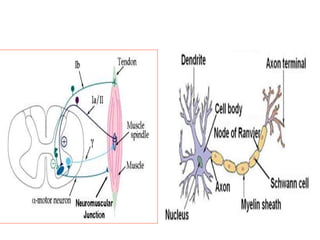
 Muscle contraction results from a chain of events that
=begins with a nerve impulse
=traveling in the upper motor neuron from the
(cerebral cortex in the brain to the spinal cord)
=the nerve impulse then
=travels in the lower motor neuron from the
(spinal cord to the neuromuscular junction)
=then stimulation of the muscles occurs.
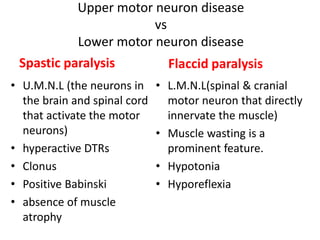
Upper motor neuron disease
vs
Lower motor neuron disease
Spastic paralysis
• U.M.N.L (the neurons in
the brain and spinal cord
that activate the motor
neurons)
• hyperactive DTRs
• Clonus
• Positive Babinski
• absence of muscle
atrophy
Flaccid paralysis
• L.M.N.L(spinal & cranial
motor neuron that directly
innervate the muscle)
• Muscle wasting is a
prominent feature.
• Hypotonia
• Hyporeflexia
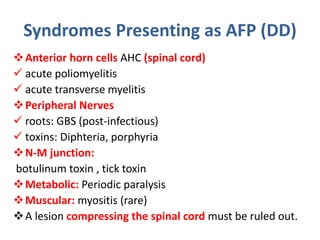
Syndromes Presenting as AFP (DD)
Anterior horn cells AHC (spinal cord)
 acute poliomyelitis
 acute transverse myelitis
Peripheral Nerves
 roots: GBS (post-infectious)
 toxins: Diphteria, porphyria
N-M junction:
botulinum toxin , tick toxin
Metabolic: Periodic paralysis
Muscular: myositis (rare)
A lesion compressing the spinal cord must be ruled out.
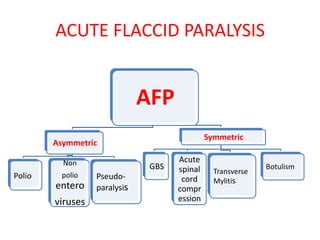
ACUTE FLACCID PARALYSIS
AFP
Asymmetric
Polio
Non
polio
entero
viruses
Pseudo-
paralysis
Symmetric
GBS
Acute
spinal
cord
compr
ession
Transverse
Mylitis
Botulism
Features assisting diagnosis
• Age.
• A history of preceding or warning illness.
• A history of trauma.
• The presence (at time of paralysis) of fever.
• Rapidity of progression.
• Cranial nerve findings, and sensory findings.
• The Examination should include a search of fracture , focal
tenderness or swelling and painful limping gait.
• The examination may show UMNL signs
 increased reflexes
 Hypertonicity
 a positive Babinski sign.
• Laboratory findings occasionally are diagnostic
Imaging&Neurophysiology
 NERVE CONDUCTION VELOCITY (NCV). Neuropathies of
various types are detected by decreased conduction.
 ELECTROMYOGRAPHY (EMG). Characteristic EMG patterns
distinguish denervation from myopathic involvement.
 CSF exam: in suspected CNS infection or GBS
 MRI is the study of choice to image the spinal cord or nerve
roots & plexus (e.g., brachial).
 CK (creatine kinase)
 Enzymes are released by damaged or degenerating muscle
fibers.
 Many diseases of the motor unit may not be associated
with elevated enzymes.
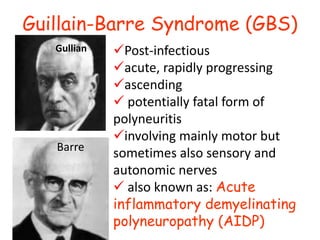
Guillain-Barre Syndrome (GBS)
Barre
Gullian Post-infectious
acute, rapidly progressing
ascending
 potentially fatal form of
polyneuritis
involving mainly motor but
sometimes also sensory and
autonomic nerves
 also known as: Acute
inflammatory demyelinating
polyneuropathy (AIDP)
Epidemiology
The most common cause of AFP among infants(2
cases per 100,000 population).
At an age usually in children over 4-9 years
Sex : any ( male > female)
follows infection by 10 days
GIT infection
 Campylobacter jejuni (26-41%)
 Cytomegalovirus
Respiratory tract infection
Mycoplasma pneumoniae
Vaccines
– Rabies
– Avian-flu influenza
Pathogenesis
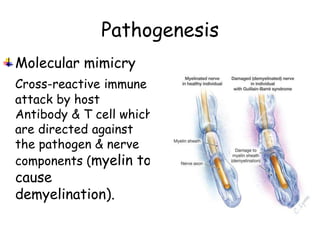
Molecular mimicry
Cross-reactive immune
attack by host
Antibody & T cell which
are directed against
the pathogen & nerve
components (myelin to
cause
demyelination).
Clinical Features
Weakness
o Onset is gradual and progresses over weeks
o Lower extremities (unable/refusal to walk)  trunks 
upper limbs  bulbar muscles  flaccid tetraplegia =
Landry Ascending Paralysis
o Proximal and distal muscles are involved relatively
symmetrically, but asymmetry is found in 9% of patient
Muscle tenderness – At the onset
Paraesthesias – in some cases
Areflexia (83%)
Clinical Features
Bulbar involvement (50%)
o Dysphagia and facial weakness – signs of impending
respiratory failure
Cranial nerve involvement (50%)
o Facial nerve , Oculomotor nerve
Autonomic involvement
o Lability of blood pressure
o Profound bradycardia
o Occasional asystole
o Urinary retention or incontinence (20% of cases)
Miller-Fisher syndrome
o External ophtalmoplegia
o ataxia
o areflexia
Investigations
Electromyography
 Motor nerve conduction velocities are reduced
 Evidence of acute denervation of muscle
Lumbar puncture – cerebrospinal fluid (CSF)
 Elevation of CSF protein (more than twice upper limit of normal)
 Cell content of CSF is normal (<10 cells/mm³)
 Glucose level normal
 Bacterial and viral culture is negative
Treatment
o Intravenous immunoglobulin (IVIG), 2 gm/kg/day
administered for 2 or 5 days
o Plasmapheresis, steroids, if IVIG is ineffective
o Supportive care, such as respiratory support,
prevention of decubiti in children with flaccid
tetraplegia, and treatment of secondary bacterial
infections
Prognosis
Spontaneous recovery begins within 2–3
weeks.
Most regain normal muscular function
Improvement usually follows a gradient
inverse to the direction of involvement.
Bulbar and respiratory muscle
involvement may lead to death if the
syndrome is not recognized and treated
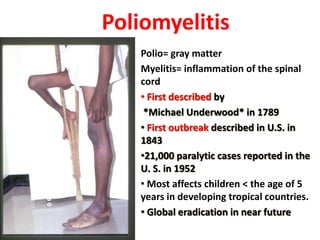
Poliomyelitis
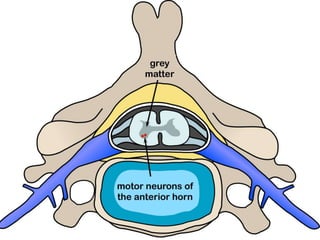
Polio= gray matter
Myelitis= inflammation of the spinal
cord
• First described by
*Michael Underwood* in 1789
• First outbreak described in U.S. in
1843
•21,000 paralytic cases reported in the
U. S. in 1952
• Most affects children < the age of 5
years in developing tropical countries.
• Global eradication in near future
Poliomyelitis
It is a viral infection Enterovirus (RNA)
Rapidly inactivated by heat, formaldehyde,
chlorine, ultraviolet light
It is contagious: usually spread from person to
person.
Incubation period ranges from 6 to 20 days
Only harmful to humans
Virus localized in the anterior horn cells of the
spinal cord and certain brain steam motor nuclei.
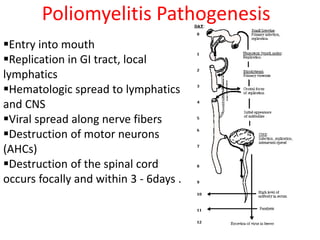
Poliomyelitis Pathogenesis
Entry into mouth
Replication in GI tract, local
lymphatics
Hematologic spread to lymphatics
and CNS
Viral spread along nerve fibers
Destruction of motor neurons
(AHCs)
Destruction of the spinal cord
occurs focally and within 3 - 6days .
Clinical Presentation
Acute stage: generally lasts 7 to 10 days.
fever
pharyngitis
headache
anorexia
nausea
vomiting.
Illness may progress to aseptic meningitis and
meningioencephalitis in 1% to 4% of patients.
 Symptoms range from mild malaise to generalized
encephalomyelitis with widespread paralysis.
Clinical course
 Paralytic disease occurs 0.1% to 1% of those who become
infected with the polio virus.
 Hyperesthesia or paresthesia in the extremities and
muscular pain is common
 Paralysis of the respiratory muscles or from cardiac arrest if
the neurons in the medulla oblongata are destroyed.
Paralysis occurs twice as often in the lower extremity as in
upper extremity.
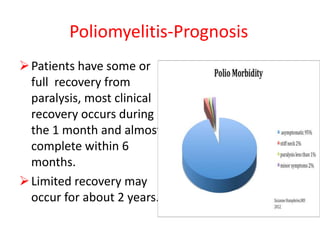
Poliomyelitis-Prognosis
Patients have some or
full recovery from
paralysis, most clinical
recovery occurs during
the 1 month and almost
complete within 6
months.
Limited recovery may
occur for about 2 years.
Treatment in the acute stage
Bed rest, analgesics, hot packs, and anatomical
positioning of the limbs
Close monitoring of respiratory and
cardiovascular functioning is essential during
the acute stage of poliomyelitis along with fever
control and pain relievers for muscle spasms.
Mechanical ventilation, respiratory therapy may
be needed depending of the severity of
patients.
Physiotherapy
gentle passive ROM exercises of all joints
Physical therapy is recommended for full
recovery.
Passive stretching exercises for mild to moderate
contractures
Surgical release of tight fascia and lengthening of
tendons may be necessary for contractures
persisting longer than 6 months.
Orthoses should be used until no further
recovery is anticipated.
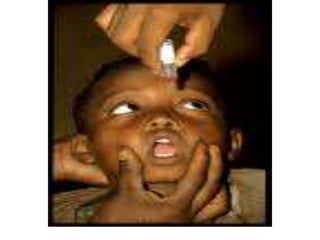
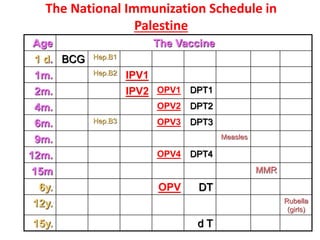
Prevention & Eradication
The National Immunization Schedule in
Palestine
The VaccineAge
Hep.B1BCG1 d.
IPV1Hep.B21m.
DPT1OPV1IPV22m.
DPT2OPV24m.
DPT3OPV3Hep.B36m.
Measles9m.
DPT4OPV412m.
MMR15m
DTOPV6y.
Rubella
(girls)
12y.
d T15y.
Non-polio enteroviruses
Coxsackie viruses and echo viruses can affect
the AHCs and cause AFP.
Paralysis is usually mild , not massive and
transient.
Pseudoparalysis
• Not a true paralysis
• May follow unrecognized trauma (fracture,
sprain, contusion), toxic synovitis of hip or
knee or acute osteomylitis
• Careful exam show focal tenderness
• Usually painful limping gait.
• Neuro exam is free.
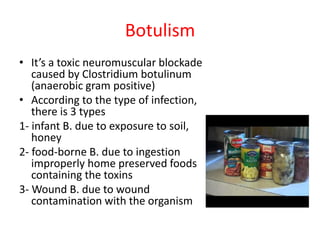
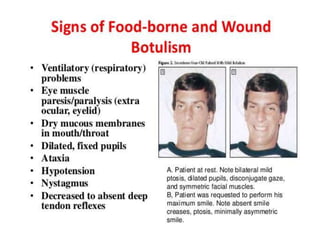
Botulism
• It’s a toxic neuromuscular blockade
caused by Clostridium botulinum
(anaerobic gram positive)
• According to the type of infection,
there is 3 types
1- infant B. due to exposure to soil,
honey
2- food-borne B. due to ingestion
improperly home preserved foods
containing the toxins
3- Wound B. due to wound
contamination with the organism
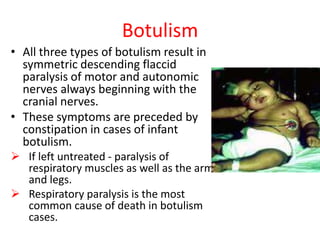
Botulism
• All three types of botulism result in
symmetric descending flaccid
paralysis of motor and autonomic
nerves always beginning with the
cranial nerves.
• These symptoms are preceded by
constipation in cases of infant
botulism.
 If left untreated - paralysis of
respiratory muscles as well as the arms
and legs.
 Respiratory paralysis is the most
common cause of death in botulism
cases.
Treatment
• Antitoxin can halt the progress of symptoms if
administered early to victims of food and
wound botulism.
• Antitoxin is not given to victims of infant
botulism because when this is diagnosed it is
generally too late for the antitoxin to do any
good.
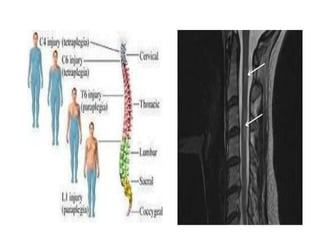
Transverse Mylitis
• The 2nd most common cause of symmetric AFP
• It’s a segmental dysfunction of spinal cord without
evidence of spinal cord compression
• The cause is either a direct viral infection or an
autoimmune disease.
• Paralysis is usually affect only LL (Paraplegia). rare
above 5th cervical segment lead to quadriplegia .
• Initially flaccid but gradual change to spasticity over
few weeks
• Sensory loss (with sensory level on the trunk)and
autonomic disturbance (urinary retention and stool
incontinence) are usually present
treatment
• Intravenous Steroids
 Although there are no clinical trials that support a
unique approach
 it is well recognized as a standard of care to give
high-dose intravenous methyl-prednisolone for 3-5 days
 The decision to offer continued steroids or add a new
treatment is often based on the clinical course and MRI
appearance at the end of 5 days of steroids.
• Plasma Electrophoresis
 mostly
• Prolonged course
• Complete recovery in 60% of cases
Acute spinal cord compression
• Trauma to the back
• Spinal epidural abscess
• Vascular anomalies of the cord
• Spinal cord tumors.
Clinically difficult to differentiate from
Transverse Mylitis
CT scan of the spine or MRI are sensitive and
can show the nature of obstruction
Prognosis & complications of AFP
According to cause for example:
Poliomyelitis
Respiratory, death, Limb atrophy.
Guillain- Barre Syndrome:
Respiratory, autonomic crises, residual weakness,
death.
Acute transverse myelitis
Residual deficits include bowel and bladder
dysfunction & weakness in the lower extremities
Acute flaccid paralysis afp ‫‬

Acute flaccid paralysis afp ‫‬

  • 1.
    ACUTE FLACCID PARALYSIS AFP Dr.Mohamed I. Abunada Head of Pediatric Neurology Department Dr. Al rantisi Specialized children Hospital
  • 2.
    DEFINITION • Sudden onsetof weakness or paralysis over a period of 15 days in a patient aged less than 15 years age • Flaccid paralysis evolving over hours or a few days • suggests involvement of the lower motor neuron complex.
  • 3.
     Muscle contractionresults from a chain of events that =begins with a nerve impulse =traveling in the upper motor neuron from the (cerebral cortex in the brain to the spinal cord) =the nerve impulse then =travels in the lower motor neuron from the (spinal cord to the neuromuscular junction) =then stimulation of the muscles occurs.
  • 5.
    Upper motor neurondisease vs Lower motor neuron disease Spastic paralysis • U.M.N.L (the neurons in the brain and spinal cord that activate the motor neurons) • hyperactive DTRs • Clonus • Positive Babinski • absence of muscle atrophy Flaccid paralysis • L.M.N.L(spinal & cranial motor neuron that directly innervate the muscle) • Muscle wasting is a prominent feature. • Hypotonia • Hyporeflexia
  • 6.
    Syndromes Presenting asAFP (DD) Anterior horn cells AHC (spinal cord)  acute poliomyelitis  acute transverse myelitis Peripheral Nerves  roots: GBS (post-infectious)  toxins: Diphteria, porphyria N-M junction: botulinum toxin , tick toxin Metabolic: Periodic paralysis Muscular: myositis (rare) A lesion compressing the spinal cord must be ruled out.
  • 7.
  • 8.
    Features assisting diagnosis •Age. • A history of preceding or warning illness. • A history of trauma. • The presence (at time of paralysis) of fever. • Rapidity of progression. • Cranial nerve findings, and sensory findings. • The Examination should include a search of fracture , focal tenderness or swelling and painful limping gait. • The examination may show UMNL signs  increased reflexes  Hypertonicity  a positive Babinski sign. • Laboratory findings occasionally are diagnostic
  • 9.
    Imaging&Neurophysiology  NERVE CONDUCTIONVELOCITY (NCV). Neuropathies of various types are detected by decreased conduction.  ELECTROMYOGRAPHY (EMG). Characteristic EMG patterns distinguish denervation from myopathic involvement.  CSF exam: in suspected CNS infection or GBS  MRI is the study of choice to image the spinal cord or nerve roots & plexus (e.g., brachial).  CK (creatine kinase)  Enzymes are released by damaged or degenerating muscle fibers.  Many diseases of the motor unit may not be associated with elevated enzymes.
  • 10.
    Guillain-Barre Syndrome (GBS) Barre GullianPost-infectious acute, rapidly progressing ascending  potentially fatal form of polyneuritis involving mainly motor but sometimes also sensory and autonomic nerves  also known as: Acute inflammatory demyelinating polyneuropathy (AIDP)
  • 11.
    Epidemiology The most commoncause of AFP among infants(2 cases per 100,000 population). At an age usually in children over 4-9 years Sex : any ( male > female) follows infection by 10 days GIT infection  Campylobacter jejuni (26-41%)  Cytomegalovirus Respiratory tract infection Mycoplasma pneumoniae Vaccines – Rabies – Avian-flu influenza
  • 12.
    Pathogenesis Molecular mimicry Cross-reactive immune attackby host Antibody & T cell which are directed against the pathogen & nerve components (myelin to cause demyelination).
  • 13.
    Clinical Features Weakness o Onsetis gradual and progresses over weeks o Lower extremities (unable/refusal to walk)  trunks  upper limbs  bulbar muscles  flaccid tetraplegia = Landry Ascending Paralysis o Proximal and distal muscles are involved relatively symmetrically, but asymmetry is found in 9% of patient Muscle tenderness – At the onset Paraesthesias – in some cases Areflexia (83%)
  • 14.
    Clinical Features Bulbar involvement(50%) o Dysphagia and facial weakness – signs of impending respiratory failure Cranial nerve involvement (50%) o Facial nerve , Oculomotor nerve Autonomic involvement o Lability of blood pressure o Profound bradycardia o Occasional asystole o Urinary retention or incontinence (20% of cases) Miller-Fisher syndrome o External ophtalmoplegia o ataxia o areflexia
  • 15.
    Investigations Electromyography  Motor nerveconduction velocities are reduced  Evidence of acute denervation of muscle Lumbar puncture – cerebrospinal fluid (CSF)  Elevation of CSF protein (more than twice upper limit of normal)  Cell content of CSF is normal (<10 cells/mm³)  Glucose level normal  Bacterial and viral culture is negative
  • 16.
    Treatment o Intravenous immunoglobulin(IVIG), 2 gm/kg/day administered for 2 or 5 days o Plasmapheresis, steroids, if IVIG is ineffective o Supportive care, such as respiratory support, prevention of decubiti in children with flaccid tetraplegia, and treatment of secondary bacterial infections
  • 17.
    Prognosis Spontaneous recovery beginswithin 2–3 weeks. Most regain normal muscular function Improvement usually follows a gradient inverse to the direction of involvement. Bulbar and respiratory muscle involvement may lead to death if the syndrome is not recognized and treated
  • 18.
    Poliomyelitis Polio= gray matter Myelitis=inflammation of the spinal cord • First described by *Michael Underwood* in 1789 • First outbreak described in U.S. in 1843 •21,000 paralytic cases reported in the U. S. in 1952 • Most affects children < the age of 5 years in developing tropical countries. • Global eradication in near future
  • 19.
    Poliomyelitis It is aviral infection Enterovirus (RNA) Rapidly inactivated by heat, formaldehyde, chlorine, ultraviolet light It is contagious: usually spread from person to person. Incubation period ranges from 6 to 20 days Only harmful to humans Virus localized in the anterior horn cells of the spinal cord and certain brain steam motor nuclei.
  • 21.
    Poliomyelitis Pathogenesis Entry intomouth Replication in GI tract, local lymphatics Hematologic spread to lymphatics and CNS Viral spread along nerve fibers Destruction of motor neurons (AHCs) Destruction of the spinal cord occurs focally and within 3 - 6days .
  • 22.
    Clinical Presentation Acute stage:generally lasts 7 to 10 days. fever pharyngitis headache anorexia nausea vomiting. Illness may progress to aseptic meningitis and meningioencephalitis in 1% to 4% of patients.  Symptoms range from mild malaise to generalized encephalomyelitis with widespread paralysis.
  • 23.
    Clinical course  Paralyticdisease occurs 0.1% to 1% of those who become infected with the polio virus.  Hyperesthesia or paresthesia in the extremities and muscular pain is common  Paralysis of the respiratory muscles or from cardiac arrest if the neurons in the medulla oblongata are destroyed. Paralysis occurs twice as often in the lower extremity as in upper extremity.
  • 24.
    Poliomyelitis-Prognosis Patients have someor full recovery from paralysis, most clinical recovery occurs during the 1 month and almost complete within 6 months. Limited recovery may occur for about 2 years.
  • 25.
    Treatment in theacute stage Bed rest, analgesics, hot packs, and anatomical positioning of the limbs Close monitoring of respiratory and cardiovascular functioning is essential during the acute stage of poliomyelitis along with fever control and pain relievers for muscle spasms. Mechanical ventilation, respiratory therapy may be needed depending of the severity of patients.
  • 26.
    Physiotherapy gentle passive ROMexercises of all joints Physical therapy is recommended for full recovery. Passive stretching exercises for mild to moderate contractures Surgical release of tight fascia and lengthening of tendons may be necessary for contractures persisting longer than 6 months. Orthoses should be used until no further recovery is anticipated.
  • 27.
  • 30.
    The National ImmunizationSchedule in Palestine The VaccineAge Hep.B1BCG1 d. IPV1Hep.B21m. DPT1OPV1IPV22m. DPT2OPV24m. DPT3OPV3Hep.B36m. Measles9m. DPT4OPV412m. MMR15m DTOPV6y. Rubella (girls) 12y. d T15y.
  • 31.
    Non-polio enteroviruses Coxsackie virusesand echo viruses can affect the AHCs and cause AFP. Paralysis is usually mild , not massive and transient.
  • 32.
    Pseudoparalysis • Not atrue paralysis • May follow unrecognized trauma (fracture, sprain, contusion), toxic synovitis of hip or knee or acute osteomylitis • Careful exam show focal tenderness • Usually painful limping gait. • Neuro exam is free.
  • 33.
    Botulism • It’s atoxic neuromuscular blockade caused by Clostridium botulinum (anaerobic gram positive) • According to the type of infection, there is 3 types 1- infant B. due to exposure to soil, honey 2- food-borne B. due to ingestion improperly home preserved foods containing the toxins 3- Wound B. due to wound contamination with the organism
  • 35.
    Botulism • All threetypes of botulism result in symmetric descending flaccid paralysis of motor and autonomic nerves always beginning with the cranial nerves. • These symptoms are preceded by constipation in cases of infant botulism.  If left untreated - paralysis of respiratory muscles as well as the arms and legs.  Respiratory paralysis is the most common cause of death in botulism cases.
  • 36.
    Treatment • Antitoxin canhalt the progress of symptoms if administered early to victims of food and wound botulism. • Antitoxin is not given to victims of infant botulism because when this is diagnosed it is generally too late for the antitoxin to do any good.
  • 37.
    Transverse Mylitis • The2nd most common cause of symmetric AFP • It’s a segmental dysfunction of spinal cord without evidence of spinal cord compression • The cause is either a direct viral infection or an autoimmune disease. • Paralysis is usually affect only LL (Paraplegia). rare above 5th cervical segment lead to quadriplegia . • Initially flaccid but gradual change to spasticity over few weeks • Sensory loss (with sensory level on the trunk)and autonomic disturbance (urinary retention and stool incontinence) are usually present
  • 39.
    treatment • Intravenous Steroids Although there are no clinical trials that support a unique approach  it is well recognized as a standard of care to give high-dose intravenous methyl-prednisolone for 3-5 days  The decision to offer continued steroids or add a new treatment is often based on the clinical course and MRI appearance at the end of 5 days of steroids. • Plasma Electrophoresis  mostly • Prolonged course • Complete recovery in 60% of cases
  • 40.
    Acute spinal cordcompression • Trauma to the back • Spinal epidural abscess • Vascular anomalies of the cord • Spinal cord tumors. Clinically difficult to differentiate from Transverse Mylitis CT scan of the spine or MRI are sensitive and can show the nature of obstruction
  • 41.
    Prognosis & complicationsof AFP According to cause for example: Poliomyelitis Respiratory, death, Limb atrophy. Guillain- Barre Syndrome: Respiratory, autonomic crises, residual weakness, death. Acute transverse myelitis Residual deficits include bowel and bladder dysfunction & weakness in the lower extremities