GST
(Goods and Services Tax)
Biggest Tax Reform Since Independence…..
By PARTH SHAH
GST
 Goods and service tax (GST) is a comprehensive
tax levy on manufacture, sale and consumption
of goods and service at a national level.
 Gst is a tax on goods and services with value
addition at each stage.
 Gst willinclude many state and central level
indirect taxes.
 It overcomes drawback present tax system
TAX STRUCTURE IN INDIA
• Direct Tax :
e.g.: Income Tax, Corporate Tax, Wealth Tax
• Indirect Tax :
e.g.: Excise duty, custom duty, Service Tax, Octrai
Tax, VAT.
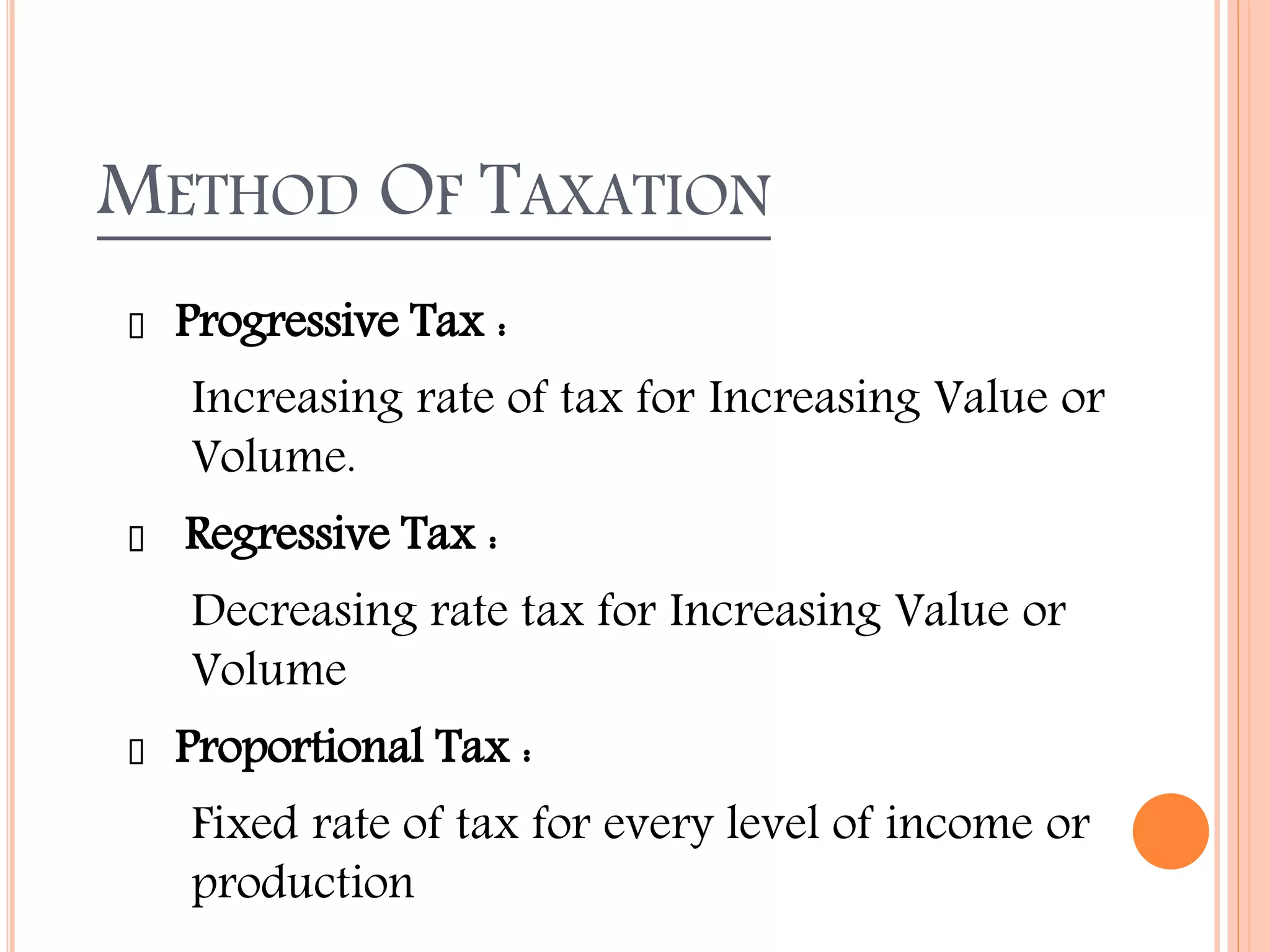
METHOD OF TAXATION
Progressive Tax :
Increasing rate of tax for Increasing Value or
Volume.
Regressive Tax :
Decreasing rate tax for Increasing Value or
Volume
Proportional Tax :
Fixed rate of tax for every level of income or
production
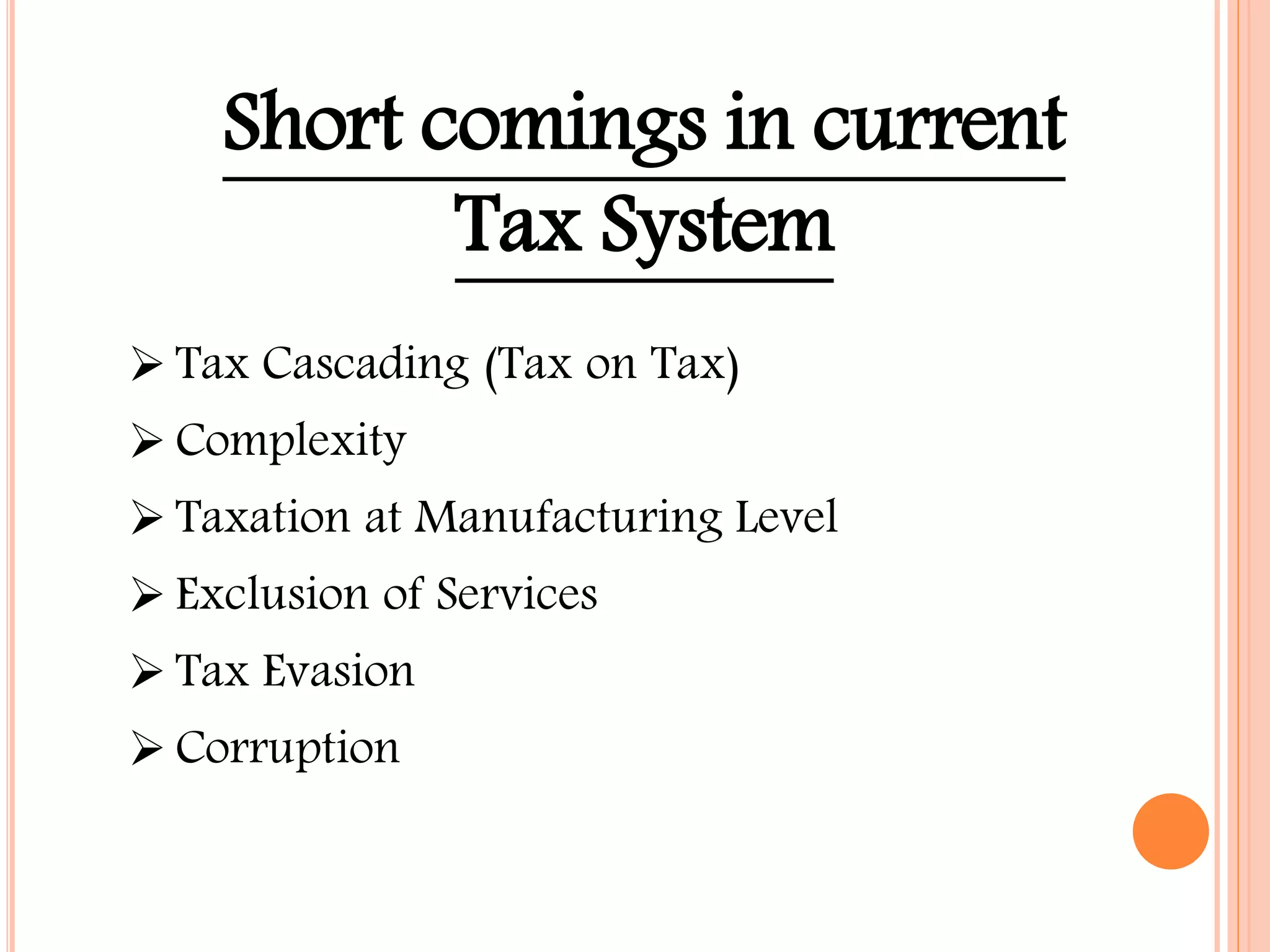
Short comings in current
Tax System
 Tax Cascading (Tax on Tax)
 Complexity
 Taxation at Manufacturing Level
 Exclusion of Services
 Tax Evasion
 Corruption
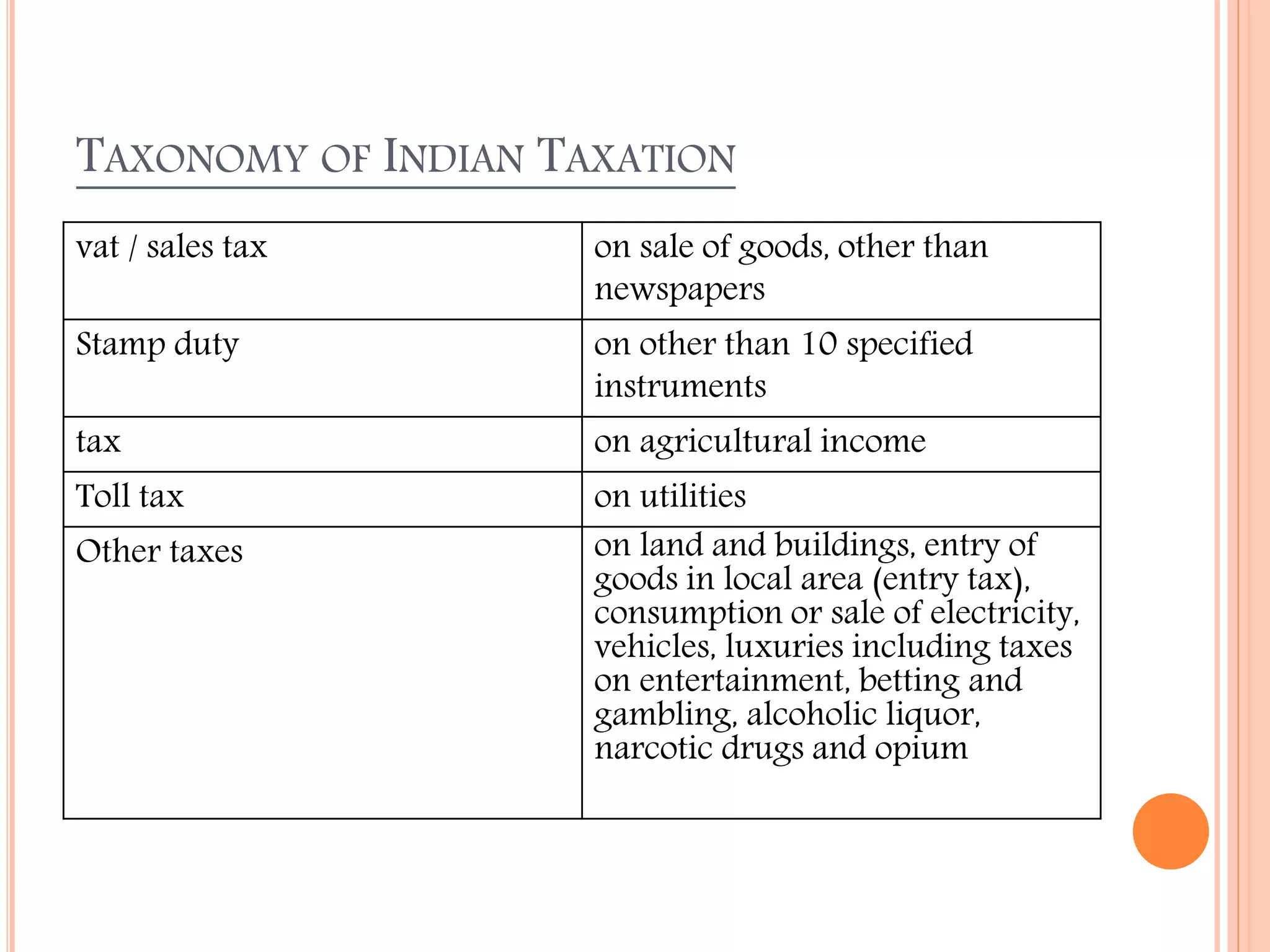
TAXONOMY OF INDIAN TAXATION
vat / sales tax on sale of goods, other than
newspapers
Stamp duty on other than 10 specified
instruments
tax on agricultural income
Toll tax on utilities
Other taxes on land and buildings, entry of
goods in local area (entry tax),
consumption or sale of electricity,
vehicles, luxuries including taxes
on entertainment, betting and
gambling, alcoholic liquor,
narcotic drugs and opium
PRE-REQUISITES FOR MIGRATING TO A GST
REGIME
 Common/unified tax rate for goods and services which may
be ideally, revenue neutral (a suitable GST rate) – dual tax
proposed
 Avoiding or minimizing differential tax rates – under
discussions
 Abolition of other small taxes - under discussions
 Abolition of CST in a phased manner - being done
 Power to levy service tax on select/agreed services to states -
under discussions
 Issue of inter-state services and goods movement vis-à-vis
levy of duty or tax to be sorted out - under discussions
 Revenue sharing mechanism to be rationalized - under
discussions
WHAT IS GST
GST is a comprehensive value added tax on goods
and services
It is collected on value added at each stage of sale
or purchase in the supply chain
No differentiation between goods and services as GST
is levied at each stage in the supply chain
Seamless input tax credit throughout the supply chain
At all stages of production and distribution, taxes are
a
Pass through and tax is borne by the final consumer
All sectors are taxed with very few
exceptions / exemptions
HISTORY
 Feb, 2006 : First time introduced concept of GST and
announced the date of its implementation in 2010
 Jan. 2007: First GST study by ASSOCHAM released
by Dr. Shome
 Feb. 2007: F.M. Announced introduction of GST from
1 April 2010 in Budget
The Government came out with a First Discussion
Paper on GST in November, 2009
Introduced the 115th Constitution Amendment (GST)
Bill in the year 2011.
MODEL OF GST
GST Structure
centre GST
GST to be levied
by the
Centre
State GST
GST to be levied
by the State
Dual GST
GST to be levied by the Centre and the
States concurrently
PROPOSED GST RATE
Presently it is (26.5 % , CENVAT-14 % and
State VAT 12.5% )
Items Total GST
rates (in %)
Centre State
Goods 20 12 8
Services 16 8 8
Essential
Goods
12 6 6
Taxes proposed to be
subsumed in GST
Central Taxes
Excise Duty
Additional Excise duty
Excise duty under medicinal and toilet
preparation Act
Service Tax
Additional Custom duty commonly known as
countervailing duty (CVD), special additional duty(
SAD)
Surcharge
CENVAT
Taxes proposed to be
subsumed in GST
State Taxes
Value added tax (VAT)
Entertainment tax levied by states
Luxury Tax
Tax on Lottery, betting and gambling
Entry tax other than for local bodies
(Octroi)
PRODUCT EXCLUDED FROM
GST
Petroleum Product
Alcohol
Tobacco Product
ILLUSTRATION OF GST
Product A VAT System GST System
Base Price 100 100
+ 12% Excise duty 12 NA
+12.5% VAT 14 NA
State GST NA 8
centre GST NA 12
Total Tax Burden 26 20
Value Of Product to
Consumer
126 120
WHY DOES INDIA NEED GST
 GST is being introduced majorly due to 2 reason
1. The current indirect tax structure is full of
uncertainties due to multiple rates.
2. Due to multiple rates there are multiple forms.
 GST the tax complexity in the prevailing tax
regime.
GST COUNCIL
 GST levy will be administered by
1. Union finance minister(chairmen)
2. Union minister in charge of state revenue or finance
3. Minister in charge of finance or taxation.
4. Any other minister(finance minister of the state)
nominated by each state gvt would constitute the
council.
DISPUTE SETTLEMENT
AUTHORITY(DSA)
 Dispute between state and centre will be
handled by the DSA.
 Appeal from dsa would be dealt with supreme
court.
 Example: if a state receives less revenue in
comparison with its previous one than it can
appeal this case to the dsa.
IMPORTANCE OF ARTICLE
246(A)
 There is resistance by the SG as VAT is the main source
of revenue for the SG.
 In 246(a) certain powers are allocated to the state
government.
 The parliament & legislature of every state will have the
power to make law with respect to goods and service
tax imposed by union(gvt) or by the state.
BENEFITS OF GST
Transparent Tax System
Uniform Tax system Across India
Reduce Tax Evasion
Export will be more competitive
HURDLES IN IMPLEMENTATION
Dispute between centre and Tax over Tax
Sharing
Highly sophisticated IT infrastructure required
.
Issue of taxing e-commerce is to be
appropriately addressed and integrated.
Political Imbalace
GST Global Scenario
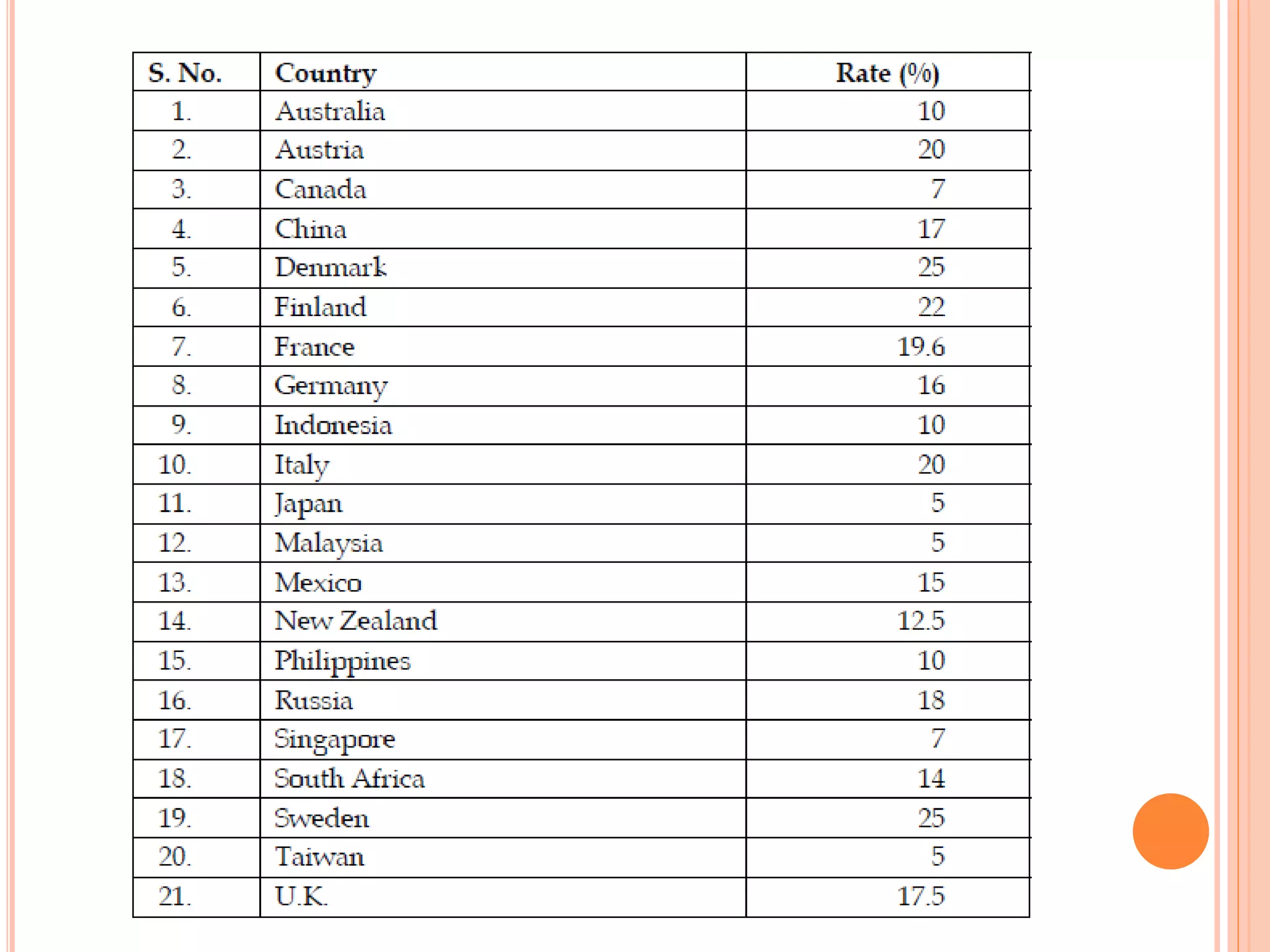
More than 140 countries have already
introduced GST/National VAT.
France was the first country to introduce GST
system in 1954.
Typically it is a single rate system but
two/three rate systems are also prevalent.
Canada and
Brazil alone have a dual VAT.
Standard GST rate in most countries
ranges between 15-20%.
INDIA'S GST STRUCTURE IS COMPLEX,
SAYS IMF
 Report says the proposed GST structure will require the centre
to coordinate with 30 states, which is an administrative
challenge.
 Even as the international monetary fund (imf) says the
proposed goods and services tax (gst) will improve tax
compliance and enhance economic growth by 1-1.5 per cent
over time, it finds the structure of the indirect tax regime in
india complex.
 “The gst design being contemplated is... Fairly complex, with a
dual administration arrangement that involves the tax
authorities of both the centre and states separately taxing a
single transaction,” says the fund in a report on india.
GST – ADVANTAGES
 As a developing country, india needs a transparent & unambiguous tax
structure
 A complex tax structure with multiple rates of taxes
 Multiple taxes across the supply chain
 High transaction cost in the hands of the tax payers
 Increased tax collections due to wider tax base and better compliance
 Improvement in international cost competitiveness of indigenous goods and
services.
 Enhancement in efficiency in manufacture and distribution due to economies of
scale
 GST encourages an unbiased tax structure that is neutral to business processes,
business models, organization structure, product substitutes and geographical
locations
 Helping as a weapon against corruption
 GST operates on a negative list i.e. All goods and services are subject to GST
unless specifically exempted

GST – ADVANTAGES
 Nature of complexities i.e. Classification to
valuation regarding taxability, exist in the present
structure.
Some of such burning issues are:
 Excise on MRP
 Excise, VAT and service tax on software,
 VAT & service tax on:
Works contracts
Right to use
GST : PROPOSED KEY FEATURES
 Dual GST : central GST & state GST
 Destination based state GST
 Uniform classification
 Uniform forms – returns, challans ( in
electronic mode)
 No cascading of central and state taxes
 Cross credit between centre and state not
allowed
 Tax levied from production to
consumption
GST : GLOBAL PERSPECTIVE
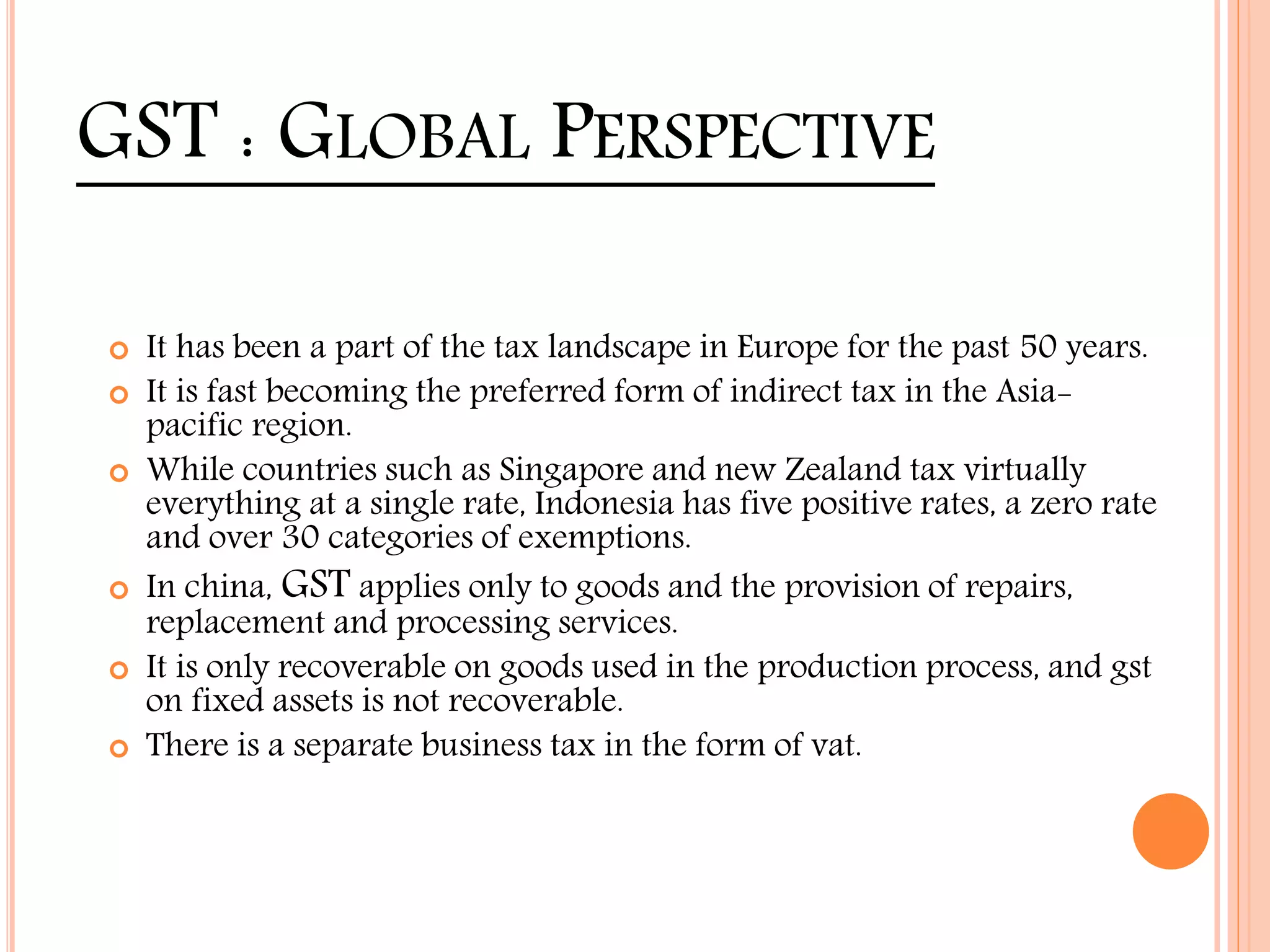
 It has been a part of the tax landscape in Europe for the past 50 years.
 It is fast becoming the preferred form of indirect tax in the Asia-
pacific region.
 While countries such as Singapore and new Zealand tax virtually
everything at a single rate, Indonesia has five positive rates, a zero rate
and over 30 categories of exemptions.
 In china, GST applies only to goods and the provision of repairs,
replacement and processing services.
 It is only recoverable on goods used in the production process, and gst
on fixed assets is not recoverable.
 There is a separate business tax in the form of vat.
GST : GLOBAL PERSPECTIVE
Goods and services tax in brazil
Brazil was the first country to adopt GST system.
Brazil has adopted a dual gst where the tax is
levied by both the central and the provincial
governments.
Gst rate is 20 %.
GST- CAN WE ADOPT IT
 An information network allowing GST Council to cross-
check payment information should be developed.
 What is needed is an IT system like the tax information
network (tin), where the TDS or the vat credit is recorded
in a central database.
 Paper bills and fraud to be largely eliminated.
KNOWING MORE ABOUT GST
 We all will pay GST on every product or service we buy/ consume
 All indirect taxes levied by the states and the centre will be
merged into one GST, we would exactly know how much tax we
pay which at present is difficult to understand.
 The sellers or service providers collect the tax from their
customer.
 Before depositing the same to the exchequer, they deduct the tax
they have already paid.
 The success of GST would rest upon efficiency, equity and
Simplicity.
Thank You

Gst ppt.

  • 1.
    GST (Goods and ServicesTax) Biggest Tax Reform Since Independence….. By PARTH SHAH
  • 2.
    GST  Goods andservice tax (GST) is a comprehensive tax levy on manufacture, sale and consumption of goods and service at a national level.  Gst is a tax on goods and services with value addition at each stage.  Gst willinclude many state and central level indirect taxes.  It overcomes drawback present tax system
  • 3.
    TAX STRUCTURE ININDIA • Direct Tax : e.g.: Income Tax, Corporate Tax, Wealth Tax • Indirect Tax : e.g.: Excise duty, custom duty, Service Tax, Octrai Tax, VAT.
  • 4.
    METHOD OF TAXATION ProgressiveTax : Increasing rate of tax for Increasing Value or Volume. Regressive Tax : Decreasing rate tax for Increasing Value or Volume Proportional Tax : Fixed rate of tax for every level of income or production
  • 5.
    Short comings incurrent Tax System  Tax Cascading (Tax on Tax)  Complexity  Taxation at Manufacturing Level  Exclusion of Services  Tax Evasion  Corruption
  • 6.
    TAXONOMY OF INDIANTAXATION vat / sales tax on sale of goods, other than newspapers Stamp duty on other than 10 specified instruments tax on agricultural income Toll tax on utilities Other taxes on land and buildings, entry of goods in local area (entry tax), consumption or sale of electricity, vehicles, luxuries including taxes on entertainment, betting and gambling, alcoholic liquor, narcotic drugs and opium
  • 7.
    PRE-REQUISITES FOR MIGRATINGTO A GST REGIME  Common/unified tax rate for goods and services which may be ideally, revenue neutral (a suitable GST rate) – dual tax proposed  Avoiding or minimizing differential tax rates – under discussions  Abolition of other small taxes - under discussions  Abolition of CST in a phased manner - being done  Power to levy service tax on select/agreed services to states - under discussions  Issue of inter-state services and goods movement vis-à-vis levy of duty or tax to be sorted out - under discussions  Revenue sharing mechanism to be rationalized - under discussions
  • 8.
    WHAT IS GST GSTis a comprehensive value added tax on goods and services It is collected on value added at each stage of sale or purchase in the supply chain No differentiation between goods and services as GST is levied at each stage in the supply chain Seamless input tax credit throughout the supply chain At all stages of production and distribution, taxes are a Pass through and tax is borne by the final consumer All sectors are taxed with very few exceptions / exemptions
  • 9.
    HISTORY  Feb, 2006: First time introduced concept of GST and announced the date of its implementation in 2010  Jan. 2007: First GST study by ASSOCHAM released by Dr. Shome  Feb. 2007: F.M. Announced introduction of GST from 1 April 2010 in Budget The Government came out with a First Discussion Paper on GST in November, 2009 Introduced the 115th Constitution Amendment (GST) Bill in the year 2011.
  • 10.
    MODEL OF GST GSTStructure centre GST GST to be levied by the Centre State GST GST to be levied by the State Dual GST GST to be levied by the Centre and the States concurrently
  • 11.
    PROPOSED GST RATE Presentlyit is (26.5 % , CENVAT-14 % and State VAT 12.5% ) Items Total GST rates (in %) Centre State Goods 20 12 8 Services 16 8 8 Essential Goods 12 6 6
  • 12.
    Taxes proposed tobe subsumed in GST Central Taxes Excise Duty Additional Excise duty Excise duty under medicinal and toilet preparation Act Service Tax Additional Custom duty commonly known as countervailing duty (CVD), special additional duty( SAD) Surcharge CENVAT
  • 13.
    Taxes proposed tobe subsumed in GST State Taxes Value added tax (VAT) Entertainment tax levied by states Luxury Tax Tax on Lottery, betting and gambling Entry tax other than for local bodies (Octroi)
  • 14.
    PRODUCT EXCLUDED FROM GST PetroleumProduct Alcohol Tobacco Product
  • 15.
    ILLUSTRATION OF GST ProductA VAT System GST System Base Price 100 100 + 12% Excise duty 12 NA +12.5% VAT 14 NA State GST NA 8 centre GST NA 12 Total Tax Burden 26 20 Value Of Product to Consumer 126 120
  • 16.
    WHY DOES INDIANEED GST  GST is being introduced majorly due to 2 reason 1. The current indirect tax structure is full of uncertainties due to multiple rates. 2. Due to multiple rates there are multiple forms.  GST the tax complexity in the prevailing tax regime.
  • 17.
    GST COUNCIL  GSTlevy will be administered by 1. Union finance minister(chairmen) 2. Union minister in charge of state revenue or finance 3. Minister in charge of finance or taxation. 4. Any other minister(finance minister of the state) nominated by each state gvt would constitute the council.
  • 18.
    DISPUTE SETTLEMENT AUTHORITY(DSA)  Disputebetween state and centre will be handled by the DSA.  Appeal from dsa would be dealt with supreme court.  Example: if a state receives less revenue in comparison with its previous one than it can appeal this case to the dsa.
  • 19.
    IMPORTANCE OF ARTICLE 246(A) There is resistance by the SG as VAT is the main source of revenue for the SG.  In 246(a) certain powers are allocated to the state government.  The parliament & legislature of every state will have the power to make law with respect to goods and service tax imposed by union(gvt) or by the state.
  • 20.
    BENEFITS OF GST TransparentTax System Uniform Tax system Across India Reduce Tax Evasion Export will be more competitive
  • 21.
    HURDLES IN IMPLEMENTATION Disputebetween centre and Tax over Tax Sharing Highly sophisticated IT infrastructure required . Issue of taxing e-commerce is to be appropriately addressed and integrated. Political Imbalace
  • 22.
    GST Global Scenario Morethan 140 countries have already introduced GST/National VAT. France was the first country to introduce GST system in 1954. Typically it is a single rate system but two/three rate systems are also prevalent. Canada and Brazil alone have a dual VAT. Standard GST rate in most countries ranges between 15-20%.
  • 23.
    INDIA'S GST STRUCTUREIS COMPLEX, SAYS IMF  Report says the proposed GST structure will require the centre to coordinate with 30 states, which is an administrative challenge.  Even as the international monetary fund (imf) says the proposed goods and services tax (gst) will improve tax compliance and enhance economic growth by 1-1.5 per cent over time, it finds the structure of the indirect tax regime in india complex.  “The gst design being contemplated is... Fairly complex, with a dual administration arrangement that involves the tax authorities of both the centre and states separately taxing a single transaction,” says the fund in a report on india.
  • 24.
    GST – ADVANTAGES As a developing country, india needs a transparent & unambiguous tax structure  A complex tax structure with multiple rates of taxes  Multiple taxes across the supply chain  High transaction cost in the hands of the tax payers  Increased tax collections due to wider tax base and better compliance  Improvement in international cost competitiveness of indigenous goods and services.  Enhancement in efficiency in manufacture and distribution due to economies of scale  GST encourages an unbiased tax structure that is neutral to business processes, business models, organization structure, product substitutes and geographical locations  Helping as a weapon against corruption  GST operates on a negative list i.e. All goods and services are subject to GST unless specifically exempted 
  • 25.
    GST – ADVANTAGES Nature of complexities i.e. Classification to valuation regarding taxability, exist in the present structure. Some of such burning issues are:  Excise on MRP  Excise, VAT and service tax on software,  VAT & service tax on: Works contracts Right to use
  • 26.
    GST : PROPOSEDKEY FEATURES  Dual GST : central GST & state GST  Destination based state GST  Uniform classification  Uniform forms – returns, challans ( in electronic mode)  No cascading of central and state taxes  Cross credit between centre and state not allowed  Tax levied from production to consumption
  • 27.
    GST : GLOBALPERSPECTIVE  It has been a part of the tax landscape in Europe for the past 50 years.  It is fast becoming the preferred form of indirect tax in the Asia- pacific region.  While countries such as Singapore and new Zealand tax virtually everything at a single rate, Indonesia has five positive rates, a zero rate and over 30 categories of exemptions.  In china, GST applies only to goods and the provision of repairs, replacement and processing services.  It is only recoverable on goods used in the production process, and gst on fixed assets is not recoverable.  There is a separate business tax in the form of vat.
  • 29.
    GST : GLOBALPERSPECTIVE Goods and services tax in brazil Brazil was the first country to adopt GST system. Brazil has adopted a dual gst where the tax is levied by both the central and the provincial governments. Gst rate is 20 %.
  • 30.
    GST- CAN WEADOPT IT  An information network allowing GST Council to cross- check payment information should be developed.  What is needed is an IT system like the tax information network (tin), where the TDS or the vat credit is recorded in a central database.  Paper bills and fraud to be largely eliminated.
  • 31.
    KNOWING MORE ABOUTGST  We all will pay GST on every product or service we buy/ consume  All indirect taxes levied by the states and the centre will be merged into one GST, we would exactly know how much tax we pay which at present is difficult to understand.  The sellers or service providers collect the tax from their customer.  Before depositing the same to the exchequer, they deduct the tax they have already paid.  The success of GST would rest upon efficiency, equity and Simplicity.
  • 32.